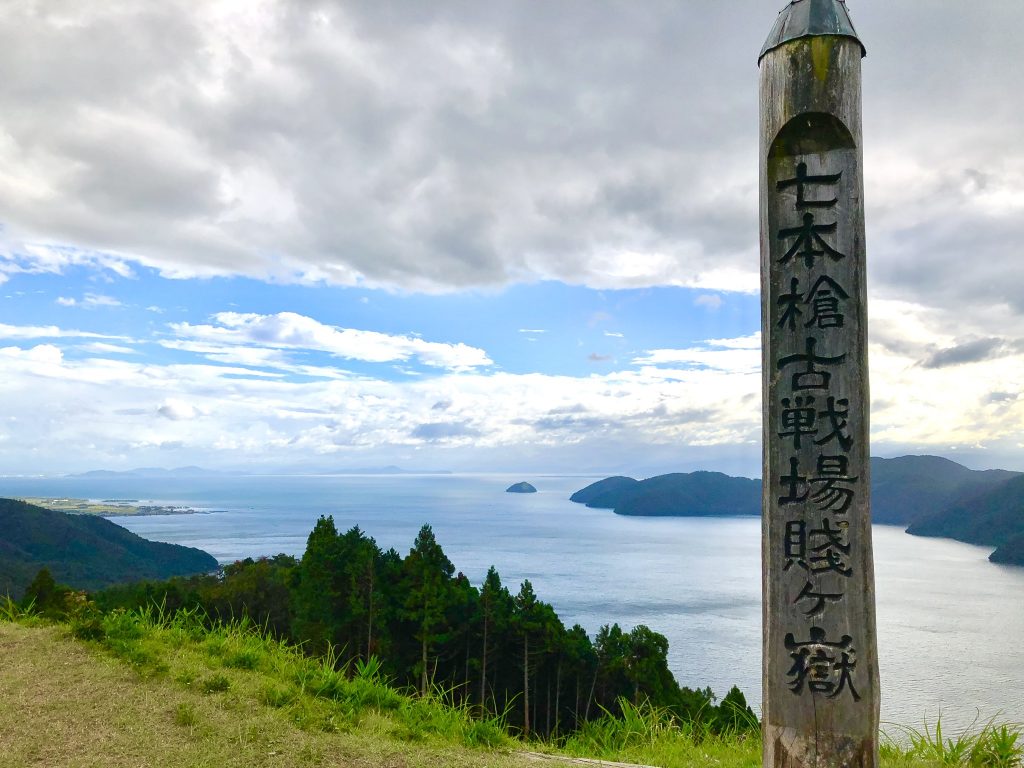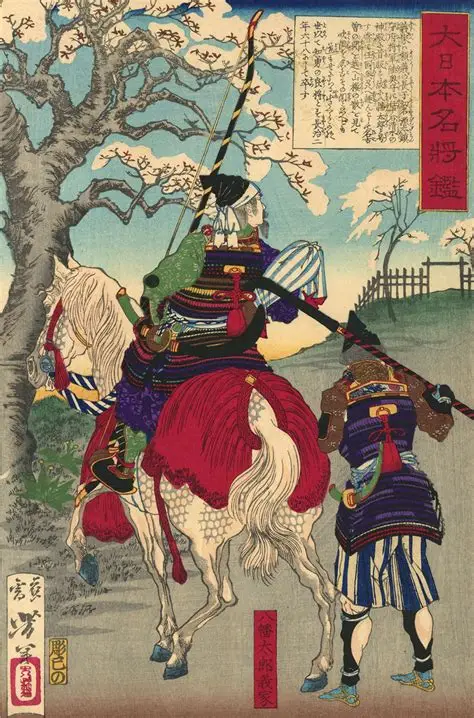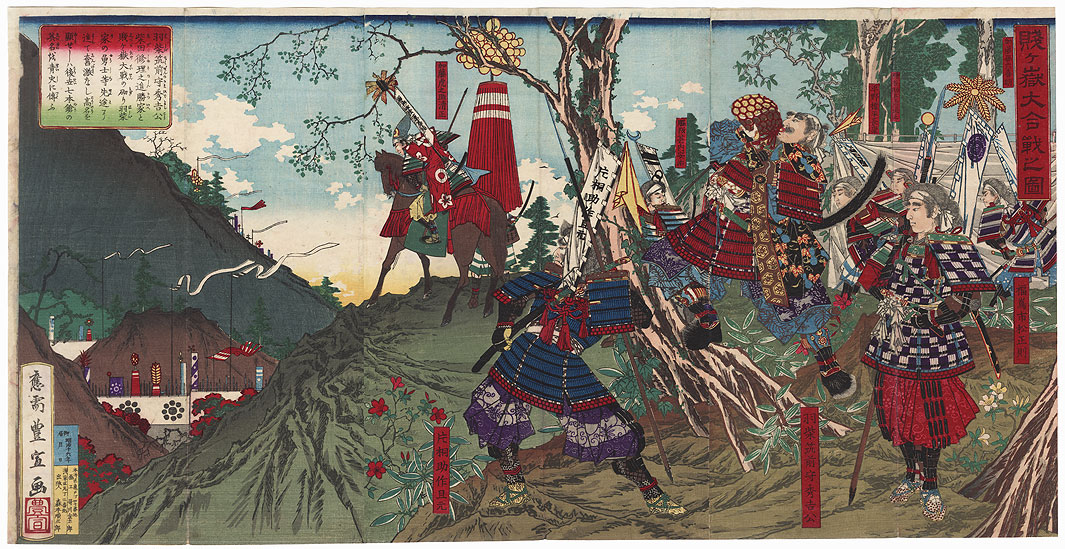
The 4th month, the eleventh year of Tensho (1583).
Hashiba Hideyoshi and Shibata Katsuie stood facing each other in northern Omi.
Around Lake Yogo, the fortified camps of both armies stood in a row, and the battlefield had become a vast contest of entrenched positions built around the mountains and the roads.
The man who broke this balance was Katsuie’s senior retainer, Sakuma Morimasa.
(For the lead-up to this battle, see The Battle of Shizugatake, Part 1 — Japanese only.)
1. The Opening Left by Hideyoshi’s March to Mino
On the 16th of the 4th month, Hideyoshi left Omi and headed for Mino.
Oda Nobutaka had risen up again at Gifu Castle.
Leave Nobutaka alone, and Hideyoshi’s army would be threatened from the rear.
Hideyoshi personally led troops toward Mino.
At this moment, Hideyoshi’s forces around Shizugatake were left without their main strength.
For Katsuie, this was a great opportunity.
The man who seized on that opportunity was Sakuma Morimasa.
2. The Sudden Assault on Oiwayama
In the early hours of the 20th of the 4th month.
Sakuma Morimasa led his troops toward Oiwayama.
Defending Oiwayama was Hideyoshi’s retainer Nakagawa Kiyohide.
Morimasa’s forces struck Oiwayama in a sudden assault.
The attack succeeded.
Nakagawa Kiyohide fell in battle, and the fort at Oiwayama was taken.
A large gap had opened in Hideyoshi’s front line.
The gain Morimasa had won here was substantial.
And Hideyoshi was still in Mino.
For the Shibata army, an opportunity had opened to push the attack even further.
3. Why Did Morimasa Stay at Oiwayama?
This is a crucial point for understanding the Battle of Shizugatake.
A famous story from later war chronicles holds that Katsuie ordered Morimasa to withdraw immediately once Oiwayama fell, but that Morimasa ignored the order and sought to press his advantage further.
This story can be presented as one account among others.
At the same time, looking at the battlefield situation as the sources reveal it, Morimasa also had real reasons to press forward.
Hideyoshi was in Mino.
Oiwayama had fallen.
Hideyoshi’s front line was shaken.
Apply more pressure now, and there was a real chance of breaking Hideyoshi’s army wide open.
Morimasa tried to seize that chance.
But there was one great problem.
How quickly Hideyoshi would return.
On this point, Morimasa would misjudge badly.
4. Hideyoshi Turns Back to Omi
Word of Oiwayama’s fall reached Hideyoshi.
Hideyoshi did not remain in Mino.
He turned back for Omi at once.
This forced march later became famous as the “Great Return from Mino.”
The rapid movement from Ogaki toward the Kinomoto area has become one of the defining episodes of the Battle of Shizugatake.
War chronicles depict dramatic scenes — Hideyoshi’s troops running through the night, torches set out along the road.
These can be enjoyed as one account handed down by later chronicles.
What matters as historical fact is this:
on learning of Oiwayama’s fall, Hideyoshi rushed his main force back from Mino to Omi at great speed.
From here, the situation changed all at once.
5. Early Hours of April 21 — Morimasa Now the Hunted
In the early hours of the 21st of the 4th month.
Hideyoshi’s army launched its attack on Morimasa’s force.
Morimasa, who only the day before had been attacking Hideyoshi’s army, now found himself the one being pursued.
It had taken barely a single day.
Morimasa began to withdraw.
But Hideyoshi’s army kept up the pursuit.
Here, the Battle of Shizugatake shifted from a fight over Oiwayama into a decisive battle that would determine the fate of the entire Shibata army.
6. Hideyoshi and Katsuie Cross Spears Directly
And here appears the most fascinating source for this part of the story.
After the battle, Hideyoshi sent Kobayakawa Takakage a detailed report on the course of the fighting at Shizugatake.
In this letter, Hideyoshi wrote of Shibata Katsuie that
they had “crossed spears as many as three times.”
This is not a later war chronicle.
It is a line from Hideyoshi’s own victory report, written after the battle itself.
Hideyoshi further wrote of Katsuie
to the effect that he was a seasoned warrior he had fought again and again since their young days together in the Oda house.
He did not regard Katsuie merely as a defeated enemy, but as a formidable rival he had known on the battlefield for years.
This single line alone shows just how significant Shizugatake was to Hideyoshi.
7. Hideyoshi’s Army Attacked in Three Divisions
The same letter records the course of the fighting in still more concrete detail.
Hideyoshi reports that he split his own mounted guard into three divisions and sent them to attack the position held by Shibata Katsuie’s forces.
And the fighting continued from the Hour of the Hare to the Hour of the Sheep — roughly from dawn until early afternoon.
Translated into modern terms, this was a long battle stretching from early morning well into the afternoon.
Both sides fought fiercely, and there was even said to have been a moment when the two armies sat back to rest.
In other words, the main battle at Shizugatake was not simply “Hideyoshi rushed back and scattered the Shibata army in one stroke.”
It was a long, hard-fought battle.
And it was Hideyoshi who, in the end, broke that balance.
8. The Pages’ Corps Charges Katsuie’s Own Guard
Hideyoshi read the battle carefully.
He then sent a unit built around his koshō — his young pages — to strike directly at Shibata Katsuie’s own guard.
Koshō were young warriors who served in close attendance on their lord.
In the Sengoku period, a koshō was not simply someone who attended to his lord’s personal needs.
Serving at his lord’s side as messenger and guard, some of them fought as warriors on the battlefield as well.
Hideyoshi sent these very koshō charging into Katsuie’s own guard.
This attack broke the Shibata army’s formation.
In his victory report, Hideyoshi wrote that they had cut down more than five thousand men.
This figure comes from Hideyoshi’s own report.
Given the nature of a victory report, this number should not be taken at face value as a confirmed death toll.
The most accurate way to put it is that
“Hideyoshi reported, in his own account of the victory, that his forces had cut down more than five thousand.”
Anything more definite risks overstating what the source can support.
9. The Shibata Line Begins to Collapse
Hideyoshi’s attack shook the Shibata army badly.
What made the outcome decisive was a wave of defections within the Shibata ranks themselves.
Maeda Toshiie and his son Toshinaga, positioned on the front line, withdrew from the field.
Kanamori Nagachika and Fuwa Katsumitsu followed, pulling out as well.
This cannot be explained away with the single line “Toshiie betrayed Katsuie.”
Later war chronicles tell a dramatic story of a secret pact struck beforehand between Hideyoshi and Toshiie.
This can be presented as one account among others.
What can be confirmed as historical fact is that
Maeda Toshiie and his men left the battlefield, and the Shibata army’s collapse accelerated from that point.
On a battlefield, one unit’s withdrawal affects the units beside it.
And if that unit is already under enemy attack, the effect spreads all at once.
At Shizugatake, that is exactly what happened.
10. Menju Katsuteru Raises Katsuie’s Own Standard
The full collapse of the Shibata army had begun.
Danger now closed in around Katsuie himself.
It was here that Menju Katsuteru stepped forward.
Katsuie handed his own battle standard to Katsuteru.
Katsuteru is said to have raised it and fought on as Katsuie’s stand-in.
This scene stands as one of the defining episodes of loyalty at Shizugatake.
Menju Katsuteru drew the enemy’s attention, and in that time Katsuie withdrew.
While the episode carries dramatic embellishment from later war chronicles, the core fact — that the Menju family supported Katsuie’s retreat and died in battle doing so — survives as an important tradition in the story of Shizugatake.
11. Katsuie Retreats to Kitanosho
The outcome at Shizugatake was decided.
Katsuie withdrew toward Echizen. His destination: Kitanosho Castle.
Kitanosho was the castle Katsuie had built as his own base for ruling Echizen.
Return there, and there was still, on the surface, a chance to regroup.
But Hideyoshi did not let Katsuie escape.
Having won at Shizugatake, Hideyoshi’s army pressed straight on into Echizen.
He advanced on Katsuie’s home base. The stage of the war shifted from Omi to Echizen.
12. Hideyoshi Marches on Kitanosho Castle
The 23rd of the 4th month.
Hideyoshi’s army closed in on Kitanosho Castle.
The assault on Kitanosho Castle began.
Katsuie held out inside, resisting under siege.
But the Shibata army, having lost its main strength at Shizugatake, no longer had the power left to fight Hideyoshi’s forces head-on again.
The castle’s outer defenses fell one after another.
And the following day.
Kitanosho Castle came to the end of its final day.
13. Katsuie Fights On to the End
The 24th of the 4th month.
The assault on Kitanosho Castle continued.
Here, an interesting source survives.
A document handed down in the Mori family records that Katsuie opened the gates and cut his way out against the enemy as many as seven times.
Which is to say, Katsuie did not simply shut himself inside the castle to the end.
He charged into the enemy’s midst again and again, by his own hand.
Even after his defeat at Shizugatake, he never abandoned the posture of a fighting warrior.
In the end, he returned to the castle.
Katsuie’s final moment was drawing near.
14. The Death of Katsuie
Katsuie climbed to the keep.
And took his own life.
Later war chronicles depict Katsuie’s final moments in highly dramatic terms.
Among them is the episode in which he showed Hideyoshi’s army his own act of seppuku, calling out words to the effect of “watch closely, and learn from it.”
This scene became famous through later war chronicles.
At the same time, the Mori family documents, close to the events in time, also preserve concrete details about Katsuie’s final moments.
What can therefore be established as fact is that
Katsuie took his own life at Kitanosho Castle.
His final words and the finer details of the scene, meanwhile, are best presented by distinguishing which kind of source each comes from.
That is the most accurate way to tell it.
15. Oichi Also Meets Her End at Kitanosho Castle
Also at Kitanosho Castle with Katsuie was Oichi.
The younger sister of Oda Nobunaga.
The wife of Azai Nagamasa.
And, in time, the wife of Shibata Katsuie.
Oichi had already once lived through the fall of Odani Castle.
Now she faced the fall of Kitanosho Castle as well.
Katsuie and Oichi met their end together at this castle.
Their three daughters, meanwhile, survived.
Chacha. Ohatsu. Go.
These three sisters would go on to move to the very center of Japanese history.
Chacha became a consort of Toyotomi Hideyoshi, and the mother of Toyotomi Hideyori.
Ohatsu became the principal wife of Kyogoku Takatsugu.
Go became the principal wife of Tokugawa Hidetada, and the mother of Tokugawa Iemitsu.
The fall of Kitanosho Castle was not only the death of the senior Oda retainer Shibata Katsuie — it was also the moment the three sisters who would carry the next era survived.
16. The End of Morimasa, Who Took Oiwayama
And the man who had set this whole battle in motion, Sakuma Morimasa, was defeated as well.
The 20th of the 4th month.
The sudden assault on Oiwayama.
The killing of Nakagawa Kiyohide.
The fort taken.
Yet the very next day, he came under a fierce counterattack from Hideyoshi’s army and was forced to withdraw.
Morimasa then fled.
But he was captured.
And executed.
In the span of only a few days,
from the victor to the hunted.
And then to a defeated commander.
His fortunes reversed completely.
This is the terrifying nature of the battlefield that was Shizugatake.
17. The “Seven Spears” Became a Great Legend in Later Ages
Shizugatake is famous above all for the Seven Spears of Shizugatake.
These are generally taken to mean the following seven men:
- Fukushima Masanori
- Kato Kiyomasa
- Kato Yoshiaki
- Wakisaka Yasuharu
- Katagiri Katsumoto
- Hirano Nagayasu
- Kasuya Takenori
These seven men later grew into commanders who would support the Toyotomi regime.
For that reason, Shizugatake became known as “the battle where the Seven Spears distinguished themselves.”
That said, these seven men were not already a fixed group called “the Seven Spears” at the time itself.
Their individual battlefield achievements were later gathered together into a single legend by posthumous commemoration.
This, too, is part of what makes Sengoku history so interesting.
Achievements on the battlefield go on to shape a man’s image for generations afterward.
18. What Decided the Outcome at Shizugatake
The Battle of Shizugatake cannot be explained by any single event.
The 20th of the 4th month.
Morimasa’s surprise attack succeeded.
Nakagawa Kiyohide fell. Oiwayama was taken. The Shibata army gained the upper hand.
But Hideyoshi returned from Mino.
The 21st of the 4th month.
Hideyoshi’s army counterattacked; Morimasa’s force withdrew.
The unit under Shibata Katsumasa and others was drawn into the fighting as well.
Hideyoshi and Katsuie crossed spears directly.
Hideyoshi’s army struck at the Shibata army’s own guard.
And then Maeda Toshiie and his men left the field.
The Shibata line collapsed.
Katsuie withdrew toward Kitanosho.
Hideyoshi pursued.
Kitanosho Castle fell.
Katsuie died.
One event after another chained together, and the house of Shibata was destroyed.
19. Why Did Katsuie Lose?
It would be easy to explain Katsuie’s defeat simply as “Morimasa disobeyed orders.”
But the actual battlefield was more complicated than that.
The Shibata army had won a major victory at Oiwayama.
At that point, the advantage lay with Katsuie’s side.
The problem was that Hideyoshi returned before that advantage could be secured.
And in the fighting the next day, Hideyoshi’s army concentrated its attack on the Shibata forces.
On top of that came the withdrawal of Maeda Toshiie and his men.
The line could no longer hold.
In other words, the defeat at Shizugatake was not decided by “a single error of judgment by Morimasa” alone.
Hideyoshi’s rapid response.
The disposition of the Shibata forces.
Morimasa’s attack.
The pursuit the following day.
The withdrawal of Maeda Toshiie and his men.
It was the chain reaction of all of these together.
20. What Did Hideyoshi Gain?
What Hideyoshi brought down at Shizugatake was not simply one warlord.
Shibata Katsuie had commanded one of the largest military forces among all of Oda Nobunaga’s retainers.
He had ruled the Hokuriku region and commanded powerful warriors including Maeda Toshiie, Sassa Narimasa, Fuwa Katsumitsu, Kanamori Nagachika, and the Sakuma clan.
That Katsuie was now destroyed.
With this, Hideyoshi eliminated one of the greatest rival forces within the Oda house.
And the struggle for power after Nobunaga’s death swung decisively in Hideyoshi’s favor.
Even so, Hideyoshi still had enemies ahead of him.
Oda Nobutaka. Takigawa Kazumasu.
And Tokugawa Ieyasu.
The Battle of Shizugatake was not the finish line of Hideyoshi’s unification of the realm.
If anything, it was the turning point where his true bid for the realm began in earnest.
Summary
From Victory at Oiwayama to the Flames of Kitanosho Castle
In the early hours of April 20, Sakuma Morimasa struck Oiwayama in a sudden assault and killed Nakagawa Kiyohide.
The Shibata army had won a major victory.
But Hideyoshi rushed back from Mino to Omi at extraordinary speed.
The following day, April 21, the situation reversed completely.
Morimasa’s force was pursued, and the main battle between Hideyoshi’s and Katsuie’s armies began.
Hideyoshi’s own victory report records that he crossed spears with Katsuie as many as three times, that he split his mounted guard into three divisions to attack, and that after a long and hard-fought battle he sent his koshō charging into Katsuie’s own guard.
Maeda Toshiie and his men then left the field, and the Shibata line collapsed.
Menju Katsuteru fought to cover Katsuie’s retreat, and Katsuie fled toward Kitanosho.
Hideyoshi pursued him.
Kitanosho Castle was surrounded, and on April 24, Katsuie took his own life.
Sakuma Morimasa, who had taken Oiwayama, was afterward captured and executed as well.
In this way, the struggle for power after Oda Nobunaga’s death moved decisively forward.
The Battle of Shizugatake was, at once, the battle in which Hideyoshi won the contest to succeed Nobunaga, and the battle that erased Shibata Katsuie — one of the greatest military forces within the Oda house — from the map entirely.
And the next man to stand in Hideyoshi’s way was Tokugawa Ieyasu.
The stage: Owari.
Hideyoshi and Ieyasu would clash there in earnest for the first time.
The story continues into the Battle of Komaki and Nagakute.