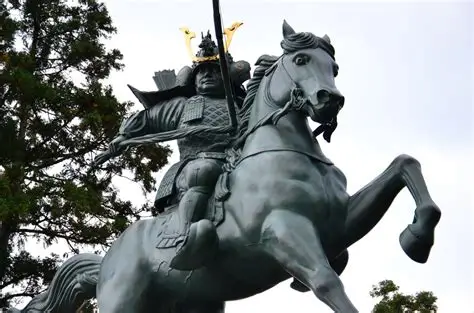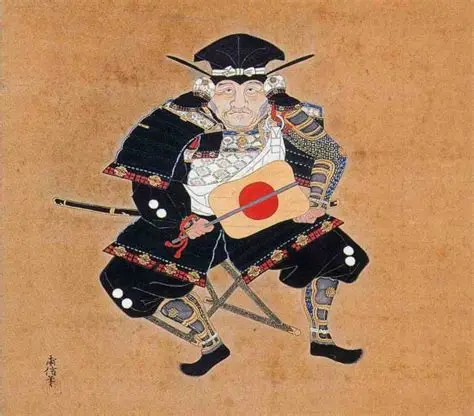
On May 11, 1183, at Mount Tonami, which straddles the border between Kaga and Etchu, Minamoto no Yoshinaka clashed with the Taira clan’s punitive forces from the Hokuriku region.
The Taira forces were led by Taira no Shigemori’s heir, Koremori, along with other family commanders such as Tomomori, Chikata, Tsunemasa, and Yukimori.
They departed Kyoto in April and advanced to Echizen.
On the 27th, they captured Hiuchi Castle, which was defended by Yoshinaka’s forces, and proceeded into Kaga.
Up to this point, the Taira army had been on the offensive.
Awaiting them was Minamoto no Yoshinaka.
At Kurikara Pass, located on the border between present-day Oyabe City in Toyama Prefecture and Tsubata Town in Ishikawa Prefecture.
The Hokuriku Road ran along the mountain ridge, with steep slopes and valleys on either side.
It was in this mountainous terrain that the Taira forces suffered a crushing defeat.
This was one of Minamoto no Yoshinaka’s greatest victories, famously depicted in the “Heike Monogatari” as the “Kurikara Drop” and later chronicled in the “Genpei Seisuiki” as the “Fire Ox Strategy.”
The Taira Forces Break Through Hiuchi Castle
The Taira clan dispatched a full-scale punitive force to the Hokuriku region in April 1183.
Since 1181, forces opposing the Taira had been active in Hokuriku.
In Echizen, Taira no Tomomori’s forces were defeated, and in Shinano, in June of the same year, at the Battle of Yokota River, Jo Sukemoto of Echigo was defeated by Yoshinaka’s forces.
The situation in Hokuriku remained unstable for the Taira.
In 1183, the Taira sent Koremori and other family commanders to the Hokuriku Road.
The “Heike Monogatari” records this punitive force as numbering over 100,000 horsemen.
The army moved from Omi into Echizen, capturing Hiuchi Castle on April 27.
Hiuchi Castle was garrisoned by warriors from various parts of Hokuriku, including Saimei, the head monk of Heisenji, Inazu Sanesumi, Togashi Nyudo Butsusei, Ishikuro, and Miyazaki, with the “Heike Monogatari” claiming over 6,000 horsemen were stationed there.
The castle defenders dammed a river to store water and prevent the Taira army’s approach. However, Saimei secretly communicated with the Taira, revealing how to breach the dam.
Once the water receded, the Taira forces attacked, and the castle defenders retreated toward Kaga.
Having passed through Echizen, the Taira army continued north along the Hokuriku Road.
The Taira Army Splits into Two
According to the “Heike Monogatari,” on May 8, the Taira forces, having advanced to the vicinity of Shinohara in Kaga, divided into two groups.
One group, led by Taira no Koremori and Taira no Tomomori, headed toward Mount Tonami, while the other, led by Taira no Tadanori and Taira no Chikata, moved toward Noto.
To enter Etchu, they had to cross the mountains.
One of the routes through Mount Tonami was via Kurikara Pass.
The area around Kurikara Pass today is still characterized by its complex network of ridges and valleys.
The road that later served as the route for the Kaga Domain’s alternate attendance system has long been a vital transportation link between Kaga and Etchu.
Historical sites related to the battle of Juei 2 still remain today.
Upon learning that the Taira forces were advancing, Minamoto no Yoshinaka moved from Shinano to Etchu.
Yoshinaka’s army included Imai Kanehira, Higuchi Kanemitsu, and Nei Yukichika, who had followed him from Shinano, along with warriors from the Hokuriku region.
Before the main forces clashed at Tonamiyama, fighting had already begun on the Etchu side.
Imai Kanehira Defeats the Taira Forces at Hannyano
According to the “Heike Monogatari,” an advance party of over 5,000 Taira cavalrymen moved into Hannyano in Etchu.
From Yoshinaka’s side, it was Imai Shiro Kanehira who advanced.
Kanehira, who grew up in Shinano like Yoshinaka, would later accompany him until the Battle of Awazu.
The “Heike Monogatari” describes how Kanehira led over 6,000 cavalrymen to Hannyano and launched a dawn attack on the Taira forces.
The Taira side could not hold their ground and retreated towards Kaga.
The battle at Hannyano involved the advance party, while the main forces under Koremori were deployed towards Tonamiyama.
Kanehira rejoined Yoshinaka.
On May 11, the battlefield shifted to the mountainous border between Kaga and Etchu.
Yoshinaka at Hanyu Hachiman Shrine
As Yoshinaka headed towards Tonamiyama, he passed through Hanyu in Etchu.
This is present-day Hanyu in Oyabe City, Toyama Prefecture.
There, he found a shrine dedicated to the god Hachiman.
According to the “Heike Monogatari,” upon discovering the shrine, Yoshinaka dismounted and prayed for victory.
The prayer was written by Kakumyo, who accompanied Yoshinaka.
Kakumyo, originally a monk, was involved in drafting documents within Yoshinaka’s army.
The “Heike Monogatari” includes a lengthy prayer offering to the god Hachiman from this occasion.
At the present-day Hanyu Gokoku Hachiman Shrine, there remains a tradition that Yoshinaka prayed for victory before the Battle of Kurikara in May of Juei 2. Although the current shrine building is of later construction, the connection to Yoshinaka has been passed down through generations.
After completing his prayers, Yoshinaka proceeded to Tonamiyama.
The Taira forces had already established their camp in the mountains.
May 11: The Two Armies Face Off at Tonamiyama
The “Heike Monogatari” records that over 70,000 Taira cavalrymen advanced towards Tonamiyama.
Yoshinaka also divided his forces and positioned them in the mountains.
The “Heike Monogatari” depicts how Yoshinaka’s forces confronted the Taira army head-on while another unit maneuvered through the mountain paths to encircle the Taira from behind.
Contact between the two armies began during the day.
Yoshinaka’s forces unleashed a volley of arrows, and the Taira responded in kind.
The massive armies did not engage in a full-scale clash, instead remaining in a standoff in the mountains as time passed.
As the day wore on, the sun began to set.
The “Heike Monogatari” describes how Yoshinaka held the Taira forces in place until dusk, then moved his troops under the cover of darkness.
The unit that had circled through the mountain paths closed in on the Taira’s rear.
In front lay Yoshinaka’s army.
Enemies appeared on the road back to Kaga as well.
As night fell, war cries rose from both the front and back of the mountain.
The Taira forces found themselves fighting in the dark of Mount Tonami.
The Kurikara Drop
Among the fierce scenes of the Battle of Kurikara as recounted in the Heike Monogatari, the night retreat stands out as the most intense.
Assailed from both front and rear, the Taira forces attempted to retreat towards Kaga.
A throng of soldiers and horses crowded the narrow mountain path, throwing the ranks into disarray. The darkness made it difficult to see one’s footing. Beyond the path lay steep slopes and valleys.
The retreating soldiers piled up, while more men and horses pressed from behind.
The Heike Monogatari describes how those who advanced first fell into the deep valley, followed by those behind, filling the valley with men and horses.
This scene later became known as the “Kurikara Drop.”
Although Taira no Koremori and Taira no Tomomori managed to escape the battlefield, the Taira forces suffered a significant collapse.
News of the defeat soon reached Kyoto.
The court noble Kujō Kanezane recorded in his diary, the Gyokuyō, that the Taira forces heading to the Hokuriku region were defeated by Yoshinaka and his allies.
Aside from the Heike Monogatari‘s depiction of the nighttime battle in the mountains, records from Kyoto also confirm the Taira’s disastrous defeat in the Hokuriku campaign during this period.
The “Fire Oxen Strategy” in the Genpei Seisuiki
The Battle of Kurikara Pass is also remembered for another famous tale.
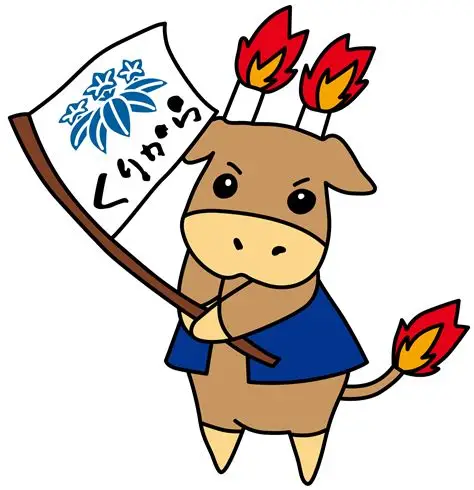
This is the “Fire Oxen Strategy,” where torches were tied to the horns of oxen and sent charging into the Taira forces.
This scene is recounted in the later work, the Genpei Seisuiki.
According to this text, Yoshinaka gathered four to five hundred oxen, set torches ablaze on their horns, and drove them into the Taira camp.
In the dark mountains, a herd of oxen with flames on their horns ran wild.
The Taira soldiers and horses panicked and scattered, with those trying to flee falling into the Kurikara Valley.
While the “Kurikara Drop” in the Heike Monogatari does not feature the fire oxen, the Genpei Seisuiki adds this vivid scene.
The National Diet Library’s Collaborative Reference Database also confirms the mention of four to five hundred oxen and torches in the “Battle of Tonami Mountain” from the Shintei Genpei Seisuiki.
The image of the fire oxen has been depicted in later artworks and became widely known as a representative anecdote of the Battle of Kurikara.
Today, the city of Oyabe introduces the “Fire Oxen Strategy” from the Genpei Seisuiki as part of the legend of the Kurikara battlefield.
Koremori’s Escape from Mount Tonami
Taira no Koremori and his companions, having escaped from Mount Tonami, retreated to Kaga.
It had been only about half a month since they had captured Hiuchi Castle on April 27.
As they advanced from Echizen to Kaga, nearing Etchu, the punitive force suffered heavy losses.
Yoshinaka’s forces pursued the fleeing Taira army over the mountains.
Among the retreating Taira forces was Saito Betto Sanemori.
Sanemori was an old warrior based in Nagai Manor, Musashi Province, who once saved the young Yoshinaka’s life and helped send him to Shinano, as recounted in the Heike Monogatari.
Now, Sanemori faced Yoshinaka’s forces as a commander for the Taira side.
The battlefield shifted to Shinohara in Kaga Province.
News of the Defeat at Kurikara Reaches Kyoto
The defeat at Mount Tonami was reported in Kyoto.
Even Kujō Kanezane, the author of the Gyokuyō, received news of the defeat of the punitive forces on the Hokuriku Road.
The Taira clan had just dispatched Koremori and others to secure the Hokuriku region.
In Echizen, they captured Hiuchi Castle and advanced their forces to Kaga. However, they were defeated by Yoshinaka’s forces at Mount Tonami, forcing Koremori and his men to retreat towards Kyoto.
In contrast, Yoshinaka advanced westward along the Hokuriku Road.
Awaiting him was Shinohara in Kaga Province.
There, Saitō Sanemori, who is said to have dyed his hair black before heading into battle according to the Heike Monogatari, stood before Yoshinaka’s forces.
Shortly after the Battle of Kurikara Pass, the Taira forces would once again face Yoshinaka’s army.
For Those Who Want to Learn More About Minamoto no Yoshinaka
From Yokota River to Kurikara Pass, and then to Kyoto—Minamoto no Yoshinaka, who defeated the Taira in Hokuriku and swiftly rose to prominence on the historical stage. For those interested in learning more about his life and his relationship with Yoritomo, we recommend Minamoto no Yoshinaka.

Minamoto no Yoshinaka (Revisiting Japanese History) [ Shimoide Seki ]