How Did Fujiwara no Yoshifusa Seize Power After Emperor Saga’s Death?
Last time, the subject was Emperor Saga.
(See this article.)
In 810, Emperor Saga prevailed over his brother, the Retired Emperor Heizei, bringing the Kusuko Incident to a close.
(See this article.)
Afterward, Emperor Saga established the Kurodo-dokoro, put the kebiishi police force in order, and made heavy use of men such as Fujiwara no Fuyutsugu.
And one of the figures who rose to prominence in Emperor Saga’s era was
Yoshifusa was a son of Fujiwara no Fuyutsugu.
He married Emperor Saga’s own daughter, Princess Minamoto no Kiyohime, deepening his ties to the imperial house.
In time Yoshifusa became a maternal relative of the throne, and advanced to the very center of the court.
Two great political crises marked that rise.
The Jowa Incident of 842. And the Otenmon Incident of 866.
Twenty-four years separate the two events.
But taken together, they reveal a single, larger current.
A political struggle over imperial succession. The downfall of powerful nobles. The rise of Fujiwara no Yoshifusa.
And, in the end,
the road to the office of sessho — a subject governing in the emperor’s place.
From the Jowa Incident to the Otenmon Incident.
These twenty-four years were the crucial period in which the Fujiwara Northern House worked its way into the very heart of the Heian court.
1. Emperor Saga’s Death Upset the Court’s Balance
In 842, the Retired Emperor Saga died.
There was another figure of equal weight within the imperial family.
The Retired Emperor Junna. Emperor Junna was Emperor Saga’s younger brother.
Saga and Junna had passed the throne back and forth between them as brothers, working to keep the imperial line stable.
But the Retired Emperor Junna died in 840.
And in 842, the Retired Emperor Saga died as well.
With both men gone, the political balance that had held until then collapsed.
The reigning emperor at the time was Emperor Ninmyo.
Emperor Ninmyo was a son of Emperor Saga.
And the crown prince was Prince Tsunesada.
Prince Tsunesada was a son of Emperor Junna.
Which is to say,
the throne belonged to Saga’s line.
The crown prince belonged to Junna’s line.
That was the structure of imperial succession at the time.
And this balance was thrown badly off by the deaths of the two retired emperors, Saga and Junna.
2. Prince Tsunesada, the Crown Prince
Prince Tsunesada had inherited his position as crown prince from his father, Emperor Junna.
But Emperor Ninmyo had a son of his own.
His name was Prince Michiyasu.
His mother was Fujiwara no Junshi.
And Junshi’s older brother was Fujiwara no Yoshifusa.
Here the political stakes surrounding imperial succession grew complicated.
If Prince Tsunesada took the throne, Emperor Junna’s line would continue.
If Prince Michiyasu became crown prince instead, the throne would pass from Emperor Ninmyo directly to his own son.
And the man who stood as Prince Michiyasu’s maternal relative was Fujiwara no Yoshifusa.
This question of succession lay behind the Jowa Incident.
3. The Jowa Incident — a Sudden “Conspiracy”
In the ninth year of Jowa (842), an incident erupted.
At its center stood
Tomo no Kowamine and Tachibana no Hayanari.
Tomo no Kowamine held a post in the crown prince’s household and stood close to Prince Tsunesada.
Tachibana no Hayanari had been active since Emperor Saga’s own reign, and was known as one of the “Three Great Brushes” of calligraphy alongside Kukai and Emperor Saga himself.
An affair broke out in which these two men were said to have plotted a conspiracy.
The court responded at once. Tomo no Kowamine and the others were arrested and interrogated.
And the fallout from the affair reached all the way to the crown prince himself.
Prince Tsunesada lost his position as crown prince.
4. Prince Tsunesada Is Removed as Crown Prince
The single greatest outcome of the Jowa Incident was the change of crown prince.
Prince Tsunesada was removed.
And in his place, the new crown prince was Prince Michiyasu.
The future Emperor Montoku.
Here the course of imperial succession changed dramatically.
What had been
Emperor Ninmyo
↓
Prince Tsunesada
became instead
Emperor Ninmyo
↓
Prince Michiyasu
And Prince Michiyasu’s mother was Fujiwara no Junshi. Her older brother was Fujiwara no Yoshifusa.
Which is to say, the Jowa Incident
opened the way for Fujiwara no Yoshifusa to become a maternal relative of the next emperor.
This matters enormously for understanding the later history of the Fujiwara clan.
5. What Became of Prince Tsunesada
Prince Tsunesada himself deserves attention here.
Stripped of his position as crown prince, Prince Tsunesada took Buddhist vows.
He was not a man remembered for raising an army to fight for the throne.
He simply vanished from the political stage in the Jowa Incident.
Tachibana no Hayanari, meanwhile, treated as the central figure of the affair, was sentenced to exile.
Ordered into exile in Izu Province, Hayanari fell ill and died on the way to his place of banishment.
A man of culture who had once flourished at Emperor Saga’s own court fell politically and ended his life through this same crisis.
6. “Did Prince Tsunesada Truly Plot a Conspiracy?”
This is one of the most important questions surrounding the Jowa Incident.
The Shoku Nihon Koki records it as an affair in which Tomo no Kowamine, Tachibana no Hayanari, and others plotted a conspiracy.
But looking at the political background, a struggle over imperial succession was already underway.
And one of the men who gained the most from the outcome was Fujiwara no Yoshifusa.
Prince Tsunesada falls.
Prince Michiyasu becomes crown prince.
As his maternal relative, Yoshifusa’s own standing grows stronger.
For this reason, the Jowa Incident has long been discussed as part of Fujiwara no Yoshifusa‘s campaign to remove rival clans.
Even so, the sources do not allow us to state flatly that “Yoshifusa planned the whole affair from the start.”
This deserves a careful, measured reading.
What can be said with confidence is that
the Jowa Incident brought about a change of crown prince, and Fujiwara no Yoshifusa‘s own political standing rose dramatically as a result.
That much is certain.
Fujiwara no Yoshifusa himself was later involved in compiling the Shoku Nihon Koki.
Which means the circumstances behind the very source that records this incident also deserve consideration when reading it.
7. Yoshifusa Strengthens His Position as a Maternal Relative
After the Jowa Incident, Yoshifusa’s own career advanced further still.
Prince Michiyasu grew up and took the throne as Emperor Montoku.
For Yoshifusa, this mattered enormously.
Emperor Montoku’s mother was Fujiwara no Junshi.
Her older brother was Fujiwara no Yoshifusa.
Which made Yoshifusa the emperor’s maternal uncle.
What is more, Yoshifusa sent his own daughter, Akirakeiko, into the palace as Emperor Montoku’s consort.
Akirakeiko would later give birth to Emperor Seiwa.
Here Fujiwara no Yoshifusa‘s ties to the imperial house grew stronger still.
8. A Nine-Year-Old Emperor — the Enthronement of Emperor Seiwa
In 858, Emperor Montoku died.
The one who took the throne was Emperor Seiwa.
He was only nine years old.
As the man supporting a child emperor, Yoshifusa’s presence grew all the more commanding.
Yoshifusa became Daijo Daijin, Chancellor of the Realm, and stood as guardian to the young emperor.
And then, in 866, an incident shook the court to its foundations.
The Otenmon Incident.
Twenty-four years after the Jowa Incident.
Once again, a political crisis shook the court.
9. 866 — the Otenmon Gate Burns
In the eighth year of Jogan (866), at the Chodoin, the ceremonial heart of the Heian Palace.
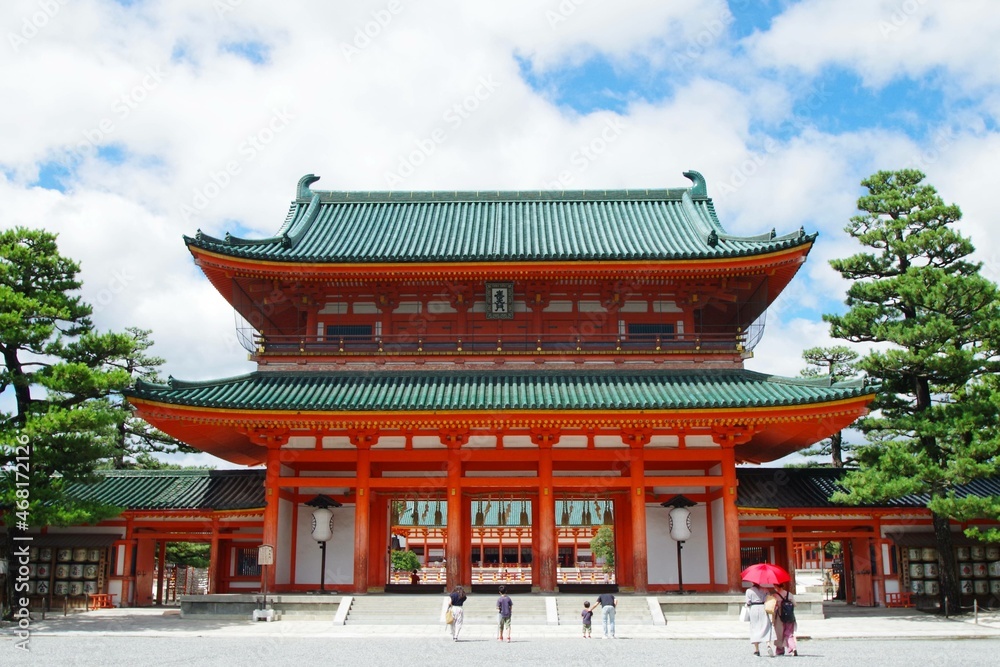
Its main gate was the Otenmon.
One night, this gate went up in flames. The main gate of the Chodoin burned.
The Otenmon was one of the most important structures of the court.
From there, the question of “who set the fire?” grew into a full political crisis.
This became known as the Otenmon Incident.
10. The First Man Named as the Culprit: Minamoto no Makoto
After the Otenmon burned, one man was named as the culprit.
The Minister of the Left, Minamoto no Makoto.
Tomo no Yoshio and others claimed that Makoto had set the fire.
Minamoto no Makoto was one of the court’s most powerful men.
If Makoto truly were the culprit, it would be a crisis that shook the entire court.
The court began to move over the question of punishing him.
Here Fujiwara no Yoshifusa steps forward.
Yoshifusa spoke in Makoto’s defense.
Makoto escaped punishment.
But the affair did not end there.
11. The “Real Culprit” Comes Forward
Some time after the Otenmon burned,
a man named Oyake no Takatori came forward with an accusation.
This time he named Tomo no Yoshio as the culprit.
Tomo no Yoshio was a Dainagon, a Major Counselor.
A powerful man at the very heart of the court.
Which is to say, the affair
swung suddenly from an accusation against Minamoto no Makoto to an accusation against Tomo no Yoshio himself.
Yoshio denied it fiercely.
But as the investigation proceeded, including the interrogation of Yoshio’s own attendants, the court concluded that Tomo no Yoshio and his son had been involved in setting the fire.
And so Tomo no Yoshio was exiled to Izu Province.
His son Nakayo and others were punished as well.
The punishment extended further, to associates and relatives.
The once-prestigious Tomo clan was dealt a severe blow.
12. Did Tomo no Yoshio Really Set the Fire?
Just as with the Jowa Incident, this is an important point for understanding the history here.
The official history settles the affair with Tomo no Yoshio and his associates setting fire to the Otenmon.
But there are aspects of how the affair unfolded that raise questions.
Why was Yoshio accused only some time after the Otenmon burned, rather than immediately?
Why was Minamoto no Makoto suspected first, only for the accusation to shift to Tomo no Yoshio afterward?
And it also matters that
Fujiwara no Yoshifusa became sessho while the investigation was still underway.
There has long been a view that Fujiwara no Yoshifusa used the Otenmon Incident to remove a political rival.
At the same time, no source directly proves that Yoshifusa actually orchestrated the arson.
So rather than declaring flatly that “Yoshifusa was the mastermind,”
the more historically faithful reading is that
“the incident brought down Yoshifusa’s political rivals, and his own power grew decisively as a result.”
13. And Yoshifusa Becomes Sessho
In 866, the very year of the Otenmon Incident.
Fujiwara no Yoshifusa became sessho, regent for the emperor.
This is an extraordinarily significant point in Japanese history.
Yoshifusa was the first man who was not of imperial blood to become sessho.
Sessho meant governing in the emperor’s place.
A political role that had always belonged to members of the imperial family now passed to a member of the Fujiwara clan.
This would lead, in time, to regency government — sekkan seiji.
The system was not fully formed in Yoshifusa’s own lifetime, exactly as it would later exist.
Even so,
the structure in which the Fujiwara became maternal relatives of the emperor, guarded child emperors, and led court politics
took clear shape from this point on.
14. The Jowa Incident and the Otenmon Incident Are Connected
Let’s lay out the sequence so far.
842 — the Jowa Incident
Prince Tsunesada is removed as crown prince.
↓
Prince Michiyasu becomes crown prince.
↓
Prince Michiyasu becomes Emperor Montoku.
↓
His maternal uncle, Fujiwara no Yoshifusa, rises in standing.
↓
Emperor Montoku’s son, Prince Koreto, takes the throne.
↓
Emperor Seiwa.
↓
Yoshifusa becomes guardian to the child emperor.
866 — the Otenmon Incident
The Otenmon burns.
↓
Minamoto no Makoto is suspected as the culprit.
↓
Tomo no Yoshio accuses Makoto.
↓
Afterward, Yoshio himself is accused as the culprit.
↓
Yoshio falls from power.
↓
Yoshifusa’s rivals are pushed back further still.
↓
Fujiwara no Yoshifusa becomes sessho.
Seen this way, the two incidents were not isolated political crises.
They were two great turning points in a single unfolding process — imperial succession intertwined with the rise of the Fujiwara as maternal relatives of the throne.
15. “Removing Rival Clans” Is Not the Whole Story
Japanese history often explains this period simply as “the Fujiwara clan drove out rival clans.”
Certainly, powerful clans were pushed out of the center of politics as a result.
In the Jowa Incident, Tomo no Kowamine and Tachibana no Hayanari were punished.
In the Otenmon Incident, Tomo no Yoshio fell, and the Tomo clan suffered a heavy blow.
But what truly matters is that
this was never simply a story of the Fujiwara clan expelling other nobles one after another.
The Fujiwara Northern House
combined marriage ties to the imperial family, maternal relationships with crown princes and emperors, official posts within the court, and guardianship of child emperors
to build up its political standing.
Fujiwara no Yoshifusa is the clearest symbol of that method.
16. Yoshifusa’s Strength Lay in His Closeness to the Throne
Looking at Yoshifusa’s own family tree makes his political strength easy to understand.
His father was Fujiwara no Fuyutsugu.
A man given great trust by Emperor Saga.
Yoshifusa himself married Emperor Saga’s own daughter, Princess Minamoto no Kiyohime.
His younger sister Junshi became Emperor Ninmyo’s consort.
Her son became Emperor Montoku.
And the daughter Yoshifusa bore, Akirakeiko, gave Emperor Montoku a son who became Emperor Seiwa.
Which is to say, Yoshifusa built up marriage ties to the imperial house from Emperor Saga’s own era onward, and by the next generation had become a maternal relative of the throne itself.
Here lies the secret of Yoshifusa’s power.
He used imperial succession and marriage alike to work his way into the very center of the court.
17. A Picture Scroll Depicting the Otenmon Incident
A famous picture scroll depicting the Otenmon Incident survives from later ages: the Ban Dainagon Ekotoba.
Thought to have been produced in the latter half of the 12th century, this scroll takes the Otenmon Incident as its subject.
The Otenmon in flames. The crowds in an uproar.
The court’s response to the crisis. And Tomo no Yoshio himself.
Unlike reading about the incident in text alone, the scroll shows how people of that time chose to pass this affair down to later generations as a story.
The Otenmon Incident was never simply an ancient political dispute.
Even for later generations, it left a powerful impression as “the great affair in which a man of power fell.”
18. And So the Age of the Fujiwara Begins
In 866, following the Otenmon Incident, Fujiwara no Yoshifusa became sessho.
Yoshifusa himself died in 872.
But the political standing of the Fujiwara Northern House did not waver.
Yoshifusa’s adopted son, Fujiwara no Mototsune, inherited that position.
And in 887–888.
The Ako Dispute broke out between Mototsune and Emperor Uda.
And in 901, the Shotai Incident followed.
The affair in which Sugawara no Michizane was demoted and sent to Dazaifu.
In this way, the politics of the Heian period moved along a single line:
Fujiwara no Yoshifusa
↓
Fujiwara no Mototsune
↓
regency government under the Fujiwara clan.
19. A “Shift in Politics” That Began With the Kusuko Incident
Let’s return to the previous article for a moment.
810, the Kusuko Incident.
The Retired Emperor Heizei and Emperor Saga came into conflict.
Emperor Saga prevailed and seized control of the court.
The man who rose to power as Emperor Saga’s close attendant was Fujiwara no Fuyutsugu.
Fuyutsugu’s son was Fujiwara no Yoshifusa.
And Yoshifusa, through the Jowa Incident, became deeply involved in imperial succession itself.
Then, through the Otenmon Incident, he became sessho.
Which is to say, a single continuous line emerges: the Kusuko Incident → Emperor Saga → Fujiwara no Fuyutsugu → Fujiwara no Yoshifusa → the Jowa Incident → the Otenmon Incident → regency government.
20. What the Two Crises Changed
The Jowa Incident and the Otenmon Incident.
Different men fell in each crisis. The circumstances were different too.
But in the end, the power structure of the Heian court changed dramatically as a result of both.
In the Jowa Incident, the crown prince was replaced.
In the Otenmon Incident, a powerful noble fell from power.
And between the two crises, Fujiwara no Yoshifusa advanced to the very center of the court.
At last, Yoshifusa became sessho.
Here appears the prototype of an age in which the Fujiwara clan, as maternal relatives of the throne, led the government.
Summary
From the Jowa Incident to the Otenmon Incident — Why Did Fujiwara no Yoshifusa Seize Power?
In 842, the Retired Emperor Saga died.
The Jowa Incident followed almost immediately.
Tomo no Kowamine and Tachibana no Hayanari were said to have plotted a conspiracy, and Crown Prince Tsunesada lost his position as well.
The new crown prince became Prince Michiyasu.
The future Emperor Montoku.
As his maternal relative, Fujiwara no Yoshifusa‘s standing rose.
Emperor Montoku then took the throne.
And when his own son, Emperor Seiwa, took the throne at just nine years old, Yoshifusa became guardian to the child emperor.
Then, in 866, the Otenmon, the main gate of the Heian Palace, burned.
At first the Minister of the Left, Minamoto no Makoto, was suspected. Afterward, Tomo no Yoshio was accused as the culprit.
Tomo no Yoshio fell from power, and the Tomo clan was dealt a heavy blow.
And that same year,
Fujiwara no Yoshifusa became the first man outside the imperial family to serve as sessho.
From the Jowa Incident to the Otenmon Incident.
Over the course of twenty-four years, the power structure of the Heian court changed profoundly.
And at the center of it all stood Fujiwara no Yoshifusa.
It began in the era when Emperor Saga overcame his brother, the Retired Emperor Heizei, in the Kusuko Incident.
Roughly half a century later.
The politics of the Heian court shifted from an age centered on the imperial family to an age in which the Fujiwara clan, having become maternal relatives of the throne, led the government.
The great turning point in that shift was the Jowa Incident and the Otenmon Incident.
And waiting further down this road are Fujiwara no Mototsune and the Ako Dispute.
And beyond that, Sugawara no Michizane and the Shotai Incident.
The power struggles of the Heian period would only grow fiercer from here.