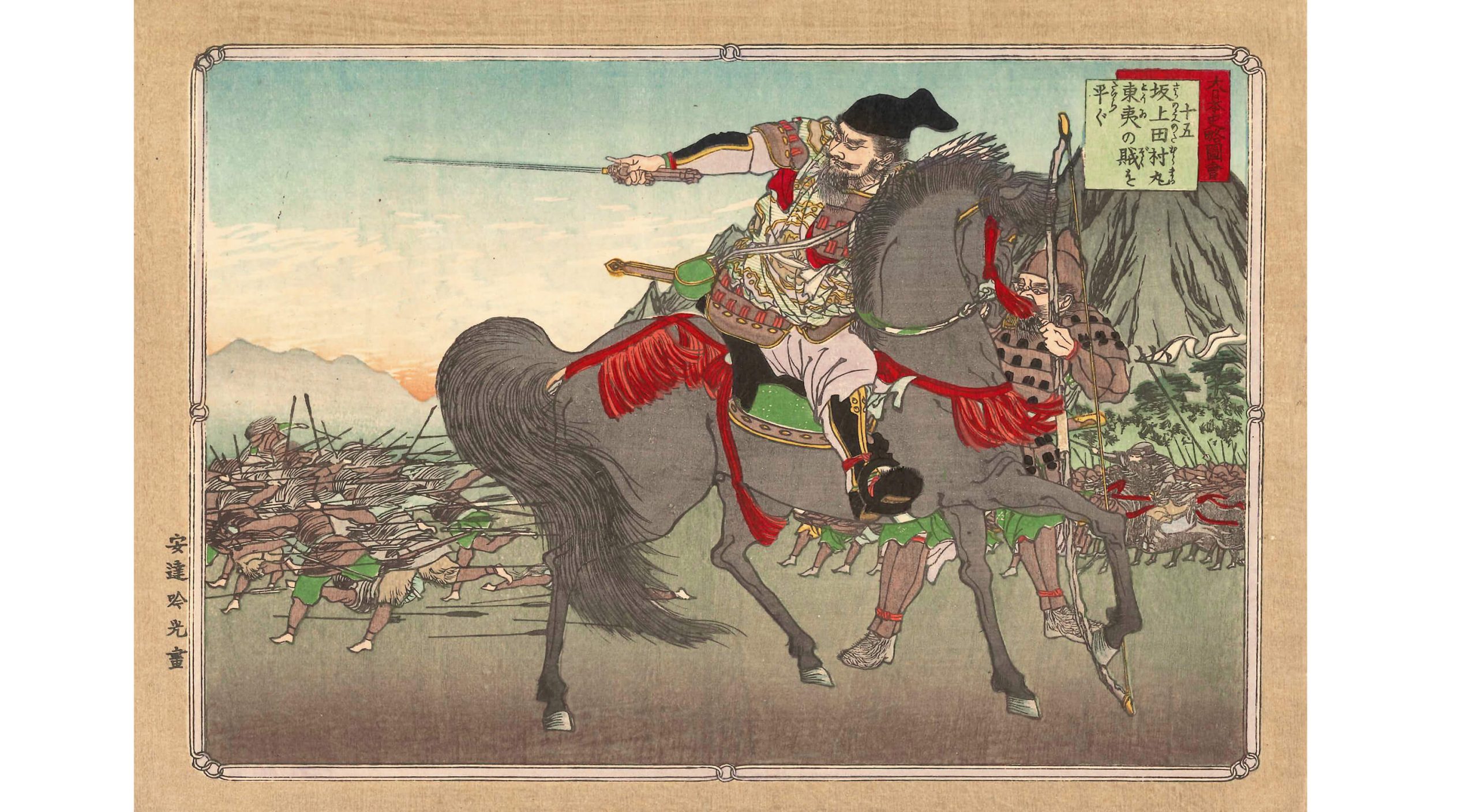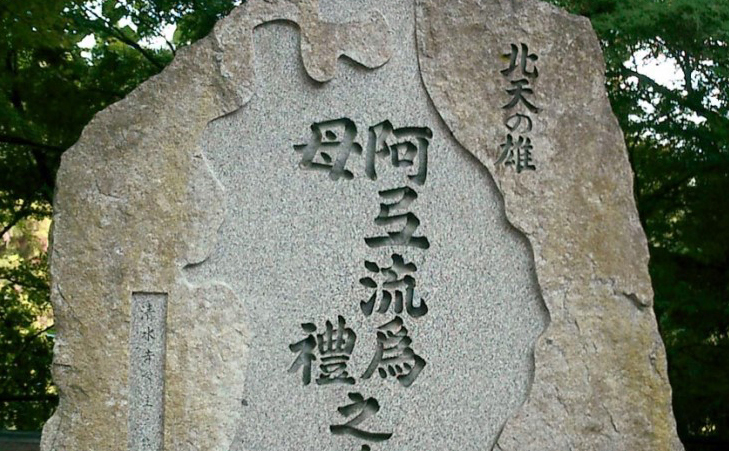
Any account of ancient Tohoku history has to include one man.
Aterui.
In the late eighth century, he was the Emishi chieftain who fiercely resisted the court’s control of the northeast from a base in the Isawa region, around present-day Oshu City, Iwate Prefecture.
Aterui’s birth year is unknown. What family he was born into and how he grew up are unknown too.
Very little written record survives; the name Aterui appears in only two major sources, once each in the Shoku Nihongi and the Nihon Kiryaku.
Even so, that scant record preserves
an enormous court army of more than 52,800 men, the Battle of Sufuse fought along the Kitakami River, 1,036 drowned,
a surrender leading more than 500 people, and an execution on August 13, 802 —
events that shook ancient Tohoku history to its core.
This episode follows the age Aterui lived in and the war he fought, drawing not on later legend, but chiefly on the record left by the court itself.
1. Who was Aterui?
Aterui is generally described as “a chieftain of the Emishi.”
In the sources he is recorded as “the barbarian Aterui,”
and later tradition also preserves the form “Otamo no Kimi Aterui.”
The name “Aterui” has, in the modern era, become extremely famous as that of a single heroic figure.
But what the sources actually tell us about the man himself is surprisingly little.
His birth year is unknown.
His birthplace cannot be fixed. His family is unknown. No record written by the man himself survives.
Even so, his name is recorded in the fighting of 789, at the moment the court’s army closed in on his home base.
What this tells us is that Aterui was a powerful chieftain who led the Emishi forces of the Isawa region against the court’s army.
2. Aterui’s home base — Isawa
To understand Aterui’s fight, one first has to understand “Isawa.”
Isawa is the region corresponding to present-day Oshu City, Iwate Prefecture.
Its center lay around what is now the Mizusawa district of Oshu City.
The Kitakami River runs through it, with the Kitakami Mountains to the east and the Ou Mountains to the west.
For the ancient court, Isawa was a critical region for pushing its control of the northeast further north.
For the Emishi, conversely, it was vital ground for holding back the court’s armies advancing from the south.
This is precisely why fierce fighting continued between the court and the Emishi forces of Isawa from the late eighth century onward.
Even before Aterui enters the record, the court was already, in the seventh year of Enryaku (788), making large-scale preparations for an expedition into Isawa the following year.
3. The 52,800 men the court prepared
In the twelfth month of the seventh year of Enryaku (788),
Emperor Kanmu‘s court appointed Ki no Kosami commander-in-chief for the eastern campaign, in order to subdue Isawa in earnest.
Soldiers were gathered from the Tokai, Tosan, and Bando regions.
Their number: more than 52,800.
This was no small-scale regional expedition.
It was a great campaign mobilized on a national scale.
(Part 2 of the Emishi Campaigns, covering the Thirty-Eight Years War, is available in English here.)
Among the soldiers selected were men who had already fought in earlier campaigns against the Emishi, men who had already distinguished themselves in battle, and men skilled with bow and horse.
Vast quantities of food and military supplies were prepared as well.
The court intended to subdue Isawa in a single decisive stroke.
But standing in its way was Aterui.
4. 789 — Aterui enters history
The eighth year of Enryaku (789).
The court’s army under Ki no Kosami set out from Taga Fortress and headed north.
Taga Fortress corresponds to present-day Tagajo City, Miyagi Prefecture.
At the time, it was the critical stronghold of the court’s control over Mutsu Province.
The court’s army continued north and reached the Koromo River, in southern Isawa, by the end of the third month.
The Koromo River flows through what is now the area from Oshu City to Hiraizumi Town, Iwate Prefecture.
The army deployed there, dividing itself into a vanguard, a central force, and a rear guard.
Ki no Kosami, however, did not advance into Isawa right away.
Emperor Kanmu, in response, issued a strong order for the army to press forward.
And at last, the court’s army began its advance into the heart of Isawa.
5. The stage shifts to the Kitakami River
The court’s army split into three and advanced north.
Of these, the central and rear forces —
4,000 men in total — crossed to the eastern bank of the Kitakami River and pressed north.
Their destination was the territory under Aterui’s control.
And as the court’s army reached the area near Aterui’s home base,
an Emishi force of roughly 300 appeared.
Here, the Shoku Nihongi records Aterui’s name clearly for the first time.
The court’s army engaged the Emishi force.
And the Emishi force retreated.
The court’s army pursued.
But this was exactly Aterui’s plan.
6. The Battle of Sufuse — Aterui’s greatest victory
The place where the court’s army, pursuing the retreating Emishi, ended up
was Sufuse Village.
This is identified with the area around the eastern part of present-day Mizusawa district, Oshu City, Iwate Prefecture.
Here, the course of the battle turned completely.
The court’s army had planned to link up with its vanguard.
But the vanguard could not cross the Kitakami River.
Its path had been blocked by an Emishi force.
Meanwhile, a new Emishi force appeared in front of the court’s army.
Its number: roughly 800.
And beyond that, roughly 400 more Emishi appeared from the rear.
The court’s army was caught between them, front and back.
And this was ground hemmed in between the Kitakami River and the mountains.
The great army’s advantage in numbers could not be brought to bear.
Aterui’s side used the terrain and the positioning of their forces to drive the court’s army into a trap.
And the court’s army collapsed entirely.
7. Catastrophe strikes the court’s 4,000-man army
The damage the court’s army suffered at the Battle of Sufuse was staggering.
The figures recorded are:
25 killed in battle.
245 wounded by arrows.
1,036 drowned.
1,257 who stripped and swam back to safety.
These are the figures.
What stands out above all is the number of drowned: 1,036.
Far more soldiers died trying to flee into the Kitakami River during the retreat than died in combat itself.
In other words, the Battle of Sufuse was never a simple frontal clash.
It was a battle in which the Kitakami River itself was used as a weapon.
Aterui’s forces lured the court’s army in, pinned it from the front, sealed it from the rear, and drove its retreat straight into the Kitakami River.
It was an extraordinarily brilliant victory, one that stands out in the history of ancient Tohoku.
8. The court’s army burned villages
But the fighting did not end with the court’s defeat alone.
The Shoku Nihongi also records that the court’s army burned
14 villages near the battlefield, destroying roughly 800 households.
This is an extremely important record.
The ancient conquest of the Emishi was never simply soldiers fighting soldiers on a battlefield.
Entire communities were drawn into the war.
The very foundations of people’s daily lives were destroyed.
And to bring this region under control, the court kept committing military force again and again.
This was the reality behind the war Aterui fought.
9. To the court, Aterui was “a bandit”
In the court’s own sources, Aterui is never depicted as a hero.
He is instead called “the bandit chieftain.”
The term means, literally, “the leader of bandits.”
To the court, Aterui was a man who resisted its authority and led an army to attack its forces.
But seen from the other side, the story looks different.
To Aterui, the court’s army had invaded Isawa, the land where his people lived.
So he fought.
In other words, this war carried two sides at once: “the court’s control of the northeast,”
and “the resistance of the Emishi forces of Isawa.”
10. Victory at Sufuse was not the end
Aterui won in 789.
But this did not mean the court gave up its ambitions in the northeast.
Quite the opposite.
The court continued its conquest of the Emishi.
Otomo no Otomaro, Sakanoue no Tamuramaro, and others took command of expeditionary armies, and the campaign against Isawa moved forward.
However, the detailed record of individual engagements between Aterui and the court’s army after 789 is remarkably thin.
This point matters for understanding Aterui.
The gap between the Battle of Sufuse in 789 and the surrender of 802 cannot be filled in, detail by detail, like a narrative.
What can be said with confidence is only that the conflict between the court and the Emishi over Isawa continued through those years, and that Aterui would eventually surrender before Tamuramaro.
11. Sakanoue no Tamuramaro enters the story
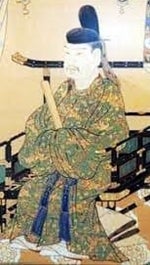
Here, another critical figure enters Aterui’s life.
Sakanoue no Tamuramaro.
(A profile of Sakanoue no Tamuramaro is available in English here.)
Tamuramaro’s own life has already been covered in depth in a dedicated biographical episode, so this account focuses specifically on his relationship with Aterui.
In the twentieth year of Enryaku (801), Tamuramaro headed to the northeast as Commander-in-Chief for the Subjugation of the Emishi.
His army numbered forty thousand men.
The court committed a massive army once again.
And with the 801 expedition, the court’s campaign against Isawa advanced significantly.
The following year, 802, Tamuramaro took an even more decisive step.
The construction of Isawa Fortress.
12. 802 — Isawa Fortress is built
The twenty-first year of Enryaku (802).
Tamuramaro built Isawa Fortress
in what is now the Mizusawa district of Oshu City, Iwate Prefecture.
This fortress was no simple battlefield outpost.
It was a massive military and administrative center meant to make the court’s control of the northeast permanent.
With the completion of Isawa Fortress, the court moved beyond merely attacking Isawa on occasion, into
the stage of “placing a stronghold here and ruling it.”
Furthermore, from the Tokai and Tosan regions,
roughly 4,000 people were relocated to Isawa.
The court did not simply send soldiers.
It relocated people, built a fortress, established administration, and sought to absorb the land itself under its control.
For Aterui’s side, this was a decisive change.
13. Aterui surrenders, leading more than 500 people
The fourth month of the twenty-first year of Enryaku (802).
Aterui and More surrendered to Tamuramaro, leading more than 500 people.
This is one of the single most important moments in Aterui’s life.
Aterui did not surrender alone.
He led more than 500 people with him.
This shows that, right up to the end, he held enormous influence among the Emishi forces of Isawa.
And the stage of the surrender was Isawa itself.
Aterui, who had defeated the court’s army in 789,
surrendered thirteen years later, this time before the fortress the court itself had built at Isawa.
14. Why did Aterui surrender?
This is the single biggest question in thinking about Aterui.
The reason cannot be narrowed to just one thing.
But the situation itself was clear.
The court’s army had launched large-scale expeditions again and again.
Tamuramaro had led forty thousand men in conquest.
And Isawa Fortress had been built.
And beyond that, roughly 4,000 people had been relocated there.
The court had shifted from occasionally attacking Isawa to permanently controlling it.
At Sufuse in 789, Aterui had defeated the court’s army.
But by 802, the very shape of the battlefield had changed.
The court had begun to hold Isawa through a combination of
army, fortress, settlement, and administration.
It is believed that the completion of this system of control lay behind Aterui’s decision to surrender with more than 500 of his people.
15. Aterui and More travel to the capital
After surrendering, Aterui and More were sent on to the capital.
In the seventh month, the two men entered the capital.
Here, records show that Tamuramaro urged the court to allow the two men to return to their home in Isawa.
Why did Tamuramaro wish for their return?
The most likely reason was Aterui’s influence on the ground.
Returning Aterui to Isawa would let the court use his influence to bring the local Emishi forces over to its side.
Rather than killing him, use him for control.
It appears Tamuramaro made this kind of pragmatic judgment.
But the court’s senior nobles reached a different conclusion.
16. “The heart of a wild beast” — how the court saw Aterui
The court’s judgment, preserved in the Nihon Kiryaku, was extremely harsh.
It described Aterui and his companions as having
“the heart of a wild beast,”
and judged that sending them back to the northeast would only sow trouble for the future.
To the court, Aterui was not simply
an enemy general who had once surrendered.
He was the chieftain who had led the resistance of the Emishi of Isawa against the court’s army for thirteen years.
Sending such a man back to his homeland was, in the court’s eyes, dangerous.
In the end, Tamuramaro’s appeal was not accepted.
17. August 13, 802 — the execution of Aterui
On the thirteenth day of the eighth month, in the twenty-first year of Enryaku,
Aterui and More were executed.
The place is recorded as
Sugiyama, in Kawachi Province.
This is identified with the area around present-day Hirakata City, Osaka Prefecture.
In other words, Aterui, who had fought the court’s army in Isawa without pause, was never able to return home.
He met his end in Osaka, far from the area around present-day Oshu City, Iwate Prefecture.
In 802, Aterui’s fight came to an end, here.
18. Aterui was executed. Even so, the fighting did not end
What matters here is that
Aterui’s execution did not equal the complete end of the war in the northeast.
In 802, the year of Aterui’s execution, the court was already advancing its control of the northeast from its base at Isawa Fortress.
And in 803, Shiwa Fortress was built.
This corresponds to present-day Morioka City, Iwate Prefecture.
And in 811, Funya no Watamaro led a further campaign north.
In other words, the court’s control of the northeast kept advancing north even after Aterui’s death.
Aterui was a figure who came to symbolize an entire age, but his death did not mean the end of Tohoku’s history itself.
19. Was Aterui “king of the whole of Tohoku”?
Here, the later image needs to be separated from the historical record.
No reliable contemporary source describes Aterui as “a king who ruled the whole of Tohoku.”
What can be confirmed is that Aterui was a powerful chieftain of the Emishi forces centered on the Isawa region.
In 789, fighting broke out near Aterui’s home base, and his forces defeated the court’s army.
In 802, he surrendered leading more than 500 people.
These two records alone show that Aterui held enormous influence in Isawa.
Which is exactly why, rather than calling him “king of the northeast,”
it is more faithful to the sources to describe him as
“a powerful chieftain of the Emishi forces centered on Isawa.”
20. What Aterui showed at the Battle of Sufuse
If one had to name Aterui’s single greatest achievement,
it would surely be the Battle of Sufuse in 789.
The court had prepared more than 52,800 men.
Of that enormous expeditionary force, 4,000 crossed the Kitakami River and advanced.
Aterui’s side met them with roughly 300 men.
And retreated.
The court’s army gave chase.
Drawing them into Sufuse Village.
Roughly 800 attacked from the front.
Roughly 400 circled around to the rear.
The court’s army was driven into the Kitakami River.
The result:
1,036 drowned.
245 wounded by arrows.
25 killed in battle.
1,257 who stripped and swam back to safety.
These figures alone show that this was never a simple frontal clash for Aterui’s side.
Terrain, troop positioning, ambush, cutting off the retreat.
Despite overwhelming numerical disadvantage, Aterui struck precisely at the court army’s weak points.
21. How was Aterui able to fight for thirteen years?
Looking only at the Battle of Sufuse in 789,
it can look like a simple story of “Aterui defeated the court’s army once.”
But what matters is what came after.
The court sent expeditionary armies again and again.
And still Aterui kept fighting, all the way through to 802.
In other words, Aterui’s strength was never just a single victory.
The terrain of Isawa.
The Emishi’s own warrior bands.
Ties to the local community.
And a style of fighting different from the court’s own.
These elements combined to hold back the court’s control of the northeast for a remarkably long time.
The Oshu City Archaeological Research Center also describes Aterui as having resisted the court’s expeditions for thirteen years.
22. Aterui and Sakanoue no Tamuramaro
Whenever Aterui is discussed, the name Sakanoue no Tamuramaro inevitably follows.
One was Commander-in-Chief for the Subjugation of the Emishi, leading the court’s army.
The other was the chieftain leading the Emishi forces of Isawa.
The two men became a defining, contrasting pair in the history of ancient Tohoku.
But a caution is worth stating here.
No contemporary source records anything like
“a single combat between Aterui and Tamuramaro.”
What is actually known is that
Tamuramaro, as the court’s supreme commander, carried out the conquest of the northeast,
and Aterui, as the central figure of the resistance at Isawa, fought against him,
and in 802, Aterui and More surrendered to Tamuramaro.
That is what the sources establish.
And Tamuramaro is recorded as having urged the court to return Aterui to Isawa and put him to use, rather than kill him.
This relationship is precisely the critical point of contact between Aterui and Tamuramaro in history.
23. “Aterui the hero” was a creation of later ages
Today, Aterui carries a strong image as
“a hero of the Tohoku region.”
But in the court’s own sources, from the age Aterui actually lived in, he was never treated as a hero.
He was “the bandit chieftain” who resisted the court.
Here lies one of the fascinations of history.
The same man,
seen from the court, was “an enemy of the state’s authority.”
Seen from the Emishi of Isawa, he was “a leader who defended their own land.”
And today, he has been
reassessed as “a hero representing ancient Tohoku.”
How Aterui is judged has changed dramatically with the age doing the judging.
24. What truly made Aterui remarkable
I do not think Aterui’s greatness lies in “winning in the end.”
If anything, it is the opposite.
In the end, he was executed.
He could not stop the court’s control of the northeast.
Isawa Fortress was built.
Shiwa Fortress was built.
The court’s territory kept expanding further north.
And yet, he resisted the court’s enormous military power for thirteen years.
That fact alone is what makes Aterui great.
Especially in 789.
Against a court that had prepared a force of more than 52,800, he fought on the ground of Isawa and inflicted devastating losses on the court’s army.
And in the end, he surrendered leading more than 500 people.
Looking at this whole sequence, Aterui was never simply “the leader of a rebel army.”
He was the man who led the largest-scale resistance in the entire process by which the court came to control the northeast.
25. What Aterui’s death meant
August 13, 802.
Aterui and More were executed.
At this moment, the court chose not to spare them and send them back to Isawa.
As a result,
the chieftain Aterui was gone.
But the court continued advancing its control of the northeast from its base at Isawa.
In other words, Aterui’s death was never only
“the tragic end of one hero.”
It was also
the moment at which the court’s control of Isawa entered its decisive, final stage.
Conclusion
Aterui tried to defend Isawa to the very end
Little written record of Aterui survives.
But precisely because there is so little, the figures that do survive carry enormous weight.
The eighth year of Enryaku (789).
The court prepared an expeditionary force of more than 52,800.
Of that force, 4,000 crossed the Kitakami River and advanced into Isawa.
Aterui’s side met them with roughly 300 men.
Drew them into Sufuse Village, then struck with roughly 800 from the front and roughly 400 from the rear.
The court’s army was heavily defeated.
The losses:
25 killed in battle.
245 wounded by arrows.
1,036 drowned.
1,257 who stripped and swam back to safety.
Through this battle, Aterui’s name was carved into the Shoku Nihongi.
Thirteen years later,
the twenty-first year of Enryaku (802).
Sakanoue no Tamuramaro led forty thousand men in conquest. Isawa Fortress was built.
And roughly 4,000 more people were relocated there.
Then, in the fourth month, Aterui and More surrendered, leading more than 500 people.
In the seventh month, they were sent to the capital.
Tamuramaro urged that they be allowed to return home.
But the court refused.
And on August 13,
Aterui and More were executed at Sugiyama, in Kawachi Province.
This is present-day Hirakata City, Osaka Prefecture.
Aterui was defeated in the end.
But the fact that he fought the court’s army for thirteen years does not disappear.
And what the court needed in order to bring that fight to an end was
an army of more than 52,800, an expeditionary force of forty thousand, and the massive military stronghold of Isawa Fortress.
The land the court went to such lengths to seize was Isawa —
the area around present-day Oshu City, Iwate Prefecture.
To know the figure of Aterui is, in that sense, also
to know how ancient Japan extended its control into the northeast.
And rather than seeing Aterui as merely “a hero of the Emishi,”
I believe he should be seen as
the chieftain who, at the very front line of an age when the court pushed to expand its state northward, resisted to the very end.
Aterui’s fight ended on August 13, 802.
But what that fight left behind still remains, more than 1,200 years later, in the land of Isawa in Oshu City, Iwate Prefecture.