On August 27, 663, a naval force from the Wa state approached the mouth of a river in the southwestern Korean Peninsula.
There, the Tang navy awaited them. According to the Nihon Shoki, the Tang fleet comprised 170 ships. The Tang forces coordinated with their land army advancing towards the Baekje restoration stronghold at Churyu Fortress, positioning themselves to intercept the reinforcements from Wa.
The Wa forces were pushed back in the battle that day.
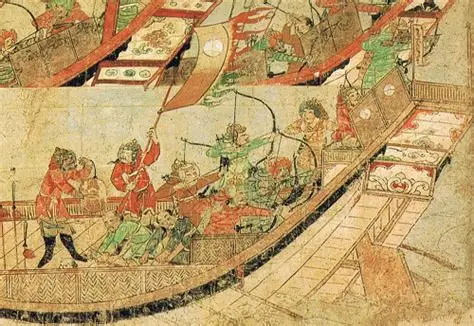
On the following day, the 28th, the Wa and Baekje forces attempted another attack. The Nihon Shoki notes that the Wa forces, without forming proper battle lines, advanced towards the Tang navy and were surrounded from both sides.
The clustered ships became immobile, and many soldiers fell into the sea.
Chinese records state that the Tang forces fought four times at Baekgang and claimed victory each time, burning 400 Wa ships.
While the figure of 400 ships should be approached with caution, both Japanese and Chinese records agree on the Wa forces’ significant defeat.
The Battle of Baekgang in 663 marked the decline of the Wa state’s efforts to support the Baekje restoration war across the sea.
Why did the Wa state send such a large military force and resources to the Korean Peninsula?
To understand this, we must look back three years to 660.
The Tang-Silla Alliance Invades Baekje
In the mid-7th century, the Korean Peninsula was home to the three kingdoms of Goguryeo, Baekje, and Silla.
Goguryeo was in the north, Baekje in the southwest, and Silla in the southeast. The conflicts among these kingdoms involved the Wa state across the sea and the Tang, which had unified the Chinese mainland.
The Tang dynasty, established in 618, increased its military involvement in the Korean Peninsula during the reigns of Emperor Taizong and Emperor Gaozong.
While repeatedly campaigning against Goguryeo, Silla strengthened its ties with Tang to push back against the pressures from Baekje and Goguryeo.
The relationship between Baekje and the Wa state was longstanding.
Through people who traveled from Baekje to the Japanese archipelago, many cultural and technological advancements such as Buddhism, writing, architecture, and crafts were introduced.
The royal families maintained diplomatic relations for many years, with envoys continuing to travel between them even into the 7th century.
In 660, the sixth year of Emperor Saimei’s reign, the Tang-Silla allied forces invaded Baekje.
The Tang general Su Dingfang crossed the sea, while the Silla army advanced from the east.
The Baekje forces, caught in a pincer attack, could not hold, and the capital city of Sabi fell. King Uija surrendered, and many members of the royal family and high officials were taken to Tang.
The Baekje dynasty was thus extinguished.
However, not all Baekje soldiers and local forces laid down their arms.
In Defeated Baekje, Leaders Like Gwisil Boksin Rally Troops
Across Baekje, resistance against the Tang-Silla forces began.
One of the central figures was Gwisil Boksin. Alongside others like the monk Dochim, they joined the restoration movement, gathering remaining troops to attack Tang-Silla strongholds.
Baekje was without a king.
The person Boksin and others sought to welcome as the new king was Prince Pungjang, who was residing in the Wa state.
The Baekje restoration forces sent envoys to the Wa state, requesting military assistance and the return of Pungjang. By establishing Pungjang, a member of the Baekje royal family, they aimed to unite the remaining Baekje people.
The Yamato court accepted the request.
It is hard to believe that they embarked on such a large-scale overseas military expedition solely due to their long-standing relations with Baekje.
If Baekje fell under the control of Tang and Silla, Yamato would lose an important diplomatic partner in the southwestern Korean Peninsula.
The expansion of Tang’s influence into the southern peninsula began to alter the military and diplomatic landscape surrounding Yamato in East Asia.
The restoration of Baekje was also tied to the position of the Yamato court itself.
Empress Saimei Heads to Tsukushi
In January of the 7th year of Saimei’s reign (661), Empress Saimei, along with Prince Naka no Oe, headed west.
The entourage navigated through the Seto Inland Sea, passing through Iyo before arriving in Tsukushi.
They then moved to Asakura Tachibana no Hironiwa Palace, believed to be located in the vicinity of present-day Asakura City in Fukuoka Prefecture.
The exact location of Asakura Tachibana no Hironiwa Palace remains undetermined to this day.
There are several traditional sites within Asakura City, and the city’s cultural heritage plan considers the entire Asakura area a strong candidate for the location.
For Yamato at the time, Tsukushi was the frontline for dispatching troops and supplies to the Korean Peninsula.
The relocation of the emperor and the central government there indicates that the aid to Baekje was being pursued as a major national endeavor.
However, on July 24, Empress Saimei passed away in Asakura.
She was 68 years old.
Preparations for war did not cease, and Prince Naka no Oe took charge of governance.
Prince Naka no Oe did not immediately ascend the throne but entered a period of “shosei,” governing as the crown prince.
Even after Empress Saimei’s death, ships, soldiers, weapons, and provisions continued to be sent to the Korean Peninsula.

Sending Back Toyosho to Revive Baekje
The Yamato court sent Toyosho back to Baekje.
The “Nihon Shoki” contains multiple records regarding Toyosho’s crossing, making it difficult to consolidate the timing and relationship with each dispatched army into a single date.
Nevertheless, it is clear that the Yamato state did not merely send back Pungchang, but continued to dispatch soldiers, ships, weapons, and provisions.
Some records mention that over 5,000 soldiers were assigned to guard Pungchang.
Furthermore, Azumi Hirafu and others led a fleet across the sea to support the Baekje restoration army.
When Pungchang arrived in Baekje, Fukushin welcomed him as king. A king once again stood in Baekje, which had fallen in 660.
The restoration army put pressure on the Tang-occupied bases and began to reclaim parts of Baekje’s former territory.
At this stage, the Baekje restoration was not an entirely hopeless struggle.
The Tang forces needed to maintain control over the conquered lands after Baekje’s fall, and the Silla army was compelled to respond to the restoration forces across various regions. As long as personnel and supplies continued to flow from the Yamato state, the war could be prolonged.
The major stronghold for the restoration army became Churujō.
Should They Leave Churujō?—A Division of Opinions Within the Restoration Army
Churujō was a well-fortified stronghold utilizing the mountainous terrain.
However, there were issues with housing a large army there for an extended period.
It was difficult to secure sufficient arable land nearby, making it inconvenient to gather food supplies.
Pungchang and others considered relocating their base to Hikijō, which was blessed with fertile farmland.
The commander from the Yamato side who opposed this plan was Park Chi Jinzo Tarakitsu.
According to the “Nihon Shoki,” Tarakitsu valued the rugged terrain of Churujō and argued that moving to the plains near Hikijō would make them more vulnerable to enemy attacks.
Pungchang and others moved to Hikijō.
Subsequently, under the offensive of the Silla army, the restoration army was forced to return to Churujō.
Choosing between a location with easy access to food or a defensible mountain fortress, the Baekje restoration army faced difficult decisions as they continued their prolonged campaign.
As 663 began, the pressure from the Tang-Silla side intensified further.
27,000 Cross from the Yamato State
In March of the second year of Tenji (663), the Yamato state dispatched a large military force to the Korean Peninsula.
The “Nihon Shoki” records the number of troops as 27,000.
Commanders such as Kamitsukeno no Kimi Wakatoko, Kose no Kamitsukimi Yakugo, Miwa no Kimi Nemaro, and Abe no Hikida no Omi Hirafu led the forces, which were divided into the vanguard, main force, and rear guard.
Of course, the figure “27,000” cannot be viewed as an exact count of troops with the same precision as modern military records.
Nevertheless, it is evident that the Yamato authority had been sending a considerable military force overseas for several years.
To engage tens of thousands of people in battle across the sea, having ships to carry the soldiers was not enough.
Weapons, food, water, and personnel to operate the ships had to be assembled, and supplies had to be continuously sent from Kyushu to the Korean Peninsula.
The Battle of Baekgang did not suddenly erupt in August 663.
It was the final phase of the Baekje Restoration War, during which the Yamato state had been continuously sending people and supplies for about three years since Baekje’s fall in 660.
On the Eve of Battle, Toyoshō Kills Kishitsu Fukushin
As a large force was dispatched from the Wa Kingdom, a severe conflict erupted within the Baekje restoration faction.
The relationship between Toyoshō, who was welcomed as king, and Kishitsu Fukushin, who initiated the restoration movement, had deteriorated.
According to the Nihon Shoki, in June 663, Toyoshō suspected Fukushin of plotting a rebellion and captured him.
Fukushin was executed.
Just about two months before the decisive battle, they lost a key figure who had been gathering troops and supporting the restoration movement since the fall of Baekje.
Chinese and Korean sources also confirm the conflict between Toyoshō and Fukushin, but the detailed circumstances leading to the conflict and who first attempted to eliminate the other differ in the records.
The Tang and Silla sides did not miss this turmoil.
The target was set on the fortress of Churyu.
The Tang Army Approaches Churyu Fortress by Sea, the Silla Army by Land
The strategy of the Tang and Silla forces was not limited to the sea.
The Tang generals Sun Renshi and Liu Renyuan, along with the Silla army, advanced towards Churyu Fortress by land, while Liu Rengui led the naval forces towards Baekgang.
This created pressure on Churyu Fortress from both land and sea.
Meanwhile, new reinforcements were approaching from the Wa Kingdom.
According to the Nihon Shoki, in August, Toyoshō received news that an army of over 10,000 led by Lord Rohara was arriving, and he headed to welcome them at Baekgang.
It is not possible to simply add these over 10,000 troops to the 27,000 from March to claim a “Wa army of 37,000”.
This is because it is unclear whether all units were present at the same battlefield at the same time or how accurately the recorded troop numbers reflect reality.
On August 27, the fleet from the Wa Kingdom made contact with the Tang navy near Baekgang.
While the exact location of Baekgang remains debated, the prevailing theory places it near the mouth of the present-day Geum River in the southwestern Korean Peninsula.
August 27 — The Wa Navy Retreats After the Initial Battle
The Nihon Shoki does not provide a lengthy account of the initial battle.
It records that the Wa army fought the Tang navy, found themselves at a disadvantage, and retreated, while the Tang forces held their formation.
The Wa and Baekje sides decided to attack again the following day.
Since they failed to disrupt the Tang army in the previous day’s battle, they ideally needed to reassess their strategy based on the enemy’s formation and the state of the waterways.
It is difficult to read the attack on the 28th as having been sufficiently prepared in this manner.
August 28 — The Wa Army Charges into the Tang Fleet
On the following day, the commanders of the Wa and Baekje forces once again advanced towards the Tang army.
The Nihon Shoki is quite critical of the decisions made on this day.
The Japanese forces, without fully assessing the situation, believed that if they rushed to attack, the Tang forces would retreat. They sent in a disordered central unit.
The Tang navy maintained their formation.
The Japanese ships approached.
The Tang forces maneuvered their ships from both sides, encircling the Japanese fleet.
The Japanese ships became densely packed in a narrow area.
Ships trying to advance, retreat, or change direction overlapped, rendering them immobile.
The Nihon Shoki records that they could not even turn the bows or sterns of their ships.
In naval battles, if ships cannot move freely, they cannot maintain their battle lines.
The soldiers aboard could not flee in any direction as they might on land.
The Japanese fleet, surrounded by the Tang forces, crumbled.
Many soldiers fell into the water, resulting in numerous drownings.
“It Can’t Be Said They Lost Because They Misjudged the Tides”
Regarding the Battle of Baekgang, there are explanations suggesting “the Japanese forces attacked without understanding the tides and were defeated.”
The Nihon Shoki includes a passage indicating that the Japanese side fought “without observing the weather.”
While this can be interpreted as ignoring wind directions and tidal currents, the records do not specifically state that they misjudged high and low tides, leading to their defeat.
The same applies to the size of the ships; there are no detailed comparative records that explain the outcome solely by the Tang having larger ships and the Japanese having smaller ones.
The accessible records indicate that the Japanese forces had already been repelled in the previous day’s battle, the Tang navy maintained their formation, the Japanese attacked in disarray the following day, and the Tang forces encircled their fleet from both sides.
The defeat at Baekgang should not be portrayed as a battle decided by a single blunder.
The Tang and Silla forces coordinated their land assault on Sabi Castle with their naval operations. On the Baekje restoration side, a conflict arose between Pungjang and Fukushin just before the decisive battle, resulting in the loss of Fukushin, who had fought for many years.
These issues were compounded by poor decisions and disordered formations at sea.
The Tang Recorded “Four Battles, Four Victories, Burning 400 Japanese Ships”
Chinese sources depict the battle at Baekgang as even more intense.
The Tang forces fought the Japanese four times and won each battle.
They reportedly burned 400 Japanese ships.
Accounts describe flames and smoke covering the sky, with the sea turning red.
Since these figures come from the victors’ records, it is not necessary to take all 400 ships as verified losses.
The Nihon Shoki does not mention this figure of 400 ships.
Nevertheless, the Chinese recorded it as a large-scale naval battle, and the Japanese documented a defeat with numerous drownings.
There is no doubt that the fleet from Japan suffered a significant blow.
On the battlefield, Park Si-Jin, a commander, also lost his life.
The “Nihon Shoki” describes how Takatsu fought bravely without retreating, cutting down dozens before meeting his end in battle.
While the details of his valiant last stand should be viewed as part of the “Nihon Shoki” narrative, the death of one of the generals of the Baekje relief forces at Hakusukinoe indicates the significant losses suffered by the Yamato forces.
Pungjang Escaped to Goguryeo
With the Yamato forces defeated at sea, the Baekje restoration army could no longer hold its ground.
Pungjang, who had been sent back as king from Yamato, fled to Goguryeo by ship.
The Tang and Silla forces were closing in on Churujong.
With the king lost and Kim Hushin already dead, the naval forces from Yamato were also defeated at Hakusukinoe.
Within the castle, surrender became rampant, and the Baekje restoration movement rapidly crumbled.
Baekje was destroyed by Tang and Silla in 660.
The period during which Hushin and others continued their resistance, welcoming Pungjang and reinforcements from Yamato to reestablish Baekje, lasted about three years.
The decisive battle that occurred at the end of this period was at Hakusukinoe.
Why Did Yamato Fight So Hard for Baekje?
Tracing the path to Hakusukinoe, it becomes clear that Yamato’s involvement was not solely to “help its ally Baekje.”
There was a long-standing diplomatic relationship between Baekje and Yamato, with personal ties through royal families and immigrants.
At the same time, the fall of Baekje in 660 altered the power dynamics of East Asia.
Tang, allied with Silla, extended its influence to the southern Korean Peninsula, eliminating Baekje, a crucial partner for Yamato.
The Yamato court sent Pungjang back as the king of Baekje, deploying soldiers, ships, weapons, and provisions to revive Baekje on the Korean Peninsula.
If Baekje could be reestablished, Yamato could maintain its existing diplomatic relations.
If they failed, a new power structure of Tang and Silla would remain across the sea.
Empress Saimei moved to Tsukushi, and even after her death, Prince Naka no Oe continued to dispatch troops, driven by these circumstances.
In August 663, Yamato lost this gamble.
Baekje was not revived, and the forces sent across the sea from Yamato had to return home.
After the defeat, the Yamato court quickly began fortifying defenses from northern Kyushu to the Seto Inland Sea. By 664, a water fortress was built in Tsukushi, and by 665, Ono Castle and Kii Castle were established. The water fortress that remains in Dazaifu today is a massive embankment stretching approximately 1.2 kilometers.
Why did Yamato rush to build such defensive structures immediately after their defeat?
The issues that Prince Naka no Oe and his court faced after the defeat at Hakusukinoe lay in this question.
The next article will follow the aftermath of the defeat at Hakusukinoe, as Prince Naka no Oe constructed water and mountain fortresses and shifted the political center to Omi.
Learn more 📖↓

【Used】 Rekishi Kaido (November 2019 Issue) Monthly Magazine / PHP Institute