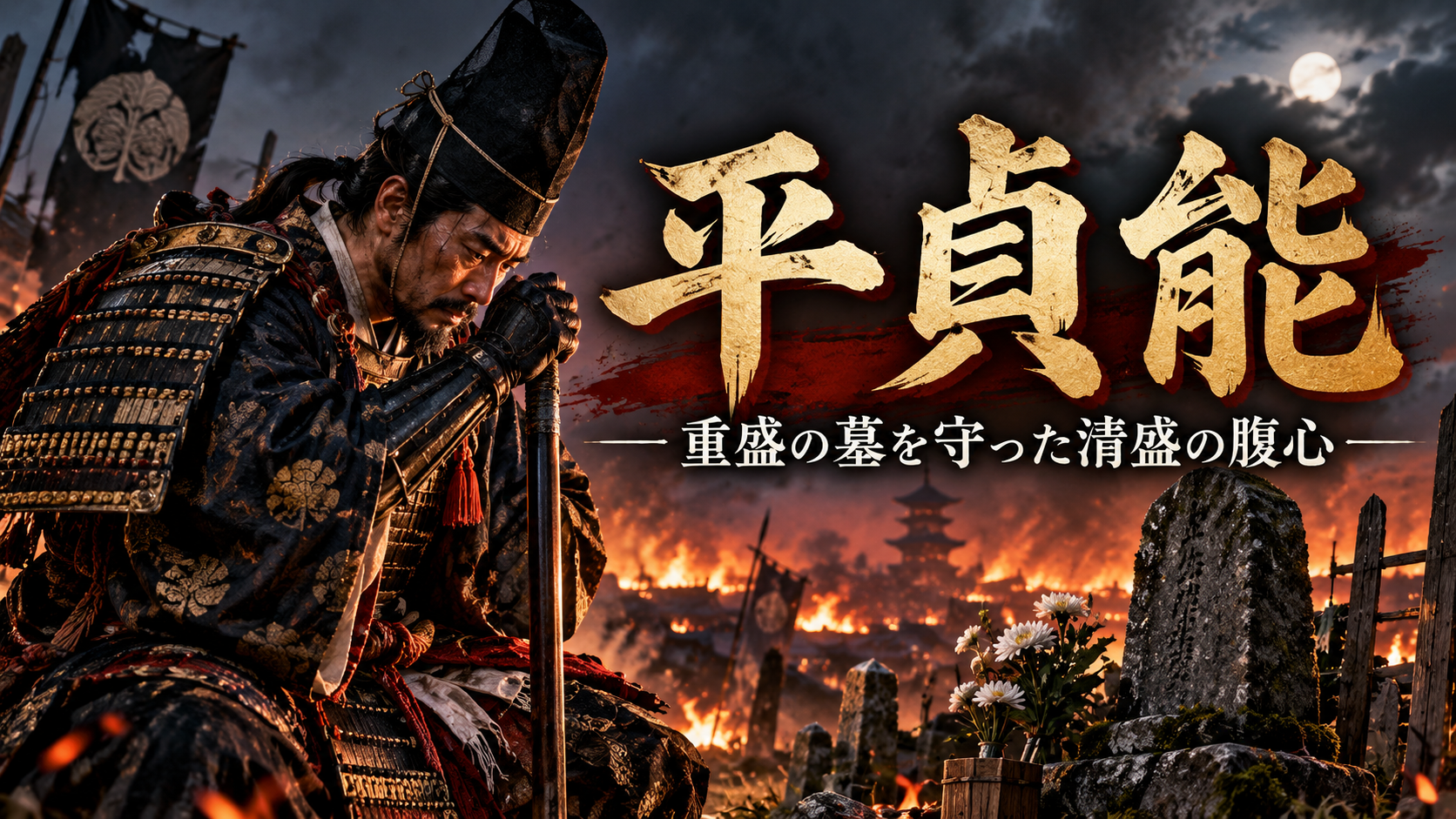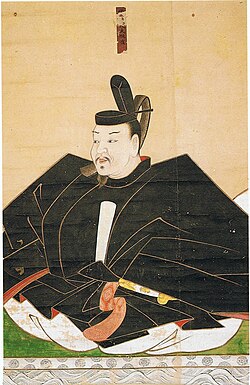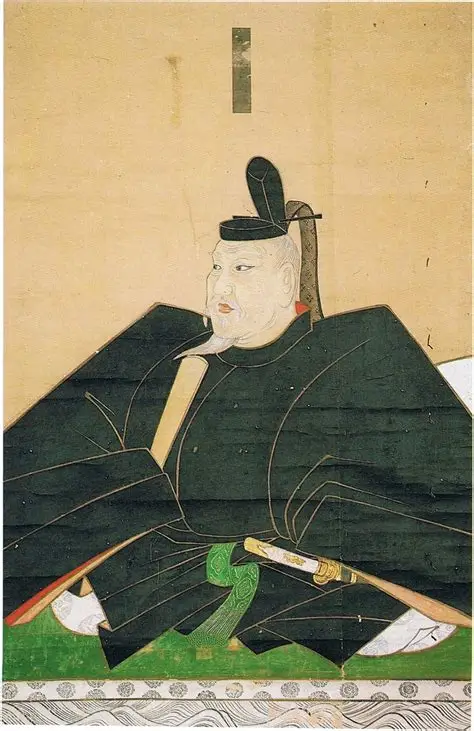
On March 24, 1185, at Dan-no-ura.
The Genji fleet was closing in, and the defeat of the Taira was inevitable.
Emperor Antoku, held by his grandmother Nii-no-Ama, entered the sea, followed by the members of the Taira clan one after another.
Among them were two brothers.
Taira no Tsunemori and Taira no Norimori.
Both were younger brothers of Kiyomori.
According to the “Tale of the Heike,” Volume Eleven, “The Final Moments of Lord Noto,” the two brothers carried anchors on their armor and, holding each other’s hands, leapt into the sea.
The younger brother, Norimori, was 58 years old.
He had once served as a middle counselor at the imperial court and was known as “Kadowaki Chūnagon” because he had a residence near the main gate of Rokuhara.
In the previous year at Ichinotani, he had lost his eldest son, Michimori, and his third son, Narimori.
News had also reached him that his second son, Noritsune, had died in battle.
His elder brother, Tsunemori, had also lost his sons at Ichinotani.
Even after the Taira were driven from Kyoto, the two brothers stayed with their clan, ultimately reaching Dan-no-ura.
Norimori had previously pleaded desperately with Kiyomori to protect his family’s lives.
The Shishigatani Incident of 1177.
Norimori’s son-in-law was captured as one of those plotting to overthrow the Taira.
At that time, “The Tale of the Heike” recounts that Norimori pleaded so fervently with his elder brother, whom he had served for many years, that he even spoke of becoming a monk.
Born as Kiyomori’s Brother
Taira no Norimori was born in 1128, the son of Taira no Tadamori.
His mother was a lady-in-waiting who served at the court of Empress Dowager Taikenmon-in and was said to be the daughter of Fujiwara no Ietaka.
He was a half-brother to Kiyomori, having a different mother.
Their father, Tadamori, served Emperor Shirakawa and Emperor Toba, gaining status at court through military and security duties.
Tadamori had several sons, including Kiyomori, Iemori, Tsunemori, Norimori, Yorimori, and Tadanori.
After Kiyomori became the head of the Taira, his brothers also secured positions at court, supporting the clan.
Norimori was appointed to the lower fifth rank in 1148.
He served as a chamberlain and later held various provincial governorships.
He was also active as an official of the retired Emperor Go-Shirakawa, maintaining close ties with the court.
In 1156, the Hogen Rebellion erupted due to the conflict between the retired Emperor Sutoku and Emperor Go-Shirakawa.
Taira no Kiyomori joined forces with Emperor Go-Shirakawa and, alongside Minamoto no Yoshitomo and others, defeated the forces of the retired Emperor Sutoku.
Taira no Norimori fought alongside his brother and was appointed to the position of Samanokami after the battle.
In the following year, Heiji 1 (1159), Fujiwara no Nobuyori and Minamoto no Yoshitomo raised an army.
Kiyomori, who was on a pilgrimage to Kumano, hurried back to Kyoto and launched a counterattack from his base at Rokuhara.
The “Heiji Monogatari” depicts Norimori setting out to battle alongside Shigemori and Yorimori.
The Taira forces defeated Yoshitomo and his allies, and Yoshitomo was killed while fleeing to the eastern provinces.
As Kiyomori’s influence at the court grew, Norimori also accumulated official positions.
However, two years after the Heiji Rebellion, he lost his position due to a dispute over imperial succession.
The Rise of Prince Norihito and Dismissal
Oho 1 (1161).
Amidst ongoing tensions between Emperor Nijo and the retired Emperor Go-Shirakawa, there was a controversial move to establish Prince Norihito, a son of Go-Shirakawa, as Crown Prince.
This prince would later become Emperor Takakura.
Involved in this movement, Taira no Tokitada and others were punished, and Norimori was stripped of his office.
Norimori, who had been serving as an official for the retired Emperor Go-Shirakawa, was caught up in the political conflict over the imperial succession.
However, in the following year, Oho 2 (1162), he was reinstated and appointed as Kurando.
He continued to advance in rank thereafter.
In Nin’an 3 (1168), when Prince Norihito ascended as Emperor Takakura, Norimori became a councilor and was awarded the rank of Senior Third Rank.
Having served as a close associate of the retired Emperor Go-Shirakawa, Norimori joined the ranks of the court nobility.
Furthermore, in Yowa 1 (1181), he was promoted to Provisional Middle Counselor, and in Juei 2 (1183), to Middle Counselor.
Norimori’s residence was located near the main gate of Rokuhara, the Taira clan’s stronghold.
As a result, he was known as “Monwaki-dono,” and after becoming a councilor, he was referred to as Monwaki Saisho, and later as Monwaki Chuunagon.
With Kiyomori rising to the position of Grand Minister of State and Shigemori becoming the Minister of the Interior, the Taira clan occupied key positions in the court.
Norimori, as part of this clan, was deeply involved in court politics for an extended period.
In the first year of the Jisho era (1177), Norimori found himself in a difficult position between his brother, Kiyomori, and his own family.
His son-in-law had been arrested on suspicion of treason.
The Shishigatani Incident—The Arrest of the Son-in-law
June of the first year of the Jisho era.
Close associates of Retired Emperor Go-Shirakawa were arrested for plotting to overthrow the Taira clan.
This was the Shishigatani Incident.
Fujiwara no Narichika, Saiko, Shunkan, and Taira no Yasuyori were implicated, and it is said that the plot was exposed by the informant Tada no Yukitsuna.
Kiyomori ordered the arrest of those involved.
Saiko was executed, and Fujiwara no Narichika was captured and later killed in Bizen Province.
Fujiwara no Naritsune was Narichika’s son.
Known as the “Lieutenant of Tanba,” Naritsune was married to Norimori’s daughter.
The second volume of “The Tale of the Heike,” “The Petition of the Lieutenant,” details Naritsune’s arrest.
Naritsune was on duty at Retired Emperor Go-Shirakawa’s palace.
There, a messenger from Norimori appeared.
Kiyomori had ordered him to report to the residence at Nishi-Hachijo.
Upon learning of his father Narichika’s arrest, Naritsune realized he too would be charged with the same crime.
Returning to Norimori’s residence, Naritsune bid a sorrowful farewell to his wife.
His wife was pregnant.
Naritsune worried about his unborn child and expressed his wish that if he were to die, his father Narichika’s soul would also be prayed for.
Afterward, Norimori accompanied Naritsune to Kiyomori’s residence at Nishi-Hachijo.
However, Kiyomori did not even allow Naritsune to enter the residence.
Naritsune was made to wait outside while only Norimori was permitted to enter.
Yet, Kiyomori refused to meet Norimori directly.
“If My Plea Is Denied, I Will Take Vows”
Norimori pleaded through a messenger for Naritsune’s life to be spared.
He asked for Naritsune to be entrusted to him.
He assured that as long as he was responsible, Naritsune would not act independently.
Norimori made this appeal.
However, Kiyomori’s anger was intense.
Since Narichika had plotted to overthrow the Taira clan, his son could not be easily forgiven.
According to “The Tale of the Heike,” Kiyomori rebuked Norimori, saying that if Narichika’s plot had succeeded, Norimori himself would not have been safe.
Even so, Norimori did not back down.
He recounted how he had fought alongside his brother since the Heiji Rebellion, and begged for Naritsune’s life to be spared in recognition of his past service.
He declared that if his plea was not granted, he would renounce the world and become a monk.
Kiyomori was taken aback and, conceding to the request, ordered that Naritsune be temporarily placed under Norimori’s care.
Norimori was finally able to bring his son-in-law back home.
However, this did not mean that Naritsune was pardoned.
Naritsune, along with Taira no Yasuyori and Shunkan, was sentenced to exile on Kikaigashima Island.
Norimori’s plea to save his son-in-law’s life managed to avert immediate execution, but it was not enough to overturn the sentence of exile.
Naritsune’s Return from Kikaigashima
In the second year of Jisho (1178).
Kiyomori’s daughter, Tokuko, who had become the consort of Emperor Takakura, was pregnant.
In hopes of a safe birth for the imperial prince, a pardon was issued, and Norimori sought Naritsune’s return to the capital.
The “Tale of the Heike” recounts that with the intercession of Shigemori and others, Kiyomori granted clemency to Naritsune and Taira no Yasuyori.
However, Shunkan was not pardoned.
Of the three exiled to Kikaigashima, only Naritsune and Yasuyori were allowed to return.
The “Tale of the Heike” depicts a scene where Shunkan, left behind by the departing ship, clings desperately and cries out on the shore.
Naritsune returned to Kyoto via Kyushu.
It is said that he also stopped by the Kagase Manor in Hizen Province, which was associated with Norimori.
He was then reunited with his wife in Kyoto.
More than a year had passed since the discovery of the Shishigatani Incident.
Norimori had finally managed to retrieve his son-in-law, who had been captured by Kiyomori.
However, the situation surrounding the Taira clan was deteriorating.
In the third year of Jisho (1179), Kiyomori led his forces into Kyoto and imprisoned Emperor Go-Shirakawa.
The following year, in the fourth year of Jisho (1180), Prince Mochihito raised an army.
The conflict between the Taira and Minamoto clans spread across the land.
Kiyomori’s Death and His Sons’ Campaign
In May of the fourth year of Jisho, Prince Mochihito and Minamoto no Yorimasa raised an army at Uji.
The Taira forces defeated them, but the anti-Taira movements did not subside.
In August, Minamoto no Yoritomo raised an army in Izu.
In the Hokuriku region, Minamoto no Yoshinaka (Kiso Yoshinaka) expanded his influence, and warriors across the country began to rebel against the Taira.
In the intercalary month of February 1181, Taira no Kiyomori passed away.
He was 64 years old.
The leadership of the Taira clan shifted to Taira no Munemori.
Taira no Norimori, along with his brother Taira no Tsunemori and others, supported Munemori, involving themselves in the defense of Kyoto and the clan’s military activities.
At that time, Norimori’s sons were also fighting in various regions.
His eldest son, Taira no Michimori, served as the governor of Echizen and fought against the forces of Minamoto no Yoshinaka in the Hokuriku region.
His second son, Taira no Noritsune, was known as the governor of Noto and is depicted as a master archer in “The Tale of the Heike.”
His third son, Taira no Narimori, also went to the battlefield as a Taira general.
Norimori had long been involved in the administration of the court as an official and noble.
His sons were sent to the front lines in the battles against the Minamoto clan.
In May 1183, the Taira’s punitive forces suffered a major defeat against Minamoto no Yoshinaka at the Battle of Kurikara Pass.
They were also defeated in the subsequent Battle of Shinohara, and Yoshinaka’s forces advanced towards Kyoto.
In July, Munemori decided to leave the capital, taking Emperor Antoku and the Imperial Regalia with him.
Norimori also headed west with his sons.
They abandoned their residence near the main gate of Rokuhara and left Kyoto, where they had lived for a long time.
Victory at Muroyama and the Advance to Fukuhara
After leaving the capital, the Taira sought to regroup in Kyushu.
However, they faced resistance from Ogata Koreyoshi and others in Bungo Province, forcing them to leave Dazaifu.
Subsequently, the clan established a base on Yashima in Sanuki Province.
In the intercalary month of October 1183, the Taira forces defeated the troops of Minamoto no Yoshinaka at Mizushima in Bitchu Province.
In November, they engaged the forces of Minamoto no Yukie at Muroyama in Harima Province.
Yukie, who was in conflict with Yoshinaka, was independently leading his forces towards the west.
According to “The Rise and Fall of the Genpei,” the Taira army set up five camps, with Norimori holding a large force in reserve at the rear.
The front camps feigned retreat to lure in Yukie’s forces, then engaged them at Norimori’s camp.
The front units then returned, encircling and defeating Yukie’s forces.
While the details of the battle and the number of troops are based on war tales, it is known that the Taira army achieved victory over Minamoto no Yukie at Muroyama.
Norimori is also remembered as a commander who participated in this battle.
The Taira clan regained their strength in the western provinces and eventually advanced as far as Fukuhara in Settsu Province.
This was the land where Kiyomori once attempted to establish the capital.
Meanwhile, in Kyoto, the forces of Minamoto no Noriyori and Minamoto no Yoshitsune had defeated Minamoto no Yoshinaka (Kiso Yoshinaka) and were moving to pursue the Taira.
The Taira, having advanced to Fukuhara, were once again facing a decisive battle with the Minamoto.
Norimori Declines the Role of Dainagon
February, 1184.
The Taira, with Emperor Antoku in their care, had set up camp around Fukuhara.
Even after losing Kyoto, it is said that appointments and promotions continued under Emperor Antoku.
According to records based on “The Tale of the Heike” and “The Rise and Fall of the Genpei,” Norimori was appointed as Dainagon with the rank of Senior Second Rank at this time.
However, Norimori declined the position.
There is a poem said to have been composed by him on this occasion.
“Even until today, do I think it is real?
In a dream, I dream again.”
Is it possible that I still believe my existence until today is real?
It feels as if I am dreaming within a dream.
Norimori had risen through the ranks under Kiyomori, advancing to Sangi and then to Chunagon.
But now, he had been driven from the capital and was about to be attacked by the Minamoto forces.
Yet, in Fukuhara, he was newly appointed as Dainagon.
The later historical work “Dai Nihonshi” also records this declination and poem based on the war tales.
However, the exact procedures of the appointment and whether Norimori composed the poem on the spot cannot be confirmed from contemporary records.
The story of Norimori declining the honor after losing the capital was passed down through the ages.
Then, on February 7th.
The forces of Minamoto no Noriyori and Minamoto no Yoshitsune launched an attack on the Taira’s encampment.
Ichi-no-Tani: Losing Two Sons
February 7, 1184.
The Genji forces attacked the Taira army, which was stationed from the Ikuta Forest to Ichi-no-Tani in Settsu Province.
The Taira defended at various locations, but their lines were broken by the Genji’s assault.
Many nobles were killed, and the clan suffered significant losses.
Norimori’s eldest son, Michimori, also perished in the battle.
Michimori had fought against Minamoto no Yoshinaka (Kiso Yoshinaka) in the Hokuriku region as the Governor of Echizen and continued to lead the Taira forces after moving to the western provinces.
According to “The Tale of the Heike,” he was surrounded and killed near Minatogawa.
Norimori’s third son, Narimori, also lost his life in this battle.
Known as Kurando no Daibu, “The Rise and Fall of the Genpei” records that Narimori died at the age of 17.
Michimori and Narimori.
In one day of fighting, Norimori lost two sons.
Moreover, tragedy also struck Michimori’s wife.
She was Kozaisho no Tsubone, a lady-in-waiting serving Empress Dowager Jōsei.
According to the “Tale of the Heike,” Taira no Michimori harbored feelings for Kozaisho no Tsubone for a long time, sending her love letters for three years before they finally became a couple.
When the capital fell, Kozaisho no Tsubone followed Michimori, and it is said that by the time the Battle of Ichi-no-Tani began, she was pregnant.
However, Michimori did not return.
Informed of her husband’s death in battle by their retainer, Kimida Takiguchi Tokiin, Kozaisho no Tsubone was overwhelmed with grief aboard a ship.
Her wet nurse tried to persuade her to reconsider, but she remained resolute in her decision to follow her husband in death.
The “Tale of the Heike” recounts that a few days after Michimori’s death, Kozaisho no Tsubone threw herself into the sea at night.
The detailed account of Michimori and Kozaisho no Tsubone’s story is derived from war tales and cannot be confirmed as historical fact, especially regarding conversations and the circumstances of her drowning.
Nonetheless, for the family of Taira no Norimori, the defeat at Ichi-no-Tani was undoubtedly a significant loss.
Their eldest son, Michimori, and third son, Narimori, were killed in battle, and Michimori’s wife was said to have drowned in the sea.
Furthermore, there was also news of the death of their second son, Taira no Noritsune.
Was the Second Son, Taira no Noritsune, Alive?
During the Battle of Ichi-no-Tani, records indicate that Taira no Norimori’s second son, Taira no Noritsune, was also killed.
The “Azuma Kagami” notes the death of Noritsune, stating that his head was sent to Kyoto.
However, on February 19, 1184, the diary “Gyokuyo” by Kujo Kanezane recorded a different report.
“It is said that Noritsune is certainly alive.”
Information had surfaced suggesting that Noritsune was indeed alive.
There are interpretative issues with this passage, but it can be read as a rumor indicating Noritsune’s survival.
In the “Tale of the Heike,” Noritsune is said to have survived Ichi-no-Tani and continued to fight as a Taira general.
At Yashima, he is depicted as shooting arrows at Minamoto no Yoshitsune and killing Sato Tsugunobu.
At Dan-no-ura, he is said to have pursued Yoshitsune and ultimately dragged a Genji warrior into the sea with him.
These exploits are depicted in war tales and do not align with the “Azuma Kagami” records of his death.
Was Noritsune killed at Ichi-no-Tani, or did he survive to fight at Dan-no-ura?
The accounts differ depending on the sources.
There is no record of how Norimori himself received this news.
However, even after losing Michimori and Narimori at Ichi-no-Tani, Norimori continued to act alongside his clan.
After losing Fukuhara, the Taira retreated once more to Yashima.
From Yashima to Dan-no-ura
Following the defeat at Ichi-no-Tani, the Taira attempted to regain their strength from their base at Yashima in Sanuki Province.
However, in February of Genryaku 2 (1185), Minamoto no Yoshitsune’s forces crossed over to Shikoku and launched an attack on Yashima.
The Taira retreated to the sea, losing Yashima in the process.
Afterwards, the clan moved towards Hikoshima in Nagato Province.
Norimori, along with Munemori and Tomomori, headed west.
In Kyoto, under the influence of Retired Emperor Go-Shirakawa, the Minamoto’s power was growing, and even in the western provinces, the number of samurai loyal to the Taira was dwindling.
The clan, carrying Emperor Antoku and the Imperial Regalia, pinned their hopes on a decisive battle at sea.
March 24th.
At Dan-no-ura in Nagato Province, the fleets of the Minamoto and the Taira clashed fiercely.
The Taira engaged in battle at sea, but soon faced the Minamoto’s onslaught, losing control of their warships one after another.
As the outcome became clear, members of the clan began to throw themselves into the sea.
According to the ‘Tale of the Heike,’ Nii no Ama took Emperor Antoku in her arms and entered the sea.
It is said that Kenreimon-in Tokuko also attempted to drown herself but was pulled up by the Minamoto forces.
Norimori met his end at Dan-no-ura alongside his brother Tsunemori.
Hand in Hand with His Brother Tsunemori into the Sea
Taira no Tsunemori was Norimori’s elder brother.
Both brothers, as siblings of Kiyomori, had supported the expansion of the Taira clan’s power.
Tsunemori also lost many sons at Ichi-no-Tani.
His eldest son, Tsunemasa.
Tsunetoshi.
And Atsumori, who is said to have been slain by Kumagai Naozane.
All of them perished at Ichi-no-Tani.
Norimori also lost his eldest son, Michimori, and his third son, Narimori.
The brothers continued to act with the Taira even after sending their sons to the battlefield and witnessing their deaths.
And then came Dan-no-ura.
The ‘Tale of the Heike,’ Volume Eleven, “The Final Moments of the Lord of Noto,” describes their end as follows:
“Kadowaki’s Taira Middle Counselor Norimori, and Shuuri Daibu Tsunemori, the brothers, bore anchors on their armor, clasped each other’s hands, and entered the sea together.”
Norimori and Tsunemori carried heavy anchors on their armor.
They held each other’s hands and threw themselves into the sea.
Norimori was 58 years old.
Tsunemori, older than Norimori, had also supported the Taira clan as Kiyomori’s brother.
He followed the clan to the western provinces during their retreat from the capital, lost his sons at Ichi-no-Tani, and finally reached Dan-no-ura.
The ‘Tale of the Heike’ depicts the two brothers clasping hands and sinking into the sea together in their final moments.
However, there are differing records regarding Norimori’s end.
While the ‘Azuma Kagami’ mentions his drowning, other sources like the ‘Daigoji Zatsujiki’ suggest he committed suicide.
The “Dai Nihonshi” also introduces both figures but refrains from making a definitive judgment about the details of their deaths.
While it is reported that Taira no Norimori lost his life at Dan-no-ura, pinpointing the exact circumstances of his final moments is challenging.
Nevertheless, the scene of him sinking into the sea hand in hand with his brother Taira no Tsunemori remains an evocative passage in the “Tale of the Heike,” marking the fall of the Taira clan.
The Final Days of the Gate-side Middle Counselor
In the third year of the Daiji era (1128), when Taira no Norimori was born, his father Taira no Tadamori was expanding his influence at the imperial court.
Norimori followed Taira no Kiyomori in the Hogen and Heiji Rebellions, later serving as a court official and provincial governor, and rising from councilor to middle counselor.
He established his residence near the main gate of Rokuhara and was known as the Gate-side Middle Counselor.
During the Shishigatani Incident in the first year of the Jisho era, his son-in-law Fujiwara no Naritsune was captured.
Norimori pleaded with his brother Kiyomori for clemency, even going so far as to say he would become a monk if his plea was not granted.
After Kiyomori’s death, Norimori supported Munemori, sending his sons to fight against the Minamoto clan.
His eldest son, Taira no Michimori, fought Minamoto no Yoshinaka in the Hokuriku region and led the Taira forces in the west.
His second son, Taira no Noritsune, was renowned as an expert archer, with legends of his death at Ichi-no-Tani and survival until Dan-no-ura.
His third son, Taira no Narimori, also went to battle at Ichi-no-Tani.
On February 7, 1184, Michimori and Narimori were killed in battle.
It is said that Michimori’s wife, Kozaisho no Tsubone, followed her husband into the sea.
Norimori continued to follow his clan, moving from Yashima to Nagato Province.
Then, on March 24, 1185, the Taira were defeated at Dan-no-ura.
His brother Tsunemori had also lost his sons at Ichi-no-Tani.
The “Tale of the Heike” records that Norimori and Tsunemori, with anchors on their armor, joined hands and entered the sea.
During the Shishigatani Incident, Norimori had pleaded with Kiyomori to save his son-in-law, even threatening to become a monk.
Eight years later, he lost his sons and joined his brother Tsunemori in the Taira’s final battle.
One year and eight months after the fall from the capital.
The man once known as the Gate-side Middle Counselor near the main gate of Rokuhara is said to have joined hands with his brother and sunk into the sea at Dan-no-ura.