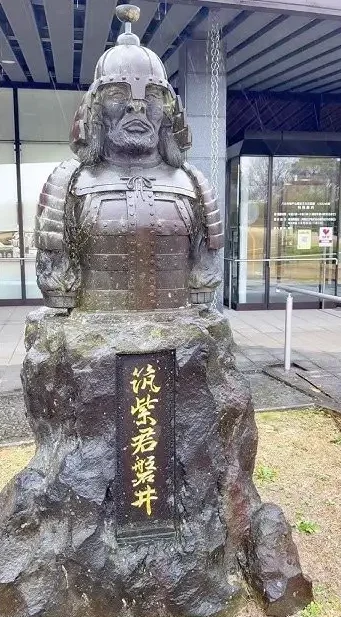
Yoshida, Yame City, Fukuoka Prefecture.
In a corner of the Yame Hills, there remains a colossal ancient burial mound over 170 meters in length.
This is the Iwatoyama Kofun.
The mound itself measures approximately 135 meters. The diameter of the rear circular section is about 80 meters, and the width of the front square section reaches about 92 meters. As a keyhole-shaped burial mound constructed in the early 6th century, it is the largest of its kind in northern Kyushu.
Additionally, on the northeast side of the mound, there is a rectangular area called the “Separate District,” measuring about 43 meters on each side.
The surviving texts of the “Chikugo no Kuni Fudoki” mention that stone figures and stone shields were lined up around the tomb, and stone statues depicting a court scene were placed in the Separate District.
The person believed to be the occupant of this massive tomb is Tsukushi no Kimi Iwai.
In the early 6th century, he was a powerful figure centered in Tsukushi, exerting significant influence over northern Kyushu.
In 527, Iwai clashed with the Yamato court.
The “Nihon Shoki” records this as a “rebellion.”
The general sent by the Yamato court was Mononobe no Arakahi.
The conflict continued into the following year, 528, culminating in a fierce battle between the two armies in the Miigun district of Tsukushi.
This is known as the Iwai Rebellion.
The Great Clan of Tsukushi in the 6th Century
The year of Iwai’s birth is unknown.
There are no records of his parents or his early life.
By the time he appears in historical records, he was already a prominent leader representing Tsukushi.
The “Nihon Shoki” refers to him as “Tsukushi no Kuni no Miyatsuko Iwai.”
The “Kojiki” calls him “Tsukushi no Kimi Iwai.”
The surviving texts of the “Chikugo no Kuni Fudoki” refer to him as “Tsukushi no Kimi Iwai.”
Today, he is commonly known as “Tsukushi no Kimi Iwai.”
Tsukushi is close to the Korean Peninsula.
From Hakata Bay, one can sail to the sea, passing through Iki and Tsushima, to reach the southern part of the Korean Peninsula.
It was a gateway for people, goods, and technology coming from the continent and the Korean Peninsula.
The Tsukushi clan had established a significant power base in northern Kyushu.
The legacy of Iwai’s power is still conveyed today by the cluster of burial mounds in the Yame Hills.
The Iwatoyama Kofun is not isolated.
Over 300 burial mounds have been identified in the Yame Hills, with large keyhole-shaped mounds constructed before and after the Iwatoyama Kofun.
Among them, the Iwatoyama Kofun stands out for its size.
The mound is approximately 135 meters long.
It is the largest keyhole-shaped burial mound in northern Kyushu.
The mound was adorned with numerous stone products characteristic of northern Kyushu, such as stone figures, stone horses, and stone shields.
The surviving texts of the “Chikugo no Kuni Fudoki” also mention that 60 stone figures and 60 stone shields were arranged around the tomb.
Given the scale of the burial mound, it is impossible to consider Iwai as merely a minor local chieftain ruling only a part of Tsukushi.
His influence extended beyond Tsukushi.
The “Nihon Shoki” records in a 527 entry that Iwai had established his power in the two provinces of “Hi” and “Toy.”
The region later known as Hizen and Higo.
Toyo refers to the area that would become Buzen and Bungo.
A vast area, spanning from the southern part of present-day Fukuoka Prefecture to the central region of Kyushu, was engulfed in conflict.
The Yamato Court and the Korean Peninsula
In the early 6th century, when Iwai appears in historical records, the Korean Peninsula was a battleground for Goguryeo, Baekje, Silla, and the Gaya confederation.
The Yamato court had long maintained relations with the southern part of the Korean Peninsula.
However, this situation underwent significant changes.
According to the Nihon Shoki, in the 6th year of Emperor Keitai’s reign (512), the Yamato court ceded four counties of Mimana to Baekje upon their request.
Furthermore, in 513, disputes arose over Kibun and Daesa.
Meanwhile, Silla was expanding its influence in the southern Korean Peninsula.
Under this pressure, the territory of the Gaya confederation gradually diminished.
In the 21st year of Emperor Keitai’s reign (527).
The Yamato court finally mobilized a large army.
In 527, Omi no Kenomaro Leads “60,000” to Kyushu
June 527.
According to the Nihon Shoki, Omi no Kenomaro led his forces towards the Korean Peninsula.
The recorded troop strength was,
60,000.
The objective was to restore the lost territories of South Gaya and Heguri, and return them to Mimana.
We must be cautious in taking the figure of 60,000 at face value.
Even considering the mobilization capacity of the early 6th century, it is an extraordinarily large number.
Nevertheless, the Nihon Shoki depicts this as a large-scale military operation, distinct from regular diplomatic missions.
Omi no Kenomaro’s forces advanced from the Kinai region to Kyushu, and from there, they were to cross the sea.
Their route passed through Tsukushi.
It was here that Iwai took action.
The Nihon Shoki records that Iwai had long been plotting rebellion, waiting for the right opportunity.
Furthermore, it states that Silla, aware of his intentions, secretly sent him treasures,
encouraging him to obstruct Omi no Kenomaro’s army.
This is the sequence of events as described by the Nihon Shoki regarding the rebellion.
There is no other contemporary source to confirm the transfer of treasures from Silla to Iwai.
The Nihon Shoki was completed in 720, roughly 200 years after Iwai’s rebellion, and was compiled from the perspective of the Yamato court.
Nevertheless, Iwai’s obstruction of Kenomaro’s forces was a pivotal event in understanding this conflict.
Iwai Blocked Kenomaro’s Army
According to the Nihon Shoki, Iwai extended his influence over the regions of Hi and Toyo.
He also diverted ships coming from Goguryeo, Baekje, Silla, and Mimana to his own base, disrupting tributes to the court.
Thus, he blocked the path of Omi no Kenomaro’s army heading to the Korean Peninsula.
To send a large army from the Kinai region to the Korean Peninsula, it was necessary to proceed westward through the Seto Inland Sea, pass through northern Kyushu, and then cross the sea.
If Iwai, a powerful figure in Tsukushi, controlled this route, the Keno army would not be able to advance to the Korean Peninsula as planned.
The Nihon Shoki even records the words Iwai spoke to Keno at this time.
Weren’t we once comrades who shared meals from the same pot?
Just because you have become an envoy, do you really think you can make me submit?
These were the sentiments expressed.
It’s hard to believe that the actual conversation was recorded verbatim.
However, it is intriguing that the Nihon Shoki portrays Iwai and Keno as individuals who were acquainted with each other from before.
The Keno army could not break through Tsukushi.
The plan to dispatch troops to the Korean Peninsula came to a halt.
The Yamato court decided to eliminate Iwai.
Who Will Emperor Keitai Send to Kyushu?
August 527.
Emperor Keitai ordered Otomo no Kanamura, Mononobe no Arakahi, and Kose no Otoko to select a general to defeat Iwai.
Otomo no Kanamura responded.
The one who can defeat Iwai is Mononobe no Arakahi.
Arakahi was a great chieftain of the Mononobe clan.
The Mononobe clan had strong ties to military affairs, and Arakahi himself was a central figure in the royal authority.
Emperor Keitai appointed Arakahi as the Grand General.
At this time, the Nihon Shoki records at length the orders Emperor Keitai gave to Arakahi.
“From Nagato eastward, I will govern. From Tsukushi westward, you shall govern.”
I will rule from Nagato eastward.
You are entrusted with everything from Tsukushi westward.
It further notes that Arakahi was given the authority to decide rewards and punishments on his own, without needing to report back to the court each time.
How much of this reflects the actual words from 527 is unknown.
Nevertheless, according to the Nihon Shoki, Arakahi went to Kyushu with significant authority to make military decisions on the ground.
The opponent was not just Iwai alone.
The Nihon Shoki itself states that Iwai held power in the two provinces of Hi and Toyo.
The Yamato court was to engage in battle with a force that encompassed a wide area of northern Kyushu.
The Battle Lasted Over a Year
Arakahi was appointed as the general in August 527.
The account of the decisive battle appears in November 528.
During this period, the Nihon Shoki provides little detail about the course of the fighting.
Which castles were attacked?
How many battles were fought?
How many troops did each side mobilize?
Where did Iwai establish his headquarters?
No specific records remain.
Therefore, it cannot be said that the forces of Iwai and Arakahi fought continuously for a year and three months.
However, in June 527, the path of the Keno army was blocked, and in August, the dispatch of Arakahi was decided, with the conflict extending until November 528.
It was not a brief skirmish.
The final battlefield was in the Miigun of Tsukushi.
This corresponds to the southern part of present-day Fukuoka Prefecture, in the Chikugo River basin.
November 528 — The Decisive Battle at Miigun
On November 11, in the 22nd year of Emperor Keitai (528).
The Nihon Shoki records that Mononobe no Arakahi and Iwai clashed in the Miigun of Tsukushi.
Here, at last, we find detailed descriptions of the battles of the Iwai Rebellion.
The two armies faced each other.
They were so close that their flags and drums were visible to each other.
As the soldiers moved, clouds of dust mingled in the air.
The Nihon Shoki describes the intensity of the battle in this way.
Neither side retreated until the outcome was decided.
For Arakahi, this was the decisive battle he had been preparing for since he was ordered to subdue the rebellion in August of the previous year.
For Iwai, a defeat here would mean losing the power he had built in Tsukushi.
The exact location of the battle within Miigun is not known.
The number of soldiers involved is also unclear.
There is no record of how cavalry and infantry were deployed or which side attacked first.
What remains is the description of a fierce, head-on clash between the two armies.
And the battle ended in victory for Arakahi’s forces.
The Nihon Shoki states,
Mononobe no Arakahi killed Iwai.
So it is written.
The conflict that began in 527 was resolved here.
However, there is another account of Iwai’s end.
Was Iwai Really Killed at Miigun?
According to the Nihon Shoki, Iwai was slain by Mononobe no Arakahi in the battle at Miigun.
The Kojiki, while differing in details, also records that Tsukushi no Kimi Iwai was killed by Mononobe no Arakahi and Otomo no Kanamura for disobeying the emperor’s orders.
In contrast, a different ending is conveyed in the lost passages of the Chikugo no Kuni Fudoki.
The imperial forces suddenly attacked.
Judging that he could not win, Iwai fled alone to the Kamitsukeno Province in Buzen, where he died in the rugged mountains to the south.
As a result, it is said that Iwai’s tomb contained no body.
In the Nihon Shoki, he died in battle.
In the Chikugo no Kuni Fudoki, he died after fleeing to Buzen.
Which account reflects Iwai’s true end cannot be determined from the current historical sources.
The importance of the Chikugo no Kuni Fudoki’s account lies in its specific description of Iwai’s tomb.
The tomb is believed to correspond to the present-day Iwatoyama Kofun.
The Tomb of Iwai with Stone Figures and Horses
According to a fragment of the ‘Chikugo no Kuni Fudoki’, Iwai’s tomb was located two ri south of Kamitsuma County.
The size of the tomb is also recorded.
60 jō from north to south.
40 jō from east to west.
Surrounded by rice paddies, the tomb was encircled by 60 stone figures and stone shields.
To the northeast of the tomb was an area called ‘Betsuku’.
The current Iwatoyama Kofun also has a square section about 43 meters on each side on the northeast of the mound.
Here, stone figures of people and animals were placed.
The ‘Chikugo no Kuni Fudoki’ mentions that there were stone statues depicting a trial scene in the Betsuku.
It depicted a person being judged for stealing a boar and attempting to atone for the crime with the stolen boar.
The size, location, and existence of the Betsuku in the Iwatoyama Kofun align well with the account in the ‘Chikugo no Kuni Fudoki’, leading to the belief that this kofun is the tomb of Tsukushi no Kimi Iwai.
Whether Iwai was actually buried in this tomb or not, archaeological evidence confirms that the Tsukushi no Kimi in the early 6th century had the power to construct the largest keyhole-shaped kofun in northern Kyushu.
Even after Iwai’s defeat, the Tsukushi no Kimi clan did not disappear.
The Offering of Kasuya Miko by His Son, Katsuko
The month following Iwai’s defeat.
December 528.
In the ‘Nihon Shoki’, Iwai’s son, Katsuko, appears.
Fearing execution for his father’s crimes, Katsuko
offered Kasuya Miko
to the Yamato court.
He hoped to avoid the death penalty by doing so.
Kasuya is the region connecting from the present-day Kasuya District in Fukuoka Prefecture to the eastern part of Fukuoka City, close to Hakata Bay.
It was a crucial location for heading from northern Kyushu to the Korean Peninsula.
Offering the miko in this region to the court held significant meaning in the post-war settlement.
Meanwhile, Katsuko himself was not executed.
In the Yame Hills, after the Iwatoyama Kofun, large kofun such as the Noriba Kofun, Zozuka Kofun, and Tsurumiyama Kofun continued to be constructed.
Armed stone figures have also been excavated from the Tsurumiyama Kofun.
Furthermore, about 150 years later, a person named ‘Tsukushi no Kimi Satsunoma’ appears in the ‘Nihon Shoki’.
Iwai’s defeat did not mean the extinction of the Tsukushi no Kimi clan.
The War Recorded as a “Rebellion” in the ‘Nihon Shoki’
The primary source detailing the Iwai Rebellion is the ‘Nihon Shoki’.
It portrays Iwai as someone who plotted rebellion from early on, received treasures from Silla, and obstructed the court’s forces.
It is important to remember that this historical account was compiled by the Yamato court about 200 years later.
The ‘Kojiki’ provides only a brief mention.
Due to Tsukushi no Kimi Iwai’s repeated disrespectful actions and refusal to obey the emperor’s orders, Mononobe no Arakahi and Otomo no Kanamura were dispatched to kill him.
In the fragments of the ‘Chronicles of Chikugo Province,’ Iwai’s final moments differ from those recorded in the ‘Nihon Shoki.’
With the limited historical records available, it is impossible to reconstruct Iwai’s motivations for fighting in his own words.
However, archaeological evidence suggests that the power of the Tsukushi no Kimi was significant.
The largest keyhole-shaped burial mound in northern Kyushu.
Large ancient tombs stretching across the Yame Hills.
A unique burial system using stone figures and stone horses.
And according to literature, their influence extended as far as Hi and Toyo.
In 527, it was the Tsukushi no Kimi, with such a strong foundation, who stood before the Omikeno army heading to the Korean Peninsula.
In November of the following year, 528, Iwai was defeated in the Battle of Miigun against Mononobe no Arakahi and vanished from historical records.
The Iwatoyama Kofun, believed to be his tomb, still stands in the Yame Hills today, approximately 1500 years later.
The burial mound is about 135 meters long.
Its size continues to convey the power of Tsukushi no Kimi Iwai, who stood against the Yamato authority for over a year.
📖For those who want to learn more

【Used】 Rekishi Kaido (November 2019 Issue) Monthly Magazine/PHP Institute
The tea bearing Iwai’s name☕↓
