The Age of the Fujiwara Began With This Man
When people talk about the political history of the Heian period, the name Fujiwara no Michinaga comes up almost immediately.
But roughly 150 years before Michinaga reached the height of his power,
one member of the Fujiwara clan had already begun shaping the very form of politics that would later become regency government.
That man was
Fujiwara no Yoshifusa.
Yoshifusa was born in the 23rd year of Enryaku (804) and died in the 14th year of Jogan (872).
He lived at a time when Heian-kyo had existed for only about eighty years.
The reorganization of the ritsuryo state that Emperor Kanmu had begun was still underway, as the throne passed from Emperor Saga to Emperor Ninmyo, Emperor Montoku, and Emperor Seiwa.
(See this article.)
At the court of this era, it was not only the imperial family but the Fujiwara, the Otomo, the Ki, the Tachibana, the Minamoto, and many other powerful clans who competed for control of politics.
In the midst of that, Yoshifusa became a maternal relative of the throne, rose to Daijo Daijin, and became the first man outside the imperial family to formally hold the office of sessho.
What matters even more is that Yoshifusa did not seize this enormous power single-handedly.
The foundation his father Fujiwara no Fuyutsugu had built.
His relationship with Emperor Saga. Marriage into the imperial family. A change of crown prince. The enthronement of a child emperor. The fall of powerful clans through political crises.
Each of these accumulated, one after another, until at last they came together in the political office of sessho.
This article traces that process.
1. Fujiwara no Yoshifusa’s Father Was Emperor Saga’s Close Attendant
Fujiwara no Yoshifusa’s father was Fujiwara no Fuyutsugu.
Fuyutsugu was the leading statesman of the Fujiwara Northern House in the early Heian period.
Especially important here is the Kusuko Incident.
(See this article.)
In 810, the conflict between the Retired Emperor Heizei and Emperor Saga broke into the open.
The retired emperor’s side had Fujiwara no Kusuko and her brother Nakanari; Emperor Saga’s side moved to counter them.
(See this article.)
Through this crisis, the Fujiwara Northern House rose sharply as Emperor Saga’s close attendants.
Fuyutsugu earned Emperor Saga’s deep trust and, as head of the Kurodo-dokoro, supported the emperor’s inner-circle government.
Yoshifusa was born as Fuyutsugu’s second son.
Which is to say, Yoshifusa’s life began as
the next generation of a Fujiwara Northern House that had grown powerful under Emperor Saga.
To understand Yoshifusa’s success, it is necessary first to look at the political foundation his father Fuyutsugu had built.
2. Married to an Imperial Princess at Eleven
One event stands out as especially important in Yoshifusa’s life.
His marriage to Emperor Saga’s own daughter, Princess Minamoto no Kiyohime.
(See this article.)
In the fifth year of Konin (814), Yoshifusa is said to have taken Kiyohime as his wife at the age of eleven.
Kiyohime was Emperor Saga’s daughter.
Which means Yoshifusa formed a direct connection to the imperial house while still a boy.
This says a great deal about the political structure of Heian aristocratic society.
For the Fujiwara clan, blood ties to the emperor carried real political weight.
And Yoshifusa would go on to draw even closer to the imperial house through several further marriage alliances beyond this one.
The bond formed here matters greatly for understanding the Fujiwara clan’s later strategy of becoming maternal relatives of the throne.
3. After His Father Fuyutsugu’s Death, Yoshifusa Carries the Northern House
In 826, his father Fuyutsugu died.
Yoshifusa was twenty-two.
Still young at this point.
But his rise afterward was remarkably fast.
After Emperor Ninmyo’s enthronement, Yoshifusa became head of the Kurodo-dokoro.
The Kurodo no To sat at the very core of the office that handled the emperor’s orders and confidential documents.
Which is to say, Yoshifusa entered a position handling political information at the emperor’s own side.
From there he rose:
Councillor. Provisional Middle Counselor. Major Counselor. Minister of the Right. Chancellor of the Realm.
climbing rank by rank.
And in the end, he became sessho.
Yoshifusa’s rise was never simply a matter of climbing the court ranks.
The very process by which he moved from the emperor’s close attendant to the highest office in the court shaped the later form of regency government itself.
4. His Sister, Fujiwara no Junshi, Becomes Emperor Ninmyo’s Consort
What raised Yoshifusa’s political power enormously was his sister.
His sister was Fujiwara no Junshi.
Junshi became Emperor Ninmyo’s consort.
And the son born of her and Emperor Ninmyo was
Prince Michiyasu.
The future Emperor Montoku.
Here Yoshifusa’s connection to the imperial house deepened all at once.
Yoshifusa himself had married Emperor Saga’s daughter.
His sister was Emperor Ninmyo’s consort.
And the son that sister bore would in time become emperor.
Which is to say, Yoshifusa stood in the position of
husband of Emperor Saga’s daughter, and uncle of Emperor Ninmyo’s son.
Within the Heian court, this was an extraordinarily strong political foundation.
5. 842 — the Death of the Retired Emperor Saga Shakes the Court
And then came the crisis that decisively changed the course of Yoshifusa’s political life.
The Jowa Incident of the ninth year of Jowa (842).
The reigning emperor at the time was Emperor Ninmyo.
The crown prince was Prince Tsunesada.
Prince Tsunesada was a son of Emperor Junna.
Meanwhile, Emperor Ninmyo had a son of his own — Yoshifusa’s nephew, Prince Michiyasu.
Two imperial lines stood in tension over the question of succession.
Emperor Saga’s line. And Emperor Junna’s line.
This underlying conflict lay behind the Jowa Incident.
In the seventh month of 842, the Retired Emperor Saga died.
Immediately afterward, Tomo no Kowamine, Tachibana no Hayanari, and others were punished on charges of plotting a conspiracy.
Prince Tsunesada, too, was removed as crown prince.
In the eighth month, Prince Michiyasu became crown prince.
Prince Michiyasu would later take the throne as Emperor Montoku.
The Jowa Incident dramatically redirected the course of imperial succession.
(See this article.)
6. Was the Jowa Incident “Fujiwara no Yoshifusa’s Plot”?
Anyone interested in history should hold onto this point.
The Jowa Incident is often explained in general accounts of Japanese history as
a crisis Fujiwara no Yoshifusa engineered in order to make his own nephew, Prince Michiyasu, crown prince.
And indeed, the outcome was extraordinarily favorable to Yoshifusa.
Prince Tsunesada removed as crown prince.
Tomo no Kowamine and Tachibana no Hayanari fallen from power.
And Yoshifusa’s own nephew, Prince Michiyasu, made crown prince.
Yoshifusa himself was promoted to Major Counselor.
But contemporary sources do not state outright that “Yoshifusa planned it all.”
What the Shoku Nihon Koki records is simply the course of events: the conspiracy of Tomo no Kowamine and others was discovered, and Prince Tsunesada was removed as a result.
Later scholarship, however, has built up a strong case for Yoshifusa’s involvement, based on the political process leading to Tsunesada’s removal and on where the interests lay.
Which is exactly what makes this incident so interesting.
The “incident” as the sources record it, and the “power struggle” that becomes visible through its political results, do not line up perfectly.
Through the Jowa Incident, Yoshifusa moved sharply closer to the center of imperial succession.
This fact is the key to understanding everything that followed for him.
7. Emperor Montoku’s Enthronement — Yoshifusa’s Nephew Becomes Emperor
850.
Emperor Ninmyo dies.
The crown prince, Prince Michiyasu, takes the throne.
Emperor Montoku.
For Yoshifusa, this was the moment his own nephew became emperor.
But Yoshifusa’s political strategy did not end here.
If anything, this was only the beginning.
Yoshifusa made his own daughter Emperor Montoku’s consort.
That woman was Fujiwara no Akirakeiko.
And in 850, Akirakeiko gave birth to a son.
The boy’s name was Prince Koreto.
The future Emperor Seiwa.
8. A Nine-Month-Old Prince Becomes Crown Prince
This event matters enormously for understanding imperial succession in the Heian period.
Prince Koreto became crown prince at just nine months old.
Startlingly early, by modern standards.
But this naming of the crown prince carried a clear political meaning.
Emperor Montoku already had an eldest son, Prince Koretaka.
His mother was Ki no Shizuko.
Prince Koreto’s mother, by contrast, was Fujiwara no Akirakeiko. His father was Emperor Montoku. His maternal grandfather was Fujiwara no Yoshifusa.
The one named crown prince was not the elder Prince Koretaka, but Prince Koreto, Yoshifusa’s own grandson through his daughter.
This decision would go on to determine the Fujiwara clan’s political dominance for a very long time.
Scholarship also argues that the father-to-son succession running from Ninmyo to Montoku to Seiwa created the conditions for a string of child emperors, which in turn led directly to a political structure in which a maternal relative supported each child emperor.
9. Tension Between Yoshifusa and Emperor Montoku
From here Yoshifusa becomes a more complicated figure.
Emperor Montoku had Prince Koretaka.
Prince Koretaka’s mother, Ki no Shizuko, came from the Ki clan.
Prince Koreto’s mother, meanwhile, was Fujiwara no Akirakeiko.
Her father was Yoshifusa.
Which means, in the contest over the crown prince,
there stood a prince whose mother came from the Ki clan and a prince whose mother came from the Fujiwara clan.
Later sources and scholarship suggest that Emperor Montoku wanted to name Prince Koretaka crown prince, and that this created tension between him and Yoshifusa.
But the details of this political process cannot be fully reconstructed from contemporary sources alone.
What can be confirmed with certainty is simply the result:
Prince Koreto became crown prince at nine months old, and later took the throne as Emperor Seiwa.
And through this result, Yoshifusa secured his path to becoming the emperor’s maternal grandfather.
10. 857 — the First Man Outside the Imperial Family to Become Chancellor
The first year of Tennan (857).
Yoshifusa is appointed Daijo Daijin, Chancellor of the Realm.
Another important point here.
Yoshifusa is considered the first man outside the imperial family to become Chancellor of the Realm during his own lifetime.
Daijo Daijin was the highest office in the ritsuryo system of government.
Yoshifusa had reached the very summit of the court.
The following year, 858, Emperor Montoku died.
The crown prince, Prince Koreto, took the throne.
Emperor Seiwa. He was nine years old.
Here a major shift took place in Japanese political history.
11. The Nine-Year-Old Emperor Seiwa and His Grandfather, Fujiwara no Yoshifusa
Emperor Seiwa’s mother was Fujiwara no Akirakeiko; her father was Fujiwara no Yoshifusa.
Which is to say, Yoshifusa had become the emperor’s maternal grandfather.
And on top of that, Yoshifusa was Chancellor of the Realm.
Here,
the political structure of a young emperor supported by his own maternal grandfather became a reality.
Even so, the terminology here needs to be handled carefully.
It is certain that Yoshifusa led the government from the moment Emperor Seiwa took the throne in 858, but care is needed before equating this directly with the later, formally established office of “sessho.”
According to the sources, the first time a man outside the imperial family was explicitly ordered to “govern the realm in the emperor’s place” was
in 866, in the midst of the Otenmon Incident.
This distinction matters a great deal for understanding Fujiwara no Yoshifusa closely.
12. A New Kind of Politics — the “Maternal Grandfather” Who Supported a Child Emperor
The greatest change to take place in Yoshifusa’s era was
a shift in the relationship between the emperor and the Fujiwara clan.
Under the ritsuryo system, the basic structure of government placed the emperor at the summit of the state, with the Daijokan handling affairs of state beneath him.
But Emperor Seiwa was nine years old.
A young emperor needed support.
And so Yoshifusa, both the emperor’s maternal grandfather and Chancellor of the Realm, took on the governing of state affairs.
Here, government by a maternal relative appears in a strong, unmistakable form.
Later generations of the Fujiwara clan would develop this arrangement even further.
Yoshifusa’s era was its first great stage.
13. 864 — Emperor Seiwa Comes of Age
In the sixth year of Jogan (864), Emperor Seiwa underwent his coming-of-age ceremony.
Yoshifusa is thought to have stepped back at this point from his political position guarding a child emperor.
But two years later, another great crisis struck.
The Otenmon Incident.
And through this crisis, Yoshifusa once again entered a position of governing in the emperor’s place.
14. 866 — the Main Gate of the Heian Palace Burns to the Ground
The eighth year of Jogan (866).
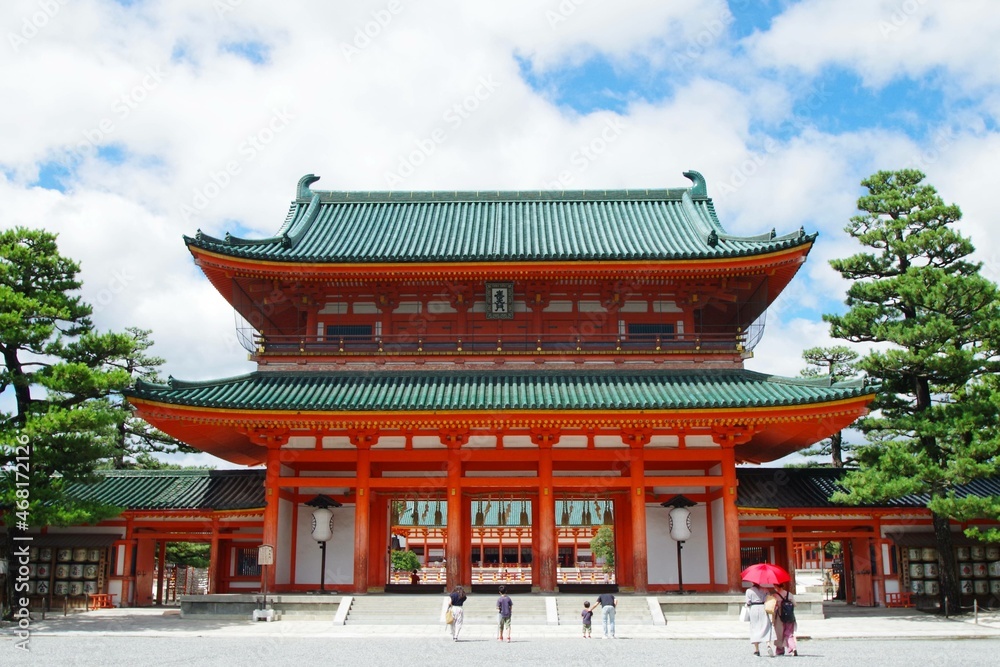
The Otenmon, standing at the Chodoin of the Heian Palace, went up in flames.
The Otenmon was the main gate of the Chodoin.
Which is to say, one of the most important structures at the very heart of the court.
This fire grew into a major political crisis.
The first man put in question was the Minister of the Left, Minamoto no Makoto.
The Minister of the Right, Fujiwara no Yoshimi, and the Major Counselor, Tomo no Yoshio, suspected Makoto of setting the fire.
But Yoshifusa spoke in Makoto’s defense.
Makoto escaped punishment.
But afterward, Oyake no Takatori accused Tomo no Yoshio and his son Nakayo of being the culprits.
The whole shape of the affair reversed at once.
In the end, Tomo no Yoshio and his allies were punished as the arsonists.
This whole chain of events became known as the Otenmon Incident.
15. Why Did Tomo no Yoshio Fall From Power?
Tomo no Yoshio was no minor provincial official.
He was a powerful court official who had risen all the way to Major Counselor.
Known as a man of considerable skill in both writing and administration.
And this same Tomo no Yoshio vanished from the central court through the Otenmon Incident.
Ki no Natsui and others were implicated and punished as well.
As a result, the political power of clans such as the Tomo and the Ki was pushed back dramatically.
Meanwhile, Yoshifusa’s own position was strengthened.
Out of this comes the view that “the Otenmon Incident was part of the Fujiwara Northern House’s campaign to remove rival clans.”
Even so, debate continues to this day over who actually set the fire.
The Nihon Sandai Jitsuroku records Tomo no Yoshio and his son as the culprits.
Later scholarship, however, looking at the circumstances of Oyake no Takatori’s accusation and the political situation that followed, has often raised doubts about the true culprit.
Which is to say, “Tomo no Yoshio was punished as the culprit”
can be confirmed as historical fact.
But no source proves “Yoshifusa ordered the arson.”
This distinction matters.
16. In the Midst of the Crisis, Yoshifusa Becomes Sessho
This is the most important point of the Otenmon Incident.
The 19th day of the 8th month, the eighth year of Jogan.
Yoshifusa received an imperial edict ordering him to “govern the realm in the emperor’s place.”
Through this, Yoshifusa formally became the first man outside the imperial family to hold the office of sessho.
This directly connects to the later system of regency government.
Which is to say, the Otenmon Incident was never simply an arson case.
Its historical significance lies in the fact that, in the midst of this political turmoil,
Fujiwara no Yoshifusa, the emperor’s own maternal grandfather, formally gained the position of governing in the emperor’s place.
17. Why Was a “Sessho” Needed at All?
Understanding this point makes Yoshifusa’s political significance clear all at once.
Emperor Seiwa had taken the throne as a young child.
Yoshifusa, as the man supporting him, already held enormous power.
But
handling state affairs as Chancellor of the Realm and governing in the emperor’s place as sessho were not the same thing.
The 866 edict formally institutionalized Yoshifusa’s political role in clear terms.
Scholarship holds that, after the Jowa Incident, succession within the line of Saga and Ninmyo became fixed, producing a run of child emperors through father-to-son succession, and that Yoshifusa’s role in supporting those child emperors as sessho became the prototype for the regency government that followed.
18. Immediately After the Otenmon Incident, Yoshifusa Moves Again
Once the Otenmon Incident was settled, Yoshifusa’s own clan grew even more prominent.
Yoshifusa had been grooming Fujiwara no Mototsune as his successor.
Mototsune was not Yoshifusa’s own son by blood.
He was a son of Yoshifusa’s older brother, Fujiwara no Nagayoshi, adopted by Yoshifusa.
This same Mototsune would go on to become a towering statesman who ran the Heian court.
After Yoshifusa’s death, he inherited that power. Yoshifusa’s political achievement did not end with his own generation.
He had even built the mechanism for passing that power on to the next generation.
This point matters a great deal.
19. Yoshifusa Was Also Involved in Compiling the Shoku Nihon Koki
Fujiwara no Yoshifusa had a side beyond politics.
He was also, in a sense, a man who recorded history.
Yoshifusa took part in compiling the Shoku Nihon Koki.
The Shoku Nihon Koki is the imperially commissioned national history recording the reign of Emperor Ninmyo.
Compilation began in 855 and was completed in 869.
But partway through this project, the Otenmon Incident occurred.
One of the compilers, Tomo no Yoshio, fell from power.
Fujiwara no Yoshimi also died.
As a result, the original editorial team collapsed, and in the end Fujiwara no Yoshifusa and Haruzumi no Yoshitada led the project to completion.
This is a remarkable detail.
Yoshifusa was also, in effect, the man recording the very era in which he himself stood at the center of politics.
When reading the political history of the early Heian period, it matters to consider the political circumstances in which the sources themselves were produced.
That the Shoku Nihon Koki is a valuable source, and that Yoshifusa himself took part in compiling it —
knowing just these two facts changes how the source itself should be read.
20. Yoshifusa’s Politics Cannot Be Explained by “Removing Rival Clans” Alone
It is easy to explain Fujiwara no Yoshifusa as “the man who pushed down other clans to build a Fujiwara world.”
And indeed, Tomo no Kowamine and Tachibana no Hayanari fell in the Jowa Incident, and Tomo no Yoshio and others were punished in the Otenmon Incident.
But that alone does not reveal the essence of who Yoshifusa really was.
Yoshifusa’s political strength lay in
the power to build relationships with the imperial house, more than the power to remove his rivals.
His father, Fuyutsugu.
His wife, Princess Minamoto no Kiyohime.
His sister, Fujiwara no Junshi.
His daughter, Fujiwara no Akirakeiko.
His nephew, Emperor Montoku.
His grandson through his daughter, Emperor Seiwa.
His adopted son, Fujiwara no Mototsune.
This web of relationships built Yoshifusa’s political foundation.
Power in the Heian period was never determined by official rank alone.
Whose blood you shared, whose maternal relative you became, whose successor you chose to support — these questions mattered enormously.
21. Yoshifusa’s Greatest Legacy
If Yoshifusa’s single greatest achievement had to be named, it would be
building the political structure that led to regency government.
Even so, the fully developed regency government of later ages was not completed in Yoshifusa’s own time.
What Yoshifusa built was its prototype.
The emperor.
↓
A young crown prince, then a child emperor.
↓
His maternal grandfather.
↓
Chancellor of the Realm.
↓
Sessho.
This structure was now established.
And the next generation, Fujiwara no Mototsune, inherited this same mechanism.
Mototsune would later stand at the center of politics as Kampaku, Chancellor-Advisor.
And after him would come Fujiwara no Tokihira, Fujiwara no Tadahira, Fujiwara no Kaneie, Fujiwara no Michinaga, and Fujiwara no Yorimichi.
Yoshifusa stands at the very start of that long lineage.
22. 872 — the Death of Fujiwara no Yoshifusa
The 14th year of Jogan (872).
Fujiwara no Yoshifusa died. He was sixty-nine.
After his death he was posthumously granted Senior First Rank and the posthumous title “Chuninko.”
And because he had been Emperor Seiwa’s own maternal grandfather, his grave, too, received special treatment.
After Yoshifusa’s death, his political foundation passed to his adopted son, Fujiwara no Mototsune.
Here, the life of one statesman came to an end.
But the political structure Yoshifusa had built did not end with him.
If anything,
this was where the Fujiwara clan’s full-scale regency government truly began.
23. “The Fujiwara World” Did Not Begin With Michinaga
Fujiwara no Michinaga is the figure who most represents power in the Heian period.
But the Fujiwara clan did not suddenly come to dominate politics in Michinaga’s own era.
Before him came Fujiwara no Fuyutsugu.
And Fujiwara no Yoshifusa.
And Fujiwara no Mototsune.
Yoshifusa pushed forward, in a major way, the mechanism by which the Fujiwara Northern House used marriage ties to the imperial family to raise its own political standing.
Reaching the summit that Michinaga occupied took generation after generation of accumulated groundwork.
Which is why understanding the Fujiwara clan of the Heian period means
not starting from Michinaga, but going all the way back to Yoshifusa.
This is the point that matters.
Summary
Fujiwara no Yoshifusa Was Not the “Perfecter” of Regency Government — He Was the Man Who Built Its Prototype
Fujiwara no Yoshifusa was born in 804 as the son of Fujiwara no Fuyutsugu.
He inherited the political foundation his father Fuyutsugu had built under Emperor Saga, and deepened his own ties to the imperial house.
He married Emperor Saga’s daughter, Princess Minamoto no Kiyohime, and his sister, Fujiwara no Junshi, became Emperor Ninmyo’s consort.
Her son became Emperor Montoku.
Yoshifusa’s own daughter, Fujiwara no Akirakeiko, then bore Emperor Montoku a son, Prince Koreto.
Prince Koreto became crown prince at nine months old, and took the throne as Emperor Seiwa at nine years old.
Yoshifusa became his maternal grandfather.
Then, in 866.
In the midst of the Otenmon Incident, Yoshifusa became the first man outside the imperial family to formally hold the office of sessho.
Here, the political structure of “a young emperor supported as sessho by his own maternal relative, the Fujiwara clan” came into being.
Later regency government would develop this structure even further.
Yoshifusa himself did not build the full flowering of regency government that Michinaga would later achieve.
But he did
open the path by which the Fujiwara clan became maternal relatives of the throne, guarded child emperors, and governed as sessho and kampaku.
Which is why Fujiwara no Yoshifusa was not simply
“one powerful man among the Fujiwara clan.”
He was a man who changed the very shape of Heian politics itself.
And Fujiwara no Mototsune, who inherited that power, would go on to reshape the relationship with the throne again, in his own way, different from Yoshifusa’s.
What awaits next is
the Ako Dispute and the enthronement of Emperor Uda.
And then Fujiwara no Mototsune and Sugawara no Michizane,
leading into a new age of politics.