March 28, 1584.
Tokugawa Ieyasu entered Mount Komaki in Owari Province.
Standing at approximately 86 meters, this mountain rises independently in the Nobi Plain. It was here, 21 years earlier, that Oda Nobunaga relocated his base from Kiyosu and built a castle.
About 5 kilometers north, in Gakuden, Hashiba (Toyotomi) Hideyoshi established his main camp.
It had been 1 year and 10 months since the Incident at Honnoji.
After defeating Shibata Katsuie in the previous year’s Battle of Shizugatake, Hideyoshi expanded his influence into Omi, Mino, and the Kinai region, positioning himself at the center of the former Oda regime.
Following the Incident at Honnoji, Ieyasu also emerged victorious from struggles over Kai and Shinano, establishing a vast domain that spanned from Mikawa, Totomi, and Suruga to Kai and Shinano.
Between the two stood Nobunaga’s second son, Oda Nobukatsu.
The Battle of Komaki and Nagakute was not a sudden clash between Hideyoshi and Ieyasu.
After Nobunaga’s death, the question arose: who would control the former Oda territories?
Amid this struggle, Hideyoshi and Nobukatsu fell out, leading Nobukatsu to ally with Ieyasu.
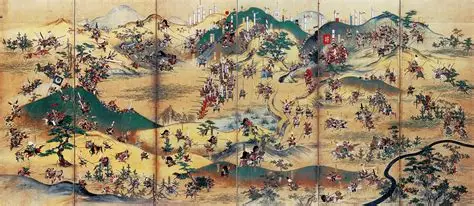
By the end of March, fortresses from both armies lined the area between Mount Komaki and Gakuden, with earthworks and moats stretching out.
Hideyoshi did not attack Mount Komaki.
Ieyasu did not descend from the mountain.
To break the stalemate, Hideyoshi’s forces eventually dispatched a large army east of Mount Komaki.
The target was Ieyasu’s base, Mikawa.
This strategy led to the Battle of Nagakute, where Hideyoshi’s army suffered significant losses of key commanders.
The Vast Domain Left to the Oda Clan After Nobunaga’s Death
June 2, 1582.
In Kyoto, at Honnoji, Oda Nobunaga was attacked by Akechi Mitsuhide and took his own life.
His heir, Nobutada, also perished after a battle at Nijo Palace.
Nobunaga and his intended successor, Nobutada, vanished on the same day.
Hashiba (Toyotomi) Hideyoshi, who was engaged in battle with the Mori clan at Takamatsu Castle in Bitchu, turned his forces around and defeated Akechi Mitsuhide at the Battle of Yamazaki on June 13.
At the subsequent Kiyosu Conference, Nobutada’s son, Sanposhi, was named the Oda clan’s successor.
He was still very young.
Nobunaga’s second son, Oda Nobukatsu, third son, Oda Nobutaka, Shibata Katsuie, Hashiba (Toyotomi) Hideyoshi, Niwa Nagahide, and Ikeda Tsuneoki,
each retained significant power, supporting the Oda territories.
This arrangement did not last even a year.
The rivalry between Hideyoshi and Shibata Katsuie intensified, leading Nobukatsu to side with Katsuie.
Nobuo aligned himself with Hideyoshi.
In April of 1583, during the Battle of Shizugatake, Katsuie was defeated and took his own life at Kitanosho Castle.
Nobukatsu was also cornered by his brother Nobuo and committed suicide in Noma, Chita District, Owari.
Within about a year of Nobunaga’s death, the power dynamics within the Oda clan had shifted significantly.
Akechi Mitsuhide was defeated and killed at Yamazaki. Shibata Katsuie took his life at Kitanosho, and Oda Nobukatsu also perished.
Amidst these events, Hideyoshi rapidly expanded his influence.
However, his relationship with Nobuo, who had been his ally, began to deteriorate.
The Break Between Oda Nobuo and Hideyoshi
Oda Nobuo, Nobunaga’s second son, was 27 years old at the time.
He was adopted into the Kitabatake family in Ise, playing a key role in Nobunaga’s control over the region.
After the Incident at Honnō-ji, he held territories centered around Kiyosu Castle, including Owari, Iga, and southern Ise.
Up until the Battle of Shizugatake, Nobuo and Hideyoshi maintained a cooperative relationship.
They stood together in the efforts to defeat Katsuie and corner Nobukatsu.
However, with Katsuie and Nobukatsu gone, their relationship quickly soured.
Hideyoshi strengthened his ties with various commanders within the former Oda territories, gaining significant influence over land distribution and diplomacy.
Former retainers of Nobunaga began to wield more political power than Nobuo, Nobunaga’s own son.
From the end of 1583 to the beginning of 1584, the conflict between the two became apparent.
Their split became official in March.
March 6: Nobuo Executes Three Senior Retainers
On March 6, 1584.
Nobuo executed three of his senior retainers.
Tsugawa Yoshifuyu.
Okada Shigetaka.
Asai Nagatoki.
He suspected them of colluding with Hideyoshi.
In response to Nobuo’s execution of the three retainers, Hideyoshi moved to subdue Nobuo.
Nobuo, preparing for conflict with Hideyoshi, allied himself with Tokugawa Ieyasu.
Ieyasu had been allied with Nobunaga for nearly 20 years, sharing numerous battlefields, including the fight against the Takeda clan.
Following the Incident at Honnō-ji, he had established a significant presence from the Tokai region to the Koshin area through conflicts over Kai and Shinano.
For Nobuo, who opposed Hideyoshi, there was no greater military ally than Ieyasu.
For Ieyasu, the expansion of Hideyoshi’s power was not something he could ignore.
As Hideyoshi consolidated the former Oda territories and extended his influence eastward, the Tokugawa lands lay directly in his path.
Supporting Nobukatsu, Nobunaga’s legitimate son, provided a political justification for opposing Hideyoshi.
March 8.
Ieyasu departed from Hamamatsu Castle.
He traveled through Okazaki, heading towards Owari.
By that time, the conflict had already begun to stir in Ise.
The First Battlefield Was Ise
Though known as the “Battle of Komaki and Nagakute,” the fighting was not confined to just those locations.
Armies moved across a broad area centered around Owari, Mino, and Ise, and as the war dragged on, forces from Kii, Hokuriku, Shikoku, and the Kanto region were also drawn into the conflict.
The initial movements occurred in Ise.
Nobukatsu held territories not only in Owari but also in Ise.
When Hideyoshi’s forces advanced into Ise, Nobukatsu and Ieyasu’s side dispatched part of their main force to counter them.
Skirmishes began around Kameyama Castle and Mine Castle, with Nobukatsu’s troops heading towards Ise.
Taking advantage of this distraction, Hideyoshi’s forces made their move in northern Owari.
March 13.
On the day Ieyasu entered Kiyosu Castle, Inuyama Castle was taken by surprise attack.
Ikeda Tsuneoki Captures Inuyama Castle
The assault on Inuyama Castle was led by Ikeda Tsuneoki and Mori Nagayoshi.
Ikeda Tsuneoki, known as Nobunaga’s milk brother, was a long-serving retainer of the Oda clan.
He had also participated in the Kiyosu Conference following the Incident at Honnoji.
Tsuneoki had now sided with Hideyoshi.
Inuyama Castle is located on the southern bank of the Kiso River.
To the north of the river lies Mino.
Moving south from there leads to Komaki, and beyond that is Nobukatsu’s stronghold, Kiyosu.
It was a crucial point for sending troops from Mino into Owari.
Nobukatsu’s commander, Nakagawa Sadanao, who was defending Inuyama Castle, had left for Ise, leaving the castle unguarded.
Tsuneoki and his forces seized this opportunity.
Inuyama Castle fell into the hands of Hideyoshi’s forces.
On the same March 13, Ieyasu entered Kiyosu Castle.
Inuyama, located about 20 kilometers north of Kiyosu, had fallen to the enemy.
If Hideyoshi’s forces moved south from there, they would approach Kiyosu via Komaki.
Ieyasu directed his troops towards northern Owari.
Mori Nagayoshi Advances to Haguro
March 17.
Mori Nagayoshi advanced south from Inuyama Castle and set up camp in Haguro.
This was in the area around present-day Haguro in Inuyama City, Aichi Prefecture.
Mori Nagayoshi was 27 years old.
Based at Mino Kanayama Castle, Mori Nagayoshi, who died at Honnoji as a page of Oda Nobunaga, was the brother of Mori Ranmaru.
He was related by marriage to Ikeda Tsuneoki.
From Haguro to Komakiyama is a distance of a little over ten kilometers.
If Mori’s forces moved further south, they would approach Kiyosu.
Upon learning that Mori Nagayoshi had advanced to Haguro, Ieyasu dispatched Sakai Tadatsugu and others.
It was here that the first major field battle of the Komaki-Nagakute Campaign took place.
The Battle of Haguro—Sakai Tadatsugu Repels Mori Nagayoshi
Sakai Tadatsugu was 58 years old.
He was 15 years older than Ieyasu and had served the Tokugawa clan since the era of the Matsudaira family.
Under Sakai’s leadership, Matsudaira Ietada and Okudaira Nobumasa advanced to Haguro.
The number of troops varies according to later military records.
One account suggests Mori’s forces numbered around 3,000, while the Tokugawa side had about 5,000.
On the morning of March 17, fighting broke out around Haguro.
Attacked by the Tokugawa forces, Mori’s army was defeated and retreated towards Inuyama.
Mori Nagayoshi himself survived and returned.
Although Ieyasu’s forces won the first significant field battle after the outbreak of hostilities, they did not recapture Inuyama Castle.
To the north lay Mino, and Hideyoshi’s main force was also advancing towards Owari.
Ieyasu chose not to attack Inuyama Castle and instead moved south.
On the following day, March 18, he ordered Sakakibara Yasumasa and others to renovate Komakiyama.
Ieyasu’s Choice of Komakiyama
Komakiyama stands at about 86 meters above sea level.
The elevation difference from the base is only about 60 meters.
Though not a steep mountain, its isolation in the Nobi Plain makes it easy to survey the surroundings.
The remains of a castle built by Nobunaga were still there.
In 1563, Nobunaga moved his base from Kiyosu to Komakiyama and constructed a castle on the mountain.
A planned castle town was also developed at the southern base.
Four years later, in 1567, after defeating Saito Tatsuoki of Mino, Nobunaga moved to Gifu, and Komakiyama Castle fell into disuse.
Seventeen years after its abandonment,
Ieyasu repurposed Nobunaga’s old castle as a military camp.
The construction that began on March 18 progressed rapidly, and by the 22nd, the main defensive structures were reportedly completed.
Current archaeological excavations also confirm traces of the extensive renovations Ieyasu undertook in preparation for the Komaki-Nagakute Campaign.
Earthen walls and moats were constructed at the base, and a defensive line was established mid-slope.
Komakiyama was transformed into a fortified camp with dual defensive lines at the base and mid-slope.
Ieyasu also established defensive outposts in the surrounding area.
On March 23, the Kanisimizu Fort, Kitaotoyama Fort, and Udatzu Fort were completed.
On the following day, the 24th, Obata Castle and Hira Castle were repaired.
Obata Castle is located southeast of Komakiyama, leading towards the Mikawa region.
Hira Castle was strategically located, connecting to the Kiyosu area.
By the 29th, the Dengaku Fort was also constructed, establishing a military road leading to Mount Komaki.
Tokugawa Ieyasu did not confine himself to Mount Komaki alone; instead, he linked surrounding castles and forts to create a defensive line.
While these fortifications were being developed, Hideyoshi’s main forces entered Owari.
March 28: Hideyoshi and Ieyasu Face Off at Komaki
Hideyoshi departed from Osaka on March 10.
He advanced through Ogaki into Owari, establishing his headquarters at Gakuden Castle on the 28th.
On the same day, Ieyasu also entered Mount Komaki.
The following day, Nobukatsu moved to Mount Komaki as well.
The distance from Gakuden to Mount Komaki is approximately 4.5 kilometers.
Hideyoshi’s forces were positioned from the north to the east of Mount Komaki.
Niju-bori Fort.
Iwasakiyama Fort.
Komatsujiyama Fort.
Aotsuka Fort.
Uchikubo Fort.
Ieyasu’s side also lined up forts centered around Mount Komaki.
In one corner of the Nobi Plain, two massive groups of fortifications faced each other.
The number of troops varied greatly depending on the sources and counting methods.
Records and estimates suggest Hideyoshi’s army ranged from tens of thousands to 100,000, while Nobukatsu and Ieyasu’s forces were estimated at several tens of thousands to tens of thousands, making it difficult to pinpoint an exact total number of troops.
It is certain, however, that Hideyoshi had superior mobilization power.
Nonetheless, a full-scale assault on Mount Komaki did not occur.
Ieyasu spent several days converting Mount Komaki into a fortified camp, also placing forts around it.
If Hideyoshi’s forces attacked head-on, they would have to cross moats and earthen walls to penetrate the Tokugawa defensive line.
Ieyasu also did not descend from the mountain.
Venturing onto the plains would mean facing Hideyoshi’s forces directly.
By the end of March, the front at Komaki had reached a stalemate.
April: Earthworks Extend Between the Two Armies
April 2.
Hideyoshi’s forces advanced towards the Ubaga-futokoro area.
On the 3rd, Nobukatsu and Ieyasu’s forces launched a surprise attack on Hideyoshi’s Niju-bori Fort.
On the 4th, Hideyoshi ordered the construction of earthworks between Iwasakiyama Fort and Niju-bori Fort.
On the 5th, Ieyasu also built earthworks between the northern base of Mount Komaki and Hachiman-zuka.
The conflict did not evolve into a direct clash between large armies.
Forts were constructed, connected by earthworks, blocking the opponent’s advance.
Defensive structures continued to proliferate across the fields of Komaki.
As time passed, a frontal assault became increasingly difficult.
Hideyoshi’s forces began preparing a strategy to move Ieyasu from another location.
The target was Mikawa, located to the east of Mount Komaki.
Into the Heart of Ieyasu’s Territory—The Mikawa Invasion
Ieyasu himself had marched to Owari, positioning his main forces around Komaki.
His stronghold was in Okazaki, Mikawa.
The distance from Komaki to Okazaki is over 40 kilometers in a straight line.
By passing through the Nagakute area from eastern Owari, one could enter western Mikawa.
If part of Hideyoshi’s army advanced towards Okazaki, Ieyasu would face a difficult decision.
Staying at Mount Komaki would allow enemy forces to approach his home territory.
Moving to pursue them would mean shifting his main forces away from Komaki’s defensive line.
Ikeda Tsuneoki is prominently mentioned in later military chronicles as the person who proposed this Mikawa invasion.
According to well-known stories, Tsuneoki suggested the plan to Hideyoshi, who initially opposed it but was eventually persuaded by Tsuneoki.
It’s challenging to accept this narrative as fact.
The actual invasion force into Mikawa was about 20,000 strong, and preparations for the route were likely made in advance. This was not a surprise attack by a small group.
The depiction of Hideyoshi reluctantly agreeing to Tsuneoki’s plan is suspected to be a later creation.
By at least early April, Hideyoshi’s forces were preparing to send a large detachment into Mikawa.
They aimed to break the stalemate at Mount Komaki by advancing from the east.
A Force of About 20,000 Heads for Okazaki
The troops heading to Mikawa included prominent commanders from Hideyoshi’s side.
Ikeda Tsuneoki and his eldest son, Mototsugu.
Mori Nagayoshi.
Hasegawa Hidekazu.
Hori Hidemasa.
And Hideyoshi’s nephew, Miyoshi Nobuyoshi—later known as Toyotomi Hidetsugu.
Miyoshi Nobuyoshi served as the overall commander.
According to Nagakute City’s explanation, their forces numbered around 24,000.
On the night of April 6th,
the army set out for Okazaki.
They were not heading towards Mount Komaki.
Instead, they entered the hilly region of eastern Owari, advancing east through Okusa and Sekida.
By the next day, April 7th, they reached Kamijo Village, where they built a fort and camped.
With such a large-scale operation, it was difficult to completely conceal their movements.
Residents of Shinogi, who saw the army, informed Ieyasu at Mount Komaki.
Hideyoshi’s forces were moving east.
Ieyasu immediately began preparations to pursue them.
The vanguard of the Tokugawa army left Komaki, heading towards Obata Castle.
The Mikawa invasion force was already advancing ahead.
In their path lay Iwasaki Castle.
From behind, Ieyasu’s forces were closing in.
After days of facing each other at Mount Komaki, the two armies were finally making significant moves.
April 9th.
From dawn, battles erupted one after another at Iwasaki Castle, Shirayama Forest, Hinokiga, and Nagakute.
Ikeda Tsuneoki and Mori Nagayoshi, who had left Komaki aiming for Mikawa, ended up clashing with Ieyasu’s main forces at Nagakute before reaching Okazaki.
To be continued in the next part.
For Those Who Want to Know More About the Battle of Komaki and Nagakute
The Battle of Komaki and Nagakute was the first time Hideyoshi and Ieyasu faced each other with large armies. For those interested in a more detailed understanding of the entire conflict, from the standoff at Mount Komaki to the fierce battles in Mikawa and Nagakute, related books are recommended.
▶ ‘The Battle of Komaki and Nagakute: The True Story of Hideyoshi and Ieyasu’s Decisive Moment’
Why did Hideyoshi’s massive army not attack Mount Komaki? How did Ieyasu counter them? Reading this alongside the article will provide a clearer picture of the events of the 1584 battle.