Episode 142
In the first year of the Genryaku era (1184), at Fujito in Bizen Province.
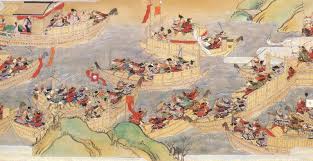
The Genji and Heike forces faced each other across the sea.
This area, now part of Kurashiki City in Okayama Prefecture, was a place where the sea deeply intruded into the land. Kojima was not yet connected to the mainland, and the Fujito Strait lay between the two armies.
The Heike army set up their camp on the Kojima side, preparing to confront the Genji forces with their ships.
On the other hand, the Genji army lacked enough ships.
According to the “Tale of the Heike,” Volume Ten “Fujito,” the Heike warriors rowed out in small boats, raising fans to taunt the Genji forces.
“Cross here,” they challenged.
They were daring the Genji to attack across the sea.
However, the Genji soldiers found it difficult to cross.
Then, a warrior advanced on horseback.
It was Sasaki Saburo Moritsuna.
A Genji commander from Omi Province.
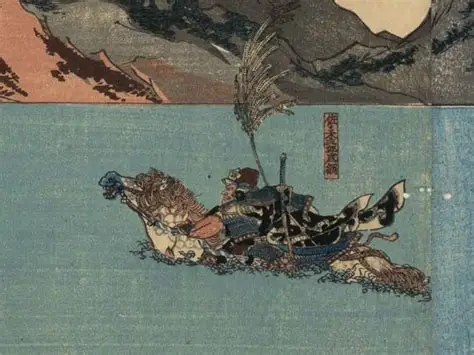
Moritsuna, accompanied by his retainers, entered the sea with seven horsemen.
In shallow areas, the water reached the horses’ bellies, and in deeper parts, they swam through.
According to the “Tale of the Heike,” seeing this, Minamoto no Noriyori ordered his troops to cross the sea.
The Genji warriors entered the sea one after another, attacking the Heike positions.
Through this battle, Moritsuna became renowned as the warrior who crossed the sea on horseback and claimed the honor of leading the charge.
However, the “Tale of the Heike” recounts another story.
On the eve of the battle, Moritsuna was reportedly informed by a local fisherman about a shallow passage that could be crossed on horseback.
After receiving the guidance, Moritsuna killed the fisherman.
He feared that if other warriors learned of the shallow path, he would lose the chance to claim the honor of leading the charge alone.
The story suggests that Moritsuna killed the fisherman to silence him.
The fisherman’s name is not recorded.
The tale of Sasaki Moritsuna’s charge and the fisherman’s death has been passed down with the Battle of Fujito.
The Heike, Defeated at Ichinotani, Retreat to Yashima
On February 7, 1184, in the third year of the Juei era, the Heike suffered a crushing defeat by the Genji forces at Ichinotani in Settsu Province.
Minamoto no Noriyori’s forces attacked from the east at Ikuta Forest, while Minamoto no Yoshitsune and others broke through the Heike positions at Ichinotani in the west.
Taira no Tadamori, Taira no Atsumori, Taira no Tsunemasa, Taira no Tomomori, and many other warriors of the Taira clan were killed in battle, and Taira no Kiyomori‘s son, Taira no Shigehira, was captured alive.
The Taira clan lost the stronghold around Fukuhara, which they had finally regained after fleeing the capital.
Munemori, Tomomori, and other surviving warriors of the clan retreated by ship to Yashima in Sanuki Province.
However, Emperor Antoku and the Imperial Regalia remained in the hands of the Taira.
Yashima was a crucial stronghold facing the Seto Inland Sea’s shipping routes.
The Taira maintained relations with the western samurai, enabling them to move troops and supplies by ship.
This naval power hindered the Genji army’s pursuit.
Even though the Genji emerged victorious at Ichinotani, they could not immediately attack the Taira, who had retreated across the sea.
Ships were necessary to cross to Yashima.
Moreover, in the western regions, Taira-aligned samurai remained scattered.
If the Genji army advanced west along the Sanyo Road, they would face these forces.
Securing provisions was also essential to send a large army from the eastern provinces.
Months passed since the victory at Ichinotani.
The Taira continued their resistance from Yashima, while the Genji prepared their forces for the next campaign.
Minamoto no Noriyori Heads West to Pursue the Taira
In September of the first year of Genryaku, Minamoto no Noriyori set out for the western provinces to pursue the Taira.
Noriyori, the brother of Minamoto no Yoritomo, was a military commander who led the main army at the Battle of Ichinotani.
This time, acting on Yoritomo’s orders, he led the powerful samurai of the eastern provinces westward.
The “Tale of the Heike” records that Noriyori departed from Kyoto on September 12.
Meanwhile, the “Azuma Kagami” entry for September 12 mentions a departure on the 1st of the same month.
The entry for January 6 of the following year in the same chronicle states that the departure from Kyoto was on September 2 of the previous year, indicating discrepancies in the recorded departure dates.
From these accounts, it is known that Noriyori headed west in early September.
The commanders in Noriyori’s army mentioned in the “Tale of the Heike” included Ashikaga Yoshikane, Hojo Yoshitoki, Doi Sanehira, Miura Yoshizumi, Hatakeyama Shigetada, and Sasaki Moritsuna.
The force was said to number over 30,000 horsemen, though this figure comes from a war tale and the actual number mobilized is unclear.
Noriyori’s army advanced west along the Sanyo Road, moving from Harima Province towards Bizen Province.
Beyond lay Yashima, a stronghold of the Taira clan.
However, leading the eastern samurai on a western campaign was no easy task.
The further the army advanced, the longer the distance to transport provisions.
Moreover, moving further west from Bizen required dealing with Taira forces remaining on the islands and coasts of the Seto Inland Sea.
Noriyori’s forces pursued the Taira while advancing along the Sanyo Road.
The Taira Army’s Position on Kojima
Kojima in Bizen Province corresponds to the southern part of present-day Kurashiki City in Okayama Prefecture.
Now connected to the mainland as the Kojima Peninsula, it was an island surrounded by sea in the late Heian period.
The Fujito Strait lay between it and the mainland.
Shallows and small islands dotted the area, with water depths changing with the tides.
The Taira stationed their forces on Kojima.
By confronting the enemy across the Fujito Strait, they could halt the advancing Genji forces.
The Taira had ships, enabling them to attack from the sea.
Additionally, the area around Kojima was a key location for controlling traffic between Yashima and the mainland across the Seto Inland Sea.
Securing this region was strategically significant for the Taira’s continued military operations in the west.
Conversely, the Genji could not ignore the Taira forces on Kojima.
Even if they advanced west along the Sanyo Road, leaving the Taira on Kojima behind could threaten their communications and supply lines.
Thus, the two armies clashed over Kojima.
The Kojima Stronghold Defended by Taira no Yukimori
The “Azuma Kagami” entry for December 7 of the first year of Genryaku notes that Taira no Yukimori, the Left Horse Guard, led over 500 horsemen to establish a fortification on Kojima in Bizen Province.
Taira no Tsunemori was the eldest son of Taira no Koremori, who was a son of Taira no Kiyomori.
As a grandson of Kiyomori, he was a noble of the Taira clan and held official positions.
Although his father Koremori passed away early, Tsunemori continued to serve as a warrior of the Taira clan.
He was also skilled in waka poetry.
It is recorded that during the fall of the Taira, he entrusted a poem to Fujiwara no Teika.
According to the “Azuma Kagami,” Tsunemori set up camp at Kojima to face the advancing Minamoto forces.
In contrast, the “Heike Monogatari” introduces different figures as the Taira commanders appearing at Fujito.
These include Taira no Sukemori, Taira no Arimori, and Taira no Tadabumi.
Sukemori and Arimori were sons of Taira no Shigemori, Kiyomori’s heir.
Tadabumi was also a noble of the Taira clan.
Additionally, as samurai commanders, names like Echizen no Jirobei Moritsugu, Kazusa no Gorohei Tadami, and Aku Shichibei Kagekiyo are mentioned.
Regarding the forces, the “Heike Monogatari” notes over 500 warships.
The “Azuma Kagami” mentions over 500 horsemen, indicating a different way of counting the troops.
The reasons for the differences in commander names and the actual troop strength remain unclear.
However, both sources agree that the Taira forces positioned themselves at Kojima, using the sea to hinder the Minamoto advance.
Sasaki Moritsuna, the Warrior Who Followed Yoritomo’s Uprising
Sasaki Moritsuna, who distinguished himself at Fujito, was a warrior with ties to Sasaki Manor in Omi Province.
His father was Sasaki Hideyoshi.
Moritsuna is considered the third son, with brothers such as Sadatsuna and Takatsuna.
The Sasaki clan was a branch of the Uda Genji, and they had connections with Minamoto no Yoritomo since his exile in Izu Province.
In the fourth year of Jisho (1180), when Yoritomo raised his army, the Sasaki brothers joined him.
Shortly after Yoritomo’s uprising, the Sasaki warriors participated in the attack on the deputy governor of Izu, Yamakami Kanetaka.
Even after the defeat at the Battle of Ishibashiyama, the Sasaki clan continued to support Yoritomo.
Moritsuna also followed Yoritomo and took part in various military campaigns.
The “Azuma Kagami” describes Moritsuna at the Battle of Fujito as the emissary of Yoritomo who attacked the Taira forces at Kojima.
Conversely, the “Heike Monogatari” depicts him as a warrior in Noriyori’s expeditionary force to the western provinces.
Within Noriyori’s army, Moritsuna vied for the honor of leading the vanguard.
At Fujito, he achieved a military feat that would be remembered for generations.
The Genpei Armies Face Off Across the Sea
According to the “Tale of the Heike,” the Genji forces set up camp at Nishikawajiri Fujito in Bizen Province.
On the Kojima side, the Heike fleet was stationed.
The sea stretched between the two armies.
The distance between them varies in different manuscripts of the “Tale of the Heike,” with figures like five chō or twenty-five chō being mentioned.
Meanwhile, the “Azuma Kagami” records that the sea route Moritsuna crossed was a little over three chō.
One chō is approximately 109 meters, so three chō would be about 330 meters.
However, these figures do not allow us to determine the actual width of the strait.
The coastline at the time was significantly different from today, and the position of the shallows changed with the tides.
Moreover, the distance between the camps and the actual route Moritsuna took might not have been the same.
The pressing issue for the Genji forces was that they had no means to cross to the opposite shore.
According to the “Tale of the Heike,” around the hour of the dragon on September 25, the Heike warriors rowed out in small boats.
The hour of the dragon corresponds roughly to between 7 and 9 in the morning.
The warriors raised fans on their boats and called out to the Genji side.
“Cross here!”
It was a taunt to attack by crossing the sea.
The Genji had a large army, but without boats, they could not advance to the other shore.
If they forced their horses into the sea, they risked getting caught in the depths.
There was also the danger of being shot by enemy arrows while swimming across.
The Heike warriors continued to provoke the boatless Genji forces from the sea.
The Man from Ura Summoned by Moritsuna
According to the “Tale of the Heike,” on the night of September 25, Moritsuna summoned a man from Fujito no Ura.
The man was well-acquainted with the local sea.
Moritsuna offered him a hitatare, kosode, okuchi, and shirasaya-maki, and asked if there was a place where horses could cross the sea.
The man replied that while many lived by the sea, few knew the exact location of the shallows.
He claimed he knew it well.
According to him, there was a place in the Fujito sea that was shallow like a river ford.
The position of this shallow changed with the lunar cycle, being on the east side at the beginning of the month and on the west side at the end.
The tides caused the crossing points to vary.
The man said that by choosing the shallow, even horses could cross easily.
Moritsuna was delighted.
Perhaps they could attack the opposite shore without boats.
However, he couldn’t move the troops based solely on the man’s story.
Moritsuna decided to investigate the shallows himself.
Moritsuna and the Fisherman Enter the Night Sea
Moritsuna and the man headed to the sea, avoiding prying eyes.
The “Tale of the Heike” notes that the two stripped down and entered the sea to examine the shallows.
The water depth varied by location.
In some places, it was only knee-deep, while in others, it reached up to the waist or shoulders.
In even deeper areas, they had to swim, before rising again to the shallows.
The man informed them that the southern side was shallower than the northern side.
However, on the opposite bank, Taira warriors were waiting.
Approaching the enemy’s position while naked posed the risk of being shot with arrows.
The man warned Moritsuna that it was too dangerous to continue.
He advised them to turn back.
Moritsuna heeded his words.
The two decided to turn back without crossing the sea entirely.
Moritsuna confirmed where they could advance on horseback.
The next morning, using that shallow path, there was a possibility of attacking the Taira position without waiting for ships.
However, on the way back, Moritsuna began to ponder something else.
The man who guided them also knew the location of the shallows.
What if he told other warriors about the same spot?
“Only I Should Know”
The “Tale of the Heike” records Moritsuna’s reason for killing the man as follows:
“Only I should know.”
It was better if only he knew.
Moritsuna feared that the man might reveal the location of the shallows to other warriors.
If another warrior crossed first, Moritsuna would lose the chance to claim the glory of leading the charge.
Thus, Moritsuna stabbed the man to death.
It is said that he also cut off the man’s head and discarded it.
The man had guided Moritsuna to the shallows at his request.
He had even received clothes and other rewards.
However, it was inconvenient for Moritsuna if the man shared that knowledge with other warriors.
The “Tale of the Heike” does not record the man’s name.
His age, whether he had a family, or what kind of life he led remains unknown.
Later traditions include stories of his body being sunk into the sea.
However, the text of the “Tale of the Heike” states that Moritsuna stabbed the man to death and discarded his head.
The details of the body being sunk into the sea are elaborated in later works like the Noh play “Fujito.”
Moreover, the “Azuma Kagami” does not mention the story of Moritsuna learning about the shallows from a fisherman or the murder.
The “Tale of the Heike” is the source that details the fisherman’s murder.
Whether the man was actually killed or what actions Moritsuna took cannot be confirmed from contemporary records.
However, this tale, along with Moritsuna’s claim to the glory of the vanguard, has been passed down through the ages.
Moritsuna’s Charge into the Sea with Seven Riders
According to the “Tale of the Heike,” around the hour of the dragon on the following September 26, the Taira warriors once again rowed out in small boats.
Just like the day before, they raised their fans and taunted the Genji forces.
“Let us cross here!”
At that moment, Sasaki Moritsuna spurred his horse forward.
Accompanied by his retainers and followers, Moritsuna entered the sea with seven riders.
He intended to cross the shallow waters he had scouted the night before.
However, the commander Minamoto no Noriyori was taken aback by Moritsuna’s actions.
He had not yet given the order to cross the sea.
Noriyori reportedly commanded that Moritsuna be stopped.
Thus, Doi Jiro Sanehira galloped after Moritsuna and caught up with him.
Sanehira called out, warning that entering the sea without the commander’s permission was reckless.
Yet, Moritsuna did not stop.
According to the ‘Heike Monogatari’, Sanehira was unable to restrain him and ended up following Moritsuna into the sea.
In the shallow parts, the water reached the horses’ chests and bellies.
In deeper areas, the water rose to the level of the saddles.
There were places where they had to let the horses swim to advance.
Nevertheless, Moritsuna and his men pressed forward.
The Genji warriors watching from the shore began to realize that Moritsuna knew a path across the sea.
Noriyori Orders the Crossing
According to the ‘Heike Monogatari’, seeing Moritsuna advance, Noriyori understood that the sea was shallow.
He then ordered the troops to cross the sea.
“Cross, cross!”
The Genji warriors entered the sea one after another.
The ‘Heike Monogatari’ notes that over 30,000 horsemen crossed at this time.
However, the exact number of those who actually crossed is unclear.
It’s difficult to treat the troop numbers recorded in military tales as factual.
The width of the strait and the extent of the shallow area are also uncertain, and it’s unknown if the entire army crossed the same route simultaneously.
Nevertheless, the ‘Heike Monogatari’ depicts the Battle of Fujito as beginning with Moritsuna leading the charge into the sea, followed by the Genji attack.
The Taira warriors had been taunting the Genji army, which lacked ships.
Yet the Genji, mounted on horses, advanced through the sea.
The Taira were not merely spectators.
They launched their ships and prepared their bows to meet the attack.
Moritsuna’s Crossing in the ‘Azuma Kagami’
The crossing of the sea by Sasaki Moritsuna is also recorded in the ‘Azuma Kagami’.
It is mentioned in the entry for December 7, Genryaku 1.
There, it states that Taira no Yukimori, the Left Horse Captain of the Taira, led over 500 horsemen and constructed a fortress on Kojima in Bizen Province.
Moritsuna, as an envoy of Yoritomo, set out to attack Yukimori’s position.
However, the sea blocked his path.
Moritsuna stopped his horse on the beach, contemplating how to cross the water.
At that moment, Ikumori on the opposite shore eagerly beckoned Moritsuna.
It was a provocation, challenging him to cross if he dared.
Moritsuna decided to enter the sea on horseback, without waiting for a boat.
The Azuma Kagami records that Moritsuna crossed a sea route of over three chō.
The names of the six retainers who accompanied him are also preserved.
They were Shiga Kurō, Kumagai Shirō, Takayama Saburō, Yono Tarō, Tachibana San, and Tachibana Go.
Including Moritsuna, there were seven riders in total.
The Heike Monogatari also notes that they crossed with seven riders, agreeing on this point.
On the other hand, the Azuma Kagami does not mention the story of Moritsuna learning about the shallows from a fisherman.
There is also no record of Noriyori trying to stop Moritsuna or Doi Sanehira following after him.
The Azuma Kagami succinctly reports that Moritsuna, accompanied by six retainers, crossed the sea and landed on the opposite shore, causing Taira no Ikumori to flee.
While both the Heike Monogatari and the Azuma Kagami recount Moritsuna’s sea crossing, the details of the events differ.
The Clash of Genpei Forces at Sea
According to the Heike Monogatari, as the Genji forces began entering the sea, the Heike also launched their ships.
The Heike warriors lined up their bows and shot arrows at the advancing Genji.
The mounted warriors crossing the sea had to endure enemy arrows in the unstable waters.
Nevertheless, the Genji continued their advance.
The Heike Monogatari describes how the warriors tilted their helmet visors to deflect the arrows and attempted to board the Heike ships.
The warriors who boarded the ships raised their voices and fiercely battled the enemy.
Some ships sank, and people fell into the sea.
The Heike tried to fend off the Genji from the sea using their ships.
However, they could not stop the Genji’s mounted assault into the sea.
The battle continued for a long time.
The Heike Monogatari records that the fighting lasted all day, and by nightfall, the Heike ships retreated offshore.
The Genji forces landed on Kojima to rest their men and horses.
The following morning, the Heike retreated toward Yashima in Sanuki Province.
The Genji tried to pursue further, but they lacked ships.
While they could cross the shallows near the coast on horseback, chasing the fleet that retreated offshore was difficult.
Meanwhile, the Azuma Kagami notes that Moritsuna landed on the opposite shore and drove Ikumori away.
There are no detailed records of the number of casualties on both sides or the exact duration of the battle.
Was the Battle of Fujito in September or December?
The date of the Battle of Fujito varies depending on the source.
The “Fujito” chapter of the Heike Monogatari states that on September 25, the Heike warriors provoked the Genji forces.
That night, Moritsuna learned about the shallows from a fisherman and crossed the sea the following day, on the 26th.
Meanwhile, the “Azuma Kagami” records the Battle of Fujito in the entry for December 7, 1184.
It states that Taira no Yukimori built a fortress on Kojima, and Moritsuna crossed the sea on horseback to attack.
There is a gap of over two months between the dates in the two accounts.
Sources like the “Nihon Rekishi Chimei Taikei” follow the “Azuma Kagami” and treat it as a battle on December 7.
However, the “Azuma Kagami” is also a historical text compiled during the Kamakura period, and not all its entries were written on the day the events occurred.
The “Heike Monogatari” also has multiple textual traditions, with differences in detailed descriptions.
To determine the exact date of the battle, one must consider the nature of these sources.
There are also differences in the commanders of the Taira forces.
The “Heike Monogatari” mentions Taira no Sukemori and Taira no Arimori, while the “Azuma Kagami” records Taira no Yukimori leading the troops.
The forces are also described differently, with over 500 ships and over 500 horsemen.
It is difficult to consolidate these accounts into a detailed reconstruction of the actual deployment of both armies.
However, both texts agree that the Genji and Heike forces clashed at Fujito, and that Sasaki Moritsuna crossed the sea on horseback.
This crossing became one of Moritsuna’s most celebrated exploits, as known from later records.
The Genji Army’s Victory at Fujito and Their Subsequent Campaign
Defeating the Heike forces at Fujito was a significant achievement for the Genji side.
However, the Heike’s main stronghold at Yashima still remained.
According to the “Heike Monogatari,” the Heike fleet retreated from Fujito to Yashima.
The Genji wanted to pursue them, but lacked the ships to continue the attack.
This was a problem the Genji army faced at the time.
While they could move large forces on land, crossing the sea required ships.
Maintaining an army far away in the western provinces also required provisions.
Before and after the Battle of Fujito, Noriyori’s army struggled with these issues.
The “Azuma Kagami” entry for January 6, 1185, notes that a letter Noriyori sent on November 14 of the previous year reached Kamakura.
The letter complained of a shortage of provisions and disorder among the troops.
Many eastern warriors, weary from the long campaign, wished to return home.
Noriyori sought aid from Yoritomo.
This letter, dated November 14, was sent before the “Azuma Kagami” records the Battle of Fujito on December 7.
Nevertheless, it shows how much Noriyori’s army suffered from a lack of provisions during their western campaign.
Yoritomo sent a reply to Noriyori, instructing him to calm the troops.
He also urged cooperation with the warriors of Kyushu and careful movement of the forces.
Yoritomo emphasized the importance of safely receiving Emperor Antoku and the Heike women at Yashima.
During Noriyori’s western campaign, securing ships and provisions became major challenges, in addition to fighting the Heike forces.
Noriyori’s Army Secures Ships and Heads to Bungo Province
In January of Genryaku 2 (1185), Minamoto no Noriyori’s forces had advanced as far as Akama in Nagato Province.
However, they lacked enough ships to cross over to Kyushu.
The Azuma Kagami entry for January 12 notes that Noriyori’s army was unable to advance due to a shortage of provisions and ships.
Some of the warriors from the eastern provinces even considered returning home.
Noriyori sought the cooperation of the local warriors in Kyushu.
These included Usuki Koretaka and Ogata Koreie of Bungo Province.
They were warriors who had previously opposed the Taira clan.
With their help, Noriyori aimed to gather ships to cross to Kyushu.
On January 26, Koretaka, Koreie, and others provided 82 warships.
Additionally, Usa no Nagatake from Suo Province offered rice for provisions.
The Azuma Kagami records that with this aid, Noriyori’s forces crossed over to Bungo Province.
With the acquisition of ships and provisions, the Genji forces were finally able to advance towards Kyushu.
Subsequently, Noriyori’s forces engaged the Taira forces in Kyushu, pressing their retreat from the west.
Meanwhile, Taira forces remained at Yashima in Shikoku.
It was Minamoto no Yoshitsune who moved to confront them.
Yoshitsune’s Attack on Yashima
In February of Genryaku 2, Yoshitsune set sail from Settsu Province to attack the Taira forces at Yashima.
According to the Azuma Kagami, Yoshitsune crossed to Awa Province with a small number of ships and landed on Shikoku.
Yoshitsune’s forces advanced from Awa Province to Sanuki Province, launching a surprise attack on the Taira forces at Yashima on February 19.
The Taira believed they were being attacked by a large Genji army and moved Emperor Antoku and their family onto ships.
Fighting continued around Yashima between the two forces.
This battle is known for the death of Sato Tsugunobu and the famous episode of Nasu no Yoichi shooting the fan target.
The Tale of the Heike vividly describes the scene where Yoichi shoots down the fan raised on a ship.
Defeated at Yashima, the Taira retreated further west.
They would face their final battle at Dan-no-ura in Nagato Province on March 24 of the same year.
From Ichi-no-Tani to Yashima, over the course of about a year,
the Genji forces advanced west along the Sanyo Road, battling Taira forces across various locations, continuing their pursuit from both the Kyushu and Shikoku fronts.
The Battle of Fujito was one of the engagements fought during this campaign.
The Grant of Kojima to Moritsuna
Sasaki Moritsuna, who led the charge at Fujito, is said to have been granted Kojima in Bizen Province for his achievements.
The Tale of the Heike recounts Moritsuna’s feat of crossing the sea on horseback, for which he was awarded Kojima.
Furthermore, it is said that his achievements were recorded in a letter from the Kamakura shogunate.
Since Minamoto no Yoritomo’s uprising, Moritsuna had been active as a warrior for the Genji.
The crossing at Fujito became a representative event of his military accomplishments.
Moritsuna continued to serve under the Kamakura shogunate, becoming known as a warrior with estates in various regions.
However, the actions of Moritsuna during the Battle of Fujito are depicted differently in the “Heike Monogatari” and the “Azuma Kagami.”
The “Azuma Kagami” records that Moritsuna crossed the sea on horseback and forced Taira no Kiyomori to retreat.
The “Heike Monogatari” includes an earlier anecdote about the killing of a fisherman.
There is no definitive record indicating that Moritsuna was punished for this incident.
Eventually, the story of this fisherman became the subject of a Noh play, becoming widely known to later generations.
The Fisherman’s Mother in the Noh Play “Fujito”
There is a Noh play titled “Fujito” based on the Battle of Fujito.
This performance is based on the Battle of Fujito from the tenth volume of the “Heike Monogatari” and is still performed in the five schools of Noh today.
The play begins after the Genpei War has ended.
Sasaki Moritsuna is granted the lands of Kojima for his military achievements at Fujito and arrives as the new lord.
Moritsuna orders the local people to come forward if they have any grievances.
Then, an elderly woman appears.
She is the mother of the fisherman Moritsuna killed before the Battle of Fujito.
The old woman tearfully laments the death of her son.
She demands that Moritsuna return her son to her.
Moritsuna admits that he once learned the location of the shallows from the fisherman.
Furthermore, he explains that he killed the man out of fear that he might reveal the shallows to other warriors.
The mother repeatedly asks for her son to be returned.
However, her son is already dead.
The mother even pleads to be killed like her son.
In the Noh play “Fujito,” the mother’s sorrow before Moritsuna is vividly portrayed.
The fisherman, whose name was not recorded in the “Heike Monogatari,” is brought to life through the words of his grieving mother in the play.
The Fisherman’s Spirit Appears Before Moritsuna
In the Noh play “Fujito,” after the mother departs, Moritsuna holds a memorial service for the fisherman.
Moritsuna gathers monks and conducts a memorial ceremony.
At that moment, the spirit of the slain fisherman appears.
The spirit recounts the agony of being killed and harbors resentment towards Moritsuna.
The play also vividly depicts the story of the fisherman’s body being submerged in the sea.
Moritsuna mourns the fisherman’s death and continues the memorial services.
Eventually, it is said that the spirit attains peace through these rites.
In the “Heike Monogatari,” the fisherman is portrayed as someone who is killed after revealing the shallows to Moritsuna.
In contrast, in the Noh play “Fujito,” the fisherman’s mother directly appeals to Moritsuna, and in the latter half, the fisherman’s spirit also appears.
The narrative shifts from Moritsuna’s military success in the battle to the story of the slain fisherman and his bereaved mother.
The events at Fujito are reimagined as a new story within the Noh play.
The Mother’s Resentment Passed Down at Sasanoyama
In the area around Fujito, there are legends involving a fisherman and his mother.
One such legend is associated with Sasayamayama.
This small mountain, located in Amagi, Fujito Town, Kurashiki City, is known as a site of the Battle of Fujito.
According to local lore, the mother of a son killed by Moritsuna harbored deep resentment.
It is said that she declared, “If it’s Sasaki, I even hate sasa (bamboo grass),” and uprooted all the bamboo grass on the mountain.
The story goes that merely hearing the name Sasaki made her despise even the similarly sounding sasa.
Another legend suggests that the mother came to hate the bamboo grass because the fisherman used it as a marker to show the shallows.
As a result, the mountain became devoid of bamboo grass and came to be known as Sasayamayama.
These are the origins of the place name passed down through generations, though there are no records confirming the mother actually uprooted the bamboo grass.
Nevertheless, the story of the fisherman’s death has been linked to the place name and continues to be told today.
The historical sites of the Battle of Fujito include not only places honoring Moritsuna’s military achievements but also those related to the fisherman and his mother.
Memorials for the Fallen at Fujito Temple
In Fujito Town, Kurashiki City, there is a temple called Fujito Temple.
This temple belongs to the Koyasan Shingon sect and is said to have been founded by Gyoki during the Nara period.
It is also known as a temple associated with the Battle of Fujito.
According to the temple’s lore, after the battle, Sasaki Moritsuna held a grand memorial service to honor the fallen from both the Genji and Heike clans.
It is also said that he memorialized the spirit of the fisherman he killed.
Within the temple grounds stands a stone five-storied pagoda constructed in the Kamakura period.
Officially known as the “Stone Five-Storied Pagoda of Fujito Temple,” it is designated as an important cultural property of Okayama Prefecture.
The pagoda is made of granite and stands about 3.55 meters tall.
It bears an inscription from the first year of Kangen (1243).
This stone pagoda was erected approximately 60 years after the Battle of Fujito.
Okayama Prefecture’s cultural heritage materials suggest it may have been built to memorialize the battle’s fallen.
However, it is difficult to ascertain the exact purpose of its construction.
There are also limited contemporary records about the memorial services Moritsuna conducted.
Fujito Temple has passed down the tradition of memorializing the fallen from both the Genji and Heike clans, as well as the fisherman.
The Fisherman’s Memorial at Kyogashima
Near Fujito Temple lies a place called Kyogashima.
Though now surrounded by land, it was once said to be a small island floating in the sea.
This island also holds stories related to Sasaki Moritsuna and the fisherman.
It is said that after the Battle of Fujito, Moritsuna performed a sutra copying to memorialize the fisherman he killed and buried the sutras on the island.
Thus, it came to be known as Kyogashima.
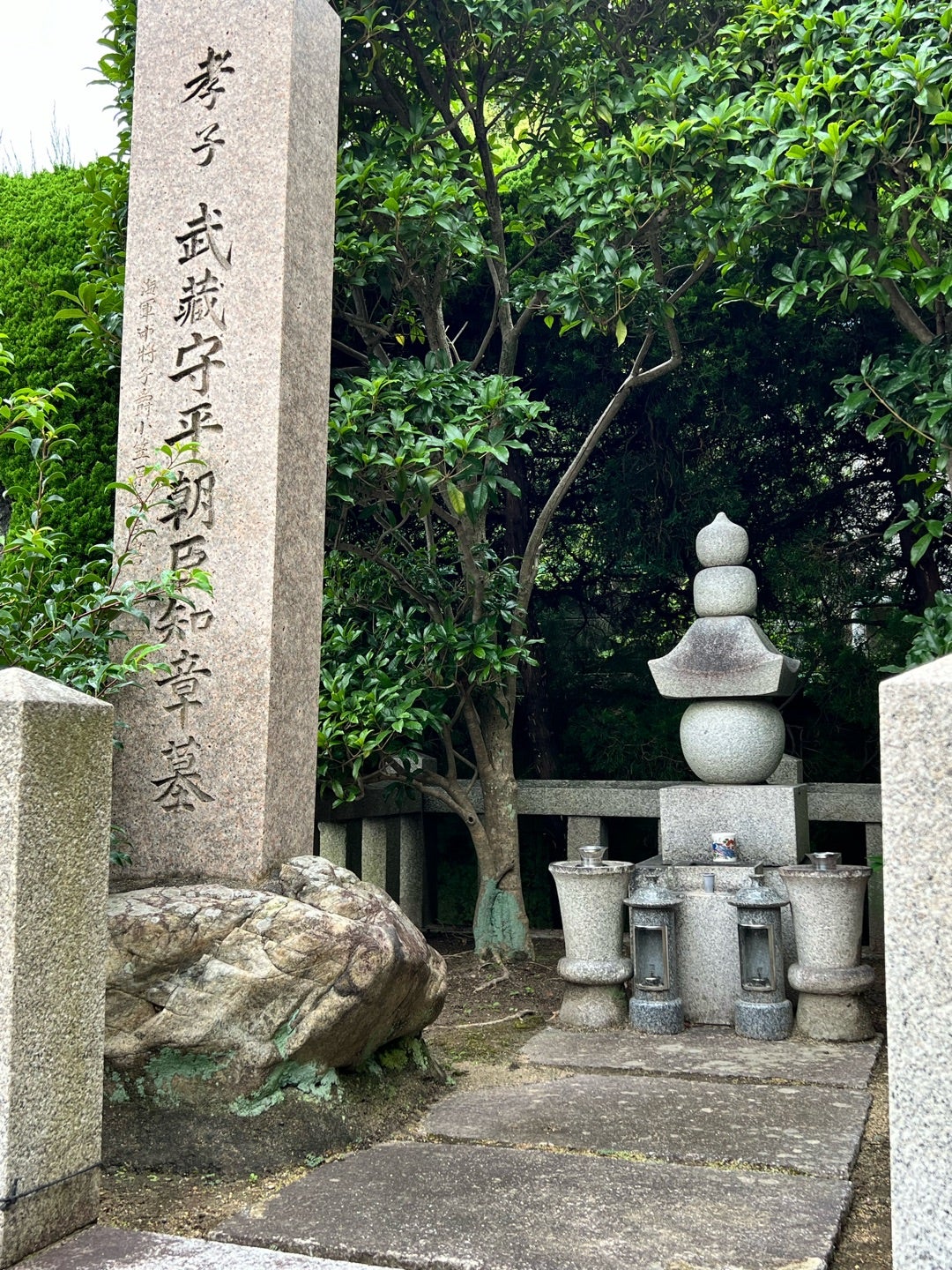
Today, two stone towers remain on Kyogashima.
The smaller of the two is said to be a tower for memorializing the fisherman.
There are no contemporary historical records confirming that Moritsuna actually buried the sutras.
However, stories related to the fishermen’s memorials are preserved not only at Fujito Temple but also at Kyojashima.
The death of a man featured in the ‘Heike Monogatari’ has been long associated with the names of places and the origins of stone monuments.
The Rock Where Moritsuna Rode His Horse
In the area around Fujito, many historical sites related to Moritsuna’s sea crossing remain.
One such site is Norideiwa, located in Ariki, Kurashiki City.
It is said to be the place where Sasaki Moritsuna rode his horse into the sea.
Although it is now surrounded by land, it was reportedly a coastal area during the late Heian period.
Additionally, there is a historical site called Meki in Tsubuie, Kurashiki City.
This is said to be where Moritsuna rested his horse while crossing the sea.
Today, it is a small park within a residential area.
Further along is Senjin-an.
This is believed to be the place where Moritsuna landed on the Kojima side after crossing the sea.
There is a tradition that a hermitage was established later to commemorate the spirits of the war dead and fishermen.
However, it is unclear from which point Moritsuna actually entered the sea and what route he took.
The distances crossed by sea differ between the ‘Azuma Kagami’ and the ‘Heike Monogatari.’
Moreover, due to significant changes in the landscape caused by land reclamation around Fujito, it is difficult to accurately map the coastline of that time onto the current geography.
Norideiwa, Meki, and Senjin-an are places that convey the tradition of Moritsuna’s sea crossing to later generations.
The Statue of a Mounted Warrior at Moritsuna Bridge
The Kurashiki River, flowing through the present-day Fujito Town in Kurashiki City, is spanned by Moritsuna Bridge.
Near the bridge stands a statue of Sasaki Moritsuna on horseback.
This statue depicts Moritsuna crossing the sea at Fujito.
The current Moritsuna Bridge was rebuilt in 1989.
Before that, a bridge with the same name had already been in place at this location.
The area through which the Kurashiki River flows was once the site of the Fujito Strait.
Today, Fujito is a region filled with residential areas, roads, and farmland.
What was once sea has become land through long-term reclamation and changes in the landscape.
Even if you look around from the current Moritsuna Bridge, you cannot see the terrain as it was when the Genpei forces faced each other across the strait.
However, the bridge retains Moritsuna’s name, and the statue of the mounted warrior stands.
Nearby are Norideiwa and Senjin-an, historical sites that tell of Moritsuna’s sea crossing.
And at nearby Fujito Temple and Kyojashima, stories related to the memorials for fishermen and the war dead remain.
The Story of Moritsuna and the Fisherman at Fujito
In 1184, in Fujito of Bizen Province, the Genpei forces clashed.
Despite their major defeat at Ichinotani, the Taira forces continued to resist, maintaining troops in the Seto Inland Sea and using Yashima as a stronghold.
Minamoto no Noriyori’s forces advanced westward along the Sanyo Road, but they struggled with a shortage of ships and provisions.
At Fujito, Sasaki Moritsuna crossed the sea on horseback.
The Azuma Kagami records that Moritsuna, accompanied by six retainers, crossed more than three chō of sea and routed Taira no Kiyomori’s forces.
On the other hand, the Tale of the Heike describes how Noriyori, witnessing Moritsuna’s crossing, ordered his troops to cross the sea and attack the Taira fleet.
The Taira retreated from Kojima and returned to Yashima, according to tradition.
Even after their victory at Fujito, the Genji continued their campaign in the western provinces.
The following year, Noriyori advanced to Kyushu, while Yoshitsune attacked the Taira forces at Yashima.
Then, on March 24, the Taira were annihilated at the Battle of Dan-no-ura.
Sasaki Moritsuna is remembered as the warrior who crossed the sea on horseback at Fujito, leading the vanguard.
However, the Tale of the Heike also recounts a story of a fisherman’s murder related to this feat.
It is said that the man who guided them through the shallows was killed by Moritsuna, who feared he might reveal the path to other warriors.
This tale later became the subject of the Noh play Fujito, where the fisherman’s mother appears before Moritsuna, pleading for the return of her son.
In present-day Kurashiki City, there remains Norideiwa, the rock where Moritsuna is said to have entered the sea, Moritsuna Bridge commemorating the crossing, and Fujito Temple, which is said to have been built to honor the fallen of both the Genji and Taira forces.
On Kyogashima, there is a stone pagoda believed to be a memorial for the fisherman, and at Sasanoyama, a story persists of the mother pulling out bamboo grass.
Moritsuna’s name is engraved on bridges and monuments, and he is also depicted as a mounted warrior statue.
The name of the fisherman who showed the way through the shallows remains unknown.
Nevertheless, the story of his murder is recorded in the Tale of the Heike and is retold in the Noh play Fujito alongside the mother’s grief.