May, 941 (Tengyō 4).
Fujiwara no Sumitomo and his forces launched an attack on Dazaifu, the center of politics, diplomacy, and defense in Kyushu.
The government offices and surrounding facilities were engulfed in flames, and valuables were looted.
At the current site of Dazaifu, traces of a fire that consumed the second phase of the government office have been confirmed, believed to be the result of Fujiwara no Sumitomo’s rebellion in 941. The government office was later rebuilt to nearly the same scale.
May 19.
A report from Ono Yoshifuru, the Pursuit Officer, reached Kyoto, detailing the pillaging of Dazaifu by Sumitomo’s forces.
The following day, May 20.
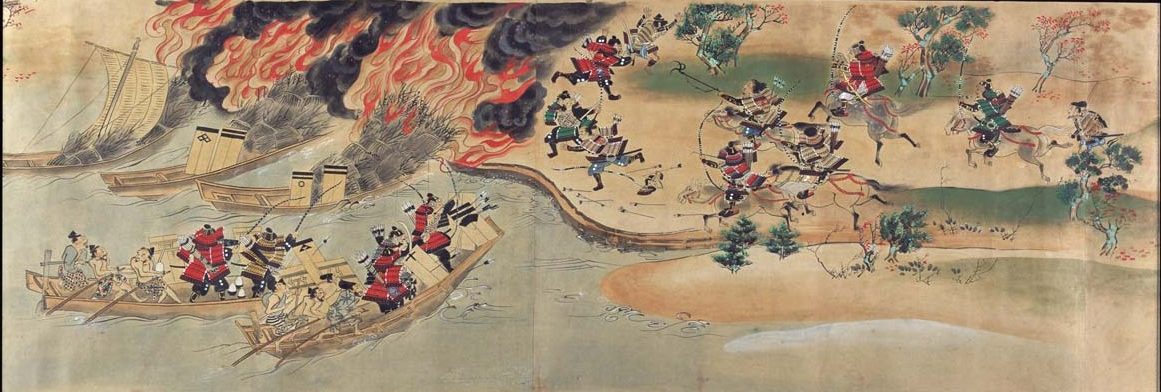
In Hakata Port, Chikuzen Province, Ono no Yoshikoto and his pursuit forces clashed with Sumitomo’s troops.
Sumitomo’s forces were defeated, and the influence they had spread from the Seto Inland Sea to Kyushu rapidly crumbled.
As seen in the previous part, by early summer of 940, the court had intensified its efforts to capture armed groups allied with Sumitomo.
Nevertheless, the unrest in the western provinces did not subside, and the conflict continued to escalate from the latter half of 940.
1. August 940—Large-scale Attacks on Iyo and Sanuki
June 18, 940 (Tengyō 3).
The court decided to issue an official order to the Pursuit Officers of the Sanyodo region to capture Sumitomo’s “violent soldiers.”
Until then, the court had attempted to placate Sumitomo himself by granting him the rank of Junior Fifth Rank, Lower Grade, but clashes with the armed groups around him persisted.
By August, the situation shifted dramatically.
A report that reached Kyoto on August 26 stated that since the 18th, over 400 pirate ships had attacked, and Iyo and Sanuki had been successively assaulted.
It was also reported that over 100 warships prepared by Bingo Province had been set ablaze.
In Awa, measures were needed against the marauders, and 100 soldiers were conscripted from Omi Province.
The attacks by forces allied with Sumitomo had spread throughout the Seto Inland Sea.
2. The Pursuit Forces of Ono no Yoshikoto and Minamoto no Tsunemoto
August 27.
The court conscripted soldiers from various provinces, organizing the pursuit forces.
Ono Yoshikata was appointed as the chief officer for the task of capturing bandits in both the Sanyo and Nankai regions, with Minamoto no Tsunemoto as his deputy, Fujiwara no Yoshiyuki as the judge, and Okura Harumi as the scribe.
These individuals, who would later fight against Sumitomo’s forces at Hakata Port, were positioned at the center of the punitive expedition during this period.
From January of the same year, Ono Yoshikata also served as the officer for capturing bandits in the Sanyo region, gathering warships in Harima and Sanuki as he advanced westward.
However, even with the strengthened punitive system, Sumitomo’s activities did not cease.
On August 29, reports of pirate raids from Kii Province reached Kyoto.
3. The Defeat of Dazaifu’s Forces
Even by the fall of 940, the battles continued.
October 22.
Reports arrived in Kyoto from Aki and Suo Provinces that Dazaifu’s forces had been defeated in battles against pirates.
On November 7, the mint in Suo Province was attacked and burned by pirates.
The mint was an important facility of the court for coin minting.
On December 19, it was reported that Hata District in Tosa Province was also attacked and destroyed by pirates.
The activities of forces allied with Sumitomo expanded from the Seto Inland Sea, centered on Iyo and Sanuki, to Kii, Suo, Tosa, and the Kyushu region.
Even after the court mobilized the punitive forces, the unrest in the western provinces did not subside.
4. January 941—Decision to Pursue Sumitomo
On January 15, 941 (Tengyo 4).
The courtiers gathered before Emperor Suzaku to discuss the pursuit of Fujiwara no Sumitomo.
The history of Ehime Prefecture views this as the final decision to pursue Sumitomo.
On January 21, Fujiwara no Mototsune, a supporter of Sumitomo, was defeated in Iyo Province, and his head was sent to Kyoto.
Changes were occurring within Sumitomo’s ranks.
One such figure was Fujiwara no Tsunetoshi.
Tsunetoshi, considered a key figure on Sumitomo’s side, submitted to the court.
On February 9, it was reported from Sanuki Province that Miyamichi Tadayo and Fujiwara no Tsunetoshi had attacked pirates in Iyo Province.
Later accounts suggest that Tsunetoshi provided information about Sumitomo’s internal affairs to the punitive forces and was involved in the attack on their stronghold.
However, the records from that day only confirm that Miyamichi Tadayo and Fujiwara no Tsunetoshi attacked pirates in Iyo.
5. February 941—Recovery of Iyo and Sanuki
The history of Ehime Prefecture suggests that by around February 941, both Iyo and Sanuki Provinces were recovered by the court’s forces.
Iyo was a region where Sumitomo had long been active.
In Iyo, the court’s offensive intensified, and the pressure from the punitive forces gradually cornered Sumitomo’s side.
Subsequently, Sumitomo headed to Kyushu.
And in May.
Sumitomo’s forces attacked Dazaifu.
Whether Sumitomo had been planning to capture Dazaifu from the start or was driven to Kyushu due to setbacks in Iyo is not clear from historical records.
Dazaifu was a crucial administrative center for the imperial court, overseeing the western provinces and handling both diplomacy and defense.
It was this vital location that Sumitomo’s forces directly attacked.
6. The Raid on Dazaifu
The exact date of Sumitomo’s raid on Dazaifu is unknown.
What is confirmed is that on May 19, a report reached Kyoto from Ono no Yoshikata stating that Sumitomo’s forces had plundered Dazaifu.
Dazaifu suffered significant damage.
It is believed that the second phase of the Dazaifu government office was destroyed in the rebellion led by Fujiwara no Sumitomo in 941.
There was once a belief that this fire led to the permanent abandonment of the Dazaifu government office.
However, archaeological excavations have revealed that a third phase of the government office, of nearly the same scale, was rebuilt after the destruction. The foundation stones visible at the Dazaifu site today are related to this third phase of construction.
Although Sumitomo’s forces dealt a heavy blow to Dazaifu, its history as a political center continued thereafter.
7. Fujiwara no Tadabumi Appointed General of the Western Expedition
On May 19, the day the report of the raid on Dazaifu arrived.
The court appointed Fujiwara no Tadabumi, a councillor and captain of the Right Gate Guards, as the General of the Western Expedition.
Tadabumi had been appointed the previous year as the General of the Eastern Expedition to subdue Taira no Masakado.
Following the eastern provinces, he was now dispatched as a general to the western provinces’ unrest.
However, before the newly assembled forces could reach Kyushu, the situation took a decisive turn.
The next day, May 20.
Ono no Yoshikata and others, who were already pursuing Sumitomo in the west, defeated his forces at Hakata Bay in Chikuzen Province.
The battle that determined the course of Fujiwara no Sumitomo’s rebellion began without waiting for Fujiwara no Tadabumi’s arrival.
8. May 20: The Decisive Battle at Hakata Bay
Hakata Bay was an important port connecting Dazaifu to the sea.
On May 20.
The pursuing forces led by Ono no Yoshikata defeated Sumitomo’s forces here.
This marked a significant turning point in Fujiwara no Sumitomo’s rebellion, as confirmed by the “Honcho Seiki”.
One of the sources detailing the course of the battle is the “Sumitomo Pursuit Record”.
According to this and other sources, Ono no Yoshikata approached by land while Okura Harumi and others closed in by sea.
The Ehime Prefecture History, based on “Honcho Seiki” and “Sumitomo Pursuit Record,” reports that over 800 of Sumitomo’s warships were captured, with hundreds of casualties.
However, the “Sumitomo Pursuit Record” has an unknown author and purpose.
The Dazaifu City Archives also notes that it is unclear who created this source or for what purpose, leading to differing opinions on its reliability.
Therefore, the figures of over 800 ships and the detailed account of the battle from both land and sea should be treated as content conveyed by the “Sumitomo Pursuit Record” and similar sources.
Meanwhile, the defeat of Sumitomo’s forces by Ono no Yoshikata at Hakata Bay on May 20 is confirmed by the “Honcho Seiki”.
This defeat led to the rapid collapse of Sumitomo’s power.
9. Retreat from Hakata Port
June 6.
Reports of the defeat of Sumitomo’s forces reached Kyoto from the pursuing officials.
By June 11, couriers sent from Bizen Province and other areas reported that Sumitomo and his men had abandoned their ships and fled from the Hibiki-nada Sea.
The court was even on alert for the possibility of Sumitomo infiltrating Kyoto.
It is said that Sumitomo, having suffered a major defeat at Hakata Port, retreated from Kyushu back to Iyo.
There, he would face his final battle.
10. June 20 – The End of Fujiwara no Sumitomo
On June 20, 941 (Tengyo 4).
Having fled to Iyo, Sumitomo was defeated in battle against Tachibana no Tōbu, the military governor of Iyo Province.
According to the “Honcho Seiki” and “Shishiki,” Sumitomo was killed along with his son.
However, the “Sumitomo Pursuit Record” claims that Sumitomo was captured and died in prison.
The accounts of Sumitomo’s end vary depending on the source.
By June 29, a report from Iyo Province announcing Sumitomo’s death reached Kyoto.
July 7.
It is recorded that Tachibana no Tōbu sent the heads of Sumitomo and his son, Juta-maru, to Kyoto.
Fujiwara no Sumitomo, who had deepened his conflict with the court since the end of 939 and even attacked Dazaifu, vanished at this point.
However, the unrest in the western provinces was not yet over.
11. Pursuit Continued After Sumitomo’s Death
Even after Sumitomo’s death, there remained figures leading armed groups across various regions.
August 9.
The imperial edict issued to Iwashimizu Hachimangu Shrine mentioned that Sumitomo’s lieutenant, Fujiwara no Fumimoto, was still at large and might have infiltrated Iyo.
On August 18, Saeki no Koremoto and others attacked Hyuga Province but were defeated and captured by Fujiwara no Sadakane and his forces.
On September 6, Kuwahara no Namayuki attacked the Saeki district in Bungo Province.
Defeated in battle against the pursuing officials, including Minamoto no Tsunemoto, Namayuki was wounded and died on the 8th.
On September 22, Miyoshi no Fumimasa was defeated in Harima.
October 18.
Fujiwara no Fumimoto and others, attempting to flee to the Hokuriku region, were defeated in Asago District, Tajima Province.
About four months after Sumitomo’s death.
The prominent figures remaining in various regions were gradually eliminated, and the unrest in the western provinces finally began to subside.
12. November 29 – Report of Pacification and Rebuilding of Dazaifu
October 23.
The court issued a decree to cease the deployment of military governors in the Sanyo and Nankai regions.
And on November 29.
Dazaifu reported to the court that it had defeated and pacified the faction of Fujiwara no Sumitomo.
The captured Saeki no Koremoto and the head of Kuwahara no Namayuki were also to be sent to the Left Gate Guards.
On December 29, a general amnesty was declared across the provinces, marking the end of the military disturbances.
More than five months had passed since the defeat of Fujiwara no Sumitomo on June 20.
The conflict did not conclude solely with Sumitomo’s death; it was only after pursuing his remaining followers that peace was finally restored at the end of 941.
Meanwhile, the Dazaifu government office, which had been burned down during Sumitomo’s attacks, was not abandoned.
Archaeological investigations have revealed that a new government office, nearly identical in scale, was rebuilt as the third phase office after the second phase office was destroyed by fire.
The traces of the 941 fire and the subsequent construction of a new government office.
Today, the site of Dazaifu bears the marks of the damage left by Fujiwara no Sumitomo’s rebellion and the history of Dazaifu’s continued role as a political center.
For those who want to delve deeper into the Rebellion of Fujiwara no Sumitomo.
This book examines the two uprisings that shook the imperial court, led by Taira no Masakado and Fujiwara no Sumitomo, from both political and military perspectives.

Experience “Iyo,” associated with Fujiwara no Sumitomo, through its flavors.🍊
Enjoy the taste of mandarin oranges grown in Ehime, where Sumitomo once roamed, in 100% pure juice form.