The “Sixth Grandchild King” of Imperial Blood
Mid-Heian Period.
Among the men living in the Kyoto court was a descendant of the imperial family.
Minamoto no Tsunemoto.
His father was Prince Sadazumi, the sixth prince of Emperor Seiwa.
For this reason, Tsunemoto was later known as the **”Sixth Grandchild King”**.
The exact year of his birth is not confirmed.
The “Sonpi Bunmyaku” records it as the 17th year of Engi (917), but this does not align with the timeline of his son, Minamoto no Mitsunaka, so this year cannot be accepted as is. It is more appropriate to consider Tsunemoto as having been born in the early 10th century, growing into a court official.
Tracing Tsunemoto’s lineage reveals a dramatic shift in the landscape of Japanese history.
His son was Minamoto no Mitsunaka.
From Mitsunaka came Yorimitsu, Yorichika, and Yorinobu.
Yorinobu’s line led to Yoriyoshi and Yoshiie, eventually connecting to the later Kawachi Genji.
Further down this line was Minamoto no Yoritomo.
Thus, Tsunemoto stands at the early stage of the lineage that would later expand into the “Warrior Minamoto” clan.
However, in Tsunemoto’s time, the “Warrior Minamoto” was not yet established.
Tsunemoto himself was primarily a court-serving noble official.
This man would meet Taira no Masakado in the Kanto region, marking the beginning of a significant turn in his life.
To the Kanto as Musashi Assistant Governor
In the first year of Tengyo (938), Tsunemoto was appointed as Musashi Assistant Governor and dispatched to Musashi Province.
Musashi Province, centered around present-day Tokyo and Saitama Prefecture, was already a populous and significant region.
The provincial capital was located near what is now Fuchu City, Tokyo.
There, Tsunemoto collaborated with Musashi Deputy Governor Prince Okyo.
However, shortly after his arrival, he clashed with local forces.
The opponent was Musashi Takeji.
Takeji was a powerful local figure serving as the district governor of Adachi District.
The conflict stemmed from tensions between the provincial government and local district authorities.
Provincial officials dispatched from the central government often clashed with entrenched local powers.
Such conflicts between these two forces were not uncommon in the local politics of the Heian period.
And there was a man who intervened in this dispute.
That man was Taira no Masakado.
Taira no Masakado Steps In to Mediate
At this time, Masakado had not yet declared himself the “New Emperor.”
He was not yet a rebel against the imperial court.
As a powerful figure in the Kanto region, he had the influence to mediate local disputes.
Masakado attempted to mediate between Minamoto no Tsunemoto, Prince Okiyo, and Musashi no Takeshiba.
Prince Okiyo accepted Masakado’s mediation.
However, Tsunemoto was wary.
If Masakado and Takeshiba allied, he would be in danger.
Tsunemoto retreated to his camp.
Then, Takeshiba’s forces surrounded Tsunemoto’s camp.
At this point, Tsunemoto made a decision.
He would return to Kyoto.
He chose to flee the Kanto region and appeal to the imperial court.
“Masakado is Plotting Rebellion”
Upon returning to Kyoto, Tsunemoto made a grave accusation to the court.
Taira no Masakado and Prince Okiyo are plotting rebellion.
This accusation sent shockwaves through the court.
A powerful figure in the Kanto region was gathering troops and clashing with the provincial governor’s side.
If Tsunemoto’s accusation were true, it would be an act of treason against the state.
However, the court did not take Tsunemoto’s words at face value.
Masakado’s side also defended themselves.
Explanations came from various provincial offices stating that “Masakado has no intention of rebellion.”
As a result, Tsunemoto found himself under suspicion instead.
The “Shomonki” records a critique of Tsunemoto, stating, “Tsunemoto is not yet skilled in the ways of warfare.”
This means,
“Tsunemoto is not yet proficient in military matters.”
This was a rather harsh assessment of Tsunemoto, who had fled back to Kyoto from the Kanto region.
At this point, Tsunemoto was neither a hero nor a renowned general.
Rather, he was seen as an official who had fled back to Kyoto in fear from the provinces.
However, the situation dramatically changed the following year.
Masakado Truly Rises in Revolt
In December of the second year of Tenkei (939).
Masakado attacked the provincial government office in Hitachi.
He then occupied the provincial government.
Afterward, he expanded his influence into Shimotsuke and Kozuke provinces.
In the first month of the third year of Tenkei (940), in the provincial capital of Kozuke, Masakado declared himself the “New Emperor.”
He appointed provincial governors independently, attempting to establish a separate regime from the imperial court.
Here, the words that Keiki had reported the previous year became a reality.
“Masakado is plotting a rebellion,”
The content that Keiki had urgently reported upon his return manifested as an actual uprising.
The imperial court’s evaluation of Keiki changed drastically.
Keiki was awarded the rank of Junior Fifth Rank, Lower Grade.
He was then appointed as a vice-commander of the army assembled to subdue Masakado, heading to the eastern provinces.
However, Masakado was already dead
By the time Keiki headed to the eastern provinces, the conflict had already been resolved.
In February of the third year of Tenkei (940).
Taira no Sadamori and Fujiwara no Hidesato cornered Masakado.
And, Masakado was killed.
By the time Keiki arrived at the scene, the greatest enemy had already been eliminated.
Masakado’s head was sent to Kyoto, and the rebellion moved toward its conclusion.
Keiki himself did not defeat Masakado.
However, he was recognized for being the first to inform the court of Masakado’s rebellion.
This event changed the course of Keiki’s life.
The next enemy was Fujiwara no Sumitomo
The fall of Taira no Masakado in the eastern provinces.
However, the court still faced another significant issue.
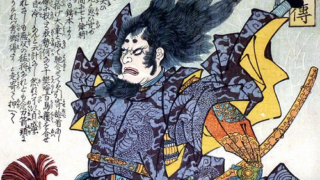
Sumitomo expanded his influence around the Seto Inland Sea, causing great upheaval in western Japan.
In the fourth year of Tenkei (941), the court dispatched a punitive force led by Ono no Yoshifuru.
Keiki also participated in this military campaign.
During the Taira no Masakado Rebellion, he went to the eastern provinces.
This time, he headed to the western provinces.
As a military official of the imperial court, Tsunemoto once again set out for the battlefield.
In 941, Tsunemoto Heads West
During the campaign against Sumitomo, Ono no Yoshikata took the lead in commanding the imperial forces.
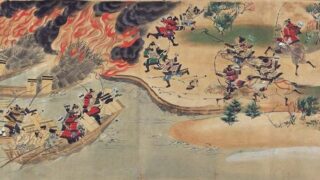
Sumitomo resisted in the Seto Inland Sea.
To counter Sumitomo’s forces, which moved freely by sea, the imperial side also prepared ships.
Ultimately, Sumitomo’s forces were defeated.
Sumitomo himself fled and returned to Iyo.
In June of the same year, he was killed in Iyo by Tachibana no Tōbu.
It is crucial to accurately understand Tsunemoto’s role here.
Ono no Yoshikata defeated the main force of Sumitomo’s army, and Tachibana no Tōbu killed Sumitomo himself.
Tsunemoto was responsible for mopping up the remaining forces of Sumitomo.
Bungo, Saiki-in—Tsunemoto Finally Engages in Battle
In the fourth year of Tengyō (941), remnants of Sumitomo’s forces were active in Bungo Province.
The central figure among them was Kuwabara no Ikinari.
As the Dazai Gon no Shōni, Tsunemoto pursued these remnant forces.
The battlefield was Saiki-in in Kaifu District, Bungo Province.
This corresponds to the area around present-day Saiki City in Oita Prefecture.
Here, Tsunemoto fought against Kuwabara no Ikinari.
The battle lasted for an extended period.
Eventually, Tsunemoto captured Kuwabara no Ikinari alive.
He also seized horses, ships, silk, and other spoils of war.
After the battle, he submitted a report detailing the course of the conflict.
This battle is significant for understanding Tsunemoto’s character.
In Musashi, he had fled to Kyoto, fearing Masakado.
Yet, a few years later, he was leading troops himself against rebel forces in the western provinces.
Here, Tsunemoto transformed from merely being a “whistleblower against Masakado” to becoming a military official actively engaging on the battlefield.
Tsunemoto Travels Across the Provinces
Even after the end of the Taira no Masakado Rebellion, Tsunemoto continued to serve the imperial court.
Musashi. Shinano. Chikuzen. Tajima. Iyo.
He is said to have served as a provincial governor in various regions.
He was dispatched to the provinces to handle administration, and when necessary, he employed military force.
Tsunemoto’s career exemplifies the role of local officials during the Heian period.
Though a noble from Kyoto, he ventured into the field of local governance.
There, he interacted with local powers and maintained order with the backing of military strength.
This experience would later hold significant meaning for the Seiwa Genji lineage.
The “Genji Warriors” Begin to Emerge
The greatest historical significance of Tsunemoto lies not only in his own military achievements.
It is his son, Minamoto no Mitsunaka.
Mitsunaka strengthened ties with the regent family and expanded his influence in the central political arena.
From his descendants emerged figures like Minamoto no Yorimitsu and Minamoto no Yorinobu.
Further down Yorinobu’s line,
Minamoto no Yoriyoshi and Minamoto no Yoshiie. followed.
By the time of Yoshiie, the Genji had strengthened their ties with the warriors of the eastern provinces, making significant inroads into the samurai society of later generations.
And at the end of the 12th century, from this lineage emerged Minamoto no Yoritomo.
Even the term “samurai era” is a perspective from later times.
Tsunemoto himself was an official of the imperial court.
However, he went to the provinces, used military force, suppressed rebellions, and elevated his status through these achievements.
His role is crucial in understanding the early stages of the Genji that would later evolve into samurai clans.
Becoming Commander of the Defense Headquarters
Tsunemoto continued to rise in rank thereafter.
Ultimately, he advanced to Senior Fourth Rank, Upper Grade and is said to have served as Commander of the Defense Headquarters.
The Defense Headquarters was a crucial institution responsible for military affairs in the Tohoku region.
Tsunemoto, who had headed to the Kanto region during the Masakado Rebellion and to the western provinces during the Taira no Masakado Rebellion, eventually took on military responsibilities in the Tohoku region in his later years.
Tracing his life reveals how deeply Tsunemoto was involved in both the military and regional governance of the imperial court.
A Poet’s Face
Tsunemoto also had a completely different side from the battlefield.
He was also a poet.
His poems are preserved in collections like the “Shuishu Wakashu.”
He wielded the bow and arrow, led troops, and served as a provincial governor.
Meanwhile, he composed waka poetry, which was at the heart of court culture.
This was the image of a high-ranking official during the Heian period.
When we think of the word “samurai,” we might picture armored warriors from later periods, but this would lead to a misunderstanding of the real figure of Minamoto no Tsunemoto.
Tsunemoto was primarily a court official who also possessed military capabilities.
His Later Years――
There are fewer detailed records of Tsunemoto’s later years compared to his youth.
Nevertheless, it is confirmed that he rose in rank and advanced to the position of Commander of the Defense Headquarters.
And then, in the first year of Owa (961).
Tsunemoto passed away.
His exact age at death is uncertain because his birth year is not definitively known.
While the year of his death, 961, is documented, there are discrepancies in later genealogies regarding his exact birth year.
After Tsunemoto’s death, his family was succeeded by his son, Mitsunaka.
Mitsunaka expanded his influence while deepening ties with the regent family.
His descendants spread their influence to regions such as Settsu, Kawachi, and the eastern provinces.
And several generations later, the Minamoto clan emerged as a central figure in Japanese history.
The Encounter with Taira no Masakado Changed His Life
The greatest turning point in Minamoto no Tsunemoto’s life was meeting Taira no Masakado in Musashi Province.
In Musashi, he fled in fear of Masakado.
He returned to Kyoto and reported Masakado’s rebellion.
However, his report was not immediately believed.
Tsunemoto himself was suspected.
Yet the following year, Masakado truly did rebel.
He declared himself the “New Emperor” and attempted to separate the Kanto region from the court.
Tsunemoto’s report ultimately became a reality.
Tsunemoto joined the forces sent to suppress Masakado. Later, he also participated in the suppression of Fujiwara no Sumitomo‘s rebellion.
In Bungo, he captured Sumitomo’s remaining follower, Kuwabara Nariyuki, alive.
He then held various provincial governorships and advanced to the position of Commander of the Defense Headquarters.
Once considered “inexperienced in military matters,” he grew into a figure responsible for the court’s military affairs.
This is what makes Minamoto no Tsunemoto fascinating.
He was not the man who defeated Masakado. Nor was he the man who defeated Sumitomo.
Yet he was involved in two major uprisings and used that experience to advance his career.
He left his family to his son, Mitsunaka. From there, the Seiwa Genji entered even greater chapters of history.
Minamoto no Tsunemoto can be seen as a bridge between Taira no Masakado and Minamoto no Yoritomo.
His life reflects the transition from the courtly society of the Heian period, which was not yet the “age of the samurai,” to the era when samurai would become central to Japanese politics.
“Minamoto no Tsunemoto’s appeal to the court about ‘Masakado’s Rebellion.’ How did the rebellion of Taira no Masakado unfold thereafter?”

Taira no Masakado and Fujiwara no Sumitomo: The Tengyō Rebellion, the Painful Cries of the Early Samurai (Japanese History Libretto People 17) [ Shimomukai Tatsuhiko ]