In January of 1184, Minamoto no Yoshinaka was facing his final moments at Awazu in Omi Province.
The previous year, Yoshinaka had defeated the Taira forces in the Hokuriku region and advanced to Kyoto, but he was now being pursued after losing a battle against the forces sent by Minamoto no Yoritomo, with only a few retainers remaining by his side.
According to the “Tale of the Heike,” among them was a woman.
That woman was Tomoe.
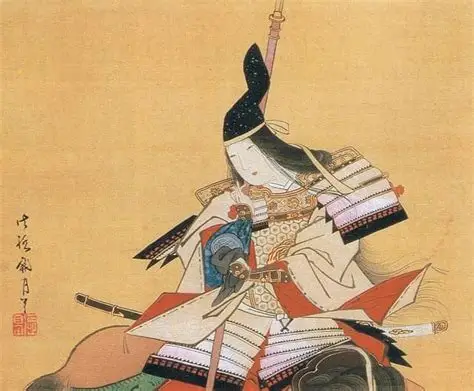
She was renowned for her beauty, yet she was also a formidable archer and swordswoman, capable of overpowering her enemies. She could skillfully ride untamed horses and was entrusted by Yoshinaka to lead an army due to her exceptional martial prowess.
When only five riders remained, Yoshinaka ordered Tomoe to leave the battlefield.
Tomoe did not immediately comply. She desired one last battle with a formidable foe, and it is said that after defeating a warrior who appeared, she fled to the eastern provinces.
After that, the “Tale of the Heike,” particularly the Kakuichi-bon version, does not record where Tomoe went.
In later times, stories emerged that she became the wife of Wada Yoshimori or became a nun to mourn Yoshinaka, but these tales contain discrepancies with historical facts.
What kind of woman was Tomoe Gozen really?
The Origins of Tomoe Gozen—Her Relationship with Minamoto no Yoshinaka
Tomoe Gozen is said to have been an active figure during the late Heian period, in the era of the Genpei War.
While she is commonly referred to as Tomoe Gozen, the various texts of the “Tale of the Heike” mainly refer to her simply as “Tomoe.” The widely used name “Tomoe Gozen” became established in later times.
No historical records definitively indicate her birth or death year, or her birthplace.
The most well-known theory about Tomoe is that she was the daughter of Nakahara Kaneto, who raised Minamoto no Yoshinaka.
Minamoto no Yoshinaka is believed to have been born in 1154, as the son of Minamoto no Yoshikata.
In 1155, Yoshinaka’s father, Yoshikata, was killed by Minamoto no Yoshihira during the Battle of Okura in Musashi Province. Yoshinaka lost his father at a young age and fled to Shinano Province, where he was raised under the protection of Nakahara Kaneto.
Known as Kaneto’s children are Higuchi Kanemitsu, who later became a senior retainer of Yoshinaka, and Imai Kanehira.
Kanehira is known as Yoshinaka’s foster brother, and he fought alongside Yoshinaka from his uprising in Shinano to his final moments at Awazu.
There is a tradition that Tomoe was also Kaneto’s daughter, making her the sister of Higuchi Kanemitsu and Imai Kanehira.
However, these family relationships differ depending on the historical sources.
Different Accounts of Tomoe’s Origins in Various Versions of ‘The Tale of the Heike’
‘The Tale of the Heike’ has several versions, including the Kakuichi-bon, Enkyou-bon, and Nagato-bon. Works like ‘The Rise and Fall of the Genpei’ and ‘The Genpei War Chronicles’ are also broadly considered part of the various versions of ‘The Tale of the Heike.’
Regarding Tomoe’s origins, the accounts do not agree.
In the Kakuichi-bon, Tomoe’s parents and age are not specified.
On the other hand, ‘The Rise and Fall of the Genpei’ describes her as the daughter of Nakahara Kaneto, a wet nurse and concubine of Yoshinaka.
‘The Genpei War Chronicles’ depicts her as the daughter of Higuchi Kanemitsu.
Her age also varies, ranging from her early twenties to around thirty.
Although the story of Yoshinaka and Tomoe growing up together is well-known, it is difficult to determine their exact relationship.
Moreover, there is no definitive record that Tomoe was Yoshinaka’s lawful wife.
The widely recognized image of her as “Yoshinaka’s beloved concubine and the sister of Imai Kanehira” has been greatly influenced by military tales like ‘The Rise and Fall of the Genpei.’
Was She the Mother of Yoshinaka’s Son, Yoshitaka?
It is also said that Tomoe was the mother of Minamoto no Yoshitaka, Yoshinaka’s son.
Yoshitaka was sent to Kamakura as the betrothed of Yoritomo’s daughter, Ohime, amid deteriorating relations between Yoshinaka and Yoritomo.
After Yoshinaka’s defeat and death, Yoshitaka was also killed on Yoritomo’s orders.
However, there is no solid historical evidence to support the theory that Tomoe was Yoshitaka’s mother.
The relationship between Yoshinaka and Tomoe has been described in various ways, including as lord and retainer, foster siblings, and as a romantic couple.
None of these accounts can be taken as historical fact solely based on the descriptions in military tales.
Tomoe’s Valor as Depicted in ‘The Tale of the Heike’
Tomoe’s vivid portrayal appears in ‘The Tale of the Heike,’ Volume Nine, “The Last Stand of Kiso.”
This section narrates how Yoshinaka was accompanied by two women, Tomoe and Yamabuki, from Shinano.
Yamabuki stayed in Kyoto due to illness, but Tomoe followed Yoshinaka to his final battle.
Tomoe is introduced as a fair-skinned, long-haired, and beautiful woman.
At the same time, she was said to be unmatched in martial skills.
‘The Tale of the Heike’ praises her as,
“a warrior worth a thousand men.”
She was known for her ability to control wild horses and maneuver them skillfully even in rugged terrain. With bow and arrow or sword in hand, she was a brave warrior who faced any enemy.
During battles, Yoshinaka equipped Tomoe with fine armor, a strong bow, and a large sword, sending her out as one of his commanders.
Each time, she achieved military success, with none able to match her prowess.
In “The Tale of the Heike,” Tomoe is depicted as a woman serving by Yoshinaka’s side, recognized for her combat abilities as a warrior.
However, the phrase “one warrior worth a thousand” is an expression praising exceptional valor, not a literal claim of facing a thousand enemies.
Additionally, in war tales, the feats of warriors are often exaggerated to emphasize their strength.
No contemporary records have been found that specifically confirm which battles Tomoe participated in or what actions she took.
There are stories that Tomoe participated in battles such as the Battle of Kurikara Pass, but it is not possible to confirm her actions as historical fact.
Minamoto no Yoshinaka’s Uprising and Advance to Kyoto
In the fourth year of the Jisho era (1180), rebellions against the Taira regime erupted across the country.
In Izu, Minamoto no Yoritomo raised an army, while in Shinano, Minamoto no Yoshinaka gathered troops.
Yoshinaka expanded his influence by uniting the warriors of Shinano and advanced towards the Hokuriku region.
In the second year of the Juei era (1183), Yoshinaka’s forces clashed in earnest with the Taira army dispatched to Hokuriku.
The Taira forces were led by Taira no Korehira and others.
Yoshinaka defeated the Taira army at the Battle of Kurikara Pass and achieved victory in the subsequent Battle of Shinohara as well.
The tide of battle in the Hokuriku region quickly turned in favor of Yoshinaka.
As Yoshinaka’s forces approached Kyoto, the Taira clan, accompanied by Emperor Antoku and the Imperial Regalia, fled the capital.
Thus, Yoshinaka succeeded in entering Kyoto.
However, Yoshinaka’s position in the capital was unstable.
At that time, Kyoto was suffering from the effects of famine, making it difficult to procure food. The unruly behavior of Yoshinaka’s soldiers provoked public backlash, and relations with Emperor Go-Shirakawa deteriorated.
Furthermore, the forces Yoshinaka dispatched to the western provinces were defeated by the Taira army at the Battle of Mizushima in Bitchu Province.
The Taira clan began to regain their strength in the western provinces.
Meanwhile, in the Kanto region, Yoritomo solidified his control over the eastern warriors, deepening the conflict with Yoshinaka.
In November of the second year of the Juei era, Yoshinaka attacked the Hojuji Palace, the residence of Emperor Go-Shirakawa.
In the Battle of Hojuji, Minamoto no Yoshinaka defeated the forces of the Retired Emperor and brought Emperor Go-Shirakawa under his control, but this decisively worsened his relations with the imperial court.
Eventually, Yoritomo sent an army led by his brothers, Minamoto no Noriyori and Minamoto no Yoshitsune, towards Kyoto.
After driving the Taira forces out of the capital, Yoshinaka found himself in a struggle with Yoritomo’s faction of the Minamoto clan for control of Kyoto.
The specific actions of Tomoe during this period remain unknown.
If, as depicted in the Heike Monogatari, Tomoe followed Yoshinaka, she would have shared in his journey from the advance into Kyoto to the collapse of his forces.
Battle of Uji River—The Collapse of Yoshinaka’s Forces
In January of the third year of Juei (1184), the forces of Noriyori and Yoshitsune advanced towards Kyoto.
Yoritomo’s forces advanced from two directions.
Noriyori approached from the Seta area in Omi Province, while Yoshitsune aimed for Kyoto from the Uji area in Yamashiro Province.
Yoshinaka’s forces were also deployed in both directions to confront the enemy.
In the Heike Monogatari, Imai Kanehira appears as the commander defending Seta.
However, Yoshitsune’s forces broke through at Uji River and entered Kyoto.
On the Seta front as well, Yoshinaka’s defensive lines crumbled, forcing him to leave the capital.
The subsequent fate of Yoshinaka is detailed in the ninth volume of the Heike Monogatari, “The Last Stand of Kiso.”
As he retreated, Yoshinaka was concerned about the safety of Imai Kanehira.
Kanehira, too, was worried about Yoshinaka’s whereabouts.
The two were said to have reunited near Uchidehama in Otsu, Omi Province.
In the Heike Monogatari, Yoshinaka takes Kanehira’s hand, expressing his wish to face their end together.
Kanehira rejoiced at Yoshinaka’s safety and resolved to fight once more.
The scattered allies gathered, reportedly forming a force of over three hundred horsemen.
However, Yoritomo’s forces continued their pursuit.
From Three Hundred to Five
According to the Heike Monogatari, Yoshinaka led over three hundred horsemen in a charge against the six thousand horsemen led by Ichijo Tadayo.
When they broke through the enemy lines, it is said that their numbers had dwindled to about fifty horsemen.
Even after that, they were blocked by the forces of Doi Sanehira and others, and Yoshinaka and his men continued to fight as they retreated.
Soon, the group was reduced to just five riders.
Among them, Tomoe remained.
The “Tale of the Heike” repeatedly notes that while other warriors were cut down one after another, Tomoe was never defeated.
These numbers are depictions from war tales and may not reflect the actual number of people on the battlefield.
The major flow of the battle was that Yoshinaka lost Kyoto and retreated towards the Omi region with a small number of followers.
It was here that Yoshinaka called Tomoe to him.
The Battle of Awazu—Yoshinaka’s Farewell Command to Tomoe
With only five riders left, Yoshinaka ordered Tomoe to leave the battlefield.
In the “Tale of the Heike,” Yoshinaka expressed his resolve to die in battle, stating that if he was not killed by the enemy, he intended to take his own life.
Moreover, he lamented the thought of being remembered as having fought his last battle accompanied by a woman.
Tomoe did not immediately comply.
She stayed by Yoshinaka’s side, ready to continue fighting.
However, Yoshinaka repeatedly commanded her to leave.
There are various interpretations as to why Yoshinaka wanted Tomoe to escape.
One might think he wished to spare her life.
However, in the “Tale of the Heike,” Yoshinaka’s words express his regret at the prospect of being judged for having a woman with him in his final battle.
This reflects his awareness of his honor as a warrior.
On the other hand, Tomoe sought to demonstrate her own valor one last time.
In the “Tale of the Heike,” her words at that moment are recorded as,
“Ah, if only a worthy enemy would come.”
If a strong enemy appeared, she could show Yoshinaka her final battle.
With this in mind, Tomoe awaited the arrival of the enemy.
The Battle with Onda no Hachiro Morishige
As Tomoe waited for the enemy, Onda no Hachiro Morishige, a warrior from Musashi Province, appeared.
According to the “Tale of the Heike,” Onda no Hachiro was known as a mighty warrior, leading about thirty horsemen.
Tomoe charged into their ranks.
Her target was Onda no Hachiro himself.
Tomoe rode alongside Onda no Hachiro, grappled with him, and pulled him from his horse.
She then pinned him against the front of her saddle, immobilizing him.
It is said that she twisted off his head and discarded it.
The depiction of twisting off a head emphasizes Tomoe’s extraordinary strength.
We cannot confirm the details of this battle through contemporary records.
There are variations in the name of Tomoe’s opponent depending on the manuscript or edited text, with names like “Mita Hachiro” and “Onda Hachiro” appearing.
In the text based on the Kakuichibon version of the “Heike Monogatari,” the name Mita Hachiro Morishige is used.
After defeating the enemy general, Tomoe discarded her armor.
She then fled to the eastern provinces.
This is the last image of Tomoe as told in the Kakuichibon.
Where Tomoe went afterward, whom she relied on, and when she learned of Yoshinaka’s end—
the Kakuichibon tells us nothing.
The End of Minamoto no Yoshinaka and Imai Kanehira
Even after Tomoe left, Yoshinaka and Imai Kanehira continued to fight.
According to the “Heike Monogatari,” Tezuka Taro was killed in battle, Tezuka Betto fled, and Yoshinaka and Kanehira were left as just two riders.
Yoshinaka told Kanehira that the armor, which usually did not bother him, felt heavy today.
Kanehira replied that neither Yoshinaka’s body nor his horse had weakened, but it was the absence of their allies that made it feel so.
He encouraged Yoshinaka to think of him as a thousand riders.
Kanehira advised Yoshinaka to head to the pines of Awazu and take his own life.
He intended to hold off the enemy with his remaining arrows to give his lord a chance to escape.
Yoshinaka wished to meet his end alongside Kanehira, but Kanehira, fearing his lord would fall to an unknown soldier, persuaded him to enter the pines.
Yoshinaka rode alone toward the pines.
However, his horse got stuck in a deep rice field along the way, immobilizing him.
The “Heike Monogatari” recounts that as Yoshinaka glanced back toward Kanehira, an arrow shot by Ishida Jiro Tamehisa struck inside his helmet.
Yoshinaka was gravely wounded and was beheaded by Ishida’s retainers who rushed over.
Yoshinaka’s life ended at the age of 31.
Upon learning of his lord’s death, Kanehira also fought fiercely before taking his own life.
Yoshinaka, who had defeated the Taira forces at Kurikara Pass and advanced to Kyoto, lost the capital in just about half a year and was killed at Awazu in Omi.
Was Yoshinaka’s Death on January 20 or 21?
There are discrepancies in the historical records regarding the date of Yoshinaka’s death.
The “Azuma Kagami” records the events from the battle at Uji and Seta to Yoshinaka’s death as occurring on January 20, 1184.
On the other hand, in the “Kiso’s Last Stand” chapter of the Heike Monogatari, there is a record stating that Yoshinaka’s end came on January 21st.
Therefore, it is generally accepted that Yoshinaka died in battle on January 20th, but when introducing scenes from the Heike Monogatari, it’s important to note the differences with the main text.
Moreover, the Azuma Kagami does not mention Tomoe fighting at Awazu.
While the broad narrative of Yoshinaka being defeated by Ishida Jiro is found in multiple historical sources, the farewells with Tomoe and the final conversation with Kanemitsu, as well as the scene where his horse gets stuck in a bog, are conveyed as stories in the Heike Monogatari.
What Happened to Tomoe Gozen Afterwards
In the Heike Monogatari’s Kakuichi-bon version, there is no account of Tomoe’s whereabouts after she headed to the eastern provinces.
However, in other versions, her life after survival is depicted.
A representative example is found in the “Gikeiki,” Volume 35, “Tomoe’s Journey to the East.”
Returning to Shinano and Relaying Yoshinaka’s Last Moments
According to the “Gikeiki,” after the Battle of Awazu, Tomoe discarded her armor and returned to Shinano in a simple kimono.
There, she reportedly conveyed to Yoshinaka’s wife and children the circumstances of his final moments.
It is said that those who heard Tomoe’s account wept in sorrow over the loss of Yoshinaka.
Afterwards, when peace was restored, Tomoe was summoned by Minamoto no Yoritomo and headed to Kamakura.
Yoritomo was an adversary of Yoshinaka, making him an enemy to Tomoe’s former lord.
Yoritomo, too, was wary of Tomoe’s exceptional martial prowess.
In the “Gikeiki,” it is said that Yoritomo entrusted Tomoe to a man named Mori Goro, and eventually, there was talk of her execution.
It was then that Wada Yoshimori took notice of Tomoe.
Marriage to Wada Yoshimori
Wada Yoshimori was from the Miura clan and a prominent retainer who supported Minamoto no Yoritomo’s uprising.
He served as the head of the Samurai-dokoro in the Kamakura shogunate.
According to the “Gikeiki,” Yoshimori was impressed by Tomoe’s martial skills and strong-willed nature and desired to take her as his wife.
Yoshimori believed that having children with a woman as strong as Tomoe would result in exceptional warriors.
Initially, Yoritomo did not approve of this.
This was due to his concern that Tomoe might seek to avenge Yoshinaka.
However, Yoshimori offered to take full responsibility for Tomoe.
Thus, Tomoe became Yoshimori’s wife and is said to have borne him a son.
That son was later known as Asahina Saburo Yoshihide, famed for his extraordinary strength.
Asahina Yoshihide was the third son of Wada Yoshimori and is known as a warrior from the early Kamakura period.
His martial prowess is also depicted in the “Azuma Kagami.”
However, there is a significant chronological issue with the story that Tomoe was the mother of Asahina Yoshihide.
Was Asahina Yoshihide Really the Son of Tomoe Gozen?
Asahina Yoshihide fought as a central figure for the Wada faction during the Wada Conflict in 1213.
According to the “Azuma Kagami,” Yoshihide was 38 years old at the time.
Calculating backwards, this means he was born in 1176.
Meanwhile, Minamoto no Yoshinaka was killed at Awazu in 1184.
The “Gikeiki” narrative suggests that after Yoshinaka’s death, Tomoe was summoned to Kamakura, married Wada Yoshimori, and gave birth to Yoshihide.
However, by 1184, Yoshihide would have already been 9 years old.
The storyline that Tomoe married Wada Yoshimori after Yoshinaka’s death and then gave birth to Yoshihide does not align with the age recorded in the “Azuma Kagami.”
The “Gikeiki” also states that Yoshihide died in battle during the Wada Conflict.
On the other hand, the “Azuma Kagami” records that Yoshihide fled by sea to Awa Province. While his ultimate fate remains unclear, there are discrepancies with the narrative depiction.
Given these circumstances, the posthumous tale that Tomoe became Wada Yoshimori’s wife and bore Asahina Yoshihide is difficult to accept as historical fact.
Similarities with the Legend of Itagaki Gozen
The marriage legend of Tomoe and Wada Yoshimori has been noted to share similarities with the tale of the real female warrior, Itagaki Gozen.
In 1201, the Jo clan in Echigo Province rebelled against the shogunate.
Itagaki was the woman who armed herself and resisted during this conflict.
Known as a master archer, Itagaki was wounded and captured in battle with the shogunate forces.
Afterwards, Itagaki was sent to Kamakura, where the gokenin Asari Yoshitō expressed his desire to take her as his wife.
The “Azuma Kagami” records that Yoshitō wished to have a brave child with Itagaki.
A brave woman is sent to Kamakura, a gokenin takes her as his wife, and they aim to have a strong child together.
The similarities with Tomoe’s posthumous tale are clear.
This suggests the possibility that Itagaki’s story was incorporated into Tomoe’s narrative.
Additionally, given that Asahina Yoshihide himself was known for his extraordinary strength, it is thought that a woman with special abilities was chosen as his mother.
Comparing the real Itagaki with the Tomoe depicted in war tales is crucial for understanding how the legend of Tomoe Gozen was shaped.
The Legend of Becoming a Nun After the Wada Conflict
In May 1213, the Wada Conflict erupted in Kamakura.
Wada Yoshimori fought against the shogunate forces led by Hojo Yoshitoki and was defeated.
The “Gikeiki” narrates that after losing Yoshimori and Asahina Yoshihide, Tomoe headed to Etchu Province.
She reportedly moved there relying on a person named Ishikuro and became a nun.
As a nun, Tomoe lived a life of prayer for the souls of Yoshinaka and the Wada clan.
It is said she lived to the age of 91 before passing away.
This story portrays Tomoe as a woman who witnessed the fall of Yoshinaka and later faced the demise of the Wada clan.
However, there are no reliable records to confirm that she moved to Etchu Province or lived to the age of 91.
Regarding Tomoe’s later years, there are variations among the different versions of the Heike Monogatari.
The Nagato version mentions that she became a nun in Echigo Province, which differs from the relocation mentioned in the Genpei Seisuiki.
Tomoe’s renunciation of the world and her later years have been recounted through these multiple traditions.
It remains unclear where she actually passed away or how old she was at the end of her life.
Did Tomoe Gozen Really Exist?
A crucial point to consider about Tomoe Gozen is that no historical evidence has been found to confirm her existence.
The Heike Monogatari, which vividly describes her valor, was not a record created during the Jisho-Juei War.
It is a war tale that was established after some time had passed since the conflicts and has been handed down through generations.
During its formation and transmission, various anecdotes and expressions were added.
On the other hand, diaries of nobles from the same era do not contain any entries that directly confirm Tomoe’s activities.
Her name does not appear in the Azuma Kagami, a historical record of the Kamakura shogunate.
Although the Azuma Kagami was also compiled in later times and cannot be accepted as historical fact without question, it is an important source for understanding the Jisho-Juei War.
The absence of her name in it poses a problem when considering her existence.
However, just because her name does not appear in records does not prove she did not exist.
It is also possible that during the late Heian period, women’s names and specific activities were not recorded as meticulously as those of male warriors.
Furthermore, the existence of women like Itagaki Gozen, who actually participated in battles, can be confirmed.
Women taking up bows and fighting in armor was something that could indeed happen in the society of that time.
Nonetheless, there is no solid evidence to confirm whether Tomoe was part of Yoshinaka’s army, led troops, or defeated Ota Hachiro Morishige at Awazu.
At present, it seems prudent to reserve judgment on the existence of Tomoe Gozen and view her as a character depicted in works like the Heike Monogatari.
Tomoe Gozen in Noh and Ukiyo-e
Tomoe’s story has had a significant impact on performing arts and visual arts since the medieval period.
Her parting with Yoshinaka and her bravery in subduing enemy generals have been depicted repeatedly in many works.
Noh Play ‘Tomoe’—The Regret of Not Dying with Yoshinaka
In the Noh play ‘Tomoe’, a monk visiting from Kiso stops by Awazu in Omi Province.
The monk encounters a woman shedding tears before a shrine.
This woman is the ghost of Tomoe, who once served Yoshinaka.
At night, Tomoe appears in warrior attire and recounts Yoshinaka’s last moments and her own battles.
She reveals her regret at being ordered by Yoshinaka to leave the battlefield, unable to die alongside her lord.
In the Noh play, Tomoe is also portrayed fighting with a naginata against enemies.
There is also a depiction of her leaving the battlefield with Yoshinaka’s memento.
The Heike Monogatari contains few scenes that detail Tomoe’s inner thoughts.
In contrast, in the Noh play ‘Tomoe,’ the central theme is the longing for Yoshinaka and the sorrow of not being able to stay by his side until the end.
While focusing on the same farewell at Awazu, new emotions are layered onto the character of Tomoe.
The Female Warrior in Ukiyo-e
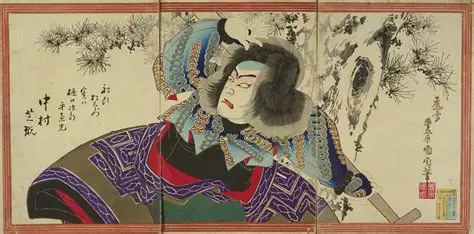
During the Edo period, Tomoe Gozen was a popular subject in ukiyo-e art.
Utagawa Kuniyoshi depicted a scene where Tomoe overpowers an enemy warrior, attempting to twist off his head.
This work is based on ‘The Tale of the Heike,’ specifically the ‘Kiso’s Last Stand’ episode.
Meanwhile, in Utagawa Toyokuni III’s ‘Biographies of Exemplary Women of Past and Present,’ Tomoe is shown holding the young Asahina Yoshihide.
This piece draws from the later tales of the ‘Gikeiki.’
Tomoe as a valiant female warrior.
Tomoe mourning her separation from Yoshinaka.
Tomoe as the wife of Wada Yoshimori, raising a child.
Through war tales, performing arts, and art, various images of Tomoe Gozen have been crafted over time.
Historical Sites Associated with Tomoe Gozen
Legends of Tomoe Gozen remain in various places connected to Minamoto no Yoshinaka.
In Kiso Town, Nagano Prefecture, there is the Yoshinaka Museum, which introduces the life of Minamoto no Yoshinaka and the Genpei War.
The Kiso region has passed down legends related to the family of Nakaura Kanetomo and Tomoe.
Additionally, in Otsu City, Shiga Prefecture, there is Gichuji Temple, known as the burial site of Yoshinaka.
Gichuji Temple is associated with Yoshinaka’s defeat and death at Awazu, and its grounds are designated as a national historic site.
The temple houses Yoshinaka’s grave, and a mound said to be for Tomoe’s memorial is also preserved.
Other locations tied to legends of Tomoe’s later years also remain across the country.
However, the existence of mounds or memorial towers related to Tomoe does not prove that she actually died in those places.
These historical sites convey the history of Tomoe’s story being passed down through generations in various regions.
The Legacy of Tomoe Gozen
There are many gaps in the life of Tomoe as depicted in ‘The Tale of the Heike.’
The names of her parents and her exact relationship with Yoshinaka remain unclear.
Her bravery in battle is vividly portrayed, yet no contemporary records directly corroborate her activities.
Nevertheless, the scene of Tomoe appearing in Yoshinaka’s final battle has lingered in people’s minds for a long time.
Even when Yoshinaka’s forces were decimated, reduced to just five riders, Tomoe still sought to fight.
Repeatedly ordered by Yoshinaka to leave, she is said to have finally slain Ota Hachiro Morishige before fleeing to the eastern provinces.
Her subsequent fate is not recorded in the Kakuichi-bon.
In later stories, she is said to have become the wife of Wada Yoshimori and the mother of Asahina Yoshihide.
Additionally, there are tales of her becoming a nun in Etchu, mourning for Yoshinaka and others.
Conversely, in the Noh play ‘Tomoe,’ she appears as a spirit lamenting her inability to share Yoshinaka’s final moments.
These stories reflect the interest and sentiments that people of different eras have projected onto Tomoe.
At present, there is no definitive historical evidence to prove the existence of Tomoe.
However, her portrayal in the The Tale of the Heike as a woman who fought alongside Yoshinaka until the end became the starting point for the image of Tomoe Gozen in later generations.
January, 1184, Awazu in Omi Province.
Following Yoshinaka’s orders, Tomoe left the battlefield.
Where she went afterward remains unknown.
The Tale of the Heike describes Tomoe discarding her armor and heading east, but after that, it ceases to mention her fate.
From that brief farewell scene, the story of Tomoe Gozen spread to later eras.
Primary Historical Sources and References
Historical Sources
- The Tale of the Heike, Volume Nine “The Last of Kiso” (mainly the Kakuichi-bon version)
- The Rise and Fall of the Genpei, Volume Thirty-Five “Tomoe Heads East”
- The Tale of the Heike, Nagato-bon and Enkyō-bon versions
- The Record of the Genpei War
- The Azuma Kagami (January 1184, May 1213, etc.)
Research and Explanatory Materials
- National Archives of Japan “The Tale of the Heike—Mysterious and Beautiful—”
- Yoshinaka Museum “The Legend of Tomoe Gozen”
- Ritsumeikan University Art Research Center “Exhibition of Female Heroes—Women Who Left Their Mark—”
- Toyama Prefecture “Chronology with Sources of Yoshinaka and Tomoe”
- Noh Association “Tomoe”
- Otsu City “Yoshinaka Temple Grounds”
- Ryōichi Hosokawa, Women of The Tale of the Heike—Strong Women, Nuns, and Shirabyōshi, Kodansha, 1996