1087: He Gave Up His Post to Save His Brother
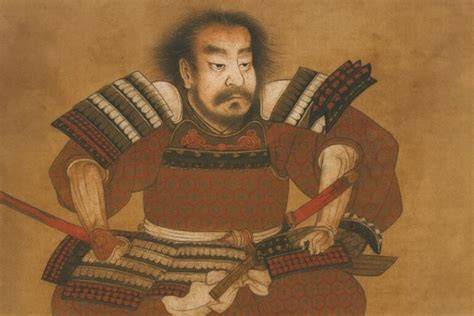
In 1087, Minamoto no Yoshimitsu was in Kyoto.
Far to the north, in Mutsu, his elder brother Minamoto no Yoshiie was locked in battle with Kiyohara no Iehira and Takehira.
Later generations would call this war the Later Three Years War.
The year before, Yoshiie had attacked Numa Fort and been beaten back. Trapped through a bitter Dewa winter, short on food, his men were said to have slaughtered their own horses for meat.
Word of it reached Kyoto.
Yoshimitsu petitioned the court.
Let me go north and help my brother.
At the time, Yoshimitsu held the post of Left Palace Guard Lieutenant.
The petition was refused.
Yoshimitsu went anyway.
Sources differ on exactly how: some say he marched north to relieve Yoshiie and was stripped of his post as punishment; others say the court turned down his request for permission, and he resigned his office himself before heading to his brother’s side.
Yoshimitsu was about 42.
This was not a hot-blooded young man rushing off on impulse.
Here was a court-titled military aristocrat, gambling his standing in the capital, to march north anyway.
Then, on the fourteenth day of the eleventh month of that same year, Kanazawa Fort fell.
Yoshiie defeated Iehira and Takehira, bringing the Later Three Years War to an end.
For this, later generations remembered Yoshimitsu as
“the Shinra Saburo who gave up his post to save his brother.”
But if Minamoto no Yoshimitsu’s story ends there, you only see half the man.
Afterward, Yoshimitsu built up his own power base in the eastern provinces, centered on Hitachi.
From his bloodline would come the Takeda, Satake, and Ogasawara clans.
And near the end of his life, in 1109, when his nephew Minamoto no Yoshitada was assassinated, later sources would name Yoshimitsu himself as the man behind it.
A man who raced to his brother’s side.
A man whose name is also tied to a Genji assassination.
Both faces belong to the same person: Shinra Saburo Yoshimitsu.
1045: Born the Third Son of Minamoto no Yoriyoshi
Minamoto no Yoshimitsu was born in 1045.
His father was Minamoto no Yoriyoshi,
the Kawachi Genji general who fought the Abe clan in the Former Nine Years War and took Kuriyagawa Fort in 1062.
His mother was a daughter of Kozuke Deputy Governor Taira no Naokata,
believed to be the same mother as his elder brothers Yoshiie and Yoshitsuna.
Yoshimitsu was the third son.
The eldest, Yoshiie, later became known as “Hachiman Taro.” The second son, Yoshitsuna, as “Kamo Jiro.”
And the third son, Yoshimitsu, became “Shinra Saburo.”
All three brothers made their names as warriors, but their paths afterward diverged sharply.
Yoshiie’s line carried the main Kawachi Genji succession forward through Minamoto no Tameyoshi, then Yoshitomo, then Yoritomo.
Yoshimitsu’s line spread instead into Hitachi, Kai, and Shinano.
Looking at the warrior society of later centuries, it is remarkable how far this third son’s bloodline reached.
Why “Shinra Saburo”?
Yoshimitsu came of age at Onjo-ji, a temple in Omi Province.
Today it is known as Mii-dera, in the city of Otsu, Shiga Prefecture.
Within Onjo-ji stands the Shinra Zenjin-do, a hall dedicated to the deity Shinra Myojin.
Because Yoshimitsu’s coming-of-age ceremony took place before that shrine,
he came to be called Shinra Saburo Yoshimitsu.
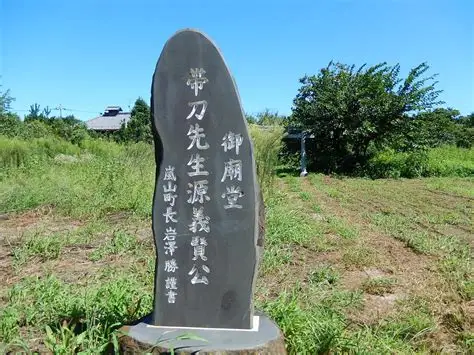
The city of Otsu itself notes that Yoshimitsu took the name Shinra Saburo after his ceremony before the Shinra Zenjin-do, and a site said to be his grave still stands southwest of the hall today.
The name carried enormous weight for the Genji line that descended from him.
The Kai Genji in particular came to see Yoshimitsu as their founding ancestor.
Centuries after Yoshimitsu’s own eleventh-century lifetime, even in the age of the Takeda clan, the name “Shinra Saburo” was still honored as the family’s forebear.
No Sign of Glory in the Former Nine Years War
Yoshimitsu was born in 1045.
Six years later, in 1051, the Former Nine Years War broke out.
His father Yoriyoshi fought the Abe clan, and his elder brother Yoshiie went with him to the battlefields of the north.
At the Battle of Kinomi in 1057, Yoshiie was 19.
He lived through Yoriyoshi’s crushing defeat by Abe no Sadato, a rout that left barely seven riders standing around his father.
Yoshimitsu, at that time, was only 13.
Even by the fall of Kuriyagawa Fort in 1062, he was just 18.
There is little solid record of Yoshimitsu fighting alongside his brother on the war’s major battlefields.
In other words, Yoshimitsu watched from somewhat behind as his father and brother built their names in the north.
It would be another 25 years before Yoshimitsu carved his own name deeply into history.
A Warrior Who Played the Sho
Yoshimitsu had a side that seems surprising for a Genji warrior.
He was a master of the sho.
The sho is a wind instrument used in gagaku, the court music of Japan.
To modern eyes, a warrior skilled in bow and horse who was also a master of courtly music might seem an odd combination.
But Yoshimitsu was no provincial warrior confined to the countryside.
He was a titled military aristocrat living within the court society of Kyoto.
To live in that courtly world meant that accomplishments like music and poetry directly shaped one’s relationships and reputation.
Yoshimitsu learned the sho from the Toyohara family.
According to the Nihon Daihyakka Zensho encyclopedia, his teacher was Toyohara no Tokitada, who granted him a renowned instrument called “Kamaru.”
A cultural legend even more famous than Yoshimitsu’s military feats grew out of this sho.
Ashigara Pass: A Secret Melody Passed Down En Route to War
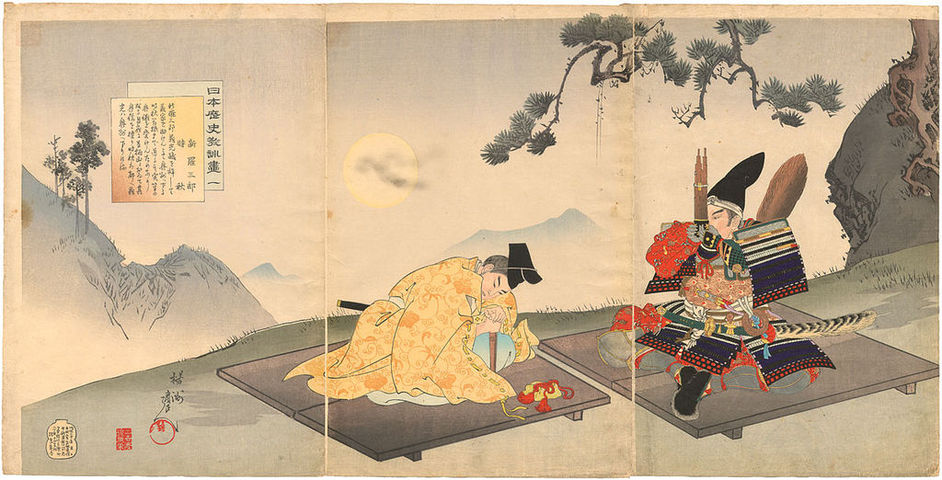
In 1087, as Yoshimitsu set out for the Later Three Years War,
a famous story about this journey survives in the Kokon Chomonju.
The court musician Toyohara no Tokiaki followed after Yoshimitsu.
Yoshimitsu told him again and again to turn back.
Tokiaki would not leave his side.
When the party reached Ashigara Pass, Yoshimitsu is said to have finally understood what Tokiaki wanted.
Yoshimitsu knew a secret melody for the sho that Tokiaki had not yet learned.
Yoshimitsu was heading into a war zone in the north.
If he died, the melody would die with him.
So, the story goes, Yoshimitsu taught Tokiaki the secret melody there at Ashigara Pass and sent him back to Kyoto.
This is not a fact recorded in a diary from Yoshimitsu’s own era, but a tale from later generations.
Even so, it says something fascinating about how Yoshimitsu was remembered.
Heading to a battlefield to save his brother. Weighing, along the way, the chance that he himself might die.
And passing on, to the next generation, a piece of music that might otherwise be lost.
Minamoto no Yoshimitsu was remembered by later generations as a warrior who drew the bow, and a cultured man who played the sho.
1087: To Kanazawa Fort
By the time Yoshimitsu reached the north, the Later Three Years War was already in its final stage.
On Yoshiie’s side stood Fujiwara no Kiyohira, Kimiko no Hidetake, and warriors of the eastern provinces.
Facing them were Kiyohara no Iehira and Takehira, holed up in Kanazawa Fort,
near present-day Kanazawa, in the city of Yokote, Akita Prefecture.
Yoshimitsu joined his brother’s army.
The war, however, had been commanded by Yoshiie from the start, with Kiyohira and Hidetake themselves playing key roles.
Yoshimitsu joined only in its final stage.
At Kanazawa Fort, direct assault stalled, so Yoshiie’s side shifted to a siege, cutting off supplies.
The defenders starved, and the fort finally fell.
Takehira was captured and beheaded; Iehira was killed after trying to flee.
The war that Yoshimitsu had thrown away his post to join ended on the fourteenth day of the eleventh month of that same year.
Victory in the Later Three Years War — But No Reward From the Court
The Later Three Years War was a different kind of conflict than the Former Nine Years War.
It was not a national campaign the court had formally ordered against Iehira and Takehira.
It took the shape of Yoshiie, as governor of Mutsu, stepping into an internal feud within the Kiyohara clan.
Because of this, the court refused Yoshiie the rewards he sought after the war.
Nor did Yoshimitsu gain any great rank simply for going to his brother’s aid.
And yet Yoshimitsu’s name endured.
The reason is simple.
He had not moved on the court’s orders — he went north because his brother was struggling.
That single act became a legend symbolizing the bonds within the Genji clan.
When later warriors spoke of Shinra Saburo, this was the part of Yoshimitsu’s story that shone brightest.
Back to Kyoto — Then On to the East
After the Later Three Years War, Yoshimitsu returned to Kyoto.
He went on to hold posts as
Gyobu Secretary
Left Palace Guard Lieutenant
Hitachi Deputy Governor
Governor of Kai
among others.
What matters most in the second half of Yoshimitsu’s life is his connection to Hitachi.
While his brother Yoshiie’s line, as the main Kawachi Genji succession, deepened its ties to eastern warriors, Yoshimitsu built his own independent power base centered on Hitachi.
The Yamanashi Prefectural Museum explains that Yoshimitsu held territory stretching from Hitachi Province down to southern Mutsu.
This push into the eastern provinces became the foundation from which Yoshimitsu’s descendants would grow into the Takeda and Satake clans.
Hitachi: Placing His Sons
Yoshimitsu had several sons.
Two would prove especially important to later warrior history:
Yoshinari and Yoshikiyo.
Yoshimitsu passed the base he built in Hitachi down to his children.
His eldest son, Yoshinari, became tied to Satake District.
His second son, Yoshikiyo, settled in Takeda District,
in what is now Ibaraki Prefecture.
Here is the interesting part.
Say “the Takeda clan,” and most people think first of Kai, present-day Yamanashi Prefecture.
But the very first “Takeda” behind that name was in Hitachi Province.
The Yamanashi Prefectural Museum, too, clearly states that the roots of the Takeda family lie in what is now Ibaraki Prefecture.
To the Takeda Clan — Yoshimitsu Himself Never Settled in Kai
Minamoto no Yoshimitsu is often called “the founder of the Takeda clan.”
Genealogically, that is true.
But Yoshimitsu himself never moved to Kai or took the Takeda name.
This distinction is worth keeping straight.
His son Yoshikiyo inherited Takeda District in Hitachi and became known as “the Takeda cadet.”
Yoshikiyo and his own son, Kiyomitsu, later clashed with local power holders in Hitachi.
Around 1130, father and son were relocated to the Ichikawa estate in Kai Province, and from there they built their power in Kai.
Yamanashi sources also identify Yoshikiyo and Kiyomitsu as the first generation to actually settle in Kai.
From Kiyomitsu’s children,
the Takeda, Kagami, Yasuda, Ogasawara, and Nanbu families all branched out.
Many generations later, that Takeda line would produce Takeda Shingen.
In other words, Yoshimitsu is the ultimate source of the entire Kai Genji line.
To the Satake Clan — Also Founded by a Grandson
The other major branch was the Satake clan.
Yoshimitsu’s eldest son, Yoshinari, inherited Satake District in Kuji County, Hitachi.
His son was Masayoshi, Yoshimitsu’s grandson.
Masayoshi settled permanently in Hitachi and took the name “Satake,” founding the Satake clan.
A genealogy from the city of Hitachiota lays out the line as
Minamoto no Yoriyoshi
↓
Minamoto no Yoshimitsu
↓
Yoshinari
↓
Masayoshi
naming Masayoshi as the first head of the Satake clan.
The Satake later grew into a major power in Hitachi.
In the Sengoku period, Satake Yoshishige and Satake Yoshinobu would emerge.
After the Battle of Sekigahara, they were relocated to Akita, ruling the Kubota Domain throughout the Edo period.
That is centuries removed from Yoshimitsu himself.
But the sense of being “descendants of Shinra Saburo” carried through to both the Takeda and the Satake alike.
Why Yoshimitsu’s Descendants Spread Across the East
Yoshimitsu’s real significance is not that he ruled some vast domain himself.
It is that he planted his family’s roots in the eastern provinces.
He entered the east through posts like Hitachi Deputy Governor.
He forged marriage ties with local powers. He passed land down to his children.
His sons and grandsons then took the names of their local territories as surnames.
In this way, Yoshimitsu’s line of the Genji transformed, region by region, into warrior bands far from Kyoto.
Yoshimitsu’s descendants became the Takeda. The Satake. The Ogasawara. The Nanbu.
Spreading out from there.
From his brother Yoshiie’s bloodline would come Yoritomo.
From Yoshimitsu’s bloodline would come the Takeda and the Satake.
Two branches splitting off from Minamoto no Yoriyoshi’s house would go on to support the eastern provinces in very different ways, all through the Kamakura period and beyond.
1106: His Brother Yoshiie Dies
In 1106, his elder brother Minamoto no Yoshiie died.
He was 68 by traditional count.
This was the very brother Yoshimitsu had thrown away his post to save in the Later Three Years War.
After Yoshiie’s death, a rapid succession of disasters struck the Kawachi Genji.
In 1108, Yoshiie’s son Minamoto no Yoshichika was reported killed by Taira no Masamori.
In 1109, Yoshiie’s chosen successor, Minamoto no Yoshitada, was assassinated.
Suspicion for the killing fell on the family of Yoshimitsu’s own brother, Minamoto no Yoshitsuna.
Yoshitsuna’s son Yoshiaki was killed, and Yoshitsuna’s family fled to Omi.
A punitive force was sent after them; the sons died, and Yoshitsuna himself was exiled to Sado.
In the space of just a few years, one Kawachi Genji leader after another had vanished.
And in later ages, Yoshimitsu’s own name would be drawn into this 1109 assassination.
The Assassination of Yoshitada — Was Yoshimitsu Really the Mastermind?
Later genealogical sources preserve a claim:
“Minamoto no Yoshimitsu engineered Yoshitada’s assassination.”
Yoshitada was Yoshimitsu’s nephew.
According to the later tradition, men loyal to Yoshimitsu struck Yoshitada down, then arranged for suspicion to fall on Yoshiaki, the son of his brother Yoshitsuna.
Looking only at the outcome, it certainly looks damning.
Yoshitada dies. Yoshiaki is killed. Yoshitsuna’s sons die. Yoshitsuna himself is exiled.
One incident, and the leading men of the Kawachi Genji are swept away almost all at once.
So later generations, asking “who benefited from this,” came to strongly favor the theory that Yoshimitsu was behind it all.
Biographical dictionaries of Yoshimitsu still state outright that he is “also said to have been the mastermind behind Yoshitada’s assassination.”
Contemporary Sources Never Named Yoshimitsu as the Culprit
What matters most about the Yoshitada assassination is separating what was recorded at the time from what later tradition added.
Sources close to 1109 let us trace
the fact that Yoshitada was killed, that suspicion fell on Yoshitsuna’s family, and that Yoshitsuna’s family was hunted down.
That much can be followed as the outline of events.
But the detailed plot — that Yoshimitsu orchestrated everything behind the scenes — was built up strongly by sources written much later.
So Yoshimitsu cannot simply be declared the true culprit.
The question remains an active subject of research even today — enough so that a paper by Sasaki Kiichi, “The Assassination of Minamoto no Yoshitada and Minamoto no Yoshimitsu,” exists as a serious research topic in its own right; the matter is far from simply settled.
What matters most about Yoshimitsu’s story is
the enormous gap between the loyal warrior who saved his brother and the alleged mastermind who later generations said killed his own nephew.
That is what makes his reputation so striking.
Why Did His Reputation Shift So Sharply?
The Yoshimitsu of the Later Three Years War is easy to understand.
He hears his brother is struggling. He asks to go north. The court refuses.
He goes anyway.
For later generations, there is no better material for a story of brotherly devotion.
But look at the Genji after 1109, and Yoshimitsu appears as a powerful figure with his own independent base in the east.
His brother Yoshitsuna also held power.
His nephew Yoshitada had inherited the main Kawachi Genji line.
Within the Genji clan, there was competition over land, office, and standing.
Yoshimitsu was not a man who simply lived out his life as “Yoshiie’s younger brother.”
He had become the founder of his own house, with power to pass on to his children and grandchildren.
That is precisely why, when later generations tried to explain what lay behind Yoshitada’s assassination, their eyes turned to Yoshimitsu.
“Shinra Saburo” was both a devoted younger brother and a military aristocrat who lived through the Genji clan’s fierce internal rivalry.
More Than Just “Takeda Shingen’s Ancestor”
Focus too much on Yoshimitsu’s link to the Takeda clan, and his character as a person grows thin.
Yoshimitsu himself was not a Sengoku-era daimyo like Takeda Shingen.
Nor did he fully rule all of Hitachi Province.
Nor did he build anything resembling the Kamakura shogunate.
What he did was lay the groundwork that came before all of that.
Gain office in Kyoto. Travel east as a provincial governor or deputy. Forge ties with local powers.
Pass land and connections to his children.
Let his descendants put down roots on the ground.
Between Yoshimitsu in the eleventh century and Takeda Shingen in the sixteenth lie roughly 500 years.
Shinra Saburo Yoshimitsu stands at the very start of those 500 years.
His Later Years: A Long Life
Yoshimitsu lived roughly another 40 years after the Later Three Years War.
During that time, he is said to have held posts including
Gyobu Secretary, Left Palace Guard Lieutenant, Hitachi Deputy Governor, Governor of Kai, and Junior Assistant Minister of Justice.
His brother Yoshiie died in 1106.
Yoshitsuna fell from power in the events of 1109.
His nephew Yoshitada also died that same year.
As the central figures of the Kawachi Genji vanished one after another, Yoshimitsu lived on.
Then, on the twentieth day of the tenth month of 1127,
Minamoto no Yoshimitsu died.
Born in 1045,
he was 83 by traditional count.
For a Heian-era warrior, that was an extraordinarily long life.
By the Time He Died, His Descendants Had Already Spread East
By the time Yoshimitsu died in 1127, his family had already put down roots in Hitachi.
His eldest son Yoshinari’s line held Satake District.
Yoshikiyo’s line was moving from Takeda District toward Kai.
Yoshimitsu’s own death did nothing to unravel that power.
This is Yoshimitsu’s great achievement.
Many warriors made a name for themselves in a single generation.
What kept Yoshimitsu’s name alive for centuries was the fact that his descendants kept surviving and thriving across the land.
In Kai, the Takeda. In Hitachi, the Satake. In Shinano, the Ogasawara.
Even the Nanbu clan traced its lineage back through Yoshimitsu’s line.
The Yamanashi Prefectural Museum, too, describes how the Kai Genji revered Yoshimitsu as their founding ancestor.
He Raced North for His Brother, and His Descendants Lasted Into the Warring States Era
1087.
At around 42, Yoshimitsu set out for the north without the court’s permission.
It was to save his brother Yoshiie.
Forty years passed.
Yoshimitsu expanded his power across the eastern provinces, centered on Hitachi, and handed that foundation to his children.
And yet in his final years, over the assassination of his nephew Yoshitada, his name would be handed down to later generations as that of a mastermind.
Martial valor. Brotherly devotion. Mastery of the sho. Building power in the east. Rivalry within his own clan.
And the shadow of assassination.
Yoshimitsu’s life carries within it all the many faces a late Heian warrior could hold.
The Takeda and Satake clans did not later look to Yoshimitsu as their ancestor merely because he was a famous member of the Genji.
He lived at the boundary between a court-serving military aristocrat and a warrior clan rooted in the eastern land,
and it was because he carried his bloodline across that boundary into the next age.
More than 400 years after Minamoto no Yoshimitsu’s death,
Takeda Shingen would rise in Kai, and Satake Yoshishige would build his own power in Hitachi as a Sengoku-era daimyo.
Trace either genealogy back far enough, and you arrive at the same name.
Shinra Saburo — Minamoto no Yoshimitsu.