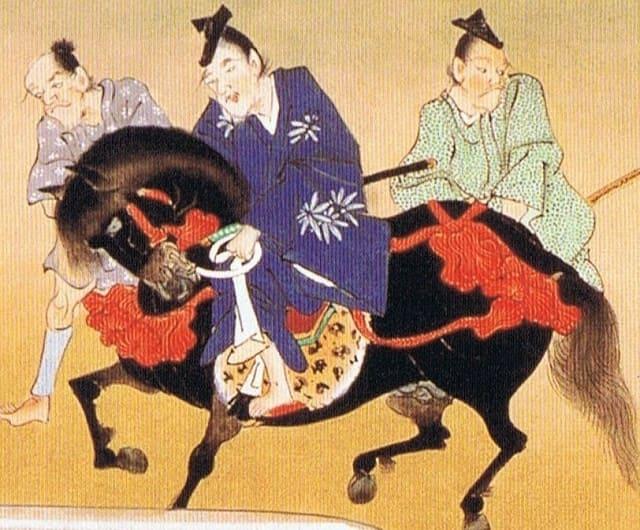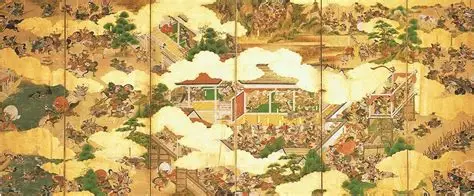
In February of 1184, Minamoto no Yoshitsune’s forces were advancing through the Tanba region.
Their target was Fukuhara in Settsu Province, where the Taira clan was gathering their troops. At Mikusayama, just before reaching Fukuhara, the Taira forces led by Taira no Sukemori and Taira no Arimori were preparing to block the Minamoto advance.
According to the Heike Monogatari, the two armies faced each other on the evening of February 4th. The Taira army set up camp on the western side of Mikusayama, readying themselves for battle the following morning.
However, Yoshitsune opted for a night attack.
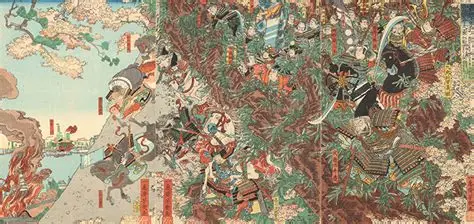
To navigate the dark mountain paths, Doi Sanehira set fire to a house in Onobara, igniting the surrounding fields and mountains, as recounted in the Heike Monogatari.
Guided by these flames, Yoshitsune’s forces crossed the mountain and launched a surprise attack on the Taira camp in the dead of night.
The sudden assault threw the Taira forces into disarray. Sukemori and others abandoned their positions and fled by ship from Takasago in Harima Province to Yashima.
Shortly after this Battle of Mikusayama, the Minamoto and Taira forces would clash at Ichi-no-Tani.
The Taira Clan, Driven from the Capital, Returns to Fukuhara
In July of 1183, the Taira clan left Kyoto.
In May of the same year, they suffered a crushing defeat at the hands of Minamoto no Yoshinaka’s forces at Kurikara Pass in the Hokuriku region. Following their struggles at the Battle of Shinohara, they found it increasingly difficult to defend Kyoto.
Taira no Munemori and others took Emperor Antoku and the Imperial Regalia with them as they headed west.
Though they attempted to regroup in Kyushu, they faced resistance from local powers like Ogata Koreyoshi in Bungo Province and were unable to establish a stable base.
Subsequently, they moved to Yashima in Sanuki Province. There, they began to restore their military strength by gathering forces from along the Seto Inland Sea.
The Taira clan regained their momentum during the Battle of Mizushima in the intercalary tenth month of the same year.
At Mizushima in Bitchu Province, the Taira forces defeated the troops dispatched by Minamoto no Yoshinaka.
Yada Yoshikiyo and Unno Yukihiro of the Yoshinaka faction were defeated, allowing the Taira to regain military dominance in the Seto Inland Sea.
Meanwhile, relations between Yoshinaka and Emperor Go-Shirakawa in Kyoto were deteriorating.
On November 19th, Yoshinaka attacked the Hojuji Palace, seizing control of Emperor Go-Shirakawa by force, deepening his conflict with the court. In response, Minamoto no Yoritomo dispatched his brothers Noriyori and Yoshitsune.
On January 20th of the following year, Noriyori and Yoshitsune’s forces advanced towards Kyoto from the Uji and Seta areas.
The Yoshinaka faction suffered defeats across various locations, and Yoshinaka himself was killed in battle at Awazu in Omi Province.
This brought Kyoto under Yoritomo’s control, but in the west, the Taira clan was once again expanding their influence.
Based at Yashima, the Taira moved eastward, returning to the vicinity of Fukuhara, where Kiyomori had once established his base.
According to the Azuma Kagami, the Taira constructed fortifications at Ichi-no-Tani, located on the border of Settsu and Harima, and gathered forces from both the western sea and the San’in region.
Fukuhara corresponds to the area around present-day Hyogo Ward in Kobe City, and it was also the land where Taira no Kiyomori attempted to relocate the capital in 1180, during the fourth year of the Jisho era.
For the Taira clan, returning to Fukuhara was a crucial step towards advancing on Kyoto.
The forces loyal to Yoritomo, wary of the Taira’s movements, ordered Noriyori and Yoshitsune, who had defeated Yoshinaka, to advance into the western provinces.
Noriyori and Yoshitsune Advance in Two Directions
According to the “Heike Monogatari,” volume nine, “Mikusa Seizoroi,” on January 29, Noriyori and Yoshitsune presented themselves to Emperor Go-Shirakawa and reported their intention to move westward to pursue the Taira.
The Emperor emphasized the importance of reclaiming the Imperial Regalia, which were in the hands of the Taira.
It is said he commanded them to recover the regalia, which had left the capital with Emperor Antoku, without damage.
The “Heike Monogatari” records that the Genji forces departed Kyoto on February 4.
The commander of the main army was Minamoto no Noriyori.
He was accompanied by Takeda Nobuyoshi, Kagami Tomomitsu, Kajiwara Kagetoki, and Oyama Tomomasa, with a total force reportedly exceeding 50,000 horsemen.
Noriyori’s army headed towards Koyano in Settsu Province, taking a route that approached Fukuhara from the east.
In contrast, Minamoto no Yoshitsune led the flanking force.
Yoshitsune was accompanied by Doi Sanehira, Tashiro Nobutsuna, Miura Yoshizumi, Hatakeyama Shigetada, Kumagai Naozane, and Sasaki Takatsuna.
According to the “Heike Monogatari,” the flanking force numbered over 10,000 horsemen.
Yoshitsune chose a different route from Noriyori, entering the Tanba Road.
This was to approach the Taira forces from the rear through the mountainous regions.
However, the departure dates and troop numbers vary among sources.
The “Azuma Kagami” notes that Noriyori and Yoshitsune departed Kyoto on January 29, with Noriyori’s force at over 56,000 horsemen and Yoshitsune’s at over 20,000.
These figures do not match the “Heike Monogatari” and do not definitively establish the actual size of the forces.
Nonetheless, the general narrative that Noriyori led the main force and Yoshitsune the flanking force, approaching the Taira from different directions, is consistent.
According to the “Heike Monogatari,” Yoshitsune’s army covered a distance that would normally take two days in just one, reaching Onobara on the eastern side of Mikusayama, at the border of Tanba and Harima.
There, a detachment of Taira forces awaited them.
Taira no Sukemori and the Sons of Shigemori Defend Mikusayama
The central figure of the Taira forces stationed at Mikusayama was Taira no Sukemori.
Sukemori was the son of Taira no Kiyomori‘s eldest son, Taira no Shigemori, and the brother of Taira no Koremori.
Shigemori, the father, passed away in 1179, leaving his sons to continue as prominent military leaders within the Taira clan.
In the “Battle of Mikusa” from the Tale of the Heike, the names Taira no Ariemori, Taira no Tadabumi, and Taira no Morimori appear alongside Sukemori.
All were Shigemori’s children, indicating that the brothers were entrusted with the defense of this area.
Additionally, as samurai commanders, Iga Heinaibei Kiyoshi and Ebi Jiro Morikata followed them.
The Taira army’s strength is noted as over 3,000 horsemen in the Tale of the Heike.
On the other hand, the Azuma Kagami records over 7,000 horsemen, showing a significant discrepancy.
The Taira forces set up camp on the western side of Mount Mikusa.
They positioned themselves to block the path of Yoshitsune’s army advancing from the east by securing the western mountain pass.
It is said that a mountain path of about three ri separated the two armies.
In mountainous terrain, the routes for advancing are limited, and deploying a large number of mounted warriors is challenging. By guarding the narrow path’s exit, they could potentially hinder the movement of a large army.
The Taira’s choice to position themselves on the western side of Mount Mikusa was likely to take advantage of this terrain.
However, detailed records of the actual defensive structures or the layout of the encampment do not survive.
Although the Taira army was aware of Yoshitsune’s approach, according to the Tale of the Heike, they expected the battle to commence the following morning.
The two armies faced each other across the mountain.
That night, Yoshitsune convened a war council to decide the timing of the attack.
Tashiro Nobutsuna’s Recommendation for a Night Attack
According to the Tale of the Heike, the council was held around the hour of the dog.
This corresponds to roughly between 7 PM and 9 PM today.
Yoshitsune summoned the samurai commander Doi Sanehira and asked whether they should attack the Taira forces camped on the western side of Mount Mikusa that night or wait until the next morning.
Sanehira was a warrior based in Doi-go, Sagami Province, and had supported the Genji since Yoritomo’s uprising.
During the Battle of Ishibashiyama in 1180, he was known for accompanying the fleeing Yoritomo through the mountains.
Tashiro Kanja Nobutsuna joined the discussion with Sanehira.
Nobutsuna was a warrior with ties to Izu Province, and the Tale of the Heike records his lineage as a descendant of Emperor Go-Sanjo’s prince, Prince Sukenari.
Nobutsuna advocated for launching a night attack.
In the Tale of the Heike, Nobutsuna pointed out the numerical advantage of having over 10,000 troops compared to the Taira’s 3,000, warning that waiting until morning might allow the enemy to receive reinforcements.
His judgment was that it was better to attack while they held the advantage in numbers.
Hearing this, Sanehira agreed.
However, the soldiers were anxious.
It was already completely dark.
Advancing along an unfamiliar mountain path at night posed the risk of losing their way. Moving with horses on narrow paths could easily disrupt their formation.
The enemy awaited on the other side of the mountain.
If the troops were to scatter by taking the wrong path, they would face the danger of being attacked individually, let alone launching a night assault.
Yoshitsune faced the challenge of how to navigate through the darkness.
He proposed using fire to illuminate the path of advance.
“What about the usual great torches?”—Fires Set in Onobara
The Heike Monogatari records Yoshitsune saying this to his soldiers who were complaining about the darkness.
“What about the usual great torches?”
Upon hearing this, Doi Sanehira agreed that it was a good idea.
It is said that they then set fire to the houses in Onobara.
The original text of the Heike Monogatari states, “They set fire to the houses in Onobara.”
“Houses” refers to private residences.
Additionally, fires were set in the fields and woods, making the surroundings as bright as day.
Yoshitsune’s forces used these flames as a guide to cross the three leagues of mountain paths.
Flames rising from the houses.
The spreading fires in the fields and mountains.
Relying on this light, the armed forces advanced along the mountain paths at night.
This scene is particularly striking in the Heike Monogatari‘s account of the Battle of Mikusayama.
However, it is important to consider the nature of the sources when it comes to the arson of houses and the use of fire in the advance.
The Azuma Kagami also mentions Yoshitsune’s night attack, but there is no record of setting fire to houses or fields.
It is unclear how many houses were actually burned or how far the fire spread.
The Heike Monogatari is a war tale, and it may include descriptions intended to emphasize Yoshitsune’s bold tactics.
Nevertheless, the fact that the narrative explicitly states that houses were set on fire for the advance is significant.
Onobara was home to residents who were not involved in the battle.
If the arson described actually occurred, it means there were people who lost their homes due to Yoshitsune’s night attack.
The Takarazuka City History also discusses the Battle of Mikusayama, mentioning the arson of houses in Onobara and highlighting the damage that battles and the passage of large armies inflicted on civilian life.
The troops continued along the mountain path, approaching the Heike forces’ positions by midnight.
The Heike Forces Sleeping with Helmets as Pillows
According to the Heike Monogatari, the Heike forces did not anticipate a night attack.
Although they were aware that the Genji forces had advanced to the eastern side of Mikusayama, they expected the main battle to occur the next morning.
The vanguard soldiers remained vigilant.
However, it is said that the rear guard warriors slept using their helmets, armor sleeves, and quivers as pillows.
They were resting in preparation for the battle the following morning.
It was then that Yoshitsune’s forces appeared.
According to the Heike Monogatari, the time was midnight.
The Genji forces surged into the western pass of Mikusayama, raising a war cry all at once.
The sudden attack caused great turmoil among the Heike forces.
The Tale of the Heike describes a scene of such chaos that warriors with bows lost sight of their arrows, and those with arrows searched frantically for their bows.
With no time to prepare their weapons, the mounted warriors of the Minamoto clan advanced, causing the Taira soldiers to scatter to the left and right to avoid their path.
The Taira forces were unable to maintain their formation and gradually began to retreat.
The Azuma Kagami also records this night attack.
According to the entry for February 5, 1184, Yoshitsune, after consulting with Tashiro no Nobutsuna and Doi no Sanehira, launched a surprise attack on Taira no Sukemori’s forces in the middle of the night.
The Taira side was thrown into a panic and scattered.
While the Tale of the Heike provides more detailed battle descriptions, both sources agree that the Taira forces crumbled under the night attack.
However, there is a discrepancy in the dates.
The Tale of the Heike states that Yoshitsune’s forces crossed the mountain on the night of February 4, while the Azuma Kagami records the battle on February 5.
Thus, the Battle of Mikusayama is sometimes described as occurring on the night of February 4 or on February 5.
In any case, the main point remains that Yoshitsune launched a night raid on the Taira camp, causing Sukemori’s forces to flee.
The Retreating Taira Forces: A Pursuit Battle Claims Over 500 Lives
The Taira forces, having lost their formation, were pursued by the Minamoto forces at various locations.
According to the Tale of the Heike, the Minamoto warriors relentlessly chased down the fleeing Taira soldiers, attacking them fiercely.
The Taira side, having lost command and control, was unable to mount a coordinated counterattack and fled in different directions.
The Tale of the Heike reports over 500 Taira soldiers were killed.
It is also noted that many were wounded.
However, there is no definitive record to substantiate this figure of over 500.
Given that the total number of Taira forces varies across sources, it is difficult to ascertain the exact extent of the losses.
It is also unclear how much resistance the Taira forces put up during the night attack or how far the battle spread.
The Tale of the Heike vividly depicts the Taira forces being driven into disarray.
In contrast, the Azuma Kagami succinctly notes that Sukemori’s forces scattered due to the night attack.
By combining the accounts from both sources, it is clear that Yoshitsune’s night raid was successful, leading to the Taira forces’ inability to hold their position at Mikusayama.
The Taira side abandoned the western mountain pass, and their commanders were forced to retreat.
Taira no Sukemori and Taira no Arimori Flee to Yashima, Taira no Morimori to Ichinotani
The defeated Taira commanders at Mikusayama retreated in different directions.
According to the Tale of the Heike, Taira no Sukemori, Taira no Arimori, and Taira no Tadabumi headed towards Takasago in Harima Province.
Takasago is a coastal area facing the Seto Inland Sea, from where they could sail to Sanuki Province.
Sukemori and his companions boarded small boats and fled to Yashima.
Yashima was a stronghold for the Taira after they had left the capital.
Before advancing to Fukuhara, the Taira clan had consolidated their power around this area, coordinating with various coastal forces along the Seto Inland Sea.
As a result of their defeat at Mikusayama, Sukemori and his group withdrew from the front lines and retreated westward by sea.
Meanwhile, Sukemori’s brother, Taira no Morimori, chose a different path.
According to the “Tale of the Heike,” Morimori, accompanied by Iga Heinaibyoe Kiyoka and Ebi Jiro Morikata, headed towards Ichinotani.
Despite being defeated at the same Mikusayama, Morimori’s retreat diverged from that of Sukemori and Arimori.
At Ichinotani, where Morimori was headed, the main Taira forces, including Munemori, had gathered.
Troops were also stationed around Fukuhara to prepare for Noriyori’s army advancing from the east.
With the mountain-side defense line broken at Mikusayama, the Taira were forced to respond to Yoshitsune’s forces advancing from the north.
The “Tale of the Heike” records that Taira no Munemori dispatched Taira no Tomomori and others to strengthen the mountain defenses.
Tomomori was a son of Taira no Kiyomori’s brother, Taira no Norimori, and a prominent general of the Taira clan.
The same text also recounts an anecdote where Tomomori, before departing for battle, bid a tearful farewell to his wife, Kozaisho no Tsubone, and was sternly admonished by his brother, Taira no Norikyo.
Although this is a scene depicted in a war tale, it conveys the state of the Taira as they prepared for the decisive battle at Ichinotani.
Morimori returned from Mikusayama to Ichinotani, where he would once again face the Genji forces.
There was little time left until the battle.
Where is Mikusayama located today?
There are multiple theories regarding the location of the Battle of Mikusayama.
The widely accepted theory places it around the area of Kamimikusa in Kato City, Hyogo Prefecture today.
Kato City is home to Mikusayama, which stands at an elevation of 423.9 meters and has long been passed down as a stage for the Genpei War.
The “Kakuichibon” edition of the “Tale of the Heike” notes that Yoshitsune’s forces advanced to Mikusayama, located on the border of Tanba and Harima.
Regarding Onohara, which appears on the eastern side, some believe it corresponds to the area around Imada Town in Tamba Sasayama City, Hyogo Prefecture today.
According to this theory, Yoshitsune’s forces would have advanced from Kyoto along the Tanba route and engaged the Taira forces near Kato City.
In fact, a research example registered by the Ono City Library in the National Diet Library’s collaborative reference database also introduces this route, referencing sources such as the “History of Hyogo Prefecture.”
However, the “Azuma Kagami” offers a different account.
This text positions Mikusayama in Settsu Province, suggesting that the battlefield might be the Mikusayama near the border of Nose Town in Osaka Prefecture and Inagawa Town in Hyogo Prefecture.
The “History of Takarazuka City” compares both theories and presents the view that the Mikusayama on the Settsu Province side is the more plausible location.
One reason for this is the route of advance to Ichinotani.
If Mikusayama in Kato City were the battlefield, Yoshitsune’s forces would have initially moved significantly westward before shifting eastward towards Ichinotani.
In contrast, if Mikusayama on the Settsu Province side were the location, it is easier to envision Yoshitsune’s forces advancing from the northern mountainous area towards Ichinotani.
There are also differences in the place names described in various editions of the “Tale of the Heike.”
The “Kakuichibon” edition describes it as the border of Tanba and Harima, while the “Enkyobon” edition provides a more concise geographical explanation, merely stating that Yoshitsune advanced from the Tanba route to Mikusayama.
Additionally, the diary “Gyokuyo” by Kujo Kanezane mentions that the Genji forces captured “Tanba Castle” before the Battle of Ichinotani.
While some views link the capture of Tanba Castle to the Battle of Mikusayama, it is difficult to definitively equate the two events.
The exact route taken by Minamoto no Yoshitsune’s forces from Mikusayama to Ichinotani remains unconfirmed in historical records.
Mikusayama in Kato City is steeped in legends of the Genpei War and is recognized today as a historical site.
However, there is still room for debate regarding the precise location of the battlefield as recorded in historical sources.
From Mikusayama to Ichinotani—Yoshitsune’s Advance
After defeating the Taira forces at Mikusayama, Yoshitsune continued his advance toward Ichinotani.
According to the Heike Monogatari, on February 6, Yoshitsune divided his forces into two groups.
He ordered Doi Sanehira to lead over 7,000 horsemen toward the western entrance of Ichinotani.
Yoshitsune himself led over 3,000 horsemen through the mountains, aiming to attack the Taira from behind.
These numbers are based on the Heike Monogatari, and the actual size of the forces remains unclear.
The mountain path taken by Yoshitsune is vividly described in the ninth volume of the Heike Monogatari, in the chapters “Old Horse” and “Hiyodorigoe.”
In “Old Horse,” there is a tale of sending an aged horse ahead to avoid getting lost in the rugged mountains.
This was based on the belief that following the old horse would help find the way even in the mountains.
In “Hiyodorigoe,” it is said that Yoshitsune learned about the local terrain from a hunter and took the hunter’s son as a guide.
This boy later took the name Washio Saburo Yoshihisa.
However, there are alternative accounts regarding the guide, with the Enkyobon Heike Monogatari stating that Taga Kuri from Yasuda Manor in Harima Province acted as the guide.
The exact route taken by Yoshitsune’s forces to reach the rear of Ichinotani remains undetermined.
On February 7, the Minamoto and Taira forces clashed at Ichinotani.
According to the Azuma Kagami, Yoshitsune led over 70 brave warriors to the mountain behind Ichinotani, known as Hiyodorigoe.
Meanwhile, Noriyori’s forces attacked the Taira from the east.
Kumagai Naozane and Hirayama Sueshige vied for the lead at Ichinotani, while the Taira warriors Hida Kagetaka, Etchu Moritsugu, and Ito Kagekiyo defended, as reported by the Azuma Kagami.
Noriyori’s forces pressed from the east, while another Minamoto detachment continued their assault from the west.
With Yoshitsune’s forces appearing from the mountains, the Taira were besieged from all sides.
The Heike Monogatari describes Yoshitsune galloping down a steep slope on horseback to launch a surprise attack on the Taira camp.
This scene later became famous as the “Sakaotoshi at Hiyodorigoe.”
However, there are differing opinions on where the actual “Sakaotoshi” took place and what actions Yoshitsune himself took.
The Gyokuyo also mentions that Tada Yukitsuna was involved in the attack from the mountain side, indicating the need to consider the actions of other warriors besides Yoshitsune.
The battle at Ichinotani ended in a crushing defeat for the Taira.
Prominent Taira commanders such as Taira no Michimori, Taira no Tadanori, Taira no Atsumori, and Taira no Tsunemasa were killed one after another.
Taira no Shigehira was captured alive by the Minamoto forces, while Taira no Munemori and others escaped by sea.
Taira no Morimori, who had fled at Mikusayama, also lost his life in this battle.
According to the Azuma Kagami, it was the forces of Yasuda Yoshisada, the governor of Totomi, who killed Morimori.
The entry for February 13 in the same chronicle notes that the heads of Morimori and other Taira commanders were sent to Kyoto and displayed at Hachijo Riverbed.
Just days earlier, Morimori had faced Yoshitsune’s forces on the western side of Mikusayama.
After losing their position due to a night attack and retreating to Ichinotani, they fought the Genji forces again and met their end in battle.
Meanwhile, Taira no Sukemori and Taira no Arimori, who fled from Mikusayama to Yashima, continued to act alongside the Taira clan.
The defeat at Ichinotani resulted in the Taira clan losing Fukuhara once more.
Emperor Antoku and the Imperial Regalia remained in the hands of the Taira, and Munemori and others continued their resistance in the Seto Inland Sea.
The campaign to subdue the Taira clan would continue into the following year, Genryaku 2 (1185), at Yashima and then Dan-no-ura.