November 14, 1087 — The Fall of Kanazawa Stockade
The 14th day of the 11th month, the first year of Kanji (1087).
Kanazawa Stockade, in Dewa Province, fell. The site lies around present-day Kanazawa, Yokote City, Akita Prefecture.
After a long siege, food inside the stockade had run out, and not only soldiers but women and children were starving. Some tried to flee, but Minamoto no Yoshiie‘s forces cut down anyone who came out through the gates. Fewer mouths inside meant the remaining food would last longer for those still holding out — so none were allowed to escape. It was a merciless siege that turned starvation itself into a weapon.
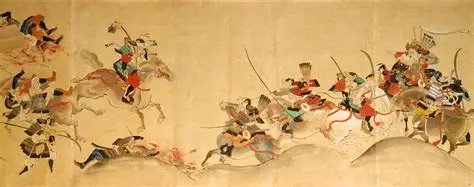
The Ōshū Gosannen ki and the later Gosannen Kassen Ekotoba both depict harrowing scenes: women and children who tried to flee were killed, and the terrified survivors turned back into the burning stockade.
In the end, Kiyohara no Takehira was captured and beheaded, and Kiyohara no Iehira was killed after trying to flee.
The Kiyohara clan had destroyed the Abe in the Former Nine Years’ War and grown into one of the greatest powers in Oshu and Dewa. Some twenty years later, that same clan tore itself apart from within and vanished from power.
And beyond the smoking ruins, one man remained.
Fujiwara no Kiyohira.
A boy who had lost his father in the Former Nine Years’ War became, in the Later Three Years’ War, the last man standing.
The story goes back four years, to the third year of Eiho (1083).
Five Years, Not Three — So What Kind of War Was This?
The Later Three Years’ War ran from the third year of Eiho (1083) to the first year of Kanji (1087) — in reality, five years.
And it did not begin as a war between the court and rebels.
It began as an internal feud within the Kiyohara clan.
The name “Later Three Years’ War” was not used during the fighting itself. In its own time it was called things like “Yoshiie’s war” or “the Eiho war,” and the paired terms “Former Nine Years” and “Later Three Years” are only clearly attested in sources from a later era still.
For that reason, the term Gosannen Kassen (“the Later Three Years’ Battle”) is generally considered closer to the historical reality than “the Later Three Years’ War” as such.
It was not a war in which the court ordered the Kiyohara suppressed and Yoshiie led an imperial army to crush a rebellion.
The Victors of the Former Nine Years’ War — the Kiyohara Become the Greatest Power in Oshu and Dewa
In the fifth year of Kohei (1062), the Former Nine Years’ War came to an end.
Abe no Sadato died at Kuriyagawa Stockade, and Fujiwara no Tsunekiyo was executed by Minamoto no Yoriyoshi. The man who sealed that victory was Kiyohara no Takenori, who marched in from northern Dewa at the head of more than ten thousand men.
The following year, 1063, Takenori was appointed Junior Fifth Rank, Lower Grade, and Chinjufu Shogun. Beyond their original base in northern Dewa, the Kiyohara now extended their power into the Oku Six Districts, formerly ruled by the Abe.
A single, vast power now spanned both Mutsu and Dewa.
But tangled blood ties left over from the Former Nine Years’ War had already worked their way into the heart of that house.
Takenori’s son was Kiyohara no Takehira.
Takehira’s son was Sanehira.
Meanwhile, the widow of Fujiwara no Tsunekiyo — executed at Kuriyagawa Stockade — was the daughter of Abe no Yoritoki. She brought her young son Kiyohira with her and remarried Takehira. With Takehira she then bore Iehira.
Sanehira and Iehira were therefore half-brothers by their father. Kiyohira and Iehira were half-brothers by their mother. Kiyohira and Sanehira shared no blood at all, yet they were raised together as one family within Kiyohara no Takehira’s household.
The Abe. The Fujiwara. The Kiyohara.
Bloodlines that had stood on opposite sides in the Former Nine Years’ War had all converged inside a single household.
Kiyohara no Sanehira — the Clan Head Who Tried to Hold It Together
After Takehira, it was Kiyohara no Sanehira who stood at the center of the clan.
Sanehira became Chinjufu Shogun and led a clan that spanned the Oku Six Districts and northern Dewa.
But Sanehira had no son to succeed him. He therefore adopted Kaidō Kotarō Narihira, said to have come from the Kaidō branch of the Taira.
The Ōshū Gosannen ki further records that Narihira took a daughter of Minamoto no Yoriyoshi as his wife.
This was no ordinary adoption. Sanehira brought in an heir from outside the Kiyohara bloodline altogether, and on top of that tied the clan to the Kawachi Genji through marriage. He was trying to remake a clan that had been held together loosely by blood into a tightly centralized house with himself at its head.
And that is exactly what provoked the clan’s old guard.
Kimiko no Hidetake Throws His Gold Dust to the Ground
Kimiko no Hidetake was one of the clan’s veteran warriors, who had fought alongside Kiyohara no Takenori in the Former Nine Years’ War. A kinsman of Takenori, he had commanded the third of the seven divisions in 1062.
On the day of Narihira’s wedding, Hidetake came to Sanehira’s residence carrying gold dust as a wedding gift.
But Sanehira kept playing go and left the elder statesman Hidetake waiting.
Hidetake was furious.
The Ōshū Gosannen ki describes him hurling the gold dust he had brought onto the ground and returning at once to Dewa.
A great war did not begin merely because a game of go was left unfinished.
The tension had been building between the clan’s long-serving elders and Sanehira, who was trying to pull all power under himself — and it finally broke into the open at a wedding.
Once back in Dewa, Hidetake raised his banner against Sanehira.
He then drew Kiyohira and Iehira to his side.
So began the Later Three Years’ War.
1083 — Minamoto no Yoshiie Returns to Oshu After 26 Years
In that same third year of Eiho (1083), one warrior entered Oshu as Governor of Mutsu.
“Hachiman Tarō,” who had fought alongside his father Yoriyoshi in the Former Nine Years’ War.
At Koromogawa in 1057, at nineteen by traditional count, he had been driven into a corner by Abe no Sadato’s forces and lived through the crushing defeat in which his father Yoriyoshi was left with barely seven riders.
Twenty-six years later, Yoshiie came back — this time as Governor of Mutsu.
The first to ally with Yoshiie was Sanehira.
When Sanehira marched to Dewa to strike Hidetake, Kiyohira and Iehira attacked his residence in his absence. But Yoshiie’s men were stationed there, and the two were driven off.
At this point the lines were drawn as:
Sanehira and Yoshiie versus Hidetake, Kiyohira, and Iehira.
But partway through the fighting, the man at the top of the Kiyohara clan suddenly vanished.
Autumn 1083 — Sanehira’s Sudden Death
Sanehira, marching toward Dewa to subdue Hidetake, died suddenly.
It was autumn, the third year of Eiho (1083).
The Ōshū Gosannen ki attributes it to a sudden illness. Sanehira left no son of his own. With the Kiyohara’s clan head gone without warning, the war reached a temporary pause.
Kiyohira and Iehira surrendered to Yoshiie.
Yoshiie then split the Oku Six Districts — held by the Abe since generations past — between the two of them. Later records say each received three districts.
By rights, that should have settled things.
But with Sanehira, their common enemy, gone, Kiyohira and Iehira now began to fight each other instead.
1086 — Iehira Burns Out His Brother Kiyohira
The third year of Ōtoku (1086).
Iehira struck at Kiyohira.
According to the Yasutomi ki, Kiyohira sensed the danger beforehand and survived by hiding in the tall grass. But Iehira set fire to Kiyohira’s residence and killed his wife, children, and kinsmen.
Kiyohira had already lost his father, Fujiwara no Tsunekiyo, in the Former Nine Years’ War when he was about seven years old.
Now, at around thirty, he lost his wife and children as well.
Kiyohira fled to Governor Yoshiie and pleaded for Iehira’s destruction.
This time Yoshiie sided with Kiyohira.
In 1083 Yoshiie had joined Sanehira to drive back Kiyohira and Iehira; three years later he joined Kiyohira to attack Iehira. This is exactly why it is so hard to say who was fighting whom in the Later Three Years’ War.
This was never simply “the Genji against the Kiyohara” from the start.
It was an internal feud within the Kiyohara clan into which Yoshiie intervened by stages.
The Battle of Numa Stockade — Yoshiie’s Crushing Defeat in the Dewa Winter
Iehira holed up at Numa Stockade. The likeliest site is around present-day Numadate, Omonogawa, Yokote City, Akita Prefecture.
In the winter of 1086, Yoshiie led several thousand horsemen against Numa Stockade.
Iehira never came out, and held firm.
Yoshiie’s army kept up the siege.
But before the enemy could break, the Oshu winter struck Yoshiie’s army first.
Heavy snow. Bitter cold. No food.
The Yasutomi ki records that soldiers died one after another from cold and hunger, and that men who had run out of food slaughtered their own horses for meat. It even records Yoshiie himself embracing frozen soldiers to warm them back to life.
Some thirty years earlier at Koromogawa, his father Yoriyoshi had likewise pushed into Oshu in the eleventh month and suffered a crushing defeat to Abe no Sadato amid snow and starvation.
Now the son, Yoshiie, repeated the same mistake.
Numa Stockade did not fall.
Yoshiie withdrew.
It was Iehira’s victory.
Kiyohara no Takehira Joins the Fight — “Move to Kanazawa”
The following year, the first of Kanji (1087), Iehira — who had turned back Yoshiie — was joined by his uncle Kiyohara no Takehira.
Takehira was a son of Kiyohara no Takenori, the hero of the Former Nine Years’ War.
According to the Ōshū Gosannen ki, Takehira praised Iehira for having beaten back the famed general Yoshiie, then urged him to move to an even stronger stronghold than Numa Stockade.
That place was Kanazawa Stockade.
It lies in the present-day Kanazawa district of Yokote City, Akita Prefecture.
The exact location of Kanazawa Stockade has still not been confirmed. Sites such as the Kanazawa Castle ruins have been investigated as candidates, but no remains have been positively identified as the stockade itself from the time of the Later Three Years’ War.
Beaten once at Numa Stockade, Yoshiie now rebuilt his forces to finish off Iehira and Takehira for good.
His Brother Minamoto no Yoshimitsu Rushes Up From the Capital
In the eighth month of 1087, Yoshiie’s brother Minamoto no Yoshimitsu arrived in Oshu.
Shinra Saburō Yoshimitsu.
Hearing of his brother’s hard-fought struggle, he is said to have thrown over his post at court to join the fighting. Yoshiie welcomed him as his second-in-command, and together with Kiyohira, Kimiko no Hidetake, and the warriors of the east, they prepared to assault Kanazawa Stockade.
From here the Later Three Years’ War entered its final phase.
A Flock of Wild Geese Breaks Formation — Yoshiie Spots an Ambush
On the march toward Kanazawa, one of the most famous episodes of the Later Three Years’ War took shape.
A line of geese flying overhead suddenly broke formation.
Yoshiie saw it and concluded that someone was hiding in the tall grass below.
A search turned up an ambush laid by Takehira.
This became known as the episode of “the broken formation of the geese.”
Later legend holds that Yoshiie had studied the art of war under Ōe no Masafusa, and here recalled the teaching that “where birds break formation, soldiers lie hidden.”
How closely the events on the actual battlefield matched this story is a question that has to be weighed against the nature of the sources. Even so, it became one of the most celebrated episodes in Yoshiie’s later reputation as “a great commander skilled not only in arms but in strategy.”
Sixteen Years Old — Kamakura Gongorō Kagemasa Takes an Arrow Through the Right Eye
The Later Three Years’ War also left behind one of the most visceral tales of eastern-warrior valor.
Kamakura Gongorō Kagemasa, later also written Kagemasa with a different character for “masa.”
According to the Ōshū Gosannen ki, he was sixteen by traditional count at the time.
On the battlefield a war arrow struck his right eye, driving clean through his face to the rivets of his helmet.
Even so, Kagemasa did not fall. He is said to have snapped off the shaft of the arrow, loosed one more arrow to bring down his enemy, and only then returned to his own lines.
A comrade, Miura Tametsugu, tried to pull the arrow out but could not. When he planted a foot on Kagemasa’s face to get leverage, Kagemasa flew into a rage.
To die by an enemy’s arrow was a warrior’s honor, he is said to have declared — but to have his living face trodden underfoot was a disgrace, and he reached for his sword.
A sixteen-year-old warrior, still fighting with an arrow lodged in his eye.
It is a story that makes clear the Later Three Years’ War was not Minamoto no Yoshiie‘s war alone — it was also a battlefield where the men who would later form the core of the eastern warrior bands first won their reputations.
Kanazawa Stockade — Unbreakable by Frontal Assault
Yoshiie’s army laid siege to Kanazawa Stockade.
But Iehira and Takehira had already turned back Yoshiie once at Numa Stockade. They held Kanazawa just as firmly, and the fighting dragged on.
It was the veteran Kimiko no Hidetake, the Ōshū Gosannen ki says, who urged Yoshiie’s side to switch to a siege of starvation.
Keep attacking head-on, and the attackers’ own casualties would only mount.
Better, then, to seal off the stockade and wait for its food to run out.
Yoshiie adopted the plan.
As autumn deepened, food inside the stockade began to disappear.
Killing Even Women and Children — the Brutality of the Siege
Unable to bear the hunger any longer, people began slipping out of Kanazawa Stockade.
Yoshiie’s side did not let them get away.
The Ōshū Gosannen ki describes even women and children being cut down.
The reasoning was plain.
Every person who left the stockade meant the food remaining inside would last that much longer. So they killed those who fled, refusing to let the numbers inside drop. It hastened the exhaustion of food and brought about collapse from within.
It was the exact opposite of a glorious single combat.
In the final phase at Kanazawa Stockade, the greatest weapon Yoshiie wielded was neither bow nor blade.
It was hunger.
November 14, 1087 — Kanazawa Stockade in Flames
The 14th day of the 11th month, the first year of Kanji (1087).
Kanazawa Stockade finally fell.
The Ōshū Gosannen ki says the defenders set the stockade ablaze themselves.
Amid the flames and smoke the defenders’ lines broke, and those who fled were cut down one after another. The later Gosannen Kassen Ekotoba depicts a grim scene of the fallen city — headless corpses and severed limbs piled upon each other.
Takehira hid in a marsh but was found and dragged before Yoshiie.
Takehira begged for his life. Yoshiie refused, and had him beheaded.
Iehira also tried to escape in disguise, but was caught and killed by his pursuers.
The Ōshū Gosannen ki further records that the heads of forty-eight leading retainers of Takehira and Iehira were laid out before Yoshiie.
The rule of the Kiyohara clan, victors of the Former Nine Years’ War, collapsed here.
Kiyohira — Allying With the Genji Who Killed His Father, He Alone Survives
By the time the war was over, Sanehira was already long dead, and both Iehira and Takehira were gone as well.
What remained was Kiyohira.
Kiyohira’s father was Fujiwara no Tsunekiyo. His mother was a daughter of Abe no Yoritoki.
In 1062, when Kiyohira was about seven, his father was executed at Kuriyagawa Stockade by Minamoto no Yoriyoshi.
Twenty-five years later, that same Kiyohira allied with Yoriyoshi’s son Yoshiie and emerged as the victor.
It is not a choice a man driven purely by his family’s old grudge would ever have made.
To survive, and to reclaim what Iehira had taken from him, Kiyohira used even the strength of the Genji who had killed his own father.
After the Later Three Years’ War, Kiyohira took the surname of his birth father, Fujiwara, and inherited the power the Kiyohara had built across the Oku Six Districts. He extended his influence into Dewa as well, and in time grew into the greatest power in all of Oshu.
The Court Gave Yoshiie No Reward for His Victory
Minamoto no Yoshiie‘s own position, meanwhile, was a complicated one.
On the battlefield, he had won.
But the court never recognized the campaign against Iehira and Takehira as an official war of the state.
At its root, it had been an internal feud within the Kiyohara clan. Yoshiie petitioned for an official writ authorizing the campaign, but the court refused to grant one, and afterward gave him no formal reward for his achievements.
The following year, the second of Kanji (1088), Yoshiie left his post as Governor of Mutsu.
In the Former Nine Years’ War, his father Yoriyoshi had been rewarded for his service with the governorship of Iyo. Yoshiie, by contrast, had brought down Kanazawa Stockade itself and still received no reward of the same kind.
If the Court Would Not Pay, Yoshiie Would
Even so, Yoshiie had warriors who had followed him at the risk of their lives.
The Ōshū Gosannen ki records that, since the court gave no reward, Yoshiie used his own personal wealth to reward his soldiers for their service.
This mattered a great deal.
For his warriors, the one who repaid them was not the distant court in the capital.
It was Minamoto no Yoshiie himself.
Yoshiie never succeeded in bringing Oshu under his own direct control. But among the eastern warriors, the personal bond of “following Hachiman Tarō Yoshiie” grew stronger than it had ever been.
The victor of a war does not always come away holding the land.
What Yoshiie won was not Oshu, but the trust and loyalty of its warriors.
And Kiyohira Moves to Hiraizumi
When the Later Three Years’ War ended in 1087, Kiyohira was in his early thirties.
At seven, he lost his father Tsunekiyo.
He grew up in the Kiyohara household. He fought against Sanehira. He lost his wife and children to Iehira.
He allied with Minamoto no Yoshiie and brought down Iehira and Takehira.
Having lived through two great wars, he alone remained standing at the end.
Afterward, Kiyohira moved his base from the Esashi area to Hiraizumi, and in the second year of Chōji (1105) began construction of Chūson-ji.
The Abe had fallen in the Former Nine Years’ War, and the Kiyohara, its victors, had then crumbled in the Later Three Years’ War.
The man who finally inherited Oshu was Abe no Yoritoki’s own grandson, and the son of Fujiwara no Tsunekiyo — Kiyohira.
From the Abe to the Kiyohara. From the Kiyohara to the Oshu Fujiwara.
When the flames of Kanazawa Stockade finally died out, a new era began in Oshu.