On August 23, 1180, in Ishibashiyama, Sagami Province.
According to the “Azuma Kagami,” Minamoto no Yoritomo’s forces, positioned on the mountain slope, numbered just over 300 horsemen.
Across the valley, Oba Kagechika commanded over 3,000 horsemen.
Additionally, Ito Sukechika, who had pursued from Izu, had maneuvered his 300 horsemen to the rear of the mountain.
It had only been six days since Yoritomo had defeated Yamaki Kanetaka and raised his army in Izu.
The Miura clan, whom he relied on, had reached the western part of Sagami, but they were unable to cross the swollen Maruko River—generally identified as the Sakawa River—due to heavy rain, and had not yet joined forces.
As night fell, the rain intensified.
Oba Kagechika advanced his troops towards Yoritomo’s camp without waiting for the next morning.
Twenty years earlier, Yoritomo had lost his father, Minamoto no Yoshitomo, who was defeated in the Heiji Rebellion, and was exiled to Izu at the age of 13. Now, he was 34 years old.
Having finally risen after a long period of exile, Yoritomo faced an overwhelming numerical disadvantage in his first field battle.
That night, Yoritomo’s forces crumbled on the steep slopes of Ishibashiyama and were driven into the mountains.
The Third Son of Minamoto no Yoshitomo, Exiled to Izu at 13
In December 1159, Fujiwara no Nobuyori and Minamoto no Yoshitomo raised an army in Kyoto.
Returning from a pilgrimage to Kumano, Taira no Kiyomori counterattacked from his base in Rokuhara, leading to Yoshitomo’s defeat.
Yoshitomo was killed in Owari while fleeing to the eastern provinces. His eldest son, Yoshihira, was captured and executed in Kyoto.
The third son, Yoritomo, was 13 years old by traditional count. He was captured during the escape but spared, and sent to Izu in 1160.
Stories of his reprieve through the pleas of Kiyomori’s stepmother, Ike no Zenni, are recorded in the “Heiji Monogatari” and other sources.
While later narratives embellish the details, it is certain that Yoritomo was spared execution and began his life in exile in Izu.
The most famous site of his exile is the area around Hirugashima in present-day Izu no Kuni City.
During those 20 years, he was not completely isolated from the world.
Yoritomo was surrounded by allies like Adachi Morinaga and maintained connections with warriors in Izu and Sagami.
His marriage to Hojo Tokimasa’s daughter, Masako, helped him establish a foothold in Izu.
Even in the spring of 1180, Yoritomo did not have a large number of retainers.
The Hojo family, too, was not as powerful as the later regent Hojo clan might suggest, and in Izu, there were samurai like the Ito clan who sided with the Taira.
It was under these circumstances that a call to arms against the Taira reached Yoritomo from Kyoto.
From Prince Mochihito’s Call to Arms to Raising an Army in Three and a Half Months
In the spring of Jisho 4, Prince Mochihito, the son of Emperor Go-Shirakawa, called for the overthrow of the Taira.
The “Azuma Kagami” records that on April 27, Minamoto no Yukie visited Izu and conveyed Prince Mochihito’s decree to Yoritomo.
The decree dated April 9 that survives today has sparked debate over its format and issuance date, so the date cannot be taken as definitive.
It is enough to understand that the call to arms against the Taira in the name of Prince Mochihito reached Yoritomo.
Yoritomo did not act immediately.
On May 26, Prince Mochihito and Minamoto no Yorimasa were defeated at Uji, losing their lives. The rebellion in Kyoto was suppressed.
Meanwhile, the “Azuma Kagami” also notes that a report from Miyoshi Yasunobu reached Yoritomo, indicating that the Taira were moving to suppress the Minamoto across the provinces. The certainty of Yoritomo’s peaceful life in Izu was gradually diminishing.
In August, Yoritomo began preparing to raise an army with Hojo Tokimasa and Doi Sanehira.
Their first target was Kanetaka Yamaki, the deputy governor of Izu Province.
The Night of August 17, Attack on Kanetaka Yamaki
Kanetaka Yamaki was the deputy governor of Izu Province, responsible for local administration on behalf of the provincial governor.
August 17 was the day of the Mishima Shrine festival.
That night, Yoritomo’s forces advanced on the residences of Kanetaka and his guardian, Tsutsumi Nobutō.
Hōjō Tokimasa, Munetoki, Yoshitoki, and Sasaki Sadatsuna, Tsunetaka, Moritsuna, and Takatsuna, along with Katō Kagemasa, moved to attack, defeating Tsutsumi Nobutō before storming Yamaki’s residence.
The battle continued into the night, with flames engulfing the residence. Kanetaka was also killed.
Yoritomo’s initial military action was a success.
Buoyed by this victory, Yoritomo advanced into Sagami.
Three days after the attack on Yamaki, on August 20, he left Izu and entered the territory of Doi Sanehira.
In response to Yoritomo’s advance, Miura Yoshizumi and others began to move from the Miura Peninsula.
At the same time, Ōba Kagechika was gathering troops in Sagami.
Among Ōba Kagechika’s Forces Were Future Vassals of Yoritomo
Ōba Kagechika, a powerful samurai in Sagami, moved to pursue Yoritomo on behalf of the Taira clan.
His ranks included names such as Matanokagehisa, Kawamura Yoshihide, Ebina Sukesada, Yamauchi Shudō Tsunetoshi, Kumagai Naozane, and Kajiwara Kagetoki.
Many of these figures would later become known as Yoritomo’s vassals.
In the eastern provinces of August 1180, “Genji samurai” and “Taira samurai” were not neatly divided from the start.
Samurai across the regions, burdened with existing lord-vassal relationships, landholdings, and local conflicts, chose their allegiances based on individual judgments.
The ‘Azuma Kagami’ records the Ōba forces as numbering over 3,000 horsemen.
Given the potential for exaggeration in medieval sources, the figure of 3,000 should not be taken as an exact count. However, it suggests that they significantly outnumbered Yoritomo’s forces, as indicated by the subsequent course of the battles.
Yoritomo was hoping to join forces with the Miura clan.
The Miura Forces Halt at the Sakawa River
Miura Yoshizumi and his men departed from the Miura Peninsula around August 22, heading towards western Sagami.
However, on the 23rd, the weather turned severe.
The ‘Azuma Kagami’ notes that the Maruko River swelled, preventing the Miura forces from crossing.
This Maruko River is generally identified as the Sakawa River.
Even today, it is a large river flowing through the Ashigara Plain into Sagami Bay. In an era without proper bridges, a flood caused by heavy rain would make it difficult for an army, including cavalry, to cross.
The Miura forces remained east of the river, setting fire to the homes of the Ōba clan’s relatives.
The flames were visible from afar.
Ōba Kagechika, facing Yoritomo at Ishibashiyama, realized that the Miura forces were nearby.
Once the river receded, they would join Yoritomo’s forces.
Before that could happen, Kagechika chose to attack.
August 23: 300 Horsemen Versus Over 3,000 at Ishibashiyama
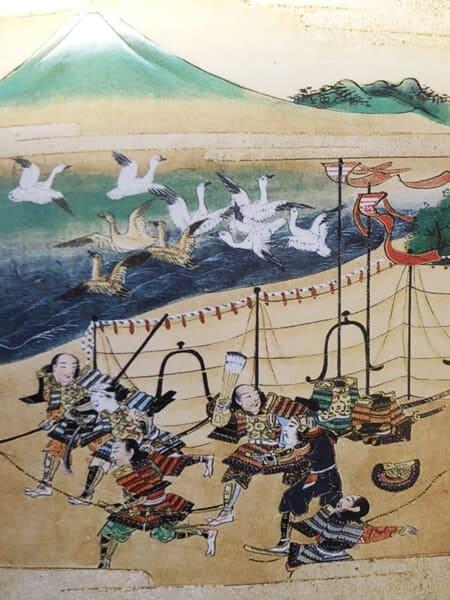
On the 23rd, Yoritomo set up camp at Ishibashiyama.
The ‘Azuma Kagami’ records his forces as numbering over 300 horsemen. Among them were Hōjō Tokimasa and his sons, Adachi Morinaga, Doi Sanehira, and Kudō Shigemitsu.
Ishibashiyama is located in the southwestern part of present-day Odawara City, with mountains reaching close to Sagami Bay.
Just inland from the coast, steep slopes rise, leaving little room for wide plains. Yoritomo’s forces entered this mountainous area, facing the Ōba forces across a valley.
The Ōba forces were recorded as over 3,000 horsemen in the ‘Azuma Kagami.’
Additionally, it is recorded that Ito Sukechika, advancing north from Izu, joined with over 300 horsemen behind Yoritomo.
Yoritomo found himself surrounded by enemies both in front and behind.
The Miura forces were on the opposite side of the swollen river.
As night fell, the rain intensified.
Oba Kagechika launched his attack during the night.
The Torrential Rains at Ishibashiyama—Oba’s Forces Cross the Valley
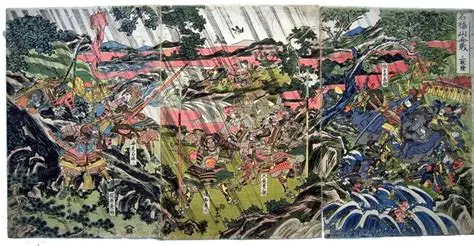
The battle commenced under the cover of darkness.
The “Azuma Kagami” depicts this night as one of storm and tempest.
Ishibashiyama, with its proximity to both mountains and sea, is characterized by slopes and valleys.
This was not a battlefield where over 3,000 horsemen could charge in a wide plain, lined up in a single row.
In the darkness and rain, it is more fitting to imagine Oba’s forces advancing on Yoritomo’s side through limited paths and slopes.
Outnumbered, Yoritomo’s forces had no choice but to hold their ground in narrow spaces.
One warrior who made a name for himself at the forefront was Sanada Yoichi Yoshitada.
According to traditions preserved in Odawara, Yoshitada led about 15 horsemen in battle, while Oba Kagechika’s brother, Matanokagehisa, led 75. Although later traditions have embellished the numbers, it is widely known that Yoshitada fiercely fought Matanokagehisa in this battle and was killed in action.
In “The Tale of the Heike” and later traditions, Yoshitada and Kagehisa are said to have exchanged names on a dark slope and grappled on horseback.
Even after falling from their horses, they continued to struggle, rolling down the slope, with Yoshitada pinning Kagehisa down.
However, he struggled to draw his sword, and during this delay, Nagao Sadakage intervened, leading to Yoshitada’s death.
Stories of Yoshitada’s sword being stuck with blood or his voice failing due to phlegm, preventing him from calling for help, are legends born from this grappling match.
Today, the area around the old battlefield still has sites like Sanada Shrine, Yoichi Mound, and Bunzando. The city of Odawara highlights the battle between Sanada Yoshitada and Matanokagehisa as a representative scene of the Battle of Ishibashiyama.
While Sanada’s forces fought at the front, Oba’s troops continued to ascend the mountain.
Yoritomo Takes Up the Bow, Fighting While Retreating
The disparity in troop numbers remained.
The Miura forces did not arrive.
Yoritomo’s forces were gradually pushed to higher ground.
The “Azuma Kagami” records that as Yoritomo retreated, he repeatedly turned his horse around to shoot arrows and engage the enemy.
Kato Kagemasa and Omi Sanemasa stayed behind Yoritomo, holding off Oba’s forces.
The rain obscured vision, and the ground became muddy. On the slopes, the movement of horses was restricted. Those at the front fell, and more enemies advanced from the rear.
Yoritomo’s forces could no longer hold their position as a single unit, and their formation unraveled.
Kudo Shigemitsu is also said to have died in battle.
With the fall of front-line warriors like Sanada Yoshitada, the soldiers protecting Yoritomo also scattered one after another.
Yoritomo retreated further into the mountains with Doi Sanehira and others.
That same night, the Hojo clan also left the battlefield.
Hojo Tokimasa’s eldest son, Munetoki, attempted to escape towards Izu but was discovered and killed by the Taira forces.
He was Masako’s brother and Yoshitoki’s elder brother.
It had been less than a week since Yoritomo defeated Yamakami Kanetaka.
Kajiwara Kagetoki Finds Yoritomo in the Mountains
Yoritomo, accompanied by a small group including Doi Sanehira, retreated into the mountains.
The area stretching from Ishibashiyama to the outer mountains of Hakone is characterized by deep valleys and complex ridges.
Guided by Sanehira, who was familiar with the terrain, was a significant advantage for Yoritomo.
Oba Kagechika sent troops into the mountains to search for Yoritomo.
One of those searching was Kajiwara Kagetoki.
At this point, Kagetoki was aligned with the Oba faction.
Though he would join Yoritomo the following year and later become a central figure in the Kamakura government, at Ishibashiyama, he was among those pursuing him.
The “Azuma Kagami” records that Kagetoki, aware of Yoritomo’s location, was moved by “human compassion” and told Oba Kagechika that there were no traces of people in the area, leading them to another peak.
In later accounts, such as the “Gikeiki,” this moment is expanded into a more dramatic scene.
Kagetoki enters the thicket and comes face to face with the hiding Yoritomo. After a moment of silent recognition, Kagetoki leaves and directs the pursuers in a different direction.
The legend of Yoritomo hiding in “Shitodo Cave” is also linked to this tale of escape and has been passed down in various regions.
The “Azuma Kagami,” compiled after the establishment of the Kamakura shogunate, was written with the knowledge that Kagetoki later became a close aide to Yoritomo. The story of Kagetoki saving Yoritomo is a famous anecdote from Ishibashiyama as conveyed by the “Azuma Kagami.”
Yoritomo managed to evade the search and continued moving through the mountains for several days.
The Miura Clan Returns to Kinugasa Castle, Failing to Reach Ishibashiyama
Upon hearing of Yoritomo’s defeat, the Miura forces abandoned their advance to Ishibashiyama and retreated eastward.
Along the way, they clashed with warriors from Musashi, including Hatakeyama Shigetada, before eventually returning to the Miura Peninsula.
On August 26, the Miura stronghold, Kinugasa Castle, was attacked.
The attackers included Hatakeyama Shigetada, Kawagoe Shigeyori, and Edo Shigenaga. These men, who would later become prominent vassals of Yoritomo, were at this time on the offensive against the Miura clan.
The “Azuma Kagami” notes that Miura Yoshizane, at the age of 89, remained in the castle after ensuring his family’s escape and was killed the following morning.
Yoritomo’s forces were shattered at Ishibashiyama, and the Miura clan lost their base.
By late August, the Taira faction, led by Oba Kagechika, was gaining the upper hand.
August 28: From Manazuru to Awa
Yoritomo emerged from the mountains and, with the help of Doi Sanehira and others, headed towards the coast.
The “Azuma Kagami” records that on August 28, a ship was launched from Manazuru Cape in Doi, heading towards Awa Province. This is the area around present-day Manazuru.
It had been 11 days since the attack on Yamakami Kanetaka on August 17.
The uprising that began in Izu had driven Yoritomo to flee across Sagami Bay.
However, upon reaching Awa, samurai began to gather around Yoritomo.
Miura Yoshizumi, who had escaped from Kinugasa Castle, also crossed the sea to join Yoritomo. Furthermore, Yoritomo reached out to influential warriors in the Boso region.
Chiba Tsunetane of Shimousa.
Kazusa Hirotsune of Kazusa.
With the addition of these two, Yoritomo’s forces grew significantly larger than they had been at Ishibashiyama.
Even the Enemies from Ishibashiyama Joined Yoritomo
Having gathered more troops in Boso, Yoritomo headed north towards Musashi.
There, Hatakeyama Shigetada, Kawagoe Shigeyori, and Edo Shigenaga also joined Yoritomo.
Just a few weeks earlier, they had been fighting against the Miura clan.
For the samurai of the eastern provinces, the battles of 1180 were not simply a Genji versus Heike conflict.
They acted based on their own circumstances—whether to protect their lands, to fight local enemies, or to maintain existing lord-vassal relationships. Amidst this, when Yoritomo returned with the powerful forces of Boso under his command, the power dynamics in the eastern provinces began to shift.
On October 6, Yoritomo entered Kamakura.
It had been only 44 days since Ishibashiyama.
On August 23, Yoritomo, with just over 300 horsemen, had been driven into the mountains. Now, he returned to Sagami with the Chiba, Kazusa, Miura clans, and samurai from Musashi following him.
Subsequently, the Heike sent a punitive force to the eastern provinces, led by Taira no Koremori and others.
The two armies faced off at the Fuji River in October.
It was still only about two months since Ishibashiyama.
Why Yoritomo Suffered a Major Defeat at Ishibashiyama
At Ishibashiyama, Yoritomo’s forces had not yet fully assembled.
The attack on Yamaki Kanetaka occurred on August 17, and Yoritomo set up camp at Ishibashiyama on the 23rd, just six days after raising his banner.
According to the “Azuma Kagami,” Yoritomo’s army numbered just over 300 horsemen, while Oba Kagechika had over 3,000. Behind them, Ito Sukechika’s 300 horsemen were closing in.
The Miura forces, who were supposed to join, were unable to cross the swollen Sakawa River due to heavy rain.
Oba Kagechika saw the fires set by the Miura forces and realized their approach. Knowing that Yoritomo’s forces would grow if he waited until the next day, he launched an attack on the night of the 23rd, amidst the rain.
While the numbers in historical records may be exaggerated, it is clear from the course of the battle that Yoritomo was significantly outnumbered and attacked before he could join forces with his reinforcements.
Oba Kagechika did not miss this opportunity.
On Yoritomo’s side, Sanada Yoshitada and others fought on the front lines, and Yoritomo himself shot arrows while retreating, but they lacked the numbers to hold out for long. Their camp was overrun in the mountain darkness, and Yoritomo fled into the hills with Doi Sanehira and others.
Ishibashiyama was not a battle Yoritomo fought after consolidating the eastern provinces.
It was a battle he faced just as he began to raise his forces and gather allies.
This haste manifested in the stark difference of 300 versus 3,000 horsemen.
44 Days After the Major Defeat, Yoritomo Entered Kamakura
On August 23, at Ishibashiyama, Oba Kagechika emerged victorious.
He drove Yoritomo’s forces into the mountains, defeated Sanada Yoshitada and others, and prevented them from joining with the Miura clan.
Yoritomo hid in the mountains and five days later escaped by boat from Manazuru to Awa.
In Awa, the Chiba and Kazusa clans joined him.
By the time he entered Musashi, even those samurai who had been on the Heike side until just after Ishibashiyama had joined Yoritomo.
On October 6, Yoritomo entered Kamakura.
44 days since Ishibashiyama.
The fact of his initial defeat in open battle remains unchanged.
However, because Yoritomo himself was not captured and had time to cross the sea and gather troops again, the course of the conflict shifted thereafter.
Ōba Kagechika, who had cornered Yoritomo at Ishibashiyama, was eventually captured by the increasingly powerful Yoritomo.
On the night of August 23, 1180, it was Ōba Kagechika who emerged victorious at Ishibashiyama.
Forty-four days later, it was Minamoto no Yoritomo who entered Kamakura.
For those who wish to delve deeper into the story of Minamoto no Yoritomo’s uprising and the Battle of Ishibashiyama, we recommend the book ‘Traveling and Reading through the Kamakura Period.’ It includes 13 stories set in places associated with Yoritomo, such as Hirugashima, Mishima Taisha, Izu-san Shrine, and the Ishibashiyama battlefield. One of the stories covers the Battle of Ishibashiyama, allowing readers to enjoy the historical narrative while connecting it to present-day locations.

Traveling and Reading through the Kamakura Period (Kodansha Bunko) [ Takada Takafumi ]
The Battle of Ishibashiyama took place in what is now Odawara City, Kanagawa Prefecture. For those intrigued by Odawara after reading this article, we recommend trying the local specialty, kamaboko. The kamaboko from the long-established “Suzuhiro” in Odawara is perfect for everyday meals or as a snack, and can be enjoyed as if visiting the Ishibashiyama battlefield or Hakone.