The fourth year of Chogen (1031).
Taira no Tadatsune, who had held out against an imperial punitive army in the Boso region for roughly three years, walked in on his own to surrender to a single warrior.
That man was Minamoto no Yorinobu.
Tadatsune had already taken Buddhist vows. Bringing two sons and three retainers with him, he presented himself to Yorinobu, who was serving as Governor of Kai in the east.
No great battle took place.
Tadatsune, whom the previous commander Taira no Naokata had pursued for more than two years without ever capturing him, submitted to Yorinobu without crossing swords at all.
Looking at this single episode alone, Yorinobu appears as “the great commander who put down a rebellion without a fight.”
But what is truly interesting comes before that.
From his youth, Yorinobu had served the Fujiwara regental house in Kyoto, moved as a military officer against bandits, and eventually became a provincial governor in the east, in Kozuke and Hitachi. There, he built relationships with the warriors of Bando, and had ties to Taira no Tadatsune himself even before the rebellion.
In other words, the bloodless surrender of 1031 was no sudden miracle.
It was the moment when the network of relationships Yorinobu had spent decades building suddenly came out into the open.
And from this Yorinobu, the bloodline runs on through Minamoto no Yoriyoshi, Minamoto no Yoshiie, Minamoto no Yoshitomo, and Minamoto no Yoritomo.
The starting point of the house that later warrior society would call “the head family of the Minamoto.”
That is Minamoto no Yorinobu.
968 — born as Minamoto no Mitsunaka’s third son
Minamoto no Yorinobu was born in the first year of Anna (968).
His father was Minamoto no Mitsunaka (covered in this article — Japanese only).
Sources and genealogies disagree on his mother: one line names her a daughter of Fujiwara no Munetada, Governor of Mutsu; another names her a daughter of the major counselor Fujiwara no Motokata.
Yorinobu’s house is generally known as a branch of the Seiwa Genji.
Emperor Seiwa
↓
Prince Sadazumi
↓
Minamoto no Tsunemoto
↓
Minamoto no Mitsunaka
↓
Minamoto no Yorinobu.
That is the line of descent.
His father Mitsunaka, based at Tada in Settsu Province, grew his family’s standing as a warrior house by making use of his ties to the Fujiwara regental house.
Yorinobu had two elder brothers.
The eldest was Minamoto no Yorimitsu (a full profile is available in English here).
The second was Minamoto no Yorichika.
In later generations, Yorimitsu’s line came to be called the Settsu Genji, Yorichika’s line the Yamato Genji, and Yorinobu’s own line the Kawachi Genji.
Yorinobu was the third son.
And yet it was this third son’s house that would go on to become the mainstream of the Minamoto.
987 — the young Yorinobu appears in the record
Yorinobu first appears clearly in a contemporary source in the third year of Kanna (987).
At this time, Yorinobu held the post of Junior Lieutenant of the Left Palace Guards.
He was still a young man, around twenty.
The Left Palace Guards was a military body responsible for guarding the imperial palace, among other duties — Yorinobu was never a man who started out as some provincial strongman.
He was a military noble raised as an officer within the court society of Kyoto itself.
Yorinobu became a retainer of Fujiwara no Michinaga’s elder brother, Fujiwara no Michikane, and after Michikane’s death drew closer to Michinaga himself.
For a warrior of that age, ties to the regental house were tied directly to advancement itself.
Serve a powerful noble. Gain a military post. Be appointed to a provincial office.
Build wealth and connections in that province. And use that wealth to gather still more retainers.
Within this cycle, Yorinobu steadily built up his strength.
994 — already known at court as “a man of martial valor”
In the fifth year of Shoryaku (994), banditry became a serious problem in Kyoto and the provinces alike.
The court mobilized men known for their martial valor to hunt the bandits down.
The chronicle Nihon Kiryaku records that Minamoto no Mitsumasa, Taira no Koretoki, Minamoto no Yorichika, and Minamoto no Yorinobu were summoned as “men of martial valor” and dispatched to hunt bandits.
Yorinobu was 27 by Japanese count.
When we think of the later Minamoto, we picture commanders leading great armies, but what was asked of Yorinobu at the close of the tenth century was, first and foremost, keeping order in the capital.
Tracking down fleeing thieves. Capturing dangerous men. Using force when it was called for.
By accumulating this kind of practical work, the reputation “Yorinobu is a warrior who gets things done” was built up inside the court itself.
Yorimitsu and Yorinobu — the elder brother in legend, the younger brother’s house in history
His elder brother, Minamoto no Yorimitsu, would become overwhelmingly famous in later generations as the hero who defeated Shuten-doji and the earth spider.
But the tale of Yorimitsu’s defeat of Shuten-doji only took shape long after his own death.
In their own lifetimes, both Yorimitsu and Yorinobu were far more down-to-earth figures.
Military nobles who served the Fujiwara regental house, held a succession of provincial governorships, and built up wealth and armed strength in the provinces.
What set Yorinobu apart within that world was the network of ties he built in Bando.
Yorimitsu’s name shone in the legends of later generations.
What Yorinobu left behind was more practical, and stronger.
A network of warriors that his own children and grandchildren could inherit.
To Kozuke — Yorinobu moves to the side that governs the provinces
Around the first year of Choho (999), Yorinobu became Deputy Governor of Kozuke.
From here, Yorinobu’s life can no longer be told through Kyoto alone.
Being posted to the provinces as a resident governor carried enormous weight for a military noble of this era.
Collecting taxes. Running the provincial office. Negotiating with local powers.
Using force when necessary. And turning the income gained in that province into strength for his own house.
Yorinobu built up this kind of experience as a provincial administrator.
The Yamakawa Concise Dictionary of Japanese History likewise records Yorinobu as a man who held a succession of governorships, including Kozuke and Kazusa.
What he gained here was not only skill with bow and horse.
What provincial warriors feared, what they wanted, and who they would actually follow.
Yorinobu learned this firsthand, on the ground.
To Hitachi — not “Governor” but, formally, “Deputy Governor” of Hitachi
In discussing Yorinobu’s ties to the warriors of the east, his time in Hitachi cannot be left out.
The Konjaku Monogatarishu calls Yorinobu “Governor of Hitachi.”
His formal office, however, was Deputy Governor of Hitachi.
Hitachi Province was reserved for appointment of an imperial prince as its nominal governor, which meant that the man who actually ran the provincial administration on the ground was the deputy governor.
The Ibaraki Prefectural Museum of History explains that although Yorinobu was formally deputy governor, he was in practice the province’s highest-ranking official, which is why the legends refer to him as “Governor of Hitachi.”
It was during this time in Hitachi that Yorinobu deepened his ties to the powerful warriors of Bando.
Foremost among them was Taira no Tadatsune, who would later rise in rebellion against the court.
The confrontation with Taira no Tadatsune, as told in the Konjaku Monogatarishu
The Konjaku Monogatarishu preserves a famous tale symbolizing the relationship between Yorinobu and Tadatsune.
Tadatsune held great power across Kazusa and Shimosa, and did not easily obey the orders even of Yorinobu, the governor of Hitachi.
So Yorinobu moved to bring Tadatsune to heel.
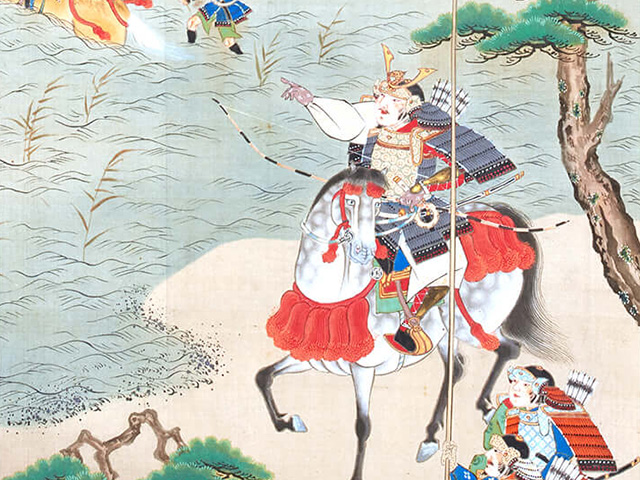
In the tale, Tadatsune hid his boats to block Yorinobu’s approach, but Yorinobu’s side found a shallow crossing, forded the water on horseback, and closed in on Tadatsune’s residence.
Astonished by Yorinobu’s action, Tadatsune is said to have finally submitted.
This tale comes from the later Konjaku Monogatarishu, and its details cannot simply be taken as an eyewitness record of the early eleventh century.
Even so, it matters as evidence that Yorinobu and Tadatsune had a strong relationship well before the rebellion of Taira no Tadatsune.
This same relationship lies behind the later Yamakawa Concise Dictionary of Japanese History‘s description of Tadatsune as Yorinobu’s own retainer.
Yorinobu did not know Tadatsune only as an enemy.
He knew what kind of man Tadatsune was, and exactly what it would take to make him act.
This would carry decisive weight in 1031.
The Yorinobu of the Konjaku Monogatarishu — feared less for muscle than for nerve
The tales of Yorinobu share a common trait.
Rather than scenes of leading great armies to slaughter the enemy, what stands out are scenes where the other side, out of fear of Yorinobu, backs down on its own.
The Konjaku Monogatarishu also tells of a time when the child of one of his retainers was taken hostage by bandits.
The bandits held a blade to the child’s throat.
While everyone around him panicked, Yorinobu did not lose his composure.
Showing that a warrior must never yield to fear out of attachment to family, he stepped forward to face the bandits himself.
Overwhelmed by Yorinobu’s presence of mind, the bandits are said to have released the hostage.
The Yorinobu of these tales is never simply a man of raw physical strength.
He reads his opponent’s mind, leaves them a way out, and brings them to submission.
He is portrayed as “a warrior who wins before the fighting starts.”
Read after knowing how the rebellion of Taira no Tadatsune ended, this portrait becomes genuinely fascinating.
1028 — becomes an early candidate to lead the punitive force against Taira no Tadatsune
In the first year of Chogen (1028), the rebellion of Taira no Tadatsune broke out in the Boso region.
Tadatsune’s side seized the provincial capital of Kazusa, and the governor of Awa was killed.
The court set about choosing a commander for the punitive force.
At a council held on the twenty-first day of the sixth month, several military men, Yorinobu among them, were named as candidates.
The Minister of the Right, Fujiwara no Sanesuke, rated Yorinobu highly.
But the men ultimately chosen were Taira no Naokata and Nakahara no Naruumi.
On the fifth day of the eighth month, the two set out from Kyoto with a force of just over two hundred men.
Yorinobu was not made commander of the punitive force at this stage.
Seen from later history, this is a genuine irony.
Because Naokata and his colleagues could not bring the rebellion to an end, and two years later, it was Yorinobu who was finally called upon.
While Taira no Naokata struggled, Yorinobu had become Governor of Kai
Taira no Naokata’s campaign dragged on.
Tadatsune made full use of his knowledge of the terrain and his connections in Kazusa and Shimosa, and kept eluding the imperial army.
The Boso region fell into ruin, and the punitive army’s own requisitioning made life harder still for the local people.
Reports compiled after the rebellion state that of Kazusa Province’s original roughly 22,980 cho of farmland, only about 18 cho were still under cultivation by the final stage of the fighting.
The local society itself was on the verge of collapse.
By this time, Yorinobu had become Governor of Kai.
Then, on the second day of the ninth month of the third year of Chogen (1030):
The court recalled Taira no Naokata, who had failed to achieve results, and ordered Minamoto no Yorinobu, Governor of Kai, along with the provincial governors of Bando, to subdue Taira no Tadatsune.
Yorinobu was 63 by Japanese count.
Not a young warrior.
He was a seasoned military man who knew the Fujiwara regental house in Kyoto, knew provincial administration, knew the warriors of Bando, and knew Tadatsune himself personally.
By the time Yorinobu took command, Tadatsune was already exhausted
To make Yorinobu’s achievement look more impressive, it is tempting to write that “the instant Yorinobu arrived, Tadatsune trembled and surrendered.”
The historical reality is more complicated.
By 1030, Tadatsune’s side, too, was worn down.
Boso lay devastated, and Tadatsune himself had taken Buddhist vows and was seeking a way to negotiate peace.
In other words, by the time Yorinobu became commander, Tadatsune’s side already had reasons of its own to want the war ended.
Even so, the choice of Yorinobu specifically carried real weight.
Taira no Naokata belonged to the Sadamori line of the Taira, a rival branch to Tadatsune’s own.
From Tadatsune’s point of view, surrendering to Naokata would have meant submitting to the very branch of the Taira his own ancestors had long contended with.
Yorinobu, on the other hand, already had a relationship with him predating the rebellion.
For Tadatsune, Yorinobu was both “an opponent easy to surrender to” and, at the same time, “an opponent worthy enough to submit to.”
April 1031 — Tadatsune surrenders to Yorinobu in Kai
The fourth month of the fourth year of Chogen (1031).
In the robes of a Buddhist monk, Tadatsune presented himself before Yorinobu in Kai, bringing two sons and three retainers with him.
No large-scale battle ever took place between Yorinobu and Tadatsune.
Tadatsune had come of his own accord.
The rebellion, which had lasted roughly three years, was, in effect, over.
Yorinobu’s manner of victory was not one of cutting down hundreds of enemy soldiers.
He had made the enemy commander walk to him. This was what made Yorinobu’s name great.
“No troops moved, no arrow was loosed” — the pride he set down in a 1046 votive text
In the first year of Eisho (1046), Yorinobu, then Governor of Kawachi, dedicated the “Votive Text of Minamoto no Yorinobu” to Iwashimizu Hachiman Shrine.
This is an important source directly tied to Yorinobu himself, also collected as item 640 of the Heian Ibun.
In this text, Yorinobu takes pride in his own achievement of putting down the rebellion of Taira no Tadatsune.
In substance, he states that he brought Tadatsune to heel without moving his troops in force, without beating the war drums, without drawing his bow, and without loosing a single arrow.
As a text dedicated before the gods in his own name, it naturally tends toward striking language about his martial achievements.
Even so, the underlying fact — that Tadatsune surrendered without a decisive battle against Yorinobu — matches the contemporary record as well.
Yorinobu himself placed the greatest achievement of his life in having ended it without fighting at all.
Tadatsune never reached Kyoto
Having surrendered, Tadatsune set out for Kyoto in Yorinobu’s company.
But on the sixth day of the sixth month of the fourth year of Chogen (1031), he died of illness on the road at Nogami, in Mino Province.
Yorinobu carried Tadatsune’s severed head with him to the capital.
The rebel who had troubled the court for roughly three years could not, in the end, be presented alive in Kyoto.
Even so, the achievement of bringing the rebellion to an end was a great one.
Yorinobu was afterward appointed Governor of Mino.
And in the ninth month of 1031, Yorinobu told the Minister of the Right, Fujiwara no Sanesuke, something genuinely revealing about why he wanted the post of Governor of Mino.
“Many men of Bando follow me.”
His reasoning was that, since so many men of Bando now followed him, Mino was a convenient location for traveling between east and west.
Here we see Yorinobu’s true wealth.
It was not land alone. It was not office alone.
It was people.
“Many men of Bando follow me” — the greatest asset of the Kawachi Genji
Around Yorinobu, more and more warriors of Bando came to follow him.
This is the single most important point in understanding the later Kawachi Genji.
Warriors were never ordered by the court, “as of today, become vassals of the Minamoto.”
They shared interests on the ground, recognized their lord’s martial authority, expected reward from him, and entered into a personal bond of lord and vassal.
The relationships Yorinobu built did not end with him alone.
They passed to his son Minamoto no Yoriyoshi. And on again to his grandson Minamoto no Yoshiie.
The lord’s house and the vassal’s house bound together across generations.
This was the prototype of the later warrior band.
The Kawachi Genji were not strong merely because they descended from Emperor Seiwa.
They were strong because Yorinobu gathered people, and Yoriyoshi and Yoshiie inherited that network in turn.
To Kawachi — the land behind the name “Kawachi Genji”
In his later years, Yorinobu served as Governor of Kawachi.
Ishikawa District in Kawachi Province, in the area of today’s Habikino and Tondabayashi cities in Osaka Prefecture, became deeply tied to Yorinobu’s line.
Biographical entries drawing on the Nihon Kokugo Daijiten likewise identify Yorinobu as the man who settled in Ishikawa, Kawachi Province, and became the founder of the Kawachi Genji.
Yorinobu himself never called his house “the Kawachi Genji.”
It was later generations who came to call this line, running from Yorinobu through Yoriyoshi and Yoshiie, the Kawachi Genji, to distinguish it from the Settsu Genji and the Yamato Genji.
From here, the lineage continues on to Minamoto no Yoshitomo and Minamoto no Yoritomo.
Hachiman worship — the prehistory of “the Minamoto and Hachiman,” visible in Yorinobu’s votive text
The 1046 Votive Text of Minamoto no Yorinobu is also an important source documenting the bond between Yorinobu and Iwashimizu Hachiman Shrine.
To the later Kawachi Genji, the god Hachiman would become a figure of special importance.
Yorinobu’s grandson Yoshiie underwent his coming-of-age ceremony at Iwashimizu Hachiman Shrine, and came to be known as Hachiman Taro Yoshiie.
His son Yoriyoshi, too, after the Former Nine Years War, invited a branch of Iwashimizu Hachiman Shrine to Kamakura.
This is the line that leads to the later Tsurugaoka Hachimangu.
Already in Yorinobu’s own time, the foundation binding the Kawachi Genji to the god Hachiman was beginning to take shape.
A genealogical puzzle that “Seiwa Genji” alone does not quite resolve
There is one point about Yorinobu that history enthusiasts tend to find fascinating.
Today, Yorinobu’s house is generally called the Seiwa Genji.
Yet in old manuscript copies of the Votive Text of Minamoto no Yorinobu, the ancestral line leading back to Tsunemoto appears in a form different from the genealogy that later became standard.
Because of this, the question of Tsunemoto’s paternal line has itself become a subject of ongoing historical research into how the “Seiwa Genji” genealogy took its final shape.
Rather than simplifying this as “Yorinobu declared himself a descendant of Emperor Yozei,” it is more accurate to read it as evidence that the Minamoto genealogies of the eleventh century did not yet take the same fixed form as the standardized pedigrees of later generations.
Precisely because this source dates close to Yorinobu’s own lifetime, it preserves a picture different from the polished genealogies of later ages.
1048 — an eighty-year life comes to a close
Minamoto no Yorinobu died in the third year of Eisho (1048).
Born in 968, he lived to the ripe age of 81 by Japanese count.
Sources differ on the exact date of his death, with one line of textual research giving the seventeenth day of the fourth month, and another, drawn from genealogies and reference works, giving the first day of the ninth month.
For a profile such as this, the safest anchor is simply the year of his death, 1048.
Looking back over Yorinobu’s life, there is scarcely a single dramatic, empire-deciding battle.
In his youth, he served as a military officer in Kyoto and worked to hunt down bandits.
He served the Fujiwara regental house. He went out to the provinces as a resident governor.
He built relationships with the warriors of Bando. And in his sixties, he brought the rebellion of Taira no Tadatsune to an end.
The greatest legacy Yorinobu left behind was not a single castle or a vast estate.
It was a mechanism by which people gathered to the house of Minamoto.
To Yoriyoshi — the son leads the warriors the father gathered onto the battlefield
Yorinobu’s heir was Minamoto no Yoriyoshi.
Yoriyoshi was born in the second year of Eien (988).
He is said to have accompanied his father even during the rebellion of Taira no Tadatsune, and afterward went on to deepen his own ties to the east still further.
Yoriyoshi married a daughter of Taira no Naokata, and with her had Minamoto no Yoshiie, Minamoto no Yoshitsuna, and Minamoto no Yoshimitsu.
Then, in the sixth year of Eisho (1051) —
three years after Yorinobu’s death, the Former Nine Years War broke out in Mutsu.
(Read the full story of the Former Nine Years War in English here.)
It was Yoriyoshi and Yoshiie who marched to meet it.
They were not suddenly and spontaneously supported by the warriors of the east.
Yorinobu had come before them.
Yorinobu had built relationships in Kozuke and Hitachi, raised his reputation through the rebellion of Taira no Tadatsune, and bound the warriors of Bando to his own house.
Yoriyoshi and Yoshiie stood on the foundation he had built.
“The head of the Minamoto” began to take shape in Yorinobu’s own generation
Yorinobu was never shogun. He never opened a shogunate.
Nor was he ever entrusted by the court with sole authority over the eastern provinces.
And yet the warriors of Bando followed him regardless.
Here lies an important shift that connects directly to the later warrior society.
Warriors who would not move for a court decree alone began moving instead through a personal bond of lord and vassal with a particular military noble.
The rebellion of Taira no Tadatsune made this shift plainly visible.
The court sent Taira no Naokata and ordered the provinces to join the punitive effort, yet could not bring matters to a close.
When Yorinobu was finally chosen, Tadatsune submitted of his own accord.
What Yorinobu possessed was something beyond mere office.
The trust and authority that made warriors think, “this is a man I can follow.”
That strength passed to Yoriyoshi, and from Yoriyoshi to Yoshiie.
And roughly 150 years later.
When Yorinobu’s descendant Minamoto no Yoritomo raised his own army, it was the warriors of Boso — the Chiba and Kazusa clans, descended from Taira no Tadatsune himself — who stood behind him.
Taira no Tadatsune, who submitted to Yorinobu in 1031.
The warriors of Boso, who followed Yorinobu’s descendant in 1180.
Different ages, but the same underlying pattern.
The strength of the Minamoto lay not in bloodline alone, but in the way they bound people to their house across generations.
And the man who took that first great step was none other than Minamoto no Yorinobu.