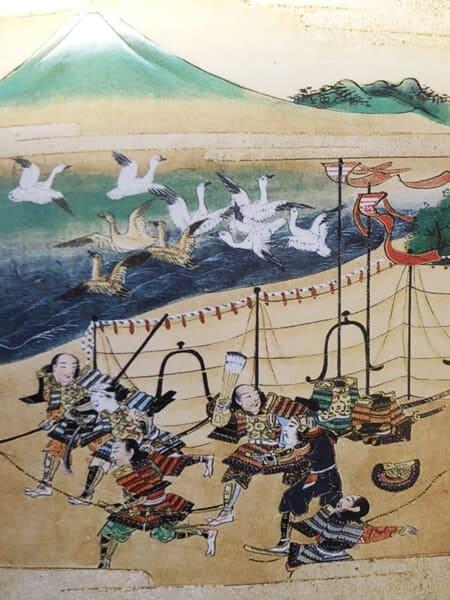
On October 20, 1180, the forces of Taira no Koremori retreated from the Fuji River in Suruga Province.
Minamoto no Yoritomo intended to continue westward, aiming for Kyoto.
However, warriors from the eastern provinces, including Chiba Tsunetane, Kazusa Hirotsune, and Miura Yoshizumi, opposed this plan.
Yoritomo had just entered Kamakura, and many warriors in the Kanto region had yet to pledge their allegiance to him.
They argued that he should secure his rear before advancing west.
The Satake clan of Hitachi Province was prominently mentioned in this context.
Yoritomo accepted this advice and halted his westward advance.
Just seven days after the events at the Fuji River, on October 27, he set out eastward instead.
His target was the northern part of Hitachi Province.
He aimed for Kanesawa Castle, where Satake Hideyoshi was entrenched.
Taira no Kiyomori and the Political Upheaval of the Third Year of Jisho to the Turmoil in the Kanto
The Battle of Kanesawa Castle can be difficult to understand if viewed solely from the perspective of Yoritomo’s uprising in Izu.
In November of the previous year, 1179, Taira no Kiyomori led his forces into Kyoto, deposing the regent Matsudono Motofusa and confining Emperor Go-Shirakawa to the Toba Palace.
This event is known as the Political Upheaval of the Third Year of Jisho.
The Taira clan made significant changes to the court’s personnel, and in February of the following year, 1180, Emperor Takakura abdicated.
Emperor Antoku, Kiyomori’s grandson, ascended the throne.
In response to the Taira regime, in April, Prince Mochihito issued a call to the Minamoto clan across the provinces to overthrow the Taira.
In May, although Minamoto no Yorimasa and Prince Mochihito were defeated and killed at Uji, their call to arms had already spread across the land.
Minamoto no Yoritomo, who was in Izu, received this call on April 27.
On August 17, Yoritomo attacked and raised his banner against Yamaki Kanetaka, the deputy governor of Izu Province.
At the Battle of Ishibashiyama on August 23, he was defeated by Oba Kagechika and others, and fled into the mountains with a few followers.
On August 28, he crossed the sea from Manazuru to Awa, where he regrouped his forces.
With the addition of Chiba Tsunetane and Kazusa Hirotsune, Yoritomo’s army rapidly expanded, and by October 6, he had entered Kamakura.
Later in October, a punitive force led by Taira no Koremori descended the Tokaido from Kyoto.
Yoritomo advanced to Suruga, while the Kai Genji also put pressure on the Taira forces.
The Taira army, stationed on the west bank of the Fuji River, suffered from desertions, and in the early hours of October 20, unable to maintain their lines, they retreated westward.
At this point, Yoritomo faced a crossroads.
Should he pursue the Taira westward?
Or should he return to Kamakura to suppress the remaining hostile forces in the Kanto region?
Yoritomo himself favored the former option.
“We must first defeat the Satake” — The Eastern Warriors Who Halted Yoritomo
According to the “Azuma Kagami,” on October 21, Yoritomo intended to pursue the retreating Taira no Koremori’s forces and march on Kyoto.
It was Chiba Tsunetane, Miura Yoshizumi, and Kazusa Hirotsune who stopped him.
The issue they raised was the Satake clan of Hitachi.
Although many warriors from Sagami, Musashi, Shimosa, and Kazusa had gathered under Yoritomo, their bonds were still fragile. Even Hatakeyama Shigetada, Kawagoe Shigeyori, and Edo Shigenaga, who had fought against Yoritomo at Ishibashiyama, only joined him in October.
If Yoritomo led a large army towards Kyoto, he would have to entrust the control of the eastern provinces, stretching from Kamakura to Hitachi, to someone else.
In Hitachi, the Satake clan resided.
The Satake were a branch of the Seiwa Genji, sharing the same lineage as Yoritomo.
They had established their power centered around the Oku Seven Districts in northern Hitachi, with their base in the area around present-day Hitachiota City.
The “Azuma Kagami” describes the Satake clan at this time as,
“Their authority extended beyond their borders, and their retainers filled the country.”
This indicates that their influence was not confined to Hitachi alone, as they commanded a large number of retainers, making them a formidable power.
Moreover, the head of the clan, Satake Takayoshi, was in Kyoto at this time.
Takayoshi sided with the Taira, and his son Hideyoshi had not joined Yoritomo.
Even after the Taira forces retreated from the Fuji River, a significant group of warriors in northern Hitachi remained defiant against Yoritomo.
For Chiba Tsunetane and Kazusa Hirotsune, this was an opponent they could not ignore.
Yoritomo accepted their advice and halted his westward advance.
He stationed Takeda Nobuyoshi in Suruga and Yasuda Yoshisada in Tōtōmi, preparing for the possibility of the Taira returning down the Tōkaidō, while he himself returned to the Kantō region.
Then, on October 27, he set out for Hitachi to pursue Satake Hideyoshi.
Fifteen Days from the Fuji River—Yoritomo Heads to the Provincial Capital of Hitachi
On November 2, Taira no Koremori and others who had retreated from the Fuji River returned to Kyoto.
By that time, Yoritomo was already on his way to Hitachi.
On November 4, Yoritomo arrived at the provincial capital of Hitachi, near present-day Ishioka City in Ibaraki Prefecture.
There, he met with Chiba Tsunetane, Kazusa Hirotsune, Miura Yoshizumi, and Doi Sanehira to discuss their strategy against the Satake clan.
Yoritomo did not immediately direct his entire army towards Kanesawa Castle.
First, he sent Kazusa Hirotsune as an envoy to gauge the Satake’s response.
Satake Yoshimasa of the Satake clan responded to Hirotsune’s invitation.
Meanwhile, Hideyoshi remained inactive.
With his father, Takayoshi, aligned with the Taira in Kyoto, he showed no intention of joining Yoritomo and instead fortified himself in Kanesawa Castle.
From here, Yoritomo’s campaign against the Satake took a rather aggressive turn.
Satake Yoshimasa Killed on the Bridge
Invited by Kazusa Hirotsune, Satake Yoshimasa came as far as the Ōyabashi Bridge.
Yoritomo separated Yoshimasa from his retainers and called him to the center of the bridge.
There, Kazusa Hirotsune killed Yoshimasa.
The Azuma Kagami records this incident succinctly.
Yoshimasa’s retainers, having lost their lord, were split between those who surrendered to Yoritomo and those who fled.
By resorting to such a drastic measure as killing an opponent summoned for negotiations, Yoritomo managed to weaken a segment of the Satake clan.
The remaining major target was Hideyoshi.
Yoritomo dispatched his forces to Kanesawa Castle.
The Azuma Kagami lists the names of those involved: Shimokobe Yukihira, Shimokobe Masayoshi, Doi Sanehira, Wada Yoshimori, Tsuchiya Munetō, Sasaki Sadatsuna, Sasaki Moritsuna, Kumagai Naozane, and Hirayama Sueshige.
These were the warriors who had supported Yoritomo’s forces since the Battle of Ishibashiyama.
The Azuma Kagami describes their numbers as “several thousand strong warriors.”
Their destination, Kanesawa Castle, was built on Nishikanasayama in present-day Hitachiota City, Ibaraki Prefecture.
The mountain’s elevation is about 412 meters.
Steep slopes extend to near the summit, with particularly sheer terrain on the western side. It was a battlefield quite different from the plains where mounted warriors clashed.
Hideyoshi chose this mountain to await Yoritomo’s forces.
The Mountain of Kanasawa that Halted Yoritomo’s Thousands
On November 4th, Yoritomo’s warriors launched an attack on Kanasawa Castle.
Atop the mountain, Hideyoshi and the Satake warriors fortified their defenses.
Yoritomo’s forces advanced up the mountain, launching their assault.
The castle defenders shot arrows and dropped stones from their elevated position.
According to the Azuma Kagami, the arrows shot by Yoritomo’s forces from below could not reach the top, and large rocks blocked the path, preventing both men and horses from advancing.
The attackers had to look up as they climbed the mountain path, while the Satake forces rained arrows and stones down on them.
There were few places where horses could be used.
Even warriors like Kumagai Naozane and Hirayama Korechika, who had fought at Ishibashiyama, found the terrain too challenging to overcome with mere bravery.
As the sun set in the west, the castle remained unconquered.
Soon, the moon rose.
Yoritomo’s forces, still clinging to the slopes of Kanasawa Mountain, ended their assault for the day.
“Impossible to Capture by Human Strength”
The next day, November 5th, at the hour of the tiger—approximately 3 to 5 AM in modern time.
Doi Sanehira and others sent messengers to Yoritomo to report on the previous day’s battle.
According to the Azuma Kagami, they conveyed the words,
“The fortifications of Satake’s position cannot be overcome by human strength.”
The defense of Kanasawa Castle was beyond the power of man to breach.
They also reported that the soldiers within the castle were as fierce as a thousand men each.
Though the expression was exaggerated, it was clear that a frontal assault was at a standstill.
Yoritomo sought the counsel of seasoned warriors.
It was Kazusa Hirotsuna who proposed a strategy.
The person Hirotsuna focused on was not inside the castle.
It was Satake Hideyoshi’s uncle, Satake Yoshiki.
Kazusa Hirotsuna’s Strategy to Divide the Satake Clan
Yoshiki was a member of the Satake clan and Hideyoshi’s uncle.
Hirotsuna advised Yoritomo.
Yoshiki was both shrewd and ambitious. If promised rewards, he might act against Hideyoshi.
Yoritomo approved this plan.
When Hirotsuna approached Yoshiki, it is said that Yoshiki welcomed him gladly.
Hirotsuna argued that while the warriors of the eastern provinces were rallying to Yoritomo, only Hideyoshi remained opposed.
He further offered that if Yoshiki defeated Hideyoshi, he would be allowed to succeed him.
Yoshiki agreed.
The day before, Yoritomo’s forces had failed to breach Kinasa Castle with a frontal assault, so this time they decided to shake the Satake clan from within.
Yoshisue had a good understanding of the local terrain.
Together with Hirotsune, he moved to the rear of Kinasa Castle.
There, they raised a battle cry from behind the castle.
The Battle Cry Echoed from Behind
The soldiers at Kinasa Castle likely expected Yoritomo’s forces to attack from the front again.
However, on November 5th, the cry came from behind.
There, the forces of his uncle, Yoshisue, were present.
The Satake defenses, which had repelled Yoritomo’s army the previous day, crumbled.
The “Azuma Kagami” records that Hideyoshi and his retainers were thrown into confusion by the unexpected direction of the attack, losing their means of defense.
Kazusa Hirotsune and others seized this opportunity to attack.
Hideyoshi abandoned the castle and fled.
Later traditions say that Hideyoshi fled further north, entering the Hanazono area of what is now Kitaibaraki City.
On November 4th, Kinasa Castle could not be taken by a frontal assault, but on the 5th, it fell due to internal betrayal within the Satake clan.
The battle itself lasted two days.
Before that, there was the assassination of Yoshimasa, and after the failed frontal attack, they finally allied with Yoshisue to strike from behind.
When Yoritomo entered Hitachi, he did not rely solely on military force.
Kumagai Naozane and Hirayama Sueshige Also Fought at Kinasayama
This battle also involved warriors who would later become famous in the Genpei War.
These were Kumagai Naozane and Hirayama Sueshige.
The “Azuma Kagami” entry for November 7th notes that the two frequently competed to be the first into battle at Kinasa Castle.
In the Battle of Ishibashiyama, Kumagai Naozane had been part of the Taira forces under Oba Kagechika.
Afterwards, he joined Yoritomo and now fought against the Satake clan in Hitachi.
Hirayama Sueshige was also a warrior from Musashi Province, later gaining fame in battles like the Battle of Ichi-no-Tani.
In Yoritomo’s army in the fourth year of the Jisho era, not only those who had long served the Minamoto were gathered. Warriors who had been on the opposing side just months earlier also joined, forming the army.
Among the warriors who attacked the steep slopes of Kinasayama, the future Kamakura retainers were already visible.
Confiscation of Satake Clan’s Lands
After the fall of Kinasa Castle, Yoritomo did not leave the Satake clan’s lands untouched.
The lands in northern Hitachi, once controlled by the Satake clan, were confiscated and distributed to the warriors who had pledged allegiance to Yoritomo.
This was more than just a post-war settlement over a single mountain fortress.
It involved seizing land and reallocating it as rewards to allies.
For the eastern warriors who gathered under Yoritomo, a system was emerging where they could earn land by demonstrating valor in battle.
The influence of the Satake clan was significantly diminished.
However, not all members of the clan were eradicated at this point.
Hideyoshi fled and later submitted to Yoritomo.
In the Battle of Oshu in 1189, he fought as part of Yoritomo’s forces.
In 1180, Yoritomo incorporated those who submitted into his military organization.
This gradual accumulation expanded the warrior band centered around Kamakura.
What Yoritomo Needed After the Victory at the Fuji River
After the Taira forces under Korehira withdrew from the Fuji River, Yoritomo intended to march towards Kyoto.
However, Chiba Tsunetane, Kazusa Hirotsune, and Miura Yoshizumi opposed this plan.
By November 2, Korehira had returned to Kyoto.
Yoritomo did not pursue him.
Instead, he turned his attention to Hitachi, and by November 4, he had ousted Satake Yoshimasa and begun his assault on Kanesawa Castle.
The following day, on the 5th, he drove Satake Hideyoshi out of Kanesawa Castle.
On August 23, at the Battle of Ishibashiyama, Yoritomo had been defeated by Oba Kagechika’s forces and fled into the mountains. Yet, just over two months later, he was leading warriors from Sagami, Musashi, Shimosa, and Kazusa to advance into Hitachi.
The Battle of Kanesawa Castle occurred amidst this rapid expansion of power.
Before toppling the Taira in Kyoto, he chose to subdue any major powers in the Kanto region that did not submit to him.
That was the order Yoritomo chose.
On November 5, Kanesawa Castle fell.
Yoritomo then returned to Kamakura, further solidifying his lord-vassal relationships with the eastern warriors.
Meanwhile, in Kyoto, Taira no Kiyomori remained in power, and the Taira regime continued.
It would take a little more time before the Genpei War would shift dramatically again.
For those interested in learning more about the Satake clan, “The Medieval Satake Clan” edited by Osamu Takahashi is recommended. It traces the Satake clan from its establishment in the late Heian period through the Kamakura, Nanbokucho, and Sengoku periods, detailing their movements in Kanesawa and Hitachi. It’s an ideal book for those looking to delve deeper into the Satake clan, sparked by the Battle of Kanesawa Castle.

The Satake Clan in the Middle Ages [ Takahashi Osamu ]
The area around present-day Hitachiota City in Ibaraki Prefecture, the setting of Kanesawa Castle, is also known for its soba production. For those who find themselves intrigued by the land of Hitachi after reading this article, we recommend trying Ibaraki’s specialty, “Hitachi Aki Soba.” There are options available that can be easily enjoyed at home, allowing you to savor the historical setting through its cuisine.