December 28, 1180.
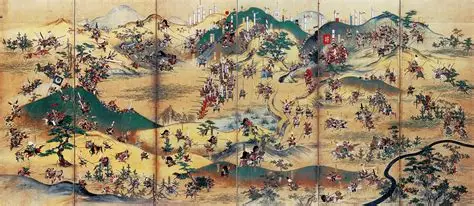
On the northern side of Nara, around Narazaka and Hannyaji, the battle had been raging since morning.
Leading the Taira forces advancing south from Kyoto was Taira no Kiyomori‘s fifth son, Taira no Shigehira, who was 24 years old.
The forces from Nanto, centered around Kofuku-ji, prepared to meet them.
The “Heike Monogatari” recounts that they dug trenches across the roads leading to Nara, lined up shields, and set up barricades to await the Taira army.
The Taira forces attacked from the direction of Narazaka and Hannyaji.
The battle continued into the evening.
After nightfall, fires broke out in the town of Nara.
The flames spread to Kofuku-ji and then to Todai-ji.
At Kofuku-ji, major buildings such as the Central Golden Hall, Lecture Hall, and the Five-story Pagoda were burned.
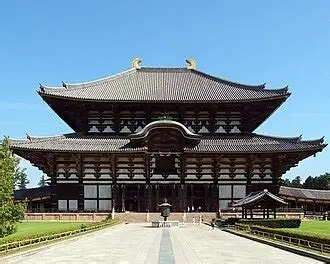
At Todai-ji, the Great Buddha Hall was engulfed in flames, causing significant damage to the Great Buddha.
The great temples, standing since the Nara period, suffered immense damage in a single night.
This battle did not erupt suddenly.
The conflict between the Taira and Nanto had been ongoing since the previous year.
The Political Upheaval of 1179: Kiyomori’s Control Over Kyoto
In the summer of 1179, significant changes occurred around Kiyomori.
On June 17, his daughter Moriko passed away at the age of 24.
Moriko was the widow of the Regent Konoe Motozane and had managed much of the regency family’s estates after his death. Following her death, Emperor Go-Shirakawa involved his close retainers in those estates.
On July 29, Kiyomori’s heir, Taira no Shigemori, died at the age of 42.
The province of Echizen, which Shigemori had governed, also shifted to the side of Emperor Go-Shirakawa.
In October, Motofusa’s son, the eight-year-old Shigeie, was appointed Provisional Middle Counselor.
This appointment surpassed the position of Konoe Motomichi, whom Kiyomori had supported.
On November 14, Kiyomori, stationed in Fukuhara, led thousands of troops into Kyoto.
On the following day, November 15, Motofusa was dismissed as Chancellor, and Konoe Motomichi was appointed as the new Chancellor.
On the 17th, 39 courtiers and officials close to Emperor Go-Shirakawa, including the Grand Minister of State Fujiwara no Moronaga, were dismissed.
On the 20th, Emperor Go-Shirakawa was moved to the Toba Palace.
Warriors were stationed around him, and access to the Emperor was restricted.
This was the political upheaval of the third year of the Jisho era.
In February of the following year, Jisho 4, Emperor Takakura abdicated in favor of Crown Prince Tokihito.
This was Emperor Antoku.
He was three years old by traditional count, just one year old in actual age.
His mother, Tokuko, was the daughter of Kiyomori, making Kiyomori the maternal grandfather of the young emperor.
That spring, Prince Mochihito, a son of the retired Emperor Go-Shirakawa, began to take action.
The Southern Capital that Prince Mochihito Sought Support From
In April of Jisho 4, Prince Mochihito called upon the Minamoto clan and various temples and shrines across the provinces to rise against the Taira clan.
When the plan was discovered by the Taira, on May 15, Prince Mochihito fled to Onjo-ji Temple.
Eventually, Minamoto no Yorimasa also joined the cause.
From Onjo-ji, they sought support from Enryaku-ji on Mount Hiei and further from Kofuku-ji in Nara.
The monks of Kofuku-ji began to mobilize.
On May 22, news reached Kujō Kanezane that the monks of the Southern Capital were rising and preparing to march on Kyoto.
On the night of the 25th, Prince Mochihito and Yorimasa left Onjo-ji.
Their destination was Nara.
However, on the following day, the 26th, they were caught by the Taira forces at Uji.
In the battle over the Uji Bridge, Minamoto no Yorimasa was defeated and took his own life at Byodoin Temple.
Prince Mochihito attempted to flee towards Nara but was killed by pursuers near the Torii-mae area of Mount Komyo.
He was unable to join forces with the troops from Kofukuji Temple.
Even after the death of Prince Mochihito, relations between Kofukuji Temple and the Taira clan did not improve.
In Nanto, not only Kofukuji but also other major temples like Todaiji were gathered, housing numerous monks, commoners, and temple lands. Kofukuji was the family temple of the Fujiwara clan, with many estates and branch temples throughout Yamato Province.
If the temple’s populace were to arm themselves and mobilize, they would become a formidable force of resistance.
The Move to Fukuhara and Uprisings Across the Land
Seven days after the death of Prince Mochihito on June 2, Emperor Antoku, the retired Emperor Takakura, and the cloistered Emperor Go-Shirakawa left Kyoto for Fukuhara.
This area is now around the Hyogo Ward of Kobe City.
It was a place where Taira no Kiyomori had long established his base.
The relocation to Fukuhara began.
From summer to autumn, conflict spread in the eastern provinces as well.
On August 17, Minamoto no Yoritomo raised his banner in Izu.
Although he was defeated by Oba Kagechika and others at Ishibashiyama on the 23rd, Yoritomo fled to Awa and gathered the forces of Chiba Tsunetane and Kazusa Hirotsune.
By October 6, he had entered Kamakura.
In Kai, Takeda Nobuyoshi and the Kai Genji were active, while in Shinano, Minamoto no Yoshinaka (Kiso Yoshinaka) raised his army.
In October, a punitive force led by Taira no Koremori advanced down the Tokaido.
The Taira forces, unable to maintain their strength, retreated from the Fuji River between the night of the 20th and the 21st.
Yoritomo did not proceed directly to Kyoto but turned north to attack the Satake clan in Hitachi.
In the Kinai region, the Omi Genji were also on the move.
The Taira clan could no longer focus their forces solely on the eastern provinces.
On November 23, Emperor Antoku and others departed from Fukuhara, returning to Kyoto by the 26th.
In just about half a year, the capital relocation to Fukuhara came to an end.
Then, in December, the Taira clan directed their forces against the rebellious factions in the Kinai region.
After Onjo-ji, Nanto Remained
In Omi, Minamoto forces were active, and the monks of Onjo-ji were involved as well.
Onjo-ji was also the temple that had accepted Prince Mochihito in May.
In December, the Taira forces entered Omi and attacked the rebellious factions.
Onjo-ji was also attacked, and its buildings were set ablaze.
Meanwhile, in Kyoto, another temple faction was being closely watched.
This was Nanto.
On December 12, news reached Kujō Kanezane, the author of “Gyokuyō,” that the monks of Nanto were gathering warriors from their branch temples and estates to march on Kyoto.
By the 14th, rumors spread that even the monks of Enryaku-ji were mobilizing to attack Rokuhara.
On the 16th, reports came in that the monks of Nanto were advancing towards Kyoto, prompting the government forces to mobilize.
This information turned out to be mere rumors.
Nevertheless, it was clear that Kyoto was on high alert regarding Nanto’s movements.
By the 22nd, Kanezane’s diary contained even more detailed information.
Plans were underway to capture the “evil monks” of Nanto and burn their quarters.
Preparations for this were advancing.
A military action against Nanto was imminent.
The “Tale of the Heike” records another incident during this period.
Kiyomori sent Senoo Kaneyasu, a warrior from Bitchu Province, with over 500 horsemen to Nara, where the monks of Nanto captured and beheaded over 60 of his men, displaying their heads by Sarusawa Pond.
Upon hearing this, Kiyomori was enraged and ordered Shigehira to attack Nanto.
This account of the beheading of over 60 men does not appear in contemporary diaries like “Gyokuyō” or “Sankai-ki.”
However, preparations for the attack on Nanto itself are confirmed by contemporary sources.
On December 25, the forces finally departed from Kyoto.
December 25—Taira no Shigehira Marches on Nanto
The commander appointed was Taira no Shigehira.
He was the son of Kiyomori and Tokiko, and the younger brother of Munemori and Tomomori.
He was 24 years old by traditional Japanese age reckoning.
In May, they also set out to suppress Prince Mochihito.
As a deputy commander, Taira no Tsunemori, the son of Taira no Norimori, also joined the campaign.
The “Tale of the Heike” records that the forces of Taira no Shigehira and Taira no Tsunemori numbered over 40,000 cavalry.
The Nanto side had 7,000 men.
These are grand figures typical of war tales.
However, “Yama no Ki,” written by the contemporary court noble Nakayama Tadachika, estimates the government forces heading to Nanto at several thousand cavalry.
On the 25th, the troops departed from Kyoto.
They encountered harsh winter weather and stayed around Uji for the day.
On the 26th, they resumed their march southward.
To enter Nara from Kyoto, they had to pass through Uji, traverse the area around the Kizu River, and head towards Yamato.
The Nanto side anticipated this route.
The populace resisted along the Kizu River banks up to the northern part of Nara, attempting to halt the Taira army’s advance south.
On the 27th, Shigehira’s forces advanced to the Kizu area.
Reports of large-scale mobilization on the Nanto side circulated, with “Gyokuyo” even recording an astonishing figure of 60,000.
This number cannot be taken as the actual count.
However, it aligns with information from early December that not only monks from Kofuku-ji gathered with weapons, but people were also mobilized through branch temples and estates.
The Taira forces approached the northern part of Nara.
Awaiting them was a defensive line centered around Narazaka and Hannyaji.
The Defensive Line Built at Narazaka and Hannyaji
Hills stretch across the northern side of Nara.
For forces entering Nara from the Kyoto direction, they must pass through these hills to advance south.
The Nanto side fortified their defenses using the roads.
According to the “Tale of the Heike,” they dug trenches and lined shields and abatis at two locations: Narazaka and Hannyaji.
An abatis is a barrier made of felled trees with branches facing the enemy.
It makes it difficult for horses to move freely.
Many on the Nanto side fought on foot.
By placing obstacles on the narrow roads and shooting arrows from behind them, the Taira cavalry could not easily break through.
Hannyaji is located north of Todai-ji.
If this position were breached, the temple precincts of Todai-ji and Kofuku-ji lay beyond.
On December 28th, Shigehira’s forces launched a full-scale attack.
December 28th—The Battle Begins in the Morning
The “Tale of the Heike” states that the battle began at the hour of the hare.
This corresponds to the time from dawn to early morning.
The Taira forces split into two groups.
One group advanced through Narazaka, while another moved through Hannyaji.
They attacked the defensive lines of Nanto from two directions.
The defenders of Nanto awaited them behind dug-out roads and barricades.
They drew their bows and showered arrows upon the approaching Taira warriors.
For mounted warriors, it was difficult to charge forward with ditches and barricades ahead.
The Taira forces returned fire from the front lines.
As they neared the defensive line, some dismounted to fight on foot.
After the exchange of arrows, the battle turned to close combat with swords and long spears.
The fighting continued at both Narazaka and Hannyaji.
The Taira had the advantage in numbers, allowing them to rotate fresh troops to the front.
The Nanto defenders resisted using the narrow paths.
The “Tale of the Heike” describes how the imperial forces, on horseback, shot arrows at the foot soldiers, taking down many.
The battle continued past noon.
The Taira forces gradually pushed back the defensive line.
Narazaka. Hannyaji.
The resistance from the Kizu direction was pushed to the northern edge of Nara.
By evening, the Taira forces had seized control of the Narazaka and Hannyaji areas.
Shigehira’s troops entered the vicinity of Hannyaji.
They were not far from Todai-ji.
Yet, the battle was not completely over.
The winter sun set.
Nara was enveloped in darkness.
Then, flames erupted.
Fires Set Amidst Night Battles
According to the “Tale of the Heike,” Shigehira ordered fires to be lit for illumination, and his soldiers set fire to nearby houses.
The flames, fanned by the wind, spread quickly.
Reading this account alone, it might seem the great fire was an accidental blaze during the night battle.
However, the “Gyokuyo,” a contemporary record, notes that as early as December 22, six days before the battle began, there was already information about plans to burn the buildings of Nanto.
At the very least, attacks involving arson were anticipated before the campaign began.
However, no contemporary records indicate that Kiyomori had ordered the destruction of major structures like the Great Buddha Hall of Todai-ji or the main halls of Kofuku-ji.
The fires set in the night in Nara spread beyond the battlefield.
Kofuku-ji was the first to suffer significant damage.
The Central Golden Hall. The Lecture Hall. The Five-story Pagoda. The Southern Octagonal Hall.
The main halls and towers of the temple complex were engulfed in flames.
Kofuku-ji had experienced fires multiple times since its founding, but the fire in the fourth year of the Jisho era was the largest.
The flames then threatened Todai-ji.
The Burning of Todai-ji’s Great Buddha Hall
Todai-ji was constructed during the Nara period at the behest of Emperor Shomu.
In the year 752, the eye-opening ceremony of the Great Buddha of Rushana was held.
The massive Great Buddha Hall that housed this statue was engulfed in flames on the night of December 28, 1180.
Fire entered the hall, and the wooden structure of the Great Buddha Hall was consumed by the blaze.
The Great Buddha of Rushana was also subjected to intense heat, suffering significant damage.
The damage was not limited to the Great Buddha Hall alone.
Many of the main buildings of Todai-ji were lost.
In later stories like the “Tale of the Heike,” it is said that elderly people, women, and children fled into the Great Buddha Hall, and over 1,700 perished in the flames.
There are no contemporary records that confirm the number of 1,700.
Nevertheless, it was not only the temples that burned.
Nara, which had become a battlefield, was home to not only monks but also people living in and around the temple precincts.
Amidst the night battles and fires, many people were caught up in the chaos.
Todai-ji. Kofuku-ji.
The monks’ quarters and houses spread around them.
On the night of the 28th, flames spread from the north of Nara to the city center.
The next morning, the news reached Kyoto.
December 29th—”Beyond the Reach of Words”
Kujō Kanezane, who was in Kyoto, recorded the news from Nanto in his diary, “Gyokuyō.”
For Kanezane, Kofuku-ji was a special temple.
It was the family temple of the Fujiwara clan.
That Kofuku-ji had burned. Todai-ji had also burned.
Upon hearing the report, Kanezane recorded his shock in his diary.
“Beyond the reach of words,” he wrote.
He further noted, “My heart is as if slaughtered,” and he looked to the heavens and wept, prostrate on the ground.
The loss of Todai-ji and Kofuku-ji had a more profound impact on the courtiers in Kyoto than the outcome of the battle in Nara.
The Taira forces, led by Shigehira, had overcome the resistance from the Nanto side.
However, what was recounted alongside their victory was the destruction of the temples.
The heads of those defeated on the Nanto side were also brought to Kyoto.
According to the “Sankai-ki,” 49 heads were brought back.
However, they were not displayed as a warning.
In Kyoto, immediately after defeating Nanto, there was no atmosphere to flaunt the victory.
Why Taira no Shigehira’s Name Became Linked with the “Burning of Nanto”
The decision to dispatch troops to Nanto was made by the Taira regime.
The commander leading those forces was Shigehira.
Even before the expedition, the plan to capture people from the Nanto side and burn their quarters had been communicated to Kyoto.
On December 28, they indeed attacked Narazaka and Hannyaji, and by nightfall, fires were set.
Up to this point, the events can be traced through contemporary records and military chronicles.
On the other hand, whether Shigehira was initially ordered to burn down the Great Buddha Hall of Todai-ji and the main buildings of Kofuku-ji is unknown.
The “Tale of the Heike” depicts how a fire spread after Shigehira requested light for a night battle.
In another version of the “Tale of the Heike,” there are descriptions that emphasize the act of arson more strongly.
What is certain is that a large-scale fire broke out in Nanto due to the attack led by Shigehira, causing devastating damage to Todai-ji and Kofuku-ji.
As a result, Shigehira came to be remembered as the “general who burned Nanto.”
This memory persisted even after the fall of the Taira clan.
Shigehira Captured at Ichi-no-Tani
On February 7, 1184.
The Battle of Ichi-no-Tani took place on the border of Settsu and Harima.
Defeated by the forces of Minamoto no Noriyori and Minamoto no Yoshitsune, the Taira army fled to the sea.
Shigehira could not escape.
While retreating from the vicinity of Ikuta Forest, he lost his horse and was captured by the Minamoto forces.
More than three years had passed since the burning of Nanto.
After being paraded in Kyoto, Shigehira was sent to Kamakura.
Minamoto no Yoritomo treated Shigehira with respect.
Eventually, in March 1185, the Taira clan met their end at Dan-no-ura.
Shigehira survived.
However, Nanto had not forgotten the events of 1180.
Voices from Todai-ji and Kofuku-ji demanded Shigehira’s handover.
Returned from Yoritomo’s custody to Kyoto, Shigehira was handed over to Nanto.
Four and a Half Years Later, the Same Path to Nara
On June 23, 1185.
Shigehira was sent toward Nara.
During the attack on Nanto, Shigehira had traveled from Kyoto through Uji and Kizu to Nara.
This time, he proceeded in the same direction as a captive.
Near the Kizu River, Shigehira was executed.
He was 29 years old by traditional count.
His head was taken to Nara.
The “Tale of the Heike” recounts that Shigehira’s head was displayed at the great torii of Hannya-ji.
On December 28, 1180, 24-year-old Shigehira had led his forces around Hannya-ji as a general.
Four and a half years later, at 29, Shigehira was sent back to this place as a prisoner.
By that time, the reconstruction of the burned Todai-ji was already underway.
Rebuilding the Burned Great Buddha
The year after the burning of Nanto, in 1181, Shunjobo Chogen became the chief overseer of Todai-ji’s reconstruction.
At that time, Chogen was 61 years old by traditional count.
Chogen traveled across the land gathering donations to advance the reconstruction of Todai-ji.
The greatest challenge was the damaged Great Buddha of Rushana.
Repairing the massive statue required a substantial amount of copper.
In addition to rebuilding the Great Buddha Hall, it was necessary to gather enormous timber, manpower for transportation, and funds.
Shunjōbō Chōgen incorporated Song dynasty architectural techniques as he advanced the project.
August, 1185.
The eye-opening ceremony for the restored Great Buddha was held.
Emperor Go-Shirakawa served as the officiating priest.
This was about two months after Taira no Shigehira was executed near the Kizu River.
The reconstruction of the Great Buddha Hall itself took even longer.
In 1195, the dedication ceremony for the Great Buddha Hall at Tōdai-ji was held.
Minamoto no Yoritomo traveled from Kamakura to attend.
Tōdai-ji, which had burned down on December 28, 1180, was rebuilt into a massive temple complex over 15 years.
At Kōfuku-ji, reconstruction was also underway, with the lost halls and pagodas being rebuilt one by one.
The temples of Nara gradually regained their former appearance.
Meanwhile, the internal conflict of 1180 did not come to an end.
The year after Nanto burned, on February 4, 1181, Taira no Kiyomori passed away.
In March, the Taira clan’s large army advanced into Owari.
To confront them were Minamoto no Yukie and the Minamoto forces.
The next major battlefield was the Sunomata River, which flows between Owari and Mino.