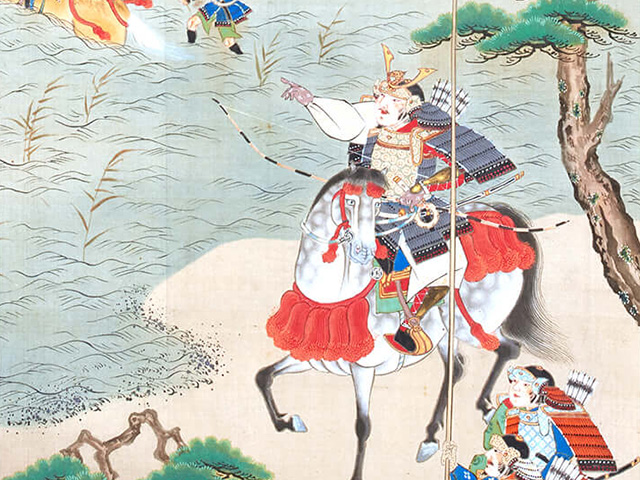
The Heian-period warrior Minamoto no Yorimitsu.
In later ages, he is also known by the alternate reading “Raiko.”
He slays Shuten-doji at Mount Oe, commands the “Four Guardian Kings of Yorimitsu” — Watanabe no Tsuna, Sakata no Kintoki, Usui no Sadamitsu, and Urabe no Suetake — and even defeats the earth spider.
In later legend, Yorimitsu is nothing less than a hero who hunts demons.
Yet the figure who emerges from sources closer to his own time looks somewhat different.
A military noble who served the Fujiwara regental house, held a succession of provincial governorships in Bizen, Mino, and Tajima, and built an enormous fortune.
In the second year of Eien (988), he presented thirty horses to celebrate Fujiwara no Kaneie’s new residence, and in the second year of Kannin (1018), he donated a complete set of furnishings for Fujiwara no Michinaga’s newly rebuilt Tsuchimikado Mansion.
A master archer.
He held real wealth. He held real connections at court. And he commanded retainers skilled in arms.
The real Yorimitsu was never a warrior chasing after demons.
He was a military noble who, in a Kyoto dominated by the Fujiwara, used military force, wealth, and connections to raise his own family’s standing.
And it was precisely this real figure that, over the centuries after his death, was built into “the Yorimitsu who slays demons.”
948 — born as Minamoto no Mitsunaka’s eldest son
Minamoto no Yorimitsu was born in the second year of Tenryaku (948).
His father was Minamoto no Mitsunaka (covered in this article — Japanese only). His mother was a daughter of Minamoto no Shun.
The commonly cited genealogy runs:
Emperor Seiwa
↓
Prince Sadazumi
↓
Minamoto no Tsunemoto
↓
Minamoto no Mitsunaka
↓
Minamoto no Yorimitsu.
His father Mitsunaka was a critical figure in the growth of the Seiwa Genji as a warrior house.
With Tada, in Settsu Province, as his key base, he served the Fujiwara regental house in Kyoto.
The warriors of this era were still not the same as the shogunal vassals of the later Kamakura period.
As court officials, they handled guard duty and the maintenance of order, were appointed to provincial posts, and built up wealth in their provinces. With that strength, they gathered retainers, and raised their own standing in the capital further still.
Yorimitsu grew up as Mitsunaka’s eldest son.
His younger brothers were Minamoto no Yorichika and Minamoto no Yorinobu (a full profile of Yorinobu is available in English here).
In later generations,
Yorimitsu’s own line came to be called the Settsu Genji, Yorichika’s line the Yamato Genji, and Yorinobu’s line the Kawachi Genji.
It is Yorinobu’s house, the third son, that leads directly to Minamoto no Yoritomo, but at the close of the tenth century, Yorimitsu stood at the very center of the Seiwa Genji as Mitsunaka’s eldest son.
What he learned from his father was “whom to serve”
The greatest asset Yorimitsu inherited from his father Mitsunaka was never martial prowess alone.
It was the ability to see exactly whose service would make his family grow.
Mitsunaka had drawn close to the Fujiwara regental house. Yorimitsu followed the same path.
Politics in this age was driven by the Fujiwara.
Rather than opposing that power head-on, Yorimitsu worked his way inside it.
Serve a powerful figure. Gain office. Become a resident governor. Build wealth in the provinces.
Carry that wealth back to Kyoto, and put it in service of the powerful.
Yorimitsu made thorough use of this cycle.
988 — thirty horses for Fujiwara no Kaneie
The second year of Eien (988).
Fujiwara no Kaneie completed a new residence.
Kaneie was Emperor Ichijo’s maternal grandfather, and stood at the summit of government as regent.
To celebrate, what Yorimitsu presented was thirty horses.
Yorimitsu was 41 by Japanese count.
In the Heian period, a horse was at once a means of transport, a military asset, and a costly form of wealth.
To prepare thirty of them at once
shows that Yorimitsu already commanded enormous wealth.
And he spent that wealth on exactly the man who could make the most of it.
Turning money into political power. This, too, was Yorimitsu’s real strength.
992 — Governor of Bizen, building further wealth as a resident governor
In the third year of Shoryaku (992), Yorimitsu became Governor of Bizen.
He went on to hold governorships in Tajima, Mino, and other provinces as well.
A resident governor in the mid-Heian period held a critical office, wielding real authority over provincial administration.
Collecting taxes. Running the provincial government office. Negotiating with local powers. Using force when necessary.
And a governor who managed his province successfully could gain enormous wealth.
Yorimitsu’s fortune was built across this string of governorships.
Which is why reducing Yorimitsu’s strength to “skill with a bow” misses the point entirely.
He was a warrior who could govern a province, and turn that governance into money.
Shooting a fox before the crown prince
The Konjaku Monogatarishu preserves a fascinating anecdote about Yorimitsu’s skill in arms.
While the future Emperor Sanjo was still crown prince, Yorimitsu served him as Junior Steward of the Crown Prince’s Household.
One day, a fox appeared at the Higashi Sanjo Mansion.
The crown prince ordered Yorimitsu, “Shoot that fox.”
For the demon-slaying hero of later legend, this would look like a trivial task.
But Yorimitsu found himself in a genuine bind.
Missing would bring shame on him as a warrior. And the crown prince and the court nobles were watching.
Even so, it was an order, so he drew his bow. The arrow flew true and struck the fox.
The fox rolled over and fell into a pond. Everyone present was astonished by Yorimitsu’s skill.
Yet Yorimitsu took the position that the shot had struck true not through his own skill alone, but because the gods and buddhas had protected the honor of the Minamoto name.
The Yorimitsu who appears here is no simple, brash warrior.
He is a courtier-warrior, calculating the eyes watching him, his own standing, and the consequences of every outcome.
1001 — exchanging letters with Oe no Masahira
In the third year of Choho (1001), Yorimitsu became Governor of Mino.
In the neighboring province of Owari, one of the leading literary men of the age, Oe no Masahira, had been posted as governor.
The two exchanged letters in Chinese prose, congratulating each other on their respective postings.
These letters survive in the Honcho Monzui.
Yorimitsu’s own waka poetry was also included in an imperial anthology.
Governing a province. Exchanging gifts with the Fujiwara. Corresponding with men of letters, and composing poetry himself.
This was the mid-Heian military noble.
The worlds of the warrior and the courtier had not yet fully separated.
Even Akazome Emon stayed under Yorimitsu’s roof
Around this same year, 1001, the poet Akazome Emon recorded in her own poetry collection that she had lodged at a place connected to Yorimitsu.
Akazome Emon was the wife of Oe no Masahira, and a celebrated poet who also served Fujiwara no Michinaga’s wife, Minamoto no Rinshi, and their daughter, Shoshi.
Caught in heavy rain during her travels, she stayed at Yorimitsu’s residence.
She even made the leaking roof the subject of a poem — the same Yorimitsu who, in later legend, would storm a demon’s own lair.
The real Yorimitsu, it turns out, kept company with the finest men and women of letters of his age.
Taking Fujiwara no Michitsuna as a son-in-law
Yorimitsu’s relationship with the Fujiwara never stopped at simple service.
Yorimitsu married his daughter to Fujiwara no Michitsuna.
Michitsuna was a son of Fujiwara no Kaneie.
His mother was the woman known to history as “the Mother of Michitsuna,” author of the Kagero Diary, making him a half-brother of Michinaga.
In other words, Yorimitsu had taken a man of the regental house itself as his own son-in-law.
He even had Michitsuna live at his own residence.
Yorimitsu was never merely a warrior standing guard at the Fujiwara gate.
Through marriage, he had worked his way directly into the regental house’s own network of relationships.
1018 — “an entire set of furnishings” for Fujiwara no Michinaga
The second year of Kannin (1018).
Here comes the single greatest episode testifying to Yorimitsu’s wealth.
Fujiwara no Michinaga’s Tsuchimikado Mansion was rebuilt.
On this occasion, Yorimitsu donated a complete set of furnishings for the entire residence.
He was 71 by Japanese count.
Well into old age, he still commanded enough wealth to furnish, all at once, everything needed for Michinaga’s grand mansion.
The single greatest display of Yorimitsu’s power in the historical record may not be cutting off a demon’s head, but rather
holding enough money to furnish, in one stroke, an entire mansion belonging to Michinaga himself.
The glittering world of Fujiwara regency rule was, in part, sustained by the wealth resident governors like Yorimitsu extracted from the provinces.
Yorimitsu’s retainers got carriage-sick
Around Yorimitsu were retainers genuinely known for their skill in arms.
The Konjaku Monogatarishu names
Taira no Sadamichi, Taira no Suetake, and Kintoki.
These are the figures who later became Usui no Sadamitsu, Urabe no Suetake, and Sakata no Kintoki.
All three are described as excelling in the martial arts, warriors feared even in the east.
And yet, one day, the three of them decided they wanted to go watch the Kamo Festival.
Riding in on horseback would draw too much attention.
So they rode in an ox-drawn carriage instead, something they were unused to.
The result: all three were violently carriage-sick.
Warriors who, in later legend, would fight demons, made sick by an ox-cart while out watching a Kyoto festival.
At this stage, Yorimitsu’s retainers were not yet the flawless “Four Guardian Kings.”
They were strong warriors, and also men perfectly capable of a thoroughly human blunder.
The original of Urabe no Suetake also encounters a “ubume”
An even stranger tale survives about Taira no Suetake.
Crossing a river at night, a woman appeared and asked him to hold her infant.
This is a tale of the supernatural leading to the later ubume legend.
Suetake did not flee. He took the child and crossed the river.
Before long, the infant transformed into something else entirely.
Even before the legend of Yorimitsu’s own defeat of Shuten-doji had fully taken shape, the image of “Yorimitsu’s retainer, the warrior who confronts the supernatural,” was already forming.
“A warrior from that household wouldn’t run, even if a monster appeared.”
The foundation of this narrative was already beginning to take shape.
The “Four Guardian Kings of Yorimitsu” were not always four
Today, the Four Guardian Kings of Yorimitsu means
Watanabe no Tsuna, Sakata no Kintoki, Usui no Sadamitsu, and Urabe no Suetake —
these four men.
But during Yorimitsu’s own lifetime, these four did not exist as a fixed team called “the Four Guardian Kings.”
In the Konjaku Monogatarishu, the men who appear together as Yorimitsu’s retainers are, first, Sadamichi, Suetake, and Kintoki.
Later generations added the legend of Watanabe no Tsuna and others, and the familiar foursome came together over time.
A real warrior existed. A tale was added. Another heroic legend became attached.
Across many generations, the ultimate team of “Yorimitsu plus his Four Guardian Kings” was assembled.
How Kintoki became “Kintaro”
Sakata no Kintoki, known as one of the Four Guardian Kings.
In children’s tales, he is “Kintaro,” the boy in a red belly-wrap who wrestles bears.
But the name of Yorimitsu’s retainer as he appears in the Konjaku Monogatarishu is simply Kintoki.
Over later generations, this same Kintoki was turned into legend, following the path
Kintoki → Kintoki (with a different reading) → Sakata no Kintoki → and, for his childhood, Kintaro.
It was not only Yorimitsu.
Even Yorimitsu’s own retainers, one after another, transformed into legendary heroes.
1021 — Governor of Settsu, in his final year
The first year of Jian (1021).
Yorimitsu became Governor of Settsu.
His father Mitsunaka had held deep ties to Tada, in Settsu Province.
Yorimitsu’s own descendants also kept Settsu as a critical base, and their line came to be known in later generations as the Settsu Genji.
While Minamoto no Yoritomo would descend from his brother Yorinobu’s Kawachi Genji, important figures emerged from Yorimitsu’s Settsu Genji as well.
The most prominent among them is Minamoto no Yorimasa, who would rise in arms alongside Prince Mochihito at the very end of the Heian period.
July 19, 1021 — dies at 74
On the nineteenth day of the seventh month, in the first year of Jian (1021).
Minamoto no Yorimitsu died.
He was 74.
Here ends the life of Yorimitsu that can be traced through the historical record.
He served the Fujiwara regental house.
He held governorships in Bizen, Mino, Tajima, and elsewhere.
He gave Kaneie thirty horses. He donated a complete set of furnishings to Michinaga.
He kept company with men of letters and poets, and shot a fox before the crown prince.
And he commanded retainers renowned for their skill in arms.
And yet the “Minamoto no Yorimitsu” we know today was born only after this point.
Roughly 300 years after his death — fighting Shuten-doji at Mount Oe
Yorimitsu’s greatest legend is his defeat of Shuten-doji.
The oldest surviving major telling of the Shuten-doji story is the Nanboku-cho-period Oeyama Ekotoba.
A work created more than 300 years after Yorimitsu’s death.
In the tale, during the reign of Emperor Ichijo, women of the capital vanish one after another.
The cause: a demon living at Mount Oe, named Shuten-doji.
Ordered to subdue him, Yorimitsu and his companions disguise themselves as mountain ascetics and enter the mountain.
He does not simply charge in.
With the help of the gods, he obtains Jinben Kidokushu, a wine poisonous to demons.
He then infiltrates Shuten-doji’s own lair.
He joins the feast, letting his guard down and putting the demon at ease.
(A full profile of Minamoto no Yorinobu, Yorimitsu’s own younger brother, is available in English here.)
He plies the demon with drink. Gets him drunk. Lets him fall asleep. And then takes his head.
Never winning through force alone.
Preparing carefully, reading his opponent’s character, and building a winning position before finally striking the blow.
Strangely enough, this way of fighting suits the real Yorimitsu rather well.
Because this was a man who lived his life at court by working his connections with the Fujiwara, and turning wealth into political power.
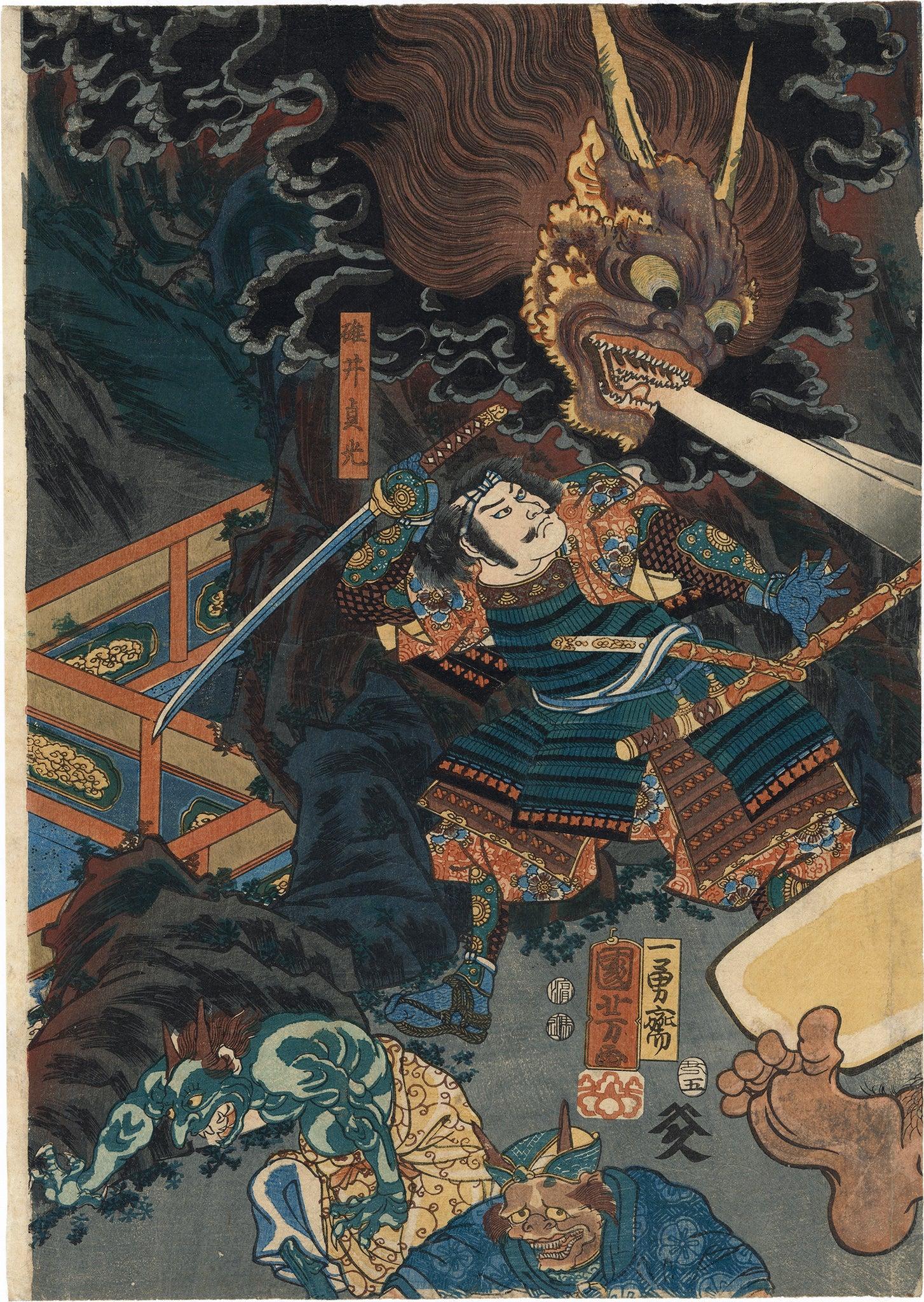
Even beheaded, Shuten-doji strikes back
Shuten-doji does not go down simply because his head is cut off.
The severed head flies through the air and attacks Yorimitsu.
Yorimitsu is saved only by a helmet granted to him by the gods.
This scene was depicted again and again in later picture scrolls and ukiyo-e prints.
The Important Cultural Property Shuden Doji Emaki, produced in the second year of Taiei (1522), runs to three full scrolls.
Laid end to end, its total length reaches roughly 66.4 meters.
A single military noble of the tenth century had become, roughly 500 years after his death, the hero of a lavish picture scroll running well over 66 meters.
Next, he even defeats “the earth spider”
The Yorimitsu legend does not end with Shuten-doji.
In the medieval period, a tale was created of his defeat of the earth spider as well.
A sinister presence appears before Yorimitsu as he lies ill in bed.
Yorimitsu strikes at it.
Following the trail of blood, he arrives at an enormous spider, and finally destroys it.
This, too, is no campaign from Yorimitsu’s own actual lifetime.
Yet by the medieval period, the casting had become completely fixed: “if a monster needs slaying, call Minamoto no Yorimitsu.”
Shuten-doji. The earth spider.
And a whole range of further demons and supernatural beings were gradually absorbed into the tales of Yorimitsu and his Four Guardian Kings.
Why “Yorimitsu,” and not his brother Yorinobu, became the hero of demon-slaying
Here is where things get interesting.
His younger brother Minamoto no Yorinobu has clear, well-documented military achievements to his name.
He ended the rebellion of Taira no Tadatsune with barely any fighting, built ties with the warriors of Bando, and became the founder of the Kawachi Genji.
It is Yorinobu who connects directly to the later warrior society.
And yet it was his elder brother Yorimitsu who became the hero of demon-slaying.
Yorimitsu himself was known for his skill in arms.
He had famous retainers around him.
He was close to the Fujiwara regental house, making him easy to write into stories set during the reign of Emperor Ichijo.
And what is more, despite being a famous warrior, the record of his actual large-scale campaigns is thin.
That gap in the record left enormous room.
“A man like Yorimitsu might well have slain a demon somewhere in that blank stretch of history.”
He was exactly the kind of figure into whom such a story could easily be written.
Because the real Yorimitsu existed, the legendary Yorimitsu was born
Neither the defeat of Shuten-doji nor of the earth spider appears in any source contemporary with Yorimitsu’s own military career.
But dismissing the legend on those grounds alone loses what makes Yorimitsu such a fascinating figure.
What matters is
why, out of all the warriors of the Heian period, Yorimitsu was the one chosen as the hero of demon-slaying.
The real Yorimitsu was known as a warrior.
He held great wealth. He held a strong relationship with the Fujiwara. He commanded retainers of proven skill in arms.
He stood near the very center of Fujiwara regency politics. That memory persisted across generations, and eventually swelled into
“a warrior of this caliber must surely have defeated even demons” —
and grew into a full heroic image.
Yorimitsu was already formidable, long before he ever slew a demon
Reducing Minamoto no Yorimitsu to simply “the man who defeated Shuten-doji” only obscures the far more interesting historical Yorimitsu.
Yorimitsu’s true strength was never a single blade.
Military force. Wealth. Court office. Marriage. Connections. Cultural refinement.
He combined all of these to survive, and thrive, through the age of Fujiwara regency rule.
And after his life ended at 74, people handed him a different kind of sword altogether.
They sent him to Mount Oe. Gave him his Four Guardian Kings. Had him cut down Shuten-doji. Had him defeat even the earth spider.
And from his own retainer Kintoki, they even created Kintaro.
In reality, a warrior who survived a society dominated by the Fujiwara.
In legend, a hero who cuts down every monster in Japan.
It is precisely because these two faces overlap that the name Minamoto no Yorimitsu has lived on for nearly a thousand years.