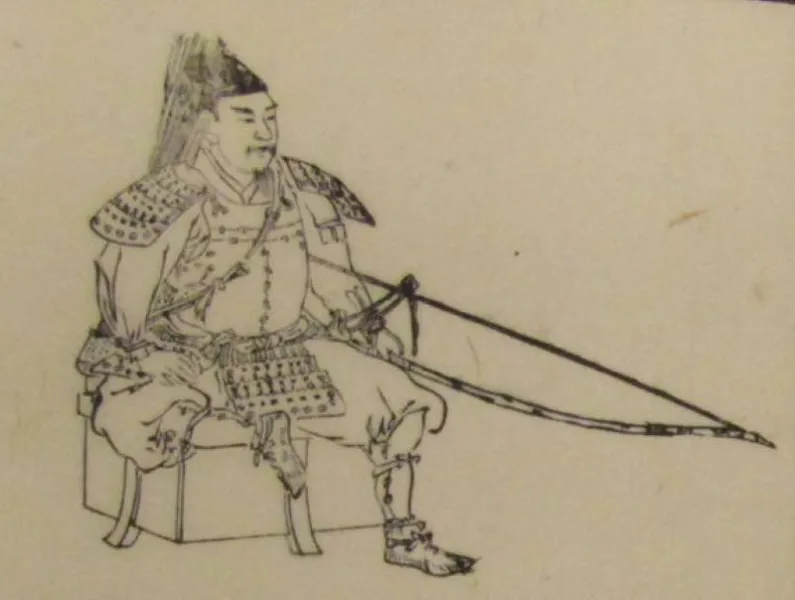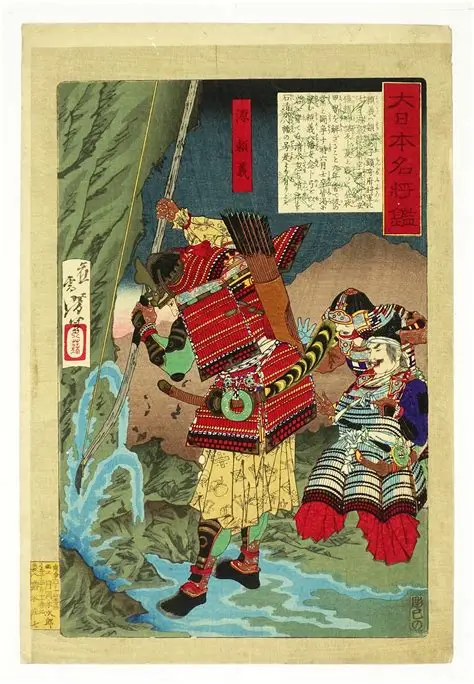
1057: Minamoto no Yoriyoshi, Down to Seven Riders
November, Tengi 5 (1057). In the snows of Oshu, Minamoto no Yoriyoshi stood at the edge of death.
Yoriyoshi’s army had marched north to strike down Abe no Sadato, and it collapsed at Kawaguchi. According to the Mutsu Waki, Yoriyoshi’s own horse was shot from under him, and even the horse of his son Yoshiie was lost. In the end, only Yoshiie and five other riders remained at Yoriyoshi’s side. Counting Yoriyoshi himself, that made seven. More than two hundred Abe horsemen closed in.
Yoriyoshi was, by the traditional count, seventy years old that year. He had lost a great army on the battlefield and was on the verge of being surrounded himself. And yet he survived. Five years later, he would go on to bring down Kuriyagawa Stockade, the Abe clan’s last stronghold.
Yoriyoshi was no unbeaten master of war. In the Former Nine Years War, he was driven into a corner again and again. Even so, after every defeat he regrouped, picked apart his enemy’s alliances one by one, brought the Kiyohara clan of Dewa onto his side, and stayed on the battlefield until it was over.
He inherited the military reputation his father Minamoto no Yorinobu had built in the Bando region, and passed it on to his son Yoshiie. In between, it was Minamoto no Yoriyoshi who deepened the bond between the Kawachi Genji and the warriors of eastern Japan.
988: Born the Eldest Son of the Famed General Minamoto no Yorinobu
Minamoto no Yoriyoshi was born in Eien 2 (988).
His father was Minamoto no Yorinobu.
His family descended from Emperor Seiwa and was known as the Seiwa Genji. Because their base was in Kawachi Province, this line came to be called the Kawachi Genji.
Yorinobu had brought the Taira no Tadatsune Rebellion to an end and built a great reputation for himself in the Bando region.
Yoriyoshi was his eldest son.
The Genji of this era looked nothing like the samurai of the later Kamakura period. Yoriyoshi, too, was a military aristocrat: he held court office, served the imperial family, and was posted to the provinces as a governor.
In his youth he served Prince Atsuakira, the retired Emperor Koichijoin, as an aide.
He was both a courtier who understood the workings of the court and a warrior skilled with bow and horse. He carried both faces at once.
1031: East to Bando with His Father Yorinobu
Chogen 4 (1031).
The Taira no Tadatsune Rebellion was still dragging on in Bando.
Taira no Tadatsune, a powerful figure centered on the Boso Peninsula, had defied the court, and even after punitive armies were sent, the affair would not be settled.
So the court turned to Yoriyoshi’s father, Yorinobu.
Yoriyoshi followed his father east.
Once Yorinobu arrived, Tadatsune surrendered, and the long rebellion came to an end. Yoriyoshi, too, entered Bando at his father’s side and experienced real combat for the first time.
What Yoriyoshi saw there was not simply a war of cutting down the enemy. His father Yorinobu had used his connections and reputation in the east to force Tadatsune into submission — deciding who to win over and who to command was the real work. That same instinct would guide Yoriyoshi decades later, when he fought the Abe clan in Oshu.
A Bride from the House of His Former Enemy — the Bond with Taira no Naokata
Yoriyoshi took as his wife the daughter of Taira no Naokata, who had served as the original commander sent to subdue Taira no Tadatsune.
Naokata was the general who had handled the Tadatsune campaign before Yorinobu took over.
He came from a distinguished branch of the Kanmu Taira and held strong footing in the Bando region.
Yoriyoshi took Naokata’s daughter as his wife.
She would later bear him Minamoto no Yoshiie, Yoshitsuna, and other sons.
Here too, we can see the process by which the Kawachi Genji put down roots in the east. Yorinobu had built his reputation through the Tadatsune rebellion, and now Yoriyoshi was bound by marriage to a Taira house with deep footing on the ground.
A later source, the Shirin Saiyosho, records that Naokata handed his residence in Kamakura down to his son-in-law Yoriyoshi.
This tradition is one reason Kamakura would later be remembered as “land handed down within the Minamoto house.”
The source itself dates from the Nanboku-cho period, well after Yoriyoshi’s own lifetime, so it cannot be treated as a contemporary record. Even so, the fact that the marriage between Yoriyoshi and Naokata’s daughter was remembered for centuries as the story explaining “how the Genji and Kamakura began” matters in its own right. The city of Kamakura itself cites this tradition when discussing the origins of the bond between the Genji and Kamakura.
Governor of Sagami — Gathering the Warriors of the East Around Himself
In Chogen 9 (1036), Yoriyoshi became Governor of Sagami.
He went on to hold a string of offices in the eastern provinces.
Warriors of Bando began gathering around him.
Reference works on Yoriyoshi note that, as Governor of Sagami, he brought the warriors of the east under his command, and that he spent his years as a provincial governor there organizing the local warrior bands.
Later, during the Former Nine Years War, warriors would turn back into the thick of battle to die for Yoriyoshi’s sake. That bond did not spring up overnight in Oshu. Through his years of activity in the east, including his time as Governor of Sagami, Yoriyoshi had steadily built ties of loyalty with the warriors of Bando.
1051: Sixty-Four Years Old, Yoriyoshi Goes to Mutsu
Eisho 6 (1051).
An appointment came that would define the rest of Yoriyoshi’s life.
Governor of Mutsu.
Yoriyoshi was, by the traditional count, sixty-four. For an 11th-century general, that was already old age.
In Mutsu, Abe no Yoriyoshi — soon to be known as Abe no Yoritoki — had seized control of the six districts known as the Oku-Rokugun and had crushed the forces of the previous governor, Fujiwara no Toto, at Onikiribe.
The court’s army had just been defeated.
It was into this situation that Yoriyoshi was sent.
He had combat experience, and ties with the warriors of the east.
From the court’s point of view, Yoriyoshi was exactly the man for the job.
Yet once Yoriyoshi entered Mutsu, the fighting stopped, for a time.
Abe no Yoriyoshi — the local leader, sharing the same reading of his name as the new governor — submitted.
In Eisho 7 (1052), a general amnesty was declared in connection with the recovery of Empress Dowager Shoshi from illness, and the Abe clan was pardoned along with everyone else.
The Mutsu Waki records that, to avoid sharing the same reading of his name as Yoriyoshi, the Abe leader changed his own name to Yoritoki.
Yoriyoshi accepted the submission of the Abe clan. The war that had begun with the defeat at Onikiribe went quiet, for now.
In Tengi 1 (1053), Yoriyoshi added the post of Chinjufu Shogun to his governorship of Mutsu.
He was now the central figure overseeing both the administration and the military of Oshu.
1056: The Akutorigawa Incident — Yoriyoshi Suspects Sadato
For roughly four years, no large-scale fighting broke out.
Yoriyoshi’s term as governor was drawing to a close.
That was when the Akutorigawa Incident occurred, in Tengi 4 (1056).
As Yoriyoshi was returning from Isawa Castle toward the provincial headquarters, the camp of his retainers Fujiwara no Mitsusada and Mototsune was raided at night.
According to the Mutsu Waki, Mitsusada suspected Yoritoki’s son, Sadato.
His accusation was that Sadato, having once asked for the hand of Mitsusada’s sister and been refused, had raided the camp out of resentment.
Who actually carried out the raid cannot be confirmed from the sources. What the Mutsu Waki records is simply that Yoriyoshi, having heard Mitsusada’s accusation, demanded that Yoritoki hand Sadato over.
Yoritoki refused.
The war resumed.
What matters for understanding Yoriyoshi’s character is what happened next.
Yoriyoshi did not only suspect his enemies.
He suspected his own men too.
Killing Taira no Nagahira — Yoriyoshi’s Severity Creates One More Enemy
In Yoriyoshi’s army were two men married to daughters of Abe no Yoritoki.
Taira no Nagahira and Fujiwara no Tsunekiyo.
Both had married into the Abe clan, yet both stood on Yoriyoshi’s side.
During the advance, Yoriyoshi grew suspicious of Nagahira’s behavior.
The Mutsu Waki says that Nagahira wore a conspicuous silver-colored helmet, among other things, which raised suspicion that he was signaling to the enemy.
Yoriyoshi judged Nagahira a traitor and had him killed.
This decision cost Yoriyoshi dearly.
The other son-in-law, Fujiwara no Tsunekiyo, grew afraid.
“Am I next?”
Tsunekiyo left Yoriyoshi’s army and fled to the Abe side.
A formidable rival who would later reach even into the tax collection of the provincial government had, in effect, been delivered to the Abe side by Yoriyoshi’s own decision.
Yoriyoshi’s suspicion and his readiness to punish did not simply cost him one ally. It handed the Abe clan a capable local warrior in Tsunekiyo.
If You Cannot Win Head-On, Break the Alliance Around Him
Even after the fighting with the Abe clan resumed, Yoriyoshi could not win easily.
So Yoriyoshi reached out to the powerful figures around the Abe clan instead.
Working through Kanetoki, the district magistrate of Kesen, he approached the northern powers and brought Abe no Tomitada over to his side.
The effect was enormous.
Abe no Yoritoki himself rode north to try to stop Tomitada and his allies from defecting.
In the seventh month of Tengi 5 (1057), he was struck by a stray arrow in the fighting against Tomitada’s side and, after retreating to Toriumi Stockade, died there.
Yoriyoshi did not strike down Yoritoki directly. He worked on the forces surrounding the Abe clan, and it was the clan’s own leader who was set in motion. He broke his enemy’s unity before ever meeting them in open battle.
But Yoriyoshi, riding high on Yoritoki’s death, suffered the worst defeat of the entire Former Nine Years War just four months later.
November 1057: Collapse at Kawaguchi
About four months after Yoritoki’s death.
Yoriyoshi pushed north in pursuit of Sadato.
According to the main text of the Mutsu Waki, Yoriyoshi’s force numbered over 1,800; the Abe force, over 4,000.
It was November in Oshu, no less.
The wind and snow grew fierce, the roads treacherous.
Provisions ran short. Men and horses alike were exhausted.
The Abe army fell on them.
Yoriyoshi’s army broke apart.
Hundreds died.
Yoriyoshi’s own horse was shot down.
His son Yoshiie’s horse fell too.
In the end, only six riders — Yoshiie among them — remained at Yoriyoshi’s side.
Counting Yoriyoshi, that made seven.
More than two hundred Abe horsemen closed in.
Yoriyoshi was, by tradition, seventy years old; Yoshiie, nineteen.
Father and son crossed the same battlefield’s edge of death and somehow escaped.
“I Will Die With My General” — Saeki no Tsunenori Turns Back
At Kawaguchi, we also see something of the relationships Yoriyoshi had built over the years with his warriors.
There was an old warrior named Saeki no Tsunenori.
According to the Mutsu Waki, he had served Yoriyoshi for thirty years.
During the retreat, Tsunenori lost sight of Yoriyoshi.
“The general is surrounded, and only a handful of men remain with him.”
On hearing this, Tsunenori stopped fleeing.
If his lord of many years was to die, he would die in the same place.
He turned back onto the battlefield and charged into the Abe ranks.
He cut down more than ten men before he finally fell.
Yoriyoshi had, in fact, already escaped. Tsunenori never knew it.
Even so, he chose not to leave his lord behind.
Tsunenori’s loyalty was not directed at some abstract idea of “the court.” It was directed at Yoriyoshi himself, the man he had served for so long. The bond that the Kawachi Genji had built with eastern warriors, from Yorinobu’s generation onward, was laid bare in the extremity of the Kawaguchi disaster.
Five Years After Kawaguchi — Still Unable to Break the Abe Clan
For roughly five years, Yoriyoshi could not secure a decisive victory.
Sadato, Munetada, and Fujiwara no Tsunekiyo remained active.
Tsunekiyo went so far as to issue his own “white tally” tax documents in defiance of the government’s “red tally,” and pushed ahead with collecting official taxes himself.
Even as Governor of Mutsu, Yoriyoshi could not stop it.
Requests for troops and provisions from the provinces did not bring in what he needed.
Records in the Mutsu Waki tradition note that, to escape this deadlock, Yoriyoshi repeatedly reached out to the Kiyohara clan in the northern reaches of Dewa, sending them rare and valuable gifts.
Yoriyoshi kept reaching out to the Kiyohara clan and kept sending gifts. Rather than insist on making up his losses from Kawaguchi with his own strength alone, he set out to draw the great power of Dewa into the war.
He Did Not Go Home When His Term Ended
Kohei 5 (1062).
Yoriyoshi was pushed further into a corner.
His term as Governor of Mutsu ended.
Takashina no Tsunee was named as his successor.
Normally, Yoriyoshi’s work would have ended there.
But Yoriyoshi did not leave Oshu.
The Mutsu Waki describes Tsunee arriving in Mutsu, seeing that the local population still followed Yoriyoshi, and returning to the capital.
Even as a former governor with no official post, Yoriyoshi stayed in Oshu until the war with the Abe clan was finally settled.
And then, in the summer of 1062.
The reinforcements he had waited so long for finally arrived.
Kiyohara no Takenori Arrives with More Than Ten Thousand Men
The Kiyohara clan of Dewa joined the war.
From Kiyohara no Mitsuyori’s household, his younger brother Kiyohara no Takenori arrived leading a massive army.
The Mutsu Waki puts his force at more than ten thousand men.
Yoriyoshi’s own army numbered around 3,000.
The man who had commanded barely 1,800 troops at Kawaguchi suddenly had a vast force added to his side.
From here, the war turned.
To treat the coming victory as “the Genji’s strength alone” misses the real picture. What finally delivered the decisive blow to the Abe clan was the Kiyohara clan’s entry into the war with more than ten thousand troops. And it was Yoriyoshi’s own political persistence — a long courtship finally paying off — that had brought the Kiyohara onto his side in the first place.
September 1062: At Seventy-Five, Yoriyoshi Reaches Kuriyagawa
The combined Yoriyoshi-Kiyohara army marched north.
Komatsu Stockade. Koromogawa Barrier. Toriumi Stockade.
One by one, they broke through the Abe clan’s defensive strongholds.
Then, in the ninth month of Kohei 5 (1062).
They closed in on the Abe clan’s last great stronghold, Kuriyagawa Stockade.
Yoriyoshi was, by tradition, seventy-five.
Five years had passed since Kawaguchi.
The full assault on September 16 cost Yoriyoshi’s side hundreds of dead.
Kuriyagawa Stockade did not fall.
The next day, the 17th, Yoriyoshi changed tactics.
He had nearby buildings torn down for timber, and had reeds cut and gathered.
These were piled at the moat and riverbank, and set alight.
The flames spread to the stockade itself.
Kuriyagawa Stockade collapsed.
Abe no Sadato, gravely wounded, was captured and died soon after being brought before Yoriyoshi.
He was thirty-four.
The man who had driven Yoriyoshi down to seven riders at Kawaguchi met his end before Yoriyoshi five years later.
Fujiwara no Tsunekiyo Alone Was Not Killed Quickly
Among those captured at Kuriyagawa Stockade was Fujiwara no Tsunekiyo.
He was the man who had defected from Yoriyoshi after the killing of Taira no Nagahira, and had gone on to become a central figure in the Abe clan.
Yoriyoshi did not forgive him.
The Mutsu Waki records a scene in which Yoriyoshi hurled a mocking remark at Tsunekiyo about his “white tally” tax collection.
Then he ordered his execution.
He had Tsunekiyo beheaded with a dull blade — a blunt sword, used to prolong the suffering.
The Mutsu Waki presents this as an execution meant to draw out the pain with a blade that would not cut cleanly. It is the scene that most fiercely conveys Yoriyoshi’s fury toward Tsunekiyo.
Tsunekiyo had once been in Yoriyoshi’s own army.
Then he had fled to the Abe side and gone so far as to challenge the provincial government’s own tax collection.
To Yoriyoshi, Tsunekiyo was more than an enemy — he was a traitorous vassal.
It is the scene that shows Yoriyoshi’s harshness most starkly.
Tsunekiyo left behind a young son.
He would later found the Oshu Fujiwara clan and build Hiraizumi.
The son of the man Yoriyoshi executed would go on to rule Oshu in the next age.
1063: The War Ends, and What Yoriyoshi Gained
Kohei 6 (1063).
In recognition of his achievements in the Former Nine Years War, Yoriyoshi was made Junior Fourth Rank, Lower Grade, and Governor of Iyo.
His son Yoshiie became Governor of Dewa.
Kiyohara no Takenori was granted the post of Chinjufu Shogun.
From taking up the governorship of Mutsu in 1051 to the fall of Kuriyagawa Stockade in 1062, twelve years passed. Despite a period of peace along the way, Yoriyoshi spent the greater part of his old age consumed by the Oshu conflict. He suffered a crushing defeat at Kawaguchi, and needed the strength of the Kiyohara clan to finally turn the tide. Even so, in 1063 his war record earned him the rank of Junior Fourth, Lower Grade, and the governorship of Iyo.
And that same year, 1063, Yoriyoshi left behind something that would carry enormous weight for the Kamakura of later ages.
1063, Kamakura — Yoriyoshi Enshrines the God Hachiman
Kohei 6 (1063).
Yoriyoshi invited the spirit of the Iwashimizu Hachimangu shrine of Kyoto to Yui Village in Kamakura.
This became what is now known as Yuinowakamiya, the “original Hachiman.”
The city of Kamakura recognizes this as the origin of Tsurugaoka Hachimangu.
One hundred and seventeen years later, in Jisho 4 (1180), Minamoto no Yoritomo entered Kamakura and moved this shrine to Kobayashigo Kitayama, the site of today’s Tsurugaoka Hachimangu.
The small shrine Yoriyoshi placed there in 1063 grew into the spiritual center of the Kamakura shogunate.
The god of war that Yoriyoshi enshrined at Yui went on to grow into the spiritual heart of the Kamakura shogunate. In the long history binding the Kawachi Genji to Kamakura, Yoriyoshi’s role cannot be left out.
Final Years — An Old General Who Lived to Eighty-Eight
Having ended the Former Nine Years War, Yoriyoshi became Governor of Iyo and later took religious vows.
On the 13th day of the seventh month of Jōhō 2 (1075), Minamoto no Yoriyoshi died.
The Dai Nihon Shiryo also records his death under this date.
By the traditional count, he was eighty-eight.
For a Heian-period warrior, that was an extraordinarily long life.
The man who watched Yoriyoshi’s wars most closely was his eldest son, Minamoto no Yoshiie. Yoshiie was nineteen when he lived through the rout at Kawaguchi, and he was there to see his seventy-five-year-old father turn the tide by bringing the great Kiyohara army onto their side. The tactics of dividing an enemy from within, the bonds of loyalty built with the warriors of Bando, the ruthlessness shown toward traitors — all of it was passed down to the next generation, to Yoshiie.
In time, Yoshiie would be known as “Hachiman Taro,” and would command even greater devotion from the warriors of the east than his father had.
One hundred and seventeen years later still, Yoriyoshi’s descendant Minamoto no Yoritomo entered Kamakura — the very place where the tradition of Yoriyoshi’s marriage to Taira no Naokata’s daughter lived on, and where Yoriyoshi himself had once enshrined the god Hachiman.
Yorinobu had built a military reputation in Bando; through the twelve-year ordeal of the Former Nine Years War, Yoriyoshi turned that reputation into an even stronger bond of loyalty, and passed the whole inheritance on to Yoshiie.
Standing at the very center of the Kawachi Genji’s growth into “the warrior house of the east” was this old general: Minamoto no Yoriyoshi.