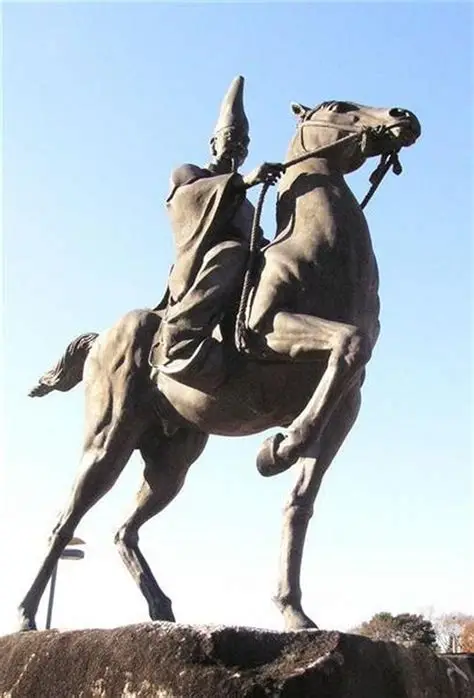
February 14, 940 (Tengyo 3).
In the northern hills of Koshima District in Shimousa Province, Taira no Masakado faced his final battle.
Masakado had gathered over 400 soldiers.
Opposing him were the forces of Fujiwara no Hidesato, Taira no Sadamori, and Fujiwara no Tamenori.
Amidst fierce winds, Masakado’s cavalry charged, breaking the ranks of the pursuing army.
According to the Shomonki, 2,900 troops from Hidesato and Sadamori’s side fled, leaving only about 300 elite soldiers on the battlefield.
Masakado’s forces pursued the retreating enemy.
However, the tide of the battle shifted.
Now, with the wind at their backs, Hidesato and Sadamori’s 300 elite soldiers counterattacked.
Masakado, clad in armor, rode into battle.
In the midst of the fight, an arrow struck Masakado.
It had been less than two months since he declared himself “New Emperor” on December 19 of the previous year.
Why did Masakado’s power, which had seized control of the provincial capitals of the Kanto region, crumble so swiftly?
The unraveling began right after he proclaimed himself “New Emperor.”
1. December 939—Taira no Masakado Becomes “New Emperor”
On November 21, 939 (Tengyo 2), Masakado seized control of the Hitachi provincial capital.
By December 11, he had advanced to the Shimotsuke provincial capital, and by the 15th, he had taken the Kozuke provincial capital, securing the official seals of each province.
Then, on December 19.
At the Kozuke provincial capital, a shamaness, claiming to be a messenger of the Hachiman Great Bodhisattva, declared that Masakado was granted the imperial throne.
The Shomonki refers to Masakado as “New Emperor” from this point onward. It contrasts with the Suzaku Emperor in Kyoto, who is referred to as “Original Emperor” or “Original Sovereign,” highlighting Masakado’s assertion of a new imperial authority.
Masakado appointed new provincial governors across the Kanto region.
Shimotsuke Governor: Taira no Masayori.
Kozuke Governor: Taji no Tsunemasa.
Hitachi Assistant Governor: Fujiwara no Kuramochi.
Kazusa Assistant Governor: Koshi no O.
Awa Governor: Fumiya no Yoshitachi.
Sagami Assistant Governor: Taira no Masafumi.
Izu Governor: Taira no Masatake.
Shimousa Governor: Taira no Masatame.
Furthermore, there were plans to build a royal castle in Shimousa Province, complete with ministers, counselors, and advisors.
Having secured control over the provincial capitals of the Kanto region, Masakado began to establish his own system of governance.
2. The Admonition of His Brother, Shouhei
Not everyone in Masakado’s family supported his policies.
According to sources like the Shoumonki, his brother Taira no Shouhei advised caution.
He argued that the imperial throne was a divine mandate and should be approached with care.
Masakado did not heed these words.
Just about half a year earlier, Masakado had been suspected of rebellion in Musashi Province and had traveled to Kyoto to clear his name with documents from five provinces.
By the end of 939, he had seized the provincial capitals and declared himself the “New Emperor.”
The rapid changes occurring in the Kanto region soon reached the ears of Kyoto.
3. Reports of Masakado’s Rebellion Reach Kyoto
December 27.
Reports arrived in Kyoto from Shimousa Province that Masakado and Prince Koushou had rebelled and were conquering the eastern provinces.
By the 29th, further reports indicated that Masakado’s forces had driven out Ueno Governor Fujiwara no Shounori and Shimotsuke Governor Fujiwara no Hiromasa.
As the year Tenkei 3 (940) began, the court intensified its efforts to subdue Masakado.
On January 11, official orders were issued to the provinces along the Tokaido and Tosando roads, promising special rewards for those who achieved significant success in the campaign against Masakado.
On January 19, Councilor Fujiwara no Tadabumi was appointed as the Commander-in-Chief of the Eastern Expeditionary Forces, and he departed Kyoto with the imperial sword on February 8.
Troops from the capital also began marching towards the Kanto region to confront Masakado.
Meanwhile, in the Kanto region, forces were moving to settle the score with Masakado before Fujiwara no Tadabumi’s arrival.
4. Taira no Sadamori and Fujiwara no Hidesato
At the center of these efforts was Taira no Sadamori.
His father, Taira no Kunika, had died in the series of conflicts that began in 935.
Despite this, Sadamori continued to fight against Masakado and was pursued as far as Shinano Province on his way to Kyoto in 938.
He was a long-standing adversary of Masakado.
Joining forces with Sadamori was Fujiwara no Hidesato.
Hidesato was a powerful military figure based in Shimotsuke Province, who had previously been targeted by the court for suppression.
Additionally, Fujiwara no Tamenori, the son of Hitachi Governor Fujiwara no Koreki, joined the cause.
Taira no Sadamori, Fujiwara no Hidesato, and Fujiwara no Tamenori.
These men, each with their own grievances against Masakado, began to mobilize for his capture.
5. Masakado Leads 5,000 Troops to Hitachi
Mid-January, Tenkei 3 (940).
Masakado led 5,000 troops towards Hitachi Province.
The objective was to locate Taira no Sadamori and Fujiwara no Tamenori.
Masakado’s forces advanced into the Naka and Kuji districts but were unable to find the two men.
According to the Shomonki, after about ten days of searching, they captured Sadamori and the wife of Minamoto no Fu near the Yoshida district, close to Hiramanoe.
Masakado sent the women back to their original location.
However, they could not find the crucial figures, Sadamori and Tamenori.
Masakado dismissed the troops he had gathered from various provinces.
As a result, he was left with fewer than 1,000 soldiers.
The Shomonki records that upon learning this, Sadamori and Hidesato gathered over 4,000 men.
Masakado’s forces, which had once swept through the Kanto region, had significantly dwindled on the eve of the decisive battle.
6. February 1, 940—Masakado’s Forces and the Over 4,000 Pursuing Army
February 1.
Upon receiving reports that Sadamori and Hidesato’s army had gathered over 4,000 troops, Masakado headed towards the Shimotsuke area.
Masakado’s forces numbered fewer than 1,000.
In the vanguard, Fujiwara no Genmo, Taji no Tsuneaki, and Sakanoue no Tsuitaka were scouting the enemy’s position.
From a high vantage point, they saw a force of about 4,000 to the north.
Without waiting to report back to Masakado, Genmo and Tsuneaki launched an attack on Hidesato’s army.
Fujiwara no Hidesato countered the attack.
The vanguard of Masakado’s forces crumbled, and many soldiers fled in all directions.
Masakado also retreated.
Sadamori and Hidesato’s forces continued their pursuit, advancing to Kawaguchi Village, which had been Masakado’s camp, by the afternoon of the same day.
The Kawaguchi Village mentioned in the Shomonki is believed to be near present-day Mizuguchi in Yachiyo Town, Ibaraki Prefecture.
7. The Pursuing Army Closes in on Masakado’s Stronghold
Even after the defeat on February 1, Sadamori and Hidesato did not cease their attack.
They regrouped their forces and advanced into Masakado’s territory.
Masakado positioned himself near Hiroe in the Koshima district, attempting to gather troops once more.
Under normal circumstances, the Shomonki notes that over 8,000 men would gather under Masakado’s command.
This time, only over 400 soldiers assembled.
February 13.
Sadamori and Hidesato’s forces entered Masakado’s stronghold.
The residences on Masakado’s side, starting with the Ishii residence, were set ablaze.
While Masakado was gathering troops, his stronghold came under attack from the pursuing army.
Masakado moved to Kitayama in the Koshima district.
The exact location of Kitayama is not confirmed, with several proposed sites within the current Bando City area.
The following day, Sadamori and Hidesato’s forces approached.
8. February 14—The Final Battle with Over 400 Men
Tengyo 3 (940), February 14.
According to the Shomonki, Masakado led over 400 soldiers.
The forces of Taira no Sadamori, Fujiwara no Hidesato, and Fujiwara no Tamekazu clashed with the enemy at Kitayama in Koshima District.
On this day, a fierce wind swept across the battlefield.
Initially, the wind blew in favor of Masakado’s army.
The “Shomonki” records that the storm was so strong it toppled shields.
Masakado’s forces charged on horseback.
The pursuing army crumbled, with over 80 soldiers slain.
Additionally, 2,900 men fled the battlefield.
Only about 300 elite soldiers remained with Sadamori, Hidesato, and Tamekazu.
Over 400 of Masakado’s troops pushed back the pursuing army.
Masakado pursued the retreating enemy.
The battle was about to take a dramatic turn.
9. The Wind Changed Direction
The wind that had been at Masakado’s back shifted.
This time, the pursuing army gained the advantage of the wind.
The 300 remaining soldiers on the battlefield launched a counterattack.
Masakado’s pursuing forces were pushed back.
Masakado himself donned armor and rode into battle.
The “Shomonki” describes Masakado riding across the battlefield.
In February 935, in battles against the sons of Minamoto no Mamoru, Masakado also benefited from favorable winds to secure victory.
Five years later.
Even in his final battle, the wind played a significant role in the outcome.
As the pursuing army counterattacked, Masakado continued to fight on horseback.
10. The “Divine Arrow” Strikes Masakado
Masakado was struck by an arrow.
The “Shomonki” records that Masakado was killed by a “divine arrow.”
The identity of the archer and the exact location of the hit are not detailed.
In later accounts, such as the “Fuso Ryakki,” it is said that Taira no Sadamori shot Masakado, causing him to fall from his horse, and Fujiwara no Hidesato took his head.
Different historical sources offer varying accounts of his final moments.
The “Shomonki” records Masakado’s death on February 14, 940, and this date is generally accepted as the day of his demise.
Meanwhile, the “Nihon Kiryaku” notes that a report arrived from Shinano Province on February 25, stating that Masakado was defeated by Sadamori and Hidesato on the 13th of that month.
There is a discrepancy of one day in the historical records regarding the date of Masakado’s death.
The series of battles that began in February 935 concluded nearly five years later.
His reign as “New Emperor” lasted less than two months.
11. The Eastern Expedition General Fujiwara no Tadabumi Did Not Arrive in Time
From Kyoto, the Eastern Expedition General Fujiwara no Tadabumi was on his way to the Kanto region.
Tadabumi received the imperial sword and set out on February 8.
Masakado was defeated just a few days later.
The imperial forces dispatched to subdue the east never directly engaged in battle with Taira no Masakado.
Instead, it was Fujiwara no Hidesato, Taira no Sadamori, and Fujiwara no Tamenori who defeated Masakado before the imperial army even arrived in the Kanto region.
After Masakado’s death, his power quickly crumbled.
Figures aligned with Masakado, such as Taira no Masayori, Fujiwara no Kuramochi, Okyo-o, and Fujiwara no Kuramitsu, were also defeated across various locations.
12. Rewards for Hidesato and Sadamori
March 9th.
Honors were bestowed for the achievements in subduing Masakado.
According to the “Nihon Kiryaku,” Fujiwara no Hidesato was awarded the Junior Fourth Rank, Lower Grade, and Taira no Sadamori received the Junior Fifth Rank, Lower Grade.
There are discrepancies in historical records regarding Sadamori’s rank.
The “Fusoryakuki” records it as Junior Fifth Rank, Upper Grade.
The “Shomonki” states it as Senior Fifth Rank, Upper Grade.
Regarding Hidesato, the “Shomonki” also confirms his rank as Junior Fourth Rank, Lower Grade.
Through their efforts in subduing Masakado, Hidesato and Sadamori were greatly recognized by the court.
In particular, the descendants of Fujiwara no Hidesato later spread throughout the eastern provinces, leaving a significant mark on the history of the samurai.
13. The Head of Taira no Masakado Sent to Kyoto
The severed head of Masakado was sent to Kyoto.
The “Nihon Kiryaku” entry for April 25th, 940, records that Fujiwara no Hidesato dispatched a messenger to deliver Taira no Masakado’s head to Kyoto.
The “Shomonki” also notes that on the same April 25th, Masakado’s head was presented to the court.
It is said that the head was eventually displayed in Kyoto.
In 935,
conflict began in Hitachi Province with the sons of Minamoto no Mamoru.
After repeated clashes with the Taira clan, by November 939, Masakado had seized control of the provincial government in Hitachi.
By December, he had advanced into Shimotsuke and Kozuke, proclaiming himself the “New Emperor.”
Then, in February 940, he lost his life in battle against Fujiwara no Hidesato and Taira no Sadamori.
The battles of Taira no Masakado came to an end.
Subsequently, numerous legends about Masakado’s head emerged, and shrines and tales honoring him remain throughout the eastern provinces.
Taira no Masakado, who rebelled against the court and declared himself “New Emperor.”
His name continues to be recounted in the history of the Kanto region, even over 1,000 years later.
For those who wish to delve deeper into the Rebellion of Taira no Masakado, this book offers insights from both the ‘Shomonki’ and historical scholarship to answer the question, “Why did Masakado fight?”
Taira no Masakado and the Tengyō Rebellion (Kodansha Gendai Shinsho) [ Naishi Masahiko ]