March 25, 649.
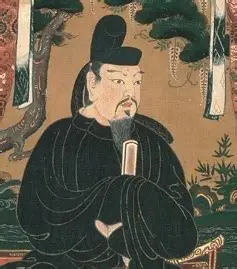
Soga no Kurayamada Ishikawa Maro was at the Yamada Temple, which he had been building himself.
Four years earlier, during the Soga no Iruka, he had joined forces with Prince Naka no Oe and Nakatomi no Kamatari to overthrow Soga no Iruka, and after Emperor Kotoku ascended the throne, he became the Right Minister.
Now, Ishikawa Maro found himself suspected of treason.
The one who informed against him was his half-brother, Soga no Hinata.
On the previous day, the 24th, Emperor Kotoku sent messengers twice to question him about the alleged treason. Ishikawa Maro consistently responded that he wished to explain himself directly before the Emperor.
That opportunity was never granted.
As the military forces began to move, Ishikawa Maro headed to Yamato and entered Yamada Temple. His eldest son, Koshi, wanted to gather troops to fight, but his father forbade it.
On the 25th, Ishikawa Maro addressed the monks, his family, and his retainers at the temple.
He opened the doors of the Buddha Hall and vowed that even in another life, he would not hold a grudge against the Emperor, before taking his own life.
However, the incident did not end there.
After Ishikawa Maro’s death, a report from the messengers who investigated his estate revealed to Prince Naka no Oe that his heart had remained loyal and pure.
The “Nihon Shoki” records that Prince Naka no Oe regretted and deeply lamented the outcome.
Despite having stood against Soga no Iruka, four years later, Soga no Kurayamada Ishikawa Maro found himself accused of treason and died seeking a direct audience to clear his name.
Let us trace the course of his life.
Born as the Grandson of Soga no Umako
The exact birth year of Soga no Kurayamada Ishikawa Maro is unknown.
Later genealogies suggest he was a grandson of Soga no Umako and belonged to the Kurayamada branch of the Soga clan.
Although he was from a different branch than the main Soga family of Soga no Emishi and Iruka, he was still a prominent figure within the Soga clan.
There are no detailed records of Ishikawa Maro’s early position in life.
He first appears prominently in the political articles of the “Nihon Shoki” during the Isshi Incident of 645.
However, construction of the temple that would later become the site of Ishikawa Maro’s final moments had already begun in 641.
This is Yamada-dera.
641 AD—The Construction of Yamada-dera Begins
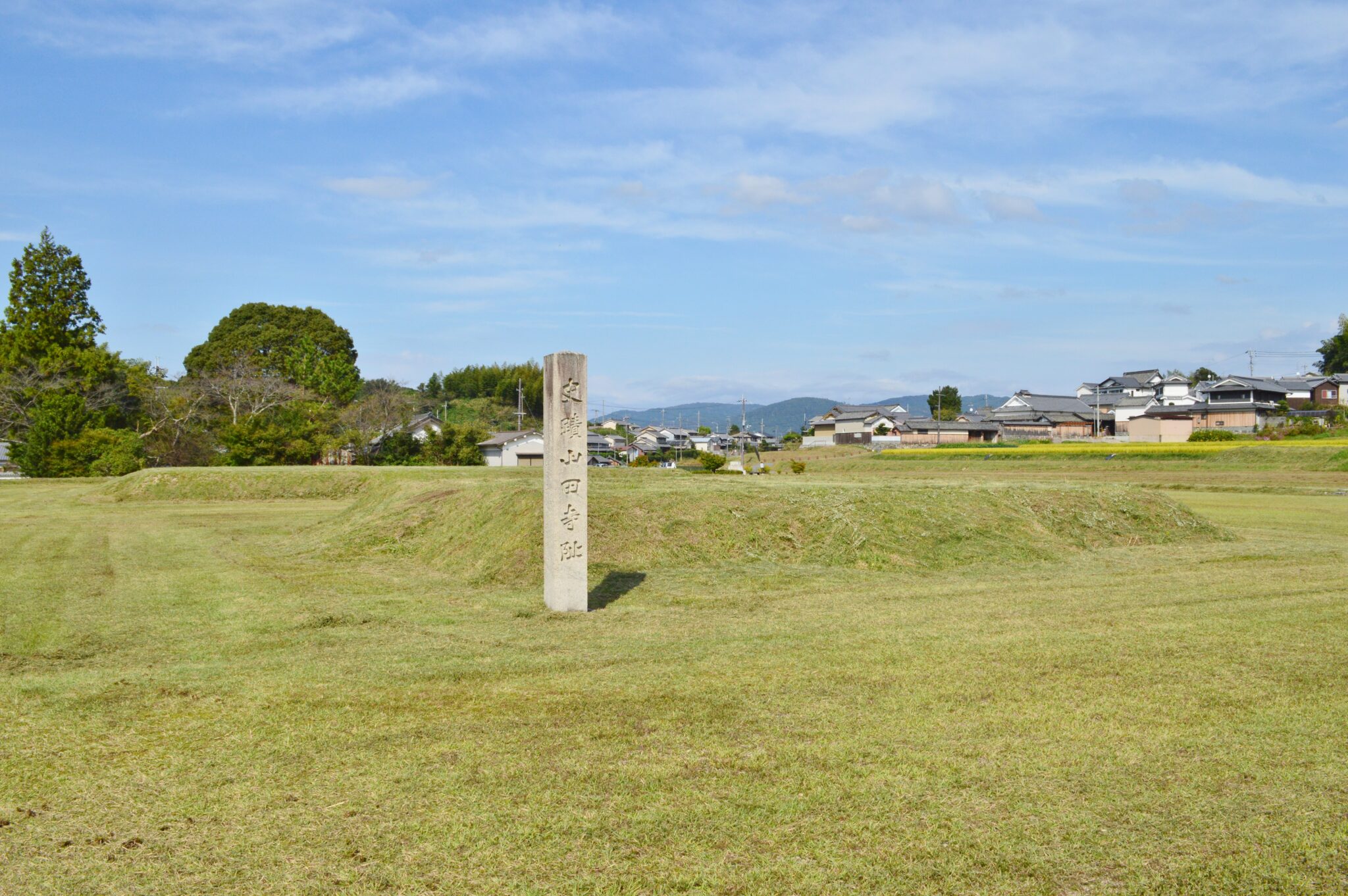
Yamada-dera is an ancient temple whose ruins remain in present-day Sakurai City, Nara Prefecture.
The “Jogu Shotoku Hooteisetsu” contains annotations that record the construction process with specific dates.
In 641, the preparation of the temple grounds began, and by 643, the main hall was constructed. By 648, monks had begun to reside there.
The temple was built as the clan temple of Ishikawa Maro.
At the current site of Yamada-dera, the remains of the main hall, pagoda, central gate, and corridors have been identified.
During the 1982 excavation, architectural materials from the eastern corridor were found collapsed underground. Some of these have been preserved and are on display at the Asuka Historical Museum of the Nara National Research Institute for Cultural Properties.
The eastern corridor, built in the mid-7th century, serves as a first-class resource for understanding ancient temple architecture.
And then, in 649.
Ishikawa Maro would end his life at the temple he had begun to build.
Connected to Prince Naka no Oe Through His Daughters
Ishikawa Maro’s family was connected to Prince Naka no Oe through marriage.
His daughter, Tochi no Iratsume, became a consort of Prince Naka no Oe and bore Princess Ota, Princess Uno Sarara, and Prince Takeru.
Princess Uno Sarara would later become Empress Jito.
Additionally, Ishikawa Maro’s daughter, Me no Iratsume, also became a consort of Prince Naka no Oe, giving birth to Princess Minabe and Princess Abe.
Princess Abe would later become Empress Genmei.
Ishikawa Maro’s lineage was carried on into the imperial family through his daughters.
In 645, Ishikawa Maro and Prince Naka no Oe would also join forces in the political arena.
Their target was Soga no Iruka of the same Soga clan.
645 AD—Joining the Plot to Overthrow Soga no Iruka
In the fourth year of Kogyoku’s reign, June 645.
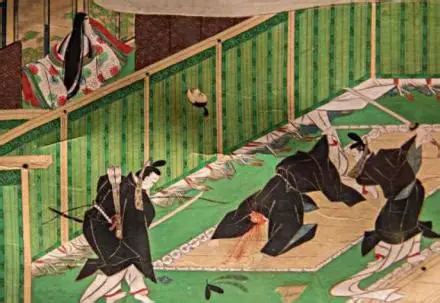
Prince Naka no Oe and Nakatomi no Kamatari and others devised a plan to assassinate Soga no Iruka in the palace.
Ishikawa Maro also participated in this plan.
For Ishikawa Maro, the Isshi Incident was a coup to overthrow Iruka, who led the main Soga family.
There is no record of Ishikawa Maro himself explaining his motives for joining the plot against Iruka.
What can be confirmed from the “Nihon Shoki” is that Ishikawa Maro participated in the plan with Prince Naka no Oe and played a crucial role on the day of the assassination, June 12.
Reading the Tribute at Itabuki Palace
June 12.
Empress Kogyoku appeared at Asuka Itabuki Palace, and Soga no Iruka entered the palace.
Ishikawa Maro’s assigned task was to read aloud the tribute from the Three Kingdoms of Korea.
While Ishikawa Maro was reading, Saeki no Komaro and Katsuragi no Waka Inukai no Amida were to attack Iruka.
However, the two did not move.
According to the Nihon Shoki, Komaro and others were so fearful of Iruka that they tried to swallow their rice with water but ended up vomiting.
As Ishikawa Maro read the memorial, he approached the end.
The attack did not begin.
Ishikawa Maro was sweating all over, his voice was unsteady, and even his hands trembled.
Seeing this, Iruka asked why he was trembling.
Ishikawa Maro replied that he was in awe of being near the Emperor, causing him to sweat unknowingly.
Eventually, Prince Naka no Oe leapt forward and struck at Iruka. Saeki Komaro and others followed, and Iruka was killed in front of Empress Kogyoku.
The next day, on the 13th, his father, Soga no Emishi, also died.
The political power of the main Soga family, which had continued from Umako to Emishi and Iruka, crumbled, and Ishikawa Maro entered the core of the new government.
Becoming the Right Minister under Emperor Kotoku
After Iruka was killed, Empress Kogyoku abdicated.
Prince Karu ascended the throne.
He became the 36th Emperor, Emperor Kotoku.
Prince Naka no Oe became the Crown Prince.
Abe no Uchimaro became the Left Minister, Soga no Kurayamada Ishikawa Maro became the Right Minister, and Nakatomi no Kamatari became the Inner Minister.
Emperor Kotoku entrusted Ishikawa Maro and Abe no Uchimaro with financial strategies.
In July of the same year, he commanded both ministers to govern the realm following the example of the ancient sage kings and to conduct politics with integrity.
The following year, in 646, the Reform Edict was issued.
As the Right Minister, Ishikawa Maro participated in the politics of Emperor Kotoku’s court.
His Daughter, Chinu, Becomes an Empress of Emperor Kotoku
Ishikawa Maro’s family was also connected to Emperor Kotoku through marriage.
In July 645.
Emperor Kotoku established two empresses.
One was the daughter of the Left Minister, Abe no Uchimaro, named Koashihime.
The other was Ishikawa Maro’s daughter, Chinu.
Meanwhile, Tochi and Niece became consorts of Prince Naka no Oe.
As the Right Minister, Ishikawa Maro was connected to both Emperor Kotoku and Crown Prince Naka no Oe through his daughters.
However, in 649, Ishikawa Maro’s position suddenly collapsed.
March 649—The Death of Left Minister Abe no Uchimaro
In the 5th year of Taika, March 649.
The Left Minister, Abe no Uchimaro, passed away.
According to the Nihon Shoki, Emperor Kotoku went to the Suzaku Gate to mourn, and the retired Empress Kogyoku, now honored as the Imperial Grandmother, Prince Naka no Oe, and other court nobles all wept together.
Immediately after, a major incident occurred involving the Right Minister, Ishikawa Maro.
The catalyst for the events was Soga no Hinokuma, the half-brother of Ishikawa Maro.
March 24th—The Betrayal by Half-Brother Soga no Hinokuma
March 24th.
Soga no Hinokuma informed Prince Naka no Oe about Ishikawa Maro.
According to the Nihon Shoki, he claimed that Ishikawa Maro planned to assassinate Prince Naka no Oe during a seaside outing and soon after, instigate a rebellion.
Hinokuma referred to Ishikawa Maro as his “half-brother.”
Prince Naka no Oe believed this accusation and reported it to Emperor Kotoku.
The Emperor dispatched Otomo no Komaro, Mikuni no Maro, and Hodumi no Kami to question Ishikawa Maro about the alleged treason.
Ishikawa Maro responded.
He wished to address the Emperor directly regarding the accusation.
Emperor Kotoku sent Mikuni no Maro and Hodumi no Kami once more to inquire further into the matter of the rebellion.
Ishikawa Maro’s answer remained unchanged.
He would speak directly before the Emperor.
Twice, Ishikawa Maro sought a direct audience for his defense.
Emperor Kotoku raised an army.
The Army Advances, Ishikawa Maro Heads to Yamato
The forces moved to encircle Ishikawa Maro’s residence.
Ishikawa Maro, accompanied by his two sons, Hoshi and Akai, took the Chinu Road towards Yamato.
His eldest son, Koshi, was in Yamada at the time, overseeing temple construction.
Upon learning of his father’s escape, he went to meet him, and they entered Yamada Temple together.
Koshi offered to lead forces to confront the pursuing army.
Ishikawa Maro refused.
According to the Nihon Shoki, that night, Koshi considered burning the palace and gathering troops.
Ishikawa Maro chose not to fight the court with force.
March 25th—”Do You Value Your Life?”
The next day, March 25th.
At Yamada Temple, Ishikawa Maro asked his eldest son, Koshi.
Do you value your life?
Koshi replied that he did not.
In front of the temple monks, Koshi, and several dozen others, Ishikawa Maro spoke.
According to the Nihon Shoki, he expressed that as a subject, he could not defy his lord, nor could he fail in filial piety as a son. The temple complex was not built for himself, but pledged to the Emperor. Fearing sudden death due to slander, he had come here, but even in the afterlife, he would remain loyal—this was the essence of his words.
Ishikawa Maro opened the doors of the Buddha Hall.
He looked up and vowed.
Even if reborn, he would not resent the Emperor.
After making his vow, he took his own life.
The Death of Ishikawa Maro and the Siege of Yamada Temple
The “Nihon Shoki” records that following Ishikawa Maro, eight members of his family also took their own lives.
On the same day, a messenger from Yamada Temple reported to the pursuing forces that Ishikawa Maro had committed suicide along with three sons and a daughter.
Since the same historical source contains two different accounts of the number of people involved, it is not possible to simply add them together.
The forces led by Otomo no Komaro and Soga no Hinata, who were pursuing Ishikawa Maro, had advanced as far as Kuroyama.
Upon receiving the news of the suicides, the troops temporarily withdrew.
On the following day, the 26th, many more from Ishikawa Maro’s family and retainers also took their own lives.
Hozumi no Kumi captured Ishikawa Maro’s associates.
That night, the forces of Kimaro, Soga no Hinata, and Hozumi no Kumi surrounded Yamada Temple.
Mononobe no Futashio was ordered to decapitate Ishikawa Maro, who was already dead.
On March 30th, those implicated in the incident faced punishment.
The “Nihon Shoki” notes that 14 people were executed, 9 were hanged, and 15 were exiled.
The suspicion of treason extended beyond Ishikawa Maro himself to his family and those around him.
Discoveries During the Posthumous Investigation
After Ishikawa Maro’s death, the court sent officials to confiscate his property.
What they found there led to Prince Naka no Oe regretting Ishikawa Maro’s death.
According to the “Nihon Shoki,” the valuable books owned by Ishikawa Maro were labeled “Crown Prince’s Books,” and the precious treasures were marked “Crown Prince’s Items.”
The officials reported these findings to the court.
Prince Naka no Oe realized that Ishikawa Maro’s heart had remained loyal and pure.
The “Nihon Shoki” records that Prince Naka no Oe felt regret, shame, and deep sorrow.
On March 24th, when the incident began, Ishikawa Maro had twice sought a direct audience with the emperor to plead his case.
He died the following day, on the 25th, without being granted that opportunity.
After his death, evidence of his loyalty to the Crown Prince was found among his remaining possessions.
Soga no Hinata’s Exile to Tsukushi
Soga no Hinata, who had informed on Ishikawa Maro, was later appointed to the position of Governor of Tsukushi.
The “Nihon Shoki” notes that people at the time referred to this appointment as “hidden exile.”
It was perceived by contemporaries as a way to distance him from the capital while still granting him a position.
The “Nihon Shoki” does not explicitly declare Hinata’s accusations as false.
However, it does record that Prince Naka no Oe, upon reviewing Ishikawa Maro’s property, realized his loyalty and purity, leading to his regret.
This is a crucial detail when considering the treason charges against Ishikawa Maro.
The Crown Prince’s Consort, Zokuhime, Mourns Her Father
The death of Ishikawa Maro also affected his daughter, who was married to Prince Naka no Oe.
The “Nihon Shoki” refers to this woman as “Soga no Zokuhime,” generally believed to be the same person as Ishikawa Maro’s daughter, Tochi no Iratsume.
Zokuhime learned that her father, Ishikawa Maro, had been beheaded by Mononobe no Futashio.
Her grief was profound.
Because the name of the person who beheaded her father included the word “salt,” she developed an aversion to even hearing the word “salt.”
Those serving nearby began to refer to salt as “hard salt” instead.
Eventually, it is said in the Nihon Shoki that she died from the grief of losing her father.
Prince Naka no Oe also mourned her death deeply.
The incident involving Ishikawa no Maro left a significant scar on Prince Naka no Oe’s own family.
The Continued Construction of Yamadadera After Ishikawa no Maro’s Death
In 649, when Ishikawa no Maro took his own life, Yamadadera was still unfinished.
The preparation of the temple grounds began in 641, the main hall was constructed in 643, and monks started residing there by 648.
Although construction was halted due to the founder’s death, it later resumed.
In 663, work on the pagoda began, the central pillar was erected in 673, the finial was raised in 676, and the casting of the Joroku Buddha commenced in 678.
In 685, the eye-opening ceremony for the Joroku Buddha was held, and Emperor Tenmu visited Yamadadera.
This was 36 years after Ishikawa no Maro’s death.
Yamadadera continued to exist thereafter, and today, its remains are designated as a Special Historic Site of Japan.
Yamadadera, whose construction began in 641.
In 645, Ishikawa no Maro joined the plot to overthrow Soga no Iruka and subsequently became the Minister of the Right under Emperor Kotoku.
On March 24, 649, he was suspected of treason due to a report from his half-brother.
Ishikawa no Maro twice sought to explain himself directly to the emperor.
On the following day, March 25, as forces closed in, he entered Yamadadera, refused his eldest son’s request for armed resistance, vowed not to hold a grudge against the emperor, and took his own life.
It was only after examining the remaining estate that Prince Naka no Oe realized Ishikawa no Maro’s loyalty.
The Nihon Shoki highlights Ishikawa no Maro’s end, emphasizing how he sought a chance to defend himself directly but was denied, only to be recognized posthumously for his loyalty and integrity.
Learn more📖↓

Reflecting on the Asuka period in which Ishikawa no Maro lived, it might be interesting to enjoy the flavors of Nara that remain today.