The Early Life of the “Man Who Defeated Masakado” is Shrouded in Mystery
When discussing the eastern provinces of the Heian period, the name Fujiwara no Hidesato cannot be overlooked.
A military commander who defeated Taira no Masakado.
Known in later generations as “Tawara Toda,” the hero who vanquished the giant centipede of Mount Mikami.
Moreover, his descendants gave rise to prominent samurai clans of the eastern provinces, such as the Oyama, Sano, and Naganuma families.
Hearing this, one might imagine a military commander renowned for his valor from a young age.
However, when tracing historical records, Hidesato’s early years reveal a different picture.
His birth year is unknown. His death year is also not confirmed. There are no records of his childhood.
His father is believed to be Fujiwara no Murao, and Hidesato belonged to a lineage connected to the Northern Fujiwara clan, specifically the Uona branch.
His base was in Shimotsuke Province, which is present-day Tochigi Prefecture.
Here, Hidesato built his power away from the aristocratic society of Kyoto, leveraging land, connections, and military strength.
Hidesato first appears in historical records in the 16th year of the Engi era (916).
And his initial appearance is not as a hero.
He was a criminal ordered into exile by the imperial court.
The Year 916—Fujiwara no Hidesato Ordered into Exile with 18 Others
August 12, 916.
A report was sent from Shimotsuke Province to the imperial court.
His name was on it.
Fujiwara no Hidesato. Along with Fujiwara no Kaneari, Takago, and Kōtei.
Together with other individuals believed to be part of his family, a total of 18 people.
The imperial court instructed the governor of Shimotsuke Province to exile them according to their respective offenses.
The crucial point here is that there is no record of what specific crime Hidesato committed.
Various theories have been proposed in later explanations.
However, what can be definitively stated from contemporary records is that
Hidesato was ordered into exile as a criminal along with his family.
This incident is crucial for understanding the figure of Hidesato.
Hidesato was not a hero loyal to the imperial court from the start.
Rather, from the court’s perspective, he was significant enough to be punished.
In other words, in 10th-century Shimotsuke, local society was not solely governed by central government orders.
Owning land. Commanding people. Wielding power.
Such local forces existed.
Hidesato was a central figure among them.
Even After Exile, Hideyoshi Did Not Disappear from Shimotsuke
This is where Hideyoshi’s life becomes even more fascinating.
Despite being exiled, the man continued his activities in Shimotsuke.
Later, Hideyoshi appears in historical records as the Deputy Governor of Shimotsuke.
Furthermore, during the rebellion of Taira no Masakado, he was active as the Deputy Governor and Military Commissioner of Shimotsuke.
The Military Commissioner was a military position responsible for suppressing local bandits and rebellions.
In other words, the court utilized local influential figures like Hideyoshi, whom they had once condemned, for maintaining public order.
This reflects the reality of local governance during the Heian period.
It was not an era where the Kyoto court could dispatch troops to every corner of the country.
They needed people who could gather soldiers locally.
People who knew the local circumstances.
People connected with local influential figures.
Without relying on such individuals, it was impossible to maintain order in the provinces.
Hideyoshi was precisely the kind of person who met those conditions.
The Year 929—Once Again Accused of “Disorderly Conduct”
There is another important record about Hideyoshi.
In the year 929, the Shimotsuke provincial office raised concerns about Hideyoshi’s “disorderly conduct.”
Once again, Hideyoshi emerged as a difficult figure for the court to handle.
However, the specific details of his disorderly conduct are not preserved.
What did he do? Who did he fight with? To what extent did he use force?
There are no records that provide such detailed information.
Therefore, we must not fill in the gaps of Hideyoshi’s early life with mere speculation.
What is certain is that he was ordered into exile in 916 and was again scrutinized for disorderly conduct in 929.
Yet, Hideyoshi continued to maintain his influence in Shimotsuke.
This fact alone shows that he was not an ordinary local official.
Taira no Masakado Rises in the Eastern Provinces
The year 935.
In the Kanto region, tensions began between Taira no Masakado and Taira no Kunika, Taira no Yoshimasa, and Taira no Sadamori.
Masakado fought against his uncle Taira no Kunika in Hitachi Province and defeated him.
Even after this, battles continued in the eastern provinces, and Masakado steadily expanded his influence.
However, Shigeyoshi was not initially at the forefront of the campaign against Masakado.
This is an important point.
The portrayal of Shigeyoshi and Masakado as “fated rivals” from the start is a narrative created by later generations.
Shigeyoshi’s significant emergence onto the historical stage occurs during the final phase in the third year of Tenkei (940).
Tenkei 2 (939) — Masakado Declares Himself “New Emperor”
At the end of Tenkei 2 (939).
Masakado attacked the provincial government office in Hitachi.
He then advanced into Shimotsuke and Kozuke.

Upon entering the provincial capital of Kozuke, Masakado crossed a significant line.
He declared himself the “New Emperor.”
Masakado pursued a vision of ruling the Kanto region as a de facto independent power.
For the imperial court, this was not merely a conflict between local warlords.
It was a challenge to the national order.
The court prepared a military response to pursue Masakado.
Meanwhile, forces opposing Masakado began to mobilize in the eastern provinces.
Taira no Sadamori and Fujiwara no Hidesato were among them.
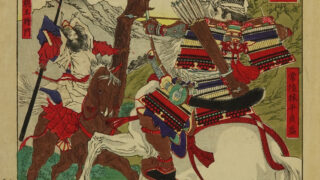
Hidesato and Sadamori — Two Generals Join Forces
For Sadamori, Masakado was the enemy who had killed his father, Taira no Kunika.
Kunika had been slain by Masakado.
Sadamori himself was repeatedly pursued in the conflict with Masakado.
On the other hand, Hidesato was a prominent figure based in Shimotsuke.
The two joined forces, and Fujiwara no Tamenori also joined them.
What is intriguing here is that even before the arrival of the imperial forces, the local powers of the eastern provinces had already organized themselves to fight against Masakado.
For Shōgō, this battle cannot be explained simply as an act of “loyalty to the court.”
The expansion of Masakado’s influence was greatly unsettling the order in the eastern provinces where they lived.
This reality drove Shōgō to the battlefield.
February 940—An Army of Over 4,000
Tengyō 3 (940), February 1.
Shōgō and Taira no Sadamori engage Masakado’s forces.
According to records from the Fusō Ryakki lineage, Shōgō and Sadamori led over 4,000 men.
Other records mention even larger numbers.
Due to discrepancies in the sources, it is prudent to note that the record of “over 4,000” remains.
In any case, Shōgō did not go into battle with just a few retainers.
As a prominent figure in the eastern provinces, he mobilized a considerable force.
This is where Shōgō’s true strength lay.
He had the power to gather people and move them as an army.
This was the greatest weapon for a regional military leader.
Approaching Masakado’s Stronghold
February 13.
Shōgō and Sadamori advance towards Masakado’s stronghold.
Masakado set up camp at Shimahiroyama in Shimōsa Province.
Shōgō and his men set fire to Masakado’s mansion and the residences of his retainers.
The battlefield quickly became tense.
The next day, February 14.
The final battle finally begins.
February 14—The Fall of Taira no Masakado
Tengyō 3, February 14.
Northern Shimōsa Province.
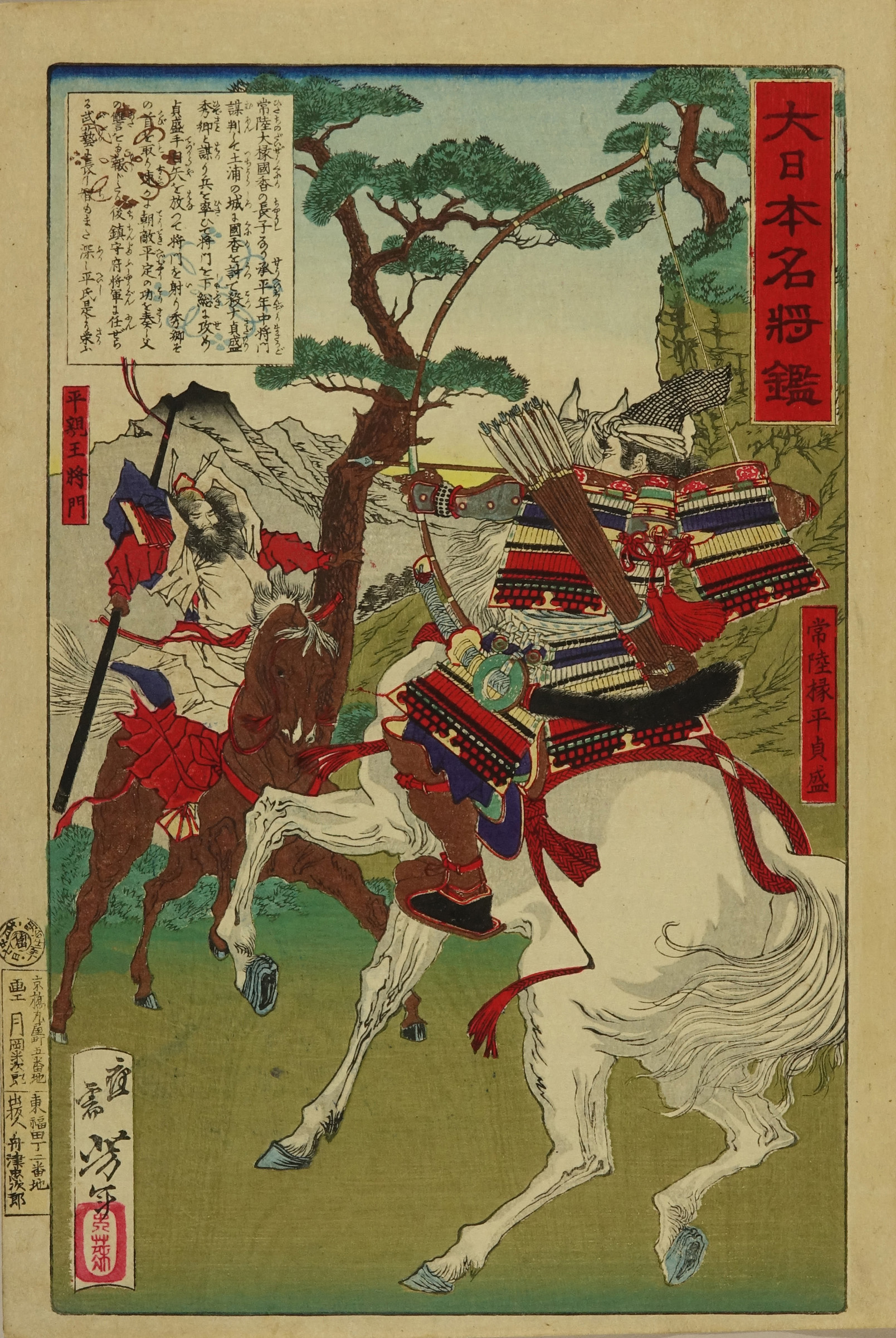
Masakado himself mounted his horse and rode into battle.
The scene from here is very famous in historical records.
Masakado was strong.
Drawing his bow, he faced the enemy. However, the tide of battle did not turn in Masakado’s favor.
Then, the decisive moment arrived.
Taira no Sadamori‘s arrow struck Masakado.
Masakado fell from his horse. At that moment, Fujiwara no Hidesato rushed over.
Hidesato beheaded Masakado.
This was the end of the man who had seized control of the eastern provinces and declared himself the “New Emperor.”
And it was Fujiwara no Hidesato who etched his name in history as the one who took his head.
This scene would be depicted many times in later military chronicles.
However, what should be noted as historical fact is that
Sadamori’s arrow struck Masakado, and Hidesato took his head.
Masakado’s Head Reaches Kyoto
Masakado’s head was sent to Kyoto.
For the imperial court, the subjugation of Masakado was a national event of great significance.
Who would receive the credit for this achievement?
Naturally, Hidesato’s name was at the top of the list.
And about a month later, a reward that would greatly change Hidesato’s life was decided.
March 9, 940—Junior Fourth Rank, Lower Grade
March 9, 940 (Tengyo 3).
The imperial court awarded honors for the achievement of subjugating Masakado.
Hidesato was granted the rank of Junior Fourth Rank, Lower Grade.
Taira no Sadamori was granted the rank of Junior Fifth Rank, Lower Grade.
Additionally, Hidesato was given merit lands, which he was allowed to pass down to his descendants.
Later historical records also note that Hidesato was appointed as the governor of both Shimotsuke and Musashi provinces.
This was the greatest turning point in Hidesato’s life.
In 916, a man sentenced to exile.
In 929, a man criticized for misconduct.
In 940, a meritorious retainer who defeated Masakado.
And now, Junior Fourth Rank, Lower Grade.
This promotion was extraordinary for a provincial warrior of the time.
Hidesato quickly elevated his presence as a military noble in the central government.
November—Appointed as Governor of Shimotsuke
In November of the same year, Hideyoshi was appointed as the Governor of Shimotsuke.
The Nihon Kiryaku clearly states that this appointment was due to his military achievements in subduing Masakado.
Shimotsuke Province, where he held influence.
To become the provincial governor there himself was significant.
As a governor dispatched from Kyoto, he would govern Shimotsuke, while also maintaining the local connections he had built.
Hideyoshi possessed both roles. This was the source of his strength.
Hideyoshi Was Not Just “The Man Who Defeated Masakado”
To truly understand Hideyoshi, one must look before his campaign against Masakado.
Exiled in 916.
Criticized for misconduct in 929.
And in 940, he defeated Masakado.
Considering this history, it’s hard to see Hideyoshi as a loyal retainer of the court from the start.
Rather, he never fully detached from the court’s control.
Yet, he maintained his own power locally.
When necessary, he would cooperate with the court’s military policies.
Through these achievements, he earned high positions from the court.
This relationship exemplifies the connection between local powers and the court in the 10th century.
Hideyoshi was not just a noble serving the court.
Nor was he a local magnate constantly rebelling against the court.
He wielded his own military power and local base, using that strength within the court’s order.
Here lies a crucial aspect that connects to the later warrior society.
The Encounter with Masakado—The Famous “Combing Masakado’s Hair” Story
There is a very famous episode about Hideyoshi.
When Masakado was still expanding his influence.
Hideyoshi visited Masakado.
Masakado was so pleased to have Hideyoshi on his side that he welcomed him even while in the middle of combing his hair.
Seeing this, Hideyoshi discerned Masakado’s character.
Such is the story. It’s quite fascinating.
However, this is not recorded in contemporary sources.
It’s a tale passed down in records like the Azuma Kagami from September 19, 1180, about 240 years after Masakado’s time.
Therefore, in the article, it is not treated as a historical fact that “Hideyoshi observed Masakado and decided to fight.”
“The Legends of Hideyoshi and Masakado Passed Down Through Generations” should be regarded as such.
The very fact that these stories have been preserved is evidence that the battle between Hideyoshi and Masakado left a lasting impression on later generations.
Hideyoshi’s Later Years—A Sudden Decline in Records
After defeating Masakado, records about Hideyoshi become surprisingly scarce.
He achieved remarkable military success. He was appointed to the lower fourth rank. He became the governor of Shimotsuke.
Beyond that, there are few detailed accounts of his later life.
This is a common phenomenon with historical heroes.
Only their greatest achievements remain vividly, while the rest of their lives fade into obscurity.
Neither the year of Hideyoshi’s birth nor his death is certain.
Later genealogies include a tradition that he died at the age of 101 in Shoreki 2 (991).
Meanwhile, another genealogy records his death in Tentoku 2 (958).
There is a significant discrepancy in these dates.
Therefore, it is not possible to write with certainty that Hideyoshi died in 991 at the age of 101 as a historical fact.
What can be said with certainty is that after the defeat of Masakado, he served as a provincial governor in Shimotsuke and Musashi, and records of his activities become sparse thereafter.
Hideyoshi’s Descendants—The “Hideyoshi Line” Grows into a Vast Warrior Clan
While the details of Hideyoshi’s later years became unclear, his name did not fade away.
On the contrary, it grew even larger after his death.
Warrior clans claiming descent from Hideyoshi spread throughout the eastern provinces.
In Shimotsuke,
The Oyama clan, the Naganuma clan, the Sano clan, the Onodera clan.
These clans claimed the lineage of the Fujiwara clan of the Hideyoshi line.
Furthermore, the genealogy of the Northern Fujiwara clan in Oshu is also said to be connected to the Hideyoshi line.
The history of Tama City introduces a genealogy where Tsunekiyo, from the line of Hideyoshi’s son Chiharu, gave rise to Kiyohira, who founded the Northern Fujiwara clan in Oshu.
However, one should not simply assume that everyone with a genealogy was a true blood relative of Hideyoshi.
In the medieval period, genealogies were often crafted to enhance a family’s prestige by linking them to noble ancestors.
Nonetheless, what is important is,
the fact that later warriors chose Hideyoshi as their ancestor.
Hideyoshi’s name held that much value.
Son Chiharu Gets Entangled in the “Anna Incident”
There is a significant event when tracing the descendants of Hideyoshi.
The Anna Incident of 969 was a significant event.
This was the incident where Minamoto no Mitsunaka and others accused Minamoto no Takaaki, leading to his downfall.
Fujiwara no Chiharu, believed to be the son of Shugo, was also implicated in this event and exiled.
After Shugo established his foothold in the central political arena by suppressing Masakado, his descendants gradually withdrew from central politics.
However, the power of the Shugo branch of the Fujiwara clan did not disappear.
The lineage of Chitsune, for example, took root in Shimotsuke and grew as a local administrative force managing provincial affairs.
In the subsequent years, the Shugo branch of the Fujiwara clan continued to maintain a significant presence in the eastern provinces.
The Origin of “Tawara Tōda”
There is another reason why Shugo’s name has remained in the memory of the Japanese people.
Tawara Tōda.
The tale of the giant centipede slaying at Mount Mikami.
The setting is Ōmi Province, present-day Shiga Prefecture.
A giant snake lay across the Karahashi Bridge in Seta.
People were too afraid to approach.
Then, a lone warrior appeared.
The warrior stepped over the snake and continued on his way.
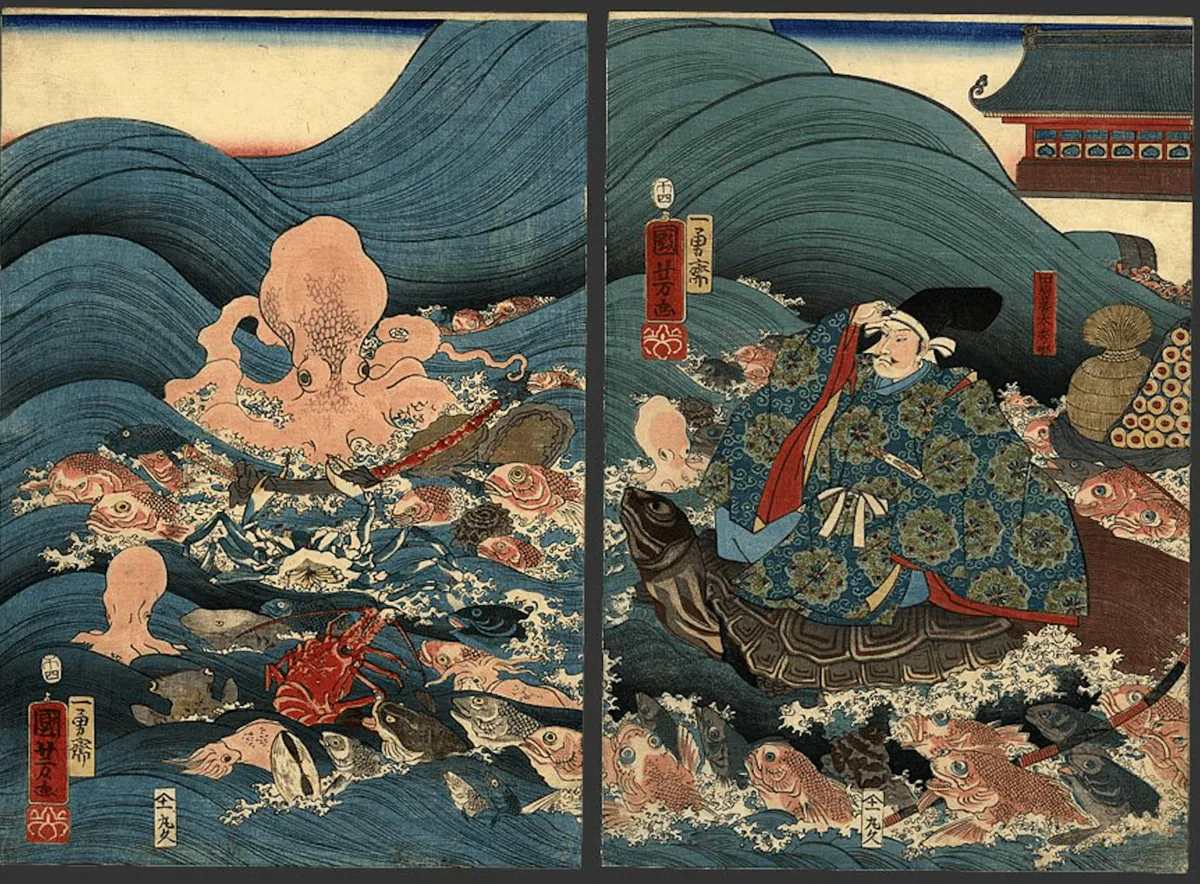
That night, the snake transformed into a human form.
It was a member of the Ryūgū family.
A giant centipede had taken residence on Mount Mikami, tormenting the Ryūgū family.
They pleaded with the warrior.
“Please slay that centipede.”
The warrior took up his bow.
And headed towards Mount Mikami.
A centipede so large it covered the mountain.
He shot an arrow.
The first shot.
No effect.
The second shot.
No effect.
Then the warrior spat on the arrow and fired his final shot.
The arrow pierced the centipede.
Thus, the giant centipede was defeated.
The warrior’s name was Tawara Tōda.
His true identity was Fujiwara no Hidesato.
This is the legend that has been passed down to this day.
The Giant Centipede Slaying Is Not Historical Fact
It is important to clearly distinguish this.
Fujiwara no Hidesato, who defeated Taira no Masakado, was a real historical figure.
The campaign against Masakado in 940 is also a historical fact.
His conferment of the Junior Fourth Rank, Lower Grade is a historical fact as well.
His appointment as Governor of Shimotsuke is confirmed in historical records.
However, the tale of slaying the giant centipede at Mount Mikami is a legend.
This legend is believed to date back at least to the Nanbokucho period and was greatly expanded in stories like the Muromachi period’s “Tawara Toda Monogatari.”
In other words, many centuries after Hidesato’s death, his martial prowess grew into a grand narrative.
Why Did Hidesato Become the “Hero of the Centipede Slaying”?
The reason lies in Hidesato’s own life.
Hidesato had the experience of being pursued by the court as a rebel.
And he defeated the great rebel Taira no Masakado.
He received high rewards from the court and wielded military power in the eastern provinces.
In later generations, his descendants thrived as warriors across various regions.
Such real martial prowess gradually transformed into legend over time.
A man who defeated Masakado, a “great enemy who defied the court.”
That same man, in legend, now slays a gigantic monster.
The defeat of Masakado and the slaying of the giant centipede merged into the valor of a single hero.
The Tochigi Prefectural Museum also distinguishes between Hidesato’s historical achievements and the later Tawara Toda legend.
Hidesato Became the “Ancestor of Warriors”
The most important aspect of Fujiwara no Hidesato’s life is not just his defeat of Masakado.
It lies in the significance that the name of the house he established held in the later warrior society.
From the Hidesato branch of the Fujiwara clan, many warrior bands emerged, centered around Shimotsuke.
The Oyama clan. The Naganuma clan. The Sano clan. The Onodera clan. There were even branches that advanced into Oshu.
Later Kamakura warriors revered Hidesato as the progenitor of martial arts.
In other words, Hidesato not only moved history as a single military commander.
His very name was passed down as the “ancestor” of warrior houses.
Alongside the Taira and Minamoto clans, the Hidesato branch of the Fujiwara clan formed a significant warrior group.
This is where Hidesato’s greatest influence lies.
From Exile to “The Man Who Defeated Masakado”
Following the life of Fujiwara no Hidesato, a clear trajectory emerges.
916.
He was ordered into exile along with 18 members of his family.
↓
929 AD.
His disruptive behavior was criticized by the Shimotsuke provincial government.
↓
February 940.
Participated in the campaign against Masakado as a Shimotsuke official and military governor.
↓
February 14.
Taira no Sadamori‘s arrow pierced Masakado.
Hideyoshi cut off Masakado’s head.
↓
March 9.
Promoted to Junior Fourth Rank, Lower Grade.
Awarded lands for his service.
↓
November of the same year.
Appointed as governor of Shimotsuke Province.
↓
Subsequently, the Hideyoshi branch of the Fujiwara clan spread across the eastern provinces.
↓
After the Nanboku-chō period.
**As “Tawara Tōda,”** he became a legendary hero known for slaying a giant centipede.
This is the confirmed historical account of Fujiwara no Hideyoshi’s life and the legends that later grew around him.
Hideyoshi’s life was not one of a hero from the start.
A local influential figure punished by the court, he survived by leveraging his military power, ultimately receiving the highest honors from the court for defeating Taira no Masakado, and his name transformed into that of a legendary hero centuries later.
This transformation is what makes the story of Fujiwara no Hideyoshi so fascinating.
For those who want to learn more about Fujiwara no Hideyoshi.
Discover the real image of the warrior who defeated Taira no Masakado and the legend of “Tawara Tōda” that emerged in later generations in this comprehensive book.

Legendary General Fujiwara no Hideyoshi [New Edition] [Minoru Noguchi]
For a taste of Tochigi, the land associated with Fujiwara no Hideyoshi, try this.