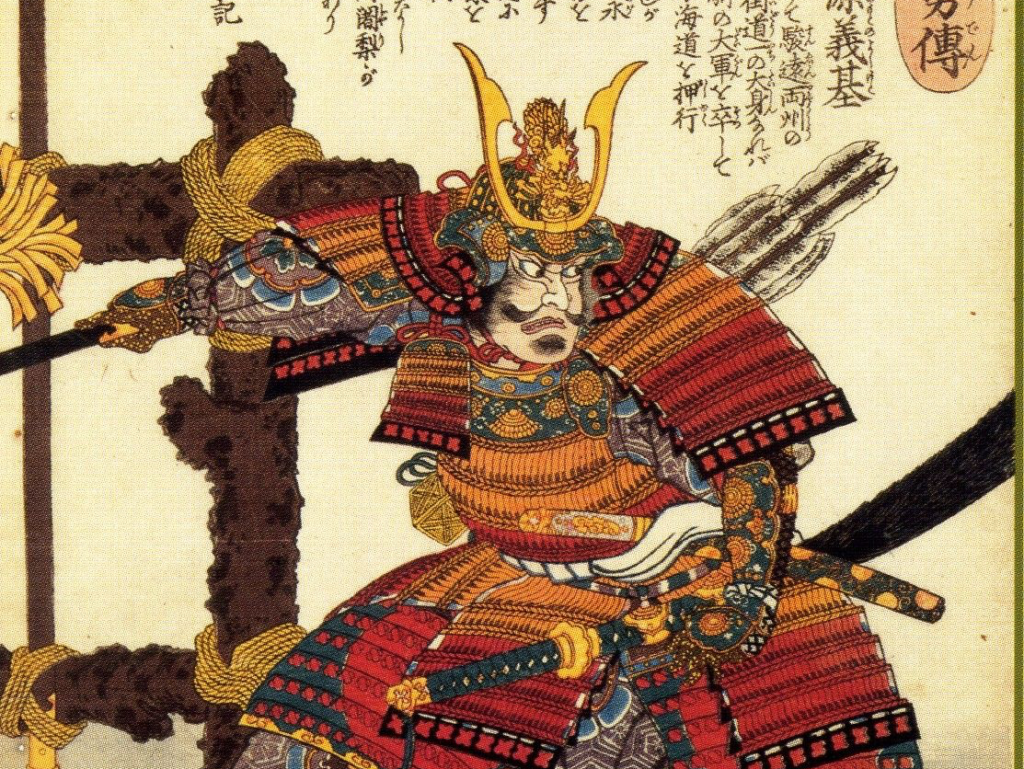
December 26, 939.
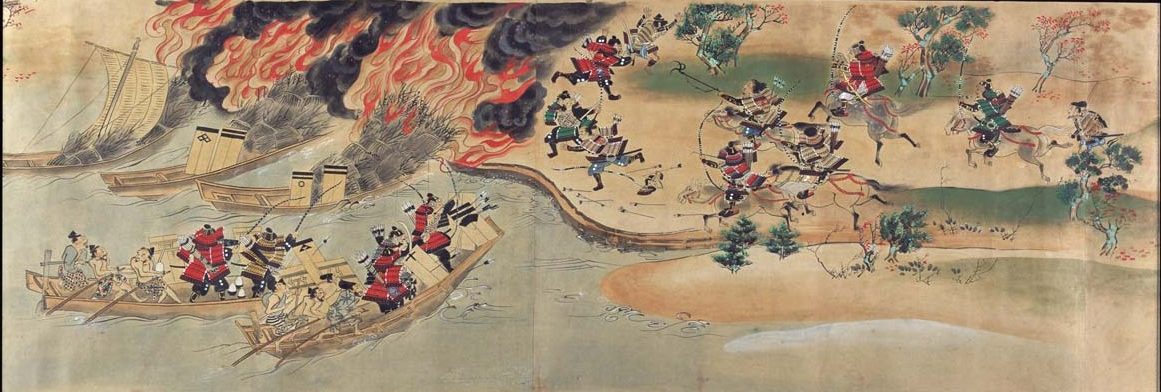
Near the Suki Station in Settsu Province, the party of Bizen Governor Fujiwara no Kotaka was ambushed.
The attackers were Fujiwara no Fumimoto and others, who had allied with Fujiwara no Sumitomo.
Kotaka was captured, and it is said that his son was killed.
Suki Station is believed to be located near present-day Nishinomiya City in Hyogo Prefecture. The activities of those connected with Sumitomo, who was based in Iyo, extended as far as Settsu, close to the capital region.
Around the same time in the eastern provinces, Taira no Masakado had seized control of the provincial capitals of Hitachi, Shimotsuke, and Kozuke, declaring himself the “New Emperor.”
In the east, Taira no Masakado.
In the west, the maritime forces surrounding Fujiwara no Sumitomo were on the move.
In later generations, stories emerged suggesting that Masakado and Sumitomo had prearranged their rebellions. However, no contemporary historical records confirm any prior collusion between the two.
At the end of 939, why did Fujiwara no Sumitomo choose to confront the imperial court?
Behind this decision were the pirate issues that had been unsettling the Seto Inland Sea for several years and the conflicts over regional control.
1. The Seto Inland Sea Linking Western Japan and Kyoto
During the Heian period, the Seto Inland Sea was a crucial maritime route connecting the Sanyo region, Shikoku, Kyushu, and Kyoto.
Maritime transport was used to send taxes and goods from the western provinces to the capital, with numerous ships plying these waters.
By the late 9th century, pirate activities threatening this maritime traffic became a frequent issue.
During the Shohei era (931–938), these activities intensified, with records noting over 1,000 pirate ships appearing at sea, seizing official goods and endangering lives. The court responded by appointing officials to pursue pirates and ordered coastal provinces to capture them.
Those referred to as “pirates” at the time were not a single unified group.
Various factions, including those involved in maritime transport, local power brokers, and armed groups in conflict with provincial governors, were active along the Seto Inland Sea coast.
Among them emerged Fujiwara no Sumitomo.
2. Former Iyo Governor Fujiwara no Sumitomo
The birth year of Fujiwara no Sumitomo is unknown.
Regarding his lineage, there are theories that he was the son of Dazai Deputy Fujiwara no Yoshinori, or that he was the son of former Iyo Governor Takahashi Tomohisa and was adopted by Yoshinori.
Sumitomo served as the governor of Iyo.
The position of governor was one of the officials comprising the provincial administration, responsible for local governance.
Even after his term ended, Sumitomo is believed to have remained in Iyo, establishing a power base there.
By 936, records already referred to him as “former Iyo Governor.” The Ehime Prefecture history introduces an article from the ‘Ribu Ouki’ stating that in March, Sumitomo led his faction to Iyo, plundering Kawashiri in Settsu Province along the way.
Meanwhile, in the same year, a decree was issued to Sumitomo for the pursuit of pirates.
Herein lies the reason why Sumitomo in the year 936 is not easily captured in historical narratives.
3. The Year 936—Was Sumitomo a Pirate Leader?
The year was 936, the 6th year of the Jōhei era.
Pirate activities in the Nankaidō region had reached a critical state.
The imperial court appointed Ki no Yoshito as the governor of Iyo and tasked him with addressing the pirate threat as the Pursuer of Pirates in Nankaidō.
Regarding Sumitomo at this time, later historical sources offer differing portrayals.
The Nihon Kiryaku describes Sumitomo as the “Leader of the Southern Pirates,” suggesting he was the head of the pirate forces gathered on Hiburi Island.
On the other hand, the Fusō Ryakki, which also reports on the pirates’ surrender, does not mention Sumitomo as a pirate leader.
Furthermore, the Honchō Seiki records that Sumitomo himself received an imperial edict to pursue pirates.
The history of Ehime Prefecture also acknowledges this discrepancy in sources and notes that there is debate over whether Sumitomo was already a pirate leader by 936.
The World Encyclopedia suggests that Sumitomo occupied a delicate position, being involved in pirate activities while also cooperating with the government in pursuing pirates.
It is difficult to categorize Sumitomo in 936 as either “completely on the side of the court” or “a rebellious pirate leader.”
He was a figure who held power in Iyo, had deep connections with maritime forces, and was also commissioned by the court to pursue pirates.
4. Pirate Countermeasures and the Surrender of Over 2,500 Men
Ki no Yoshito advanced measures against the pirates.
According to records from the Nihon Kiryaku and Fusō Ryakki, over 2,500 pirates surrendered, including more than 30 leaders such as Ono no Ujihiko.
Ki no Yoshito provided the surrendered with clothing, food, fields, and seeds, encouraging them to engage in agriculture.
Pirate activities temporarily subsided.
Rather than solely relying on military force for suppression, policies were also implemented to reintegrate those who surrendered back into the community.
Sumitomo’s name is also recorded as someone involved in the pursuit of pirates.
However, the conflicts surrounding the Seto Inland Sea did not disappear.
A few years later, new disputes emerged between local leaders involved in the pacification of pirates and the provincial governors.
5. The People Involved in Pirate Pacification and the Provincial Governors
The background of the Fujiwara no Sumitomo Rebellion involved conflicts over local governance.
In Bizen Province, Fujiwara no Fumimoto, who was involved in pirate pacification, clashed with Bizen Assistant Governor Fujiwara no Kotaka.
In Sanuki Province, conflicts arose between local forces such as Fujiwara no Sanetsugu and the provincial governors.
The military power acquired through pirate pursuit led to clashes of interest with the newly appointed provincial governors responsible for local governance.
The Yamakawa Japanese History Dictionary also cites the conflict between local forces who achieved merit in pirate pacification and the provincial governors as a significant background to the Sumitomo Rebellion.
Sumitomo deepened his connections with these individuals.
By the end of 939, these conflicts escalated into incidents directly attacking the provincial governors.
6. The Year 939—Taira no Masakado and Fujiwara no Sumitomo
In the 2nd year of the Tengyō era (939), battles surrounding Taira no Masakado rapidly expanded in the eastern provinces.
On November 21, Masakado seized control of the Hitachi Provincial Government Office.
In December, he advanced into Shimotsuke and Kozuke, declaring himself the “New Emperor.”
Around the same time, the situation surrounding Sumitomo in the western provinces was also shifting.
In later generations, a story emerged that Masakado and Sumitomo met at Mount Hiei and promised to rebel simultaneously from the east and west.
There is no historical evidence to support this conspiracy theory.
The “Sumitomo Pursuit Record” claims that Sumitomo plotted rebellion upon hearing of Masakado’s insurrection. However, the authorship and date of this document are unknown, and it is considered a later military chronicle believed to have been written before the “Fusoryakki” of 1094.
It is not possible to link Masakado’s actions and Sumitomo’s actions as part of a single plan from the outset.
Nevertheless, it is certain that while the court was preoccupied with dealing with Masakado in the eastern provinces, armed conflicts were also escalating in the west.
7. December 17th — Report from Iyo Province
December 17th.
A report arrived from Iyo Province to Kyoto, stating that Sumitomo was attempting to set out to sea, defying the restraint of Ki no Yoshito, and urging that he be summoned quickly.
The court began to be wary of Sumitomo’s movements.
Nine days later.
Fujiwara no Fumimoto and others allied with Sumitomo attacked Bizen Governor Fujiwara no Kotaka in Settsu Province.
This incident significantly strained the relationship between Sumitomo and the court.
8. December 26th — Attack at Suki Station
Tengyo 2 (939), December 26th.
The party of Bizen Governor Fujiwara no Kotaka, who was heading to Kyoto, was attacked near Suki Station in Settsu Province.
The attackers were Fujiwara no Fumimoto and his group.
The “Sumitomo Pursuit Record” reports that Fumimoto, as a retainer of Sumitomo, pursued Kotaka, capturing him and killing his son.
Meanwhile, the Ehime Prefecture History states that the true extent of Sumitomo’s involvement in this incident is unclear.
Therefore, it cannot be definitively stated that Sumitomo personally directed the attack at Suki Station.
Nevertheless, the attack on a provincial governor by those allied with Sumitomo was a serious incident for the court.
Some view this incident as the “beginning of Sumitomo’s rebellion,” while others consider the latter half of 940, when Sumitomo openly began military actions against the state, as the true escalation of the rebellion.
The question of “when should Sumitomo’s actions be called a rebellion” remains regarding Fujiwara no Sumitomo’s uprising.
9. The Court Did Not Immediately Suppress Sumitomo
After the attack at Suki Station, the court did not immediately target Sumitomo for full-scale suppression.
On February 3, 940, Fujiwara no Akikata, who had been dispatched with a summons for Sumitomo in December of the previous year, returned to Kyoto with a report from Iyo Province and a statement from Sumitomo himself.
This indicates that there were also efforts from Sumitomo’s side to explain the situation to the court.
A few days earlier, on January 30.
The court discussed promoting Sumitomo to the fifth rank.
In the eastern provinces, the response to Masakado continued.
The court aimed to stabilize the situation in the western provinces through appeasement rather than severing ties with Sumitomo completely.
10. Sumitomo Granted Junior Fifth Rank
On January 30, 940, it was decided within the imperial court to confer the rank of Junior Fifth Rank, Lower Grade, upon Sumitomo.
On February 3, a messenger named Ninamochi Arisuke was dispatched to Iyo with the official document of rank.
By March 2, the messenger returned to Kyoto and reported that Sumitomo was pleased with his new rank.
This occurred shortly after the provincial governor was attacked by forces allied with Sumitomo in December of the previous year.
The court aimed to incorporate Sumitomo into the aristocratic hierarchy with the rank of Junior Fifth Rank, Lower Grade, to avoid escalating military conflicts.
This conciliatory strategy was also intended to prevent large-scale warfare on both eastern and western fronts simultaneously, as the court was already engaged in battles with Taira no Masakado in the east.
At the beginning of 940, Sumitomo was not yet completely isolated as a rebel by the court.
11. “Sumitomo Takes to the Sea”
February 22.
A report from the Sanyo-do Pursuit Officer, Ono Yoshifuru, reached Kyoto, stating that Sumitomo had taken to the sea on a ship.
On the following day, the 23rd, the court stationed guards at Yamazaki, Kawajiri in Settsu Province, and Bingo.
By the 25th, troops were dispatched to Yamazaki.
The World Encyclopedia interprets this report as information that Sumitomo was advancing towards Kyoto via sea.
Whether Sumitomo truly planned to march on Kyoto remains uncertain.
Some believe it was a false report, while others think the plan was aborted due to changing circumstances, such as Masakado’s defeat.
At this time, significant changes were occurring in the eastern provinces.
In February, Taira no Masakado was killed in battle against Fujiwara no Hidesato and Taira no Sadamori.
The situation where the court had to be vigilant on both eastern and western fronts gradually began to change.
12. Early Summer 940—From Conciliation to Pursuit
After Masakado’s death, the court intensified its response to the pirate forces in the western provinces.
June 18.
It was recorded that an official order was issued to the Sanyo-do Pursuit Officer to capture Sumitomo’s “violent soldiers.”
Even here, the focus was not a straightforward command to “immediately eliminate Sumitomo,” but rather to first pursue the armed forces allied with him.
However, the situation further deteriorated after this.
In August, large-scale raids began in Iyo, Sanuki, Awa, and other areas, marking a new phase in the conflict with the court. The Ehime Prefectural History suggests that it was after August 940 that Sumitomo himself stepped into a full-scale rebellion against the state.
In 936.
Sumitomo had received an imperial order to pursue pirates.
By the end of 939, forces allied with Sumitomo attacked the provincial governor.
At the beginning of 940, he was granted the rank of Junior Fifth Rank, Lower Grade, by the court and was still a target of conciliation.
This relationship deteriorated with Masakado’s death and the ongoing military clashes in the western provinces.
A full-scale pursuit battle between Fujiwara no Sumitomo and the court began in the Seto Inland Sea.
――Continue to The Rebellion of Fujiwara no Sumitomo: Part Two.
For those who want to delve deeper into the Rebellion of Fujiwara no Sumitomo.
This book explores the two uprisings that shook the imperial court from east to west, led by Taira no Masakado and Fujiwara no Sumitomo, through both political and military lenses.

The region where Fujiwara no Sumitomo was active, Iyo Province, corresponds to present-day Ehime Prefecture.
Since you’ve read about Sumitomo, why not also enjoy the flavors of Iyo? You can savor the rich taste of mandarin oranges with 100% pure juice made from Ehime-grown mandarins 🍊