In 774, the Kaido Emishi launched an attack on Momonou Castle.
From the rebellion led by Korehari no Azamaro, to the Battle of Subuse where Aterui defeated the imperial forces, to the expeditions of Sakanoue no Tamuramaro, the construction of Isawa Castle, and the campaigns led by Bun’ya no Watamaro in 811, we trace the 38-year conflict between the imperial court and the Emishi.
On July 25, 774, in the fifth year of Hoki.
A report reached the imperial court from Mutsu Province that the Kaido Emishi had gathered forces and risen in rebellion.
The Emishi forces burned bridges, blocked roads to cut off travel, and attacked Momonou Castle.
The “Shoku Nihongi” records, “They invaded Momonou Castle and destroyed its western fort.”
The fortifications built by the court to advance into northern Mutsu were attacked, and their western fort was breached.
From this attack on Momonou Castle until the second year of Konin (811), military clashes between the court and the Emishi continued in the Tohoku region.
38 years.
This marked the beginning of the long conflict later known in historical research as the “Thirty-Eight Years’ War.”
774 — The Kaido Emishi Attack Momonou Castle
Momonou Castle was a fortification located in what is now Ishinomaki City, Miyagi Prefecture.
These fortifications served as both military and administrative centers for the court’s governance of the Tohoku region.
In the 8th century, the court continued its northern expansion by building fortifications in Mutsu and Dewa, relocating people from regions like Bando.
Momonou Castle was positioned at the forefront of this expansion.
The Kaido Emishi burned bridges, blocked highways, and then attacked the castle.
They cut off transportation routes and breached the western fort.
The court’s fortifications and the supporting transportation network became targets of the attack.
The court ordered the Bando provinces to prepare reinforcements, intensifying military actions in Mutsu.
776 — The Attack on Isawa
In November of the seventh year of Hoki (776), the court mobilized 3,000 soldiers from Mutsu Province to attack the Emishi in Isawa.
Isawa, located in the area around present-day Oshu City, Iwate Prefecture, appears in historical records as a target of the court’s campaigns.
This region would later be known as the base of Aterui.
During this period, clashes with the Emishi continued in Mutsu and Dewa, with soldiers, weapons, and supplies being sent from the Bando provinces.
The court continued its northern expansion by building fortifications, improving roads, and relocating people.
Four years later, Korehari no Azamaro, who was within this system of control, would rise in rebellion.
780 — Korehari no Azamaro Burns Tagajo
On March 22, in the eleventh year of Hoki (780).
A major incident occurred at Korehari Castle.
The rebellion was led by Korehari no Azamaro.
Azamaro was a prominent figure among the Emishi who had submitted to the imperial court, serving as the head of Kurihara District.
In 778, the ninth year of the Hoki era, he was granted the rank of Junior Fifth Rank, Lower Grade, for his military achievements in the subjugation of the Emishi.
Azamaro then killed Kii no Hirozumi, the Inspector General, and Michishima no Otate, the head of Oshika District, at Izari Castle.
The “Shoku Nihongi” records that Michishima no Otate often insulted Azamaro by calling him a “barbarian.”
The rebel forces then moved further south.
Their target was Tagajo, the center of governance in the Tohoku region.
Otomo no Masatsuna and others abandoned the castle and fled.
A few days later, Azamaro’s forces entered the castle, seized the supplies stored in the government warehouse, and set fire to the remaining items.
Tagajo, the hub of Tohoku governance, went up in flames.
From Imperial Official to Rebel Leader
Azamaro originally served as an official of the imperial court, was granted rank, and participated in the subjugation of the Emishi as part of the imperial forces.
In the 8th century Tohoku, there were influential figures in various regions, each with different relationships with the imperial court.
Some cooperated with the court to gain status, while others eventually rebelled against its control.
Korehari no Azamaro’s rebellion was a large-scale uprising that erupted from within the northern territories the court was attempting to consolidate.
781—The Accession of Emperor Kanmu
In 781, the first year of the Ten’ō era, Emperor Kanmu ascended the throne.
Tensions remained high in the Tohoku region following Korehari no Azamaro’s rebellion.
During the Kanmu era, preparations for a large-scale expedition were underway over several years.
In March of 788, the seventh year of the Enryaku era, an order was issued to mobilize over 52,800 infantry and cavalry from various provinces, to gather at Tagajo by March of the following year.
Orders were also given to transport over 35,000 koku of military provisions to Mutsu Province and over 23,000 koku of dried rice to the Tokai, Tosan, and Hokuriku regions.
Tens of thousands of soldiers and a vast amount of provisions began moving towards the expedition to Isawa.
789—4,000 Imperial Troops Advance
In 789, the eighth year of the Enryaku era.
The army led by General Kii no Kosami set its sights on Isawa.
The figure of over 52,800 represents the total size of the forces mobilized for the expedition.
Only a portion of this force advanced towards the Subuse area.
From the central and rear divisions, 2,000 troops each, totaling 4,000, moved forward.
The objective was to advance deep into Isawa.
As the imperial forces reached the vicinity of Aterui’s location, about 300 Emishi warriors appeared.
When the imperial forces attacked, the Emishi retreated.
The government troops continued their pursuit, burning Emishi settlements as they moved towards Subuse Village.
The tide of battle turned dramatically at that point.
The Battle of Subuse: 4,000 Men Attacked from Both Sides
The imperial forces planned to rendezvous with the vanguard advancing from another direction at Subuse Village.
The vanguard had remained on the opposite bank of the Kitakami River.
In the meantime, about 800 Emishi warriors appeared in front of the 4,000-strong imperial army.
Fierce fighting ensued, and the imperial forces were pushed back.
Additionally, about 400 Emishi soldiers emerged from the eastern mountains, cutting off the rear.
Approximately 800 in front.
About 400 behind.
The vanguard, which was supposed to join them, remained across the Kitakami River.
The imperial forces were attacked from both sides, causing their formation to collapse.
The Shoku Nihongi records the aftermath: 25 dead, 245 wounded by arrows, 1,036 drowned in the Kitakami River, and 1,257 swam back naked.
Commanders Takebe no Zenri, Takada no Michinari, Aizu no Sōmaro, Asukabe no Yoshitashi, and Ōtomo no Iotsugu were also killed in action.
The imperial forces reported burning 14 Emishi villages, destroying approximately 800 homes.
The expedition led by Ki no Kosami, aiming to conquer Isawa, suffered significant losses at Subuse.
The Name of Aterui Enters the Historical Record
The name of Aterui appears in the accounts of this battle.
The Shoku Nihongi refers to him as “the rebel leader Aterui.”
It is said that about 300 Emishi intercepted the imperial forces as they approached Aterui’s “residence.”
Existing historical records focus on Aterui’s activities at Subuse in 789 and his surrender and execution 13 years later in 802.
For a detailed account of Aterui as a person, see the biography section; here, we will track his movements during the Thirty-Eight Years’ War.
791: The Isawa Expedition Resumes
After suffering heavy losses at Subuse, the court prepared for another expedition to Isawa.
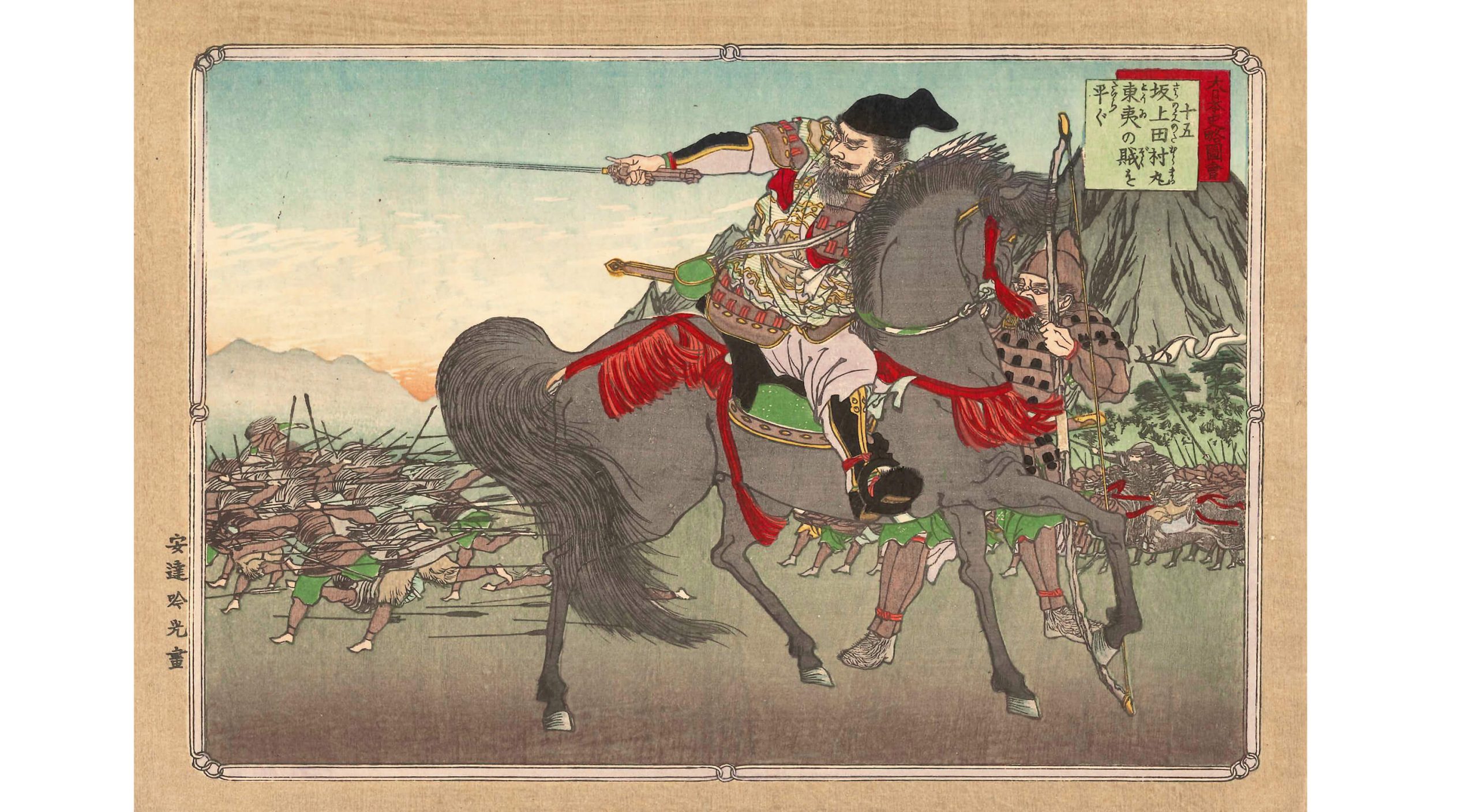
In Enryaku 10 (791), Ōtomo no Otomaro was appointed as the Great General for the Subjugation of the East, with Sakanoue no Tamuramaro and others as deputies.
By Enryaku 12 (793), the title “General for the Subjugation of the East” was changed to “General for the Subjugation of the Barbarians.”
The following year, Enryaku 13 (794), an expeditionary force led by Ōtomo no Otomaro as the Great General headed to the northeast.
In June, Sakanoue no Tamuramaro and others engaged the Emishi, and by October, Ōtomo no Otomaro reported the results to the court.
457 beheaded.
150 prisoners.
85 horses.
75 bases burned.
These figures were recorded in the court’s report.
Even after the 794 expedition, the court continued its advance into Isawa.
797: Sakanoue no Tamuramaro Becomes the Great General for the Subjugation of the Barbarians
In Enryaku 16 (797), Sakanoue no Tamuramaro was appointed as the Great General for the Subjugation of the Barbarians.
Eight years had passed since the battle at Subuse in 789.
In the 20th year of Enryaku (801), Tamuramaro once again set out for the northeast.
The expeditionary force was a massive assembly, consisting of 40,000 soldiers, 5 military supervisors, and 32 sergeants.
Historical records detailing the progress of battles in 801 are limited.
This is due to parts of the “Nihon Koki,” which documented this era, having been lost.
The existing “Nihon Kiryaku” notes that in September of the same year, Tamuramaro reported having “subdued the barbarians.”
The traceable events from surviving records conclude with this report of military success.
802—The Construction of Fort Isawa
In the 21st year of Enryaku (802), the imperial court established a new base at Isawa.
This was Fort Isawa.
Located in present-day Oshu City, Iwate Prefecture, it was a large-scale fortification, with each side measuring approximately 670 meters.
In the New Year, 4,000 ronin from Suruga, Kai, Sagami, Musashi, Kazusa, Shimousa, Hitachi, Shinano, Kozuke, and Shimotsuke were ordered to relocate to Fort Isawa.
The garrison at Fort Isawa, built by Sakanoue no Tamuramaro, became the new seat of the Chinjufu, transferred from Tagajo by the 3rd year of Daido (808).
Thereafter, it functioned for a long time as a political and military hub governing the northern Mutsu region.
Alongside military expeditions, a system of continuous governance was established at Isawa, with fortifications and people strategically placed.
Aterui and Morei Surrender with Over 500 Men
On April 15 of the same year.
Aterui of the Ohotsu clan and Morei of the Pangu clan surrendered with over 500 followers.
Aterui, who had defeated the imperial forces at Subuse in 789, reappears in historical records.
In July, Sakanoue no Tamuramaro escorted Aterui and Morei to the capital.
Tamuramaro and his companions proposed to the court that the two be sent back to the hinterlands to help bring the local Emishi into submission.
The court officials opposed, arguing that releasing them to the hinterlands would sow future discord.
On August 13.
Aterui and Morei were executed at Mount Moriyama in Kawachi Province.
Meanwhile, at Isawa, the construction of fortifications continued, shaping a new center of imperial control.
803—Onward to Fort Shiwa
The following year, Enryaku 22 (803), the court advanced its base further north from Isawa.
This was Fort Shiwa.
Located in present-day Morioka City, Iwate Prefecture, the fortifications were overseen by Sakanoue no Tamuramaro.
This was just one year after the construction of Fort Isawa.
Fort Momonou, Fort Koromo, Fort Tagajo, Fort Isawa, Fort Shiwa.
From the 8th century to the early 9th century, the court’s political and military bases steadily moved northward along the Kitakami River basin.
Behind this movement, soldiers and provisions were dispatched, and many people were relocated from various regions.
805—The Suspension of “Military and Construction”
In the 24th year of Enryaku (805), a significant policy debate occurred within the court.
This was the Tokusei Debate between Fujiwara no Otsugu and Sugano no Mamichi.
The issues at hand were the prolonged military campaigns and the construction of the capital.
The subjugation of the Emishi and the building of Heian-kyo required a significant investment of soldiers, labor, food, and transportation resources.
Fujiwara no Otsugu pointed out that “military actions and construction” were causing suffering for the people, and argued that stopping these would bring relief to the farmers.
Emperor Kanmu adopted Otsugu’s opinion and decided to halt these activities.
The large-scale policy of subjugating the Emishi, promoted during Emperor Kanmu’s reign, thus reached a turning point.
The Year 811—Funya no Watamaro Heads to Nirsatai and Hei
Kōnin 2 (811).
During the era of Emperor Saga, another large-scale military campaign was launched in the northeast.
The court targeted the Emishi of Nirsatai and Hei.
Funya no Watamaro and others proposed mobilizing 26,000 soldiers from the provinces of Mutsu and Dewa.
In this battle, prisoners who had submitted to the court were also mobilized as part of the forces.
Otomo no Imabito, the governor of Dewa, led over 300 brave prisoners in a surprise attack on Nirsatai through the snow.
The Nihon Kōki records that this attack resulted in the deaths of over 60 people.
That same year, Funya no Watamaro was appointed as the shogun for the subjugation of the Emishi.
The military campaign towards Hei also progressed, and by October, the court received reports of the battle’s results.
The Nihon Kōki states,
“There were many slain and captured, and not a few who surrendered.”
This report indicates that many were killed or taken prisoner, and there were also numerous surrenders.
Some of those captured were relocated to areas far from their homelands.
“From the Fifth Year of Hōki to This Year, a Total of Thirty-Eight Years”
Kōnin 2 (811), intercalary 12th month.
Funya no Watamaro reported to the court about the prolonged military mobilization in the northeast.
Within this report, a sentence that symbolizes this era was left.
“From the Fifth Year of Hōki to this year, a total of thirty-eight years.”
The Fifth Year of Hōki.
The year 774 AD.
The year when the Emishi of the coastal region attacked Momonou Castle.
From there until Kōnin 2 (811), 38 years.
Watamaro lamented that during this time, conflicts repeatedly erupted in the frontier, security efforts were unceasing, and both the young and old were exhausted by conscription and the transportation of supplies, causing hardship for the farmers.
Since the western wall of Momonou Castle was breached in 774,
Tagajo burned in 780, and in 789, the court’s forces suffered significant losses at Subuse.
Subsequently, tens of thousands of troops were sent to the northeast, Isawa Castle and Shiwa Castle were constructed, and after surrendering, Aterui and More were executed.
The burden of military mobilization and transportation over 38 years had worn down the people.
In the end, the court’s own records marked these “thirty-eight years.”
The long-term conflict that began with the attack on Momonou Castle in 774 reached a milestone in 811, with Funya no Watamaro’s report reflecting on those 38 years.
📚 For Those Wanting to Dive Deeper into the Conquest of the Emishi
If you are interested in learning more about the conquest of the Emishi and Aterui as introduced in this article, we recommend related books.
‘Aterui: Never Call Them Barbarians’
This book covers not only the life of Aterui but also delves into Emishi society, the attack on Momonou Castle, the rebellion of Korehari no Azamaro, the campaigns against the Emishi during the Enryaku era, the Battle of Isawa, and the final days of Aterui.

Aterui: Never Call Them Barbarians (Minerva Japan Biography Selection) [ Tomoyuki Higuchi ]