[Character Profile Vol.13] Sakanoue no Tamuramaro: From the Surrender of Aterui and the Construction of Isawa Castle to the Kusuko Incident
April, Enryaku 21 (802).
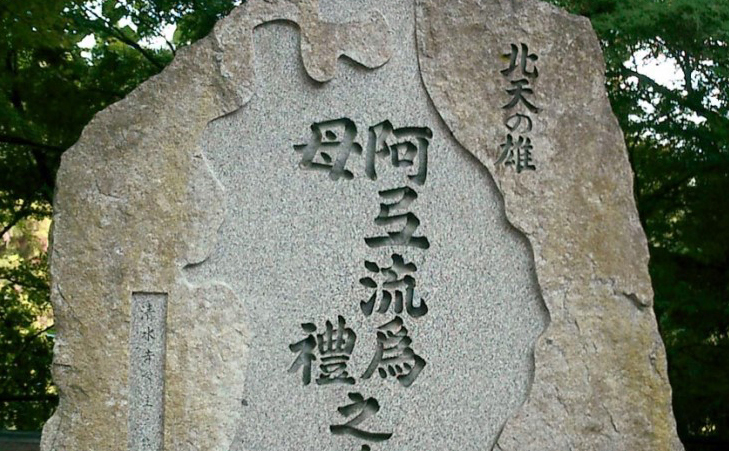
Aterui and More, who had been resisting the imperial forces from their base in Isawa, Mutsu Province, surrendered with over 500 followers. Learn more about Aterui.
Their surrender was accepted by the shogun, Sakanoue no Tamuramaro.
Tamuramaro returned to the capital with the two men.
It is said that he proposed sending Aterui and More back to Mutsu to help bring in the remaining Emishi.
However, his proposal was not accepted.
In August of the same year, the two were executed in Kawachi Province. According to the “Yamakawa Japanese History Dictionary,” Tamuramaro pleaded for their lives, but his request was denied.
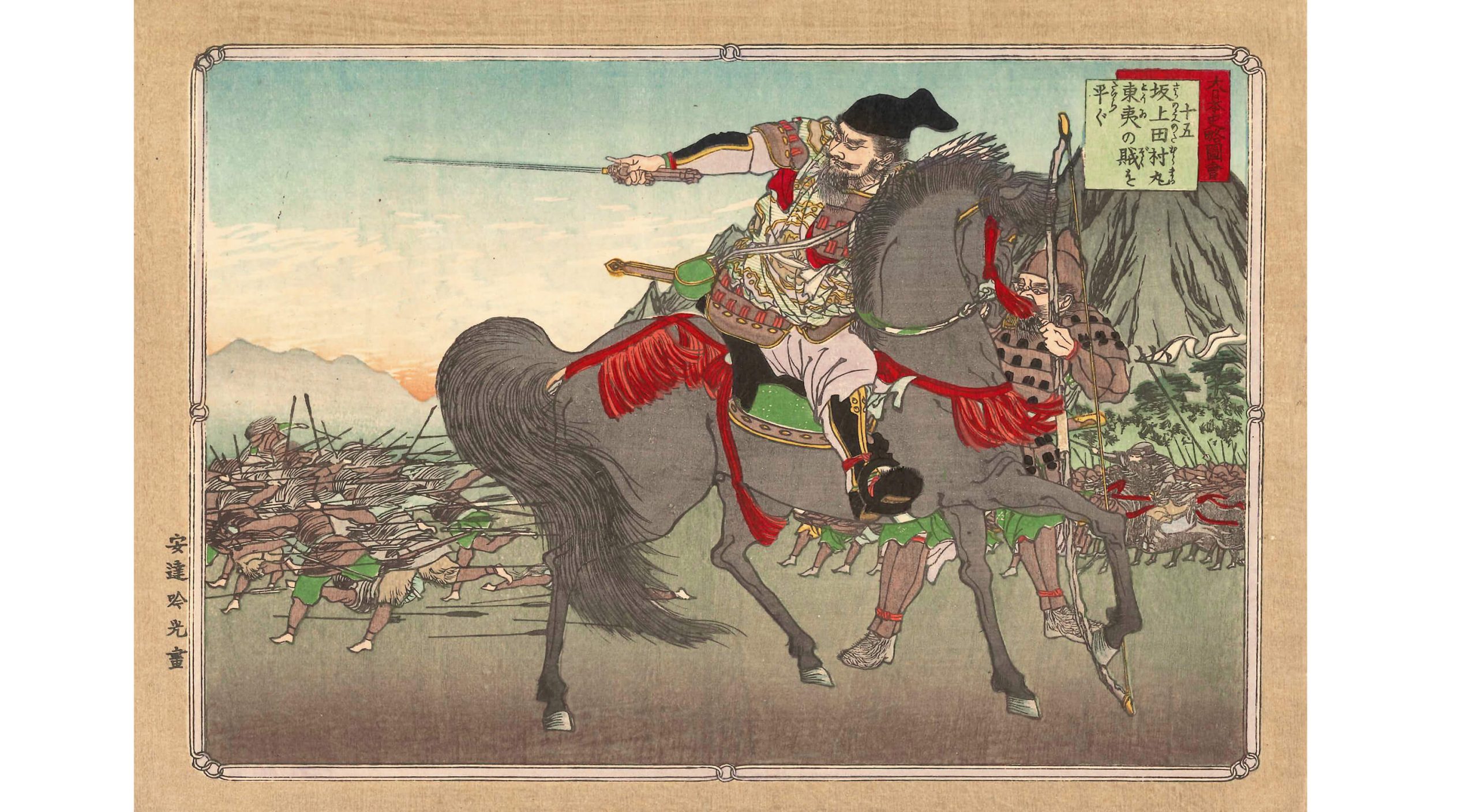
Sakanoue no Tamuramaro is well known for his title as “Sei-i Taishogun” (Barbarian Subduing Generalissimo).
However, he was not the first to receive this title.
During the campaign against the Emishi in 794, Otomo no Otomaro held the title of Sei-i Taishogun, while Tamuramaro served as his deputy.
Tamuramaro himself became Sei-i Taishogun in 797. The title itself can be traced back to before his time.
Following the expeditions of 801, the construction of Isawa Castle in 802, and the building of Shiwa Castle in 803, the imperial court’s political and military influence expanded further north along the Kitakami River.
However, Tamuramaro’s life did not end with his military campaigns in the Tohoku region.
In the central political arena, he rose through the ranks to become a councilor, middle counselor, and then senior counselor, and in his later years, he was involved in the Kusuko Incident of 810.
After his death, many stories such as the founding of Kiyomizu Temple and the defeat of the Akuro-o were attributed to him.
There is a distinction between the historical Sakanoue no Tamuramaro and the heroic figure shaped by later generations.
We will explore his life while distinguishing between these two aspects.
1. 758: Born into the Sakanoue Clan
Sakanoue no Tamuramaro was born in the second year of Tenpyō-hōji (758).
His father was Sakanoue no Karitamaro.
The Sakanoue clan was connected to the Tōka clan, a group of immigrant origin, and produced many officials involved in military affairs.
His father, Karitamaro, was one of them.
During the Fujiwara no Nakamaro Rebellion in the eighth year of Tenpyō-hōji (764), he fought on the side of the imperial court and later held positions such as the Governor of Mutsu.
In the second year of Ten’ō (782), he was temporarily stripped of his office due to his involvement in the Hikami no Kawatsugu Incident, but he was later reinstated.
The background to Tamuramaro’s later military leadership in the Tohoku region includes the Sakanoue clan’s accumulation of experience as officials and military officers.
However, his father’s career alone does not fully explain Tamuramaro’s own path.
Tamuramaro’s official career becomes clearly documented from his twenties onwards.
2. The Year 780—The Beginning of a Career in the Imperial Guard
The year 780, during the Hōki era.
It was then that Tamuramaro became a member of the Imperial Guard.
He was an official responsible for the security of the imperial court.
By 785, in the Enryaku era, he had attained the rank of Junior Fifth Rank, Lower Grade.
In 787, he advanced to the position of Minor Captain of the Imperial Guard.
At this point, Tamuramaro had not yet become the Seii Taishogun.
He was building his career as a military officer in the central government.
Meanwhile, in the northeast, tensions between the imperial court and the Emishi continued.
In 780, the rebellion led by Korehari no Azamaro resulted in an attack on Tagajo.
In 789, the court’s army, led by Ki no Kosami, attempted to advance into the Isawa region but suffered significant losses due to resistance from leaders like Aterui.
A few years after this defeat, Tamuramaro would also join the military campaigns in the northeast.
3. The Year 791—Heading to the Northeast as Deputy Commander
The year 791, during the Enryaku era.
The court organized a new expedition to the northeast.
The commander of this expedition was Otomo no Otomaro.
Tamuramaro was appointed as one of the deputy commanders.
In 793, the title of the expedition was changed from “Seito-shi” to “Seii-shi,” and by the following year, Otomo no Otomaro became the Seii Taishogun, with Tamuramaro as his deputy.
At this stage, Tamuramaro was not the overall commander of the expeditionary forces.
He participated in military actions under the leadership of Otomo no Otomaro.
Although Tamuramaro is more famous in later generations, he did not initially lead the campaign against the Emishi on his own.
4. The Year 794—Campaigns Under Otomo no Otomaro
The year 794, during the Enryaku era.
The expeditionary forces, led by Otomo no Otomaro as Seii Taishogun, set out for the northeast.
One of the deputy commanders was Sakanoue no Tamuramaro.
The court reported the following military achievements:
457 heads taken.
150 prisoners captured.
85 horses seized.
75 bases burned.
These figures were recorded as the achievements of the entire court army, not those of Tamuramaro alone.
Moreover, the relevant sections of the “Nihon Kōki,” which detailed the battles in the northeast during this period, have been lost.
Thus, it is difficult to reconstruct exactly where and how Tamuramaro conducted his operations.
What can be confirmed is that the court reported significant achievements, and subsequently, Tamuramaro advanced to a more prominent role in the northeastern policies.
5. The Years 796–797—Governance in Mutsu and Becoming Seii Taishogun
The year 795, during the Enryaku era.
Tamuramaro was promoted to the lower fourth rank.
In the following year, 796, he took on the roles of Inspector of Mutsu and Dewa, as well as Governor of Mutsu, while also serving as the Commander of the Defense Forces.
His responsibilities extended beyond military command to include the administration and governance of Mutsu and Dewa.
Then, in the 16th year of Enryaku (797).
Tamuramaro was appointed as the Seii Taishogun.
The term “Seii Taishogun” later became closely associated with the leaders of samurai governments such as the Minamoto, Ashikaga, and Tokugawa clans.
However, under Emperor Kanmu, the role of Seii Taishogun was established to command military campaigns in the northeast.
Tamuramaro did not hold the same position as the shoguns of later shogunates.
Moreover, the title of Seii Taishogun did not originate with Tamuramaro.
Tamuramaro became particularly renowned for his significant role in subsequent expeditions and policies in the northeast.
6. The Year 801—An Expedition Recorded as “40,000 Men”
In the 20th year of Enryaku (801).
Tamuramaro, as Seii Taishogun, once again headed to the northeast.
Historical records and dictionaries state that this expeditionary force numbered 40,000.
However, it’s not necessary to interpret this figure as the actual number of combatants present on a single battlefield.
Large-scale expeditions required not only soldiers from various regions but also personnel for transport and logistics.
It’s important to distinguish between the recorded mobilization scale and the actual number of combat participants.
Furthermore, detailed accounts of the battles in 801 are not preserved.
Tamuramaro set out for the northeast in February, reported the defeat of the Emishi to the court in the autumn, and returned to the capital in October.
Following this expedition, the court’s military expansion reached the Isawa region.
And in the following year, 802.
A new political and military base was established in Isawa, which had long been a battlefield.
7. The Year 802—Construction of Isawa Castle
In the 21st year of Enryaku (802).
Tamuramaro went to Mutsu as the official in charge of constructing Isawa Castle.
This was to build Isawa Castle in what is now Oshu City, Iwate Prefecture.
Isawa Castle was a square structure with each side measuring approximately 670 meters, housing government offices and administrative buildings within.
Surrounded by earthen walls, it functioned as both a military facility and an administrative and ceremonial center.
In the same year, an order was issued to relocate 4,000 “ronin” from ten provinces in the eastern country to Isawa Castle.
Here, “ronin” does not refer to masterless samurai as in later periods, but rather people living away from their registered domiciles. The records list ten provinces: Suruga, Kai, Sagami, Musashi, Kazusa, Shimousa, Hitachi, Shinano, Kozuke, and Shimotsuke.
Merely advancing the military was not sufficient to maintain the court’s control.
Policies were implemented to establish fortifications, appoint officials, relocate people, and integrate surrounding areas into the administrative system.
The construction of Isawa Castle in 802 marked an expansion of the court’s control over the Kitakami River basin.
By the 3rd year of Daido (808), the Chinju-fu, originally located at Tagajo, was also relocated to Isawa Castle.
Subsequently, Isawa Castle functioned as a crucial administrative and military base in the northern Tohoku region until the late 10th century.
8. The Surrender of Aterui and More, Over 500 People
The construction of Isawa Castle progressed in the year 802.
Aterui and More, leading over 500 people, surrendered to Tamuramaro.
Aterui was the leader of the Isawa region who inflicted significant damage on the government forces led by Ki no Kosami in 789.
Tamuramaro returned to the capital with Aterui and More.
It is said that Tamuramaro requested that the two not be executed and be returned to Mutsu.
However, there were objections from the court, fearing the possibility of another rebellion.
Tamuramaro’s plea was not accepted, and on August 13 of the same year, Aterui and More were executed in Kawachi Province.
From this, we cannot deduce any “friendship” between Tamuramaro and Aterui.
The historical records confirm that Tamuramaro brought the two to the capital and opposed their execution.
It remains unclear how Tamuramaro evaluated Aterui and More, or what feelings he harbored towards them.
9. 803—Shiwa Castle, Further North
Enryaku 22 (803).
Tamuramaro advanced further north from Isawa to the Shiwa region and constructed Shiwa Castle.
This is near present-day Morioka City.
With the construction of Isawa and Shiwa Castles, the court’s political and military bases extended further north along the Kitakami River basin.
However, this did not mean that the entire Tohoku region came under the direct control of the court.
There were still areas in the north beyond the court’s reach.
The construction of Isawa and Shiwa Castles did not signify the complete end of the wars with the Emishi, but rather the expansion of the court’s bases further north.
In the following year, 804, Tamuramaro was once again appointed as the Seii Taishogun.
However, the large-scale subjugation policy itself was at a turning point.
10. 805—A Shift in the Subjugation Policy
Enryaku 24 (805).
Under Emperor Kanmu, a debate on virtuous governance was held by Fujiwara no Otsugu and Sugano no Mamichi.
Otsugu pointed out “military affairs” and “construction” as burdens on the people and called for their cessation.
Military affairs referred to the subjugation of the Emishi.
Construction referred to the building of the Heian Palace and Heian-kyo.
Emperor Kanmu adopted Otsugu’s opinion.
The long-standing large-scale subjugation efforts thus saw a change in policy.
In the same year, 805.
Tamuramaro became a councilor.
He was the first member of the Sakanoue clan to be appointed to the court nobility.
The military commanders who had led forces in the Tohoku region were now advancing to even higher positions in the central political arena.
11. From Councilor to Middle and Senior Counselor
In the first year of Daido (806).
Emperor Kanmu passed away, and Emperor Heizei ascended the throne.
Tamuramaro was promoted to Middle Counselor.
He continued to rise as a military officer and court noble, reaching the rank of Senior Third Rank in the fourth year of Daido (809).
Ultimately, he advanced to the positions of Senior Counselor and Right Commander of the Imperial Guards.
If we conclude Tamuramaro’s career with his campaigns in Tohoku, we miss this significant period.
Even after completing the large-scale Tohoku policies from 801 to 803, Tamuramaro continued to play a central role in the court.
Then, in 810.
A major political upheaval occurred in the central government.
This was the Incident of Kusuko.
12. 810—The Incident of Kusuko
The fifth year of Daido, the first year of Konin (810).
The relationship between the Retired Emperor Heizei and Emperor Saga deteriorated, bringing internal court conflicts to the surface.
The Retired Emperor Heizei ordered a move of the capital back to Heijo-kyo.
In response, Emperor Saga’s faction captured Fujiwara no Nakanari and stripped Fujiwara no Kusuko of her court rank.
The Retired Emperor Heizei attempted to flee to the eastern provinces with Kusuko, but the court dispatched troops to block their path.
Tamuramaro also took charge of military responses for Emperor Saga, fortifying the Mino Road to thwart the Retired Emperor’s movements.
Ultimately, the Retired Emperor Heizei was blocked within Yamato Province and had to return to Heijo-kyo.
During this political upheaval, Tamuramaro was promoted to Senior Counselor.
Meanwhile, Bun’ya no Watamaro, initially aligned with the Retired Emperor Heizei, was detained.
Tamuramaro, valuing his martial skills, reportedly petitioned for his pardon, and Watamaro was released.
Subsequently, Watamaro took on military roles for Emperor Saga’s side.
Having long commanded forces in Tohoku, Tamuramaro found himself in a military leadership role during central political upheavals in his later years.
13. 811—The Death of Sakanoue no Tamuramaro
On May 23, the second year of Konin (811).
Sakanoue no Tamuramaro passed away at his villa in Awata.
He was said to be 54 years old.
After his death, he was posthumously awarded the Junior Second Rank.
Born in 758 into the Sakanoue family, he began his career as a military officer in the Imperial Guard.
In 791, he joined the northern expedition as Deputy Commander and fought as a vice-general under Otomo no Otomaro in 794.
In 797, he became the Seii Taishogun and led the expedition in 801.
By 802, he had constructed Isawa Castle and accepted the surrender of Ateirui and others.
In 803, he built Shiwa Castle.
He later rose to the positions of councilor, middle counselor, and great counselor, and was involved in the Kusuko Incident of 810.
And in the same year of 811 when Tamuramaro passed away.
Bun’ya no Watamaro became the Seii Taishogun and advanced military actions towards the Nittai and Hei regions.
Tamuramaro’s death did not immediately end the military policies towards the northeast.
Meanwhile, the large-scale subjugation campaigns that began under Emperor Kanmu were approaching a conclusion during this period.
14. Kiyomizu-dera and the Legends of Tamuramaro in Later Generations
In addition to his historical role as an official and military commander, many legends about Sakanoue no Tamuramaro have been passed down.
The most notable of these is his association with Kiyomizu-dera in Kyoto.
According to the temple’s origin story, Tamuramaro visited Otowa Mountain for deer hunting, where he met the monk Kenshin, later known as Enchin, and collaborated with his wife, Miyoshi Takako, to establish the temple.
Today, Kiyomizu-dera still regards Tamuramaro as its “Great Benefactor.”
However, this is part of the founding legend passed down in the temple’s origin story.
The tale of Jizo Bosatsu and Bishamonten aiding Tamuramaro on his expedition is also a later tradition based on the Kiyomizu-dera origin story.
Furthermore, from the medieval period onward, a story emerged that Tamuramaro defeated the demon king Akuro-o.
Some theories suggest that Akuro-o is a legendary representation of Ateirui, but there is no direct evidence to confirm they are the same person.
The historical Sakanoue no Tamuramaro is not recorded as a legendary warrior who vanquished demons and monsters.
He built his career as a military officer for the court and participated in the subjugation of the Emishi under Otomo no Otomaro.
Later, he became the Seii Taishogun and led the expedition in 801.
He constructed Isawa and Shiwa Castles, extending the court’s political and military reach northward.
In 802, he requested that the surrendered Ateirui and Morei be returned to Mutsu instead of being executed, but they were executed.
Even after concluding large-scale military activities in the northeast, he continued to work in the central government as a court noble and was involved in the Kusuko Incident in his later years.
After his death, these experiences, along with the origin story of Kiyomizu-dera and the tale of defeating Akuro-o, merged to form the later heroic image of “Seii Taishogun Sakanoue no Tamuramaro.”
📚 For those who want to learn more about Sakanoue no Tamuramaro and Ateirui
Why not experience the Emishi subjugation depicted in this article as a historical novel next?
In Takahashi Katsuhiko’s “Fire Grudge: The Northern Star Ateirui,” the battle between Ateirui and Sakanoue no Tamuramaro is portrayed on a grand scale.

Fire Grudge, Vol. 1: The Northern Shining Star, Aterui (Kodansha Bunko) [Takahashi Katsuhiko]

Fire Grudge, Vol. 2: The Northern Shining Star, Aterui (Kodansha Bunko) [Takahashi Katsuhiko]
※Used books are available at a lower price, so please check the above URL👌