February, 1184.
A letter arrived from Kyoto for Taira no Tokiko, who was in Yashima, Sanuki Province.
The sender was her son, Taira no Shigehira.
He had been captured by the Minamoto clan at the Battle of Ichinotani and taken to Kyoto.
The letter asked her to persuade Munemori to return the Imperial Regalia to the capital if she wished to see her son again.
According to the “Letter of Appeal” in the tenth volume of the Heike Monogatari, Tokiko pressed the letter to her face and entered the room where her family had gathered.
She collapsed in front of her son, Munemori.
For a while, she could not speak.
Eventually, Tokiko pleaded for the return of the regalia to Kyoto to save the captured Shigehira.
However, Munemori did not comply.
For the exiled Taira clan, the young Emperor Antoku and the Imperial Regalia were crucial symbols of their continued allegiance to the emperor.
Even if the regalia were returned, there was no guarantee that Minamoto no Yoritomo would release Shigehira.
Munemori rejected his mother’s plea.
Tokiko could not reclaim her son.
More than a year passed.
March 24, 1185, Dan-no-ura.
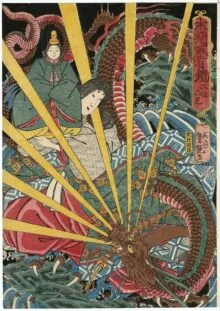
As the Genji fleet approached, the Heike Monogatari recounts that Tokiko lifted the eight-year-old Emperor Antoku in her arms.
Emperor Antoku was Tokiko’s grandson.
“Grandmother, where are you taking me?”
The young emperor asked his grandmother.
Tokiko is said to have advised him to bid farewell to the Ise Grand Shrine to the east and to chant prayers to the west.
And finally, she is reported to have said:
“Even beneath the waves, there is a capital.”
With Emperor Antoku in her arms, Tokiko leapt into the sea.
This was the day of the Taira clan’s downfall as depicted in the Heike Monogatari.
However, the Azuma Kagami offers a different account.
While it agrees that Tokiko entered the water with the sacred sword, it records that it was a lady-in-waiting named Ansho no Tsubone who held Emperor Antoku.
The details of their final moments differ depending on the source.
Tokiko was the wife of Taira no Kiyomori.
She witnessed her husband becoming the Grand Minister of State, her daughter Tokuko marrying Emperor Takakura, and her grandson Emperor Antoku ascending the throne.
After Kiyomori’s death, she left Kyoto with her sons Munemori and Tomomori, moving through the western provinces.
Then came Dan-no-ura at the age of sixty.
Tokiko stood on the final battlefield with the grandson she had protected since Kiyomori’s passing.
Born as the Daughter of Taira no Tokinobu
Taira no Tokiko is said to have been born in the first year of Daiji (1126).
Her father was Taira no Tokinobu.
He served as an official at the court, holding positions such as Assistant Director of the Ministry of War.
Tokinobu’s family belonged to the Kanmu Heishi Takamune lineage.
Taira no Kiyomori‘s family also traced their roots to Emperor Kanmu, but they were of the Ise Heishi lineage, descending from Prince Takamochi.
Despite sharing the Taira surname, the two families belonged to different lineages.
Kiyomori’s father, Tadamori, served under Emperor Shirakawa and Emperor Toba, enhancing his position at court through military strength.
In contrast, Tokiko’s father, Tokinobu, was a court official.
Regarding Tokiko’s mother, some genealogies claim she was the daughter of Fujiwara no Ienari. There are also accounts suggesting she was his granddaughter, leaving some ambiguity about her exact lineage.
Tokiko had a younger brother, Taira no Tokitada.
The two were considered siblings from the same mother.
She also had a younger sister named Taira no Shigeko.
Shigeko shared the same father as Tokiko but was believed to have a different mother.
Tokitada later rose to the position of Acting Grand Counselor and played a significant role in Kiyomori’s government.
Shigeko was favored by Emperor Go-Shirakawa and became the mother of the future Emperor Takakura.
The relationships among these siblings played a crucial role in the Taira clan’s rise to power at court.
Tokiko herself had connections to the court from a young age.
She served as a lady-in-waiting to Empress Bifukumon-in.
Tokiko in Service to Bifukumon-in
Bifukumon-in was the favored consort of Emperor Toba and the mother of Emperor Konoe.
She wielded significant influence during Emperor Toba’s cloistered rule, attracting many nobles and court ladies to her side.
Tokiko was among them.
Details about when she entered court service or how long she remained with Bifukumon-in are not well-documented.
However, the fact that Tokiko, with her court experience, later became the wife of Taira no Kiyomori is crucial in understanding the relationship between their families.
At the time, women serving the cloistered emperors or empresses were not merely attending to their personal needs.
They were involved in ceremonies and document handling, and played a role in forging relationships within the aristocratic society.
Women who became wet nurses to the emperor often retained a special status even after the child grew up.
It was not uncommon for the husbands or relatives of these wet nurses to rise as close retainers of the emperor.
Tokiko later appears in records as a court lady involved in the Yashima Festival of Emperor Nijō.
The exact timing of her marriage to Kiyomori is unclear, but the experience Tokiko gained at court was utilized after she became part of the Taira clan.
Becoming Kiyomori’s Second Wife
The precise year Tokiko became Kiyomori’s wife is unknown.
It is believed that Kiyomori had a wife before Tokiko.
She was the daughter of Takashina no Motoaki.
It is widely accepted that Kiyomori’s eldest son, Shigemori, and his second son, Motomori, were born to this woman.
Some older genealogies and biographical notes list Tokiko as their mother, so one must be cautious of the discrepancies in historical sources regarding the mothers of Kiyomori’s children.
The children known to be Tokiko’s are Munemori, Tomomori, Shigehira, and Tokuko.
Munemori was born in the third year of Kyuan (1147).
Subsequently, Tomomori, Shigehira, and Tokuko were also born.
After the Hogen and Heiji Rebellion, Kiyomori strengthened his influence at court, and as his sons grew, they began to acquire official positions.
Munemori later became the head of the Taira clan.
Tomomori led troops in the Genpei War, participating in battles such as Ichinotani and the Battle of Dan-no-ura.
Shigehira commanded the attack on Nanto, becoming a prominent Taira general.
Tokuko became the consort of Emperor Takakura and gave birth to Emperor Antoku.
Tokiko was the mother of these children.
However, Tokiko’s standing at court, later known as the Second Rank Nun, was not solely due to being Kiyomori’s wife.
The Yashima Festival and Junior Third Rank
December, 1160.
Taira no Tokiko was involved in the Eighty Islands Festival for Emperor Nijō.
The Eighty Islands Festival is an important ceremony held in conjunction with the emperor’s enthronement.
Envoys were dispatched to the coast of Naniwa in Settsu Province to worship the gods of Ikushima, Ashikushima, and Sumiyoshi.
This ceremony was considered to be related to the emperor’s governance of the land and was performed once in a reign.
During the festival, a box containing the emperor’s garments was used.
The emperor himself did not travel to Naniwa; instead, the ceremony was conducted through his garments.
The emperor’s wet nurse, known as the “Tenji,” played a crucial role in this ceremony.
Tokiko is said to have participated in the festival as the Eighty Islands Tenji.
On December 24 of the same year, she was promoted to the Junior Third Rank.
This promotion is recorded in Fujiwara no Tadayoshi’s diary, “Sankaiki.”
It is evident that Tokiko, while being the wife of Taira no Kiyomori, also played a significant role in the court’s ceremonies.
Only about a year had passed since the Heiji Rebellion had ended.
After defeating Minamoto no Yoshitomo and others, Kiyomori was rapidly advancing in the court.
His wife, Tokiko, also attained a high rank in Emperor Nijō’s court.
As the Taira clan moved into the core of the court, Tokiko’s name appeared in court records.
Tokiko’s Sister Shigeko and Retired Emperor Go-Shirakawa
1161.
Tokiko’s sister, Shigeko, gave birth to a prince of Retired Emperor Go-Shirakawa.
This was Prince Norihito.
Shigeko was deeply favored by Retired Emperor Go-Shirakawa.
With the birth of the prince, Shigeko’s status rose even further.
However, the succession to the throne was not proceeding smoothly at the time.
There was political tension between Emperor Nijō and Retired Emperor Go-Shirakawa.
The move to establish Prince Norihito as the crown prince became contentious, and in 1161, Taira no Tokitada and others were punished.
Tokiko’s brother was also caught up in this conflict.
There was intense maneuvering between the factions of Emperor Nijō and Retired Emperor Go-Shirakawa over Prince Norihito.
After Emperor Nijō passed away, the political landscape shifted.
In the third year of Nin’an (1168), Prince Norihito ascended the throne as Emperor Takakura.
Shigeko became the mother of the emperor.
The following year, in the first year of Kaō (1169), Shigeko received the title of Kenchūmon-in.
For Tokiko, Emperor Takakura was the child of her younger sister.
Eventually, Emperor Takakura would take Tokiko’s daughter, Tokuko, as his empress.
The Nishihachijō Residence—Where Tokiko Lived
As Kiyomori expanded his influence at the court, the Taira clan began to establish large residences in Kyoto.
The most well-known of these was Rokuhara.
This area corresponds to the present-day Higashiyama Ward in Kyoto.
It was a gathering place for Kiyomori’s clan and retainers, serving as a political and military hub.
However, Rokuhara was not Kiyomori’s only residence.
He also had a vast estate in Nishihachijō, Heian-kyō.
This was known as the Nishihachijō Residence.
Located around what is now Umekoji Park, the estate featured Kiyomori’s mansion and buildings for his clan.
After Kiyomori took Buddhist vows in the third year of Nin’an (1168), he spent more time in Fukuhara.
Meanwhile, Tokiko resided at the Nishihachijō Residence.
Historical explanations in Kyoto note that after Kiyomori’s ordination, Tokiko primarily lived in this residence.
The estate was also known as “Hachijō-tei.”
After Tokiko was conferred the title of Second Rank, it became associated with the name “Hachijō Second Rank.”
When the Taira clan later fled the capital, it was from this residence that Tokiko departed.
Even when Kiyomori was in Fukuhara, Tokiko lived in a large mansion in Kyoto.
It is believed that women of the clan, ladies-in-waiting, and retainers frequented the residence.
Although records of Tokiko’s life are scarce, the existence of the Nishihachijō Residence allows us to trace her significant role within the Taira clan.
Kiyomori’s Illness and Ordination
In February of the third year of Nin’an (1168), Kiyomori fell ill.
He took Buddhist vows and adopted the name Jōkai.
Although he had already resigned as Grand Minister of State, he continued to wield significant influence as the head of his clan even after ordination.
There are records suggesting that Tokiko also took vows around the same time as Kiyomori.
However, some dictionaries state she shaved her head after Kiyomori’s death, leading to discrepancies about the timing of her ordination.
Regardless, it is certain that in her later years, Tokiko became a nun and was known as the Second Rank Nun.
Kiyomori began to place greater importance on Fukuhara.
He utilized the Seto Inland Sea routes and was involved in the development of Ōwada Anchorage.
Fukuhara was a crucial location for Kiyomori’s trade with the Song Dynasty.
Even as Kiyomori’s life centered around Fukuhara, Tokiko remained at the Nishihachijō Residence in Kyoto.
At that time, a significant issue for the Taira clan was deciding who would become Empress to Emperor Takakura.
Kiyomori was planning to marry his daughter to the Emperor.
The chosen bride was Tokiko’s daughter, Tokuko.
Tokuko Enters the Imperial Court as Consort to Emperor Takakura
In December of 1171.
Tokuko entered the court as consort to Emperor Takakura.
She became an adopted daughter of the retired Emperor Go-Shirakawa and entered the palace as a consort.
In February of the following year, 1172, she was elevated to the status of Empress.
At that time, Emperor Takakura was the son of the retired Emperor Go-Shirakawa and Kenshunmon-in Shigeko.
In other words, he was Tokiko’s nephew.
Tokiko’s daughter, Tokuko, married this Emperor Takakura.
The ties between the Taira clan and the Imperial family deepened further.
In the Heian period court, if a woman who became the Emperor’s consort bore a prince, and that prince ascended to the throne, her family would gain significant status as maternal relatives.
The Fujiwara regency maintained its power for a long time due to such marital ties with the Emperor.
Kiyomori also married his daughter Tokuko to Emperor Takakura.
If their child succeeded to the throne, Kiyomori himself would become the Emperor’s maternal grandfather.
Tokuko’s entry into the court was a significant event for the Taira clan.
However, the details of how Tokiko negotiated this arrangement are not well-documented.
Tokiko’s sister, Shigeko, was the mother of Emperor Takakura and was close to the retired Emperor Go-Shirakawa.
Tokiko’s daughter, Tokuko, became the Empress of this Emperor Takakura.
Through these three women, Kiyomori’s family and the Imperial family became deeply intertwined.
The Death of Kenshunmon-in Shigeko
On July 8, 1176.
Kenshunmon-in Shigeko passed away.
She was thirty-five years old.
Her death marked the loss of Emperor Takakura’s mother, a woman cherished by the retired Emperor Go-Shirakawa.
Tokiko lost her sister.
After Shigeko’s death, the relationship between the retired Emperor Go-Shirakawa and Kiyomori rapidly deteriorated.
This was due to dissatisfaction within the court over the expanding power of the Taira clan and political differences between the retired Emperor and Kiyomori.
The following year, in 1177, the Shishigatani Incident occurred.
Fujiwara no Narichika and other close associates of the retired Emperor were arrested for plotting to overthrow the Taira clan.
Saiko was executed, and Narichika was later killed.
Hiraga no Yasutada, Fujiwara no Naritsune, and Shunkan were exiled to Kikaigashima.
This incident also involved Fujiwara no Naritsune, the son-in-law of Kiyomori’s brother, Norimori.
Norimori is said to have pleaded desperately with Kiyomori to save Naritsune’s life, according to “The Tale of the Heike.”
What Tokiko said about the incident is not recorded.
However, the retired Emperor Go-Shirakawa was her sister Shigeko’s husband, and Kiyomori was Tokiko’s own husband.
While Shigeko was alive, the two were connected through her.
The relationship crumbled, and within the court, the conflict between the Taira clan and Emperor Go-Shirakawa deepened.
A Prince is Born in Rokuhara
On November 12, 1178.
Tokuko gave birth to a prince.
Prince Tokihito.
He would later become Emperor Antoku.
The birth took place at Tokuko’s residence in Rokuhara, Kyoto.
Tokuko’s childbirth was a significant event for the entire court.
The diary of Fujiwara no Tadanaga, “Sankaiki,” records the events of that day.
As Tokuko went into labor, her close attendants and officials of the Imperial Household Agency bustled about.
Monks gathered for prayers, and the court awaited the birth of the prince.
The delivery did not proceed easily, causing concern among those present.
Eventually, in the afternoon, the prince was safely born.
The “Tale of the Heike,” Volume Three “The Birth,” recounts an anecdote of Kiyomori shedding tears of joy upon hearing the news of the prince’s birth.
The birth of the long-awaited prince had finally come.
For Tokiko, it was the day her daughter Tokuko gave birth to the Emperor’s child.
The day after the prince’s birth, Emperor Takakura sent a letter of gratitude to Prince Shukaku.
It was a thank-you note for the prayers conducted during the childbirth.
The handwritten letter by Emperor Takakura still exists today and is designated as a national treasure.
The birth of Prince Tokihito is confirmed by contemporary records and actual letters.
The following year, in 1179, the prince became the Crown Prince.
Kiyomori’s long-desired succession to the throne was about to become a reality.
Emperor Antoku at Three
In November 1179, Kiyomori led his forces into Kyoto.
He confined Emperor Go-Shirakawa and dismissed many court nobles.
This was the political upheaval of 1179.
The court’s personnel changed significantly, making it difficult to proceed with politics without considering Kiyomori’s intentions.
In February 1180, Emperor Takakura abdicated.
Prince Tokihito ascended the throne.
He became Emperor Antoku.
He was only three years old by traditional counting.
Kiyomori became the emperor’s maternal grandfather.
Tokiko also became Emperor Antoku’s maternal grandmother.
Many years had passed since Tokiko became Kiyomori’s wife.
Kiyomori had triumphed in the Heiji Rebellion, risen to the position of Grand Minister, and made his daughter the Empress Consort.
And now, the prince born to her daughter has ascended the throne.
Tokiko’s sons also held high positions at the court.
Munemori was the Minister of the Interior, and Tomomori and Shigehira were active as influential members of the clan.
Tokiko herself held a high rank and was esteemed among the women of the Taira family.
The Status of Junbo and Second Rank Nun
In the fourth year of Jisho (1180), when Emperor Antoku ascended the throne, Tokiko was granted the status of Junbo.
This was a special treatment equivalent to the Three Empresses.
The Three Empresses refer to the Grand Empress Dowager, the Empress Dowager, and the Empress.
It signified Tokiko’s status as the maternal grandmother of the Emperor.
Tokiko was also elevated to the second rank, and in later years, she became known as the “Second Rank Nun.”
There are discrepancies in the timing of her promotion in biographical dictionaries and genealogies, but by the end of Kiyomori’s life, she was known by titles such as “Hachijo Second Rank.”
The “Second Rank Lady” and “Second Rank Nun” appearing in the ‘Tale of the Heike’ refer to this Tokiko.
Tokiko was the grandmother of the Emperor, the wife of Kiyomori, and the mother of the main Taira generals.
However, being in such a position does not necessarily mean she directly commanded Kiyomori’s military or political decisions.
Her name appears most often in contexts related to court ceremonies and family matters.
One of the most detailed records is her plea for Shigehira’s life, later recorded in the ‘Tale of the Heike.’
The Young Emperor’s Move to Fukuhara
The year Emperor Antoku ascended the throne, resistance against the Taira began to spread across the land.
In April of the fourth year of Jisho, Prince Mochihito issued a call to arms against the Taira.
In May, he raised an army with Minamoto no Yorimasa, but they were defeated at Uji and lost their lives.
At that time, Kiyomori was advancing plans to move the capital to Fukuhara.
In June of the same year, Emperor Antoku and the retired Emperor Takakura left Kyoto for Fukuhara.
It was a place Kiyomori had long used as a base.
However, the facilities were not adequately prepared for a capital.
There was strong opposition to leaving Kyoto, and the court was forced into a new way of life.
In the eastern provinces, Minamoto no Yoritomo raised an army.
In October, the Taira’s punitive forces were defeated at the Fuji River.
Kiyomori abandoned the plan to relocate the capital to Fukuhara and returned Emperor Antoku and others to Kyoto in November.
The young emperor, who had just ascended the throne, was moved to a new capital and then back to Kyoto within a few short months.
There are no records of what opinions Tokiko held regarding this relocation.
However, Emperor Antoku, who was forced to move, was her grandson, and his mother, Tokuko, was Tokiko’s daughter.
Eventually, the Taira clan would be driven westward, unable to return to Kyoto.
The Deaths of Retired Emperor Takakura and Kiyomori
On the 14th day of the first month in the fifth year of Jisho (1181).
Retired Emperor Takakura passed away.
He was twenty-one by traditional count.
He was Tokuko’s husband and Emperor Antoku’s father.
To Tokiko, he was also the son of her sister, Shigeko.
Shigeko had already passed away.
Her son, Retired Emperor Takakura, also left this world at a young age.
Tokuko was left a widow, with only the young Emperor Antoku.
Soon after the death of Retired Emperor Takakura, Kiyomori fell ill.
On the 4th day of the intercalary second month in the fifth year of Jisho.
Kiyomori died at the age of sixty-four.
The “Tale of the Heike” recounts that Kiyomori suffered from a severe fever, so intense that cold water poured over him would immediately turn to steam.
It is also said that he wished for Minamoto no Yoritomo’s head to be offered at his grave.
This is a scene from a military chronicle depicting Kiyomori’s intense rage, and it cannot be confirmed as his actual condition or last wishes.
Tokiko lost her husband.
Even after Kiyomori began living more frequently in Fukuhara, Tokiko resided at the Nishi-Hachijo residence.
Just two days after Kiyomori’s death, a fire broke out at that residence.
The Fire at Nishi-Hachijo Residence
On the 6th day of the intercalary second month in the first year of Yowa (1181).
Two days after Kiyomori’s death, the Nishi-Hachijo residence was struck by fire.
It is said to have been caused by arson.
After Kiyomori made Fukuhara his main residence, it was the house where Tokiko lived.
The historical explanations in Kyoto City also record this fire.
The Nishi-Hachijo residence was a large estate of the Taira clan, with buildings spread across a wide area.
Even after being damaged by the fire, the residence continued to serve as the Taira’s base in Kyoto.
However, during the fall of the capital two years later, it would be set ablaze once more.
The life Kiyomori built at Nishi-Hachijo was lost along with the Taira clan’s political standing.
The Taira Clan Entrusted to Munemori
After Kiyomori’s death, Munemori became the central figure of the clan.
Kiyomori’s eldest son, Shigemori, had died in the third year of Jisho (1179), and his second son, Motomori, had passed away even earlier.
Munemori was Tokiko’s son.
He had risen to the position of Minister of the Interior at the court.
His brothers, Tomomori and Shigehira, were also powerful generals supporting the Taira clan.
Tokiko’s brother, Tokitada, supported the family in political matters.
Meanwhile, the conflict with the Minamoto clan continued.
In the eastern provinces, Yoritomo was consolidating his power, while in the Hokuriku region, Minamoto no Yoshinaka was gathering his forces.
The Taira clan dispatched punitive forces to various regions, but they struggled to change the course of the war.
After Kiyomori’s death, Munemori, who led the clan, was tasked with both negotiating with the imperial court and commanding the military.
There are few detailed records of what advice Tokiko gave to Munemori.
However, Munemori, Tomomori, and Shigehira were Tokiko’s sons.
While Kiyomori was alive, his sons operated under his leadership, but now they were tasked with battles that would determine the fate of the Taira clan.
And in the second year of Juei (1183), the Taira forces suffered a major defeat in the Hokuriku region.
The day when they would have to leave Kyoto was drawing near.
July of the Second Year of Juei, the Fall of the Capital
May of the second year of Juei.
The punitive force led by Taira no Koremori was defeated by Minamoto no Yoshinaka at Kurikara Pass.
In the subsequent Battle of Shinohara, the Taira forces were again defeated.
Yoshinaka’s forces advanced towards Kyoto.
On the night of July 24th to the early morning of the 25th, Emperor Go-Shirakawa fled the capital, escaping towards Mount Hiei.
Munemori decided to retreat to the western provinces, taking Emperor Antoku and the Imperial Regalia with him.
Tokiko accompanied them.
By her side were Tokuko and Emperor Antoku.
Emperor Antoku was just six years old.
Only three years earlier, he had ascended to the throne in Kyoto.
The “Fall of the Capital” chapter in the seventh volume of the Tale of the Heike depicts the Taira clan setting fire to their residences and leaving the capital.
Both Rokuhara and Nishi Hachijo were lands where the Taira had long resided.
These were the centers of power passed down from Tadamori to Kiyomori.
Kiyomori had already passed away.
Tokiko left the Kyoto residences her husband had built, accompanied by her sons.
Among the clan, there were those who chose a different path.
Kiyomori’s brother, Yorimori, did not head to the western provinces but remained in Kyoto.
Tadanori is said to have entrusted his own poetry to Fujiwara no Shunzei.
Taira no Sadayoshi, who served under Taira no Shigemori, is remembered for the story of how he exhumed his lord’s remains and relocated them.
Taira no Tokiko took Emperor Antoku and headed west with her family.
Even after Taira no Kiyomori took vows and moved to Fukuhara, Tokiko continued living at the Nishi-Hachijo residence.
She never returned there again.
Two Emperors
After the Taira clan left Kyoto, Emperor Go-Shirakawa began the process of enthroning a new emperor.
Emperor Antoku had moved to the western provinces.
Moreover, the Taira had taken the Imperial Regalia with them.
In August of the second year of Juei, Emperor Go-Toba ascended the throne in Kyoto.
He was enthroned without receiving the regalia.
In Kyoto, there was Emperor Go-Toba.
In the western provinces, the Taira supported Emperor Antoku.
This led to the unprecedented situation of two emperors reigning simultaneously.
The Taira’s retention of the regalia was of great significance.
The Imperial Regalia are treasures deeply tied to the succession of the throne.
Even after Emperor Antoku left Kyoto, the Taira sought to maintain their position by supporting the young emperor and holding the regalia.
Emperor Antoku was Tokiko’s grandson.
Alongside Kiyomori, Tokiko had arranged for Tokuko to marry Emperor Takakura and witnessed their child’s ascension.
However, she could not now return her grandson to Kyoto.
Munemori and others aimed to regroup around Emperor Antoku in the western provinces.
From Kyushu to Yashima
The Taira clan moved from Fukuhara towards Kyushu.
They attempted to regroup around the Dazaifu area, but the samurai in Kyushu did not all align with the Taira.
In Bungo Province, Ogata Koreyoshi and others resisted.
The Taira left Dazaifu and began moving along the coast of Kyushu.
Emperor Antoku, Tokuko, and Tokiko traveled with the family.
There are no detailed records of where Tokiko stayed in Kyushu or what she said.
The “Tale of the Heike” describes scenes of the family longing for distant Kyoto, composing poems as they gazed at the moon.
Those who once lived in the court were now wandering through unfamiliar lands.
As it became difficult to regroup in Kyushu, the Taira moved to Yashima in Sanuki Province.
From Yashima, the Taira launched a counterattack, defeating Minamoto no Yoshinaka’s forces at Mizushima in Bitchu Province in the intercalary October of the second year of Juei.
In November, they also achieved victory over Minamoto no Yukie‘s forces at Muroyama in Harima Province.
The Taira clan temporarily regained their strength and advanced to Fukuhara.
However, in February of the following year, Juei 3 (1184), the forces of Minamoto no Noriyori and Minamoto no Yoshitsune approached.
The Taira clan prepared for a decisive battle at Ichinotani.
Shigehira Captured at Ichinotani
February 7, Juei 3 (1184).
The Genji forces attacked the Taira army, which was positioned from Ikuta Forest to Ichinotani.
The Taira suffered a crushing defeat.
Taira no Tadanori, Taira no Atsumori, Taira no Michimori, Taira no Tsunemasa, and many other nobles perished in battle.
Moreover, Tokiko’s son, Taira no Shigehira, was captured by the Genji forces.
Shigehira was the commander who led the forces that attacked the temples and shrines of Nara in Jisho 4 (1180).
During this assault on Nanto, the halls and towers of Todai-ji and Kofuku-ji were burned down.
Shigehira was deeply resented by the monks of Nanto.
Now, Shigehira found himself a prisoner of the Genji.
He was taken to Kyoto, where his fate would be decided by the court of Emperor Go-Shirakawa and the Genji leadership.
Among the many Taira clan members who were slain at Ichinotani, Shigehira survived.
However, his execution could occur at any moment.
Tokiko received this news at Yashima.
Soon, negotiations concerning Shigehira’s life and the Imperial Regalia would be brought from Kyoto.
The Imperial Regalia and Shigehira’s Fate
After the Battle of Ichinotani, Emperor Go-Shirakawa demanded the return of the Imperial Regalia from the Taira clan.
At that time, Shigehira was used as a bargaining chip in the negotiations.
According to the “Heike Monogatari,” Volume Ten “Yashima Imperial Edict,” an imperial edict dated February 14, Juei 3, stated that Shigehira would be pardoned if the Imperial Regalia were returned to Kyoto.
The edict was reportedly delivered to the Taira at Yashima on the 28th of the same month.
Munemori and others gathered the clan’s court nobles to discuss their response.
The Taira held Emperor Antoku and the Imperial Regalia.
Meanwhile, in Kyoto, Emperor Go-Toba had ascended the throne.
Returning the Regalia would not only comply with Emperor Go-Shirakawa’s request but also significantly alter the Taira’s position, who supported Emperor Antoku.
Moreover, there was no guarantee that Shigehira’s life would be spared.
Even if Emperor Go-Shirakawa agreed to spare him, it was uncertain how Yoritomo or the temple forces in Nanto would react.
Munemori and others faced a difficult decision.
At that time, Shigehira himself seemed to think it would be difficult for the clan to return the Regalia just to save his life.
In the “Heike Monogatari,” “The Ladies of the Imperial Palace,” there is a scene where Shigehira expresses that his clan would not agree to return the court treasures in exchange for his life alone.
Nevertheless, Shigehira wrote a letter to his mother, Tokiko.
The Letter to His Mother from Kyoto
“Heike Monogatari,” Volume Ten “The Petition.”
Shigehira asked Tokiko to persuade Munemori to return the Regalia to Kyoto if she wished to see him again.
Otherwise, they would likely never meet again in this world.
The letter that reached Tokiko reportedly contained such sentiments.
Tokiko opened the letter.
After reading it, she remained silent for a while.
Eventually, she tucked the letter into her bosom and lay face down.
The “Heike Monogatari” vividly describes this scene.
After some time, the clan’s court nobles gathered to discuss their response to the imperial edict.
Among them were Munemori and Tokitada.
Tokiko pressed Shigehira’s letter to her face.
Then, she opened the sliding door to the room where everyone was seated and stepped forward in front of Munemori.
She reportedly collapsed there.
The suddenness of her actions must have surprised the clan members.
Tokiko could not speak for a while, but eventually, she began to speak, holding back tears.
The letter from Shigehira that arrived from Kyoto was unbearably painful.
How much suffering must that child be enduring?
And so, she pleaded with Munemori to return the sacred treasures to Kyoto.
“Please, grant me this wish and return the Naishidokoro to the capital.”
She implored them to heed her request and send the Naishidokoro back to the capital.
Such words are recorded in the circulated texts of the ‘Tale of the Heike.’
In this context, the Naishidokoro refers to the sacred mirror, discussed within the negotiations for the return of the imperial regalia.
In various versions of the text, expressions demanding the return of the Three Sacred Treasures can also be found.
Tokiko pleaded for the life of her son in front of the family.
Why Munemori Refused
Munemori listened to his mother’s plea.
He too wished to save Shigehira.
However, he could not return the sacred treasures.
The ‘Tale of the Heike’ recounts that this was Munemori’s response.
Munemori’s concerns were not solely about public perception.
The Taira clan supported Emperor Antoku.
Returning the treasures to the capital could severely undermine their position of supporting Emperor Antoku.
Moreover, even if the treasures were returned, there was no guarantee that Shigehira would be safely returned.
Munemori also questioned his mother whether it was right to sacrifice other children and close ones for the sake of Shigehira alone.
Many of their kin had already lost their lives at Ichinotani.
Munemori had the responsibility to protect his own children, brothers, and Emperor Antoku.
Should he return the treasures to save Shigehira?
Or should he protect the treasures to continue supporting Emperor Antoku?
Mother and son held differing opinions.
Munemori’s answer was harsh for Tokiko.
Why She Continued to Live After Kiyomori’s Death
Tokiko listened to Munemori’s response and pleaded further.
The ‘Tale of the Heike’ “Petition Chapter” preserves Tokiko’s lengthy words.
After Kiyomori’s death, she had not wished to live even for a moment.
However, Emperor Antoku had left the capital, embarking on a journey with no end in sight.
She wished to return the young emperor to Kyoto and secure his position as emperor.
She had lived until today for that wish.
It is said that Tokiko expressed these sentiments.
Furthermore, since hearing of Shigehira’s capture at Ichinotani, she had been in such distress that she could not eat.
If she heard news of Shigehira’s death, she intended to follow him.
Such was the depth of her suffering.
It is said that Tokiko cried out in anguish.
This scene is depicted in the ‘Tale of the Heike,’ and it cannot be confirmed that the exact words were exchanged in reality.
However, it is clear where the war tale found Tokiko’s sentiments.
Even after Kiyomori’s death, the desire to return Emperor Antoku to the capital persisted.
At the same time, there was also a wish to recover Shigehira, who had been captured by the Minamoto clan.
Tokiko sought the return of the imperial regalia, which supported Emperor Antoku’s position, in order to save her son’s life.
Munemori refused this request.
Tokiko, who had been Kiyomori’s wife, now had to appeal to her son, who had become Kiyomori’s successor.
Tomomori’s Words
Despite Tokiko’s plea, Munemori’s decision remained unchanged.
Tomomori also opposed the return of the regalia.
According to the “Heike Monogatari,” Tomomori stated that even if the regalia were returned, there was no guarantee that Shigehira would be released.
This was because it was uncertain how Minamoto no Yoritomo would respond.
Tomomori suggested that a written reply should be sent to Kyoto.
The members of the clan followed this advice.
Munemori drafted a letter stating that the regalia would not be returned.
Tokiko’s request was rejected.
The “Heike Monogatari” records that Tokiko, overwhelmed with tears, wrote a reply to Shigehira.
Though it was difficult to even hold the brush, she wrote the letter with her thoughts for her son.
Shigehira’s wife was also present.
She was known as the Lady of the Great Counselor.
It is said that she remained silent, covering herself with her robe.
Tokiko, the mother, and the Lady of the Great Counselor, the wife.
Both wished for the return of Shigehira, who was held captive in Kyoto.
However, the Heike chose not to relinquish the regalia and continued the fight.
Shigehira’s Return Was Not to Be
Subsequently, Shigehira was sent from Kyoto to the eastern provinces under the control of the Minamoto clan.
It is recorded in the “Azuma Kagami” that he even met with Minamoto no Yoritomo.
However, he never returned to his mother.
In June of Genryaku 2 (1185), Shigehira was handed over to the temple forces in Nanto and was executed.
This was because he was held accountable for the Nanto Siege.
However, by that time, Tokiko was no longer alive.
Tokiko passed away on March 24 of the same year.
This was nearly three months before Shigehira’s execution.
Tokiko died without knowing the fate her son met.
The “Heike Monogatari” also recounts the scene where Shigehira bid farewell to his wife before his execution in Nanto.
However, there is no scene of him reuniting with his mother, Tokiko.
When Tokiko received the letter at Yashima, she wished for one more chance to see her son.
That wish was never fulfilled.
Losing Yashima
After their defeat at Ichinotani, the Taira clan once again made Yashima in Sanuki Province their stronghold.
Emperor Antoku, Tokuko, and Tokiko were also at Yashima.
Munemori, Tomomori, and others gathered warriors from the western provinces to continue resisting the Minamoto clan.
However, the situation continued to deteriorate.
In February of Genryaku 2 (1185), Minamoto no Yoshitsune crossed over to Shikoku.
Yoshitsune’s forces rapidly advanced towards Yashima.
The Taira clan lost the opportunity to prepare for the attack and retreated to the sea by ship.
The Heike Monogatari recounts that the Taira clan overestimated Yoshitsune’s forces.
The clan left Yashima and headed towards Nagato Province.
In Kyushu, Minamoto no Noriyori’s forces were active.
Naval forces in the Seto Inland Sea were increasingly joining the Minamoto side.
The Taira, accompanied by Emperor Antoku, no longer had a stable base.
Tokiko had lost her husband Kiyomori, her residence in Kyoto, and Shigehira had been taken captive.
Now, Yashima was lost as well.
Yet, Emperor Antoku remained on the Taira’s ship.
Munemori, Tomomori, and others led the clan towards their final battle.
Hikoshima in Nagato Province
Driven from Yashima, the Taira clan moved their base to the Hikoshima area in Nagato Province.
This corresponds to the area around present-day Shimonoseki City in Yamaguchi Prefecture.
Hikoshima was near the Kanmon Straits, a crucial maritime route connecting Kyushu and Honshu.
The Taira prepared to confront the Minamoto forces in this area.
The power that Kiyomori had once built was deeply tied to the sea routes of the Seto Inland Sea.
Routes to Fukuhara, Owada no Tomari, and Kyushu.
The Taira had used maritime transport to mobilize warriors and resources across regions.
However, by the time of the final battle, the western naval forces were increasingly joining the Minamoto side.
Emperor Antoku and the Three Sacred Treasures remained in the Taira’s possession.
Tokiko was also aboard the ship with her grandson, the emperor.
It had been a year and eight months since they left Kyoto.
Emperor Antoku was now eight years old by traditional count.
The Battle of Dan-no-ura
On March 24, Genryaku 2.
The fleets of the Minamoto and Taira clashed on the waters of Dan-no-ura.
The Minamoto forces were led by Minamoto no Yoshitsune.
The Taira, using the area around Hikoshima as their base, faced the sea battle.
The Heike Monogatari describes how, at the start of the battle, the Taira initially pushed back the Minamoto.
However, the tide of battle gradually shifted.
The Genji forces intensified their attack, and the Taira’s ships found themselves cornered.
There are stories that during the battle, some warriors who had been loyal to the Taira switched sides to join the Genji.
The defection of Awa Minbu Shigeno is one such well-known anecdote.
However, the actual process of defection and its impact on the battle varies according to different historical sources.
While the theory that changes in the tide determined the Taira’s defeat is well-known, the outcome cannot be explained by tidal currents alone.
Factors such as the military strength of the Genji, the movements of the western naval forces, and the Taira’s leadership and manpower all played a role.
In the end, the Taira were defeated.
The Genji soldiers boarded the Taira’s ships.
Danger also loomed over the ship carrying Emperor Antoku.
The Taira clan was facing their final moments.
Tomomori’s Announcement of Defeat
From “The Tale of the Heike,” Volume Eleven, “The Former Emperor’s Drowning.”
When the Taira’s defeat became certain, Tomomori went to the ship where Emperor Antoku was.
It is said that Tomomori began throwing unsightly things from the ship into the sea and started cleaning up himself.
The ladies-in-waiting were puzzled and asked what was happening.
Tomomori replied that they would soon see the rare sight of warriors from the eastern provinces.
He was sarcastically announcing the boarding of the Genji soldiers.
Understanding the implication, the ladies-in-waiting cried out.
Tokiko was also present there.
According to “The Tale of the Heike,” Tokiko had already resolved to enter the sea.
She donned a dull-colored robe and adjusted the hem of her ceremonial trousers high.
Then she tucked the sacred jewel under her arm and fastened the treasured sword at her waist.
The sacred jewel was the Yasakani no Magatama.
The treasured sword was also one of the Three Sacred Treasures.
Tokiko lifted Emperor Antoku and headed towards the ship’s edge.
She declared that even as a woman, she would not fall into enemy hands.
She would accompany Emperor Antoku.
So she said, and began to walk, as “The Tale of the Heike” recounts.
“Grandmother, where are you taking me?”
Emperor Antoku was eight years old by traditional reckoning.
In “The Tale of the Heike,” he is depicted as a mature and beautiful young emperor, beyond his years.
His black hair was said to flow down past his back.
This young emperor was lifted by his grandmother, Tokiko.
However, he did not understand why they were heading towards the ship’s edge.
“Grandmother, where are you taking me?”
Emperor Antoku asked.
Tokiko, holding back tears, spoke to the young emperor.
She told him that he was born an emperor because of the good deeds he had accumulated in his past life.
However, their fate was nearing its end.
First, they were advised to head east and bid farewell to the Ise Grand Shrine.
Then, they were told to turn west and recite prayers.
This was to wish for a welcome to the Western Pure Land.
Emperor Antoku, following his grandmother’s words, clasped his small hands together.
He first prayed to the east, and then turned west to recite the prayers.
Tokiko embraced the emperor once more.
And finally, she spoke these words.
“Even beneath the waves, there is a capital.”
Indeed, there is a capital beneath the waves.
With Emperor Antoku in her arms, Tokiko entered the deep sea.
This is the final moment of the Second Rank Nun and the young emperor, as recorded in the ‘Tale of the Heike.’
Another Account in the ‘Azuma Kagami’
The entry of Tokiko and Emperor Antoku into the sea is also recorded in the ‘Azuma Kagami.’
It is noted in the entry for March 24, Genryaku 2.
In the ‘Azuma Kagami,’ Tokiko is referred to as “the Second Rank Zen Nun.”
The following details are recorded.
Tokiko held the sacred sword.
A lady-in-waiting known as Anshitsu no Tsubone held Emperor Antoku.
The two entered the sea together.
Tokuko also entered the water but was rescued by the Genji forces.
Anshitsu no Tsubone also survived.
However, Emperor Antoku never resurfaced from the sea.
In the ‘Tale of the Heike,’ it is Tokiko herself who holds Emperor Antoku.
On the other hand, in the ‘Azuma Kagami,’ it was Anshitsu no Tsubone who held the emperor.
Both records agree that Tokiko entered the sea with the sacred sword.
However, they differ on who held the young emperor in his final moments.
The ‘Azuma Kagami’ is a historical chronicle compiled by the Kamakura shogunate for future generations.
It is not a diary written by someone who was present at the Battle of Dan-no-ura.
Similarly, the ‘Tale of the Heike’ is a military tale composed after the battles.
What Tokiko said to Emperor Antoku, and who held him last.
It is impossible to completely recreate that scene.
The deaths of Tokiko and Emperor Antoku at Dan-no-ura are recorded in multiple accounts.
However, the details of their final moments differ between sources.
The Sunken Sacred Sword
During the Battle of Dan-no-ura, one of the Imperial Regalia, the sacred sword, was lost.
According to the “Azuma Kagami,” after the battle, the sacred mirror and jewel were secured, but the sword was not found.
The sacred mirror is known as the Naishidokoro.
The sacred jewel is the magatama.
Both were deeply connected to the succession of the imperial throne.
The Minamoto forces continued to search the sea but were unable to recover the sword.
The sword in question was the one passed down within the imperial court as part of the succession.
It is important to distinguish between the Kusanagi sword enshrined at Atsuta Shrine and the ceremonial sword kept at the court.
The sword lost at Dan-no-ura was the one traditionally held at the court.
It was the sword depicted in the “Heike Monogatari” as being carried into the sea by Tokiko, and “Azuma Kagami” also notes that Tokiko held it.
The loss of the sacred sword had lingering effects on the court after the fall of the Taira clan.
Emperor Go-Toba ascended the throne without receiving all three Imperial Regalia.
After Dan-no-ura, the mirror and jewel were returned.
However, the sword remained submerged in the sea.
The sacred treasure that Tokiko reportedly never relinquished was never recovered.
Tokuko Rescued from the Sea
Many members of the Taira clan lost their lives at Dan-no-ura.
According to the “Heike Monogatari,” Kiyomori’s brothers, Tsunemori and Norimori, entered the water holding each other’s hands.
Tomomori also realized defeat and sank into the sea.
Munemori and his son Kiyomune were captured.
Tokiko’s daughter, Tokuko, also threw herself into the sea.
However, Tokuko was rescued by the Minamoto forces.
The “Azuma Kagami” also records that Tokuko was saved.
Tokuko had lost her husband, the Retired Emperor Takakura, and at Dan-no-ura, she lost her mother Tokiko and her son, Emperor Antoku.
After becoming a captive of the Minamoto, she was returned to Kyoto.
Eventually, she took vows as a nun and dedicated her life to praying for the souls of the Taira clan.
In later years, her secluded life at Jakkoin in Ohara is depicted in the “Heike Monogatari” Kanjō volume and other works.
Even after Tokiko’s death at Dan-no-ura, Tokuko’s life continued.
Meanwhile, Munemori and Kiyomune were executed in Omi, and Shigehira was executed in Nanto.
Her brother Tokitada was exiled to Noto.
Tokiko never learned of her family’s fate.
The Legend of Nii-no-hama
In Nagato City, Yamaguchi Prefecture, there is a beach known as Nii-no-hama.
This is the place where, according to legend, Tokiko’s body washed ashore after she entered the water at Dan-no-ura.
Tokiko was known as Nii no Ama.
It is said that the place name Niinohama was derived from her title.
However, there are no reliable contemporary sources indicating that Tokiko’s body actually washed ashore on this coast.
The name of Nii no Ama, who perished at Dan-no-ura, has been preserved in later legends.
Akamajingu Shrine in Shimonoseki City is known as a place dedicated to Emperor Antoku.
It is located overlooking Dan-no-ura, adjacent to Emperor Antoku’s Amida Temple Mausoleum.
At Akamajingu Shrine, the Senteisai festival is held to honor Emperor Antoku and the Taira clan.
The words Tokiko is said to have spoken to Emperor Antoku, “Even beneath the waves, there is a capital,” have been passed down along with the story of Dan-no-ura.
“Even beneath the waves, there is a capital”
On November 12, 1178.
On the day Tokuko gave birth to Prince Tokihito, people from the court gathered at Rokuhara to celebrate the birth of the prince.
The Heike Monogatari recounts that Kiyomori was overjoyed.
Tokiko was the grandmother of that prince.
In 1180, Prince Tokihito ascended the throne as Emperor Antoku.
He was only three years old.
Eventually, Kiyomori passed away, and Munemori took charge of the clan.
In July 1183, the Taira clan left the capital with Emperor Antoku.
Tokiko and Tokuko accompanied the young emperor to the western provinces.
The following year, Shigehira was captured at Ichinotani.
Tokiko reportedly prostrated herself before Munemori, pleading for the return of the imperial regalia to save her son.
However, Munemori did not comply, and Shigehira did not return.
The Taira clan lost Yashima and was finally cornered at Dan-no-ura in Nagato Province.
On March 24, 1185.
The Heike Monogatari records that Tokiko tucked the sacred mirror under her arm, fastened the sacred sword to her waist, and held Emperor Antoku in her arms.
Meanwhile, the Azuma Kagami notes that it was Kozaisho no Tsubone who held the sacred sword and Emperor Antoku.
Despite these differences, it is conveyed that Tokiko and Emperor Antoku perished on the same battlefield.
Once, Tokiko had rejoiced with Kiyomori at the birth of her grandson, and seven years later, she was with the same grandson at Dan-no-ura.
The Heike Monogatari preserves the words Emperor Antoku asked his grandmother.
“Grandmother, where are you taking me?”
It is said that Tokiko made the young emperor bow to the east and chant a Buddhist prayer to the west.
And then, they entered the sea.
“Even beneath the waves, there is a capital.”