June 12, 645.
At the Itabuki Palace in Asuka, the ceremony for Empress Kōgyoku’s appearance was about to begin.
The Nihon Shoki records this day as the “Day of Tribute from the Three Kingdoms.” Envoys from Goguryeo, Baekje, and Silla were to present tribute and read their formal addresses.
Soga no Iruka, son of the minister Soga no Emishi, also entered the palace.
The Nihon Shoki tells us that Iruka habitually wore a sword both day and night.
Nakatomi no Kamatari was wary of this.
He used an entertainer to make Iruka laugh, creating a moment to remove his sword.
Iruka took his seat without a weapon.
The palace gates were closed to prevent anyone from entering or leaving.
Prince Naka no Ōe hid beside the hall with a long spear, while Nakatomi no Kamatari held a bow and arrows.
Two swords prepared in a box were handed to Saeki no Komaro and Katsuragi no Wakenokimi no Amida.
Soga no Kurayamada no Ishikawa no Maro stepped forward to begin reading the formal addresses from the Three Kingdoms.
This was the signal.
However, the two assassins did not appear.
The Nihon Shoki notes that Saeki no Komaro and others were so terrified of Iruka that they were physically sick with fear.
Even as Ishikawa no Maro continued reading, there was no sign of movement.
The reading of the formal address was nearing its end.
Sweat began to pour from Ishikawa no Maro’s forehead, and his voice started to tremble.
Iruka noticed.
Why was he trembling?
Ishikawa no Maro replied that he was nervous because of his proximity to the emperor.
Seeing this, Prince Naka no Ōe leaped out.
The sword struck Iruka from head to shoulder.
Saeki no Komaro followed, cutting Iruka’s leg.
Iruka fell.
He was still alive.
Bleeding, he approached Empress Kōgyoku’s throne and bowed his head.
What crime had he committed?
Please investigate.
Empress Kōgyoku, shocked, questioned her son, Prince Naka no Ōe.
What are you doing?
Prince Naka no Ōe accused Iruka of trying to destroy the imperial family and usurp the throne.
Empress Kōgyoku stood up and withdrew to the inner chambers.
Afterward, Saeki no Komaro and Katsuragi no Wakenokimi no Amida finished off Iruka.
June 12, 645.
The heir of the Soga clan, who had long influenced Asuka’s politics, was killed in the imperial palace.
This event is known to later generations as the “Isshi Incident.”
At first glance, this assassination appears to be an uprising by Prince Naka no Ōe and Nakatomi no Kamatari against the Soga clan’s dominance.
However, tracing the politics up to 645 reveals a more complex picture.
The assassination of Iruka was not solely due to the power of the Soga clan; it was also deeply intertwined with the long-standing struggle over who would become the next Great King.
The Soga Clan’s Four-Generation Ties with the Royal Family
Iruka’s great-grandfather was Soga no Iname.
In the mid-6th century, during the reign of Emperor Kinmei, he served as a minister.
Iname strengthened marital ties with the royal family by marrying his daughters, Katashi Hime and Oane no Kimi, to Emperor Kinmei.
From Katashi Hime came Emperor Yomei and Empress Suiko, while from Oane no Kimi’s line came Emperor Sushun.
The number of royals with Soga blood increased.
During the time of Iname’s son, Soga no Umako, the Soga clan became even more central to court politics.
In the second year of Yomei (587), Soga no Umako defeated Mononobe no Moriya.
This was the Battle of Shigisen.
After the powerful rival Mononobe clan was defeated, Umako, along with Empress Suiko and Prince Shotoku, supported the court for a long time.
Umako was also involved in the assassination of Emperor Sushun.
In the fifth year of Sushun (592), the Nihon Shoki records that Umako ordered Yamato no Aya no Atai Komaro to assassinate the emperor.
Yet, the Soga clan did not overthrow the royal family to become Great Kings themselves.
Empress Suiko ascended the throne, and Prince Shotoku participated in politics.
The Soga clan influenced politics through their marital ties with the royal family and their position as ministers.
In the 34th year of Suiko (626), Umako passed away.
His successor was Soga no Emishi.
And stepping onto the political stage as Emishi’s successor was Iruka.
The Struggle for the Throne After Empress Suiko’s Death
Empress Suiko passed away in the 36th year of her reign (628).
There were two strong candidates for the next Great King.
Prince Tamura.
Prince Yamashiro no Oe.
Prince Tamura later became Emperor Jomei.
Prince Yamashiro no Oe was the son of Prince Shotoku.
Both had blood ties to the Soga clan.
Soga no Emishi supported Prince Tamura.
Prince Tamura ascended the throne as Emperor Jomei.
This did not mean that Prince Yamashiro no Oe vanished from the political scene.
As the son of Prince Shotoku, he remained a significant figure who could not be ignored when considering the next succession.
In the 13th year of Jomei (641).
Emperor Jomei passed away.
Once again, the issue of succession arose.
At this time, it was Jomei’s consort, Princess Takara, who ascended the throne.
Empress Kogyoku.
With Emperor Jomei, she had Prince Naka no Oe and Prince Oama.
Meanwhile, Emperor Jomei also had Prince Furubito no Oe from another consort.
Prince Yamashiro no Oe was still alive.
The enthronement of Empress Kōgyoku did not resolve the issue of succession to the throne.
There were several princes who could potentially become the next sovereign.
Iruka became deeply involved in this conflict.
How Powerful Was Soga no Iruka?
In the first year of Kōgyoku’s reign (642), the Nihon Shoki records that Soga no Emishi mobilized many people to build a tomb for his ancestors.
The following year, Kōgyoku 2 (643), it is noted that Emishi stopped attending court due to illness, and Iruka was given a purple cap, likening him to a minister.
This was not described as an official ministerial appointment.
The Nihon Shoki portrays it as Emishi privately bestowing a high rank upon his son.
By Kōgyoku 3 (644), the narrative becomes even more intense.
Emishi and Iruka built residences side by side on Mount Amakashi.
Emishi’s residence was called “Upper Palace Gate,” while Iruka’s was “Valley Palace Gate.”
Their children were referred to as “princes.”
They surrounded their homes with fences, established armories near the gates, and stationed soldiers.
There is even an account of Emishi building a house east of Mount Unebi, digging a pond, and fortifying it as a castle.
Reading this, it seems as though the Soga father and son were attempting to replace the royal family.
The Nihon Shoki arranges its entries to create precisely this impression.
However, this historical record was completed in Yōrō 4 (720).
That was 75 years after Iruka’s assassination.
The prince who orchestrated the assassination later became Emperor Tenji.
The Fujiwara clan, descendants of Nakatomi no Kamatari, also wielded significant power in 8th-century politics.
The detailed story of the Isshi Incident that survives today is conveyed through historical texts compiled under the authority of those who overthrew Iruka.
There is no reason to dismiss the Soga residences and armaments as pure fiction, but accepting the portrayal of them as “traitors attempting to seize the throne” as fact is problematic.
What can be more clearly seen in Iruka’s actions is his strong involvement in the succession to the throne.
As a result, a prominent royal family member was destroyed.
The Attack on Prince Yamashiro no Oe in 643
On November 1, Kōgyoku 2 (643).
Iruka sent Kose no Tokuta no Omi and Haji no Saba no Muraji to Ikaruga to attack Prince Yamashiro no Oe.
According to the Nihon Shoki, Iruka intended to make Prince Furubito no Oe the next sovereign.
The attack was aimed at eliminating Prince Yamashiro no Oe, who stood in the way.
A battle ensued at Ikaruga.
A man named Mitsunari, serving Prince Yamashiro no Oe, led dozens of attendants in resistance, and Haji no Saba no Muraji was killed by an arrow.
The Soga forces temporarily withdrew.
Prince Yamashiro no Oe placed a horse’s bones in his sleeping quarters to feign death, then escaped with his consort and children.
They fled to Mount Ikoma.
The pursuers mistakenly believed that the bones left in the ashes belonged to Prince Yamashiro no Ōe and lifted the siege.
Four or five days in the mountains.
Prince Yamashiro no Ōe and his group found themselves unable to secure adequate food.
His retainer, Miwa no Fumiya no Kimi, advised him to head east.
He suggested moving to Fukakusa’s estate and from there, gathering troops in the eastern provinces to ensure victory.
This advice is recorded in the Nihon Shoki.
Prince Yamashiro no Ōe refused.
He left words to the effect that he did not wish to cause suffering to the common people for his own sake, and returned to Ikaruga.
There, he committed suicide along with his family.
The royal family of Ue-no-miya, descendants of Prince Shōtoku, suffered a significant blow.
The Nihon Shoki emphasizes Iruka’s “arbitrary decision” in this incident.
His father, Emishi, reprimanded his son.
By destroying Prince Yamashiro no Ōe, he warned, he would eventually endanger himself.
Whether these words were actually exchanged is unknown.
What is intriguing, however, is that the Nihon Shoki does not portray Soga no Emishi and Iruka as a father and son acting with a single will from the start.
This suggests the possibility of differing political views within the Soga clan.
Even after the disappearance of Prince Yamashiro no Ōe, there was more than one candidate for the throne.
Prince Furubito no Ōe and Prince Karu
According to the Nihon Shoki, Prince Furubito no Ōe, supported by Iruka, was a son of Emperor Jomei.
His mother was Hōdai no Iratsume, a daughter of Soga no Umako.
He was very closely related to the Soga clan.
There was another influential royal figure.
Prince Karu.
He was the full brother of Empress Kōgyoku and later became Emperor Kōtoku.
There was also Prince Naka no Ōe, the son of Empress Kōgyoku.
In 645, he was about 20 years old.
Even with Prince Yamashiro no Ōe gone, the situation regarding the next succession to the throne remained unresolved.
In this context, Nakatomi no Kamatari took action.
Kamatari Was Not Focused Solely on Prince Naka no Ōe
In the third year of Kōgyoku’s reign (644).
The Nihon Shoki records that Nakatomi no Kamatari declined an appointment as Chief of the Department of Divinities, citing illness, and withdrew to Mishima in Settsu.
At that time, Prince Karu also suffered from a leg ailment and was not attending court.
Kamatari had been close to Prince Karu for some time.
When Kamatari visited Prince Karu’s residence, the prince instructed his favored consort, from the Abe clan, to prepare a separate hall, clean it, and lay out new bedding, warmly welcoming Kamatari.
Kamatari was deeply moved by this hospitality.
The Nihon Shoki even suggests that Kamatari expressed a sentiment that Prince Karu should indeed become the ruler of the realm.
Prince Karu was pleased to hear this.
Immediately following, the “Nihon Shoki” shifts the narrative to the encounter between Kamatari and Prince Naka no Oe.
This is the famous scene involving kemari, the ancient ball game.
Under the Zelkova Tree at Hoko-ji Temple
Hoko-ji Temple—near present-day Asuka Temple.
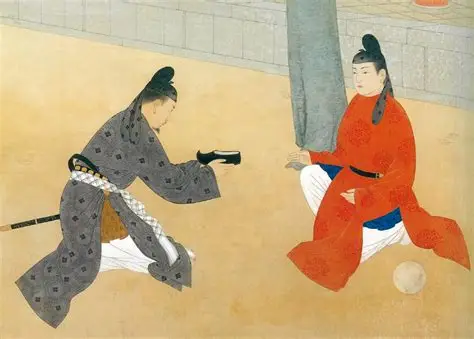
Under the zelkova tree, members of the imperial family were playing kemari.
Prince Naka no Oe’s footwear slipped off.
Kamatari picked it up, placed it on his palm, knelt, and offered it to him.
Prince Naka no Oe also knelt to receive it.
The “Nihon Shoki” notes that from this moment, the two became close.
It is a remarkably well-crafted scene of their meeting.
There is a possibility that this anecdote was polished to narrate the beginning of the relationship between the future Emperor Tenchi and Kamatari, the ancestor of the Fujiwara clan.
Their political alliance can be confirmed from subsequent events.
To avoid attention, they are said to have studied under Nanba no Okina and discussed matters on their way to and from his place.
Kamatari also sought to bring Soga no Kurayamada Ishikawa Maro into their circle.
Ishikawa Maro was a member of the Soga clan.
He arranged for Prince Naka no Oe to marry Ishikawa Maro’s daughter, establishing a marital bond.
The Soga clan itself was involved in the execution of the Isshi Incident.
The political lines of conflict were not drawn solely between the “Soga clan” and “anti-Soga factions.”
They also ran within the Soga clan itself.
The Reason for Choosing June 12
On June 8, 645 (the 4th year of Emperor Kogyoku’s reign).
Prince Naka no Oe revealed the plan to Soga no Kurayamada Ishikawa Maro.
According to the “Nihon Shoki,” on the day when tributes from the Three Kingdoms of Korea were to be presented, Ishikawa Maro was to read the memorial and then Iruka was to be slain on the spot.
Four days later, on June 12.
Empress Kogyoku was to appear at the “Daigokuden” as mentioned in the “Nihon Shoki.”
Prince Furuhito no Oe was also present.
Iruka came as well.
The planners had even considered Iruka’s personality in their preparations.
Iruka was suspicious by nature and always carried a sword.
They used actors to make him laugh and remove his sword.
Prince Naka no Oe closed the palace gates and locked all twelve gates simultaneously, according to the “Nihon Shoki.”
He himself carried a long spear.
Kamatari and others prepared with bows and arrows.
Umi no Inukai no Katsumaro took two swords from a box and handed them to Saeki no Komaro and Katsuragi no Waka Inukai no Amida.
They blocked escape routes, disarmed Iruka, and positioned assassins within the palace.
It was a meticulously planned operation.
Yet, when the moment of execution came, things did not go as planned.
Ishikawa Maro’s Voice Trembles
Soga no Kurayamada no Ishikawa no Maro began to read the petition.
The assassins, Saeki no Komaro and Katsuragi no Wakahinokuma no Amida, did not appear.
It is said that the two feared Iruka’s power.
They tried to swallow their rice with water but ended up spitting it out.
Kamatari scolded them.
Even so, they could not move.
Ishikawa no Maro was anxious.
Once he finished reading, there would be no reason to keep Iruka there.
Sweat poured from his body, his hands trembled, and even his voice was unsteady.
Iruka asked.
“Why are you trembling?”
Ishikawa no Maro replied.
“Being in the presence of the Emperor is overwhelming, and it makes me sweat.”
Nakano Oe no Oji saw that the assassins still had not moved.
He stepped forward himself.
Nakano Oe no Oji Strikes Iruka
Nakano Oe no Oji and Saeki no Komaro rushed at Iruka.
Nakano Oe’s sword wounded Iruka’s head and shoulder.
Iruka stood up.
Saeki no Komaro swung his sword and cut Iruka’s leg.
Iruka approached Emperor Kōgyoku’s throne and bowed his head.
The exchanges from here on illustrate how the “Nihon Shoki” intended to record the Isshi Incident for posterity.
Iruka protested that he was unaware of any crime.
Emperor Kōgyoku was also surprised and asked Nakano Oe no Oji what was happening.
Nakano Oe no Oji answered, bowing low.
“Iruka—Kuratsukuri is trying to destroy the imperial family and seize the throne.”
Emperor Kōgyoku withdrew inside.
Saeki no Komaro and Katsuragi no Wakahinokuma no Amida killed Iruka.
According to the “Nihon Shoki,” rain fell and water flooded the garden, so Iruka’s body was covered with screens and other items.
Soga no Iruka was killed in front of the Emperor.
Iruka’s age at the time of the incident is unknown.
Did Emperor Kōgyoku Know About the Assassination Plan?
This remains an unresolved question.
Did Emperor Kōgyoku know about the plan in advance?
If one reads only the “Nihon Shoki,” it appears she did not.
She was surprised when Iruka was struck and asked Nakano Oe no Oji for an explanation.
There are no contemporary sources that prove this depiction is factual.
Emperor Kōgyoku was Nakano Oe no Oji’s mother and abdicated just two days after the assassination.
On the other hand, the killers did not remove Emperor Kōgyoku from power after the incident.
Later, she would ascend the throne again as Empress Saimei.
The role of Empress Kōgyoku in the Isshi Incident remains one of the major points of debate about the event.
Another important figure present in the court was Prince Furuhito no Ōe.
He was Prince Furuhito no Ōe.
“The Koreans Killed Iruka”
Having witnessed Iruka’s assassination, Prince Furuhito no Ōe rushed back to his residence.
According to the Nihon Shoki,
he said, “The Koreans have killed Kuratsukuri no Iruka.”
There are various theories about who exactly “the Koreans” refers to in this context.
Prince Furuhito no Ōe then entered his sleeping quarters and shut the gate.
Prince Naka no Ōe’s faction moved to Hōkō-ji Temple.
Members of the imperial family and various retainers gathered one after another.
Prince Naka no Ōe fortified Hōkō-ji Temple like a fortress, preparing for a confrontation with Soga no Emishi.
Even though Iruka’s assassination was successful, the outcome of the political upheaval was still undecided.
Emishi still had military strength.
There were also those like the Azuma no Muraji who followed the Soga clan.
The next day, June 13th.
The balance shifted.
The Day After Iruka’s Death, Emishi’s Forces Deserted
Gathered around Soga no Emishi were the Azuma no Muraji and others.
Prince Naka no Ōe’s side sent Kose no Tokuta no Omi and others to persuade them to surrender.
Eventually, the soldiers guarding Emishi abandoned their weapons and left.
Having lost the power to resist, Emishi set fire to his own residence.
On June 13th,
Soga no Emishi took his own life.
The Nihon Shoki records that documents such as the “Tennōki” and “Kokki,” which the Soga clan had in their possession, were also burned at this time.
However, it is said that only the “Kokki” was retrieved from the flames by Fune no Fubito no Esaka and handed over to Prince Naka no Ōe.
The contents of these documents are not known today.
With Emishi’s death, the political dominance of the main Soga family line, which had continued from Iname to Umako, Emishi, and Iruka, came to an end.
This did not mean the complete downfall of the Soga clan.
Soga no Kurayamada no Ishikawa Maro, who participated in Iruka’s assassination, became the Right Minister in the subsequent government.
A different branch of the Soga clan remained within the court.
Two Days Later, Empress Kōgyoku Abdicates
On June 14th,
Empress Kōgyoku decided to abdicate the throne.
The Nihon Shoki notes that her initial thought was to pass the throne to Prince Naka no Ōe.
However, Prince Naka no Ōe did not ascend to the throne.
Consulting with Kamatari, he raised concerns about the order of succession.
Prince Furubito no Ōe was the elder brother of Prince Naka no Ōe, and Prince Karu was their uncle.
If Prince Naka no Ōe were to ascend the throne, bypassing these two, it would not sit well with the people.
Thus, it was advised that Prince Karu should be appointed.
Empress Kōgyoku abdicated in favor of Prince Karu.
Prince Karu initially attempted to pass the throne to Prince Furubito no Ōe.
Prince Furubito no Ōe declined, removed his sword on the spot, and headed to Hōkōji Temple to shave his head.
Prince Karu ascended to the throne.
He became Emperor Kōtoku.
This occurred just two days after the Isshi Incident.
Prince Naka no Ōe became the Crown Prince.
Abe no Uchimaro was appointed as the Left Minister.
Soga no Kurayamada Ishikawa Maro became the Right Minister.
Nakatomi no Kamatari was appointed as the Inner Minister.
Takamu no Genri and the monk Min were appointed as National Scholars.
After the fall of Iruka, a regime that completely excluded the Soga clan from politics was not established.
Soga no Ishikawa Maro was part of the central government as the Right Minister.
The political shift of 645 was not a simple “Imperial Family vs. Soga Clan” conflict, as seen from the appointments immediately following the incident.
The Isshi Incident and the “Taika Reform” Are Not the Same Event
June 19th.
According to the Nihon Shoki, Emperor Kōtoku, former Empress Kōgyoku, and Prince Naka no Ōe gathered the court officials and vowed to correct the government.
The era name “Taika” was used in the same year.
In the following year, Taika 2 (646), the famous “Reform Edict” was issued in January.
It addressed the governance of land and people.
Local administration.
Household registers and tax rolls.
The tax system.
These were systems that would later connect to the Ritsuryō state.
In the past, the assassination of Iruka in 645 was often explained as the start of the “Taika Reform,” with Prince Naka no Ōe and Kamatari rapidly establishing a centralized state immediately afterward.
Today, this narrative has been significantly revised.
There has been long-standing debate about whether the Reform Edict recorded in the Nihon Shoki reflects the actual content from 645-646 or if it was later refined to align with subsequent systems.
The state systems of the 7th century were gradually developed over several decades, extending into the reigns of Emperors Tenji, Tenmu, and Jitō.
The Isshi Incident is better viewed as a political coup that occurred in the midst of this long period of change.
Why Was Iruka Assassinated?
The Nihon Shoki provides a clear answer.
Soga no Iruka disrupted the order between sovereign and subjects, annihilated the clan of Prince Yamashiro no Ōe, and attempted to manipulate the imperial succession by supporting Prince Furubito no Ōe.
Prince Naka no Ōe and Nakatomi no Kamatari thwarted these plans.
Explaining the events of 645 with just this narrative has become increasingly difficult.
In current research, the Taika Reform is primarily viewed through the lens of conflicts over royal succession.
Indeed, there were several candidates for the throne surrounding the incident.
Prince Yamashiro no Oe.
Prince Furuhito no Oe.
Prince Karu.
Prince Naka no Oe.
In 643, Prince Yamashiro no Oe was eliminated, and in 645, Iruka was assassinated.
Two days later, Prince Karu ascended to the throne, and Prince Naka no Oe became the crown prince.
Kamatari had a close relationship with Prince Karu even before the incident and was also allied with Prince Naka no Oe.
From within the Soga clan, Ishikawa no Maro joined the assassination plot.
Several factions were intertwined.
Moreover, in the early 7th century, Tang China was rapidly expanding its influence in East Asia.
On the Korean Peninsula, Goguryeo, Baekje, and Silla were fiercely competing, and the Yamato state could not remain uninvolved in the peninsula’s affairs.
Alongside domestic succession issues and relationships among powerful families, there was also the challenge of establishing a political system capable of responding to foreign affairs.
The Taika Reform occurred amidst these mid-7th century political circumstances.
The Narrative Left by Iruka’s Assassins
Today, the “Nihon Shoki” is indispensable for a detailed understanding of the Taika Reform.
The preparation and execution of the assassination are described in astonishing detail.
Ishikawa no Maro sweating profusely.
Saeki no Komaro and others vomiting from fear.
Iruka’s head, shoulders, and legs being cut.
Iruka, bleeding, appealing to Empress Kogyoku.
The account is that detailed.
However, by the time the “Nihon Shoki” was completed in 720, Prince Naka no Oe had already become Emperor Tenji, one of the historical emperors.
It was also a time when Kamatari’s son, Fujiwara no Fuhito, held significant power at court.
Thus, the “Nihon Shoki” was a historical record compiled by the state connected to those who overthrew Iruka.
Therefore, current research does not discard the text of the “Nihon Shoki” but rather reads it by distinguishing between what is a record of events and what includes later evaluations or fictionalizations.
Was Iruka truly attempting to seize the throne?
Was Empress Kogyoku unaware of the assassination plan?
Was the attack on Prince Yamashiro no Oe solely Iruka’s decision?
Did Kamatari always consider Prince Naka no Oe as the next political center?
There are many aspects that cannot be definitively determined.
What is certain is that on June 12, 645, Iruka was killed in the imperial court, the following day Emishi committed suicide, and two days later, Empress Kogyoku abdicated.
In just three days, the human relationships that had driven Asuka’s politics were dramatically reshuffled.
Today, the remains of the Asuka Palace can be found in Asuka Village, Nara Prefecture.
This site was once known as the “Ruins of the Asuka Itabuki Palace.”
As archaeological excavations progressed, it became clear that this site overlapped with several palaces from different periods: the Asuka Okamoto Palace of Emperor Jomei, the Asuka Itabuki Palace of Empress Kogyoku, the Later Asuka Okamoto Palace of Empress Saimei, and the Asuka Kiyomihara Palace of Emperors Tenmu and Jito. Consequently, in 2016, the site’s historical designation was changed to “Asuka Palace Site.”
The stone-paved plaza and well that are currently restored on the surface are not remnants from the exact time when Iruka was assassinated in 645, but rather from the later Asuka Kiyomihara Palace period.
Beneath the ground, layers of royal palaces from various generations are stacked upon each other.
At one point, Empress Kogyoku’s palace stood here.
June 12, 645.
In that palace, Prince Nakano Oe drew his sword and attacked Soga no Iruka.
The main Soga family vanished from the political center, and a new government was formed by Emperor Kotoku, Prince Nakano Oe, and Nakatomi no Kamatari.
Prince Nakano Oe, who would later become Emperor Tenji, was only about 20 years old at this time.
Learn more 📖↓


[Free Shipping on Orders Over 3,000 Yen] The Taika Reform / Mizutani Toshiki / Osugi Yukihiro