meta_description:
In 658, Abe no Hirafu led a fleet of 180 ships northward. From negotiations with the Emishi of Akita, Nushiro, and Tsugaru, to contact with the Emishi of Watari Island, and battles with the Sushen in 660, we trace the northern expeditions of the 7th century through the Nihon Shoki.
In the fourth year of Empress Saimei’s reign (658), a fleet of 180 ships sailed northward through the Sea of Japan.
The leader was Abe no Omi. Another entry in the Nihon Shoki records him as Abe no Hikita no Omi Hirafu.
Ahead of the fleet lay the northern lands known as Akita, Nushiro, Tsugaru, and Watari Island.
The Nihon Shoki notes that in the following year, 659, another fleet of 180 ships headed north, and in 660, a fleet of 200 ships did the same.
In Akita, the local chieftain pledged allegiance, and in Nushiro and Tsugaru, district leaders were appointed. Further north, contact with the Emishi of Watari Island led to conflict with the people known as the Sushen.
In the mid-7th century, the court repeatedly engaged with the northern peoples via the Sea of Japan.
658—Abe no Hirafu Heads North with a Fleet of 180 Ships
In the fourth year of Empress Saimei’s reign (658), the Nihon Shoki records that Abe no Omi led a fleet of 180 ships to subjugate the Emishi.
Another entry from the same year notes that “Abe no Hikita no Omi Hirafu, governor of Echigo Province,” defeated the Sushen, and it is generally accepted that this Abe no Omi is Abe no Hirafu.
The first records mention Akita and Nushiro.
Akita is often identified with the area around present-day Akita, and Nushiro with the area around Noshiro.
When the fleet of 180 ships appeared, the Emishi of Akita and Nushiro offered their submission.
Hirafu lined up his ships in Akita Bay.
There, Onka, the leader of the Akita Emishi, stepped forward.
Onka swore that they carried bows and arrows only for hunting game and had no intention of fighting the imperial forces.
In Akita, negotiations and submission proceeded against the backdrop of the 180-ship fleet.
The Title of “Ko Otsu no Kami” Given to Onka
The court awarded Onka, who had declared submission, the rank of Ko Otsu no Kami.
Furthermore, the Nihon Shoki records that district leaders were appointed in Nushiro and Tsugaru.
The mid-7th century was a period when the Ritsuryo state’s local administrative system was being established, and there is scholarly debate about the actual nature of the “districts” and “district leaders” mentioned here.
From the records, we can see the court granting status to local leaders and building political relationships with the northern peoples.
Hirafu continued northward, gathering the Emishi of Watari Island at Arima Beach for a grand banquet.
Leading the military ships north, accepting submission, granting ranks and positions to local chieftains, holding banquets, and bestowing goods.
The 658 expedition is recorded as a time when the court, backed by military power, forged relationships through negotiation and hospitality.
July 658—Over 200 Emishi Visit the Court
In July of the same year, the Nihon Shoki notes that over 200 Emishi visited the court.
The court entertained them, granting them ranks and goods.
In Nushiro, Saniguna was recorded as the chief, and Ubasa as the deputy chief; in Tsugaru, Mabu was the chief, and Aomaru the deputy chief.
Saniguna was also ordered to survey the households of the Emishi and “captives.”
That same year saw the dispatch of military ships, the granting of ranks to local chieftains, the appointment of district leaders, the visit of the Emishi to the court, and the survey of households all recorded in succession.
The relationship between the imperial court and the people of the north expanded through military actions as well as through hospitality, appointments, and tributes.
Two Live Bears and 70 Bear Pelts
The “Nihon Shoki” provides another intriguing entry for the year 658.
It records that Abe no Hirafu, the governor of Koshi Province, subdued the Mishihase and presented two live bears and 70 bear pelts as tribute.
Here, the name “Mishihase” appears in the account of Abe no Hirafu.
Research continues on which group the Mishihase specifically referred to. Some theories suggest a connection with the people of the Okhotsk culture, which spread from northern Hokkaido to the coast of the Sea of Okhotsk.
The account of the bear tribute has also served as a clue to understanding the scope of Hirafu’s activities.
The theory that Abe no Hirafu reached present-day Hokkaido has been around for a long time, with place names like Watarishima and Shiribeshi being discussed in relation to Hokkaido.
There are multiple theories regarding the identification of each place name.
The “Nihon Shoki” reveals that by the mid-7th century, the imperial court was aware of the northern world beyond northern Honshu and recorded interactions with the people living there.
659—180 Ships Head North Again
In March of the fifth year of Empress Saimei’s reign (659), the “Nihon Shoki” again mentions an expedition by Abe no Hirafu.
The fleet consisted of the same 180 ships as the previous year.
During this expedition, the number of people gathered by Hirafu is meticulously recorded.
241 Emishi from Akita and Nushiro and 31 “captives.”
112 Emishi from Tsugaru and 4 “captives.”
20 Emishi from Iburi.
The Emishi mentioned in the records alone number 373.
Hirafu gathered them in one place, hosted a grand banquet, and bestowed rewards.
He also offered a ship and five-colored cloth to the local deities before proceeding north.
Beyond that point, the “Nihon Shoki” mentions “Nikuiri-kago” and “Shiribeshi.”
Making Shiribeshi a “Government Office”—A Proposal from the Local Emishi
When Hirafu arrived at Nikuiri-kago, two Emishi from the Tomo clan, named Tanashima and Uhonaga, came forward.
They proposed to Hirafu that Shiribeshi be made a “government office.”
The “Nihon Shoki” records that Hirafu followed their advice, established a district office, and returned.
Shiribeshi is annotated as being read as “Shirihe-shi.”
There is a place name “Shiribeshi” in present-day Hokkaido, and the connection between the two has long been noted.
There are multiple theories about the locations of Nikuiri-kago, Iburi, and Shiribeshi, and debate continues about how far north Abe no Hirafu’s fleet actually traveled.
Understanding the nature of “government offices” and “district offices” during this period requires careful consideration, as it may not align with the administrative systems under the later Ritsuryo codes. Some research views them as bases for managing tribute and trade with northern leaders.
Another tradition is recorded in the same year’s entry.
The “Nihon Shoki” notes “according to one source,” Abe no Hirafu fought the Mishihase and returned, presenting 49 captives as tribute.
The presence of differing accounts for the same year is significant for considering Abe no Hirafu’s northern expeditions.
The Year 660: A Fleet of 200 Ships and the Emishi
In March of the sixth year of Empress Saimei’s reign (660 AD).
Abe no Omi set out with a fleet of 200 ships to subdue the Emishi.
This time, the Emishi from Mutsu also boarded Hirafu’s ships.
The Emishi, who had established relations with the imperial court, joined Hirafu on his northern voyage.
When the fleet arrived at the banks of the “Great River,” over a thousand Emishi from Watari Island gathered at the coast, setting up camp facing the river.
Two of them ran towards Hirafu.
They reported that a large fleet of Emishi ships had appeared and was preparing to attack them.
When Hirafu inquired about the Emishi’s location and the number of their ships, he was told there were over 20 ships.
The Abe army with its 200 ships.
Over 20 Emishi ships.
Over a thousand Emishi from Watari Island gathered at the coast.
The chronicles of 660 depict a scene where multiple forces—the imperial court, the Emishi, and the Emishi—confront each other in the northern seas.
Cloth, Weapons, and Iron Piled on the Shore
Hirafu sent messengers to summon the Emishi.
When the Emishi did not respond, Hirafu piled colorful cloth, weapons, and iron on the shore.
Eventually, the Emishi fleet appeared.
They tied feathers to trees as flags and aligned their ships, approaching the shallows.
Two elderly men disembarked from one of the ships.
After carefully inspecting the items placed on the shore, they removed their own clothes, changed into the ones left there, took the cloth, and returned to their ship.
After a while, they reappeared on the shore, returned the clothes they had changed into and the cloth they had taken, and left.
Hirafu sent ships again to summon the Emishi, but they returned to Heirobem Island.
This series of actions, involving the placement of goods on the shore and mutual verification, is discussed in research as related to “silent trade.”
Eventually, the Emishi sought peace.
Hirafu did not accept this, and the Emishi barricaded themselves in a fort, leading to battle.
The Death of Noto no Omi Mabinryu
In the battle around the fort, there were casualties on the Abe side as well.
The name recorded in the “Nihon Shoki” is Noto no Omi Mabinryu.
Mabinryu lost his life in combat with the Emishi.
The battle continued, and eventually, the Emishi were defeated.
The “Nihon Shoki” notes that the defeated Emishi killed their own wives and children.
In 658, negotiations and submission were progressing in Akita, and in 659, a banquet was held with hundreds of Emishi gathered.
By 660, contact with the Emishi escalated into armed conflict, resulting in casualties on the side of the imperial court.
Abe no Hirafu’s northern voyage records both scenes of building relationships through hospitality and gifts, and moments where negotiations broke down, leading to armed conflict.
Abe no Hirafu’s Northern Voyage as Depicted in the “Nihon Shoki”
The primary historical source detailing Abe no Hirafu’s expedition is the “Nihon Shoki.”
This work was completed in the fourth year of Yoro (720).
This is approximately 60 years after the events of 658 to 660.
The “Nihon Shoki” records that Abe no Omi “subjugated the Emishi” and “attacked the land of the Mishihase.”
The text describes a variety of actions beyond just military advances, including the northward journey by warships, conferring ranks on local chieftains, appointing district leaders, hosting banquets, bestowing gifts, conducting rituals for local deities, and engaging in contact and combat with the Mishihase.
These diverse activities, which cannot be summarized by the single word “conquest,” are documented over the course of three years.
How Far North Did Abe no Hirafu Venture?
A major point of debate regarding Abe no Hirafu’s expedition is the extent of his reach.
Places like Akita, Nushiro, and Tsugaru are thought to correspond to regions spanning present-day Akita Prefecture to Aomori Prefecture.
However, locations such as Iburi, Shiribeshi, and Oshima have sparked differing opinions regarding their exact identification.
There is also a strong theory suggesting a connection to Hokkaido, and Abe no Hirafu is often introduced as a figure who reached as far as Hokkaido.
The “Nihon Shoki” contains place names from the 7th century, some of which are difficult to accurately place on modern maps.
What can be confirmed from historical sources is that Abe no Hirafu’s fleet advanced beyond Tsugaru to the north, repeatedly making contact with the Emishi and Mishihase of Oshima.
It is important to distinguish between the areas reached by the expedition fleet and the regions under continuous control by the imperial court.
Were the Three Consecutive Years of Expeditions Separate Events?
The “Nihon Shoki” records:
658: 180 ships
659: 180 ships
660: 200 ships
These entries document Abe no Omi’s northern expeditions over three consecutive years.
The 659 entry includes an alternate account stating that Hirafu fought the Mishihase and presented 49 captives.
There is also a record of a campaign against the Mishihase in 658, and detailed accounts of battles with them in 660.
Given the similar content across multiple years, some scholars suggest that parts of these records might be duplicates of the same events, proposing that there was only one or two expeditions. Conversely, other research supports the view that three separate expeditions took place as recorded.
It is believed that the “Nihon Shoki,” completed about 60 years later, utilized multiple sources, including records passed down by the Abe clan.
The articles spanning three years should be read with an understanding of how these historical sources were compiled.
The Northern World of the 7th Century and Abe no Hirafu
About a century after Abe no Hirafu’s northern voyages, the imperial court’s policy towards the Emishi evolved to include large-scale fortification and military expeditions.
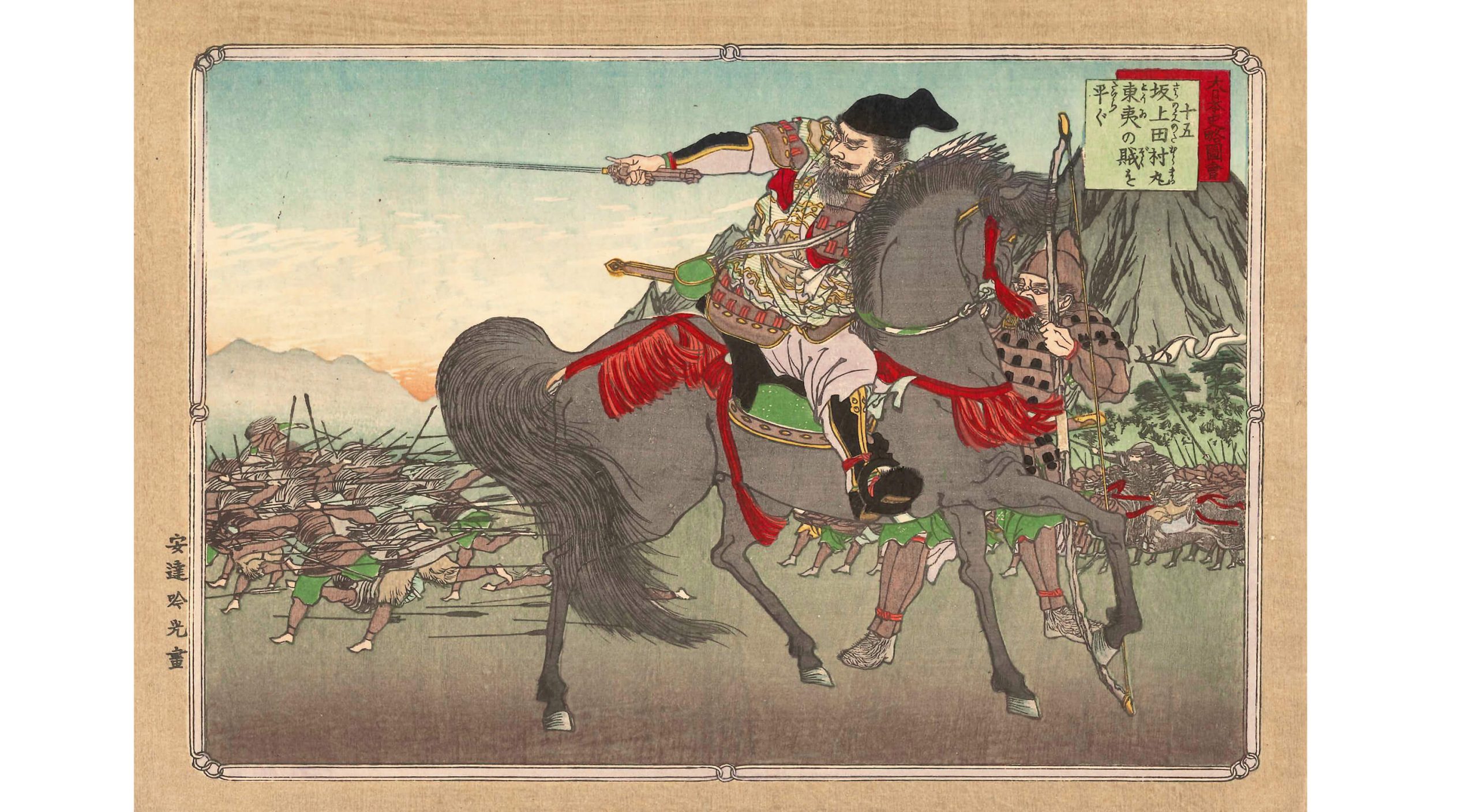
From the fifth year of Hoki (774), a prolonged conflict known in later times as the “Thirty-Eight Years’ War” began.
The rebellion led by Korehari no Azamaro, the resistance centered in Isawa by Aterui, and the subsequent expedition led by Sakanoue no Tamuramaro were significant events in this period.
About a century earlier, in 658, Abe no Hirafu led a fleet of 180 ships northward.
In Akita, Noto, Tsugaru, and Oshima, there were distinct leaders and societies. Further north, there were people known as the Sushen.
Hirafu’s fleet made contact with these groups, held feasts, bestowed ranks and goods, engaged in trade, and at times, resorted to force.
The northern expeditions from 658 to 660 were different in nature from the later castle-based governance and large-scale subjugation campaigns of the 8th century onwards.
The entries in the Nihon Shoki covering these three years depict a mid-7th century world where the imperial court and the northern peoples interacted through negotiations, banquets, appointments, trade, and conflict.
Learn more 📖↓