January, 1160.
In Kyoto, at Rokujō Riverbed, a young warrior was brought forth.
Minamoto no Yoshihira.
The eldest son of Minamoto no Yoshitomo, and the half-brother of Minamoto no Yoritomo.
In the previous December, during the Heiji Rebellion, he fought alongside his father, Yoshitomo, against Taira no Kiyomori. After their defeat, he initially headed to the eastern provinces, but upon learning of his father’s death in Owari, he returned to Kyoto to target Kiyomori.
He was captured by a retainer of the Taira, Namba Tsunefusa.
Yoshihira was executed at Rokujō Riverbed.
If he was born in 1141, he would have been 20 years old. The exact date of his execution varies among sources, listed as January 19th, 21st, 22nd, or 25th, with no definitive date.
His life was brief, lasting only about 20 years.
Yet, Yoshihira’s name endured.
At 15, he defeated his uncle, Minamoto no Yoshikata, in the Battle of Okura.
At 19, he is said to have fought against Taira no Shigemori at the Siege of the Gate of Waiting.
The story of his return to Kyoto to target Kiyomori after his defeat.
And the legend that, just before his execution, he vowed, “I will become lightning and strike down my enemies.”
In later generations, Yoshihira was called “Aku Genta.”
“Aku” implies not evil, but rather wild, extraordinarily strong. “Genta” refers to the eldest son of the Minamoto clan.
Raised amidst the power his father, Yoshitomo, built in the eastern provinces, he was already on the battlefield in his mid-teens.
While Yoritomo was still a boy, it was this elder brother who carried the future of the Kawachi Genji.
Born as Yoshitomo’s Eldest Son
Minamoto no Yoshihira was born around 1141.
His father was Minamoto no Yoshitomo.
His grandfather was Minamoto no Tameyoshi.
His great-grandfather was the renowned “Hachiman Taro,” Minamoto no Yoshiie, who left his mark during the Later Three Years War.
Thus, Yoshihira was born quite close to the main line of the Kawachi Genji.
His brothers included Tomonaga, Yoritomo, Noriyori, and Yoshitsune.
There is no consensus among historical records regarding Yoshihira’s mother.
The “Sonpi Bunmyaku” suggests she was a courtesan from Hashimoto-juku, while other genealogies claim she was the daughter of Miura no Yoshiaki.
It is difficult to determine this definitively.
However, what is crucial in considering Yoshihira’s youth is that his father, Yoshitomo, was primarily active in the eastern provinces during this time.
Yoshitomo ventured into Sagami, Kazusa, and Shimosa, forging connections with local warriors.
In Sagami, it was the Oba Manor. In Shimosa, the Soma Manor.
He intervened in land disputes, sometimes asserting his rights quite forcefully, expanding his influence.
Yoshihira grew up amidst his father’s activities in the eastern provinces.
Unlike Yoritomo in later years, who spent his youth in the aristocratic society of Kyoto, Yoshihira’s experience was different.
For Yoshihira, the Genji were not just names on a family tree.
They were a tangible military force, contesting lands, gathering troops, and mobilizing warriors from Musashi and Sagami.
The ‘Heiji Monogatari’ and Yoshihira’s Descent to Kamakura at Age 13
The ‘Heiji Monogatari’ records that Yoshihira descended to Kamakura at the age of 13.
This is not a story confirmed by contemporary sources, and his exact age cannot be verified.
Nevertheless, considering the Battle of Okura later on, it seems natural that Yoshihira was active in the eastern provinces from a young age.
His father, Yoshitomo, became the Governor of Shimotsuke in 1153, strengthening his position in Kyoto.
While Yoshitomo himself advanced to the capital, his established connections with the warriors in the eastern provinces remained.
Someone had to maintain those ties.
It is believed that his eldest son, Yoshihira, was part of this effort.
In the second year of Kyūju (1155), Yoshihira, then around 15 years old, suddenly appears in historical records.
The opponent was not the Taira clan.
He was his father’s younger brother—his uncle, in other words.
Uncle Minamoto no Yoshikata Enters Musashi
Minamoto no Yoshikata was the younger brother of Yoshitomo.
He is known as the father of Minamoto no Yoshinaka (Kiso Yoshinaka).
Yoshikata was not in the eastern provinces from the start.
In Kyoto, he served as the sword-bearer for Prince Taira, who later became Emperor Konoe, earning the nickname “Sword-Bearer Teacher.”
Later, he lost his official position and began to operate around Fujiwara no Yorinaga.
By the 1150s, Yoshikata headed to the eastern provinces.
He advanced from the province of Kozuke to Musashi, forming a strong alliance with the influential Musashi warrior, Chichibu Shigetaka.
This is where problems arose.
The Yoshitomo faction, expanding its influence around Sagami. The Yoshikata faction, entering from Kozuke to Musashi.
The two branches of the Kawachi Genji began to extend their power in the same eastern provinces.
Yoshitomo had already shifted his focus to Kyoto.
It was Yoshihira who remained in the eastern provinces.
August 16, 1155—The 15-Year-Old Yoshihira Strikes Down His Uncle
On August 16, 1155, during the Kyūju era.
Yoshihira and Yoshikata clashed in Musashi Province.
This battle is known to posterity as the Battle of Okura.
The battlefield is believed to be near present-day Okura in Ranzan Town, Saitama Prefecture.
Contemporary records of this battle exist.
In Fujiwara no Yorinaga’s diary, ‘Taiki,’ it is noted that Yoshikata was **”killed in Musashi Province by the son of his brother, the Governor of Shimotsuke, Yoshitomo.”**
The ‘Hyakurensho’ also records that Yoshikata and Yoshihira fought in Musashi Province.
Yoshihira was around 15 years old by traditional Japanese age reckoning.
As for how many troops he led, or how he attacked Okura Manor.
Whether it was a night assault, or how Yoshikata was killed.
These details remain unknown.
Imagining the battlefield based on the later tales of “Evil Genji”‘s valor leads to stories not found in historical records.
The confirmed facts alone are intense enough.
A nephew, around 15 years old, struck down his father’s brother in Musashi Province.
This alone was a major incident.
Why a 15-Year-Old Boy Could Defeat His Uncle
This is not a story that can be explained by Yoshihira’s martial prowess alone.
The backdrop involves the warriors of the eastern provinces.
In Musashi, the Chichibu clan had complex relationships, and alliances could shift the balance of power in the region.
Yoshikata had allied with Chichibu Shigetaka.
The Yoshitomo faction also had long-standing connections with warriors in the Sagami and Musashi areas.
Yoshihira fought within this world.
Furthermore, there are no contemporary records indicating that Yoshitomo directly ordered Yoshihira to kill Yoshikata.
There is no need to fabricate a conversation between father and son to that extent.
What is clear is that Yoshitomo and Yoshikata’s forces were competing in the eastern provinces, and Yoshihira, the eldest son, was at the forefront of this military clash.
At this time, Yoshihira was only 15 years old.
He was not merely a boy borrowing his father’s name; he had already become a figure capable of leading military actions.
The Child Left Behind at Okura—Minamoto no Yoshinaka
Yoshikata died in the Battle of Okura.
However, his child survived, who would later become Minamoto no Yoshinaka.
According to the ‘Azuma Kagami’, Yoshinaka fled to Shinano as a young child and was raised by Nakahara Kanetomo.
The famous story of Saito Sanemori and others rescuing the young Yoshinaka is largely derived from later military tales and legends.
Nevertheless, the fact that Yoshikata’s child survived and grew up in Shinano is of great significance when considering subsequent history.
About 28 years later, Yoshinaka advanced from the Hokuriku region to Kyoto, driving the Taira clan out of the capital.
However, it was Minamoto no Yoritomo who later opposed Yoshinaka.
He was Yoshihira’s younger brother.
In 1155, Yoshitomo’s son Yoshihira defeated Yoshikata.
In the 1180s, Yoshikata’s son Yoshinaka and Yoshitomo’s son Yoritomo clashed.
The internal conflict within the Kawachi Genji would continue across generations.
The Year After the Battle of Okura: The Outbreak of the Hogen Rebellion
Eleven months after the Battle of Okura.
In July of the first year of Hogen (1156), the Hogen Rebellion erupted in Kyoto.
Minamoto no Tameyoshi, the grandfather, sided with the retired Emperor Sutoku and Fujiwara no Yorinaga.
Meanwhile, the father, Minamoto no Yoshitomo, supported Emperor Go-Shirakawa.
The Minamoto clan was split between father and son.
However, it is unclear how Minamoto no Yoshihira acted during this conflict.
While the “Hogen Monogatari” depicts a vivid scene of warriors, suggesting Yoshihira might have participated, it is challenging to confirm any specific exploits from contemporary sources.
For Yoshihira, the significant aspect was the transformation within the Minamoto clan after the war.
With the victory of Emperor Go-Shirakawa’s faction, many, including his grandfather Tameyoshi and several uncles, were executed.
The previous year, Minamoto no Yoshikata had also died.
Within the Minamoto clan, the lineage of his father, Minamoto no Yoshitomo, rose to prominence.
Yoshihira was the eldest son of this line.
Should Yoshitomo’s status continue to rise in the coming years, Yoshihira might have been poised to become a central figure of the next generation.
However, this period lasted only three years.
The Heiji Rebellion: At 19, to Kyoto
In December of the first year of Heiji (1159).
Minamoto no Yoshitomo allied with Fujiwara no Nobuyori to attack the Sanjo Palace, the residence of the retired Emperor Go-Shirakawa.
They drove Shinzei to his death and secured the retired Emperor Go-Shirakawa.
For a brief moment, they had control over the court.
Amid this political upheaval, Yoshihira also entered Kyoto.
Four years had passed since the Battle of Okura.
Yoshihira was about 19 years old.
Meanwhile, Taira no Kiyomori, having returned from a pilgrimage to Kumano, did not immediately confront Yoshitomo. Instead, he welcomed Emperor Nijō to his stronghold at Rokuhara.
Retired Emperor Go-Shirakawa also distanced himself from Nobuyori’s side.
On December 26, Yoshitomo’s faction, politically cornered, clashed with Kiyomori’s forces, who supported Emperor Nijō, in Kyoto.
Yoshihira’s name once again rose to prominence.
The Gate of Waiting—Yoshihira and Taira no Shigemori
The highlight for Yoshihira in the ‘Heiji Monogatari’ is the Battle at the Gate of Waiting.
His opponent was Taira no Kiyomori’s eldest son, Taira no Shigemori.
Shigemori was about 22 years old. Yoshihira was about 19.
The sons of Kiyomori and Yoshitomo clashed at the imperial palace in Kyoto.
In the ‘Heiji Monogatari’, Shigemori enters the imperial palace through the Gate of Waiting, and Yoshihira confronts him.
Shigemori runs. Yoshihira pursues. Shigemori’s retainers intervene.
The battle extended to the vicinity of the Shishinden, near the cherry blossoms on the left and the tachibana trees on the right.
Armored warriors on horseback raced through the ceremonial grounds of the imperial court.
It is a scene typical of a war tale.
The ‘Heiji Monogatari’ portrays Yoshihira as a fierce general, matching or surpassing the heir of the Taira clan.
The valor he showed during the Battle of Okura, where he defeated his uncle, “the wicked Genji,” is echoed in the Heiji Rebellion.
The image of Yoshihira for later generations is largely formed here.
Brave but Unable to Win the War
In the ‘Heiji Monogatari’, Yoshihira and the Genji forces temporarily push back the Taira army, forcing Shigemori to retreat towards Rokuhara.
However, Kiyomori awaited them there.
At Rokuhara, the Taira clan’s forces were gathered, along with Emperor Nijō.
Yoshitomo’s faction had already lost its political legitimacy.
The narrative tells us that Minamoto no Yorimasa and others distanced themselves from Nobuyori’s side.
No matter how strong Yoshihira was on the front lines, he couldn’t turn the tide of the overall military situation.
The Taira forces pushed back, and the Minamoto army crumbled.
Yoshitomo decided to abandon Kyoto and flee to the eastern provinces.
Yoshihira also left the capital with his father.
At the age of 15, he won the Battle of Okura.
But at 19, he faced defeat in Kyoto.
For the first time in Yoshihira’s life, he encountered an irretrievable defeat.
Parting from His Father, Heading Once to the East
Yoshitomo and his group headed east along the Tokaido Road.
His eldest son, Yoshihira.
His second son, Tomonaga.
His third son, Yoritomo.
And his trusted retainer, Kamada Masakiyo, among others.
However, during the midwinter retreat, the group gradually dispersed.
Yoritomo got separated along the way. Tomonaga was injured and lost his life.
Yoshihira also parted ways with his father.
Yoshitomo made it to Noma in Owari Province, seeking refuge with Nagata Tadaichi, the father-in-law of Kamada Masakiyo.
There, he was betrayed and killed.
Yoshihira himself is believed to have once fled to the eastern provinces.
From here, the tale of Yoshihira as depicted in the ‘Heiji Monogatari’ begins.
Upon learning of his father’s death, Yoshihira did not remain hidden in the east.
He returned to Kyoto.
His target was said to be Taira no Kiyomori.
Why Did He Return to Kyoto?
Did Yoshihira truly return to Kyoto solely to assassinate Kiyomori?
It’s impossible to determine his precise intentions from contemporary sources.
In the ‘Heiji Monogatari’, Yoshihira is depicted as scouting the situation at Rokuhara, repeatedly attempting to approach Kiyomori.
At times, he would ride a horse to observe from the gate.
At other times, he would stealthily enter the mansion, holding his footwear in hand.
This was a different side of “the fierce Genji warrior” who typically led troops in battle.
His father’s forces were no longer with him.
Just as he couldn’t lead the eastern warriors during the Battle of Okura, he couldn’t do so now.
As a lone warrior, he infiltrated the enemy’s stronghold.
Even considering that this scene was crafted by the ‘Heiji Monogatari’, it clearly shows how later generations viewed the defeated Yoshihira.
He was not a man to flee and wait for another chance.
A man who, even after defeat, would return to the enemy’s throat.
That was the story of “Akugenta”.
Captured by Namba no Tsunefusa
Yoshihira’s concealment in Kyoto did not last long.
He was captured by Namba no Tsunefusa, a retainer of the Taira clan.
And executed at Rokujogawara.
Records of the execution date vary, with some sources stating January 19th, while others claim the 21st, 22nd, or 25th.
He was 20 years old.
His father, Yoshitomo, was already dead.
His brother, Tomonaga, was also gone.
Yoritomo was captured and later exiled to Izu.
The house of Yoshitomo, which had fought in Kyoto until December of the previous year, crumbled in just a few weeks.
Yoshihira’s life ended here.
Ordinarily.
Yet, later generations did not let Yoshihira’s story end here.
“I Will Become Lightning and Kill You”
The account of Yoshihira’s final moments in the ‘Heiji Monogatari’ is striking.
He foretold his posthumous revenge to Namba no Tsunefusa, his executioner.
I will become lightning and kill you—
He left these words before being beheaded.
Moreover, both the ‘Heiji Monogatari’ and the ‘Sonpi Bunmyaku’ recount a bizarre tale where Yoshihira’s decapitated body clutched his head under his left arm, making it difficult to separate.
What is intriguing is that the thunder god legend cannot be entirely dismissed as pure fiction.
The story that Namba no Tsunefusa later died from a lightning strike appears in older tales independent of the ‘Heiji Monogatari’.
Research suggests that the legend of “Tsunefusa killed by lightning” merged with the image of “Akugenta Yoshihira”, eventually evolving into a narrative where the dead exact revenge as a thunder god.
Years Later, It Was Said Lightning Struck Namba no Tsunefusa
In the ‘Heiji Monogatari,’ Kiyomori later heads to Settsu accompanied by Namba Tsunefusa and others.
The sky suddenly clouds over. Thunder roars fiercely.
Tsunefusa recalls Yoshihira’s last words.
And then he was struck by lightning and died.
The Hyogo Prefectural Museum of History also introduces how this tale of Yoshihira’s vengeful spirit, originating from the ‘Heiji Monogatari,’ later evolved into stories set at Nunobiki Falls.
By the Edo period, this story had become even more famous.
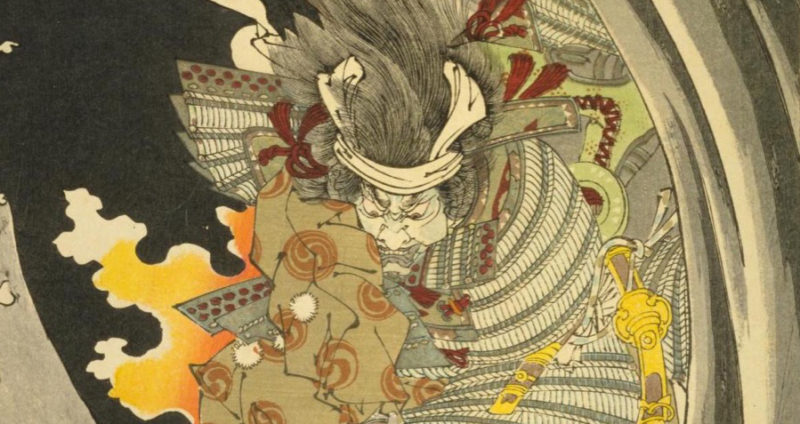
Utagawa Kuniyoshi depicted the scene where Yoshihira’s vengeful spirit appears before Kiyomori’s party and strikes down Namba Tsunefusa with lightning in a triptych woodblock print.
On Cultural Heritage Online,
‘Kiyomori Nyudo at Nunobiki Falls: The Spirit of the Wicked Genji Yoshihira Strikes Down Namba Jiro’ remains.
Nearly 700 years after the Battle of Okura in 1155.
The young warrior, cut down at the age of 20, was known even to the people of Edo as “the wicked Genji who pursues his enemies even in death.”
The “Wicked Genji” Who Ended at 20
The life of Minamoto no Yoshihira is a mix of verifiable historical facts and later stories created by subsequent generations.
His defeat of Yoshikata at the Battle of Okura is recorded in contemporary sources.
It is also certain that he fought alongside his father in the Heiji Rebellion and was defeated.
After his father’s death, he returned to Kyoto to target Kiyomori, was captured by Namba Tsunefusa, and executed—a widely known sequence of events.
On the other hand,
The dramatic single combat with Shigemori. The infiltration of Rokuhara.
The words at the execution ground, “I will become lightning and take revenge.”
The scene where, after death, his vengeful spirit strikes down Tsunefusa with lightning.
These are the images of the “Wicked Genji” crafted by the ‘Heiji Monogatari.’
Yet, the reason this story expanded so much is likely because Yoshihira’s actual life was so short and intense.
At 15, he defeated his uncle. At 19, he stood on the battlefields of Kyoto. His father was killed.
He himself was captured. At 20, he was executed.
Still, the name “Wicked Genji” endured.
Even hundreds of years after the Heiji Rebellion, he is still remembered as the young warrior who would become lightning to strike down his foes.
The impression left by Minamoto no Yoshihira has endured far beyond his 20-year life.