June, 645.
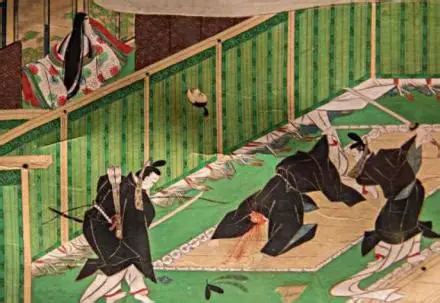
At the Asuka Itabuki Palace, Soga no Iruka was assassinated.
This was the Isshi Incident, orchestrated by Prince Naka no Oe and Nakatomi no Kamatari.
Iruka’s body was sent to his father, Soga no Emishi.
Gathered around Emishi were still armed members of the Eastern Han clan. If they chose to fight, they still had the strength to resist.
However, the soldiers gradually began to disperse.
The following day, Emishi burned the “Chronicles of the Emperors” and the “National Chronicles” and took his own life.
This was the end for the man who became a minister after the death of his father, Soga no Umako, and was at the center of political power from the late Suiko era through the reigns of Jomei and Kogyoku.
Emishi is often remembered as the father of Soga no Iruka.
Yet, during the imperial succession of 628, he gathered the opinions of the court nobles and clashed with the internal opposition within the Soga clan that supported Prince Yamashiro no Oe.
In 643, he granted Iruka a position equivalent to a minister, but was furious when Iruka destroyed the family of Prince Yamashiro no Oe.
The immense power inherited from his father, Umako, passed through Emishi’s era to his son, Iruka.
What awaited them was the downfall of the main Soga family in 645.
Born as the Son of Soga no Umako
The birth year of Soga no Emishi is unknown.
His father was Soga no Umako.
His grandfather was Soga no Iname.
The Soga clan expanded its influence at the court from the time of Iname, and during Umako’s era, they triumphed over Mononobe no Moriya.
Umako served as a minister across the reigns of four emperors: Bidatsu, Yomei, Sushun, and Suiko. During the Suiko era, he was at the center of politics alongside Prince Shotoku.
In 592, he was involved in the assassination of Emperor Sushun, after which Empress Suiko ascended to the throne.
The Soga clan frequently intermarried with the imperial family.
Umako’s daughter, Tojiko no Iratsume, bore Prince Yamashiro no Oe with Prince Shotoku, and another daughter, Hotei no Iratsume, bore Prince Furubito no Oe with Prince Tamura.
During the time of Emishi, the imperial succession was intricately linked with these Soga clan bloodlines.
626—The Death of Father Soga no Umako
May 626.
Soga no Umako passed away.
The “Nihon Shoki” describes Umako as a man of military prowess and eloquence who revered the Three Treasures.
After leading the Soga clan for many years, Umako was succeeded by Emishi.
By 628, Emishi had taken a leading role in the court’s politics as a minister.
Just two years after his father’s death.
Emishi faced his first major political challenge.
The death of Empress Suiko.
628—The Unsettled Succession After Empress Suiko
March 628.
Empress Suiko passed away.
She had reigned for 36 years.
Prince Shotoku had already died in 622, leaving the question of who should become the next emperor.
The candidates that emerged were Prince Tamura and Prince Yamashiro no Oe.
Prince Tamura was the son of Prince Hikohito no Oe, the son of Emperor Bidatsu.
Prince Yamashiro no Oe was the son of Prince Shotoku, and his mother was Tojiko no Iratsume, daughter of Soga no Umako.
Even after Empress Suiko’s funeral concluded in September, no successor had been decided.
According to the “Nihon Shoki,” Emishi attempted to decide the successor on his own but feared the ministers would not comply, so he consulted with Abe no Maro.
He then gathered the ministers at his residence and presented the words Empress Suiko had left for Prince Tamura and Prince Yamashiro no Oe.
Who should be the next emperor?
Emishi sought the ministers’ opinions.
The Factions of Prince Tamura and Prince Yamashiro no Oe
The ministers were divided in their opinions.
Otomo no Kujira supported Prince Tamura.
Uneme Mareji, Takamukai Uma, Nakatomi Miki, and Naniwa no Kishi Misashi also agreed.
On the other hand, Kose no Oomaro, Saeki no Azumahito, and Ki no Shiode supported Prince Yamashiro no Ooe.
Soga no Kuramaro avoided making a clear statement on the spot.
Emishi realized that the opinions among the court officials were not unified, and thus could not reach a conclusion that day.
Even within the Soga clan, there were those who supported Prince Yamashiro no Ooe.
This included Sakaibe no Marise.
Marise was considered the brother of Soga no Umako and was a prominent figure within the Soga clan.
When Emishi asked who should be the emperor, Marise clearly expressed his support for Prince Yamashiro no Ooe.
The differences in opinion over the imperial succession eventually led to a conflict between Emishi and Marise.
The Inquiry from Prince Yamashiro no Ooe
Prince Yamashiro no Ooe was residing at Ikaruga Palace.
Upon hearing that Emishi intended to make Prince Tamura the emperor, he sent Mikuni no O and Sakurai no Omi Wajiko as envoys to inquire about the truth of this matter.
Prince Yamashiro no Ooe referred to Emishi as “uncle.”
This was because Prince Yamashiro no Ooe’s mother, Tojiko no Iratsume, was Emishi’s sister.
Emishi did not respond alone; he gathered Abe no Omi, Nakatomi no Muraji, Ki no Omi, Kawabe no Omi, Takamukai no Omi, Uneme no Omi, Otomo no Muraji, and Kose no Omi.
He explained that he was not unilaterally deciding the successor, but rather presenting the words left by Empress Suiko to the court officials.
Prince Yamashiro no Ooe’s side countered, stating that the words they heard from Empress Suiko were slightly different.
During the imperial succession of 628, there was a discrepancy in the understanding of Empress Suiko’s words between the two parties.
Emishi attempted to decide the successor by sending envoys back and forth between the court officials and Prince Yamashiro no Ooe.
The Break with Sakaibe no Marise
The conflict intensified with Sakaibe no Marise.
At the time, the Soga clan was constructing the tomb of the late Umako.
Marise dismantled the temporary shelter at the tomb site and withdrew to the Soga clan’s residence.
Emishi sent an envoy, urging him to reconsider his stance.
Nevertheless, Marise did not comply and entered the palace of Prince Hatsuse in Ikaruga.
Emishi further sent an envoy to Prince Yamashiro no Ooe, requesting to investigate the circumstances of Marise’s presence at Prince Hatsuse’s palace.
Prince Yamashiro no Ooe mentioned that Marise was a person favored by his father, Prince Shotoku, and advised Marise not to disrupt the realm for the sake of one individual.
He also cited his father’s admonition to his children, “Do no evil, perform all good deeds.”
Marise left Ikaruga and returned to his home.
A few days later, Prince Hatsuse, whom he relied upon, died of illness.
Subsequently, Emishi dispatched troops.
Marise, along with his second son Aya, awaited at the gate of their home and was strangled by Kurume Mononobe no Ikubi.
The eldest son, Kezu, fled and ultimately took his own life by stabbing himself in the neck at Mount Unebi.
The internal conflict within the Soga clan over imperial succession escalated to the point of resulting in the death of a family member.
629 AD—Prince Tamura Ascends the Throne
January 629.
The Emishi and the court officials presented the imperial seal to Prince Tamura.
Prince Tamura initially declined, but upon the insistence of the court officials, he accepted the throne.
He became the 34th sovereign, Emperor Jomei.
Prince Yamashiro no Oe did not ascend to the throne.
The Emishi remained in power as a minister.
Even in the reign of Emperor Jomei, the Nihon Shoki records the Emishi’s involvement in politics.
In 636, Prince Oho requested the Emishi to regulate the court attendance times with a bell, as the court officials and attendants had become lax in their duties.
However, the Nihon Shoki notes that the Emishi did not comply with this request.
The ministerial position inherited from his father, Umako, continued to be the Emishi’s political foundation during Emperor Jomei’s reign.
641 AD—The Death of Emperor Jomei
October 641.
Emperor Jomei passed away at the Palace of Kudara.
In January of the following year, 642, the Empress Consort, Princess Takara, ascended the throne.
She became the 35th sovereign, Empress Kogyoku.
The Emishi continued to serve as a minister.
However, in the Nihon Shoki‘s account of Empress Kogyoku’s accession, the Emishi’s son, Iruka, is prominently featured.
It is said that Iruka took control of the government, surpassing his father’s influence.
Even thieves were so afraid that they wouldn’t dare pick up items dropped on the road.
The political center of the Soga clan was beginning to shift from father to son.
642 AD—Constructing “Great Tomb” and “Small Tomb” During Their Lifetimes
The first year of Empress Kogyoku’s reign, 642.
The Nihon Shoki records that the Emishi built an ancestral shrine at Takamiya in Katsuragi and had the eight-row dance performed there.
In the same year, the Emishi mobilized the people and 180 groups across the country to construct two tombs at Imaki.
The Emishi’s tomb was called the “Great Tomb.”
Iruka’s tomb was called the “Small Tomb.”
According to the Nihon Shoki, the purpose was to prevent people from being used for labor in tomb construction after their deaths.
However, even the wet nurses of the Yamashiro no Oe and the upper royal family were mobilized for the tomb construction.
This angered Princess Oho of the upper royal family.
The Nihon Shoki records her words criticizing the Soga clan for monopolizing state affairs and committing acts of disrespect.
This account reflects the harsh scrutiny directed at the Soga clan, who would later face downfall, as depicted in the Nihon Shoki.
At the same time, it also suggests that Emishi and his son Iruka had the power to mobilize a large number of people.
643 — Emishi Bestows the Purple Crown on Iruka
October 643.
Emishi stopped attending court, citing illness.
During this time, he took an unprecedented action.
According to the Nihon Shoki, Emishi privately bestowed the purple crown upon his son Iruka, “equating him to the rank of a minister.”
This was not an official appointment by the Emperor to the position of minister.
Emishi, using his own authority, placed his son in a position equivalent to that of a minister.
It is also recorded that Iruka’s brother was referred to as the “Minister of Mononobe.”
The transfer of power from Emishi to Iruka had progressed to this extent.
Shortly thereafter, Iruka moved to eliminate Prince Yamashiro no Oe.
Iruka Destroys Prince Yamashiro no Oe
According to the Nihon Shoki, Iruka plotted to depose the princes of the Upper Palace and install Prince Furubito no Oe as Emperor.
It is also noted that he deeply resented the widespread fame of the Upper Palace princes.
Prince Furubito no Oe was the son of Emperor Jomei, and his mother, Hoteirou no Iratsume, was the daughter of Soga no Umako.
November 1 of the same year.
Iruka ordered Koseno Tokuta no Omi and Haji no Saba no Muraji to lead troops and attack Prince Yamashiro no Oe at Ikaruga.
After fleeing to Mount Ikoma, Prince Yamashiro no Oe returned to Ikaruga Temple and took his own life along with his children and consorts.
The Upper Palace family, descended from Prince Shotoku, was annihilated.
Upon hearing this news, Emishi was enraged.
According to the Nihon Shoki, Emishi rebuked Iruka, saying that his foolishness and reckless tyranny would endanger his own life.
It was Emishi himself who had elevated Iruka by giving him the purple crown and placing him in a ministerial position.
Yet, Emishi harshly criticized Iruka for destroying the Upper Palace family.
The political judgments of father and son diverged at this point.
644 — Residences at Amakashi Hill
November 644.
Emishi and Iruka each built residences at Amakashi Hill.
The Nihon Shoki refers to Emishi’s house as “Kamimiya Gate” and Iruka’s house as “Tanimiyagate,” and notes that the men and women serving there were called “princes.”
They constructed fortifications outside the residences and placed armories near the gates.
At each gate, they prepared boats filled with water and wooden hooks as a precaution against fire, and armed strong men to guard them.
It is said that when Emishi went out, he was accompanied by a guard of 50 soldiers.
The residence of Emishi and his son Iruka, as depicted in the Nihon Shoki, was fortified with weapons and soldiers.
This was the period when the power of the Soga clan was at its peak.
In the shadows, Nakatomi no Kamatari and Prince Naka no Oe began to move against Iruka.
Nakatomi no Kamatari and Prince Naka no Oe
The year was 644.
Nakatomi no Kamatari approached Prince Naka no Oe.
According to the Nihon Shoki, the two became close when, during a game of kemari under a zelkova tree at Hoko-ji Temple, Prince Naka no Oe’s leather shoe came off, and Kamatari picked it up and handed it back to him.
They secretly consulted with each other on their way to study under Minabuchi no Shogun.
Eventually, Soga no Kurayamada Ishikawa Maro also joined their plan.
Ishikawa Maro was a member of the Soga clan.
Thus, even among those opposing Emishi and Iruka, there was a member of the Soga clan.
Then, in June 645.
The plan was put into action.
June 12, 645 – The Assassination of Iruka
On June 12, 645.
At the Asuka Itabuki Palace, where Empress Kogyoku was present, Soga no Iruka was killed by Prince Naka no Oe and Nakatomi no Kamatari.
This was the Isshi Incident.
Iruka’s body was sent to Emishi that same day.
Prince Naka no Oe entered Hoko-ji Temple, using it as a base of operations.
Princes, kings, and courtiers began to rally to Prince Naka no Oe’s side.
Meanwhile, Emishi was joined by the Azuma no Muraji clan and others.
They donned armor, armed themselves, and prepared for battle.
Iruka was dead.
Yet, there were still those ready to fight alongside Emishi.
Desertion from Emishi’s Ranks
As Prince Naka no Oe’s side began to persuade them, Emishi’s forces started to crumble.
According to the Nihon Shoki, Takamuko no Kokuo addressed the Azuma no Muraji clan, saying that they would be executed for Iruka, and Emishi would be defeated today or tomorrow. He questioned for whom they were fighting and risking annihilation.
Kokuo removed his sword, threw away his bow, and left.
The soldiers followed suit.
Surrounded by armed men, Emishi found himself rapidly isolated.
The next day.
Facing imminent defeat, Emishi made his final move.
June 13, 645—The Final Days of Soga no Emishi
June 13.
The Nihon Shoki records that as Emishi and his followers were about to be executed, they set fire to the “Tennoki,” “Kokki,” and other treasures.
At that moment, Fune no Fubito no Esaka hurriedly retrieved the “Kokki” from the flames.
The “Kokki” was then presented to Prince Naka no Oe.
The “Tennoki” does not appear in any subsequent records.
On this day, Emishi took his own life.
The Nihon Shoki also notes that Emishi and Iruka’s bodies were allowed to be buried, and their family was permitted to mourn their deaths.
The Soga clan itself did not vanish entirely.
Branches of the Soga family, including Soga no Kurayamada no Ishikawa no Maro, who cooperated in the Isshi Incident, continued to remain at the court.
What disappeared from the political center was the main line of the Soga clan, which had extended from Umako to Emishi and Iruka.
In 628, when Empress Suiko passed away, Emishi gathered the ministers and was at the heart of the political scene to decide the next emperor.
Seventeen years later.
His son, whom he had elevated to a ministerial position, was killed in the palace, and the armed people who had gathered around Emishi abandoned him.
June 13, 645.
Emishi, who inherited a vast political foundation from Soga no Umako, ended his life by burning the “Tennoki” and “Kokki.”