A War That Should Have Ended in Sakanoue no Tamuramaro’s Time — So Why Did It Start Again?
Sakanoue no Tamuramaro carried out the campaign against the Emishi, Isawa Castle was built, and Aterui surrendered.
(See this article and this article.)
Then, in the second year of Konin (811), Funya no Watamaro carried out a further campaign into the Nisatai and Hei regions.
The court’s control over Tohoku had advanced significantly.
And yet, roughly seventy years later, a large-scale uprising broke out in Dewa Province.
The second year of Gangyo (878).
Akita Castle came under attack, and the court’s forces suffered defeat after defeat.
The court gathered troops from the eastern provinces of Kozuke and Shimotsuke, and further ordered the provinces along the Tokai and Tosando routes to muster brave soldiers as well.
And the man dispatched to Dewa Province to put down this uprising was Fujiwara no Yasunori.
This conflict became known to later generations as the Gangyo War.
It was never simply a minor regional uprising.
It was a crisis in which the court, which had believed it had already brought Tohoku firmly under its control through the campaigns against the Emishi, found itself confronted once again with large-scale resistance on the very ground it thought it ruled.
1. What Happened to Tohoku After the Campaigns Against the Emishi Ended?
To understand the Gangyo War, it helps first to see its connection to the earlier campaigns against the Emishi.
In the latter half of the 8th century, the court steadily extended its control into the Mutsu and Dewa regions.
It built fortified stockades, resettled people from the eastern provinces, sent in troops, and drew the local population into the court’s own system of rule.
Sakanoue no Tamuramaro’s campaign brought the Isawa region under court control, and Isawa Castle was built there.
Afterward, stockades such as Shiwa Castle and Tokutan Castle were established as well, and a system of court control over northern Tohoku took shape.
But what matters here is that not everyone brought under court control stood in the same position.
The court referred to the people of Tohoku with terms such as “Emishi,” “ifu,” and “fushu,” folding those groups who had submitted into its own system of rule.
At the same time, the areas where these people lived retained social relationships that the court’s institutions alone could not fully absorb.
Which is to say, even once the military campaigns were over, the problem of governance itself was not.
The Gangyo War was the moment this problem surfaced on a massive scale.
2. Dewa Province — a Special Kind of Place
The stage of the Gangyo War was Dewa Province, centered on what is now Akita Prefecture.
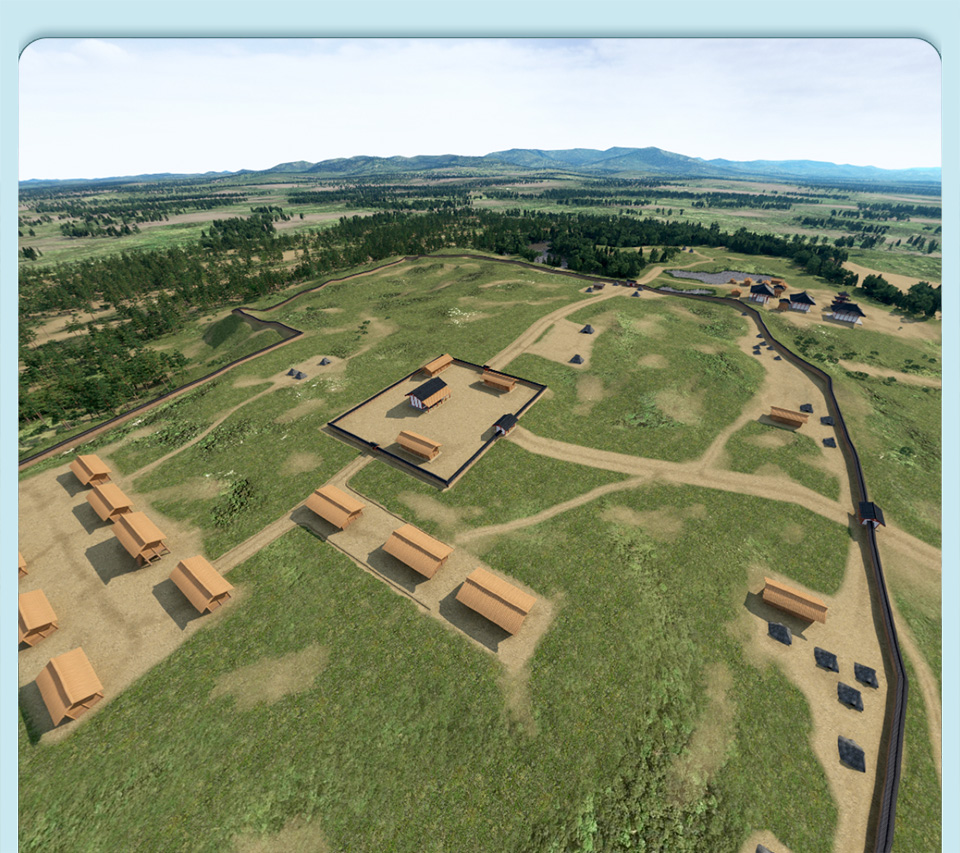
In Dewa Province, the court maintained Akita Castle as its stronghold.
Akita Castle served as the key administrative, military, and diplomatic base for the court in northern Dewa.
Facing the Sea of Japan, it also mattered a great deal for contact with the continent and with regions to the north.
Around Akita Castle lived people who had been drawn into the court’s system of rule.
The Nihon Sandai Jitsuroku records that, during the Gangyo War, twelve villages — including Kamitsuno, Hinai, Sugifuchi, and Notashiro — sided with the rebels.
This corresponds to the area stretching from northern Akita Prefecture into the Yoneshiro River basin.
Around present-day Odate City, Akita Prefecture, the old place name Hinai (Hinai) can still be identified.
This local society became the center of the Gangyo War.
3. Why Did the Uprising Happen?
This is the single biggest question surrounding the Gangyo War.
Why did people take up arms against the court?
Sources in the tradition of the Biography of Fujiwara no Yasunori describe the cause as harsh tax collection and requisitioning carried out by the Dewa provincial government and the Akita Castle command, despite a poor harvest the previous year.
In particular, the Akita Castle commander Yoshimine no Chikashi is described in extremely harsh terms.
He is said to have repeatedly levied taxes and imposed severe punishment on anyone who failed to comply.
Which is to say, famine, taxation, and oppressive local governance likely formed the major backdrop to the uprising.
From the Konin era through the Jogan era, the court had been strengthening its control over the provinces across the country.
But out in the provinces, the systems set by the central government collided with the realities of local society.
In Dewa, that tension exploded.
Even so, the nature of the source material deserves some caution here.
The Biography of Fujiwara no Yasunori is a biography that portrays Yasunori as a distinguished statesman, and its account of the uprising’s causes is shaped partly to highlight the good governance Yasunori later brought.
For that reason,
rather than settling on “heavy taxation alone was the cause,” it is more accurate to see this as an incident born from the overlap of poor harvests, the conduct of local officials, taxation and forced labor, and the underlying tension between local society and court rule.
4. 878 — the Uprising Begins in Dewa
In the second year of Gangyo (878), a large-scale uprising broke out in Dewa Province.
Court records describe how the rebel forces spread across the region.
On the 19th of the 4th month, the Dewa provincial government dispatched 560 government troops from Mogami District to scout the situation.
But this force encountered roughly 300 rebels along the way and was drawn into battle.
The government side suffered casualties as well.
The Provisional Secretary Funya no Aritsusa fought fiercely but was wounded, and the force withdrew without receiving any reinforcement.
The Nihon Sandai Jitsuroku further records the loss of enormous quantities of military supplies: 300 suits of armor, 700 koku of rice and dried provisions, 1,000 quilts, and 1,500 horses.
This was a severe blow to the court.
This was no minor local disturbance.
The court’s own army had been defeated on the ground, losing enormous stores of weapons, food, and horses in the process.
The rebel forces were already well beyond a scale the court could easily suppress.
5. Akita Castle Is Driven Into a Corner
The uprising spread further still.
Around Akita Castle, twelve villages — Kamitsuno, Hinai, Sugifuchi, Notashiro, and others — sided with the rebels.
And Akita Castle itself came under siege.
On the 7th day of the 6th month of the second year of Gangyo, an urgent report reached the court from the Governor of Dewa, Fujiwara no Okiyo.
Its contents were shocking.
The government forces had struggled badly in battle against the rebels, and enormous stores of weapons and provisions had been seized.
And now, Akita Castle itself was being pressed hard by the rebel forces.
Akita Castle was the very center of court rule in northern Dewa.
And that center had fallen into crisis.
The court judged that this was no longer a matter local officials could handle on their own.
Reinforcements would have to be sent.
6. The Court Gathers Troops From the Eastern Provinces
The court’s response was swift.
It sent reinforcements from Kozuke and Shimotsuke Provinces.
It further ordered the provinces along the Tokai and Tosando routes to select brave soldiers who could be dispatched at once if Dewa Province requested them.
Which is to say, the Gangyo War had stopped being a matter for Dewa Province alone.
Troops were gathered from the eastern provinces, and preparations for military mobilization on a nationwide scale moved forward.
This closely resembles the campaigns against the Emishi in the 8th century.
Whenever fighting broke out in Tohoku, the court mobilized troops centered on the eastern provinces.
But in the Gangyo War, a major shift appeared in how the court actually waged this fight.
And that shift was the arrival of Fujiwara no Yasunori.
7. Fujiwara no Yasunori Goes to Dewa
The court dispatched Fujiwara no Yasunori to Dewa.
Yasunori also held the post of Ucho no Ben, the Middle Controller of the Right, and had experience in provincial administration.
On arriving in Dewa, he reviewed the state of the fighting so far and worked out his military strategy.
And the method Yasunori chose is genuinely fascinating.
Rather than simply fighting the rebels, he made use of the fushu who had remained loyal to the court.
The Nihon Sandai Jitsuroku records that government rice was given to fushu who had stayed loyal to the court, and that they were sent to fight the rebel forces.
As a result, the fushu of the three villages of Soekawa, Shimowake, and Sukegawa launched a night raid on the rebels, reportedly killing eighty of them and seizing their food and dwellings.
This is a crucial moment for understanding the Gangyo War.
The court’s own army did not fight this war alone.
It made use of local forces loyal to the court to break down the rebels from within.
The court was never fighting a simple, clean division of “Emishi versus the court.”
8. A War That “Emishi Versus the Court” Cannot Explain
This is the single most important point about the Gangyo War.
Modern accounts often describe this simply as “the Emishi rebelled against the court.”
But looking at the sources, the reality is far more complicated.
Some fushu fought for the court. Others joined the rebels.
And the people of Tsugaru and Watari no Shima each moved in their own different directions as well.
The Nihon Sandai Jitsuroku records that the court’s own policy was explicitly summed up as “using Emishi to strike down Emishi.”
Which is to say, even the court itself never regarded the people of Tohoku as a single, unified bloc.
It exploited the internal divisions of local society to break the rebel forces apart.
Here we see a form of court rule in the late 9th century very different from the era of Sakanoue no Tamuramaro.
9. Ono no Harukaze and Sakanoue no Yoshikage Close In From the North
The court moved further forces into the field.
An army led by the Chinjufu Shogun Ono no Harukaze and the Provisional Deputy Governor of Mutsu, Sakanoue no Yoshikage, advanced into Dewa.
Ono no Harukaze entered Kamitsuno from the direction of Tsugaru and called on the local rebels to surrender.
Sakanoue no Yoshikage, meanwhile, led his own troops forward as well.
The court’s forces built up a system for pressing the rebels from multiple directions at once.
What matters here, again, is that this was no simple frontal assault.
They displayed military strength while pressing for surrender.
Drawing out defectors from within the rebel ranks, and steadily whittling down their strength.
Yasunori’s policy carried this method through consistently.
10. Akita Castle Burns
And then the event that would come to symbolize the Gangyo War took place.
The burning of Akita Castle.
An entry in the Nihon Sandai Jitsuroku for the 5th day of the 9th month notes that the court had learned the castle had “burned down.”
Which is to say, Akita Castle suffered massive damage in the course of the Gangyo War.
Akita Castle was the very symbol of court control over northern Dewa.
And that stronghold went up in flames. This was no simple loss of a military facility.
It was a moment in which the ritsuryo state’s own control over Tohoku itself was badly shaken, if only for a time.
11. Even So, the Rebel Forces Were Gradually Cornered
But the momentum of the rebel forces gradually faded.
The court’s forces advanced from multiple directions, drawing local fushu to their side.
The court also made clear its willingness to accept those who surrendered.
On the 29th day of the 8th month of the second year of Gangyo, roughly 300 rebels are recorded as having come to the Akita garrison to plead for surrender.
Ono no Harukaze also entered the rebel territory himself and received documents of surrender.
What is fascinating here is that even within the court’s own side, debate broke out over whether to accept these surrenders at all.
The fushu who had already sided with the court raised objections to the effect that
“we have earned the rebels’ hatred by remaining loyal to the state — unless the rebel forces are destroyed completely, we will face retaliation later.”
Which is to say, even once the fighting ended, deep divisions would remain within the local community.
The court had to think through how to manage that as well.
12. The Court Recognizes “Surrender”
In the end, the court made clear its policy of accepting those who wished to surrender.
Even so, it did not simply take every surrender at face value.
Genuine intent to surrender would be accepted. Continued rebellion would be met with force.
Which is to say,
“strike down those who keep fighting; accept those who surrender.”
The court applied both policies as circumstances required. This was an extremely pragmatic approach.
What mattered to the court was never killing every last rebel.
It was restoring Dewa to a state it could govern once again.
13. The Third Year of Gangyo (879) — the War Winds Down
By the third year of Gangyo (879), the fighting had come to an end.
On the 11th of the 1st month, the Nihon Sandai Jitsuroku records that 103 chieftains of the Watari no Shima Emishi came to Akita Castle leading roughly 3,000 people, and submitted to the court.
Over a hundred fushu of Tsugaru who had never joined the rebellion also came in and submitted at the same time.
This is an extraordinarily significant record.
The Gangyo War was never a conflict that played out entirely within Dewa Province alone.
The people of the northern regions — Tsugaru, Watari no Shima, and beyond — also saw their relationship with the court reshaped by this conflict.
The court did not simply bring the fighting to an end — it rebuilt its relationship with the societies of the north.
14. What Changed Because of the Gangyo War
The Gangyo War was not a complete defeat for the court.
But it left the court with a major lesson.
That lesson was the reality that Tohoku could not be ruled by military force alone.
In the campaigns against the Emishi in the latter half of the 8th century, the court had sent enormous armies, built fortified stockades, and pushed its territory northward through sheer force.
In the Gangyo War, the uprising broke out from inside that very system of control.
Akita Castle was attacked, its military supplies seized, and the castle itself burned to the ground.
Yet the court brought the crisis under control by making use of local fushu, committing military force, accepting those who surrendered, and reorganizing the local society.
The very way of waging this kind of war had changed.
15. A Decisive Difference From Sakanoue no Tamuramaro’s Era
Let’s compare this with the campaign against the Emishi some seventy years earlier.
In Sakanoue no Tamuramaro’s era.
The court pushed its army into Isawa. It built Isawa Castle. Aterui surrendered. And the court’s own bases of control moved steadily northward.
But in the Gangyo War, the uprising broke out in territory already under the court’s control.
Which is to say, this marked the shift from “an age of conquest” to “an age of maintaining rule.”
The Gangyo War marked exactly that turning point.
The court no longer simply treated Tohoku as “enemy territory.”
It used local fushu as government troops, accepted those who surrendered, and negotiated even with the forces of Tsugaru and Watari no Shima.
This was a shift toward a politics that ruled not through force alone, but by making use of local society itself.
16. Even So, Tension in Tohoku Did Not Disappear
The end of the Gangyo War did not mean the tension in Tohoku had vanished.
In the fifth year of Gangyo (881), it became a problem that the Dewa provincial government had used reserve grain without authorization to entertain the Watari no Shima Teki.
Further, in the fifth year of Kanpyo (893), the court ordered the Dewa provincial government to keep its fortifications on guard in preparation for fighting between the Watari no Shima Teki and the fushu of the interior.
Which is to say, even after the Gangyo War, tension between Dewa and the societies of the north persisted.
This point matters.
The fighting of 878 did not resolve the Tohoku question once and for all.
The court continued adjusting its military and political relationship with the societies of the north for a long time afterward.
Summary
What the Gangyo War Revealed About “Life After the Conquest of the Emishi”
The second year of Gangyo (878).
A large-scale uprising broke out in Dewa Province.
The rebels extended their power across a wide area of northern Dewa, defeating the court’s own forces and attacking Akita Castle.
The court gathered troops from the eastern provinces of Kozuke and Shimotsuke, and levied soldiers from the Tokai and Tosando routes as well.
At the center of it all stood Fujiwara no Yasunori.
Rather than relying on military force alone, Yasunori made use of fushu loyal to the court, breaking the rebels apart from within.
Ono no Harukaze and Sakanoue no Yoshikage also led troops into Dewa and pressed for surrender.
In time, surrenders from the rebel side came one after another, and by the third year of Gangyo (879), 103 chieftains of the Watari no Shima Emishi came to Akita Castle leading roughly 3,000 people to submit.
In this way, the Gangyo War came to an end.
But the significance this conflict left behind is enormous.
The end of the campaigns against the Emishi did not mean the end of the challenge of ruling Tohoku.
Once the court had pushed into Tohoku, new problems awaited it: taxation, forced labor, the conduct of local officials, and its relationship with fushu society.
The Gangyo War was the moment all of those contradictions burst out at once.
And through this conflict, the court learned one hard truth.
Armies alone are not enough to rule Tohoku.
It had to win local people to its side, absorb those who surrendered, and maintain its rule by working with — and around — the divisions within local society.
Roughly seventy years after Sakanoue no Tamuramaro’s own campaigns.
The court’s policy toward Tohoku had shifted from “conquest, striking down the enemy” to “governance, maintaining control.”
The Gangyo War stands as the symbol of that shift.
And at this same moment, another great change was underway at the court itself.
At the center of government, Fujiwara no Yoshifusa had become sessho, and the Fujiwara clan was taking hold of the reins of politics.
The Gangyo War in Tohoku. The rise of the Fujiwara clan at the center.
Japan in the latter half of the 9th century was moving, in this way, into a new age.