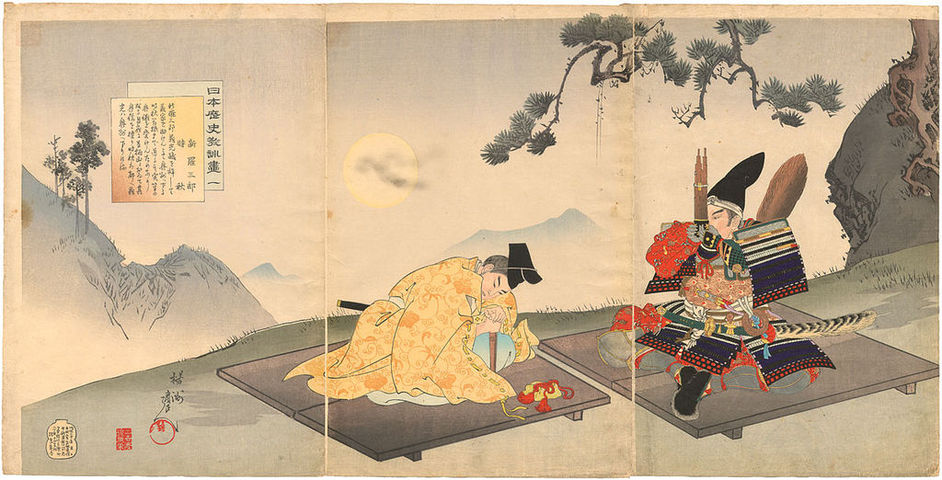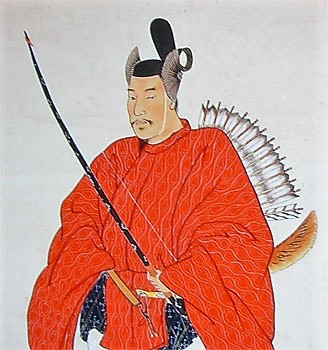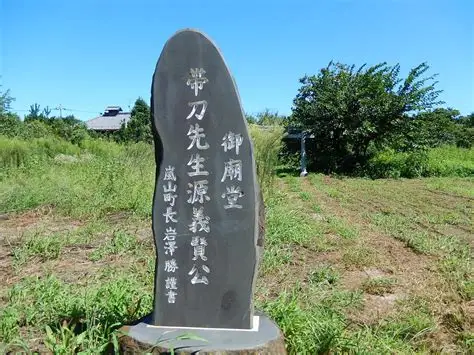
On August 16, 1155, in Musashi Province, an uncle and his nephew from the Kawachi Genji went to war against each other.
The uncle was Minamoto no Yoshikata, a son of Minamoto no Tameyoshi.
The nephew was Minamoto no Yoshihira, the eldest son of Yoshikata’s own elder brother, Minamoto no Yoshitomo.
Yoshihira had been born in 1141, which made him fifteen by the traditional count.
The fight ended in Yoshihira’s victory. Yoshikata was killed.
History remembers it as the Battle of Okura.
No contemporary record preserves troop numbers or a blow-by-blow account of the fighting.
Even so, this is not a battle that can be waved away as a minor skirmish.
A fifteen-year-old nephew had used armed force to remove his own uncle from within a clan that, only a year earlier, still presented itself as a single family. Eleven months later, that same family’s founder, Tameyoshi, and his son Yoshitomo would stand on opposite sides of a battlefield in Kyoto.
And Yoshikata’s death at Okura was not the end of the story for his own line, either.
He left behind an infant son who survived — the boy who would grow up to be Kiso Yoshinaka, the man who later contested leadership of the Genji with Minamoto no Yoritomo.
Looked at in isolation, a single day’s fighting at Okura tells you almost nothing.
Why did the Kawachi Genji fracture so badly that a son of Yoshitomo would kill his own uncle?
To answer that, the story has to go back forty-six years, to 1109.
1109: A Fourteen-Year-Old Tameyoshi Hunts Down Yoshitsuna
In 1109, an incident shook the Kawachi Genji to its core.
A son of Minamoto no Yoshiie, Minamoto no Yoshitada, was murdered in Kyoto, and suspicion fell on Yoshiie’s own younger brother, Minamoto no Yoshitsuna, and his household.
The court ordered Yoshitsuna’s family hunted down.
Among those who joined the manhunt was a boy of fourteen by the traditional count: Minamoto no Tameyoshi.
Together with Minamoto no Mitsukuni of the Mino Genji and others, Tameyoshi cornered Yoshitsuna’s people in Omi Province. One by one, Yoshitsuna’s sons died, and Yoshitsuna himself finally surrendered.
For his part in the campaign, Tameyoshi was appointed to the post of saemon no jo, a junior guards office.
It was the moment a mere boy stepped onto the public stage as a leading man of the Kawachi Genji, backing his family’s military authority in the capital.
Yet the world around the Kawachi Genji had changed a great deal since Yoshiie’s own heyday.
Yoshiie had built an enormous reputation in the east through the Former and Later Nine Years and Three Years Wars.
Tameyoshi, by contrast, spent his career serving in the capital as a kebiishi, a kind of police-and-judicial magistrate, but he never rose as fast as the Ise Taira, whose leaders Taira no Masamori and Tadamori were racing up the ranks of the central government through a string of provincial governorships.
In 1143, he became a personal retainer of Fujiwara no Yorinaga, the powerful figure at the head of the Fujiwara regental house.
What matters here is that the story is not as simple as “Tameyoshi was weak, so the family split apart.”
Tameyoshi’s own sons each began building their own networks and their own armed followings, in Kyoto and in the eastern provinces alike.
Of all of them, it was the eldest, Minamoto no Yoshitomo, who built up the largest power base of all.
What Was Yoshitomo Doing in the East?
Yoshitomo had gone down to the eastern provinces while still young, making Kamakura in Sagami Province his base.
To say simply that he “built up power in the east” sounds tidy enough, but the process itself was anything but gentle.
In 1143, records show Yoshitomo intervening in a dispute over the Soma mikuriya, an estate in Shimosa Province.
The following year, 1144, warriors under Yoshitomo pushed into the Oba mikuriya, an estate in Sagami Province belonging to the Ise Shrine.
Contemporary records accuse Yoshitomo of claiming part of the Oba estate as lying “within Kamakura district,” crossing the Matano River into Kugenuma, and seizing fish, soybeans, and azuki beans. He went on drawing local warriors into his camp and tightening the pressure on the estate.
This was not simple looting.
Pushing into disputes over the rights attached to shoen estates and mikuriya lands, then pulling the local warriors of that land onto your own side, was one of the standard ways a warrior of the age built up regional power.
Yoshitomo forged ties with the Miura, the Oba, and other warrior houses of Sagami, shaping an independent power base across the southern Kanto.
Then, in 1153, Yoshitomo was appointed Junior Fifth Rank, Lower Grade, Governor of Shimotsuke.
It was an appointment as a provincial governor.
His father Tameyoshi had never reached that rank; the son got there first.
Within the Kawachi Genji, Yoshitomo’s stature had clearly grown larger than his father’s.
Even so, it would be wrong to conclude that, by this point, “Tameyoshi and Yoshitomo were already completely at odds.”
Knowing how the Hogen Rebellion turned out, it is tempting to assume Tameyoshi and Yoshitomo, or Yoshikata and Yoshihira, had been divided into two camps from the very start. The relationships before 1155 were not actually so clear-cut.
The tension that actually produced the Battle of Okura came from another member of the Genji altogether, one who pushed into territory that overlapped with Yoshitomo’s own sphere of influence in the east.
Yoshitomo’s own younger brother, Minamoto no Yoshikata.
“Lord Tachihaki” Minamoto no Yoshikata
Yoshikata did not start out in the east, either.
As a young man he was active in Kyoto.
In 1139, when Prince Narihito — the future Emperor Konoe — was named crown prince, Yoshikata was appointed tachihaki no osa, commander of the guard charged with protecting him.
From this post, Yoshikata came to be called “Lord Tachihaki.”
“Senjo,” the honorific attached to his name, did not mean “teacher” in any schoolroom sense — it was simply a title referring to the office of tachihaki no osa.
But the following year, 1140, Yoshikata lost the post.
According to the later story collection Kokon Chomonju, Yoshikata was implicated in the killing of a takiguchi guardsman named Minamoto no Sonau, and was dismissed as a result.
After that, Yoshikata, like his father Tameyoshi, moved into the orbit of Fujiwara no Yorinaga.
The diary Taiki records that in 1143 Yorinaga entrusted Yoshikata with managing an estate in Noto Province — proof that Yoshikata was no mere provincial warrior, but a man with a direct line to the regental house itself.
Sometime in the 1150s, this same Yoshikata went down to the eastern provinces.
He is thought to have made Tago district in Kozuke Province his base, then pushed further into Musashi Province.
There, he formed a close bond with a powerful local warrior of Musashi, Chichibu Shigetaka.
Later genealogies and local histories describe Yoshikata either as Shigetaka’s son-in-law, or as a young lord Shigetaka had formally taken in.
The finer details of the family relationship remain uncertain in the sources, but the political and military bond between Yoshikata and Shigetaka matters a great deal for understanding the Battle of Okura.
In time Yoshikata moved his base to Okura, in Hiki district, Musashi Province.
This is present-day Okura, in the town of Ranzan, Hiki district, Saitama Prefecture.
Okura lay near the Toki River, at a strategic point on the road linking Musashi with Kozuke, close to the route that would later be known as the Kamakura Kaido Kamitsumichi.
In other words, Yoshikata was building a second Kawachi Genji power center just to the north of the territory Yoshitomo had spent years cultivating in the east.
Brother Against Brother — the Real Prize Was Musashi
Treat the Battle of Okura as a mere family quarrel and you miss the point of it.
Behind both Yoshitomo and Yoshikata stood networks of eastern warriors loyal to each of them.
Yoshitomo had spread his power across the southern Kanto, centered on Sagami.
Yoshikata had come down from Tago in Kozuke into Musashi, and tied his fortunes to Chichibu Shigetaka.
The place where their two spheres of influence overlapped was Musashi Province.
For a warrior of this era, controlling land was never something one person could accomplish alone.
It meant forging marriage and lord-vassal ties with local powers, inserting yourself into the rights attached to shoen and public lands, and winning over the armed local warriors who actually held the ground. A sphere of influence was the sum of all those accumulated ties.
So when Yoshikata tied himself to Chichibu Shigetaka and pushed into Musashi, it was not something Yoshitomo’s side could simply ignore.
The city history of Kitamoto frames the Battle of Okura as, at once, a struggle over “control of Musashi Province” and a contest between the brothers Yoshitomo and Yoshikata for leadership of the Bando warriors.
Yoshitomo himself was, at this time, occupied in Kyoto, building his standing as a court official.
Carrying the fight on the ground in the east fell to his eldest son, Minamoto no Yoshihira.
The Fifteen-Year-Old “Wild Genta”
Minamoto no Yoshihira was born in 1141.
He was Yoshitomo’s eldest son, and the elder half-brother of Minamoto no Yoritomo, Noriyori, and Yoshitsune.
At the time of the Battle of Okura in 1155, he was fifteen by the traditional count.
Later generations called him Kamakura no Aku-Genta — “Wild Genta of Kamakura.”
“Aku” did not mean “evil” in the everyday sense.
In this period, the word carried a sense of ferocious, untamed strength — someone so fierce and formidable that ordinary standards simply did not apply.
“Genta” was a name traditionally given to the eldest son of a Genji house.
Put together, “Wild Genta” was a name meant to capture Yoshihira’s ferocious martial reputation.
Even so, that nickname should not be used to reconstruct the shape of the actual battle.
No contemporary source preserves the details of the fighting itself.
What can be said for certain is only this: on August 16, 1155, Yoshihira and Yoshikata fought each other in Musashi Province.
August 16, 1155 — Uncle and Nephew Collide
The single most important thing about the Battle of Okura is that it is confirmed by contemporary witnesses.
An entry in Fujiwara no Yorinaga’s diary, Taiki, dated the twenty-seventh day of the eighth month of 1155, records that word had reached him that Yoshikata
“had been killed in Musashi Province by the son of his elder brother, the Governor of Shimotsuke, Yoshitomo.”
To Yorinaga, Yoshikata was no distant figure — he was a warrior who had served under him directly.
A separate source, the Hyakurensho, records under the sixteenth day of the eighth month of that same year a rumor that
the former tachihaki no osa, Minamoto no Yoshikata, and his elder brother’s son, Minamoto no Yoshihira, had fought a battle in Musashi Province.
Taken together, these two records let us establish, with reasonable confidence, at least these two facts:
That Yoshihira and Yoshikata fought in Musashi Province on August 16, 1155.
That Yoshikata died as a result.
Those two points can be treated as fairly solid.
The specific claim that “Okura Fortress” was the battlefield, on the other hand, comes down to us through later sources, including the Kamakura-period chronicle Azuma Kagami.
Azuma Kagami records that Yoshikata was killed at “Okura Fortress in Musashi Province” in the eighth month of 1155, by Kamakura no Aku-Genta Yoshihira.
Today, the site traditionally identified as Okura Fortress, in the town of Ranzan, is a prefecturally designated historic site.
Later sources also say that Chichibu Shigetaka, Yoshikata’s ally, lost his life in the same battle.
Yet no source lets us reconstruct the fighting as a narrative.
Claims that “Yoshihira’s army surrounded the fortress,” that “fire was set,” or that a particular number of horsemen fought on each side, cannot be written down as confirmed history.
What is certain is one thing only.
A fifteen-year-old, Yoshihira, defeated his uncle Yoshikata, and in doing so shattered the power base Yoshikata had built up in Musashi in a single stroke.
That alone makes it a violent enough event.
Why Did Yoshihira Kill His Own Uncle?
So why did Yoshihira kill his own blood uncle?
No contemporary source records Yoshihira’s own motive.
Nor can the claim that “Yoshitomo ordered Yoshihira to do it” be confirmed directly from any contemporary record.
So this is not a place to work backward from the outcome and invent a tidy story.
What can be seen is the political and military situation that produced the fight.
Yoshitomo had built ties with eastern warriors centered on Sagami, and had become Governor of Shimotsuke in 1153.
Into that world came Yoshikata, moving from Kozuke into Musashi and forming a power base with Chichibu Shigetaka.
Yoshihira, as Yoshitomo’s eldest son, stayed in the east to guard the foundation his father had built there.
To Yoshihira, then, Yoshikata was never simply “my father’s younger brother.”
He was another powerful figure of the Kawachi Genji, moving in on the sphere of influence his father had built in the east.
That is the key to understanding the Battle of Okura.
They did not fight simply because they were both Genji.
They fought precisely because they were both Genji — because that shared name was exactly what let either of them become a rallying banner for the warriors of the east.
Once two such men extended their power into the same region, collision became far more likely.
On August 16, 1155, that rivalry was settled by force of arms.
After Yoshikata’s Death, a Vendetta Begins
The Battle of Okura did not end with Yoshikata’s death.
What followed matters just as much as the battle itself.
Yoshikata had a younger brother, Minamoto no Yorikata.
According to an entry in Taiki dated the thirteenth day of the tenth month of 1155, Yoshikata and Yorikata had sworn a formal “father-son pact” with one another.
When Yoshikata was killed by Yoshitomo’s son, Yorikata left Kyoto for Shinano Province to avenge him.
But Yorikata, once in Shinano, trespassed on estates belonging to the retired emperor’s household, and the court ordered him hunted down.
The man given the order to carry out that hunt was, of all people, Minamoto no Yoshitomo.
Yoshitomo’s son Yoshihira kills the uncle, Yoshikata.
Yorikata, bound to Yoshikata by their father-son pact, moves to avenge him.
And now Yoshitomo himself is ordered to hunt down Yorikata in turn.
Barely two months after the Battle of Okura, the conflict within the Kawachi Genji had already spread from Musashi all the way to Shinano.
This episode makes plain that the Kawachi Genji did not suddenly split in two during the Hogen Rebellion the following year.
The crack had already deepened, by 1155, to the point of drawing blood.
The Infant Who Survived Okura: Kiso Yoshinaka
The Battle of Okura also reaches forward into the Genpei War, roughly thirty years later.
Yoshikata had left behind an infant son.
That boy would grow up to become Minamoto no Yoshinaka — Kiso Yoshinaka.
Azuma Kagami, compiled in the Kamakura period, records that Yoshinaka was “an infant of three” when Yoshikata was killed at Okura, and that his wet nurse’s husband, Nakahara no Kaneto, carried the boy to safety in Shinano Province, where he raised him in the Kiso valley.
The famous story that Saito Sanemori and Hatakeyama Shigeyoshi were the ones who saved the infant Yoshinaka comes mainly from later war chronicles and legend, above all the Genpei Josuiki.
That distinction, between contemporary record and later legend, needs to be kept in mind here as well.
Even so, the fact that Yoshikata’s infant son survived and grew up in Shinano carries enormous historical weight.
In 1183, Yoshinaka marched down the Hokuriku road and grew powerful enough to drive the Taira out of Kyoto altogether.
He then found himself at odds, in the struggle over Kyoto, with Yoshitomo’s own son, Minamoto no Yoritomo.
The conflict of 1155, in which Yoshihira killed Yoshikata, would resurface a generation later in a different form: a confrontation between Yoshikata’s son Yoshinaka and Yoshitomo’s son Yoritomo.
Eleven Months After Okura, the Kawachi Genji Split Again
Less than a year had passed since the Battle of Okura on August 16, 1155.
In July of 1156, the Hogen Rebellion broke out in Kyoto.
This war split the Kawachi Genji even more deeply than before.
The father, Minamoto no Tameyoshi, sided with the Retired Emperor Sutoku and Fujiwara no Yorinaga.
The eldest son, Minamoto no Yoshitomo, sided with Emperor Go-Shirakawa.
Most of Tameyoshi’s other sons followed their father, and Yoshitomo found himself facing his own father and his own brothers as enemies.
In 1109, a fourteen-year-old Tameyoshi had stepped onto the public stage as a leading man of the Kawachi Genji by hunting down Yoshitsuna.
Forty-six years later, in 1155, it was Tameyoshi’s own grandson — fifteen-year-old Yoshihira — who struck down Tameyoshi’s own son, Yoshikata.
And the very next year, Tameyoshi himself became the enemy of his eldest son, Yoshitomo.
What weakened the Kawachi Genji was never only war against outside enemies.
Lord-vassal ties in the capital, competing claims to land in the east, and bonds with local warriors had all tangled together, until multiple centers of power had grown up inside a single clan.
The Battle of Okura was the moment that underlying fracture first broke into open violence.
And what waited next was no longer a family struggle confined to the east.
It was a political convulsion in Kyoto itself, one that would drag in the emperor and the retired emperor, the regental house, the Taira, and the Genji all together —
the Hogen Rebellion.