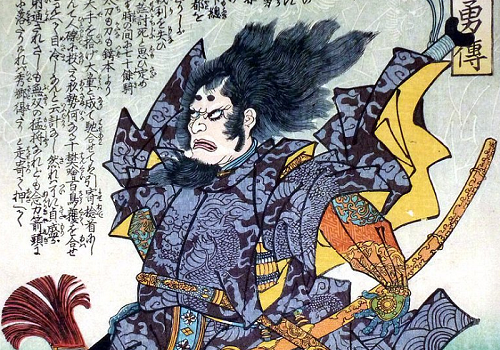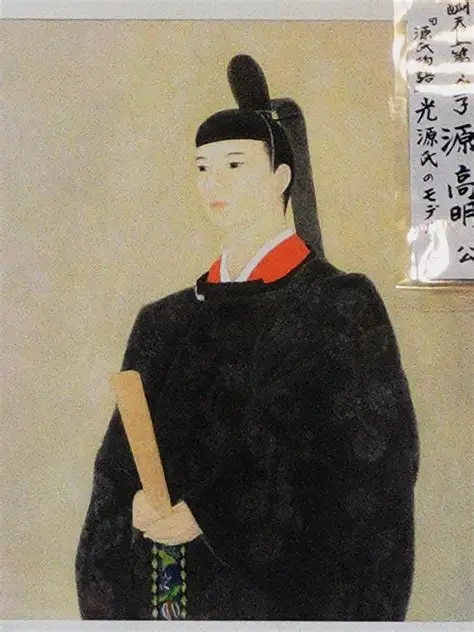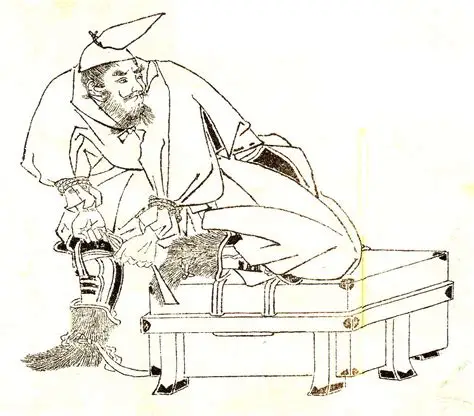
――What Happened to the “General Who Defeated Sumitomo”?
May 20, 941 (Tengyō 4).
Hakata Port, Chikuzen Province.
The forces of Fujiwara no Sumitomo, who had ravaged the Seto Inland Sea and even captured Dazaifu, clashed with the imperial army.
At the center of the imperial side was Ono no Yoshikō.
Yoshikō advanced to Hakata Port by land, while Fujiwara no Yoshiyuki and Ōkura no Harumi attacked by sea.
The battle ended in a victory for the imperial forces.
Sumitomo’s army suffered a crushing defeat, losing over 800 ships and suffering hundreds of casualties.
Sumitomo fled in a small boat and returned to Iyo.
Then, on June 20, he was killed by Tachibana no Tōbu, the Iyo Province security officer.
There is an important point to note here.
Ono no Yoshikō did not personally kill Sumitomo.
What Yoshikō did was crush the main force of Sumitomo’s army at Hakata Port, effectively dismantling the rebellion’s military power.
After the battle, Yoshikō returned to Kyoto.
However, his life did not end there.
Using his achievements in pursuing Sumitomo as a stepping stone, Yoshikō continued to advance in his career.
In 947 (Tenryaku 1), he became a Councilor.
In 962 (Ōwa 2), he was promoted to Junior Third Rank.
In 967 (Kōhō 4), he retired.
And on February 14, 968 (Kōhō 5), he passed away at the age of 85.
The image of “the man who defeated Fujiwara no Sumitomo” alone does not capture the true nature of Ono no Yoshikō.
This man lived a long life not only on the battlefield but also in the political and administrative worlds of the court.
1. Ono no Yoshikō Was the Grandson of the Famous Ono no Takamura
Ono no Yoshikō was born in 884 (Gangyō 8).
His father was Ono no Katsukore, and his grandfather was the renowned Ono no Takamura.
Ono no Takamura is known as a leading literary figure of the early Heian period.
He is famous for anecdotes about his time as an envoy to Tang China and for his poem in the Hyakunin Isshu:
“Tell the people, O fisherman’s boat, that I have set out across the wide sea, over the myriad islands.”
Yoshikō’s younger brother was the renowned calligrapher Ono no Michikaze.
In other words, Yoshikō was the grandson of Ono no Takamura and the elder brother of Ono no Michikaze.
While his family was known for their achievements in literature and calligraphy, Yoshikō pursued a path in military and politics.
Even within the Ono family, Yoshikō’s life was quite unique.
He composed waka poems and engaged with court culture while also serving as a military officer in the court’s military actions.
These dual aspects define the character of Yoshikō.
2. The Early Days of Yoshikō—Climbing the Ranks Step by Step
Yoshikō was not a prominent figure from the start.
In his youth, he gained experience in various local and capital positions one by one.
In 917 (Engi 17), he became the Junior Assistant to the Crown Prince for Crown Prince Hōmyō.
In 922 (Engi 22), he was promoted to Junior Fifth Rank, Lower Grade and became the Right Capital Officer.
He then progressed through positions such as Assistant Minister of the Treasury, Senior Assistant to the Empress, and Provisional Assistant Director of the Right Gate Guards.
In 930 (Enchō 8), he was Provisional Assistant Director of the Right Gate Guards.
In 931 (Shōhei 1), he was granted the privilege of court attendance.
And by 938 (Shōhei 8), he advanced to Provisional Minor Captain of the Right Guards.
Up to this point, Yoshikō was not yet “the general who defeated Fujiwara no Sumitomo.”
He was just another noble steadily building his career within the court.
3. Yoshikō Was Not Just a Warrior
What is intriguing about Yoshikō is that he excelled not only in military matters but also in waka poetry.
He composed a mourning poem for Emperor Daigo’s passing and contributed poems to the folding screens for Fujiwara no Morosuke’s fiftieth birthday.
Yoshikō’s poems were included in collections such as the ‘Gosen Wakashū’.
In other words, he was a military officer skilled in archery and horsemanship, yet also a noble versed in court culture.
This was Ono no Yoshikō.
When thinking of Heian period warriors, one might imagine figures akin to later samurai.
However, Yoshikō was a figure from before the samurai became the main actors in society.
He rose through the ranks as a court official and took on military roles when necessary.
He stood out in that world.
4. The Year 940—The Court Shaken in the East and West
In 940 (Tengyō 3).
The court faced an unprecedented situation.
In the east, there was Taira no Masakado.
In the west, there was Fujiwara no Sumitomo.
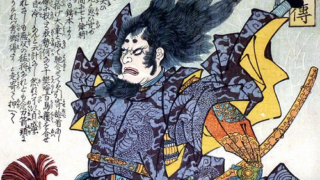
Two major rebellions were occurring simultaneously.
It was a crisis severe enough to affect the court’s New Year’s ceremonies.
The court established military commissioners across the country to prepare for military action.
Among them, Yoshikō was given an important role.
Commissioner for the Pursuit of Rebels in the San’yō Region.
He was also appointed as the chief officer for the pursuit of rebels in both the San’yō and Nankai regions.
The opponent was Fujiwara no Sumitomo, who was expanding his power around the Seto Inland Sea.
This marked a significant turning point in Yoshikō’s life.
5. “Defeat Sumitomo”—Yoshikō Heads to the West
Sumitomo was attacking various locations in the Seto Inland Sea.
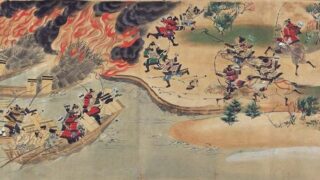
Iyo, Sanuki, Bizen, Bingo, Aki, Suō, Tosa.
He was even extending his influence to Kyushu.
The court could no longer ignore Sumitomo.
Thus, Yoshikō was ordered to pursue him. Yoshikō left Kyoto and headed west.
At this time, Yoshikō was not a warrior leading his own retinue like later generals.
He was an official appointed by the court, conducting military operations under imperial orders.
Both Yoshikō and Sumitomo were deeply involved with local society, but they stood on different sides.
Sumitomo opposed the court with his maritime power base.
Yoshikō suppressed that power from the court’s side.
The paths of these two contemporaries clashed head-on here.
6. 941—Attacking Sumitomo’s Stronghold
February 941 (Tengyō 4).
Fujiwara no Tsunetoshi, a commander under Sumitomo, surrendered to the court.
Using this information, the imperial forces attacked Sumitomo’s stronghold.
Sumitomo’s power was significant.
Records mention that he lined up over 1,500 ships to confront the imperial army.
The imperial side, led by Yoshikō, mobilized its forces.
However, in this battle, Sumitomo’s army was defeated.
Having lost his stronghold, Sumitomo fled to the sea and headed for Kyushu.
From there, Sumitomo made his final move.
His target was Dazaifu.
7. Sumitomo Captures Dazaifu
After fleeing to Kyushu, Sumitomo regrouped his forces.
He then attacked Dazaifu.
Dazaifu was the center of the Western Sea Circuit.
It was a massive administrative and military hub overseeing Kyushu.
Sumitomo attacked it, entered the city, and committed arson and looting.
This was a major incident for the court.
Sumitomo was not just a pirate.
He had reached the point of directly attacking the center of the court’s control in western Japan.
The court quickly mobilized its forces.
At the center was Ono no Yoshikō.
Yoshikō advanced to Dazaifu by land.
Meanwhile, Fujiwara no Yoshiyuki and Ōkura no Harumi advanced by sea.
And on May 20.
At Hakata Port, Chikuzen Province, Sumitomo’s army and the imperial army clashed.
8. The Decisive Battle at Hakata Port—Sumitomo’s Army Crushed
The battle at Hakata Port was Sumitomo’s last major gamble.
Sumitomo knew the sea well.
He had used ships to move through the Seto Inland Sea and raid various locations.
However, the imperial side had also prepared its naval forces.
Yoshikō advanced by land, while Ōkura no Harumi and others attacked by sea.
From both land and sea.
Encircled from both sides, Sumitomo’s army collapsed.
In this battle, over 800 ships were seized by the imperial side.
Records indicate that casualties reached several hundred.
Sumitomo fled in a small boat.
The man who once led a massive fleet ended up escaping with his life in a single small boat.
This was the moment that determined the outcome of Sumitomo’s rebellion.
9. Yoshikō Did Not Personally Defeat Sumitomo
This is important for understanding history.
It is often simply stated that “Ono no Yoshikō defeated Fujiwara no Sumitomo.”
However, the actual events were different.
At Hakata Port, the imperial army led by Yoshikō defeated Sumitomo’s forces.
Sumitomo himself escaped from there.
Returning to Iyo, Sumitomo was killed on June 20 by Tachibana no Tōbu, the Iyo Province security officer.
In other words, Yoshikō defeated the main force of Sumitomo’s army.
It was Tachibana no Tōbu who defeated Sumitomo himself.
Understanding this distinction clarifies the conclusion of Fujiwara no Sumitomo‘s rebellion.
The course of Fujiwara no Sumitomo‘s rebellion is explained in detail in this article.
10. How Did the Court Reward the Man Who Defeated Sumitomo?
Yoshikō’s achievements were significant.
On May 7, 941 (Tengyō 4), he was promoted to Junior Fourth Rank, Lower Grade.
In August of the same year, he was granted the privilege of court attendance.
In 942, he became the Middle Captain of the Left Guards. In 944, he was appointed Governor of Yamashiro. In 945, he became Vice-Governor of Dazaifu.
This is interesting.
After defeating Sumitomo, Yoshikō himself became deeply involved with Dazaifu.
Yoshikō, who had defeated Sumitomo’s attack on Dazaifu, now found himself governing it.
And in 947.
Yoshikō finally became a Councilor.
A Councilor was a member of the court’s political council.
A local official who had achieved military success was now entering the central political arena.
Yoshikō’s career took a significant step up here.
11. The Man Known as “The Wild Vice-Governor”
Yoshikō continued to serve as Vice-Governor of Dazaifu.
Not just once.
He served as Vice-Governor of Dazaifu twice, earning him the nickname “The Wild Vice-Governor”.
Furthermore, because he was also a Councilor, he was known as “The Wild Minister”.
This indicates that Yoshikō was not just a military man but also a court noble involved in local administration.
Yoshikō was involved in the governance of Kyushu.
It was not just about military affairs. It was about governing the region. Connecting the court with the provinces.
And participating in politics.
The rebellion of Sumitomo marked a complete change in Yoshikō’s life.
12. Yoshikō Returns to Dazaifu Once More
Yoshikō became Vice-Governor of Dazaifu in 945 (Tengyō 8).
And after becoming a Councilor in 947 (Tenryaku 1), he continued to serve as Vice-Governor.
In 960 (Kōhō 4), he again served as Vice-Governor.
In other words, Yoshikō remained closely connected to Kyushu, near the site where he defeated Sumitomo.
This was no coincidence.
For Yoshikō, Kyushu was both the place where he made his name during Sumitomo’s rebellion and an important stage for the court’s regional governance.
Winning on the battlefield. Then governing the land.
These two aspects were connected in Yoshikō’s life.
13. Yoshikō Was Not Just a Warrior—He Was Also a Poet
Yoshikō had an unexpected side.
Waka poetry.
His poems were included in collections like the ‘Gosen Wakashū’.
The man who pursued Sumitomo and led the army also composed waka at court.
This was the world of Heian aristocrats.
One could not advance solely on military ability.
Politics. Administration. Literature. Ceremony.
Various skills were required.
Yoshikō survived in that world.
That is why he did not end as just “the general who defeated Sumitomo.”
14. 962—Promoted to Junior Third Rank
Yoshikō’s career continued to advance.
In 962 (Ōwa 2), he was promoted to Junior Third Rank.
While participating in court politics as a Councilor, he also served as Vice-Governor of Dazaifu.
Twenty-one years after Sumitomo’s rebellion.
The man who once led a punitive expedition to the west was now a high-ranking noble at court.
While Sumitomo lost his life due to rebellion, Yoshikō greatly elevated his political status by suppressing that rebellion.
The lives of these two men, who were part of the same rebellion, ended in completely opposite outcomes.
15. 967—Retiring from Politics at 85
In 967 (Kōhō 4), Yoshikō retired.
Retirement meant resigning from office and withdrawing from politics.
Yoshikō was 84 at the time.
For a person of the Heian period, it was an exceptionally long life.
And on February 14, 968 (Kōhō 5).
Ono no Yoshikō passed away at the age of 85.
Born in 884, he defeated Sumitomo’s forces in 941,
became a Councilor in 947, was promoted to Junior Third Rank in 962,
retired from politics in 967, and ended his life in 968.
He lived 27 years beyond Sumitomo’s rebellion.
16. The Interesting Life of “The Man Who Defeated Sumitomo”
What is fascinating about Ono no Yoshikō’s life is that the rebellion of Fujiwara no Sumitomo was not the endpoint of his life.
Rather, it was the beginning of his true rise.
In 941, he defeated Sumitomo’s forces at Hakata Port.
In 947, he became a Councilor.
In 953, he was promoted to Junior Fourth Rank, Upper Grade.
In 958, he was promoted to Senior Fourth Rank, Lower Grade.
In 962, he was promoted to Junior Third Rank.
In 967, he retired.
In 968, he passed away.
For 27 years after the rebellion, Yoshikō continued to live within the court.
And in the end, he lived to the ripe old age of 85.
He was not just a figure who “ended with suppressing a rebellion.”
He made his name on the battlefield and then lived as a politician.
That was Ono no Yoshikō.
17. Ono no Yoshikō and Fujiwara no Sumitomo—Two Men Who Became Winner and Loser
Yoshikō and Sumitomo.
Both lived during the same Heian period.
Sumitomo was a member of the Fujiwara clan. Yoshikō was a member of the Ono clan.
Both were involved with local society, and both were deeply involved in the affairs of the western provinces.
However, the paths they chose were completely opposite.
Sumitomo clashed with the court with the power he had built locally.
Yoshikō, on the other hand, acted on the court’s orders to suppress that power.
In May 941.
The outcome was decided at Hakata Port.
Sumitomo fled. Yoshikō returned to Kyoto.
Afterward, Sumitomo died in Iyo.
Yoshikō became a Councilor and rose to Junior Third Rank.
18. The True Nature of Ono no Yoshikō
Ono no Yoshikō cannot be confined to the term “general” as understood in later times.
The grandson of Ono no Takamura. The elder brother of Ono no Michikaze.
A court official. A noble who composed waka.
Vice-Governor of Dazaifu, responsible for local administration. A Councilor.
And, the central figure in the punitive force that defeated Fujiwara no Sumitomo‘s army at Hakata Port.
This was Ono no Yoshikō.
The spotlight in Sumitomo’s rebellion was, of course, on Sumitomo himself.
The man who led pirates. The man who attacked Dazaifu. The man who roamed the Seto Inland Sea.
As a story, Sumitomo’s tale is more flamboyant.
However, the life of Ono no Yoshikō, who pursued Sumitomo, was also quite intense.
He steadily climbed the ranks from a young age, took on the major task of pursuing Sumitomo in his late 40s, and became a Councilor in his mid-50s.
He continued to be involved in Kyushu administration, reaching Junior Third Rank in his late 60s.
He lived into his 80s and ended his life at 85.
The man who won on the battlefield continued to survive within the court and ultimately rose to the rank of Councilor.
That was Ono no Yoshikō.
And by examining Yoshikō’s life, one can see that “warriors” of the Heian period were entirely different from later samurai.
They were court officials. They were also politicians. They were local administrators.
And when necessary, they led armies into battle.
Ono no Yoshikō is one of the clearest examples of this type of figure.
Fujiwara no Sumitomo, whom Ono no Yoshikō pursued, and Taira no Masakado, who shook the eastern provinces.
This book is recommended for those who want to learn more about the simultaneous “Jōhei-Tengyō Rebellion” involving these two uprisings.
Reading it alongside the article on Ono no Yoshikō provides a more vivid picture of the clash between the court and local powers in the 10th century.

Taira no Masakado and Fujiwara no Sumitomo: The Jōhei-Tengyō Rebellion, The Painful Cry of the Early Samurai (Japanese History Libretto People 17) [ Shimomukai Tatsuhiko ]