April 9, 1584.
As dawn broke over the eastern part of Owari, the forces dispatched by Hashiba (Toyotomi) Hideyoshi were advancing eastward on their mission to invade Okazaki.
The army numbered approximately 24,000.
This formidable force included Ikeda Tsuneoki and his son Motosuke, Mori Nagayoshi, Hori Hidemasa, Hasegawa Hidekazu, and Hideyoshi’s nephew, Miyoshi Nobuyoshi.
Their target was Okazaki, the stronghold of Tokugawa Ieyasu in Mikawa.
Meanwhile, the Tokugawa forces were already closing in from behind.
Upon detecting the movements of the Okazaki invasion army, Ieyasu dispatched troops from Komakiyama, leading his main force of about 9,300 to Obata Castle.
About 4,500 troops under Sakakibara Yasumasa had already pushed further east.
As the Hashiba forces advanced eastward along the narrow roads, their formation stretched out.
Ikeda Tsuneoki and Mori Nagayoshi were at the front.
Hori Hidemasa followed behind them.
Miyoshi Nobuyoshi brought up the rear.
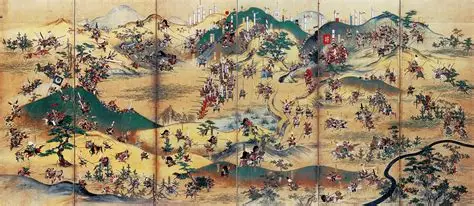
On the morning of April 9, each of these separated units found themselves simultaneously drawn into battle.
Ikeda Tsuneoki attacked Iwasaki Castle.
Miyoshi Nobuyoshi was ambushed from behind in the Hakusan Forest.
Hori Hidemasa confronted the Tokugawa forces at Hinokine.
Meanwhile, Ieyasu’s main force entered Nagakute.
Around 10 a.m.
The Tokugawa forces completed their deployment in the hilly terrain of Nagakute.
Ikeda Tsuneoki and Mori Nagayoshi, having captured Iwasaki Castle, began to retreat.
By midday, Mori Nagayoshi was struck down by gunfire, and both Ikeda Tsuneoki and his eldest son Motosuke were killed.
Around 1 p.m.
The battle was over.
For over ten days, the two armies had faced each other at Komakiyama, avoiding a decisive confrontation.
That balance was shattered in just a few hours on April 9.
April 6: Approximately 24,000 Move Toward Okazaki
Since the end of March, the forces of Tokugawa Ieyasu and Oda Nobukatsu, stationed at Komakiyama, had been in a standoff with Hashiba (Toyotomi) Hideyoshi’s army, which was based at Rakuden.
Ieyasu fortified Komakiyama as a castle and constructed outposts around it.
Hideyoshi’s side also built a series of outposts from the north to the east of Komakiyama, with earthworks erected between the two armies.
No large-scale frontal battles occurred.
As April began, Hideyoshi’s forces put into action their plan to send troops to Okazaki, Ieyasu’s base.
According to later military chronicles, Ikeda Tsuneoki proposed the invasion of Mikawa, and although Hideyoshi initially opposed it, he eventually gave his approval. This story is widely known.
In recent years, this account has been re-evaluated.
The force sent to Mikawa numbered about 24,000.
Evidence suggests that preparations for the advance route were made in advance, indicating that this was not a minor operation with just a few hundred or thousand troops slipping past the enemy unnoticed.
There is considerable room to believe that Hideyoshi himself was involved in preparing this large-scale military operation.
The force was divided into multiple units.
Ikeda Tsuneoki and his son Mototsugu.
Mori Nagayoshi.
Hori Hidemasa.
Hasegawa Hidekazu.
At the very rear was Miyoshi Nobuyoshi.
Nobuyoshi, later known as Toyotomi Hidetsugu, was 17 years old at this time. He was the son of Hideyoshi’s sister, Tomo (Nisshu).
The young Nobuyoshi was appointed as the supreme commander of the entire army.
On the night of April 6th.
The forces began moving eastward from the Komaki area.
They passed through Okusa and Sekida, traversing the hilly terrain of eastern Owari, and entered Mikawa.
If they advanced to Okazaki, they could directly threaten Ieyasu’s main territory.
If Ieyasu left Komakiyama to pursue them, it would create an opportunity for Hideyoshi’s main forces to move.
The strategy was to shift the battlefield, which had been stagnant in front of Komakiyama, by attacking Ieyasu from behind.
The Movement of the Okazaki Invasion Force Reaches Ieyasu
April 7th.
The Okazaki invasion force reached the vicinity of Kamijo Village, where they built a fort and set up camp.
According to the chronicle of Komaki City, on this day, the residents of Shinogi informed Ieyasu about the presence of the Okazaki invasion force.
Ieyasu’s side began to move.
A vanguard of about 4,500, including Sakakibara Yasumasa, departed from Komaki and headed towards Obata Castle.
Among them were Mizuno Tadaju and Niwa Ujitaka.
Niwa Ujitaka was the lord of Iwasaki Castle.
Familiar with the geography of eastern Owari near his domain, he guided the Tokugawa forces.
Ieyasu himself also led the main force out of Komakiyama.
Their strength was estimated at about 9,300.
By the night of April 8th, they had entered Obata Castle.
The Okazaki invasion force was advancing further east.
In the early hours of April 9th.
Ieyasu’s main force also moved out from Obata Castle.
Ieyasu did not return to Okazaki.
Instead, he pursued the rear of the Hashiba forces heading towards Okazaki.
The battlefield, which had extended from Komakiyama, shifted significantly towards the Nagakute area.
The Hashiba Army’s Column Stretches Along Narrow Paths
The Okazaki invasion force did not advance as a single massive group.
Instead, about 24,000 troops were divided into several units, moving east along the hilly paths.
The roads they traveled had limited width.
It was impossible for tens of thousands to march side by side.
As the vanguard advanced, the column stretched long from east to west.
Early morning on April 9th.
The vanguard, including Ikeda Tsuneoki, had reached near Iwasaki Castle.
The rearmost Miyoshi Nobuyoshi’s unit was far behind, near the Shirayama Forest.
In the meantime, there were units led by Hori Hidemasa stationed there.
The distance between them had grown too large to send reinforcements quickly.
It was at this moment that the Tokugawa forces caught up.
The first to suffer a major blow was the rearguard, led by a 17-year-old commander.
At the same time, at the front, the Battle of Iwasaki Castle was beginning.
Iwasaki Castle—16-Year-Old Niwa Ujishige Defends
In front of the Ikeda Tsuneoki unit, advancing at the head of the Okazaki invasion force, stood Iwasaki Castle.
This is in present-day Nisshin City, Aichi Prefecture.
A hilltop castle built in the eastern hills of Owari.
The castle lord, Niwa Ujitsugu, had joined Ieyasu’s forces.
The castle was entrusted to his younger brother, Niwa Ujishige.
He was 16 years old.
Kato Tadakage, the lord of Nagakute Castle, was also inside the castle.
It is said that Ikeda Tsuneoki, in his haste to advance on Okazaki, initially intended to bypass Iwasaki Castle.
However, gunfire was directed at them from the castle.
The Ikeda forces changed their course.
Iwasaki Castle reportedly had over 200 defenders, with local tradition in Nisshin City claiming over 300.
The difference in military strength with the Ikeda forces was significant.
The castle defenders barricaded themselves inside and prepared to repel the advancing Ikeda army.
Gunfire erupted, and a battle ensued around the castle.
The Ikeda forces continued their assault and breached the castle interior.
Niwa Ujishige, Kato Tadakage, and others were killed in action.
Many of the castle defenders were also slain.
Iwasaki Castle fell.
Ujishige was 16 years old.
Kato Tadakage was 41 years old.
In later years, it was sometimes said that the resistance at Iwasaki Castle delayed the Ikeda forces, contributing to their defeat at Nagakute.
It is certain that the Ikeda forces engaged in battle here and spent time as a result.
Meanwhile, battles had already begun in the rear of the Okazaki invasion force.
Shirayama Woods—Miyoshi Forces Attacked by Tokugawa Army During Breakfast
Early morning on April 9.
At the very rear of the Okazaki invasion force, Miyoshi Nobuyoshi’s unit was near Shirayama Woods.
This is around present-day Owariasahi City.
According to records from Nagakute City, the soldiers were having breakfast.
At that moment, Sakakibara Yasumasa and other Tokugawa vanguard units approached.
The direction of the enemy’s approach was not from the front, but from behind.
The Tokugawa forces, pursuing from the Komaki direction, launched an attack on the rearguard.
The sudden assault threw the Miyoshi forces into disarray.
As the soldiers scrambled to arm themselves and form ranks, the Tokugawa forces pressed in.
There was a distance between Hori Hidemasa, Mori Nagayoshi, Ikeda Tsuneoki, and the forces ahead.
The Miyoshi forces crumbled.
The commander-in-chief, Nobuyoshi, also fled.
The 17-year-old young warrior retreated to the vicinity of Hosogane.
It is said that he lost his horse during the escape.
The distance between him and the pursuing Tokugawa soldiers was closing.
Nobuyoshi was saved by Kinoshita Kageyuri.
Kageyuri gave his horse to Nobuyoshi.
Nobuyoshi used that horse to leave the battlefield.
Kageyuri, along with his brother Kinoshita Sukehisa, stayed behind and fought the pursuing Tokugawa forces, losing their lives.
The commander-in-chief of the Okazaki invasion force survived.
The troops he led collapsed at Shirayama Forest.
The Tokugawa vanguard continued eastward.
The victory at Shirayama Forest had given them momentum.
The next opponent waiting for them was Hori Hidemasa, far more experienced in battle than Miyoshi Nobuyoshi.
Hinokigane—The Victorious Tokugawa Forces Are Repelled
Upon hearing of the Miyoshi forces’ retreat, Hori Hidemasa set up camp on the hills of Hinokigane.
Hidemasa was 31 years old.
He served closely with Nobunaga and followed Hideyoshi after the Incident at Honnoji.
The Tokugawa vanguard, victorious at Shirayama Forest, continued their pursuit.
The Hori forces waited on the hill.
The Tokugawa forces approached.
Gunfire erupted.
According to records from Nagakute City, the Hori forces unleashed a barrage of gunfire on the approaching Tokugawa forces.
The Tokugawa troops, stretched thin from their pursuit from Shirayama Forest, were thrown into disarray by the gunfire.
Hori Hidemasa ordered a full assault.
This time, the Tokugawa side was pushed back.
At Shirayama Forest, it was the Tokugawa forces.
At Hinokigane, it was the Hashiba forces.
Within a short distance, the tide of battle had turned.
It is said that the Tokugawa side suffered many casualties.
Hori Hidemasa did not continue the pursuit.
It is said that the golden fan standard of Ieyasu was visible on the nearby Mihata Mountain.
It was not just the Tokugawa vanguard.
Ieyasu’s main force had already entered Nagakute.
If the Hori forces pursued further west, they would clash with Ieyasu’s main force.
Hidemasa regrouped his troops and withdrew north.
This decision kept the Hori forces out of the decisive battle at Nagakute.
The Miyoshi forces crumbled at Shirayama Forest, and the Hori forces also left the battlefield at Hinokigane.
The Okazaki invasion force remained divided.
At the front, Ikeda Tsuneoki and Mori Nagayoshi were left to face off against Ieyasu’s main force.
Around 8 AM, Ieyasu Enters Irokane Mountain
On the morning of April 9th, around 8 AM.
Ieyasu’s main force arrived in the area around Irokane Mountain in Iwasaku.
This is present-day Iwasaku Irokane in Nagakute City.
From there, Ieyasu assessed the battlefield situation and advanced his troops further east.
They crossed the Kanare River.
By around 10 AM, the Tokugawa and Nobukatsu forces had positioned themselves from Fujigane to Butsugane and the area around Maeyama.
This area was not just flat fields.
Small hills surrounded the lowlands along the Kanare River, creating a landscape of undulating terrain.
The area around the current Battlefield Park was also a place where hills and valleys intermingled at the time.
On the Tokugawa side, Ii Naomasa and others moved to the front.
Ii Naomasa was 23 years old.
The previous year, he had been entrusted with leading a unit centered around former retainers of the Takeda clan, commanding the red-armored troops.
According to Nagakute City records, he fought with a group of 20 musketeers and 300 muskets entrusted to him by Ieyasu.
Nobukatsu’s forces also took their positions.
Ieyasu had pursued the invading forces to Nagakute.
At that time, news of a disturbance in the rear reached Ikeda Tsuneoki.
Miyoshi Nobuyoshi’s unit had been defeated.
Hori Hidemasa had already retreated north.
If they continued towards Okazaki, their rear would be held by Ieyasu’s main force.
Ikeda Tsuneoki and Mori Nagayoshi hurriedly turned back.
The Ikeda-Mori Forces Return from Iwasaki Castle
After capturing Iwasaki Castle, Ikeda Tsuneoki and his forces returned to Nagakute.
Before them, Ieyasu’s army had already set up camp.
Ikeda Tsuneoki placed his eldest son, Mototsuke, on the right flank.
His son-in-law, Mori Nagayoshi, took the left flank.
The Ikeda-Mori forces also prepared for battle.
This was not an ambush like at Hakusan Forest, nor a pursuit battle like at Hinokagane.
It was a frontal battle where both sides were aware of each other’s presence and had taken their positions.
From around 10 to 11 AM.
The fighting intensified around Butsugane.
The Ikeda-Mori forces did not easily collapse.
According to records from Nagakute City, the battle was fierce, and the outcome remained undecided for some time.
The tide of the battle turned on the left flank.
This was Mori Nagayoshi’s unit.
Mori Nagayoshi Approaches Ieyasu’s Main Camp
Mori Nagayoshi was 27 years old.
The lord of Mino Kanayama Castle.
Mori Nagayoshi, who died at Honnoji as a page to Oda Nobunaga, was the older brother of Ranmaru.
After the fall of the Takeda clan, he was granted the four districts of Kawanakajima in Shinano.
He had already fought against the Tokugawa forces once during the Battle of Komaki and Nagakute.
This was on March 17 at Haguro.
Defeated by Sakai Tadatsugu and others, he retreated towards Inuyama.
Twenty-three days later.
This time, he faced Tokugawa Ieyasu’s main force at Nagakute.
The Mori forces attacked the Tokugawa side.
According to records from Nagakute City, Nagayoshi charged towards Ieyasu’s main camp.
Ii Naomasa’s unit was equipped with 300 matchlock guns.
Around noon.
A bullet struck Mori Nagayoshi.
It is said he was shot in the head.
Nagayoshi died in battle on the spot.
He was 27 years old.
The Mori forces began to collapse with the loss of their commander.
The collapse of the left flank also affected the Ikeda forces fighting beside them.
Ikeda Tsuneoki Fights Without Retreating
Ikeda Tsuneoki was 49 years old.
He was a milk brother to Nobunaga.
His mother, Yotoku-in, served as Nobunaga’s wet nurse.
Tsuneoki himself served the Oda family from a young age and participated in Nobunaga’s campaigns.
After the Incident at Honnoji, he defeated Akechi Mitsuhide at the Battle of Yamazaki alongside Hideyoshi and attended the Kiyosu Conference.
On March 13, 1584.
As the Battle of Komaki and Nagakute began, Tsuneoki captured Inuyama Castle.
By the early morning of April 9, he had taken Iwasaki Castle.
That afternoon.
Mori Nagayoshi fell at Nagakute.
The Ikeda forces were also pushed back by the Tokugawa side.
Tsuneoki could not escape from the battlefield.
It is said that Nagai Naomasa of the Tokugawa forces killed Tsuneoki.
His eldest son, Mototsuke, was also fighting.
Mototsuke was 26 years old.
He joined the Mikawa invasion army with his father, leading the right wing.
Mototsuke is said to have been killed by Ando Naotsugu.
The Ikeda family lost both its head and heir in a single battle.
Father, Tsuneoki, was 49 years old.
Eldest son, Mototsuke, was 26 years old.
Son-in-law, Mori Nagayoshi, was 27 years old.
All three died at Nagakute on April 9.
The second son, Ikeda Terumasa, survived.
He later married Ieyasu’s daughter, Tokuhime, and participated in the Eastern Army at the Battle of Sekigahara.
He governed 520,000 koku in Himeji and was responsible for the major renovation of what is now Himeji Castle.
In 1584 at Nagakute, his father and brother were defeated by Ieyasu’s forces.
The Battle Concludes at 1 PM
With the fall of Mori Nagayoshi and the deaths of Ikeda Tsuneoki and his son Motonobu, the Ikeda and Mori forces crumbled on the battlefield.
According to records from Nagakute City, the battle ended around 1 PM.
From the early morning skirmishes at Iwasaki Castle and Shirayama Woods, through Hinokigane, to the decisive battle around Butsugane, it spanned about half a day.
During this time, the forces invading Okazaki suffered significant losses.
Miyoshi Nobuyoshi’s troops retreated from Shirayama Woods.
Hori Hidemasa defeated the Tokugawa vanguard at Hinokigane, but upon learning of Ieyasu’s main force advancing, he withdrew north.
Ikeda Tsuneoki, Ikeda Motonobu, and Mori Nagayoshi were killed in action.
The army of approximately 24,000 heading towards Okazaki never reached its destination.
Ieyasu emerged victorious on the battlefield of Nagakute.
Yet, he did not remain there.
Hideyoshi’s main force had begun to move.
Hideyoshi Heads to Nagakute
Hideyoshi was in Rakuda.
Upon learning that the forces invading Okazaki were engaged with Ieyasu, he set out to provide aid.
On April 9th.
Hideyoshi departed Rakuda and advanced towards the Ryusenji area.
From Nagakute’s perspective, this was to the northwest.
If Hideyoshi’s main force arrived, Ieyasu would have to contend with a new large army.
Ieyasu did not continue the pursuit at Nagakute and gathered his troops.
He returned towards the Obata Castle area.
And further back to Komaki Mountain.
This all occurred on April 9th.
Hideyoshi was unable to catch Ieyasu.
The next day, April 10th.
Hideyoshi also returned to Rakuda.
The battle on April 9th concluded with a victory for Ieyasu’s side.
It wasn’t that Hideyoshi himself was defeated by Ieyasu at Nagakute.
The fighting was done by the Okazaki invasion force sent by Hideyoshi,
and Hideyoshi’s main force still retained significant strength.
The war was not over.
“For Now, It Seems Ieyasu Has the Upper Hand”
The blow dealt to Hideyoshi’s side at Nagakute was substantial.
Ikeda Tsuneoki.
Ikeda Motonobu.
Mori Nagayoshi.
Generals who had seen many battlefields since the time of Nobunaga were lost in a single day.
The victory for Ieyasu’s side was reported even in the distant Kinai region.
The ‘Tamonten Diary’ written by the monk Eishun of Kofuku-ji records the following after hearing about the state of the battle:
“For now, it seems that Ieyasu will win.”
This implies, “At this moment, it looks like Ieyasu will come out victorious.”
The fact that Ieyasu won at Nagakute was perceived in this way by the people of that time.
However, the phrase “for now” is included.
The war itself continued.
Hideyoshi’s military might was not shattered by the defeat at Nagakute alone.
Likewise, Ieyasu did not possess overwhelming forces to march directly on Hideyoshi’s main base.
Both sides maneuvered their armies, seeking an opening in their opponent’s defenses.
The Battlefield Shifts from Komaki to Mino
In early May.
Hideyoshi moved his forces away from Owari towards the Unuma area.
On May 3rd, Nobukatsu also returned from Mount Komaki to Nagashima Castle.
The standoff between the large armies around Mount Komaki came to an end.
However, the war itself was not over.
Hideyoshi expanded his military actions beyond just Ieyasu’s main forces, targeting Nobukatsu’s territories and surrounding castles.
Owari. Mino. Ise.
Fighting continued across multiple regions.
In June, another major battle erupted in the western part of Owari.
This was the Battle of Kanie.
The Battle Over Kanie Castle
Kanie Castle is located in what is now Kanie Town, Ama District, Aichi Prefecture.
At the time, it was near Ise Bay, in a region interwoven with rivers and waterways.
Using water transport, it connected with the Ise area.
On June 16th.
Hideyoshi’s allies, Takigawa Kazumasu and Kuki Yoshitaka, took action.
In the absence of Kanie Castle’s lord, Sakuma Masakatsu, they persuaded Maeda Tanetoshi, who was in charge of the castle, to switch sides.
Kanie Castle.
Maeda Castle.
Shimoichiba Castle.
These three castles fell into Hideyoshi’s hands.
Ieyasu and Nobukatsu quickly launched a counterattack.
On June 18th.
The Nobukatsu-Ieyasu forces attacked the Kanie area and recaptured Shimoichiba Castle.
By the 23rd, they had also regained Maeda Castle.
The assault on the remaining Kanie Castle continued.
Hideyoshi’s side had Kuki Yoshitaka’s naval forces.
Ieyasu and Nobukatsu’s side maintained a siege on the castle while remaining wary of movements from the water.
On July 3rd.
Kanie Castle was also recaptured by Nobukatsu and Ieyasu’s forces.
Takigawa Kazumasu and his forces withdrew.
Following Nagakute, Hideyoshi’s side was unable to break the forces of Ieyasu and Nobukatsu through military might alone.
Nevertheless, Hideyoshi did not cease the war.
Summer Passes Without Resolution
July 13th.
Ieyasu returned to Kiyosu Castle, and Nobukatsu to Nagashima Castle.
On August 26th, Hideyoshi’s forces crossed the Kiso River again, advancing northwest of Komakiyama.
On the 28th, Ieyasu moved his camp from Kiyosu to Iwakura Castle.
The two armies faced each other once more.
September 2nd.
Peace negotiations began.
No agreement was reached.
Ieyasu returned to Kiyosu on September 27th, and Hideyoshi went back to Osaka on October 6th.
Despite more than half a year of fighting, Hideyoshi could not subdue Ieyasu militarily, nor could Ieyasu defeat Hideyoshi.
October 23rd.
Hideyoshi’s forces moved again.
This time, they headed for Northern Ise.
Nobukatsu’s domain was now directly under attack.
Hideyoshi Cornered Nobukatsu
Hideyoshi’s forces entered Northern Ise and attacked Nobukatsu’s castles.
By late October, Toki Castle in Southern Ise fell.
On November 5th, they captured Komano Castle in Eastern Mino.
In Northern Ise, they besieged Hamada Castle and entered Nawa Castle.
They could not defeat Ieyasu’s main force at Nagakute.
Nor did they achieve the desired results at Kanie.
Yet, Hideyoshi had the strength to continue deploying troops across a wide area.
As the war dragged on, Nobukatsu’s domain came under increasing pressure.
Nobukatsu began his conflict with Hideyoshi in March.
By November, Nobukatsu opted for peace with Hideyoshi.
The two met at Yadagawa in Ise Province.
This was a separate peace, negotiated without Ieyasu.
Nobukatsu ceded parts of Iga and Ise to Hideyoshi.
Having killed his three senior retainers in March to initiate war with Hideyoshi, Nobukatsu himself made peace with him about eight months later.
Ieyasu had joined the war in support of Nobukatsu.
With Nobukatsu making peace, the premise for continuing the war collapsed.
Ieyasu also withdrew his troops.
The Battle of Komaki and Nagakute came to an end.
Ieyasu Won at Nagakute. It Was Hideyoshi’s Political Prowess That Ended the War
April 9th at Nagakute.
The victor was Ieyasu.
Following the rear of the Okazaki invasion force, they defeated Miyoshi Nobuyoshi’s troops at Shirayama Forest.
Although they were pushed back by Hori Hidemasa at Hinokine, Ieyasu’s main force advanced to Nagakute.
They intercepted Ikeda Tsuneoki and Mori Nagayoshi upon their return, defeating Mori Nagayoshi, Ikeda Tsuneoki, and Ikeda Motosuke.
Before Hideyoshi’s reinforcements could arrive, they left the battlefield and returned to Komakiyama.
It was a clear tactical victory.
However, when considering the war as a whole, the outcome is not easily summarized.
Hideyoshi was unable to subdue Ieyasu on the battlefield.
Likewise, Ieyasu could not dismantle Hideyoshi’s power.
Seven months after Nagakute, Hideyoshi directly negotiated peace with Nobuo, undermining the political basis for Ieyasu’s fight.
Subsequently, Ieyasu sent his second son, Ogi-maru—later known as Yuki Hideyasu—to Hideyoshi.
The relationship between Hideyoshi and Ieyasu was not entirely settled.
It was in 1586, during the 14th year of Tensho, that Ieyasu traveled to Osaka to clearly demonstrate his allegiance to Hideyoshi.
In the meantime, the maneuvering between the two continued.
In 1585, during the 13th year of Tensho, Hideyoshi became Kanpaku.
The following year, he was appointed as Daijo Daijin and granted the Toyotomi surname.
Ieyasu was gradually integrated into this regime.
Nevertheless, Ieyasu held Komakiyama against Hideyoshi’s large army, pursued the enemy’s detached forces himself, and defeated Ikeda Tsuneoki and Mori Nagayoshi at Nagakute.
Hideyoshi came to understand that military might alone could not compel Ieyasu to surrender.
Hideyoshi died in 1598, during the 3rd year of Keicho.
Two years later, Ieyasu emerged victorious at the Battle of Sekigahara.
In 1603, during the 8th year of Keicho, Ieyasu became the Seii Taishogun.
In 1584, neither of the two who fought at Komakiyama and Nagakute could defeat the other in this war.
The victor at Nagakute was Ieyasu.
However, it was Hideyoshi who went on to unify the realm.
And ultimately, it was Ieyasu who established the shogunate.
The Battle of Komaki and Nagakute was a conflict where the last two of the Three Unifiers clashed head-on with their armies.
Learn more 📖↓


The Story of the Brothers Niwa Ujitsugu and Ujishige: Warlords of the Sengoku Era [Kenta Uchiki]