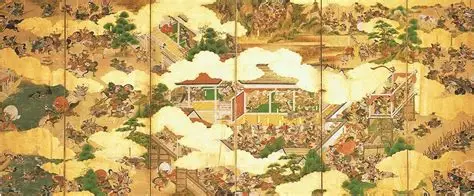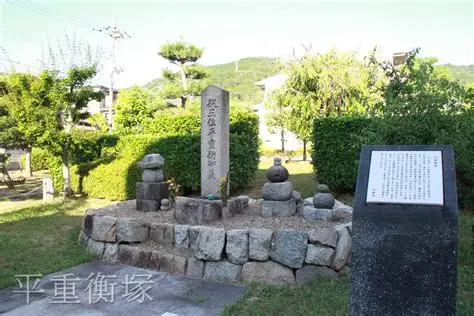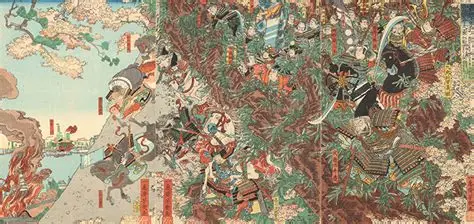
On February 7, 1184, the Genji forces were closing in on the area around Fukuhara in Settsu Province.
According to the Azuma Kagami, it was snowing that day.
Minamoto no Noriyori’s troops were advancing from the east at Ikuta Forest, while Kumagai Naozane and Hirayama Sueshige were competing to lead the charge in the west at Ichi-no-Tani.
Additionally, in the mountains to the north, it is said that Minamoto no Yoshitsune led a select group of over 70 horsemen.
This is the famous “descent down the slope of Hiyodori Pass.”
The Taira forces had established a defensive line centered around the coastline at Fukuhara, preparing for the Genji’s advance. However, with attacks from both east and west and the mountain positions breached, they began to flee in defeat across various locations.
In this battle, Taira no Tadanori, Taira no Michimori, and Taira no Atsumori were killed, and Taira no Kiyomori‘s son, Shigehira, was captured alive.
Fukuhara, where Kiyomori had once pushed for the capital’s relocation, was a base the Taira had finally regained after more than half a year since their flight from the capital.
This Fukuhara was once again seized by the Genji after a brief battle.
The Taira Return to Fukuhara Half a Year After Fleeing the Capital
In July 1183, the Taira clan, accompanied by Emperor Antoku and the Imperial Regalia, left Kyoto.
In May of the same year, they suffered a crushing defeat at the hands of Minamoto no Yoshinaka’s forces at Kurikara Pass in the Hokuriku region. Following their struggles at the Battle of Shinohara, it became difficult to defend Kyoto.
Taira no Munemori and others headed west, aiming to regroup their forces in Kyushu.
However, they faced resistance from local forces like Ogata Koreie in Bungo Province and were unable to establish a stable base.
Subsequently, the Taira moved to Yashima in Sanuki Province, gathering warriors from along the Seto Inland Sea to rebuild their military strength.
The turning point came with the Battle of Mizushima in the intercalary tenth month of the same year.
At Mizushima in Bitchu Province, the Taira forces defeated the troops dispatched by Yoshinaka, including Yada Yoshikiyo and Unno Yukihiro.
In the following November, they defeated Minamoto no Yukie’s forces at Muroyama in Bizen Province, regaining their advantage in the western provinces.
Meanwhile, in Kyoto, the conflict between Yoshinaka and Emperor Go-Shirakawa was intensifying.
On November 19, Yoshinaka attacked the Hojuji Palace and subdued Emperor Go-Shirakawa by force.
In response, Minamoto no Yoritomo dispatched his brothers Noriyori and Yoshitsune. On January 20, 1184, Yoshinaka’s forces were defeated at Uji and Seta, and Yoshinaka himself was killed at Awazu in Omi Province.
Although Kyoto had fallen under Yoritomo’s control, in the western regions, the Taira clan had already extended their influence from Harima to Settsu.
The focal point of their power was Fukuhara.
Fukuhara, which corresponds to the present-day Hyogo Ward in Kobe City, was the site where Taira no Kiyomori attempted to relocate the capital in 1180.
It was also a key maritime transport hub centered around Owada no Tomari, playing a crucial role in moving troops and supplies from the Seto Inland Sea.
According to the Azuma Kagami, the Taira clan constructed fortifications at Ichinotani, on the border of Settsu and Harima, and gathered forces from the western sea and San’in regions.
They were preparing for the Genji army’s attack while keeping an eye on a return to Kyoto.
The Taira Army’s Deployment: East at Ikuta Forest, West at Ichinotani
The Taira’s defensive line extended over a wide area that now corresponds to the urban center of Kobe City.
The strategic eastern location was Ikuta Forest.
It is believed that a more extensive forest existed around the current Ikuta Shrine area at the time.
The old Ikuta River flowed nearby, and the terrain, flanked by mountains to the north and the coast to the south, was well-suited for repelling enemies advancing from the east.
This area was defended by Taira no Tomomori and Taira no Shigehira.
Both were sons of Taira no Kiyomori and prominent commanders within the Taira clan.
On the other hand, the western defensive stronghold was Ichinotani.
Located near present-day Suma Ward in Kobe City, it was bordered by mountains like Mount Hachibuse and Mount Tekka to the north, with the Seto Inland Sea to the south.
Controlling this narrow area between the mountains and the coast made it easier to obstruct enemy advances from the west.
In the Heike Monogatari, Taira no Tadanori is mentioned as the commander in this area.
Tadanori was Kiyomori’s brother and served as the governor of Satsuma. He was also known for his poetic talent, having studied under Fujiwara no Shunzei.
Additionally, Taira no Michimori and Taira no Moritoshi were said to be responsible for the mountain defenses.
The Heike Monogatari describes the gates and palisades of the fortifications, indicating that the Taira had established defensive structures, although the exact design and scale remain unknown.
In the area around Fukuhara at the time, Taira ships were also stationed at sea.
The Gyokuyou mentions names like Ichinotani, Fukuhara, Yamate, Hamaji, and Shimabe, showing that the Taira forces were deployed across multiple locations.
The Genji army advanced towards these positions from two directions.
Noriyori Takes the Main Force, Yoshitsune the Flanking Force
According to the Azuma Kagami, on January 29, 1184, Minamoto no Noriyori and Minamoto no Yoshitsune departed Kyoto to pursue the Taira.
Meanwhile, the Heike Monogatari records that they reported their departure to Emperor Go-Shirakawa on the same day and left on February 4, showing a discrepancy in the dates.
The Genji forces were divided into two main groups.
Leading the main force was Minamoto no Noriyori.
He was accompanied by Takeda Nobuyoshi, Kagami Tomomitsu, Kajiwara Kagetoki, and Oyama Tomomasa, advancing along the coast of Settsu to approach the eastern side of Fukuhara.
In charge of the flanking force was Minamoto no Yoshitsune.
Yoshitsune’s forces included Doi Sanehira, Tashiro Nobutsuna, Miura Yoshizane, Yasuda Yoshisada, Kumagai Naozane, and Hirayama Korekage.
Unlike Noriyori’s army, Yoshitsune’s forces entered the northern Tanba route.
They moved through the mountainous region to advance on the western side of the Taira forces, aiming to attack the coastal defense line.
The “Azuma Kagami” records Noriyori’s army as having over 56,000 horsemen, while Yoshitsune’s had over 20,000.
In contrast, the “Heike Monogatari” Kakuichi-bon version states that Noriyori’s army had over 50,000 horsemen and Yoshitsune’s had over 10,000.
However, the contemporary diary “Gyokuyo” by Kujō Kanezane mentions that due to the dispersal of the Minamoto forces, the strength in one area was about 1,000 to 2,000 horsemen.
There is a significant discrepancy in the numbers, making it difficult to determine the actual size of the forces.
“Gyokuyo” also reports that the Taira forces, including troops from Shikoku and Kii Province, numbered in the tens of thousands, though this too is based on reported figures.
Nevertheless, it is clear that the Kyoto nobility were wary of the Taira’s military power.
It was not a foregone conclusion that the Minamoto would win, and it is believed that the Taira had regained considerable military strength in the western provinces.
Yoshitsune’s Forces Break Through Mikusayama
Between February 4 and 5, Yoshitsune’s forces clashed with the troops of Taira no Sukemori and Taira no Arimori near Mikusayama.
The Taira forces were positioned on the western side of the mountain, attempting to block Yoshitsune’s advance.
According to the “Heike Monogatari,” Yoshitsune, after consulting with Tashiro Nobutsuna and Doi Sanehira, decided to launch a night attack.
It is said that to navigate the dark mountain paths, Sanehira set fire to the houses in Onobara, using the flames to illuminate the route through the fields and mountains.
This account of arson does not appear in the “Azuma Kagami,” and the actual scale and events remain unverified.
What both sources agree on is that Yoshitsune’s forces broke the Taira lines with their nighttime assault.
The defeated Taira no Sukemori and Arimori fled by ship from Takasago in Harima Province to Yashima, while Taira no Moromori retreated to Ichinotani, as reported in the “Heike Monogatari.”
This defeat resulted in the Taira losing their forces guarding the mountain route.
The “Heike Monogatari” notes that upon hearing of the defeat at Mikusayama, Taira no Munemori ordered Taira no Tomomori and others to defend the mountain paths.
Tomomori was the son of Kiyomori’s brother, Taira no Norimori, and a prominent general of the Taira clan.
Before his departure, he bid farewell to his wife, Kozaisho no Tsubone, and was admonished by his brother, Taira no Noritsune, for being complacent, according to legend.
With the defeat at Mikusayama, Yoshitsune’s forces were able to advance further towards Ichinotani.
The Letter from Emperor Go-Shirakawa on the Eve of Battle
As the Genpei forces moved towards their decisive battle, the Kyoto court was also considering peace negotiations with the Taira.
For Emperor Go-Shirakawa, the matter of utmost importance was Emperor Antoku and the Imperial Regalia.
Even if the Taira were attacked, losing the regalia would be a grave situation for the court.
According to the “Gyokuyo,” while the Emperor was dispatching forces to pursue the Taira, he was also attempting to send envoys for peace negotiations.
However, the monk chosen as the envoy declined, stating that he could not proceed with negotiations while the Minamoto forces were advancing.
On February 2, a portion of the Genji forces remained near Mount Oe, west of Kyoto.
Among the military leaders, there were those who supported peace negotiations, but it is said that Emperor Go-Shirakawa’s close advisors were demanding a more aggressive attack.
Evidence that a ceasefire notice reached the Taira comes from a letter sent by Taira no Munemori after the battle.
According to Munemori’s reply, recorded in the “Azuma Kagami,” on February 6, the day before the battle, a message from Emperor Go-Shirakawa reached the Taira.
The message requested that no combat take place until the envoy, who was to be dispatched on February 8, returned to the capital.
Munemori claimed that he understood the same order had been communicated to the Genji forces.
However, on the following day, February 7, the Genji forces launched their attack.
In his letter, Munemori questioned whether the emperor’s order had not reached the Genji or if they had ignored it and attacked regardless.
Some suggest that Emperor Go-Shirakawa might have used this ceasefire notice to lull the Taira into a false sense of security.
However, the true intentions of the emperor remain unclear.
The Taira had already constructed defensive facilities around Ichinotani and stationed troops at Mikusayama.
As Munemori asserted, it is hard to believe that the Taira had no intention of fighting.
Nevertheless, the arrival of the ceasefire notice just before the battle may have influenced the Taira’s decision-making.
It should be noted that Munemori’s reply is dated February 23, which does not match the date recorded in the “Azuma Kagami.” For research purposes, it is treated as a letter from late February.
While the Genji forces were advancing on Fukuhara, negotiations for peace between the court and the Taira were ongoing.
The Race for the Vanguard at Ichinotani: Kumagai Naozane and Hirayama Sueshige
In the early morning of February 7, Genji warriors were advancing towards the enemy camp on the western side of Ichinotani.
Leading the charge were Kumagai Naozane and Hirayama Sueshige.
Kumagai Naozane, a samurai from Kumagai-go in Musashi Province, was part of Yoshitsune’s forces along with his son, Naoie.
According to “The Tale of the Heike,” in the section “The Twelfth Charge,” Kumagai left Yoshitsune’s forces, who were attacking from the mountains, and headed towards the western entrance of Ichinotani.
In the chaos of a mountain ambush, it was unclear who first entered the enemy camp.
Thus, Kumagai aimed to advance to the enemy front, announce his name, and claim the honor of being the first to charge.
Hirayama Sueshige was also vying for the vanguard position.
Kumagai, mindful of Hirayama’s movements, advanced through the night with his son.
“The Tale of the Heike” recounts that the Kumagai father and son arrived at the western entrance of Ichinotani before dawn and loudly announced their presence to the enemy camp.
“I am Kumagai Jiro Naozane, a resident of Musashi Province.”
“And I am his son, Kojiro Naoie.”
They declared their arrival as the Genji vanguard and challenged the Taira to respond.
However, the Taira warriors did not immediately emerge.
The tale suggests they intended to tire out Kumagai’s horses and deplete their arrows.
Eventually, Hirayama Sueshige also arrived.
As dawn broke, the Taira opened the gates, and the battle between the Genji and Taira forces commenced.
“The Tale of the Heike” records that Echizen Jirobei Moritsugu, Kazusa Gorohei Tadamitsu, and Akushichibyoe Kagekiyo fought for the Taira side.
Kumagai’s horse was struck by arrows and fell, and his son, Naoie, was also injured.
Meanwhile, Hirayama charged through the enemy’s opened gate, eager to gain the honor of leading the vanguard.
The Azuma Kagami also records the rivalry between the Kumagai father and son and Hirayama for the vanguard position. However, there are discrepancies between sources regarding the exact sequence of events and individual actions in the battle.
At the western entrance of Ichinotani, Genji warriors were attempting to break through the Heike’s defensive structures.
Taira no Tomomori and Taira no Shigehira Confront Noriyori’s Forces at Ikuta Forest
As fighting began on the western side of Ichinotani, Minamoto no Noriyori’s forces were advancing on the eastern Ikuta Forest.
The Heike side was led by Taira no Tomomori and Taira no Shigehira.
According to the Heike Monogatari, the Heike army had set up gates in Ikuta Forest to fend off the Genji attack.
From the Genji side, the Kawara brothers, Taro and Jiro, attempted to lead the charge but were reportedly killed by the powerful bow of the Heike’s Manabe Goro.
Additionally, the tale of “Kajiwara’s Second Charge” involving Kajiwara Kagetoki and his son Kagesue is also recounted.
Kagetoki initially charged into the enemy camp but then retreated.
However, he realized that his son Kagesue had been left behind in enemy territory.
The Heike Monogatari describes how Kagetoki charged back into the enemy camp to rescue Kagesue with the help of his allies.
There is also a tradition that Kagesue fought with a plum branch tucked into his quiver, which is related to this battle.
At present-day Ikuta Shrine, the legend of “Ebira no Ume” associated with the Kajiwara father and son still remains.
While these detailed accounts of the battle are depicted in war tales, the fact that Noriyori’s forces attacked the Heike’s defensive line from Ikuta Forest aligns with the Gyokuyo‘s account of the attack on the Fukuhara area.
The Heike forces faced the Genji army at both the eastern Ikuta Forest and the western Ichinotani.
However, enemy forces were also advancing on the mountain positions in between.
Yoshitsune Selects Over 70 Riders and Heads for the Steep Mountains
After breaking through Mikusayama, Yoshitsune’s forces are said to have split further on their way to Ichinotani.
The Heike Monogatari states that Doi Sanehira led over 7,000 riders to the western side of Ichinotani, while Yoshitsune himself led over 3,000 riders into the mountains.
On the other hand, the Azuma Kagami entry for February 7 notes that Yoshitsune selected over 70 brave warriors and headed for the mountains behind Ichinotani.
The overall strength of Yoshitsune’s forces and the number of elite troops heading for the steep mountains should be considered separately.
According to the Azuma Kagami, Yoshitsune reached the mountain summit at the hour of the tiger.
This corresponds to approximately 3 to 5 a.m. today.
Yoshitsune, accompanied by Miura Yoshiaki and others, advanced along the steep mountain path.
The “Old Horse” section of the Heike Monogatari includes a story about sending an old horse ahead to avoid losing the path.
In “Hiyodorigoe,” it is said that Yoshitsune sought out a hunter familiar with the local terrain and enlisted his son as a guide.
This young man later took the name Washio Saburo Yoshihisa.
However, the Heike Monogatari in the Enkyou edition records that Taga Hisatoshi, a warrior from Yasuda Manor in Harima Province, served as the guide, with different versions naming different individuals.
It is conceivable that Yoshitsune’s forces received assistance from local warriors or residents familiar with the terrain to navigate the steep mountain paths.
The Azuma Kagami describes the mountain behind Ichinotani as a rugged area traversed only by wild boars, deer, rabbits, and foxes.
Yoshitsune then launched an attack on the Taira camp from there.
The Descent of Hiyodori Pass: The Genji Army Charges Down Behind the Taira
The “Descent” scene in the Tale of the Heike is one of the most famous moments in the Battle of Ichinotani.
Yoshitsune’s forces arrived at the mountaintop overlooking the Taira positions.
Below them lay a steep slope, treacherous for mounted warriors to descend.
Yoshitsune reasoned that if deer could traverse the path, so could horses.
According to the Tale of the Heike, they tested the slope by sending several horses down first to see if it was passable.
Seeing the horses descend safely, Yoshitsune decided to advance.
However, midway down the slope, a more perilous rocky section awaited.
It was then that Sahara Yoshitsura of the Miura clan stepped forward.
Yoshitsura, a samurai from the Miura clan in Sagami Province, was part of Yoshitsune’s forces.
The Tale of the Heike depicts him boasting that such slopes were mere training grounds in his native Miura, and he was the first to charge down.
Following his lead, Yoshitsune’s troops descended the slope and attacked the Taira camp.
The sudden appearance of the Genji forces from the mountainside reportedly threw the Taira into disarray.
However, the story of testing the horses and Yoshitsura’s boast cannot be corroborated by contemporary records.
The Azuma Kagami does note that Yoshitsune, along with Miura Yoshitsura, attacked from the steep mountains.
Yet, recreating the scene of a large army charging down a steep slope, as in the Tale of the Heike, as historical fact is challenging.
The exact route and point of attack by the 70-odd horsemen led by Yoshitsune remain uncertain.
Nevertheless, it is evident from records like the Gyokuyou that the Genji attack from the mountainside significantly impacted the battle.
Was the Descent at Ichinotani or Hiyodori Pass?
There are various theories regarding the location of the descent.
The Tale of the Heike states that Yoshitsune headed towards “Hiyodori Pass behind Ichinotani.”
However, the current Hiyodori Pass is a mountain path near the boundary of Hyogo Ward and Nagata Ward in Kobe City, about 7 to 8 kilometers from Ichinotani in Suma Ward.
Applying the place names directly to modern geography raises questions about their relationship.
Thus, multiple interpretations have been proposed regarding the location of the descent.
One theory places it near Mount Hachibuse and Mount Tekka behind present-day Ichinotani Town in Suma Ward.
This area, where the mountains approach the coast, is a plausible route for attacking the defenses of Ichinotani from behind.
On the other hand, some emphasize the vicinity of the current Hiyodori Pass.
Descending from this location would lead towards areas near Fukuhara and Oowadano Tomari.
Adding to the complexity is the contemporary source, the Gyokuyou.
On February 8, Kujou Kanezane recorded in his diary the reports that had reached Kyoto about the previous day’s battle.
According to this account, Yoshitsune’s forces first captured Tanba Castle and then took Ichinotani.
Meanwhile, Noriyori’s forces advanced from the coast towards Fukuhara.
Another name is mentioned as the first to capture the mountain position.
That name is Tada Yukitsuna.
The Mountain Position First Captured by Tada Yukitsuna
Tada Yukitsuna was a member of the Settsu Minamoto clan, based in the Tada Manor of Settsu Province.
He is known for informing Kiyomori about the plot by Fujiwara no Narichika and others to overthrow the Taira during the Shishigatani Incident in 1177.
Afterwards, he was active around Kyoto, navigating relationships with Yoshinaka and the Taira, and participated in the Genji military actions at the Battle of Ichinotani.
According to the Gyokuyou entry for February 8, Tada Yukitsuna attacked from the mountains and was the first to capture the mountain position.
If we take this account seriously, Yukitsuna’s role as the commander who broke through the Taira’s mountain defenses cannot be ignored.
There is also a view that Yoshitsune attacked the rear of Ichinotani while Yukitsuna advanced from another point towards the mountain position.
Specifically, it is thought that Yukitsuna descended from the vicinity of present-day Hyogo towards Fukuhara, while Yoshitsune attacked Ichinotani from the Suma side.
On the other hand, Kondo Yoshikazu reexamined the Azuma Kagami and proposed that Yoshitsune conducted a “slope drop” from the vicinity of Mount Hachibuse and Mount Tekka.
In this interpretation, Yoshitsune led a small elite force to the rear of Ichinotani, while the remaining forces, led by Yasuda Yoshisada and others, attacked the front.
Both interpretations are based on historical sources, but the exact routes taken by Yoshitsune and Yukitsuna remain uncertain.
Moreover, since the Gyokuyou article is based on the first reports that reached Kyoto, there is room for doubt about the accuracy of the actions of each unit.
The scene of the “slope drop” depicted in the Heike Monogatari and the mountain position capture by Tada Yukitsuna described in the Gyokuyou.
When these accounts are compared, it suggests that multiple Genji forces attacked from the mountain side during the Battle of Ichinotani.
The Mountain Position is Breached, and the Taira Forces Begin to Retreat
The attack from the mountain side had a significant impact on the Taira’s defensive posture.
In the east, Noriyori’s forces attacked the Ikuta Forest, while in the west at the Ichinotani entrance, Kumagai Naozane and Hirayama Sueshige fought fiercely.
To this, the Genji forces that breached the mountain position were added.
The Taira had to contend not only with attacks on their eastern and western defensive lines but also from the rear.
The Heike Monogatari describes how the Taira positions were set ablaze by Yoshitsune’s forces advancing from the mountain side, spreading chaos in various locations.
Taira no Tomomori, fighting in the Ikuta Forest, saw the black smoke rising from the west and realized that their positions had been breached.
However, the extent and origin of the fires cannot be precisely confirmed from historical sources.
Taira no Moritoshi, involved in the mountain defense, also lost his life in this battle.
According to the Heike Monogatari “The Last Stand of the Former Governor of Etchu,” Moritoshi grappled with Genji’s Inomata Koheita Noritsuna and subdued him.
However, Noritsuna feigned surrender, pleading for his life, and when Moritoshi let his guard down, Noritsuna struck him down.
While the details of this tale are from a military chronicle, Moritoshi’s death at Ichinotani is also recorded in the Azuma Kagami.
The Taira commanders began to face pursuit from Genji forces across various locations.
Some headed for the coast to escape by ship, while others attempted to retreat westward by land.
Many of the commanders who left their positions were eventually caught by Genji warriors.
The Last Stand of Taira no Tadanori—A Poem Left in His Quiver
Taira no Tadanori, who was defending the western side of Ichinotani, also faced the pursuit of the Genji forces.
Tadanori was the brother of Taira no Kiyomori and was not only active as a warrior but also an accomplished poet.
According to an anecdote in the “Heike Monogatari,” when he was leaving the capital, he visited his poetry teacher, Fujiwara no Shunzei, and entrusted him with his poems.
After the defeat at Ichinotani, Tadanori attempted to flee westward.
It was then that he was caught up by Okabe Rokuyata Tadasumi of the Genji side.
According to “The Last Stand of Tadanori” in the “Heike Monogatari,” Tadanori tried to escape without revealing his identity.
However, Tadasumi saw through his noble demeanor and continued the pursuit.
Eventually, the two engaged in combat, and Tadanori managed to pull Tadasumi from his horse and subdue him.
However, Tadasumi’s retainer arrived and cut off Tadanori’s right arm.
Unable to resist any longer, Tadanori chanted a Buddhist prayer before being killed by Tadasumi.
Tadasumi only learned his opponent’s identity afterward.
It is said that a piece of paper with a poem was tied to Tadanori’s quiver.
“As evening falls, if I make my lodging beneath the trees, will the flowers welcome me as their host tonight?”
This poem reflects the notion that if one were to rest under the shade of trees during a journey, the flowers might welcome them as the host for the evening.
The “Heike Monogatari” depicts Tadasumi realizing that the man he had killed was Taira no Tadanori upon seeing this poem.
Tadanori left a lasting legacy as a poet.
In the “Senzai Wakashu,” compiled by Fujiwara no Shunzei, Tadanori’s poems were included anonymously as “author unknown.”
Tadanori’s end was later featured in Noh plays such as “Tadanori.”
Among the warriors who perished at Ichinotani, his death continues to be recounted alongside his poetry.
Taira no Shigehira Escapes from Ikuta Forest Only to Be Captured Alive
One of the key figures captured by the Genji forces at the Battle of Ichinotani was Taira no Shigehira.
Shigehira was the son of Kiyomori and a brother to Munemori and Tomomori.
In the fourth year of Jisho (1180), he was involved in military actions to suppress the uprising led by Prince Mochihito and Minamoto no Yorimasa, and later that year, he led forces in the assault on Nanto.
During this campaign, the halls and towers of Todai-ji and Kofuku-ji were burned down, resulting in numerous casualties.
At the Battle of Ichi-no-Tani, it is recorded in the “Heike Monogatari” that he served as a deputy general in the Ikuta Forest.
When the Genji forces attacked and the Heike positions began to crumble, Shigehira also started to retreat.
According to the “Heike Monogatari” in the section “Shigehira Captured Alive,” Shigehira fled with his wet nurse’s son, Goto Heiemon Morinaga, with just two riders.
Shigehira was riding a famous horse known as “Doji Kage.”
Relying on the swift horse, they headed west, but Kajiwara Kageki and others pursued them.
It is said that Kageki shot an arrow from a distance, hitting Shigehira’s horse.
When the horse weakened, Shigehira tried to borrow Morinaga’s horse.
However, Morinaga, fearing for his own safety, fled without offering his horse.
The image of the wet nurse’s son abandoning his master is harshly depicted in the “Heike Monogatari.”
Meanwhile, knowing the enemy was closing in, Shigehira attempted to take his own life.
At that moment, Shojiro Takai from the Genji side arrived and apprehended Shigehira.
The interactions and details of the escape with the wet nurse’s son should be considered as part of the narrative of military tales.
However, the fact that Shigehira was captured alive at Ichi-no-Tani is also recorded in the “Azuma Kagami.”
The capture of Shigehira, a son of Kiyomori, was a significant victory for the Genji.
Shigehira was sent to Kyoto and was used in negotiations where Emperor Go-Shirakawa demanded the return of Emperor Antoku and the Imperial Regalia from the Heike.
Taira no Tomoakira, Protecting His Father Tomomori, Dies in Battle
Taira no Tomomori, who commanded the forces alongside Taira no Shigehira in the Ikuta Forest, headed toward the coast after their defeat.
Tomomori, also a son of Kiyomori, was a central figure among the Heike clan’s warriors.
The “Heike Monogatari” in the section “Tomoakira’s Last Moments” depicts Tomomori fleeing with his son Taira no Tomoakira and his retainer Kanemoto Taro Yorikata.
On their way to the coast, they were pursued by mounted warriors from the Genji side.
Yorikata responded with his bow, but the pursuit continued.
It is said that Tomoakira turned back to confront the pursuers.
While Tomoakira held off the enemy, his father Tomomori escaped.
However, Tomoakira was killed in action there.
The “Heike Monogatari” also portrays Tomomori later reflecting on the event, regretting having abandoned his son to escape.
While the detailed conversations and emotions are depicted in military tales, Tomoakira’s death at Ichi-no-Tani is also recorded in the “Azuma Kagami.”
Tomomori escaped to the sea by ship and joined up with Munemori and others.
He continued to be a central figure in the Heike forces, fighting until the Battle of Dan-no-ura the following year.
Kumagai Naozane and Taira no Atsumori—The Young Warrior Slain on the Shore
One of the most well-known anecdotes from the Battle of Ichi-no-Tani is the confrontation between Kumagai Naozane and Taira no Atsumori.
Atsumori was the son of Taira no Tsunemori, the brother of Taira no Kiyomori.
According to the “Tale of the Heike,” he was said to be 17 years old at the time of the battle.
As the Taira forces retreated, Atsumori attempted to escape to a ship, heading towards the coast.
He rode his horse into the sea, trying to reach the ship offshore, when Kumagai Naozane called out to him.
In the “Tale of the Heike,” Naozane is depicted as mistaking the young warrior for a general and urging him to turn back and not show his back to the enemy.
The young warrior responded to this call and returned to the shore.
Naozane grappled with him, pulling him from his horse and pinning him down.
When he lifted the helmet to see his face, he found a boy of about 16 or 17 years old.
He was about the same age as Naozane’s own son, Naoie.
Naozane considered sparing the young warrior, but the Genji forces were closing in from behind.
If he let him go, another warrior would surely kill him.
The “Tale of the Heike” recounts that Naozane, with tears in his eyes, took the boy’s head.
Afterwards, when Naozane examined the body, he noticed the young warrior had a flute tucked in his belt.
It was a flute in a brocade bag.
According to the “Tale of the Heike,” this flute was a gift from Emperor Toba to his grandfather, Taira no Tadamori, passed down through his father Tsunemori to Atsumori.
Its name was “Koeda.”
In later generations, it became known as “Aoba.”
Naozane was deeply moved by the sight of the young warrior carrying a flute into battle.
He learned that the opponent he had killed was Taira no Atsumori only afterwards.
This story became widely known as the reason Kumagai Naozane decided to become a monk.
However, it is also noted that there were other reasons for Naozane’s decision to take religious vows, such as disputes over land and his relationship with Yoritomo.
Moreover, the detailed conversations and descriptions surrounding Atsumori’s final moments and the flute should be considered as part of the tradition centered on the “Tale of the Heike.”
Atsumori’s end was also passed down through Noh plays like “Atsumori” and the Kōwakamai dance.
The anguish of the eastern warrior who killed the young Taira noble would be repeatedly depicted in later literature and performing arts.
The Death of Taira no Michimori and the Drowning of Kozaishō
Taira no Michimori, who was involved in the defense of the mountains, also lost his life in the Battle of Ichinotani.
Michimori was the son of Kiyomori’s brother, Taira no Norimori, and a prominent general of the Taira clan.
The “Tale of the Heike” depicts him bidding a poignant farewell to his wife, Kozaishō, before the decisive battle.
Kozaishō served as a lady-in-waiting to Empress Dowager Kenrei and the story of her marriage to Michimori is also recorded in the same text.
When the Genji forces broke through the mountain defenses, Tsunemori was caught up in the battle.
According to the Heike Monogatari, he was surrounded and killed by Genji warriors.
Meanwhile, Kozai no Tsubone, who had fled to the sea, was informed of her husband’s death.
The Heike Monogatari recounts a scene where she is tormented by grief over her loss while aboard a ship.
Her nursemaid tried to persuade Kozai no Tsubone not to throw herself into the sea.
However, it is said that she leapt into the sea at night, and although her nursemaid and others attempted to save her, she disappeared from sight.
The story of Tsunemori and Kozai no Tsubone has been passed down through generations as a tragedy that befell the Heike family.
Kozai no Tsubone’s detailed emotions and final moments are largely depicted in the Heike Monogatari.
On the other hand, Tsunemori’s death at Ichinotani is also recorded in the Azuma Kagami.
His father, Tadamori, lost his son in this battle.
Taira no Morimori Also Killed After Fleeing Mikusayama
Taira no Morimori also lost his life in the Battle of Ichinotani.
Morimori was the son of Taira no Shigemori and the brother of Taira no Sukemori and Taira no Arimori.
Just a few days earlier, Morimori had retreated to Ichinotani with Iga Heinaibyoe Kiyie and others after a night attack by Yoshitsune’s forces at Mikusayama.
However, on February 7, they were once again attacked by the Genji forces.
According to the Azuma Kagami, Morimori was killed by the forces of Yasuda Yoshisada, the governor of Totomi.
Yoshisada was a prominent military commander from the Kai Genji clan, involved in battles such as the Battle of Fujikawa and the pursuit of Yoshinaka.
It is suggested that Yoshisada played a significant role in the frontal assault at Ichinotani, having joined Yoshitsune’s forces.
Sukemori and Arimori, who were defeated at Mikusayama, had already fled to Yashima.
Meanwhile, Morimori returned to Ichinotani and was killed in battle against the Genji forces.
The fates of the brothers who fled from Mikusayama diverged significantly afterward.
Did Taira no Noritsune Die at Ichinotani?
There are discrepancies among historical sources regarding those who died at Ichinotani.
A notable figure in this regard is Taira no Noritsune.
Noritsune was the son of Taira no Tadamori and the brother of Taira no Tsunemori.
The Azuma Kagami entry for February 7 states that Noritsune was killed by Yasuda Yoshisada’s forces.
In this text, he is treated as one of the fallen at Ichinotani and does not appear in subsequent battles.
However, in the Heike Monogatari, Noritsune survives Ichinotani and continues to fight as a prominent commander of the Heike forces.
In the Battle of Dan-no-ura, it is depicted that he fought valiantly against the Genji warriors, ultimately meeting his end by drowning.
Furthermore, the February 19 entry of the Gyokuyou notes information about Kyoikei, stating “it is certain he is alive.”
This “alive” requires careful interpretation, but there is a view that considers it a description indicating Kyoikei’s survival.
It has also been suggested that the report of his death in the Azuma Kagami might have been based on misinformation.
On the battlefield at the time, it was sometimes difficult to accurately confirm the identity of those who were killed.
There is also the possibility that names and achievements were confused by the time reports of victory reached Kyoto.
When considering Kyoikei’s movements, it is necessary to compare later military tales, compiled historical records, and contemporary accounts.
The Brief Resolution Reported in the Gyokuyou
Regarding the Battle of Ichinotani, the February 8 entry of the Gyokuyou contains an intriguing account.
According to reports heard by Kujo Kanezane in Kyoto, the battle took place from the hour of the dragon to the hour of the snake, concluding in less than two hours.
In this era, one “hour” roughly corresponded to about two hours today.
Thus, it is reported that the Heike’s defensive line collapsed in less than two hours.
However, the article in the Gyokuyou is based on reports from the battlefield, and it cannot be definitively stated that all combat ended within that timeframe.
Different forces were fighting at Ikuta Forest, Ichinotani, and Yamate.
The exact sequence of when each unit began their attack and broke through the positions is not clear.
The Gyokuyou distinguishes between Yoshitsune’s attack on Ichinotani, Noriyori’s assault on the Fukuhara area, and Tada Yukitsuna’s attack on Yamate.
While it is certain that the Heike forces suffered significant losses, it is difficult to pinpoint a single event as the cause of their defeat.
The Heike’s defensive line stretched east to west, with forces also positioned on the mountain side.
The Genji forces attacked from multiple directions, forcing the Heike to respond on various fronts.
Particularly, the breach of the Yamate position is thought to have greatly impacted their defensive posture.
Furthermore, the ceasefire notice from Emperor Go-Shirakawa may have dulled the Heike’s decision-making.
In this situation, the Heike forces retreated across a wide area, heading towards the ships prepared on the coast.
Taira no Munemori and Taira no Tomomori Escape to the Sea
Following their defeat at Ichinotani, Taira no Munemori and others retreated to the sea.
The Heike had utilized maritime routes in the Seto Inland Sea for troop movements and supply transport.
Ships were prepared around Fukuhara, and when land battles turned unfavorable, the clan’s warriors attempted to escape by sea.
However, not all soldiers managed to board the ships.
The Heike Monogatari recounts that some were killed on their way to the coast, or were pursued by Genji forces as they tried to flee to the ships.
The Gyokuyou also reports that some ships left stranded at sea were set on fire.
However, it is unclear who set the ships ablaze or the extent of the damage incurred.
Although the Genji forces captured positions around Fukuhara, they were unable to capture Taira no Munemori or Taira no Tomomori.
Emperor Antoku and the Imperial Regalia also remained in the hands of the Heike.
According to the “Gyokuyou” entry for February 8, even when the victory report reached Kyoto, there was no reliable information about the safety of the Imperial Regalia.
Munemori and his followers retreated to Yashima in Sanuki Province, gathering the remaining forces to continue their resistance.
Those like Sukemori and Arimori, who had previously fled to Yashima after the Battle of Mikusayama, also joined the Taira clan in their actions.
Defeated at Ichinotani, the Taira clan lost Fukuhara and once again shifted their activities to the Seto Inland Sea.
The Heads of Taira Generals Sent to Kyoto
On February 8, the Genji victory was reported to Kyoto.
The “Azuma Kagami” records that nine Taira generals were killed, along with over 1,000 others.
However, these numbers are based on victory reports, making it difficult to confirm the actual number of casualties.
In Kyoto, there was debate over whether to display the heads of the Taira generals in the city.
The Taira clan had long served the court and held high ranks.
There were cautious opinions about displaying their heads like those of ordinary warriors.
Nevertheless, “Azuma Kagami” reports that it was ultimately decided to display the heads.
On February 13, the heads of the Taira generals were taken to Hachijo Riverbed in Kyoto.
The names recorded include Taira no Tsunemori, Taira no Tadanori, Taira no Tsunemasa, Taira no Morimasa, Taira no Atsumori, and Taira no Tomonaga.
These heads were labeled with their names and displayed at the execution ground.
However, there were discrepancies in the records regarding the life and death of some individuals, such as Taira no Noritsune mentioned earlier.
Thus, the list of heads cannot be treated as a definitive roll of the dead.
The Taira clan, once holding high ranks at the Kyoto court.
Their generals’ heads were now brought to the capital as defeated leaders.
Meanwhile, Taira no Shigehira, taken prisoner, was sent to Kyoto to be used by Emperor Go-Shirakawa in negotiations with the Taira.
The Emperor sought the return of Emperor Antoku and the Imperial Regalia through Shigehira.
However, Munemori did not comply, continuing to protest to the court about the Genji army’s attack after a ceasefire notice had been received.
The Taira Lose Fukuhara, the Battlefield Shifts to Yashima
With their defeat at Ichinotani, the Taira lost the defensive line they had built around Fukuhara.
Taira no Tadanori, Taira no Tsunemori, Taira no Atsumori, Taira no Tomonaga, and Taira no Morimasa were killed, while Taira no Shigehira was captured.
With the loss of these supporting generals, Munemori and others were forced to regroup their forces in the western provinces.
On the other hand, the Genji army could not conclude their pursuit with just the victory at Ichinotani.
Emperor Antoku and the Imperial Regalia remained in Taira hands, and Munemori and Tomomori had fled to Yashima.
The Taira had many ships in the Seto Inland Sea, continuing their activities using maritime routes.
Although the Genji army achieved a major victory on land, they were not immediately in a position to pursue the Taira forces at sea.
Following this, Noriyori continued his advance towards the western provinces, but he struggled with securing provisions and ships.
Yoshitsune, after his duties around Kyoto following the Battle of Ichinotani, set out once again to pursue the Taira clan in the second year of Genryaku (1185).
In February of the same year, Yoshitsune crossed from Watanabe-tsu in Settsu Province by ship to Shikoku and launched a surprise attack on Yashima in Sanuki Province.
Munemori and Tomomori, who had been defeated at Ichinotani, faced another assault by the Genji forces at Yashima and were forced to retreat further west.
Then, on March 24, the final decisive battle between the Genji and Heike took place at Dan-no-ura in Nagato Province.
Tomomori, who survived Ichinotani, drowned himself at Dan-no-ura, while Munemori was captured by the Genji forces.
Emperor Antoku also perished in the sea, and among the Three Sacred Treasures held by the Taira, the sacred sword was lost.
Meanwhile, Shigehira, who was taken prisoner at Ichinotani, was executed following the fall of the Taira, at the demand of the monks of Nanto.
On February 7, 1184, the Taira generals defeated at Ichinotani.
Those who continued to fight in the Seto Inland Sea, those sent to Kyoto as prisoners, and those who lost their families on the battlefield each met different fates.