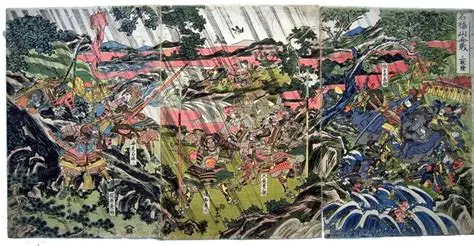
On the night of October 20, 1180, the Taira clan’s punitive force was positioned on the western bank of the Fuji River in Suruga Province.
The commander was Taira no Koremori, the eldest son of Taira no Shigemori, who had passed away the previous year, and was 23 years old by traditional Japanese count.
He was accompanied by Taira no Tadanori, Taira no Tomomori, and other clan warriors, with Ito no Tadakiyo handling the army’s operations.
To the east, Minamoto no Yoritomo was advancing. Additionally, around the Fuji River, Takeda no Nobuyoshi and other Kai Genji forces were deploying their troops.
In the middle of the night, Takeda no Nobuyoshi’s forces began to move.
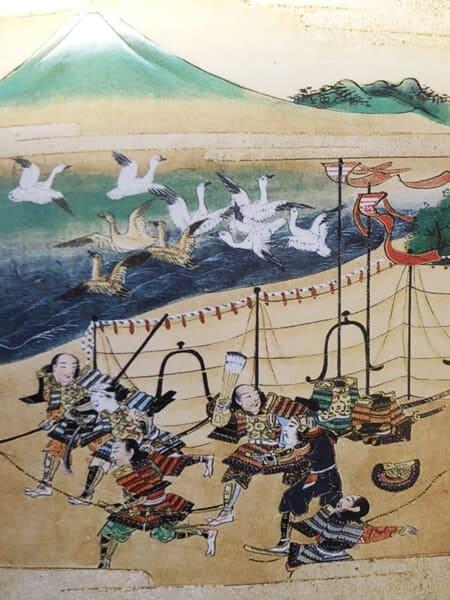
As they attempted to maneuver behind the Taira forces, waterfowl in the Fuji Marsh suddenly took flight.
The sound of countless wings filled the quiet night, causing a commotion in the Taira camp.
Soon, the punitive force abandoned their position and retreated westward.
This was the famous Battle of the Fuji River, as recounted in the ‘Tale of the Heike.’
The Taira forces had taken approximately three weeks to travel from Kyoto along the Tokaido road to reach this point.
Their retreat before a major confrontation was influenced by changes in the eastern provinces leading up to their arrival at the Fuji River.
The beginning of this shift can be traced back to about two months earlier at Ishibashiyama.
From Ishibashiyama to Awa—Yoritomo Advances North through the Eastern Provinces
On August 23, Minamoto no Yoritomo was defeated by Oba Kagechika’s forces at Ishibashiyama.
According to the ‘Azuma Kagami,’ Yoritomo’s side had just over 300 horsemen, while Oba’s forces numbered over 3,000.
After his defeat, Yoritomo, along with Doi no Sanehira and others, retreated into the Hakone mountains and set sail from Manazuru on August 28, crossing Sagami Bay to reach Awa Province.
From there, Yoritomo proceeded northward along the Boso Peninsula.
In Awa, he joined forces with Miura no Yoshizumi, and was soon joined by Chiba no Tsunetane from Shimosa and Kazusa no Hirotsune from Kazusa, who brought their troops to his side.
By the time he entered Musashi, even Hatakeyama no Shigetada, Kawagoe no Shigeyori, and Edo no Shigenaga, who had been on the opposing side at Ishibashiyama, had pledged their allegiance to Yoritomo.
Although the troop numbers recorded in the ‘Azuma Kagami’ are believed to be exaggerated, the entry for September 29 mentions over 27,000 horsemen, and the entry for October 2 mentions over 30,000.
Prominent warriors from various regions were bringing their families and retainers to join Yoritomo’s camp.
On October 6, Yoritomo arrived in Kamakura.
Forty-four days had passed since the defeat at Ishibashiyama.
Koremori Heads East from Kyoto
In response to Yoritomo’s uprising, the Taira clan also organized a punitive force.
Taira no Koremori, chosen as the commander, was the grandson of Taira no Kiyomori.
His father, Shigemori, had supported the Taira regime as Kiyomori’s heir, and after Shigemori’s death, Koremori represented the younger generation of the clan.
The ‘Tale of the Heike’ describes Koremori’s army as having over 30,000 horsemen at the time of departure, swelling to over 70,000 as they advanced along the Tokaido road.
The armies described in contemporary diaries differ significantly.
According to the information received by Kujo Kanezane in his diary, the ‘Gyokuyo,’ the Taira forces that reached the Fuji River numbered over 4,000 horsemen.
While the exact numbers cannot be determined, it’s unrealistic to take the “70,000 horsemen” mentioned in war tales as the actual military strength.
The punitive forces departed Kyoto on September 29.
They advanced eastward along the Tokaido, reaching the vicinity of Takahashi Station in Suruga Province by October 16.
There, Taira no Koremori and his men learned the outcome of the battle that had occurred earlier in Suruga.
October 14: The Kai Genji Enter Suruga
Takeda Nobuyoshi is an indispensable figure when discussing the Battle of the Fuji River.
Nobuyoshi was a military commander of the Kai Genji, descended from Minamoto no Yoshimitsu, and he, along with his kin such as Ichijo Tadayori, Itagaki Kanenobu, and Yasuda Yoshisada, were based in Kai.
When Minamoto no Yoritomo raised his army in Izu, the Kai Genji also mobilized their forces.
By October, Takeda Nobuyoshi and his men had advanced from Kai into Suruga.
They were met by Tachibana no Tomomune, the deputy governor of Suruga, who gathered troops from Suruga and Totomi to halt the advance of the Kai Genji.
On October 14, the two armies clashed at Hachida.
The Kai Genji, led by Takeda Nobuyoshi and Yasuda Yoshisada, defeated Tomomune’s forces, capturing Tomomune himself.
This battle placed Koremori’s forces, advancing from Kyoto, in a difficult position.
By the time the punitive forces arrived in Suruga, the local power that had sided with the Taira and gathered troops had already been defeated.
Nevertheless, on October 18, Koremori’s forces advanced to the west bank of the Fuji River.
The West Bank of the Fuji River: Over 4,000 Taira Horsemen
According to the ‘Gyokuyo,’ the Taira forces that reached the Fuji River numbered over 4,000 horsemen.
They prepared their forces for an attack planned for the following day.
However, soldiers began to desert the camp.
Hundreds of horsemen left, with some even defecting to the enemy.
The ‘Gyokuyo’ records that the remaining troops numbered less than 1,000 or 2,000 horsemen.
Meanwhile, the Taira forces received reports that the Takeda forces numbered over 40,000 horsemen.
This figure of 40,000 is also unlikely to be accurate.
It was not uncommon for medieval battle records to exaggerate enemy numbers.
The soldiers in camp heard rumors of an enemy force vastly outnumbering them nearby.
Itō Tadakiyo began to consider retreat.
Koremori expressed his intention to fight.
The ‘Gyokuyo’ notes that even though Tadakiyo advised retreat, Koremori was unwilling to withdraw.
Tadakiyo continued to argue based on the state of the forces.
The surrounding warriors also agreed with Tadakiyo, and eventually, Koremori accepted the decision to retreat.
At that time, Yoritomo’s forces were also approaching from the east.
October 20: Yoritomo Enters Kaga Island
On October 20, Yoritomo advanced into Kaga Island in Suruga Province.
This area corresponds to present-day Fuji City in Shizuoka Prefecture, on the eastern bank of the Fuji River.
On the western side of the Fuji River were the forces of Korehira, Tadamori, and Tomonori.
Meanwhile, in Suruga, Takeda Nobuyoshi and the Kai Genji had already made their entry.
The relationship between Yoritomo and the Kai Genji had not yet solidified into the later “Kamakura Shogunate and its vassals” form.
Takeda Nobuyoshi had his own base and forces in Kai, and he independently led his troops into Suruga.
It was also the Kai Genji who defeated Tachibana no Tōmochi at Hachida.
At the Fuji River, Yoritomo’s forces and the Kai Genji applied pressure on the Taira forces from the east.
That night, Takeda Nobuyoshi made his move.
The Night the Waterfowl Took Flight
According to the Azuma Kagami, on the night of October 20, Jisho 4, Takeda Nobuyoshi mobilized his troops to attack the rear of the Taira forces.
As the troops entered the vicinity of Fuji Swamp, the waterfowl gathered there suddenly took flight.
Fuji Swamp is thought to have been a wetland area stretching from the eastern part of present-day Fuji City to the western part of Numazu City.
The Azuma Kagami notes that the sound of their wings was like the noise of an army on the move.
The story of the waterfowl is made even more dramatic in the Tale of the Heike.
The Taira soldiers, fearing the eastern warriors, mistook the sound of the waterfowl’s wings at night for an attack by the Genji forces.
“Alas, the Genji’s great army is upon us!”
The soldiers hurriedly mounted their horses, abandoning their bows and armor as they fled.
This scene became widely known, and the Battle of Fuji River has been recounted as “the battle where the Taira fled in fear of the waterfowl’s wings.”
The story of the waterfowl itself appears in records earlier than the Azuma Kagami and the Tale of the Heike, both of which were compiled in the Kamakura period.
It is found in the diary of the Provisional Middle Counselor, Nakayama Tadachika, titled Yamakai-ki.
About half a month after the Battle of Fuji River, on November 6, Tadachika recorded the story that had reached Kyoto.
A large number of birds near the Taira army’s camp suddenly took flight at night, and their sound echoed like thunder. The soldiers thought the enemy was coming and withdrew during the night.
Tadachika was in Kyoto and not present at the scene.
Nevertheless, the story linking the waterfowl and the night retreat had reached the capital shortly after the battle.
Ito Tadakiyo Decides to Retreat
The waterfowl took flight, throwing the Taira camp into chaos.
According to the Azuma Kagami, Ito Tadakiyo and others then held a consultation.
The eastern warriors were beginning to rally under Yoritomo. If they continued, they risked being surrounded and losing their way back.
They decided to return to Kyoto and reorganize their forces.
Korehira and others accepted Tadakiyo’s advice.
The Taira forces headed west from the Fuji River before dawn.
At the Fuji River, unlike at Ishibashiyama, there was no prolonged, direct clash between the two armies.
Nevertheless, after the retreat began, a pursuit battle ensued.
Chasing the Retreating Taira Forces
As the Taira forces started moving west, the Genji troops gave chase.
The Azuma Kagami records that Iida Goro Ieyoshi and his son, Iida Taro, crossed the Fuji River to pursue the Taira forces.
Seeing this, Ito Musha Jiro, a warrior from Ise Province, turned back.
The two sides clashed, resulting in the death of Iida Taro.
Grieving his son, Ieyoshi killed Ito Musha Jiro.
It is also recorded that Indō Jiro Tsuneyoshi of the Taira side was killed at Samejima.
This was one of the few confirmed skirmishes at the Fuji River, where no major battle between the main forces occurred.
On October 22, Ieyoshi brought the head of Ito Musha Jiro to Yoritomo and reported the course of the battle.
The pursuing army of Koremori continued westward along the Tokaido.
Yoritomo’s Attempt to Pursue the Taira Forces
The day after the Taira forces withdrew, on October 21.
Yoritomo advanced westward, intending to pursue Koremori’s army.
There was even a plan to head directly to Kyoto.
Chiba Tsunetane, Miura Yoshizumi, and Kazusa Hirotsune advised him.
In the eastern provinces, there were still powerful warriors who had not submitted to Yoritomo.
Particularly, the Satake clan in Hitachi Province held significant power. Satake Takayoshi was in Kyoto serving the Taira, while his sons, Yoshimasa and Hideyoshi, were in Hitachi.
Advancing westward along the Tokaido while leaving the Satake clan behind would not stabilize control over the Kanto region.
Yoritomo decided to abandon the pursuit.
He entrusted Takeda Nobuyoshi with military actions in Suruga and Yasuda Yoshisada in Totomi, while he himself returned to the Kanto region.
On October 27, Yoritomo headed for Hitachi.
The next target was the Satake clan.
The Changing Battles in the Eastern Provinces from the Fuji River
On August 23 at Ishibashiyama, Oba Kagechika defeated Yoritomo.
On October 20 at the Fuji River, the Taira punitive force dispatched from Kyoto retreated westward.
In just 58 days, the situation in the eastern provinces had shifted dramatically.
Warriors from Boso, Musashi, and Sagami gathered under Yoritomo, who had crossed to Awa. In Kai, Takeda Nobuyoshi and others mobilized troops, advancing to Suruga and defeating Tachibana no Tōmo.
By the time Koremori’s forces arrived at the Fuji River, the Taira side in Suruga had already been defeated, and Yoritomo was approaching from the east.
After the Taira forces retreated, Yoritomo did not head for Kyoto.
There were still forces in the Kanto that had not submitted.
Yoritomo turned his troops back eastward, heading for Hitachi.
A week after the Fuji River, the battle with the Satake clan began.
For those who want to read more about the Battle of Fuji River, there is also “The Battle of Fuji River” by Kazuhiko Kawamura. This e-book covers the Fuji River battle of October 1180 and is reasonably priced at around 220 yen. It’s recommended for those who want to further follow the flow of the battle along with this article.

The Battle of Fujikawa [E-book] [Kawamura Kazuhiko]
In connection with Fuji City in Shizuoka Prefecture, the setting of the Battle of Fujikawa, we introduce rice crackers made with whitebait and sakura shrimp from Suruga Bay. These are a delightful and affordable Shizuoka souvenir, offering a taste of Fuji and Suruga right at your fingertips.