Episode 149
February 7, 1184, Ichinotani in Settsu Province.
The Taira forces were in disarray, with Genji horsemen pursuing the samurai fleeing towards the coast.
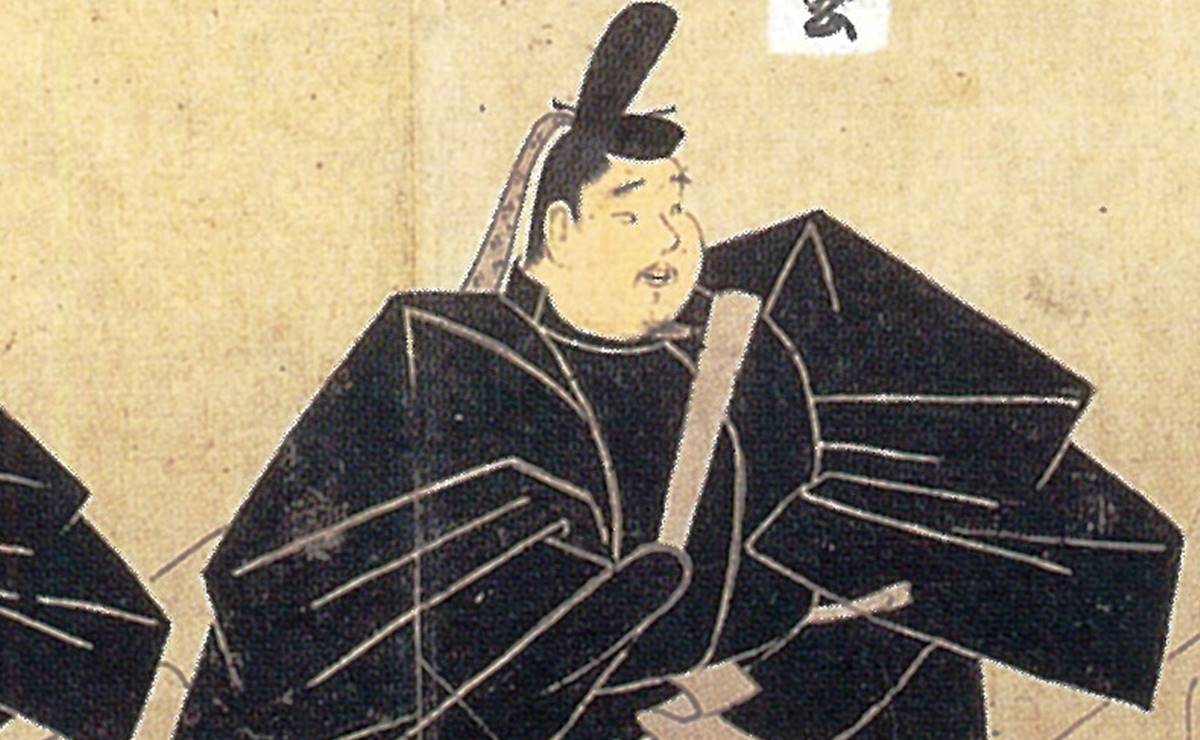
Among them was Taira no Tomomori, who had been defending the forest of Ikuta.
Taira no Kiyomori‘s fourth son, he rose to the rank of Junior Second Rank and Provisional Middle Counselor, becoming a prominent general of the Taira clan.
However, at that moment, the only ones remaining by Tomomori’s side were his son, Taira no Chikazane, and a retainer, Kanmotsu Taro Yorikata.
According to the “Heike Monogatari,” Volume Nine, “The Last Moments of Chikazane,” as the three fled towards the coast, about ten Genji warriors pursued them from behind.
Yorikata turned back and shot down an enemy, but the pursuers continued to close in.
Then, Chikazane turned his horse around.
He was sixteen years old.
He grappled with the enemy commander approaching his father, pulling him down from his horse.
Chikazane took his head.
But as he tried to stand, another enemy soldier attacked.
Chikazane was killed.
His father, Tomomori, witnessed the scene.
His son fought and lost his life to allow him to escape.
Yet Tomomori did not turn back, riding his horse towards the coast.
Eventually, Tomomori reached the ship where his brother Munemori was aboard, reportedly shedding tears and regretting his actions.
“How precious life is,” he lamented.
He had not realized how dear his life was.
The “Heike Monogatari” records these words.
The son who saved his father’s life died, while the father who did not save his son survived.
Tomomori continued to support the Taira forces thereafter.
In negotiations to save his brother Shigehira, he rejected his mother’s pleas.
He established a base at Hikoshima in Nagato Province, gathering troops from Kyushu to defend the Kanmon Straits.
A year later, the Taira clan met their end at Dan-no-ura.
There is a phrase attributed to Tomomori at that time.
“I have seen all there is to see.”
The warrior who once fled, leaving his son behind, was the last to sink into the sea.
Born as Kiyomori’s Fourth Son
Taira no Tomomori was born in 1152, the second year of Ninpei, as the fourth son of Taira no Kiyomori.
His mother was Taira no Tokiko, who would later be known as the Nun of the Second Rank.
Tomomori had a half-brother, Shigemori, and a full brother, Munemori. His younger brother, Shigehira, and sister, Tokuko, were also children of Tokiko.
Tokuko later became the consort of Emperor Takakura and gave birth to Emperor Antoku.
When Tomomori was young, his father Kiyomori was rapidly expanding his influence at the imperial court.
In 1156, the first year of Hogen, Kiyomori sided with Emperor Go-Shirakawa during the Hogen Rebellion.
In the following Heiji Rebellion of 1159, Kiyomori defeated Minamoto no Yoshitomo and other rival samurai forces, consolidating his power.
Subsequently, Kiyomori’s rank continued to rise.
By 1167, the second year of Nin’an, he had ascended to the position of Grand Minister of State, the highest rank in the court. Under Kiyomori’s leadership, many in the Taira clan also attained high positions.
Tomomori was granted official positions from a young age.
In the first year of Heiji, at the age of eight by traditional count, he was appointed to the Junior Fifth Rank, Lower Grade, and the following year, 1160, he became the Governor of Musashi.
Musashi Province corresponds to parts of present-day Tokyo, Saitama, and Kanagawa Prefectures.
There is no record of young Tomomori actually visiting Musashi Province; instead, he steadily advanced within the aristocratic system of the time, gaining income and authority through his official titles.
He continued to accumulate positions, such as in the Konoe Guards, enhancing his status at court.
Tomomori’s life took a significant turn when the internal conflicts with the Minamoto clan began.
Until then, his path was primarily as a court noble, but he eventually took on roles leading military forces across various regions.
“Kiyomori’s Most Beloved Son” as Recorded in the ‘Gyokuyo’
The expectations Kiyomori held for Tomomori are documented in contemporary records.
One such record is the diary ‘Gyokuyo’ by Kujo Kanezane.
In the entry for December 5, 1176, the second year of Angen, Kanezane wrote about Tomomori as follows:
“The most beloved son of the retired Chancellor.”
This refers to Kiyomori, the retired Chancellor, and his deep affection for Tomomori.
At this time, Tomomori was twenty-five years old by traditional count.
Kanezane also noted that Tomomori wielded unparalleled power at the time.
However, the record of that day did not announce Tomomori’s promotion.
In the appointment of the Kurando no To, Tomomori was not chosen.
The Kurando no To was a crucial position handling governmental affairs close to the Emperor.
Tomomori had experience as a Kurando and was in a position to expect the appointment.
However, those actually chosen were individuals close to Emperor Go-Shirakawa.
Tensions had already arisen between Kiyomori and Emperor Go-Shirakawa.
Their conflict over court appointments is thought to have affected Tomomori, who was favored by Kiyomori.
Nevertheless, Tomomori’s rise continued.
The following year, Angen 3 (1177), he was promoted to Junior Third Rank, joining the ranks of the court nobles.
By Juei 1 (1182), he had reached Junior Second Rank and Acting Middle Counselor.
In the “Tale of the Heike,” Tomomori is referred to as the “New Middle Counselor” due to this position.
Among Kiyomori’s children, Tomomori was particularly expected to excel by his father.
However, as the regime Kiyomori built began to falter, Tomomori left his cultivated position as a court official and headed to the battlefield.
Uji River, the First Major Battle
Jisho 4 (1180), May.
Prince Mochihito, a son of Emperor Go-Shirakawa, called for the overthrow of the Taira clan.
Joining him was Minamoto no Yorimasa.
Yorimasa was a Minamoto warrior who had long served the court and risen to Junior Third Rank.
Prince Mochihito and Yorimasa left Kyoto, aiming to head to Nanto via Onjoji.
However, the Taira forces were in pursuit.
The two armies clashed at the Uji River.
In the “Tale of the Heike,” Volume Four “Battle at the Bridge,” Tomomori and his brother Shigehira appear as the Taira’s commanding generals.
Tomomori held the position of Left Military Guard, while Shigehira was Head Middle Captain.
The Minamoto forces removed the planks of the Uji Bridge to hinder the Taira’s advance.
When the Taira soldiers rushed to the bridge, unaware that the planks had been removed at the front, many mounted warriors fell into the river.
Archery attacks began across the river.
It is said that the warrior monks of Onjoji fought valiantly on the Minamoto side, defeating the Taira warriors one after another.
Meanwhile, the Taira forces struggled to cross the bridge.
Then, Tadatsuna of Shimotsuke Province suggested crossing the river.
Crossing the swollen Uji River on horseback during the May rains posed a significant risk of being swept away.
Nevertheless, Yoshitsuna took the lead, guiding over three hundred horsemen into the river, as depicted in the ‘Tale of the Heike.’
The Taira forces successfully crossed the river and launched an attack on the Genji camp.
Yorimasa took his own life at Byodoin Temple.
Prince Mochihito also lost his life on the way to Nanto.
Tomomori and his forces suppressed the rebellion that had erupted near Kyoto.
However, Prince Mochihito’s call to arms had already reached various Genji factions across the land.
In August of the same year, Yoritomo raised an army in Izu, and Minamoto no Yoshinaka (Kiso Yoshinaka) began to expand his influence in Shinano Province.
The victory at Uji marked the beginning of an even larger conflict.
The Death of Kiyomori and the Era of Munemori
February 4, 1181 (Jisho 5, intercalary 2nd month).
Kiyomori passed away.
Tomomori was thirty years old by traditional count.
Kiyomori’s eldest son, Shigemori, had already died in 1179 (Jisho 3).
As a result, the leadership of the Taira clan fell to Munemori.
Munemori took charge of negotiations with the court and political decisions, while Tomomori and Shigehira supported military operations.
Even after his father’s death, the Taira continued their battles.
In March of the same year, at the Sumiyoshi River on the border of Owari and Mino Provinces, Taira forces clashed with the army of Minamoto no Yukie.
Yukie, a son of Minamoto no Tameyoshi and an uncle to Yoritomo, attempted a night assault, but the Taira detected it and defeated them.
While some biographies and later historical accounts suggest that Tomomori participated in the battle against Minamoto no Yukie, the ‘Azuma Kagami’ records the names of Shigehira and Koremori among the Taira commanders.
There is little recorded about Tomomori’s specific command actions.
While the Taira clan continued to achieve victories in various regions, Yoritomo was consolidating his power in the eastern provinces, and Minamoto no Yoshinaka was advancing along the Hokuriku Road.
In May of Juei 2 (1183), the Taira suffered a major defeat at Kurikara Pass.
They were subsequently defeated at Shinohara in Kaga Province, significantly reducing the forces defending Kyoto.
Even Enryaku-ji Temple leaned towards Yoshinaka’s side.
In July of the same year, Munemori left the capital with Emperor Antoku and the Imperial Regalia.
Tomomori also headed west with his family.
Once a key figure in the imperial court under Kiyomori’s influence, Tomomori now found himself retreating from Kyoto to protect the Taira clan.
Counterattack in the West, Victory at Mizushima
After leaving Kyoto, the Taira sought to regroup in Kyushu.
However, they faced resistance from the likes of Ogata Koreie in Bungo Province and were unable to establish a stable base around Dazaifu.
They then returned to the Seto Inland Sea, organizing their forces at bases such as Yashima in Sanuki Province.
In the western provinces, there were still samurai loyal to the Taira.
These included local warriors along the Seto Inland Sea coast and maritime forces capable of mobilizing ships.
Gathering these forces, they awaited an opportunity to advance eastward once more.
On the intercalary 10th month, 1st day of Juei 2.
At Mizushima in Bitchu Province, the fleets of Minamoto no Yoshinaka’s forces and the Taira clashed.
This corresponds to the area near Tamashima in present-day Kurashiki City, Okayama Prefecture.
The commander for Yoshinaka’s side was Yada Yoshikiyo.
The samurai general was Unno Yukihiro.
According to the “Tale of the Heike,” Volume Eight, “Battle of Mizushima,” the Taira’s commander was Tomomori, with the vice-commander being Noto no Kami Taira no Noritsune.
Noritsune was the son of Kiyomori’s brother, Taira no Norimori, and Tomomori’s cousin.
According to military chronicles, Noritsune ordered the ships to be linked together.
They tied the bows and sterns with ropes and placed planks between the ships.
This allowed the warriors to move across the fleet.
The Genpei forces exchanged arrows, and as the ships drew closer, they fought with swords and grappling hooks.
Eventually, Unno Yukihiro of Yoshinaka’s side was killed, and the commander Yada Yoshikiyo’s ship was sunk, leading to his death.
The battle ended in victory for the Taira.
On that day, a solar eclipse also occurred at Mizushima.
The “Gikeiki” records that Yoshinaka’s forces were thrown into confusion by the sudden darkness.
While the occurrence of the eclipse is confirmed by contemporary records, its impact on the outcome of the battle remains unclear.
The victory at Mizushima allowed the Taira to push back against the disadvantage they had faced since leaving the capital.
The next battlefield was to be Muroyama in Harima Province.
The Fifth Division Awaits at Muroyama
Around November 29, 1183.
The Taira clan engaged in battle with Minamoto no Yukie‘s forces at Muroyama in Harima Province.
Muroyama corresponds to the present-day area around Mitsu Town in Tatsuno City, Hyogo Prefecture.
Yukie, having fallen out with Minamoto no Yoshinaka, was independently leading his troops towards the western provinces.
The Taira commanders who confronted him were Tomomori and Shigehira.
According to the “Tale of the Heike,” Volume Eight, “The Battle of Muroyama,” the Taira forces numbered over twenty thousand horsemen, while Yukie’s forces were just over five hundred.
While the scale of the forces should be taken with the typical exaggeration of war chronicles in mind, it is clear that the Taira had amassed a significant army.
The Taira forces were divided into five divisions.
The first division was led by Iga Heinaizaemon Ienaga.
The second division was commanded by Etchu Jirobei Moritsugu.
The third division was under Kazusa Gorobei Tadamitsu and Aku Shichibei Kagekiyo.
The fourth division was led by Shigehira.
And in the fifth division, Tomomori held back with over ten thousand horsemen.
There are versions of the “Tale of the Heike” where the commanders of the first and second divisions are switched, but in all accounts, Tomomori’s large force is positioned at the end.
When Yukie’s forces attacked, the first division engaged for a while before opening up the center.
Yukie’s forces advanced through the gap.
Then the second division also opened up the center.
The third and fourth divisions reportedly did the same.
Believing he was breaking through the Taira lines, Yukie pressed further in.
But what awaited him was Tomomori’s fifth division.
When Yukie’s forces reached Tomomori, the troops that had opened the center turned back.
In front was Tomomori.
From behind came Shigehira and his forces.
Yukie’s army was surrounded.
The “Tale of the Heike” describes this as a pre-arranged Taira strategy.
Tomomori reportedly ordered his men to grapple with the enemy.
However, Yukie did not fall easily.
Tomomori’s trusted warriors, Ki Shichiemmon, Ki Hachiemmon, and Ki Kurou, were killed, and the Taira suffered losses.
In the end, Yukie broke through a section of the encirclement and escaped.
Though Yukie fled, his forces suffered a crushing defeat.
The “Gyokuyo” by Kujo Kanezane also records Yukie’s defeat at Muroyama.
Following their victory at Mizushima, the Taira advanced as far as the Fukuhara area.
They were once again on the verge of threatening Kyoto.
However, from the eastern provinces, Yoritomo’s forces were advancing westward.
The Fall of Ichinotani and the Forest of Ikuta
February, 1184.
Under the orders of Minamoto no Yoritomo, the forces led by Minamoto no Noriyori and Minamoto no Yoshitsune set out westward to defeat the Taira clan.
On February 5th, Yoshitsune’s army defeated the Taira forces at Mikusayama.
Two days later, a decisive battle unfolded at Ichinotani.
Tomomori was defending the area around the Forest of Ikuta.
This corresponds to the present-day Chuo Ward in Kobe City, Hyogo Prefecture.
The “Tale of the Heike” describes Tomomori as the general of the Forest of Ikuta.
Noriyori’s forces attacked from the east, while Yoshitsune and his men approached from the west and the mountains.
The Taira forces defended various locations, but their lines gradually began to crumble.
Taira no Tadanori, Taira no Atsumori, Taira no Tsunemasa, and Taira no Tomomori were killed in battle, and Tomomori’s younger brother, Shigehira, was captured alive.
Tomomori’s forces were also defeated.
According to the “Tale of the Heike,” Volume Nine, “The Last Moments of Tomonaga,” Tomomori, accompanied by his son Tomonaga and his retainer Yorikata, rode towards the coast.
There, they were overtaken by their pursuers.
Tomonaga, trying to protect his father, grappled with an enemy warrior and was killed at the age of sixteen.
Yorikata also lost his life trying to hold off the pursuers.
During this time, Tomomori managed to escape.
However, when Tomomori reached the coast, he faced yet another challenge.
The ships had already set sail.
The Legendary Horse Inoue Kuro Saves a Life
Tomomori was riding a black horse known as “Inoue Kuro.”
This renowned horse, said to have originated from Inoue in Shinano Province, was particularly skilled at swimming.
According to the “Tale of the Heike,” Tomomori rode the horse into the sea, swimming for over twenty cho.
Twenty cho is approximately 2.2 kilometers.
He finally reached Munemori’s ship, but it was already crowded with people.
There was no room to carry the horse.
Tomomori tried to send Inoue Kuro back to the shore.
However, the horse was reluctant to leave the ship.
Seeing this, Awa Minbu Shigeno took up his bow.
It would be better to shoot it than let it fall into enemy hands.
When Shigeno suggested this, Tomomori stopped him.
I cannot kill the horse that just saved my life.
It is said that Tomomori replied in this way.
Inoue Kuro swam near the ship for a while.
Eventually, as the ship sailed away, it returned to the shore, reaching shallow waters where it could stand, and neighed, looking back at the ship two or three times.
The Heike Monogatari also records the history of Inoue Kuro.
Originally, it was a horse cherished by Emperor Go-Shirakawa.
When Munemori became the Minister of the Interior, he was granted the horse, which was later entrusted to Tomomori.
Tomomori valued this horse greatly, and it is said that he prayed for its long life by worshipping Taizan Fukun on the first day of every month.
Afterward, Inoue Kuro was captured by the Genji warrior Kawagoe Kotaro Shigefusa and presented to Emperor Go-Shirakawa.
Since then, it was called “Kawagoe Kuro.”
Tomomori, who had lost his son at Ichinotani, refused to allow the horse that saved him to be killed, even if it meant it would fall into enemy hands.
Tears Shed Before Munemori
Tomomori boarded Munemori’s ship and stepped forward to his brother.
And he wept.
He had lost his son, Musashi-no-kami Tomonaga.
He had also let Kanmotsu Taro Yorikata be killed.
Now, he felt utterly forlorn.
According to the Heike Monogatari, Tomomori expressed these feelings.
Moreover, he regretted fleeing without saving his son.
“How dear life is,” he lamented.
Had it been someone else, he would have harshly criticized a father who abandoned his son to die.
Yet, when faced with the same situation himself, he couldn’t suppress his desire to survive.
Tomomori was ashamed of himself and covered his face with his armor sleeve as he wept.
Munemori also mourned Tomonaga’s death.
Tomonaga was a young man skilled in martial arts, with a promising future.
Munemori’s son, Kiyotsune, was also sixteen years old.
Munemori glanced at Kiyotsune with tears in his eyes, and the surrounding warriors also wetted their armor sleeves, as depicted in the Heike Monogatari.
Tomomori survived Ichinotani.
However, the Heike forces lost many commanders, and Shigehira was captured.
In the days that followed, Tomomori faced harsh decisions beyond the battlefield.
A Mother’s Plea for Her Son Shigehira’s Life
Shigehira, captured at Ichinotani, was sent to Kyoto.
Shigehira was the fifth son of Taira no Kiyomori and the younger brother of Tomomori by the same mother.
In the burning of Nanto in 1180, Shigehira led the Taira forces in a battle that resulted in the destruction of the halls and pagodas of Todai-ji and Kofuku-ji.
After being captured at Ichi-no-Tani, there were calls for Shigehira to face severe punishment.
Meanwhile, in Kyoto, Retired Emperor Go-Shirakawa sought to use Shigehira to retrieve the Imperial Regalia.
When the Taira fled the capital, they took Emperor Antoku and the regalia to the western provinces.
In Kyoto, Emperor Go-Toba had already ascended the throne, but the regalia were incomplete.
The Retired Emperor sent an envoy to the Taira, offering to spare Shigehira and allow him to return to Yashima if the regalia were returned.
This negotiation is depicted in the “Heike Monogatari,” Volume Ten, “Request Letter.”
When the imperial decree reached Yashima, a letter from Shigehira was also delivered to his family.
In the letter addressed to his mother, Tokiko, Shigehira expressed his wish to see her again and asked for the regalia to be returned to the capital.
It is said that Tokiko pressed the letter to her face and went before Munemori.
She then broke down in tears.
She longed to see Shigehira’s face once more.
She pleaded for the regalia to be returned and her son saved.
Although Munemori listened to his mother’s plea, he hesitated to comply.
Returning the regalia would affect the Taira’s position of supporting Emperor Antoku.
Moreover, many Taira warriors had died at Ichi-no-Tani.
Could they really hand over the regalia for the sake of Shigehira alone?
It is said that Munemori pondered this.
Then Tomomori offered his opinion.
Refusing the Deal to Save Shigehira
According to the “Heike Monogatari,” Tomomori judged that even if the regalia were returned, there was no guarantee that Shigehira would be released.
“Even if the regalia are returned to the capital, it is unlikely that Shigehira will be returned.”
Returning the regalia would not necessarily result in Shigehira’s return.
Tomomori reportedly stated this.
The family followed this opinion, and Munemori had a letter drafted to refuse Retired Emperor Go-Shirakawa’s demand.
His mother, Tokiko, was left in tears.
It is said that Shigehira’s wife was too overcome with grief to speak.
In this situation, Tomomori sought to protect Emperor Antoku and the regalia, which the Taira upheld.
Even with his brother’s life at stake, he could not trust in the success of the negotiation.
Having lost his son at Ichi-no-Tani, Tomomori now found himself opposing his mother’s wishes.
While the depiction of the meeting and Tomomori’s statements are from the “Heike Monogatari,” the Taira’s refusal to return the regalia was deeply tied to the political situation of the time.
As long as they supported Emperor Antoku in the western provinces, the Taira still had room to negotiate with the court.
Returning the regalia could jeopardize that position.
Ultimately, Shigehira could not return to the Taira.
Tomomori remained in the west, continuing to support the Taira’s military efforts.
Tomomori Fortifies Hikoshima Before the Fall of Yashima
After their defeat at Ichinotani, the Taira clan made Yashima in Sanuki Province a crucial stronghold.
Meanwhile, Tomomori also established a camp in Nagato Province.
This location was Hikoshima.
Hikoshima is an island in present-day Shimonoseki City, Yamaguchi Prefecture, situated on the western side of the Kanmon Straits.
The Azuma Kagami entry for February 16, 1185, records Tomomori’s movements.
“The new Middle Counselor Tomomori, accompanied by soldiers from nine provinces, fortified Moji and established a camp at Hikoshima.”
Tomomori led forces from Kyushu to secure Moji and set up his camp at Hikoshima.
This record dates to three days before Yoshitsune’s attack on Yashima.
Tomomori had established a military base between Nagato Province and Kyushu even before the fall of Yashima.
Moji corresponds to the area around present-day Moji Ward in Kitakyushu City, Fukuoka Prefecture.
The Kanmon Straits were a vital maritime route between Honshu and Kyushu.
Controlling this area allowed for monitoring ship movements from the Seto Inland Sea to Kyushu.
It was also crucial for transporting troops and supplies from Kyushu to Nagato Province.
The Taira clan was supported by seafaring warriors such as the Yamaga clan from Chikuzen Province and the Matsuura party from Hizen Province.
Tomomori relied on these forces to strengthen the defenses around the Kanmon Straits.
Meanwhile, Minamoto no Noriyori advanced westward along the Sanyo Road.
Despite struggling with a shortage of provisions and ships, Noriyori’s army obtained vessels from warriors in Bungo Province to cross over to Kyushu.
On February 1, 1185, they defeated the Taira forces at Ashiyahama.
This location corresponds to the area near present-day Ashiya Town in Onga District, Fukuoka Prefecture.
The Genji forces began to pressure the Taira not only from the Honshu side but also from Kyushu.
The movements of these forces prompted Tomomori to fortify Hikoshima and Moji.
Losing Yashima and Gathering the Remaining Ships
On February 19, 1185.
Minamoto no Yoshitsune launched a surprise attack on Yashima in Sanuki Province.
In the midst of a storm, Yoshitsune crossed to Awa and appeared behind the Taira by traversing the mountain paths.
Munemori and others moved Emperor Antoku onto a ship and retreated to the sea.
During this time, Yoshitsune’s forces set fire to the imperial palace at Yashima.
The Taira attempted a counterattack but could not reclaim their stronghold at Yashima.
Yoshitsune continued his pursuit towards the Shido area.
Tanai Saemon-no-jo, who had been with the Taira, surrendered, and Kono Michinobu from Iyo Province joined the Genji side.
The forces supporting the Taira in Shikoku began to defect one after another.
During this time, Tomomori was fortifying defenses centered around Hikoshima and Moji.
However, with Noriyori’s forces active in Kyushu, the Taira had fewer places to retreat freely.
Emperor Antoku and Munemori headed towards Nagato Province as their last destination.
The Kanmon Straits, where Tomomori had gathered his forces, would become the stage for the final battle between the Genji and the Taira.
Words Spoken Before Dan-no-ura
March 24, 1185.
Dan-no-ura in Nagato Province.
According to the Azuma Kagami, the Genji forces had over 840 ships, while the Heike had over 500.
The Heike fought with Yamaga Hidechika from Chikuzen Province and the Matsuura clan from Hizen Province leading the vanguard.
The Tale of the Heike records different numbers of ships, and the exact count remains uncertain.
However, it is certain that the Heike gathered their fleet in the waters of Nagato Province to face the Genji in a final showdown.
In Volume Eleven of the Tale of the Heike, it is said that Tomomori stood on the deck of a ship, encouraging his warriors.
“Today is the limit for our army.”
This battle would be the last.
Tomomori reportedly declared this.
No matter how renowned a general, fate can lead to defeat.
Yet, do not tarnish the name of a warrior by showing weakness to those from the eastern provinces.
It is said he called out in this manner.
The Heike had lost many commanders at Ichi-no-Tani.
Shigehira was taken captive, and they lost Yashima.
In Kyushu, Noriyori’s forces were active, and in Shikoku, defections among warriors were increasing.
Tomomori, aware of this situation, still led his remaining forces into battle.
However, as the battle on the ships progressed, grim news began to reach the Heike.
The Defection of Awa Minbu Shigeno
The Tale of the Heike recounts that at Dan-no-ura, Awa Minbu Shigeno defected to the Genji side.
Also known as Taguchi Nariyoshi, Shigeno had long served the Heike as a prominent warrior of Awa Province.
He led the warriors of Shikoku, supporting the Heike’s military endeavors.
It was Shigeno who attempted to shoot Tomomori’s beloved horse at Ichi-no-Tani.
However, as the Genji expanded their influence in Shikoku, Shigeno’s position began to shift.
In Volume Eleven “The Former Emperor’s Departure” of the Tale of the Heike, it is said that Shigeno’s son, Tanai Saemon Noriyoshi, was captured by the Genji, which contributed to his defection.
Shigeno left the Heike and joined the Genji.
Upon hearing this news, Tomomori regretted it.
He wished he had cut down Shigeno.
The Tale of the Heike records that Tomomori thought this.
The same text also states that Shigeno’s defection revealed the Heike’s plans to the Genji.
The Heike had placed common soldiers on conspicuous Chinese-style ships, moving key commanders to other vessels.
The plan was to encircle the Genji if they attacked the Chinese-style ships.
However, because Shigeno leaked this information, the Genji avoided the Chinese-style ships and targeted the vessels carrying the Heike clan.
The detailed course of this strategy is based on war tales, and uncertainties remain about when and how Shigeno actually defected.
In the Azuma Kagami, Nariyoshi is listed as one of those captured at Dan-no-ura.
Meanwhile, in “The Tale of the Heike,” Shigeno’s defection is depicted as a significant event leading to the Taira clan’s defeat.
Tomomori had been gathering forces in Nagato Province and rallying troops from Kyushu to fight.
For Tomomori, losing influential samurai allies was a severe blow.
The Messenger Sent to Noto-no-kami Noritsune
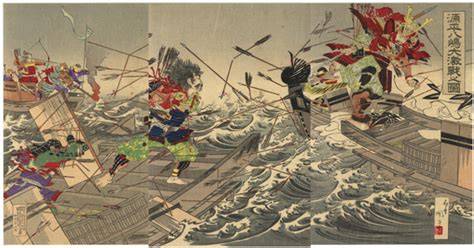
As the battle progressed, the Genji warriors began boarding the Taira ships.
The Taira forces were losing their ships and their escape routes.
Amidst this, Tomomori’s cousin, Noto-no-kami Taira no Noritsune, continued to fight fiercely.
Noritsune was the son of Kiyomori’s brother, Tadamori.
In “The Tale of the Heike,” it is said that even after exhausting his arrows, he boarded enemy ships with a large sword and naginata, cutting down samurai one after another.
Tomomori, witnessing this, sent a messenger.
“Lord Noto, do not commit such grave sins.”
Stop needlessly killing and accumulating sins.
Are the opponents you are fighting now truly such formidable enemies?
It is said that Tomomori conveyed this message.
Upon hearing these words, Noritsune decided that his target should be the enemy commander.
He then searched for Minamoto no Yoshitsune, moving from ship to ship, and eventually cornered him.
Yoshitsune leaped to another ship to escape.
This scene later became famous as the “Eight-Boat Leap.”
Noritsune was unable to capture Yoshitsune and, in the end, sank into the sea with two enemy warriors.
However, there are records that claim Noritsune died in battle at Ichinotani, and the pursuit of Yoshitsune and the final struggle are anecdotes depicted in “The Tale of the Heike.”
Tomomori, too, was facing his final moments as the Genji forces closed in.
Towards Emperor Antoku’s Imperial Ship
The Genji ships were boarding the Taira ships one after another.
According to “The Tale of the Heike,” the sailors and helmsmen were being shot and cut down, making it difficult to even maneuver the ships.
The Taira warships had no escape.
Tomomori boarded a small boat and headed towards Emperor Antoku’s imperial ship.
Onboard were Emperor Antoku’s mother, Kenreimon-in Tokuko, and his grandmother, Nii no Ama Tokiko.
Tomomori spoke.
“The world is now as it is.”
It is over.
He urged them to discard anything unsightly into the sea.
It is said that Tomomori himself ran from the bow to the stern, sweeping the deck and picking up debris.
The ladies-in-waiting, seeing this, inquired about the state of the battle.
“Lord Chunagon, how goes the battle?”
Tomomori replied.
“You shall soon see these rare men from the east.”
With those words, he laughed aloud.
The women wailed in despair.
The Genji warriors were about to board the imperial barge.
Tomomori’s words foretold this.
The Drowning of His Mother Tokiko and Emperor Antoku
In the “Tales of the Heike,” Volume Eleven “The Former Emperor’s Drowning,” it is depicted that after Tomomori announced their defeat, Nii-no-Ama Tokiko took Emperor Antoku in her arms and headed for the edge of the ship.
Tokiko was the wife of Kiyomori and the mother of Tomomori.
To Emperor Antoku, she was his maternal grandmother.
Emperor Antoku was eight years old by traditional counting.
Since the Heike left the capital, he had been traveling with Munemori and others through the western provinces.
It is said that Tokiko carried the sacred mirror under her arm and wore the treasured sword at her waist.
Then she lifted Emperor Antoku in her arms.
The emperor is said to have asked where they were going.
Tokiko told him they were heading to the Western Pure Land.
“Even beneath the waves, there is a capital.”
With these comforting words, she entered the sea with Emperor Antoku.
On the other hand, “The Azuma Kagami” records that it was a lady-in-waiting named Anshitsu who carried Emperor Antoku into the water.
Anshitsu was rescued from the sea, but Emperor Antoku did not return.
There are discrepancies in the records regarding their final moments.
However, multiple accounts confirm that Tomomori’s mother, Tokiko, perished at Dan-no-ura.
Additionally, Kiyomori’s brothers, Norimori and Tsunemori, as well as Shigemori’s sons, Koremori and Arimori, also threw themselves into the sea.
Munemori and his son Kiyotsune were captured alive, while Kenreimon-in Tokuko was rescued.
Of the Three Sacred Treasures, the treasured sword was lost to the sea.
Emperor Antoku never returned to the capital.
Amidst all this, Tomomori remained on the ship until the end.
“I Have Seen All There Is to See”
Having witnessed the end of the Taira clan, Tomomori decided to enter the sea himself.
This scene is preserved in “The Tales of the Heike,” Volume Eleven “The Imperial Palace’s Entry.”
“I have seen all there is to see; what more is there to await?”
I have seen all that needed to be seen.
What more could there be to wait for?
It is said that Tomomori spoke these words.
Then he called for his wet nurse’s son, Iga Heinaizaemon Ienaga.
The term “wet nurse’s son” refers to someone who is the child of one’s wet nurse, indicating a close relationship from childhood.
Ienaga was a warrior who served Tomomori and had accompanied him in battles such as the Battle of Muroyama.
There was reportedly a longstanding promise between Tomomori and Ienaga.
It was a vow to share the same fate until the very end.
Tomomori asked Ienaga,
“Will you not break our agreement from days past?”
Surely, you won’t break the promise we’ve held for so long.
Ienaga replied,
“Indeed, I will not.”
Of course.
Ienaga prepared two sets of armor.
He helped Tomomori don two layers of armor and then put on two layers himself.
This was to sink into the sea.
Then, hand in hand, the two walked into the sea.
The Tale of the Heike records that over twenty warriors, witnessing this, followed them into the depths.
Tomomori was born in the second year of Ninpei (1152).
He died on March 24, in the second year of Genryaku (1185), at the age of thirty-four by traditional counting.
At Ichinotani, he fled after witnessing his son’s death.
At Dan-no-ura, he watched as the people of the Taira clan sank into the sea.
The Tale of the Heike has Tomomori say, “I have seen all there is to see.”
Tomomori Sinking with an Anchor
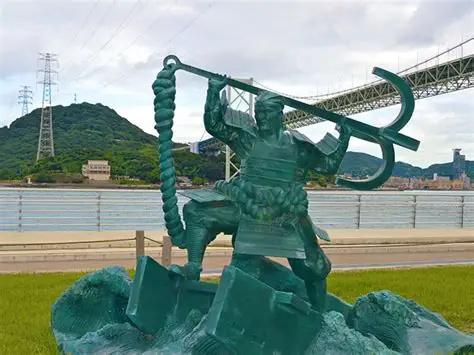
Today, Tomomori’s end is widely known as the image of him sinking into the sea with a large anchor.
However, in the Kakuichibon version of The Tale of the Heike, Tomomori is depicted wearing two sets of armor and entering the water hand in hand with Iga no Ienaga.
The image of him sinking with an anchor became popular through later theatrical productions.
The most notable of these is “Yoshitsune Senbon Zakura.”
First performed as a puppet play in Osaka in the fourth year of Enkyō (1747), it was later adapted for kabuki.
In this work, Tomomori, who was supposed to have died at Dan-no-ura, is actually alive.
He had assumed the identity of Ginpei, the owner of a boat inn at Daimotsu-no-ura in Settsu Province.
Daimotsu-no-ura corresponds to the present-day area around Amagasaki City in Hyogo Prefecture.
Tomomori was waiting for an opportunity to defeat Minamoto no Yoshitsune.
However, his plan failed.
When Yoshitsune discovered his true identity and cornered him, Tomomori wrapped a large anchor’s rope around himself and threw the anchor into the sea.
Its weight dragged him to the ocean floor.
This scene became widely known as “Anchor Tomomori.”
Tomomori also appears in the Noh play “Funa Benkei.”
As Yoshitsune, in conflict with his brother Yoritomo, attempts to escape to the west, a storm arises at sea from Daimotsu-no-ura.
The vengeful spirits of the Taira clan appear.
At their center is Tomomori.
He brandishes a naginata and attacks Yoshitsune.
However, he is driven back by Benkei’s prayers and disappears once more into the sea’s depths.
Taira no Tomomori, who lost his life at Dan-no-ura, became a military commander in later cultural works, forever pursuing Yoshitsune even after death.
The Statue of Taira no Tomomori at the Kanmon Straits
In present-day Shimonoseki City, Yamaguchi Prefecture, there is Mimosusogawa Park, which overlooks the historic battlefield of Dan-no-ura.
In this park facing the Kanmon Straits, statues of Minamoto no Yoshitsune and Taira no Tomomori have been erected.
Yoshitsune is depicted leaping from ship to ship.
Tomomori is shown carrying a large anchor, preparing to sink into the sea.
The statue of Tomomori is based on the image of “Anchor Tomomori” popularized by later works such as “Yoshitsune Senbon Zakura.”
In front of the park, the Kanmon Straits stretch out, with the Moji ward of Kitakyushu City visible across the water.
Even now, many ships pass through the straits, with the currents changing with the tides.
This is the sea where Tomomori is said to have met his end on March 24, 1185.
In “The Tale of the Heike,” Tomomori did not enter the sea with a large anchor.
His wet nurse’s son, Iga no Ienaga, dressed Tomomori in two suits of armor.
Ienaga himself also wore two suits of armor, and the two of them held hands.
Then, they entered the sea together, as recorded.
Today, at the Kanmon Straits, stands the statue of Tomomori carrying a large anchor, an image that spread during the Edo period stage plays.
At his feet, ships pass by, carried by the flow of the tides.