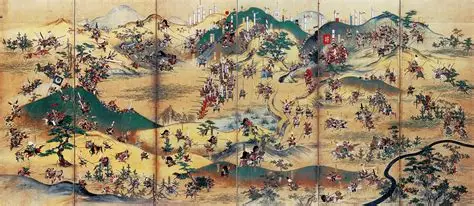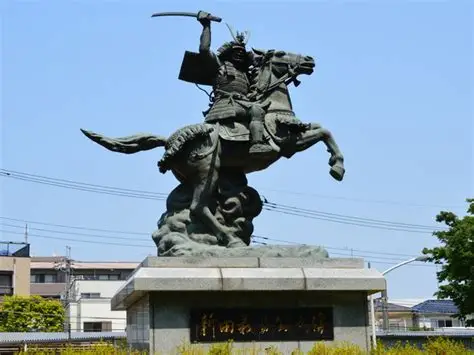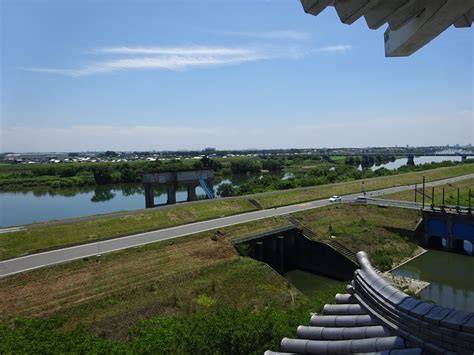
On March 10, 1181, the Genpei forces faced each other across the Sumiyoshi River, which flows along the border of Mino and Owari provinces.
Approaching from the west was the Taira army led by Taira no Shigehira.
Joining him were other prominent Taira commanders, including Taira no Koremori, Taira no Tomomori, Taira no Tadanori, and Taira no Chikakata.
Opposing them was Minamoto no Yukie.
Among Yukie’s forces was Minamoto no Yoshitomo‘s son, Yoshikata.
He was the half-brother of Yoritomo and the full brother of Yoshitsune.
Having entered a temple at a young age and lived as a monk for a long time, the Sumiyoshi River became one of the few battlefields where Yoshikata’s name prominently appeared in historical records.
In October of the previous year, the Taira forces had been unable to maintain their position at the Fuji River and had retreated.
About five months later,
having just lost Kiyomori, the Taira once again sent their forces to the Tokaido region and this time defeated the Minamoto forces at the Sumiyoshi River.
In this battle, Minamoto no Yukie lost many of his troops, and Yoshikata did not return.
Shortly After Kiyomori’s Death, the Taira Sent Troops Again to the Tokaido
On December 28, 1180, during Taira no Shigehira’s assault on Nanto, the halls of Todai-ji and Kofuku-ji were engulfed in flames.
At the beginning of the new year, on February 4, 1181, Taira no Kiyomori, who had led the Taira, passed away.
Since the previous year, anti-Taira movements had been spreading across the country. Minamoto no Yoritomo was expanding his influence in the eastern provinces from his base in Kamakura, and the Kai Genji continued their activities. In Shinano, Minamoto no Yoshinaka (Kiso Yoshinaka) was gathering troops, and forces opposing the Taira were active in Omi, Mino, and Owari.
In the Tokaido region, Minamoto no Yukie was gathering troops.
Yukie was a son of Minamoto no Tameyoshi and the brother of Minamoto no Yoshitomo, making him Yoritomo’s uncle.
In April 1180, when Prince Mochihito issued a call to arms against the Taira, Yukie took on the role of conveying this intent to the various Minamoto clans across the provinces.
Subsequently, he gathered his own troops and advanced towards the Owari and Mikawa regions.
The Tokaido route, which passes through Mino to Owari, was a crucial pathway connecting the capital with the eastern provinces.
If Yukie’s influence expanded here, it would pose a significant threat to the Taira clan.
Shortly after Kiyomori’s death, the Taira clan dispatched a punitive force to the Tokaido.
The army was led by Taira no Shigehira.
It had only been a few months since he commanded the attack on Nanto.
Shigehira’s forces were joined by Taira no Koremori, Taira no Tomomori, Taira no Tadanori, and Taira no Chikahira.
Koremori, who had retreated at Fujikawa the previous year, was once again part of the forces heading to the eastern provinces.
The records of troop numbers vary depending on the source.
Kujō Kanezane’s diary, “Gyokuyō,” records Yukie’s forces as “over five thousand horsemen,” while “Kikki” states “over three thousand horsemen.”
There are also discrepancies in the records regarding the Taira side, and later military tales present even larger numbers, making it difficult to determine the exact size of both armies.
Nevertheless, it is evident from the records left after the battle that the Taira clan deployed a substantial force to the Tokaido to suppress Yukie.
In March of the fifth year of Jishō, both armies approached the border between Mino and Owari.
Yoshitomo’s Son, Gien, Raised in a Temple
Among Yukie’s ranks was Gien, the son of Minamoto no Yoshitomo.
Gien was born to Yoshitomo and Tokiwa Gozen, and his childhood name was Otowaka.
His full brother was Imawaka, later known as Ano Zenjo. His younger brother, Ushiwaka, would later take the name Minamoto no Yoshitsune.
In the first year of Heiji (1159), their father Yoshitomo was defeated in the Heiji Rebellion and was killed while fleeing to Owari.
The young brothers would walk a different path from their father.
Otowaka entered a temple and grew up as a monk. He eventually took the name Gien and was also known as “Kyōko.”
About 20 years later, in the fourth year of Jishō, Yoritomo raised an army in Izu.
It was also a time when the sons of Yoshitomo, scattered across the land after the Heiji Rebellion, reappeared on the historical stage.
Gien joined Yukie’s forces and threw himself into the struggle against the Taira clan.
The details of how Gien came to join Yukie vary between sources.
In the later work ‘The Tale of the Heike,’ it is depicted that Yoritomo sent Yoshitsune with troops, instructing him to “join forces with Juro Kurando Yukie.”
The Azuma Kagami entry for March 10, 1181, notes that Yoshitsune, along with Yukie and his son Mitsuie, led warriors from Owari and Mikawa, but it does not mention the circumstances of their dispatch by Yoritomo.
On March 10, 1181, Yoshitsune was on the battlefield at Sunomata River with Yukie.
His life from this point onward was not to last long.
The Genpei Armies Face Off Across Sunomata River
The Sunomata River corresponds to the Nagara River, which flows through the southwestern part of present-day Gifu Prefecture.
It was a strategic point when advancing from Mino to Owari, and if the Taira forces broke through here, they would enter Owari.
Further advances into Mikawa, Totomi, and Suruga would lead them to the eastern provinces where Yoritomo was consolidating his power.
On March 10, the Genpei armies confronted each other near Sunomata River.
The Azuma Kagami records that on the Genji side, Yukie, his son Mitsuie and Jiro, Yoshitsune, and Izumi Taro Shigemitsu led warriors from Owari and Mikawa.
On the Taira side, the names included Shigehira, Koremori, Tomomori, Tadanori, Chikado, Moritsuna, and Morihisa.
In the previous year at the Fuji River, the Taira forces had retreated before engaging in a large-scale battle with Yoritomo’s forces.
At Sunomata, the two armies were set to clash in combat.
The Gyokuyo entry for March 13, 1181, contains a report that reached the capital a few days after the battle.
It conveyed that as the government forces attempted to cross Sunomata, approximately 5,000 anti-Taira horsemen from the Owari region advanced against them.
As both armies were stationed by the river, Yukie planned a night raid to offset the disparity in numbers.
Yukie’s Night Raid Plan Exposed to the Taira
According to the Azuma Kagami, as night fell, Yukie devised a plan to secretly attack the Taira forces.
He intended to cross the river under the cover of darkness and launch an assault on the Taira camp.
However, someone detected the movement before Yukie’s forces could act.
It was Kaneshimaru, who served under Taira no Shigehira.
Kaneshimaru noticed the Genji army’s movements while out at Sunomata River to wash his horse.
Upon receiving the alert, the Taira forces took action before Yukie’s attack could commence.
Shigehira’s troops moved first, striking the Genji forces who were preparing for the night raid.
Yukie’s army, intending to take the enemy by surprise, lost the initiative before they could launch their attack.
Combat erupted by the riverside.
The Collapse of Yukie’s Forces at Sunomata River
The report in the Gyokuyo states that the battle lasted from the hour of the snake to the hour of the monkey.
Though the exact hours cannot be directly translated to modern time, it indicates that the fight was not a brief skirmish but extended over several hours.
Yukie’s forces missed the chance for a night attack, and the Taira army held the advantage in numbers.
As the battle lines crumbled, Yukie’s troops were driven into the river.
For warriors clad in armor, retreating into a river was perilous. If they fell from their horses, the heavy armor would drag them into the current, making it difficult to reach the shore.
The Azuma Kagami records that many drowned in the river or succumbed to their injuries.
The same chronicle reports the death toll as “over 690.”
In a victory report sent to the Gyokuyo, even larger numbers are mentioned, with over 1,000 killed in battle and more than 300 drowning in the river afterward.
The Kikki provides specific figures for the heads and captives taken by the Taira forces.
These include 213 by Shigehira’s forces, 67 by Tomomori’s, 74 by Koremori’s, 21 by Tadanori’s, and 8 by Tomonori’s, among others.
These records, transmitted through different channels, cannot be simply added together to determine the actual number of casualties. However, the multiple sources reporting significant losses suggest that Yukie’s army suffered a devastating blow at the Mino River.
Amidst this chaos, Gien was also fighting against the Taira forces.
Gien Falls at the Mino River
The Azuma Kagami offers a succinct account of Gien’s end.
Zen Master Gien was slain by Taira no Moritsuna.
But how exactly was he killed?
The chronicle provides no further details.
In later accounts like the Heike Monogatari, Gien’s final moments are depicted in more detail.
According to this narrative, Yukie and Gien were competing to be the first into battle.
Gien, eager to achieve glory before Yukie, crossed the river alone to hide on the Taira side.
When Yukie’s forces began to cross, Gien announced himself and attempted to lead the charge.
This scene highlights Gien’s bravery, though it is absent from the Azuma Kagami and Gyokuyo.
It must be read as a portrayal of Gien from later war tales.
What can be confirmed from historical sources is that Gien fought alongside Yukie’s army at the Mino River and was killed by Taira no Moritsuna.
Gien is believed to have been in his twenties.
When his father, Yoshitomo, was defeated in the Heiji Rebellion, Gien was still a child.
He was subsequently raised in a temple, spending years as a monk.
About 20 years after his father’s death, as Minamoto forces across the land rose against the Taira, Gien joined the battlefield, only to fall at the Mino River.
It was around this time that his younger brother, Yoshitsune, met Yoritomo and began to emerge as a central figure in the Genpei War.
Unlike Yoshitsune, Gien never had the chance to fight in battles like Ichinotani, Yashima, or Dan-no-ura.
Yukie’s Son Captured, Army Collapses
It wasn’t just Yoshimaru who was lost at the Battle of Sunomata River.
According to the Azuma Kagami, Kurando Jiro, the son of Yukie, was captured alive by Taira no Tadanori.
Izumi Taro Shigemitsu and his brother were also killed by Taira no Morihisa.
Having lost its key commanders, Yukie’s army could no longer maintain order, and the soldiers attempted to flee across the river.
Yukie himself was in a perilous situation.
The initial report in the Gyokuyo even suggested that Yukie was injured, entered the river, and possibly died.
The chaos of Yukie’s army’s retreat was so severe that news reaching the capital left his fate uncertain.
Yukie survived and retreated from Owari to the Mikawa region.
The Taira forces crossed the Sunomata River and pursued them.
The Retreat Continued to Yahagi River in Mikawa
Yukie entered Mikawa Province, retreating as far as the Yahagi River.
This is around present-day Okazaki City in Aichi Prefecture.
The Taira forces also advanced eastward, pursuing Yukie.
In military chronicles, battles between the two forces are depicted even at Yahagi River.
Having lost many soldiers at Sunomata, Yukie did not have the strength to repel the Taira pursuit forces.
Yukie, who had been expanding his influence in Owari and Mikawa, faced a significant setback due to this defeat.
From the Taira perspective, it was a victory that regained the momentum lost at the Fuji River the previous year.
At the Fuji River, the pursuit forces led by Koremori were unable to maintain the front line and had to retreat.
About five months later, forces led by Shigehira defeated Yukie’s army at Sunomata River and advanced from Owari to Mikawa.
Even shortly after Kiyomori’s death, the Taira still had the power to assemble a large army and send it to the Tokaido.
Defeated Yukie Continues to Appear on the Battlefield
The major defeat of Yukie’s forces at Sunomata River was significantly influenced by the disparity in troop strength with the Taira forces, as well as the fact that their plan for a night attack was anticipated and preempted.
The presence of the Sunomata River where the battle lines broke also exacerbated the losses. Both the Azuma Kagami and the Gyokuyo record drownings, indicating the severe chaos at the riverbank during the retreat.
Nevertheless, Yukie did not perish in this battle.
He later allied with Minamoto no Yoshinaka (Kiso Yoshinaka) and became involved in the conflict between Yoshinaka and Yoritomo.
Even after Yoshinaka’s downfall, he survived and eventually joined forces with Yoshitsune, who was in conflict with Yoritomo.
The man who had spread the imperial edict for the Taira’s subjugation across the land would continue to navigate the internal strife within the Minamoto clan.
At Sunomata River, it was Yoshimaru who met his fate alongside Yukie.
The Heiji Rebellion claimed the life of his father, Minamoto no Yoshitomo, leaving the young boy, Otowaka, to be raised in a temple. Upon reaching adulthood, he took the name Minamoto no Gien. During the Jisho era, when the Minamoto clan once again took up arms, he joined Yukie’s forces heading towards the Sumidagawa River, where he met his end at the hands of Taira no Moritsuna on March 10, 1181.
Meanwhile, Yoritomo was alive in Kamakura, and his half-brother Yoshitsune was about to enter the battlefield.
Gien’s life came to an end at Sumidagawa.
The Taira clan emerged victorious in this battle.
However, in the eastern provinces, Yoritomo was consolidating his power, while in Shinano, Minamoto no Yoshinaka’s forces were growing stronger.
About two years after Sumidagawa, in the second year of Juei (1183), the Taira would face Yoshinaka’s army advancing from the Hokuriku region.
For Those Who Want to Know More About the Genpei War
Fuji River, Sumidagawa, Kurikara Pass, Ichinotani, Yashima, Dan-no-ura—
Following each battle of the Genpei War individually can make it difficult to understand the movements of the Minamoto and Taira clans across the regions.
“The Complete Illustrated Guide to the Genpei War” is a book that allows you to trace the flow of the Genpei conflict with maps and illustrations.
From the Battle of Sumidagawa, where Yukie was defeated, to Yoshinaka’s advance, Yoshitsune’s emergence, and the eventual downfall of the Taira, this book is recommended for those who want to read in chronological order.
👉 Check out “The Complete Illustrated Guide to the Genpei War” on Rakuten Ichiba and Rakuten Books

The Complete Illustrated Guide to the Genpei War (Yosensha Mook)