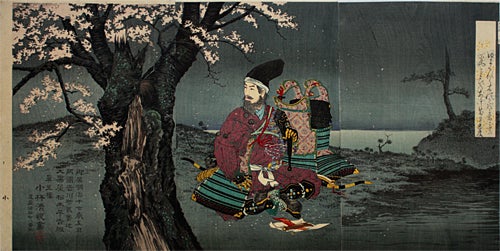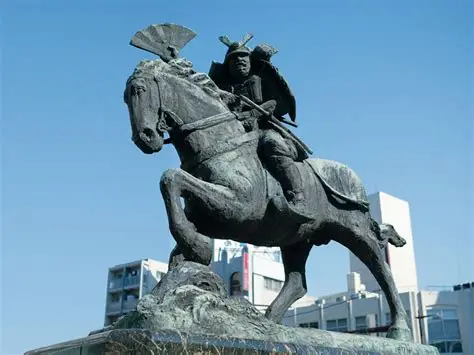
On November 25, 1192, in front of Minamoto no Yoritomo in Kamakura, a samurai erupted in anger.
Kumagai Jirō Naozane.
He was a samurai from Musashi Province who had served Minamoto no Yoritomo’s uprising, earning military distinction in the campaign against the Satake clan and at the Battle of Ichi-no-Tani.
On this day, Naozane was embroiled in a dispute over land in Kumagai Village, Musashi Province, with Kuge Naomitsu. His opponent was a maternal relative with whom he had a long-standing relationship since childhood, and they had been contesting the rights to the land for many years.
According to the “Azuma Kagami,” Yoritomo repeatedly questioned Naozane to hear both sides of the argument. However, Naozane grew frustrated at being the only one interrogated and suspected that Kajiwara Kagetoki was siding with the opposition.
Finally, Naozane threw down the lawsuit documents and stood up.
It is said that he then went to the western quarters, took a sword, and cut off his topknot.
This was a declaration of his intention to renounce his samurai status and become a monk.
However, a document dated March 1, 1191, the previous year, shows that Naozane had already transferred the land to his son.
In it, he was already referred to as “Jitō Monk Renshō.”
This suggests that Naozane had adopted a monk’s name even before the land dispute depicted in the “Azuma Kagami” as the catalyst for his renunciation.
There is another well-known story about Naozane’s decision to become a monk.
In 1184, during the Battle of Ichi-no-Tani, Naozane killed Taira no Atsumori and, upon learning of his youth, was deeply remorseful. “The Tale of the Heike” portrays this experience as the turning point that led him towards Buddhism.
However, before Naozane left the life of a samurai, there were long-standing land disputes and conflicts with Yoritomo.
After becoming a monk, he received teachings from Hōnen and left behind a vow expressing his wish for rebirth in the Pure Land.
Born in Kumagai Village, Musashi Province
Kumagai Naozane is said to have been born in 1141 in Kumagai Village, Osato District, Musashi Province.
This area is centered around present-day Kumagaya City in Saitama Prefecture.
There is also a theory that he was born in 1138, and the genealogy of the Kumagai clan varies in its accounts. Although the 1141 theory is widely used, there are few historical sources that can confirm his exact birth date.
His father was Kumagai Naosada. Naozane is said to have been his second son.
There are multiple genealogies regarding the origins of the Kumagai clan, some linking their ancestry to the Kanmu Taira clan, while others indicate connections with local samurai groups in Musashi Province.
What is certain is that Naozane’s family held rights in Kumagai Village and were active as regional samurai.
For samurai of that era, land was a crucial foundation supporting the family’s livelihood.
Income from the fields was essential for supporting one’s family and retainers, as well as for preparing horses and weapons for battle. Losing rights to one’s land would make it difficult to continue as a samurai.
However, by the late Heian period, land ownership was often complicated by overlapping claims from estate lords, provincial governors, and local influential figures.
Where exactly does one’s land end, and who is entitled to collect the taxes?
Disputes over these issues frequently arose among the samurai.
Naozane spent his life striving to protect his rights to Kumagai-go.
His rival in these disputes was Kuge Naomitsu, who was based in the neighboring Kuge-go.
The Boy Raised by Kuge Naomitsu
It is said that Naozane lost his father at a young age and was raised by Kuge Naomitsu.
According to later biographies, his father, Naozane, died when he was just two years old, and he was known as Yumiyamaru in his childhood. It is also said that he came of age at fifteen.
These details of his early life mainly come from later traditions.
Meanwhile, the deep connection between Naozane and Kuge Naomitsu is evident from the land dispute records in the Azuma Kagami.
Naomitsu was a maternal relative of Naozane, though the specifics of their relationship vary. Some traditions say he was Naozane’s mother’s brother, while the Azuma Kagami suggests he was the husband of Naozane’s maternal aunt.
Naozane is believed to have grown up under the protection of the Kuge family.
However, Kumagai-go and Kuge-go were adjacent.
Their land rights were intricately intertwined, and as Naozane matured, the conflict between them intensified.
For Naozane, Kumagai-go was the land he was meant to inherit from his ancestors.
His desire to break free from the influence of the Kuge family and control the land as his own home would later drive his actions.
The Hogen and Heiji Rebellions—Traditions of Fighting for Minamoto no Yoshitomo
In the first year of Hogen (1156), the Hogen Rebellion erupted in Kyoto.
The conflict began against the backdrop of a rivalry between Emperor Go-Shirakawa and the retired Emperor Sutoku, with Taira no Kiyomori and Minamoto no Yoshitomo and others emerging victorious on the side of Emperor Go-Shirakawa.
Naomitsu is said to have made his debut in this battle, serving under Minamoto no Yoshitomo.
If he was born in the first year of Eiji, he would have been 16 years old by traditional Japanese age reckoning.
Furthermore, during the Heiji Rebellion in the first year of Heiji (1159), he also fought on the side of Yoshitomo.
In works like the ‘Heiji Monogatari’, Naomitsu is depicted as a young warrior serving the Minamoto clan.
However, it is challenging to trace detailed records from the time about which units Naomitsu belonged to or what specific actions he took during the Hogen and Heiji Rebellions.
In the Heiji Rebellion, Kiyomori defeated the forces of Fujiwara no Nobuyori and Minamoto no Yoshitomo.
Yoshitomo was ultimately killed while fleeing, and his son Yoritomo was exiled to Izu Province.
As the Taira clan rapidly expanded their influence in Kyoto, warriors from the eastern provinces sought new alliances with powerful figures.
Naomitsu eventually came to serve a prominent member of the Taira clan.
His new lord was Taira no Tomomori, the son of Taira no Kiyomori.
Kyoto Guard Duty—Becoming a Retainer of Taira no Tomomori
It is said that in his youth, Naomitsu served as a deputy for Kuge Naomitsu in the Kyoto guard duty.
The Kyoto guard duty involved provincial warriors taking turns traveling to the capital to perform security and other responsibilities.
For Naomitsu, who had come to the capital from Musashi Province, it was an opportunity to interact with influential figures of the court and the Taira clan.
The Azuma Kagami entry for November 25, 1192, records the circumstances of this period.
Naomitsu, who had come to the capital as an agent for Kuge Naomitsu, was reportedly looked down upon by other warriors from Musashi Province.
Naomitsu was dissatisfied with being the only one placed in the position of an agent for the Kuge family.
It is said that he left Naomitsu and began to serve Taira no Tomomori.
Tomomori was a son of Taira no Kiyomori and a powerful general supporting the military might of the Taira clan.
For Naomitsu, becoming a retainer of Tomomori meant leaving the protection of the Kuge family to serve a more powerful master directly.
However, this action worsened his relationship with Naomitsu.
According to the Azuma Kagami, Naomitsu considered Naomitsu’s departure a problem and seized control of Kumagai Village.
Although Naomitsu gained a new patron, his rights to his ancestral land were threatened.
Since this account is written retrospectively in the 1192 entry, some details about the exact timing of events remain unclear.
Nevertheless, the conflict with the Kuge family clearly had a significant impact on Naomitsu’s life, as evidenced by later records.
The Battle of Ishibashiyama—Initially an Enemy of Yoritomo
In August 1180, Minamoto no Yoritomo, who had been exiled to Izu, raised an army.
After attacking Yamaki Kanetaka, the deputy governor of Izu Province, Yoritomo advanced his forces into Sagami Province.
It was Oba Kagechika, a warrior of the Taira faction, who confronted him.
Naomitsu was part of Oba Kagechika’s forces.
On August 23, the two armies clashed at Ishibashiyama.
Yoritomo’s side was outnumbered, and the battle ended in victory for Oba Kagechika and his allies.
Yoritomo fled into the mountains and, with the help of Doi Sanehira and others, escaped. He then crossed the sea to Awa Province.
At that time, Naomitsu was on the side attacking Yoritomo.
Later, Naomitsu, who would become a renowned vassal of Yoritomo, was initially aligned with the Taira faction at the time of the uprising.
Details of Naomitsu’s actions at Ishibashiyama are not well-documented.
Subsequently, Naomitsu joined Yoritomo’s ranks.
Although the exact timing and circumstances of his defection are unclear, it coincided with the period when Yoritomo, having fled to Awa Province, rapidly expanded his influence with the support of Chiba Tsunetane and Kazusa Hirotsune.
In October, Yoritomo entered Kamakura and, at the Battle of Fujikawa, repelled the forces of Taira no Koremori and others.
Naomitsu, now a warrior under Yoritomo, would proceed to the next battle.
The Battle of Kinsajo—Contesting the Vanguard with Hirayama Kagekage
After his victory at the Battle of Fujikawa, Yoritomo advanced to subdue forces in the eastern provinces that did not submit to his authority.
One such force was the Satake clan of Hitachi Province.
Although the Satake clan was part of the Minamoto family, they did not immediately align with Yoritomo’s uprising, maintaining their independent stance.
Yoritomo marched his troops into Hitachi Province, attacking the stronghold of Satake Hideyoshi and his allies.
On November 4, 1180, a battle took place at Kinsajo.
Kinsajo was a formidable fortress, utilizing the rugged mountain terrain. The paths were narrow and the slopes steep, making it difficult for even a large army to penetrate easily.
In this battle, Naozane took the lead in the vanguard.
The “Azuma Kagami” records that he, along with Hirayama Kagekage, launched an aggressive attack.
Hirayama Kagekage was a warrior based in Hirayama-go, Musashi Province, and like Naozane, he was a follower of Yoritomo.
The two would later compete for the vanguard at the Battle of Ichinotani as well.
During the Battle of Kinsajo, it is said that Naozane led the charge into the enemy’s position, earning military honors.
Remarkably, just months after fighting against Yoritomo at Ishibashiyama, Naozane was now serving as his vanguard.
This achievement became the turning point for Naozane to reclaim the rights to Kumagai-go, which he had long contested.
The “One-Man Army” Praise from Yoritomo
On May 30, 1182, Yoritomo issued a document recognizing Naozane as the steward of Kumagai-go.
Naozane received this document upon his visit to Yoritomo on June 5.
The “Azuma Kagami” entry for that day includes a quote from the document.
It stated that Kumagai-go was land inherited from Naozane’s ancestors and ordered the cessation of Kuge Naomitsu’s usurpation.
Furthermore, the reason for granting the stewardship was cited as Naozane’s military achievements at Kinsajo.
Naozane was credited with being the first to attack the enemy, breaking their lines.
“One-Man Army”
This phrase was included in the document.
Yoritomo praised Naozane’s valor as equivalent to that of a thousand men.
He recognized Naozane as the steward of Kumagai-go, decreeing that no one should interfere with his descendants’ rights to the land.
This was a significant achievement for Naozane.
Naomitsu, who had long been troubled by his relationship with the Kuge clan, finally gained recognition from Yoritomo for his battlefield achievements, securing the right to control his ancestral lands.
However, obtaining the position of estate steward did not eliminate the complex relationships with the manor lords and neighboring rights holders.
The boundary disputes between Kumagai and Kuge villages persisted thereafter.
Although Naomitsu regained land rights through military merit, he now faced the challenge of defending those rights.
The Pursuit of Minamoto no Yoshinaka—Heading West with His Son, Naouji
In the second year of Juei (1183), Minamoto no Yoshinaka entered Kyoto.
The Taira clan, taking Emperor Antoku and the Imperial Regalia, retreated from the capital to the western provinces.
However, Yoshinaka clashed with Retired Emperor Go-Shirakawa, and in November, he attacked the Hojuji Palace, seizing the emperor by force.
Yoritomo dispatched his brothers, Noriyori and Yoshitsune, to Kyoto.
In January of the following year, the third year of Juei (1184), battles erupted around the Uji and Seta rivers.
It is said that Naomitsu also joined the campaign against Yoshinaka.
The Heike Monogatari mentions Naomitsu as a warrior in Noriyori’s forces.
Although specific details of his actions in battle are scarce, Yoritomo’s forces defeated Yoshinaka, who fell in battle at Awazu in Omi Province on January 20.
With Kyoto secured, the Minamoto forces turned their attention to pursuing the Taira clan.
Naomitsu had a son named Kojiro Naouji.
Naouji joined his father in heading west and participated in the Battle of Ichinotani, as recounted in the Heike Monogatari.
Father and son vied for the honor of leading the charge on the battlefield.
Dawn at Ichinotani—The Kumagai Father and Son’s Vanguard
On February 7, in the third year of Juei, the Minamoto forces attacked the Taira army around Fukuhara in Settsu Province.
This was the Battle of Ichinotani.
The Taira had fortified positions stretching from the eastern Ikuta Forest to the western Ichinotani, preparing for the Minamoto advance.
To the north lay mountains, and to the south, the Seto Inland Sea. The Taira had also secured a fleet for retreat by sea.
According to the Heike Monogatari, Naomitsu approached the gates of Ichinotani before dawn.
He was accompanied by his son Naouji and his retainers.
Their aim was to achieve the honor of leading the vanguard.
For warriors of the time, being the first to charge into the enemy camp was a great honor.
Military achievements were later reported to Yoritomo and held significant importance when seeking rewards.
It is said that Naomitsu loudly announced himself as he approached the enemy camp.
“Resident of Musashi Province, Kumagai Jiro Naomitsu. His son, Kojiro Naouji. Vanguard at Ichinotani.”
However, the Taira forces did not respond.
The Tale of the Heike depicts them as planning to exhaust the enemy and weaken their horses during the night.
While waiting, Naozane heard the sound of horses approaching from behind.
It was Hirayama no Kagechika who appeared.
He was a warrior who had fought alongside him at Kanesawa Castle.
Kagechika, also aiming for the honor of the vanguard, had followed after Naozane.
Although Naozane had already announced himself, upon learning of Kagechika’s arrival, he is said to have declared himself to the enemy once more.
Even before the battle began, the two were competing for the honor of leading the charge.
Horses Shot, Son Injured
At dawn, warriors emerged from the Taira’s gate.
The Tale of the Heike records that Naozane and Kagechika attacked the Taira warriors, leading to fierce combat.
Naozane’s horse was struck by an arrow, causing him to fall.
His son, Naoie, was also reportedly shot in the left arm.
Seeing his son’s injury, Naozane inquired about his condition.
However, Naoie replied that he could still fight.
The Taira forces closed the gate again, shooting arrows from within.
Naozane and Kagechika continued their assault, attempting to break into the enemy’s camp.
Who was the first to break through?
Though different versions of the Tale of the Heike vary in details, the story of Naozane and Kagechika competing for the vanguard has been known for ages.
Eventually, the Genji forces advanced from the east, west, and mountain side, breaking the Taira’s defenses.
Defeated Taira warriors gathered on the coast, attempting to flee to ships offshore.
Naozane also moved his horse towards the coast.
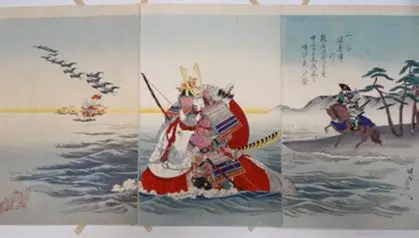
There, he spotted a lone young warrior.
Aiming for the Offshore Ships: Taira no Atsumori
In the ninth volume of the Tale of the Heike, “The Last Moments of Atsumori,” Naozane is depicted pursuing a lone young warrior.
The young warrior wore splendid armor and rode a dappled gray horse.
He had already entered the sea with his horse, aiming for the Taira ships floating offshore.
Naozane raised his fan and called out loudly.
“You appear to be a fine general. Are you fleeing from the enemy? Return here and face me in battle!”
According to the Tale of the Heike, the young warrior responded to this call, turning his horse back to the shore.
Naozane grappled with him, pulling him from his horse and pinning him down.
He then pushed up the helmet to take his head.
What he saw was a boy of about 16 or 17 years old.
Her face was lightly made up, and her teeth were blackened.
It is said that Naozane was reminded of his own son, Naoie.
Naoie, who had been injured in the same battle, was about the same age as the young boy before him.
Naozane tried to save him.
However, with allied forces approaching from behind, he thought that even if he let him go, the boy would be killed by another warrior.
In “The Tale of the Heike,” it is depicted that Naozane, with tears in his eyes, took the boy’s head himself.
Afterwards, he noticed a flute tucked into a brocade bag at the boy’s waist.
Recalling the sound of music from the Taira camp before the battle began, Naozane was deeply moved.
The young warrior’s name was Taira no Atsumori.
He was the youngest son of Taira no Tsunemori, the brother of Taira no Kiyomori.
Atsumori’s death at Ichinotani is also recorded in “Azuma Kagami.”
On the other hand, the story of how Naozane called Atsumori back from the sea, their final conversation, and Naozane’s feelings when he killed him, are largely drawn from the detailed narrative of “The Tale of the Heike.”
In later years, Naozane became known as a man who sought to become a monk out of regret for killing Atsumori.
However, there were still years left before Naozane would leave the life of a warrior.
Naozane After Killing Atsumori
“The Tale of the Heike” portrays Naozane as deeply regretting the killing of Atsumori.
Killing a boy who was about the same age as his own son.
The sight of a Taira noble carrying a flute into battle.
These experiences led to his doubts about living as a warrior.
However, no documents written by Naozane himself about Atsumori have been found.
Moreover, there is no record of Naozane becoming a monk immediately after Ichinotani.
Naozane continued to serve as a retainer of Yoritomo thereafter.
The war between the Minamoto and Taira clans continued until Dan-no-ura in the second year of Genryaku (1185), but there are few detailed records of Naozane’s military actions at Yashima or Dan-no-ura.
On the other hand, there are records of Naozane’s actions in Kamakura after the war ended.
In the third year of Bunji (1187), Naozane refused an order from Yoritomo.
Separate from the sorrowful tale of Atsumori’s death in “The Tale of the Heike,” here is recorded the image of Naozane, unwilling to compromise his pride as a warrior.
Yabusame at Tsurugaoka Hachimangu—Refusing the Role on Foot
On August 4, in the third year of Bunji, preparations were underway in Kamakura for the Hojou-e at Tsurugaoka Hachimangu.
Yoritomo decided to hold a yabusame ceremony at the Hōjō-e, assigning roles such as archers and target setters to his vassals.
In yabusame, archers shoot at targets while riding on horseback.
It was also necessary to prepare and set up the targets.
Naozane was tasked with the role of the upper target setter.
However, Naozane expressed dissatisfaction with this order.
According to the “Azuma Kagami,” Naozane questioned the difference between archers and target setters, arguing that all vassals were comrades.
Archers ride horses.
Target setters perform their duty on foot.
This seemed to imply a hierarchy based on roles.
Naozane protested this and refused to comply with the order.
Yoritomo explained that roles were assigned according to each person’s abilities, and being a target setter did not mean it was an inferior task.
He further cited examples of influential figures serving as target setters at the festival of the Shin-Hiyoshi Shrine in Kyoto, urging Naozane to comply.
Even so, Naozane did not relent.
Ultimately, Yoritomo ordered a portion of Naozane’s estate to be confiscated as punishment.
Naozane had vied for the vanguard at Kanesawa Castle and Ichinotani, accumulating military achievements.
For Naozane, the distinction between mounted archers and foot target setters was a matter concerning his status.
On the other hand, Yoritomo was in a position to command his vassals.
Even if they fought bravely on the battlefield, he could not ignore vassals who disobeyed orders.
Naozane lost part of the lands he had gained through military service due to his defiance of his lord.
The Ongoing Land Dispute between Kumagai and Kuge Villages
The issue in Kumagai Village persisted.
In 1182, Naozane was recognized as the steward by Yoritomo.
However, the conflict with Kuge Naoaki, based in the neighboring Kuge Village, remained unresolved.
The dispute centered on the boundary between the two villages.
Where did Kumagai’s land end and Kuge’s begin?
This boundary affected the income from fields and the control over those who cultivated the land.
Naozane was determined to protect the land passed down from his ancestors.
The Kuge family likely had their reasons for asserting their rights as well.
The relationship between the two parties evolved into a familial dispute, as it was said that Naozane had been cared for by them in his youth.
According to the “Azuma Kagami,” a hearing on this matter was held before Yoritomo on November 25, 1192.
There, Naozane attempted to assert his rights once more.
However, competing for the vanguard on the battlefield and explaining land rights in court were different matters.
Throwing Down the Petition Before Yoritomo
According to the “Azuma Kagami,” during the hearing on the land dispute, Yoritomo repeatedly questioned Naozane.
Despite his outstanding martial prowess, Naozane struggled to adequately articulate his claims in the legal setting.
Meanwhile, Kuge Naomitsu was presenting his side of the story.
Naomitsu’s frustration gradually intensified.
It is said that he began to suspect that Kajiwara Kagetoki was siding with the opposition to disadvantage him.
However, there is no evidence to confirm that Kagetoki engaged in any unfair manipulation.
The “Azuma Kagami” depicts Naomitsu as perceiving the situation in this way.
Eventually, Naomitsu could no longer contain his anger.
He reportedly threw away the documents used in the lawsuit and left the scene.
He then headed to the western samurai quarters, took a sword, and cut off his own topknot.
The “Azuma Kagami” records this act as a moment when Naomitsu resolved to become a monk.
Naomitsu then left Kamakura, intending to head to Kyoto.
Yoritomo is said to have searched for him and, through Senko-bo and others at Izu’s Hashiriyu Mountain, attempted to dissuade Naomitsu from going to Kyoto.
However, there are issues with treating this record as the date of Naomitsu’s ordination.
By the previous year, 1191, a document using the name “Renshō” had already been created.
The 1191 Deed of Transfer—Already Bearing the Name “Renshō”
Dated March 1, 1191 (Kenkyū 2), a document remains in which Naomitsu transferred his estate.
This is the “Kumagai Renshō Naomitsu Deed of Transfer.”
It is one of the documents passed down in the Kumagai family, registered at the Yamaguchi Prefectural Archives as the “Kumagai Renshō Naomitsu Deed of Transfer Draft.”
The content involved transferring 20 chō of rice fields within Kumagai Village in Musashi Province to Kumagai Shirō Jikka.
Jikka’s name is also written as “Maki.”
The document details the boundaries of the land to be transferred, clearly defining the area of inheritance.
At the end of the document appears the name “Jitō Monk Renshō.”
This indicates that Naomitsu was already using a monk’s name at that time.
Furthermore, the names of his heir Naoya and his second son Mikage also appear in this deed of transfer.
It shows that Naomitsu was attempting to pass on the Kumagai family’s estate to the next generation.
However, the transmission and creation of the deed of transfer require further examination.
There were once doubts that it might be a later copy.
Subsequent research comparing handwriting and seals with other Naomitsu-related documents has led to the view that it is a document from that time.
If this evaluation is adopted, Naomitsu had become a monk by March 1191.
On the other hand, the “Azuma Kagami” records that he cut his topknot during a land dispute trial in November 1192.
The dates in both accounts do not match.
It is possible that the dramatic actions during the trial were linked to the narrative of his ordination, but when and how Naomitsu first shaved his head remains unclear.
At the very least, the prolonged land dispute and Naomitsu’s use of a monk’s name for land inheritance by 1191 remain significant facts.
Encounter with Hōnen—A Warrior’s Quest for Rebirth in the Pure Land
After becoming a monk, Naomitsu deeply embraced the teachings of Hōnen.
Honen was a monk who spread the practice of exclusive nembutsu and later became known as the founder of the Jodo sect.
He preached the path of believing in the vow of Amida Buddha and chanting the nembutsu to aspire for rebirth in the Pure Land.
Stories about the encounter between Naozane and Honen are preserved in works like the “Illustrated Biography of Honen Shonin.”
It is said that Naozane visited Seikaku Hoin in Kyoto, who then introduced him to Honen.
Seikaku was a scholar monk of the Tendai sect and had a deep connection with Honen’s teachings.
According to the “Illustrated Biography of Honen Shonin,” Naozane was troubled by the many people he had killed in the past.
He fought for the Taira side at Ishibashiyama and attacked enemy camps for Yoritomo at Kanazawa Castle.
He also battled the Taira warriors at Ichinotani.
Could the path to rebirth in the Pure Land be open even to someone like him, who had taken so many lives?
It is said that Naozane approached Honen with such questions.
Honen taught that one could seek salvation from Amida Buddha through the nembutsu.
Upon hearing these words, Naozane is depicted as shedding tears of joy.
This detailed conversation is derived from later biographies of Honen.
Moreover, there are differing accounts regarding the date when Naozane became a disciple of Honen. While he took the name Rensei in 1191, some accounts suggest his relationship with Honen deepened around 1193.
It is difficult to describe his ordination and entry into Honen’s teachings as a single event.
Nevertheless, it is evident from his own writings and related historical materials that Rensei diligently practiced nembutsu as Honen’s disciple.
Horyakubo Rensei—An Unchanged Temperament After Ordination
After ordination, Naozane was known as Horyakubo Rensei.
The readings “Rensei” and “Rensho” are associated with his name.
The “Illustrated Biography of Honen Shonin” depicts Rensei fervently chanting the nembutsu.
On the other hand, anecdotes remain that he retained a fierce temperament even after ordination.
It is said that he harshly scolded those who neglected the nembutsu and sometimes forcibly made them practice.
Honen is said to have admonished him at times.
Furthermore, there are stories of Rensei taking a title given by Honen to another disciple.
It is difficult to verify all these actions as actual events.
However, they provide insight into how later generations remembered Rensei.
On the battlefield, he is said to have vied for the vanguard, refused foot service at Tsurugaoka Hachimangu, and tossed aside petitions in land disputes.
This strong temperament carried over into the tales of his life as a nembutsu practitioner.
On the other hand, his serious acceptance of Honen’s teachings is evident from documents he left in his later years.
Meeting Yoritomo Again After Ordination
On August 10, 1195, Rensei’s name appears in the “Azuma Kagami.”
The entry describes Rensei, who had come down from Kyoto, visiting Yoritomo.
It is recorded that Rensei spoke with Yoritomo about Buddhist teachings and also discussed military strategy.
In the past, Naozane had vied for the vanguard in Yoritomo’s forces and earned the position of steward of Kumagaya Village through his military achievements.
Afterward, he was said to have refused to participate in the yabusame ceremony and fiercely opposed the land dispute rulings.
However, even after becoming a monk, he met with Yoritomo again.
This shows that his relationship with Yoritomo was not completely severed by his taking of the tonsure.
Additionally, the account of him discussing military strategy is intriguing.
Though he had become a monk known as Rensei, he remained a person with extensive battlefield experience.
While studying under the teachings of Honen, he maintained his connections with the warrior society he once served.
It is said that on February 9th of the same year, he also composed a testament for his descendants.
This document, passed down in the Kumagai family, indicates that even after becoming a monk, Naozane was concerned about the future of his family.
Land Bequeathed to the Kumagai Clan
Naozane’s son, known as Kojirō Naoie, is well recognized.
In “The Tale of the Heike,” he is depicted as competing for the vanguard with his father at the Battle of Ichi-no-Tani and being wounded by enemy arrows.
On the other hand, the bequest documents passed down in the Kumagai family mention the names of Jikka and Jitsukage.
In the bequest of Kenkyū 2, Jikka was granted 20 chō of rice fields within Kumagai Township.
The detailed description of the boundaries in all directions shows Naozane’s intention to clearly define the land’s extent and pass it on to the next generation.
Kumagai Township was land where Naozane continued disputes with the Kuge family and was recognized as the steward due to his military achievements at Kanesawa Castle.
Even after becoming a monk and taking the name Rensei, inheritance remained an important issue for Naozane.
After Naozane’s death, the Kumagai clan expanded their influence into the Miyoshi Manor in Aki Province while managing their holdings in Musashi Province.
Miyoshi Manor corresponds to the present-day area around Asakita Ward in Hiroshima City.
The Kumagai clan later became a warrior group active in the Chugoku region, deepening their ties with the Mōri clan during the Sengoku period.
Documents recounting such activities of the clan have been preserved as the Kumagai Family Documents.
The “Reverse Riding” That Did Not Turn Away from the Western Pure Land
There is a famous anecdote about Rensei when he traveled from Kyoto to Musashi Province.
This is the legend of the “Eastward Journey Reverse Riding,” where he rode a horse facing backward.
In Pure Land Buddhism, it is taught that Amida Buddha’s Western Pure Land is located to the west.
Rensei had a strong yearning for the Western Pure Land and disliked turning his back to the west when returning to the eastern provinces.
Thus, he is said to have faced west while the horse moved eastward.
People along the road were astonished by his unusual riding style.
Some laughed, but Rensei continued on undeterred.
This story was later featured in biographies and paintings, becoming a tale that conveys Rensei’s fervent devotion to reciting the nembutsu.
Whether he actually traveled the long distance in that position cannot be confirmed from contemporary records.
As a warrior, Naozane sought to be the first to enter the enemy camp.
In the stories after he became a monk, he is portrayed as a man with the same strong will, always facing the Western Pure Land.
In present-day Kumagaya City, there are still places said to be where Rensei practiced his nembutsu training.
The temple of Kumagai-dera is said to have originated from a simple hut built by Rensei in his hometown, according to temple tradition.
The Nembutsu Dojo Established in Aon
There are other temples associated with Rensei besides those in Musashi Province.
One such temple is Komyo-ji, located in Nagaokakyo City, Kyoto Prefecture.
The present-day head temple of the Nishiyama Jodo sect, Komyo-ji, is said to have originated from a Nembutsu dojo established by Rensei.
According to temple tradition, in the year Kenkyu 7 (1196), Rensei built the Nembutsu Samadhi Hall in the area of Aon.
It is said that he created a place for practicing Nembutsu, following the teachings of Honen.
Subsequently, the temple developed into Aon Komyo-ji.
Although the detailed history of its founding includes later temple traditions, records indicate that Rensei traveled between Kyoto and Musashi Province, engaging in Nembutsu devotion.
At this time, Honen’s teachings were spreading not only among samurai and aristocrats but also among people from various walks of life.
Meanwhile, temple powers such as Enryaku-ji on Mount Hiei and Kofuku-ji were increasingly critical of exclusive Nembutsu practices.
Rensei’s later years coincided with a period of intense conflict over Honen’s teachings.
Amidst these circumstances, Rensei made a vow concerning his own rebirth.
The Autographed Vow of Naozane Preserved at Seiryo-ji
On May 13, Genkyu 1 (1204), Rensei made a vow before Amida Buddha in Toba, Kyoto.
The document recording this vow is known as the “Autographed Vow of Kumagai Naozane,” preserved at Seiryo-ji.
It is currently designated as an Important Cultural Property by the nation.
The document is a lengthy piece composed of five joined sheets of paper, with the first half detailing the vow and the latter half recounting dreams.
At the end, it bears Rensei’s signature, making it a document of significant importance as his own writing.
The central wish of the vow was to achieve “highest rebirth in the Pure Land.”
In Pure Land Buddhism, there are nine levels of rebirth for those who attain it.
The highest rebirth is the most exalted of these levels.
Rensei wrote that if it were only for his own rebirth in the Pure Land, the lowest level would suffice.
However, he did not stop there.
He wished to welcome all those connected to him without exception.
He extended his thoughts even to those with no connection to him, wishing to offer them salvation.
For this reason, he aspired for the highest rebirth.
The vow document also mentions the difficulty of achieving the highest rebirth in the age of the decline of the Dharma.
Having received teachings from Honen, Rensei was aware of these challenges but still chose to aspire for the highest rebirth.
This document reveals a different aspect of Naozane than that depicted in later war tales.
In “The Tale of the Heike,” his regret over killing Atsumori is linked to his taking of monastic vows.
In contrast, the wishes recorded in Rensei’s own vow document extend beyond the memorial for Atsumori alone.
They encompass all those he encountered, and even those with no connection to him.
What kind of rebirth did Rensei aspire for in his later years through his long Nembutsu practice?
These words have been preserved in his own handwriting.
The Year Genkyu 3—A Dialogue with a Monk in a Dream
The latter part of his handwritten vow contains a passage about a dream.
This section is referred to as the “Dream Record.”
On October 1, Genkyu 3 (1206), Renshō meticulously documented a dream he had.
In the dream, he encountered a monk around the age of forty and engaged in a dialogue about rebirth in paradise.
Renshō recounted discussing his beliefs about the path to rebirth and debating with the monk.
Additionally, it is said that on the night he made his vow in 1204, he dreamed of sitting on a lotus.
For medieval Buddhists, dreams sometimes held religious significance.
They could be interpreted as messages from the deities or omens regarding rebirth.
Renshō recorded his dreams and pondered their meanings.
This Dream Record is also an important historical document for understanding Renshō’s faith.
Regarding his youth, many war tales recount his bravery on the battlefield.
In his later years, writings in his own hand reflect his contemplation of his own rebirth.
It is said that Renshō eventually began to predict the day of his own death.
The Proclamation of Rebirth at the Market in Muraoka
In the first year of Ken’ei (1206), Renshō reportedly erected a notice at the market in Muraoka, Musashi Province.
The notice stated that he would achieve rebirth on February 8 of the following year, inviting skeptics to witness it.
This story is depicted in the twenty-seventh scroll of the “Illustrated Biography of Master Hōnen.”
Muraoka corresponds to the area around present-day Muraoka, Kumagaya City.
People heard Renshō’s announcement and gathered to witness his rebirth.
As the predicted day approached, Renshō purified himself and began chanting the nembutsu.
However, he did not pass away on that day.
It is said that Renshō then announced he would change the date of his rebirth to September 4 of the same year.
The gathered crowd was astonished, and some even laughed.
Renshō explained that he changed the date based on a message from Amida Buddha.
This series of events forms a religious narrative surrounding Renshō’s rebirth.
It is difficult to verify the historical accuracy of the notice’s erection or the interactions with the gathered people.
However, his handwritten vow and Dream Record reveal that Renshō was deeply conscious of his rebirth in his later years.
Two different accounts of his final moments have been recorded.
The Final Moments Said to Have Occurred in Muraoka, Musashi Province
According to the “Illustrated Biography of Master Hōnen,” Renshō passed away on September 4, Ken’ei 2 (1207), in Musashi Province.
The location is said to have been a nembutsu hermitage west of the Kumagaya residence.
Renshō gathered people on the predicted day and met his end while chanting the nembutsu.
It is also depicted that a mysterious fragrance and light appeared at the scene.
In the Pure Land Buddhism’s tales of rebirth, such phenomena are sometimes recounted as signs of rebirth in the Pure Land.
The ‘Illustrated Biography of Honen Shonin’ also conveys the rebirth of Rensei in this manner.
On the other hand, the ‘Azuma Kagami’ records a different year and place of death.
According to this record, Naozane lived until the following Shogen 2 (1208).
The Passing in Kyoto’s Higashiyama as Told by ‘Azuma Kagami’
On September 3, Shogen 2 (1208), the ‘Azuma Kagami’ notes that Kumagai Kojirō Naoie traveled to the capital.
He had received news from his father, Rensei, that he would pass away on the 14th of the same month.
Upon hearing this, Naoie hurried to Kyoto.
According to the article, Rensei was in a grass hut in Higashiyama, Kyoto.
This announcement became a topic of conversation even in Kamakura.
There were voices expressing wonder at the idea of someone knowing the time of their own death in advance.
However, Nakahara Hirokata cited Rensei’s long years of practicing the Nembutsu and argued that his words should be believed.
Furthermore, on October 21, the ‘Azuma Kagami’ records that Tō Shigetane returned to Kamakura from Kyoto and reported Rensei’s passing.
It is said that on the predicted date of September 14, Rensei passed away while seated, wearing a kesa, and reciting the Nembutsu with hands in prayer.
It is reported that monks and laypeople surrounded the grass hut and watched over the scene.
This record places the year of death as 1208, and the location as Higashiyama, Kyoto.
This differs in year, date, and location from the rebirth in Musashi Province on September 4, 1207, as conveyed by the ‘Illustrated Biography of Honen Shonin’.
Both are historical sources established after Naozane’s death, and scholarly debate continues over which record to accept.
If he was born in Eiji 1 (1141), he would have been 67 years old if he died in 1207, or 68 if in 1208.
Naozane is believed to have lived into his late 60s.
Rensei’s Grave and Nembutsu Dojo in Kumagaya
While there are differing theories about Naozane’s place of death, traditions concerning Rensei’s later years remain in Kumagaya, Musashi Province.
Kumagaya-dera, located in present-day Kumagaya City, is said to have originated from a grass hut Rensei established in his hometown.
Within the temple grounds, there is a site believed to be Naozane’s grave, where memorial services continue to this day.
Additionally, historical sites related to Rensei remain in Higashiyama, Kyoto.
There is also a tradition that Rensei established a Nembutsu dojo at Komyo-ji in Nagaokakyo City.
Naozane was born as a local samurai in Musashi Province, traveled to Kyoto for military service, and participated in the battles between the Minamoto and Taira clans.
Even after becoming a monk, he is said to have traveled between Kyoto and the eastern provinces, with his traces left in the histories of various temples.
However, crucial to tracing Naozane’s life are the documents concerning land holdings passed down in the Kumagai family and the self-written vow preserved at Seiryo-ji.
The documents transferring land to his children detail the extent of the Kumagaya estate.
Meanwhile, the vow expresses his wish to achieve the highest rebirth and save every person connected to him.
Both serve as historical sources that convey Naozane’s life and thoughts in detail.
After Naomitsu’s Death, the Kumagai Clan Expands to Aki
Following Naomitsu’s death, the Kumagai clan continued their activities as vassals of the Kamakura shogunate.
The clan extended their influence to Mii-no-sho in Aki Province while managing their lands in Musashi Province.
Mii-no-sho corresponds to the present-day vicinity of Asakita Ward in Hiroshima City.
Throughout the Kamakura period, the Kumagai clan deepened their ties with this area, evolving into a warrior group active in the Chugoku region.
The clan persisted through the Nanboku-cho and Muromachi periods, eventually aligning with the Mouri clan during the Sengoku period.
The Kumagai family documents convey these activities.
Currently, 255 documents of the Kumagai family, preserved at the Yamaguchi Prefectural Archives, are designated as Important Cultural Properties of Japan.
The oldest known document is a draft of a deed of transfer dated March 1, 1191, by Kumagai Renjo Naomitsu.
It details Naomitsu’s transfer of 20 cho of rice fields within Kumagai-go to his family.
Meanwhile, at Seiryo-ji in Kyoto, there remains a vow of superior rebirth made by Renjo in 1204, along with a record of a dream from 1206.
Additionally, the Azuma Kagami entry for October 21, 1208, notes that Higashi Shigetane, returning from Kyoto, reported Renjo’s passing to Kamakura.
According to this report, Renjo passed away on September 14, wearing a kesa and chanting the nembutsu in a grass hut in Higashiyama.
The rights to Kumagai-go, once acquired by Naomitsu through military achievements, were passed down to his descendants.
The story of him slaying Taira no Atsumori at Ichinotani was incorporated into the Noh play ‘Atsumori’ and the Kōwaka-mai dance, becoming widely known as the tale of Kumagai Naomitsu, who became a monk to pray for the repose of the young noble’s soul.