Early 6th century.
In what is now Yame City, Fukuoka Prefecture, the largest keyhole-shaped burial mound in northern Kyushu was constructed.
This is the Iwatoyama Kofun.
The mound itself measures 135 meters in length, and when including the surrounding moat, the total length exceeds 170 meters.
To the northeast of the mound lies a rectangular area known as the “Separate Section,” measuring approximately 43 meters on each side. Stone figures depicting people, horses, boars, and shields were arranged around the mound and its surroundings.
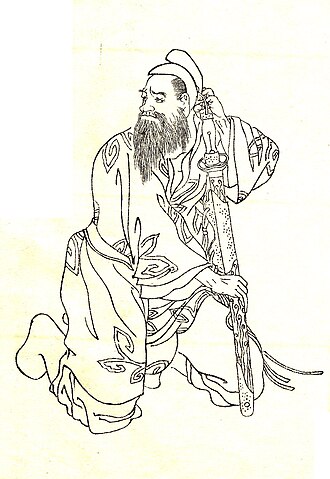
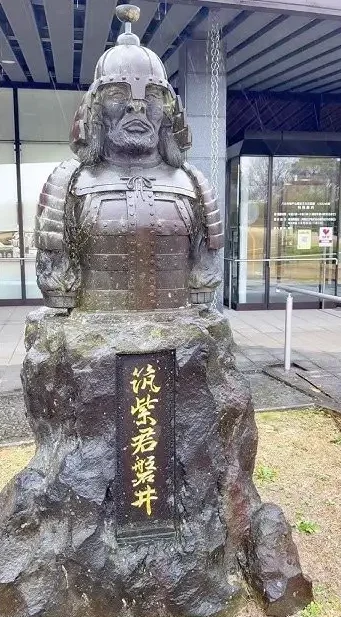
The individual believed to be entombed in this massive burial mound is Tsukushi no Kimi Iwai.
The year and place of Iwai’s birth remain unknown, as does his age at the time of death.
His name prominently appears in history in the 21st year of Emperor Keitai’s reign (527 AD).
Iwai obstructed the path of a military force that the Yamato court intended to send to the Korean Peninsula. In the following year, 528, he clashed with a force led by Mononobe no Arakahi in the Mii District of Tsukushi Province.
The “Nihon Shoki” records that Iwai was killed in this battle.
However, an excerpt from the “Chikugo no Kuni Fudoki” tells a different story, suggesting that Iwai fled to Kamitsukue in Buzen Province and disappeared into the mountains.
Even before the conflict in 527, the Tsukushi clan had established a significant presence in northern Kyushu.
The ancient burial mounds and the Iwatoyama Kofun in the Yame Hills bear witness to this legacy today.
Who Was “Tsukushi no Kimi”?
Different historical sources refer to Iwai by various titles.
The “Nihon Shoki” calls him “Tsukushi no Kuni no Miyatsuko Iwai.”
In the excerpt from the “Chikugo no Kuni Fudoki,” he is referred to as “Tsukushi no Kimi Iwai.”
Today, the name “Tsukushi no Kimi Iwai” is widely used.
His stronghold is believed to have been centered in the Yame Hills, which is now part of Yame City in Fukuoka Prefecture.
Over 300 burial mounds have been identified in the hills spanning Yame City, Chikugo City, and Hirokawa Town.
This is known as the Yame Kofun Group.
The construction of large burial mounds began in earnest in the 5th century.
In the western part of the Yame Hills, the Sekijinzan Kofun, with a mound length of about 107 meters, was built, followed by other large keyhole-shaped burial mounds.
Then, in the early 6th century, the Iwatoyama Kofun was constructed.
The vast power did not emerge in Iwai’s lifetime alone.
Even before Iwai, the chieftains of the Yame Hills had been amassing power over several generations by constructing large keyhole-shaped burial mounds.
Iwai was the figure who stood at the pinnacle of this power.
The Iwatoyama Kofun: A Mound 135 Meters Long
Yoshida, Yame City, Fukuoka Prefecture.
Here lies the Iwatoyama Kofun.
The tumulus measures 135 meters in length, with the rear circular portion about 80 meters in diameter, and the front rectangular section approximately 92 meters wide.
Including the surrounding moat, the total length exceeds 170 meters.
It is the largest keyhole-shaped tomb in northern Kyushu.
A significant clue suggesting that the Iwatoyama Kofun is the tomb of Iwai comes from an excerpt of the ‘Chikugo no Kuni Fudoki.’
The ‘Chikugo no Kuni Fudoki’ itself has not survived to the present day.
However, a passage quoted in the 13th volume of the later compiled ‘Shaku Nihongi’ remains as an excerpt.
It mentions the tomb of “Chikushi no Kimi Iwai” located two ri south of Agata County, detailing its scale and structure.
The burial site measures 60 jo from north to south, and 40 jo from east to west.
It is said to have been constructed by piling stones, with rice fields surrounding it.
Additionally, a section called “Gato” was established to the northeast of the tomb.
The Iwatoyama Kofun also features a “separate area” about 43 meters on each side, located on the northeast side of the tumulus.
The location, scale, construction period, and distinctive separate area of the kofun align with the descriptions in the Fudoki excerpt, leading to the belief that the Iwatoyama Kofun is indeed the tomb of Chikushi no Kimi Iwai.
Stone Figures and Horses Lining the Tomb
The Iwatoyama Kofun is distinguished by its stone decorations, including stone figures and horses.
In many kofun centered around Yamato, cylindrical haniwa and figurative haniwa representing people and animals were arranged on the tumulus.
In Kyushu, a unique culture developed where stones were carved to depict people and animals.
The Iwatoyama Kofun is particularly rich in these stone decorations.
Various figures were created, including armed individuals, nude figures, horses, boars, chickens, shields, and quivers.
The primary material used was Aso welded tuff.
The Fudoki excerpt also mentions that stone figures and shields were arranged at Iwai’s tomb, along with stone horses, halls, and storehouses.
Most striking is the separate area to the northeast.
The Fudoki excerpt describes a scene resembling a trial constructed there.
A figure called “Kaibe” stands, with a “Tobin” lying naked on the ground before him.
Beside them is a stone boar representing the stolen animal.
This is interpreted as depicting the scene of a thief being judged for stealing a boar.
It was Iwai who could create such a space along with the massive tumulus.
The Spread of Stone Figures and Horses
Stone figures and horses are not unique to the Iwatoyama Kofun.
They are particularly abundant in the Chikugo region of southern Fukuoka Prefecture and northern Kumamoto Prefecture.
They have also been found in Saga, Oita, and Miyazaki Prefectures, with examples discovered as far away as Tottori Prefecture.
In the Yame Kofun group, the Sekijinzan Kofun, built before the Iwatoyama Kofun, also featured armed stone figures.
The culture of stone decorations existed in the Yame Hills even before the emergence of Iwai.
The distribution of stone figures concentrated in the northern part of Kumamoto Prefecture from Chikugo provides material for considering the regional connections centered around the Chikushi clan.
This overlaps with the region described in the Nihon Shoki regarding the battles of 527.
In the same text, it is depicted that Iwai expanded his influence over “Hi” and “Toyou.”
“Hi” corresponds to the present-day Kumamoto Prefecture, extending towards Saga and Nagasaki, while “Toyou” corresponds to the eastern part of Fukuoka Prefecture extending towards Oita.
It is not possible to directly equate the regions where stone figures and horses were found with the territories directly controlled by Iwai.
Nevertheless, archaeological evidence shows that the culture of stone decorations centered around Yame spread over a wide area.
Emperor Keitai and Chikushi Clan’s Iwai
During the same era as Iwai, Emperor Keitai stood at the pinnacle of the Yamato court.
According to the Nihon Shoki, Keitai was a fifth-generation descendant of Emperor Ojin and was invited from Echizen to ascend the throne.
The first year of Keitai’s reign is considered to be 507.
The Iwatoyama Kofun, believed to be Iwai’s tomb, was also constructed in the first half of the 6th century.
What is noteworthy is that the Iwatoyama Kofun itself is a keyhole-shaped tomb.
This type of tomb is significant for considering the political relationships between the Yamato court and the powerful local leaders.
It is not necessarily the case that Iwai was a figure who continuously opposed the Yamato court from the beginning.
He was a powerful local leader who maintained political relations with the Yamato court while establishing an independent base in northern Kyushu.
This relationship developed into a military confrontation in 527.
The Situation on the Korean Peninsula
In the first half of the 6th century, the Korean Peninsula was a battleground for power among Goguryeo, Baekje, Silla, and the Gaya confederation.
Northern Kyushu held a crucial position for maritime traffic heading towards the Korean Peninsula.
When the Yamato court sent personnel or troops to the Korean Peninsula, they would pass through Chikushi.
In the 21st year of Keitai’s reign (527), June.
According to the Nihon Shoki, the Yamato court assigned 60,000 soldiers to Omi no Mino no Omi, intending to dispatch them to the Korean Peninsula.
The purpose was to restore the territories of South Gaya and Heguri, which had been seized by Silla, and to align them with Mimana.
The figure of 60,000 soldiers is the number recorded in the Nihon Shoki.
For Omi no Mino’s forces to cross the sea, they needed to pass through northern Kyushu.
Iwai obstructed this route.
527, Silla’s Approach to Iwai
The Nihon Shoki records that Silla was involved in the background of the war’s outbreak.
Upon learning of Omi no Mino’s dispatch, Silla sent bribes to Iwai, urging him to obstruct Mino’s forces.
Iwai complied with this request.
The text describes Iwai at this time as having harbored rebellious intentions from earlier on.
Furthermore, Iwai expanded his influence over “Hi” and “Toyou,” obstructing ships heading from Goguryeo, Baekje, Silla, and Mimana to the Yamato court, and blocking the path of Omi no Mino’s forces.
The Nihon Shoki was completed approximately 200 years after Iwai’s battle, in the 8th century.
The account of the war’s events must be read as a history compiled from the perspective of the Yamato court.
On the other hand, the Iwatoyama Kofun and the Yame Kofun group indicate that the Chikushi clan had established a significant political and economic base in northern Kyushu even before 527.
In 527, this Chikushi clan clashed militarily with the Yamato court.
Iwai Blocks the Path of Omi no Ken
The Nihon Shoki records an exchange between Iwai and Omi no Ken.
Iwai reportedly told Ken that although they once shared meals from the same pot, Ken was now a messenger trying to subjugate him.
It is impossible to verify this conversation as an actual statement.
The historical records depict Iwai and Ken as acquaintances from before.
Iwai blocked Ken’s forces, preventing them from crossing to the Korean Peninsula.
The Yamato court decided to suppress Iwai.
In August of the same year, Emperor Keitai appointed Mononobe no Arakahi as the general.
The conflict continued into the following year, 528.
Mononobe no Arakahi Heads to Kyushu
The Nihon Shoki details Emperor Keitai’s words when dispatching Mononobe no Arakahi.
He would govern east of Nagato, where Iwai was, and leave west of Chikushi to Arakahi.
Rewards and punishments were also entrusted to Arakahi.
Such was the content.
Arakahi, a prominent figure of the Mononobe clan, was sent as a general, and the conflict reached its conclusion in Chikushi.
The decisive battle took place in the Mii District of Chikushi Province.
This is around present-day Kurume City in Fukuoka Prefecture.
The Battle of Mii District in November 528
In November of the 22nd year of Emperor Keitai’s reign (528), on the 11th day.
According to the Nihon Shoki, Mononobe no Arakahi and Iwai’s forces clashed in the Mii District of Chikushi Province.
The two armies faced each other with flags and drums, raising dust as they fought.
They fiercely contested for victory, neither side retreating easily.
In the end, Arakahi slew Iwai.
Iwai’s forces were defeated.
How many troops did Iwai mobilize?
Where exactly in the Mii District did the decisive battle occur?
What formations did the two armies use?
No historical records remain to answer these questions.
What can be traced from the Nihon Shoki is that Mononobe no Arakahi was dispatched in the military conflict that began in 527, and the decisive battle took place in the Mii District in November 528.
Two Accounts of Iwai’s End
How did Iwai meet his end?
Here, the accounts of the Nihon Shoki and the fragmentary Chikugo no Kuni Fudoki diverge.
In the Nihon Shoki, Mononobe no Arakahi slays Iwai on the battlefield in the Mii District.
In the fragmentary Chikugo no Kuni Fudoki, Iwai, unable to win against the imperial forces, fled alone to Kamitsuke County in Buzen Province.
And so, he met his end in the southern mountains.
It is said that no one knew where Iwai died.
Regarding the final moments of Iwai, one account states he was “cut down on the battlefield,” while another suggests he “fled to Buzen and disappeared.”
The Stone Figures and Horses Said to Be Destroyed by the Imperial Forces
The lost texts of the ‘Chronicles of Chikugo Province’ also contain stories about Iwai’s tomb.
It is said that the imperial forces, having failed to capture Iwai, destroyed the stone figures and horses that were lined up at his tomb.
They broke the arms of the stone figures and knocked off the heads of the stone horses.
As a result, it is recorded that the elders spoke of calamities befalling the land.
Numerous damaged stone artifacts have also been discovered at the Iwatoyama Kofun.
Whether these were destroyed by the imperial forces after the war in 528 remains unknown.
Nevertheless, the description in the lost texts of the chronicles about the numerous stone figures and horses at Iwai’s tomb aligns with the fact that many stone decorations have been confirmed at the Iwatoyama Kofun.
His Son Katsuko and the Kazuya Manors
After Iwai’s defeat, his son Katsuko appears in the ‘Nihon Shoki’.
In December of the 22nd year of Keitai’s reign (528).
Fearing execution for his father’s crimes, Katsuko offered the “Kazuya Manors” to escape death.
Kazuya refers to the area centered around present-day Kazuya District in Fukuoka Prefecture.
From Yame, it is located quite to the north.
This entry in the ‘Nihon Shoki’ also provides material for considering the possibility that the influence of the Chikushi clan extended to the area around present-day Fukuoka City before the war.
Katsuko survived.
In the Yame Hills, the construction of large kofun did not cease with the Iwatoyama Kofun.
The Yame Kofun Group Continued After Iwatoyama
Even after the Iwatoyama Kofun, large keyhole-shaped kofun were built in the Yame Hills.
These include the Noriba Kofun, the Zozuka Kofun, and the Tsurumiyama Kofun.
In 2005, an armed stone figure was unearthed from the Tsurumiyama Kofun.
From the Donoyama Kofun Group, a stone figure depicting a woman carrying a child was also discovered.
The culture of stone figures and horses that had continued since before the Iwatoyama Kofun persisted in the Yame Hills even after the war in 528.
Furthermore, the ‘Nihon Shoki’ mentions a person claiming the title “Chikushi no Kimi” more than 140 years after Iwai’s battle.
This is “Chikushi no Kimi Satsunoma” in the 10th year of Emperor Tenji’s reign (671).
Eight years after the Battle of Baekgang, his name was recorded among those returning from Tang.
The direct genealogical relationship between Satsunoma and Iwai is unknown.
What can be confirmed is that a person claiming the title “Chikushi no Kimi” appears in records 143 years after 528.
The Legacy of Chikushi no Kimi Iwai at Iwatoyama
Even today, the Iwatoyama Kofun remains in Yame City, Fukuoka Prefecture.
The mound is 135 meters long.
Including the surrounding moat, the total length exceeds 170 meters.
This is the largest keyhole-shaped burial mound in northern Kyushu.
Before the time of Iwai, large burial mounds were already being constructed in the Yame Hills.
Within this tradition, the Iwatoyama Kofun was built, adorned with numerous stone figures and horses.
According to the Nihon Shoki, Iwai extended his influence to Hi and Toyo, and in 527, he appears as the figure who blocked the forces of Omi no Kenou.
In November of the following year, 528, he was defeated in the Battle of Mii District by Mononobe no Arakahi.
In December of the same year, it is recorded that his son, Katsuko, offered the Kazuya Tonomura.
Even 143 years later, in 671, the Nihon Shoki mentions the name “Chikushi no Kimi.”
We do not know the number of years Iwai lived, nor his appearance.
The massive mound and stone figures and horses left in the Yame Hills tell us today of Chikushi no Kimi Iwai, who in the early 6th century in northern Kyushu, wielded enough power to confront the Yamato authority and its forces.
“Iwai no Tsurugi” is a gyokuro shiraore tea named after the Yame region in Fukuoka Prefecture, known for its Yame tea. It is a recommended choice for history enthusiasts, bearing the name of Chikushi no Kimi Iwai. ↓

【八女産茶葉使用】玉露白折 磐井の剣(いわいのつるぎ)100g白折 くき茶 茎茶 玉露 お茶 日本茶 煎茶 緑茶 茶葉 八女茶 九州産 国産