June 12, 645.
In the Asuka Itabuki Palace, Soga no Iruka was present.
The Nihon Shoki describes Iruka as a suspicious character, always carrying a sword day and night.
Nakatomi no Kamatari was aware of this.
He enlisted the help of an actor to make Iruka laugh, causing him to momentarily remove his sword.
Meanwhile, preparations were underway in the court to read the tribute from the Three Kingdoms, and Prince Naka no Oe ordered the guards to close the twelve gates.
Prince Naka no Oe hid near the palace with a long spear.
Nakatomi no Kamatari and others waited with bows and arrows in hand.
Saeki no Komaro and Katsuragi no Wakenokimi Amida, tasked with killing Iruka, were paralyzed by his intimidating presence.
The Nihon Shoki even records that the two were so terrified they tried to swallow their rice with water but ended up vomiting.
It was Prince Naka no Oe who first sprang towards Iruka.
Iruka, wounded on the head, shoulder, and leg, approached the throne of Empress Kōgyoku.
He pleaded about the imperial succession and asked to be judged on what crime he had committed.
His plea was not granted.
Iruka was slain in the court by Saeki no Komaro and Katsuragi no Wakenokimi Amida.
The Nihon Shoki notes that “he took control of the government himself, surpassing even his father in power.”
Soga no Iruka wielded significant power during the reign of Empress Kōgyoku, backed by the political foundation inherited from his grandfather Soga no Umako and father Soga no Emishi.
Why did Iruka annihilate the clan of Prince Yamashiro no Oe and then be killed in the court just two years later?
Grandson of Soga no Umako, Son of Soga no Emishi
The birth year of Soga no Iruka is unknown.
His father was Soga no Emishi.
His grandfather was Soga no Umako.
The Soga clan, during Umako’s era, established a formidable influence within the imperial court.
In 587, Umako triumphed in a battle against Mononobe no Moriya.
In 592, he was involved in the assassination of Emperor Sushun, after which Empress Suiko ascended the throne.
During Suiko’s reign, he stood at the center of politics alongside Prince Shotoku, serving as a minister until his death in 626.
The position was inherited by Emishi, the father of Iruka.
When Empress Suiko passed away in 628, the succession to the throne saw Prince Tamura and Prince Yamashiro no Oe emerge as strong candidates.
The opinions of the court nobles were divided, and even within the Soga clan, Sakaibe no Marise supported Prince Yamashiro no Oe.
Ultimately, Prince Tamura ascended the throne in 629.
He became Emperor Jomei, the 34th emperor.
Prince Yamashiro no Oe, whom Iruka would later overthrow, was already at the heart of the political struggle for succession at this point.
Young Iruka in the “Toshi Kaden”
The “Nihon Shoki” provides little information about Iruka’s youth.
However, the “Toshi Kaden,” a family chronicle of the Fujiwara clan compiled in the Nara period, contains accounts of young Iruka.
Iruka studied at the school of the monk Min.
Min was a monk who had traveled to the continent with the Japanese missions to Sui China, studied extensively, and returned to Japan.
According to the “Toshi Kaden,” Min’s school attracted the children of influential families, who studied the “I Ching.”
Among them, Min is said to have remarked that none could match “Soga Taro.”
This “Soga Taro” refers to Iruka.
The “Toshi Kaden” is a historical document compiled later as a family chronicle of the Fujiwara clan, not a contemporary record of Iruka.
Nevertheless, it conveys an image of Iruka, later depicted as an authoritarian figure, being highly regarded in academic circles.
642 AD—”Authority Surpasses the Father”
October 641.
Emperor Jomei passed away.
In January of the following year, 642, Empress Kōgyoku, who was Emperor Jomei’s consort, ascended the throne.
She became the 35th sovereign, Empress Kōgyoku.
Her father, Emishi, continued to serve as minister.
However, the “Nihon Shoki” leaves strong words about Iruka in the article on Empress Kōgyoku’s accession.
It states that Iruka took control of national affairs himself, and his influence surpassed that of his father.
Even thieves feared him, and it was said that people did not dare pick up items dropped on the road.
While Emishi still held the position of minister, his son Iruka wielded significant influence over the government.
Iruka’s rise began even before the attack on Prince Yamashiro Ōe in 643.
The “Great Tomb” and “Small Tomb” Built for Father and Son
The same year, 642.
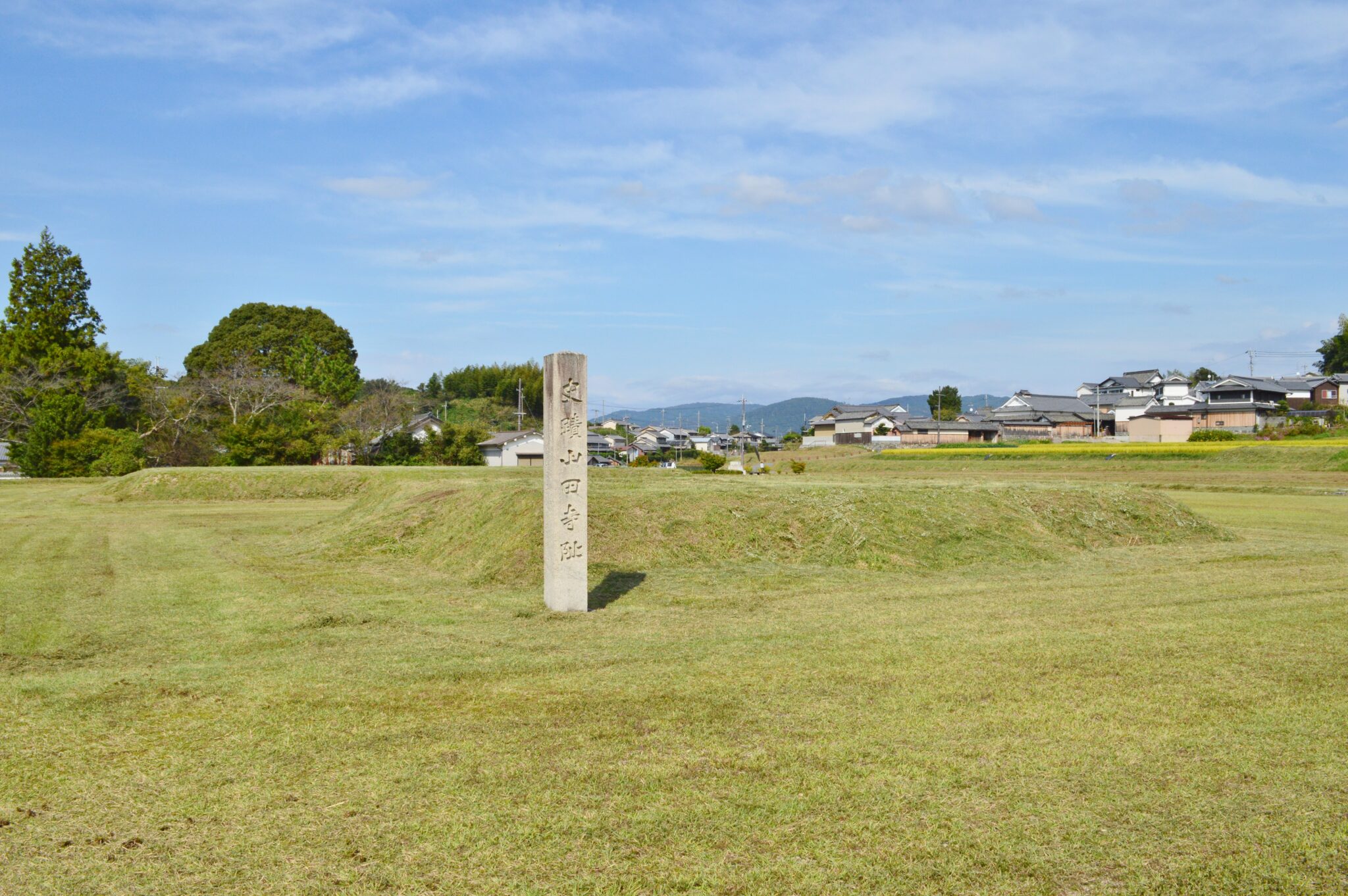
Emishi mobilized the people of the nation and 180 groups to construct two tombs at Imaki.
Emishi’s tomb was called the “Great Tomb.”
Iruka’s tomb was called the “Small Tomb.”
According to the “Nihon Shoki,” the purpose was to prevent people from being forced into tomb construction after their deaths.
However, even the wet nurses of the Upper Palace, belonging to the Yamashiro Ōe lineage, were mobilized for the tomb construction.
This angered Princess Ōomiwa.
Through her words, the “Nihon Shoki” harshly criticizes the politics of Emishi and Iruka.
It is important to note that this account was written after the fall of the main Soga family, but it also conveys that Emishi and Iruka were in a position to mobilize a large number of people.
643 AD—The Purple Crown Passed to Iruka
October 643.
Emishi stopped attending court due to illness.
At that time, Emishi privately bestowed the purple crown upon his son, Iruka.
The “Nihon Shoki” notes that this was “akin to the rank of minister.”
It was not an official appointment to minister by the emperor.
Emishi placed Iruka in a position equivalent to a minister by his own authority.
It is also recorded that Iruka’s brother was referred to as “Minister of the Mononobe.”
The transfer of power from father to son had progressed to this extent.
And in the same month,
Iruka began to move against Prince Yamashiro Ōe.
Why Did Iruka Target Prince Yamashiro Ōe?
Yamashiro no Oe was the son of Prince Shotoku.
His mother, Tojiko no Iratsume, was the daughter of Soga no Umako.
After Empress Suiko’s death in 628, he was considered a candidate for the throne alongside Prince Tamura.
The Nihon Shoki records that in October 643, Iruka plotted to depose the Ue no Miya and install Prince Furubito no Oe as emperor.
It also notes that Iruka deeply resented the widespread influence of the Ue no Miya.
Prince Furubito no Oe was the son of Emperor Jomei.
His mother, Hotei no Iratsume, was also a daughter of Soga no Umako.
According to the Nihon Shoki, Iruka attempted to support Prince Furubito no Oe’s claim to the throne while eliminating the Ue no Miya family.
No words or records left by Iruka himself have survived.
What we know about the attack on Yamashiro no Oe is that the Nihon Shoki portrays Iruka as the central figure, citing his desire to elevate Prince Furubito no Oe and his wariness of the Ue no Miya family.
November 1, 643—The Attack on Ikaruga
November 1, 643.
Iruka sent Koseno Tokuta no Omi and Haji no Saba no Muraji with troops to attack Yamashiro no Oe at Ikaruga.
The battle was not easily won.
On Yamashiro no Oe’s side, Nuno no Mitsunari resisted with several dozen retainers.
Mitsunari fought valiantly.
Haji no Saba no Muraji was killed by an arrow, causing the attacking troops to retreat in fear.
The Nihon Shoki reports that the soldiers praised Mitsunari, saying he was “a match for a thousand men.”
Yamashiro no Oe threw a horse bone into the main hall and escaped the palace with his consort and children.
The attackers burned Ikaruga Palace and, seeing bones in the ashes, assumed Yamashiro no Oe had perished.
However, the prince was still alive.
He had fled to Mount Ikoma with his family and close retainers.
Iruka Plans to Head to Mount Ikoma Himself
Someone who saw Yamashiro no Oe in the mountains reported it to Iruka.
The Nihon Shoki states that upon hearing this, Iruka was greatly alarmed and immediately dispatched troops.
He ordered Takamukai no Kuni no Oshi to search for Yamashiro no Oe, but Kuni no Oshi refused, citing his duty to protect the imperial palace.
Consequently, Iruka decided to go to Mount Ikoma himself.
It was Prince Furubito no Oe who stopped him.
Prince Furubito no Oe told Iruka that a mouse lives by hiding in its hole, and without it, it dies.
Iruka abandoned his plan to go personally and sent the troops to search instead.
However, they failed to find Yamashiro no Oe.
The prince and his party remained in the mountains for four or five days, unable to find food.
Prince Yamashiro Ōe Chooses Not to Fight
While Prince Yamashiro Ōe was hiding in the mountains, his close advisor Miwa Fumiya offered him counsel.
He suggested heading to Fukakusa Tonokura, and from there, riding on horseback to the eastern provinces.
There, they could rally the people of Chikushi as a base and raise an army to fight against Iruka.
Miwa Fumiya argued that doing so would lead to victory.
Prince Yamashiro Ōe also believed that if they raised an army and fought Iruka, they could win.
Yet, he chose not to fight.
He did not want to cause suffering to many people for his own sake.
He did not want anyone to lose their father or mother because of him.
Prince Yamashiro Ōe expressed these sentiments.
Eventually, he descended from the mountains and returned to Ikaruga Temple.
Iruka’s forces surrounded the temple.
Prince Yamashiro Ōe took his own life, along with his children and consorts.
The royal family of Uji, descended from Prince Shōtoku, was destroyed at this point.
Eminent Father Rebukes Iruka
Upon hearing of the Uji royal family’s demise, the father, Emishi, harshly reprimanded Iruka.
According to the “Nihon Shoki,” Emishi scolded Iruka, calling him foolish and reckless, warning that even his own life was in danger.
It was Emishi who had elevated Iruka to the rank of minister by granting him the purple crown.
Yet, Emishi fiercely criticized his son for destroying Prince Yamashiro Ōe’s family.
According to the “Nihon Shoki,” the father and son did not agree on the attack on Prince Yamashiro Ōe.
About a year and a half after this incident,
Iruka’s own life would be targeted.
The Residences at Asuka Kiyomihara in 644
In November 644,
Emishi and Iruka each built residences at Asuka Kiyomihara.
The “Nihon Shoki” records that Emishi’s residence was called “Kamimiya Gate,” and Iruka’s was “Tanimiya Gate.”
Moreover, they referred to the men and women serving there as “princes.”
Outside the residences, they constructed fortifications and placed armories near the gates.
At each gate, they prepared boats filled with water and wooden hooks for fire prevention, and armed strong men to guard them.
The “Nihon Shoki” describes the residences at Asuka Kiyomihara as being equipped with weapons and guards.
While Iruka’s power grew, efforts to eliminate him were also underway.
Nakatomi no Kamatari and Prince Naka no Oe
The central figures opposing Iruka were Nakatomi no Kamatari and Prince Naka no Oe.
According to the Nihon Shoki, Kamatari sought to overthrow the main branch of the Soga clan and approached Prince Naka no Oe.
While playing kemari under a zelkova tree at Hokoji Temple, Prince Naka no Oe’s leather shoe slipped off.
Kamatari picked it up and handed it back, sparking a friendship between the two.
They frequently consulted in secret during their journeys to study under Minabuchi no Shogun.
The plan also involved Soga no Kurayamada Ishikawa Maro.
Ishikawa Maro was a member of the Soga clan.
Even among those aiming to overthrow Iruka, there were members of the Soga clan.
June 645.
The plan was set into motion.
June 12, 645—The Twelve Gates Are Sealed
On June 12, the fourth year of Kōgyoku’s reign.
Empress Kōgyoku appeared at the Daigokuden, with Prince Furubito no Oe also present.
Iruka entered the palace.
The Nihon Shoki describes Iruka as suspicious, always carrying a sword day and night.
Nakatomi no Kamatari was aware of this.
He arranged for an entertainer to distract Iruka with laughter, causing him to remove his sword.
Kurayamada Ishikawa Maro began reading the tribute document from the Three Kingdoms of Korea.
Meanwhile, Prince Naka no Oe ordered the guards to close the twelve gates simultaneously.
Movement in and out was halted.
Prince Naka no Oe took a long spear and hid by the palace side.
Kamatari and others prepared with bows and arrows.
Umakai no Katsuhiro handed two swords from a box to Saeki no Komaro and Katsuragi no Waka Inukai no Amida.
The two were tasked with cutting down Iruka.
But they could not move.
They feared Iruka’s authority.
The Nihon Shoki notes that Komaro and others tried to swallow their food with water but vomited it back up in fear.
Kamatari scolded them.
Meanwhile, Ishikawa Maro continued reading the tribute document.
As the reading neared its end, the attack had not yet begun.
Ishikawa Maro was drenched in sweat, his voice faltered, and even his hands trembled.
Iruka noticed something was amiss.
Why was he trembling?
When asked why he was sweating, Ishikawa Maro replied that it was due to the awe of being in the presence of the Emperor.
In front of Iruka, the plan was reaching its critical point.
Prince Naka no Oe Attacks Iruka
Seeing that Saeki Komaro and the others were too afraid to advance, Prince Naka no Oe leapt forward himself.
Komaro and the others followed suit.
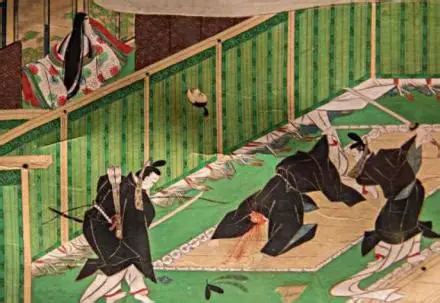
Iruka, caught off guard, was struck on the head and shoulder.
Startled, Iruka stood up.
Saeki Komaro swung his sword again, injuring one of Iruka’s legs.
As Iruka fell, he approached Emperor Kōgyoku’s throne and bowed his head.
He pleaded about the imperial succession and asked to be judged on what crime he had committed.
Emperor Kōgyoku, surprised, asked Prince Naka no Oe what he was doing.
Prince Naka no Oe reported that Iruka was trying to destroy the imperial family and destabilize the throne.
Emperor Kōgyoku stood up and went inside the palace.
Saeki Komaro and Katsuragi Waki Inukai no Amita struck down Iruka.
Soga no Iruka was killed in the imperial court where Emperor Kōgyoku was present.
Rain at Itabuki Palace
It rained that day.
The “Nihon Shoki” records that rainwater overflowed into the courtyard.
A screen was placed over Iruka’s body.
Prince Furuta no Oe, upon seeing Iruka killed, fled to his palace, shut the gates, and did not come out.
Prince Naka no Oe entered Hōkō-ji Temple.
Princes, kings, and courtiers began to gather on Prince Naka no Oe’s side one after another.
Iruka’s body was sent to his father, Emishi.
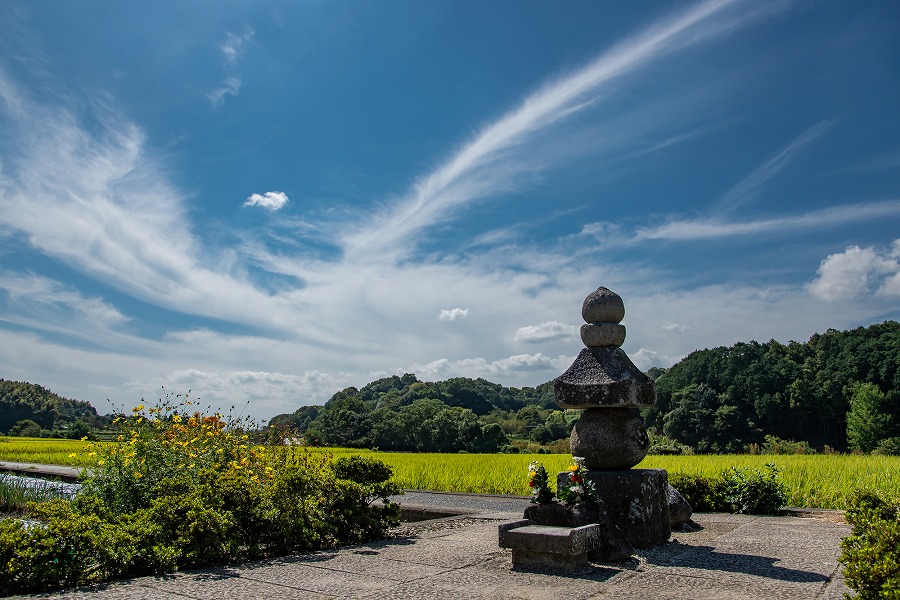
The life of Soga no Iruka ended here on June 12, 645.
The Day After Iruka’s Death
At Emishi’s place, where Iruka’s body was received, the Higashi no Han clan and others gathered.
They assembled their clans, donned armor, armed themselves, and prepared for battle.
There was still strength left to resist.
However, when persuasion came from Prince Naka no Oe’s side, Emishi’s side began to falter.
Takamukai no Kuni Oshi spoke to the Higashi no Han clan, saying that they would be executed for Iruka’s sake, and that Emishi would be defeated today or tomorrow, questioning for whom they were fighting and risking annihilation.
He then removed his sword, threw away his bow, and left.
The soldiers followed suit.
The next day, June 13.
The “Nihon Shoki” records that as the Emishi were about to be executed, the “Tennoki,” “Kokki,” and other treasures were set ablaze.
Fune no Fubito no Esaka managed to retrieve the “Kokki” before it was burned and presented it to Prince Naka no Oe.
On that same day, Emishi took his own life.
The Soga clan itself did not vanish entirely.
Members of the Soga clan, including Soga no Kurayamada Ishikawa Maro who participated in the Isshi Incident, continued to remain in the imperial court.
It was the main Soga family line, from Umako to Emishi and Iruka, that disappeared from the center of political power.
The “Nihon Shoki,” which serves as a primary source of records about Iruka, was completed in 720.
This was 75 years after Iruka’s death.
The “Nihon Shoki” portrays Iruka as a figure with greater influence than his father, one who destroyed the royal family of the Upper Palace.
On the other hand, the “Fujishikaden” depicts a young Iruka who was highly regarded at Min’s school.
June 12, 645.
In front of Empress Kōgyoku, Iruka was struck down, yet he questioned his charges and sought a trial.
In the rain that day, Iruka’s body was covered with a screen and sent to his father, Emishi.
The following day, Emishi also died.
The political power that had been passed down from Umako to Emishi and Iruka in the main Soga family crumbled within two days.
For more details 📖↓

The land of Asuka, where Soga no Iruka once lived.
Even today, the area retains places where one can feel the ancient history.
While experiencing “Asuka,” it might be interesting to enjoy some Nara sweets.

Kudzu Gift Irori Set | Kudzu Tea, Matcha, Yuzu, Kudzu Mochi, Kudzu Jelly Pururun | Guilt-Free, Body-Friendly Nourishing Food, Easy to Eat, Loss of Appetite, Yoshino Honkuzu, Japanese Sweets, Kudzu Confectionery, Year-End Gift Assortment, Souvenir for Homecoming, Souvenir, Kudzu Tea, Kudzu Mochi, Jelly, Mother's Day, Father's Day, Nara Tengyokudo