July 30, 1156.
At Funaokayama, north of Kyoto, a group of Genji warriors was put to death.
At the center of it stood Minamoto no Tameyoshi.
His grandfather was Minamoto no Yoshiie, known as “Hachiman Taro.” His father was Minamoto no Yoshichika, hunted down and killed on the court’s own orders. His eldest son was Minamoto no Yoshitomo, whose own sons included Minamoto no Yoritomo, Noriyori, and Yoshitsune. Another son, Yoshikata, fathered Kiso Yoshinaka.
Trace the Genji family tree forward into the Kamakura period, and Tameyoshi sits at an almost absurdly important junction.
And yet his own life was, for the most part, a string of bitter setbacks.
At fourteen, he helped hunt down his own kinsman Minamoto no Yoshitsuna, and shouldered the family’s military authority in the capital while still barely more than a boy. For nearly half a century afterward, he served the court and the regental house, yet he never climbed the ranks the way Taira no Tadamori did.
His eldest son, Yoshitomo, built up his own power in the east, apart from his father. Yoshikata went his own way too. And Tametomo caused an uproar of his own down in Kyushu.
Late in Tameyoshi’s life, his own grandson, Yoshihira, killed his own son, Yoshikata.
The following year, Tameyoshi himself ended up on the opposite side of the Hogen Rebellion from Yoshitomo.
And after the family’s defeat, it was Yoshitomo, too, to whom Tameyoshi finally turned for refuge.
In 1109, a fourteen-year-old Tameyoshi had stood on the side that hunted down his own kin, acting on the court’s orders.
Forty-seven years later, in 1156, he found himself on the side being hunted.
Follow Tameyoshi’s life from beginning to end, and you can see clearly why the Kawachi Genji, for all the fame Yoshiie had left them, never became a single unified force — and why the Taira got there first.
Born a Grandson of Hachiman Taro Yoshiie
Minamoto no Tameyoshi is said to have been born in 1096.
His father is generally identified as a son of Minamoto no Yoshiie: Minamoto no Yoshichika. Some later genealogies instead make Yoshichika a son of Yoshiie’s own generation rather than a grandson, and questions remain about the exact line of descent, but he is most commonly treated today as Yoshichika’s son.
His grandfather Yoshiie had left behind an enormous reputation in the east through the Former Nine Years War and the Later Three Years War.
The court had refused to recognize the Later Three Years War as an official punitive campaign, so Yoshiie never received the rewards he felt he deserved. Even so, his bond with the warriors of the Kanto only grew stronger, and the name “Hachiman Taro Yoshiie” became a symbol of the warrior class itself.
Tameyoshi was born into the world as that man’s grandson.
It was a privileged bloodline — but the Kawachi Genji of his childhood was already an unstable house.
Yoshiie had fathered many sons — Yoshichika, Yoshitada, Yoshikuni among them — and his own younger brothers included Yoshitsuna and Yoshimitsu. Each branch of the Genji maintained its own separate ties to the court and the aristocracy, and held its own estates and its own retainers.
This was never a house where “whoever succeeds Yoshiie, everyone falls in line.”
Right around the time Tameyoshi was entering his teens, all of that underlying complexity erupted at once.
The Man Who Killed His Father Was Taira no Masamori
Tameyoshi’s father, Minamoto no Yoshichika, had been one of Yoshiie’s most promising potential heirs.
Instead, he caused trouble out in the western provinces and was exiled to Tsushima. Even in exile he kept defying the court, seizing government property in Izumo, until he was finally made a target for suppression.
In 1108, the man sent to Izumo as the punitive commander was Taira no Masamori.
Masamori reported that he had killed Yoshichika, and returned to Kyoto in triumph with his head.
For Tameyoshi’s life, this incident was almost symbolic.
The man who won fame by striking down Yoshichika, an enemy of the court, was Taira no Masamori of the Ise Taira. His son would be Taira no Tadamori. His grandson would be Taira no Kiyomori.
Tameyoshi, Yoshichika’s son, meanwhile stayed behind in Kyoto.
Looking only at the later rivalry between Genji and Taira, it is easy to imagine the two houses as having always stood as equals. In reality, in the early twelfth century, the Ise Taira were rising fast on the strength of their ties to the retired emperor’s household, while the Kawachi Genji were mired in internal disorder.
Tameyoshi had barely lost his father when the next crisis landed on him.
Hunting Down His Own Kin at Fourteen — the Pursuit of Yoshitsuna
In 1109, Minamoto no Yoshitada, who had become Yoshiie’s heir, was attacked in Kyoto and died a few days later.
Suspicion fell on Yoshiie’s own younger brother, Minamoto no Yoshitsuna, and his sons.
The court ordered them hunted down.
Among those who marched to Omi Province as part of that mission was a fourteen-year-old boy: Tameyoshi.
Alongside Minamoto no Mitsukuni of the Mino Genji and others, he pursued Yoshitsuna’s family and cornered them in the mountains. Yoshitsuna’s sons died one after another, and Yoshitsuna himself finally surrendered.
For this achievement, Tameyoshi was appointed to the post of saemon no jo.
He was fourteen years old.
His father had been struck down as an enemy of the court the year before. The very next year, he himself hunted down his own kinsman as a warrior of the court’s own side, and won an official post for it.
It was an episode that would define the first half of Tameyoshi’s life.
He did not hold his position on bloodline alone, as Yoshiie’s grandson. He carried out the court’s orders with force of arms, and built his standing in Kyoto through that service.
That said, it would be a stretch to say this campaign made Tameyoshi the “undisputed head of the entire Kawachi Genji.”
Yoshimitsu’s line was already growing into the Kai Genji and the Satake, and Yoshiie’s son Yoshikuni’s line was heading toward the Ashikaga and the Nitta. The Kawachi Genji had already begun branching into several distinct, powerful houses.
What Tameyoshi held was the center of one prominent branch descended from Yoshiie — not command of the whole.
The “Rokujo Hangan” Who Kept Working in the Capital
The young Tameyoshi was put to use in Kyoto as military muscle for the court and the retired emperor’s household.
In the Kyoto of his day, the goso — armed protests staged by great temples like Enryakuji and Kofukuji — were a constant political headache.
Warrior monks would march into the capital carrying portable shrines and sacred trees, pressing their demands. The court found them extremely difficult to handle.
Tameyoshi was repeatedly mobilized to guard against these protests as well.
During the 1123 protest by Enryakuji, he was posted to the defense alongside Taira no Tadamori. As one of the “capital warriors” responsible for keeping order in Kyoto and guarding the retired emperor’s residence, Tameyoshi worked in that role for a long time.
Because he lived near Rokujo Horikawa, later generations called him Rokujo Hangan.
“Hangan” is read han-gan, a title deriving from offices such as emon no jo and kebiishi no jo.
Tameyoshi never had a great war in the east, the way his grandfather Yoshiie had.
What he left behind instead was a record of holding off temple protests in the capital, chasing down men on the aristocracy’s orders, and keeping the peace.
That work looked unglamorous, but it was essential to how the warriors of the late Heian period worked their way into the machinery of central government.
And in that very same arena, another warrior was climbing the ranks far more skillfully than Tameyoshi.
Tadamori, His Contemporary, Got There First
Tameyoshi and Taira no Tadamori lived through almost exactly the same era.
Both men served as military muscle for the retired emperor’s household and the court, and both were mobilized against temple protests.
Yet by the time they reached their forties and fifties, an enormous gap had opened between them.
Tadamori held a string of provincial governorships — Hoki, Echizen, Bizen among them — and built up wealth through his grip on provincial administration and Seto Inland Sea shipping routes in the west. His ties to Retired Emperor Toba ran deep, deep enough that he was permitted access to the inner palace, a mark of real standing at the center of power.
Tameyoshi, meanwhile, remained stuck for years in the minor post of saemon no jo, and never got the chance to govern a province of his own as a full provincial governor.
His grandfather Yoshiie’s reputation had been overwhelming.
But in twelfth-century Kyoto, a warrior needed more than an ancestor’s fame to rise. He needed ties to the retired emperor and the great aristocratic houses, the wealth that came from a governorship, and bonds with local warriors in the provinces.
Tadamori rode that current skillfully.
Tameyoshi kept serving as the working muscle of Kyoto’s security, while increasingly looking elsewhere for a political patron.
The house he turned to was the Fujiwara regental family.
Into Fujiwara no Yorinaga’s Orbit — a Turning Point Before Fifty
From around 1143, Tameyoshi deepened his relationship with Fujiwara no Yorinaga, the powerful figure of the Fujiwara regental house.
Yorinaga was the second son of Fujiwara no Tadazane, and would later rise to Minister of the Left. A man of fierce scholarly ambition and rigid political principle, he would later be nicknamed the “Wicked Minister of the Left.”
Tameyoshi worked as Yorinaga’s personal retainer, providing the armed force behind the regental family’s estates and household affairs.
In 1146, he was appointed kebiishi.
The kebiishi were an important office responsible for criminal investigation, arrests, trials, and public order in Kyoto.
Tameyoshi was, by this time, around fifty years old.
More than thirty years had passed since he became saemon no jo at fourteen.
After a long period of stagnation, he had finally built a new foothold by tying himself to a powerful figure in the regental house.
This bond with Yorinaga would come to define the final chapter of Tameyoshi’s life.
In 1156, when Yorinaga found himself pushed to the side of Retired Emperor Sutoku, Tameyoshi found himself pulled into the same camp.
Around that same time, something far more troublesome was brewing within Tameyoshi’s own household.
His sons, each in his own place, were starting to build power of their own.
The Eldest Son, Yoshitomo, Overtakes His Father in the East
His eldest son, Minamoto no Yoshitomo, had gone down to the eastern provinces while still young.
Based in Kamakura, in Sagami Province, he tied himself to the Miura and other Bando warrior houses, and threw himself aggressively into disputes over local land rights.
Yoshitomo’s name surfaces in a dispute over the Soma mikuriya, in Shimosa Province, in 1143, and again the following year, 1144, in a dispute over the Oba mikuriya in Sagami.
His opponent, in both cases, was a shoen estate tied to one of the great religious institutions of the age, the Ise Shrine.
Through these struggles, Yoshitomo drew local warriors of the east into his own camp and built an independent military base of his own.
In 1153, Yoshitomo was named Governor of Shimotsuke.
He had reached the rank of provincial governor before his father ever did.
Tameyoshi was in his late fifties. Yoshitomo was in his early thirties.
The relationship between father and son had, by this point, shifted a great deal.
The father, who had spent decades working in the capital, was now outranked at court by his own eldest son, who commanded a body of warriors in the east.
Even so, this should not simply be read as “father and son had broken apart.”
Modern scholarship suggests that succession within the Kawachi Genji was never a simple matter of eldest-son inheritance — Yoshitomo’s brothers, Yoshikata and Yorikata, held important positions of their own. Well before the Hogen Rebellion, Tameyoshi’s household already had several powerful sons standing side by side.
And in 1155, that configuration turned to bloodshed.
A Son, Yoshikata, Struck Down by a Grandson, Yoshihira
Yoshitomo’s younger brother, Minamoto no Yoshikata, had as a young man served the future Emperor Konoe, then still Prince Narihito, as commander of his personal guard, in Kyoto.
After losing that post, he moved into Fujiwara no Yorinaga’s orbit, and eventually headed for the eastern provinces.
Pushing from Kozuke into Musashi, he formed a bond with Chichibu Shigetaka.
To the south of that territory lay the power his elder brother Yoshitomo had already built across the southern Kanto.
Yoshikata pushed into Musashi from the north.
The rivalry between them broke into the open at the Battle of Okura, on August 16, 1155.
Yoshitomo’s eldest son, fifteen-year-old Minamoto no Yoshihira, killed his own uncle Yoshikata in Musashi Province.
To Tameyoshi, Yoshikata was a son, and Yoshihira was a grandson.
It was almost too violent to be described as something that happened “within the family.”
And it did not even end with Yoshikata’s death.
Yoshikata’s younger brother, bound to him by a sworn “father-son pact,” rode for Shinano to avenge him, and Yoshitomo was then ordered to hunt that brother down as well.
By the autumn of 1155, the conflict within the Kawachi Genji — between Yoshitomo’s line and his brothers — had already spread from Musashi to Shinano.
The days when Tameyoshi could simply call out his whole clan and expect them all to march were already long gone.
The Eighth Son, Tametomo, Ran Wild in Kyushu — and His Father Paid For It
Another son who shook Tameyoshi’s final years was Minamoto no Tametomo.
Later generations called him “Chinzei Hachiro” — the Eighth Son of the Western Frontier Guard.
The war chronicle Hogen Monogatari describes him as a monstrous warrior, seven feet tall, wielding a bow no ordinary man could draw. That is, of course, heavily exaggerated storytelling.
Still, the fact that Tametomo crossed to Kyushu while still young and built up serious armed power there is borne out by what followed.
In 1154, Tametomo’s conduct in Kyushu became a problem for the court, and his father Tameyoshi was held responsible and stripped of his own office.
Tameyoshi was, by then, nearly sixty.
His eldest son, Yoshitomo, held a base in the east as Governor of Shimotsuke.
Yoshikata was off doing his own thing.
Tametomo was giving the court headaches down in Kyushu.
Having many sons never simply added up to more military strength for Tameyoshi.
If anything, as his grown sons each built up serious power in different places, the Kawachi Genji ended up with several rival centers of gravity instead of one.
1156: Why Did Tameyoshi Side With Sutoku and Yorinaga?
On July 2, 1156, Retired Emperor Toba died.
The rivalry between Retired Emperor Sutoku and Emperor Go-Shirakawa deepened within the imperial family, while the regental house was riven by the feud between Fujiwara no Tadamichi and Yorinaga.
With Toba’s death, the one figure capable of holding those rivalries in check was gone, and tension in Kyoto rose sharply.
Tameyoshi threw in with Retired Emperor Sutoku and Fujiwara no Yorinaga.
Given his long years as Yorinaga’s personal retainer, it was the natural choice.
Alongside Tameyoshi, his sons Yorikata, Yorinaka, Tamemune, Tarinari, and Tametomo all gathered at the Shirakawa North Palace.
His eldest son, Yoshitomo, meanwhile took the side of Emperor Go-Shirakawa.
The year before, Yoshitomo’s son Yoshihira had already killed Yoshikata, and Yorikata too had already been set against Yoshitomo’s side.
Father and son did not suddenly fall apart during the Hogen Rebellion itself.
The networks and loyalties, and the family conflicts, that had already built up over the years simply took the shape of two armies facing each other in Kyoto.
On the night of July 10, Tameyoshi and his sons were inside the Shirakawa North Palace.
Across the Kamo River, Yoshitomo was readying two hundred-odd horsemen for an attack.
The Sixty-Year-Old Warrior Who Proposed a Night Raid
The Hogen Rebellion has one famously dramatic council-of-war scene.
Hogen Monogatari has Tametomo propose a night raid, only for Fujiwara no Yorinaga to overrule him.
Gukansho, on the other hand, credits the same proposal to the father, Tameyoshi.
Which of the two actually made the proposal, and in what words, cannot be settled with any certainty.
Still, it is telling that Tameyoshi’s name became attached to the idea of a night attack at all.
He had joined his first punitive campaign at fourteen and stood guard against temple protests in Kyoto countless times since. By the time of the Hogen Rebellion, Tameyoshi was around sixty — but he was no old man unfamiliar with actual combat.
The Retired Emperor’s side did not attack that night.
Emperor Go-Shirakawa’s side moved first instead.
Before Dawn on July 11 — His Own Son Attacks With Two Hundred Horsemen
Before dawn on July 11.
The war diary Heihanki records that Emperor Go-Shirakawa’s main force numbered some three hundred horsemen under Taira no Kiyomori, two hundred under Minamoto no Yoshitomo, and one hundred under Minamoto no Yoshiyasu, with Minamoto no Yorimasa and other reinforcements joining once the fighting had begun.
Two hundred-odd horsemen, led by his own eldest son, closed in on the Shirakawa North Palace, which Tameyoshi was defending.
Hogen Monogatari devotes most of its attention to Tametomo, harrying Kiyomori’s and Yoshitomo’s men with his powerful bow. Tameyoshi himself more often appears simply as the father holding his younger sons together.
The fighting lasted several hours, from before dawn onward.
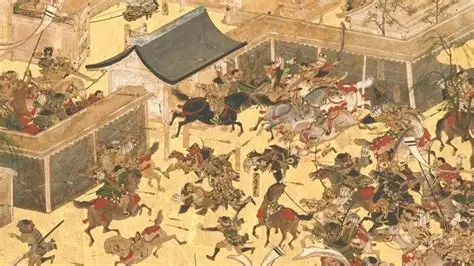
Emperor Go-Shirakawa’s forces attacked from multiple directions and kept feeding in fresh troops. In the end, fire was set around the Shirakawa North Palace, and the Retired Emperor’s line collapsed.
Retired Emperor Sutoku fled.
Fujiwara no Yorinaga suffered a mortal wound while fleeing.
Tameyoshi, too, left the battlefield.
For a warrior’s career that had begun at fourteen, this was the last battle.
Defeated and in Flight, Tameyoshi Turned to the Enemy — His Own Son Yoshitomo
After escaping the Shirakawa North Palace, Tameyoshi fled toward Mount Hiei.
According to Heihanki, Tameyoshi took Buddhist vows, and eventually turned himself in to Yoshitomo.
This was the same eldest son he had faced as an enemy only days before.
Yorinaga was mortally wounded, and Retired Emperor Sutoku had already been taken into the court’s custody. Orders had gone out to hunt down the Retired Emperor’s remaining warriors.
If there was anyone in Kyoto who might still save Tameyoshi’s life, it was Yoshitomo, the victor, and the most reliable option left to him.
The later Hogen Monogatari tells, at length, of Yoshitomo pleading for his father’s life.
The dialogue and emotion in that account belong to the world of war-tale embellishment and cannot be taken as verified fact.
What the contemporary Heihanki confirms is only that Tameyoshi appeared before Yoshitomo, and that his fate was left in the court’s hands.
The court’s verdict was severe.
Execution at Funaokayama — a Different Ending From the One in Hogen Monogatari
After the Hogen Rebellion, the death penalty — long avoided in political cases under the Heian court — was carried out in earnest once again.
On July 28, Taira no Tadamasa and others were executed.
On July 30, Tameyoshi and his sons were executed as well.
Here, the famous scene in Hogen Monogatari and the contemporary record need to be kept separate.
In Hogen Monogatari, Tameyoshi is executed at Shichijo Suzaku, and Yoshitomo faces the agony of cutting down his own father. The details even vary between different manuscript versions of the tale.
The contemporary diary Heihanki, by contrast, records that Tameyoshi was beheaded together with his sons at Funaokayama, and that a formal identification of the heads took place afterward. Gukansho likewise states that Yoshitomo was involved in the execution — and for understanding how Tameyoshi actually died, this is the account worth trusting.
If he was born in 1096, he was sixty-one by the traditional count.
Forty-seven years had passed since he joined the hunt for Yoshitsuna at fourteen.
The boy who had once stood with the court, hunting down his own kin, was in the end defeated by that same court, and executed by the side to which his own eldest son belonged.
By coincidence or not, the beginning and end of Tameyoshi’s life mirror each other in an eerie way.
Why Tameyoshi Could Never Become Another Taira no Tadamori
It would be a disservice to sum up Tameyoshi as merely “a weak clan head” or “a father who could not control his sons” — that misses most of what he actually did across nearly sixty years of activity.
At fourteen he became saemon no jo, and went on guarding the retired emperor’s household and the court in Kyoto.
He dealt with temple protests, became a kebiishi, and served as the military strength behind Fujiwara no Yorinaga.
For nearly half a century, he stayed deeply involved in the practical business of central government.
Meanwhile, his contemporary Taira no Tadamori piled up governorship after governorship, deepened his ties to the retired emperor, and built both wealth and rank at the same time.
That gap cannot be explained purely by a difference in personal ability.
After Yoshiie’s death, the Kawachi Genji lost their cohesion amid the turmoil surrounding Yoshichika, Yoshitada, and Yoshitsuna. Multiple powerful lines then branched out from Yoshiie’s sons and brothers, each building independent power bases of its own in the eastern provinces.
Within Tameyoshi’s own household, too, Yoshitomo pushed east, Yoshikata into Musashi, and Tametomo down to Kyushu, each building his own network and his own armed following.
A system in which one patriarch moved an entire clan was giving way to one in which individual warriors forged their own ties to the retired emperor, the regental house, provincial governors, and local warriors.
From Tameyoshi’s Defeat to Yoritomo, Yoshinaka, and Yoshitsune
In 1156, Tameyoshi died a defeated man.
But his descendants did not vanish with him.
Yoshitomo’s sons included Yoshihira, Yoritomo, Noriyori, and Yoshitsune.
Yoshikata’s son was Kiso Yoshinaka.
Twenty-four years later, Tameyoshi’s grandsons would range across the country during the Genpei War, beginning in 1180.
Yoritomo united the warriors of the east and made Kamakura his base.
Yoshinaka advanced on Kyoto from Shinano and the Hokuriku.
Noriyori and Yoshitsune led the campaign to hunt down the Taira.
Out of the very branches of the Kawachi Genji that Tameyoshi, their grandfather, had never managed to hold together, came one commander after another who would build the Kamakura era.
And Yoshitomo himself, the man who had stood among Tameyoshi’s executioners, lost his own life only three years later, defeated by Taira no Kiyomori in the Heiji Rebellion.
Tameyoshi’s life had begun under the weight of Yoshiie’s great name, and in the end it came to reflect not the Genji’s golden age, but its fracturing.
A boy who hunted down his own kin at fourteen.
A “Rokujo Hangan” who spent half a century working in the capital.
A father whose grown sons scattered in every direction, and who, in the end, found himself facing his own eldest son as an enemy.
Follow the life of Minamoto no Tameyoshi, and you can see the late Heian warrior class outgrowing the logic of “the clan” alone, and beginning instead to choose its own separate paths through lordship, land, and region.
Beyond that tangled fracture, the age of Yoritomo and his generation was already waiting.