The 3rd day of the New Year, Heiji 2 (1160).
At Noma, in Chita district, Owari province, a warrior was killed.
Minamoto no Yoshitomo.
He was thirty-eight years old by the traditional count.
Only days earlier, Yoshitomo had been commanding an army in Kyoto.
Together with Fujiwara no Nobuyori, he had attacked the Sanjo Palace, the residence of Retired Emperor Go-Shirakawa,
driven Shinzei to his death, and for a brief moment held the reins of the court itself.
Then Emperor Nijo escaped his custody, the whole arrangement collapsed, and after losing to Taira no Kiyomori in battle, Yoshitomo fled east along the Tokaido road without stopping.
The sons who had left Kyoto with him fell away one by one.
Thirteen-year-old Yoritomo was separated from the group along the way.
His second son, Tomonaga, was wounded.
His eldest son, Yoshihira, also went his own way.
Still Yoshitomo pushed east.
The place he wanted to reach was the Kanto — Bando, as it was known.
Sagami. Kazusa. Shimosa.
Land where, since his twenties, he had waded into local disputes, forged ties with the warriors there, and built up a power base of his own.
Even beaten in Kyoto, if he could reach the Kanto he might still raise an army.
That possibility, at least, still remained open to him.
But in Owari, with the east almost in sight, the flight came to an end.
The man he turned to was Osada Tadamune, father-in-law of his trusted retainer Kamada Masakiyo.
The Tale of the Heiji tells of Yoshitomo being attacked while bathing,
crying out in his last moments that he wished he had even a single wooden sword.
The exact scene in the bath house, and the words spoken there, come from a later war chronicle. But Yoshitomo’s death at Noma at the hands of Osada Tadamune and his men is not merely legend — historical sites on the present-day Chita Peninsula still mark where his life ended.
Looking back over Yoshitomo’s life, something odd stands out.
He was not the man who came out on top in Kyoto.
He was killed at thirty-eight, and his son Yoritomo was exiled.
And yet, trace the roots of the Kamakura shogunate that followed, and Yoshitomo’s name keeps turning up.
He went down to the east while still young. He waded into land disputes. He built ties with the warriors of Bando.
He became Governor of Shimotsuke at thirty.
In the Hogen Rebellion, he turned against his own father, Tameyoshi, and won.
Then, in the Heiji Rebellion, he was defeated by Taira no Kiyomori — the very man who had stood beside him in that same Hogen Rebellion.
More than twenty years before Yoritomo raised his own army in the east,
there was a man who had already walked that ground, trying to rebuild the strength of the Genji.
His father, Minamoto no Yoshitomo.
Great-Grandson of Hachiman Taro Yoshiie — and Still the Family Struggled
Minamoto no Yoshitomo was born in Hoan 4 (1123).
His father was Minamoto no Tameyoshi.
His grandfather is generally identified as Minamoto no Yoshichika, whose own father was Hachiman Taro, Minamoto no Yoshiie.
In other words, Yoshitomo was Yoshiie’s great-grandson.
On lineage alone, nothing was lacking.
Yoshiie had built enormous prestige in the east through the Former Nine Years War and the Later Three Years War.
But by 1123, the year Yoshitomo was born, the Kawachi Genji’s fortunes had shifted a long way from the peak of Yoshiie’s day.
Yoshiie’s son Yoshichika had been branded an enemy of the court and was reported killed by Taira no Masamori in 1108.
Yoshiie’s heir, Yoshitada, was murdered in turn in 1109.
That killing triggered a purge that swept up Yoshiie’s brother Yoshitsuna and his entire branch of the family.
Yoshitomo’s father, Tameyoshi, took part in that purge of Yoshitsuna at fourteen, and went on working in Kyoto as a soldier for the court and the retired emperors’ household.
Meanwhile, the Ise Taira were steadily climbing.
Taira no Masamori drew close to Cloistered Emperor Shirakawa, and his son Tadamori deepened the family’s ties with Cloistered Emperor Toba in turn.
Tadamori held one provincial governorship after another, built up wealth in the west, and by 1132 had even been granted the privilege of entering the inner palace hall.
By the time Yoshitomo was growing from boy to young man,
the contrast was already visible: for ancestral military renown, the Kawachi Genji; for political power and money in Kyoto, the Ise Taira.
That gap was starting to show.
Yoshitomo did not choose to live out his life in Kyoto the way his father had.
While still young, he headed for the eastern provinces.
That choice would decide the rest of his life.
The Young Man They Called “the Young Lord of Kazusa”
At what age Yoshitomo went down to the eastern provinces, and whose household he first lived in, is not clearly known.
The details simply aren’t recorded.
What is certain is that from a young age his sphere of activity centered on Kazusa and Sagami, and later generations came to call him “the young lord of Kazusa.”
The term referred to a young man of noble birth living away from the capital.
A great-grandson of Hachiman Taro Yoshiie, making his life in Kazusa and the surrounding east.
Here begins the unusual course of Yoshitomo’s career.
The Kawachi Genji’s ties to the eastern provinces did not start with Yoshitomo.
Since the days of his great-grandfather Yoshiie, and Yoshiie’s own father Yoriyoshi, the family had deep connections with the warriors of Bando.
But the world was not so forgiving that warriors would flock to a man simply on the strength of a hundred-year-old family name.
In twelfth-century Bando, all sorts of forces were competing over land.
Estate proprietors. Provincial offices. District officials. Local warriors.
Even relatives within the same family fought each other over land.
Yoshitomo waded straight into that world.
He used the Genji name as his banner, drew allies to his side, seized land, and expanded his power piece by piece.
Yoshitomo in his twenties was far rougher than the image later generations would form of him — the father of the future “Lord of Kamakura.”
One incident makes this side of him unmistakably clear.
The raid on the Oba-no-mikuriya estate.
1144: The Raid on the Oba-no-Mikuriya Estate
The Oba-no-mikuriya estate lay in Koza district, Sagami province.
It was Ise Shrine land, spreading across what is now the area around Fujisawa and Chigasaki.
A mikuriya was an estate whose purpose was producing offerings for the gods.
In the ninth month of Tenyo 1 (1144),
forces loyal to Yoshitomo pushed into this estate.
Yoshitomo was around twenty-two.
The incident is recorded in considerable detail in a document from the Ise Shrine side, the Tenyoki.
Yoshitomo’s men claimed part of the estate as “land belonging to Kamakura district.”
They also joined forces with the Sagami provincial office and pushed into the estate.
Shrine attendants were injured. Fish, soybeans, and adzuki beans were seized.
A larger incursion the following month was reported as well.
From the shrine’s point of view, Yoshitomo was plainly a menace.
This is a long way from the tidy story of “local warriors admiring a great house of the Genji.”
Assert a claim over a boundary.
Join forces with the provincial office. Use force when needed.
That is how the twenty-two-year-old Yoshitomo forced his way into the land disputes of the eastern provinces.
What matters here is that Yoshitomo was not commanding hundreds or thousands of warriors as fully subordinated retainers.
Every time he joined a land dispute, he allied with someone local.
That someone had enemies of their own.
Warriors who stood to gain by teaming up with Yoshitomo kept appearing, and those accumulated ties became his strength.
It was a network of relationships that bloodline alone could never have built.
Reaching for the Soma-no-Mikuriya Estate in Shimosa
Sagami was not the only place Yoshitomo turned up.
His name also appears in the dispute over the Soma-no-mikuriya estate in Shimosa province.
This was Ise Shrine land spreading from what is now northwestern Chiba prefecture into southern Ibaraki.
The Chiba clan, the Kazusa clan, the provincial office, and the Ise Shrine were all tangled up in competing claims to the land.
In Koji 2 (1143),
Yoshitomo allied with Kazusa Tsunezumi and is said to have forcibly taken documents concerning the Soma-no-mikuriya estate from Chiba Tsuneshige.
Then in 1145 he moved to donate the land to the Ise Shrine. A lecture given by the city of Chiba on Chiba Tsunetane also mentions Yoshitomo’s involvement in the estate around this time.
Here too Yoshitomo’s methods were fairly heavy-handed.
Seizing land to make it his own private holding wasn’t the whole goal.
Donating it to the Ise Shrine let him use the authority of a great religious power to protect his claim to the land more securely.
Warriors of the Heian period did not defend their land with the sword alone.
The court. The provincial governor. Temples and shrines. The nobility.
Whatever authority could be used, was used.
Yoshitomo lived by that logic too.
And the Chiba clan, who appear in the Soma-no-mikuriya dispute, would go on to play a major role for Yoshitomo’s son Yoritomo much later, in 1180.
Chiba Tsunetane was not a loyal retainer of Yoshitomo’s from the start.
In the land disputes, the Chiba clan had also stood on the losing side, with Yoshitomo taking their rights away.
Even so, when Yoritomo fled to the Boso peninsula decades later, the land there still held warriors who had had dealings with “the Genji” since his father’s generation.
That accumulated history cannot be dismissed.
Were the Warriors of Bando “Retainers of the Genji”?
Around Yoshitomo were the Miura, the Yamanouchi-Shudo, the Oba, the Hatano, and other clans
whose names would reappear in the Kamakura period.
Here too, caution is needed.
They were not organized into a single retainer band moving on Yoshitomo’s command alone.
Each clan had its own lands and its own enemies.
Protecting their own house came first.
If tying themselves to the Genji brought advantage, they moved closer to Yoshitomo.
If circumstances changed, they drifted away.
The Oba clan, in fact, went on to serve under the Taira regime as well, and
in 1180, at Ishibashiyama, it was Oba Kagechika who defeated Yoritomo.
The picture was never one of eastern warriors keeping unbroken loyalty to the Genji for twenty straight years, from Yoshitomo down to Yoritomo.
Still, Yoshitomo had gained a strength his father Tameyoshi never had.
A network of his own, outside the capital.
Even if he failed politically in Kyoto, he had somewhere to return to.
That sense of a fallback would stay with him to the very end.
In Kyoto, His Brother Yoshikata Was Ahead of Him
While Yoshitomo was pushing into land disputes in the east, his brother Minamoto no Yoshikata was in Kyoto.
In Hoen 5 (1139), he was appointed guard captain to Prince Narihito, the future Emperor Konoe.
This was the man known as “the guard captain.”
Judged purely by early career, there was a stretch when Yoshikata’s path in Kyoto looked more brilliant than that of Yoshitomo, who held next to no office in the east.
But Yoshikata was dismissed from his post after an incident and afterward drew close to Fujiwara no Yorinaga.
In the 1150s, Yoshikata too headed for the eastern provinces.
He advanced from Kozuke into Musashi and allied with Chichibu Shigetaka, a powerful warrior of Musashi.
Yoshitomo’s line, long active in the southern Kanto.
Yoshikata’s line, pushing into Musashi from the north.
Brothers of the same Kawachi Genji, now colliding over territory in the east.
On the 16th day of the 8th month, Kyuju 2 (1155),
fighting broke out at Okura in Musashi province.
Yoshitomo’s eldest son, Minamoto no Yoshihira, struck down his uncle Yoshikata.
Yoshihira was fifteen by the traditional count.
This was the Battle of Okura.
Fujiwara no Yorinaga’s diary, the Taiki, records that word reached him of Yoshikata being killed in Musashi “by the son of his elder brother, Yoshitomo, Governor of Shimotsuke,” and the Hyakurensho likewise records the clash between Yoshihira and Yoshikata.
But there is no surviving proof that Yoshitomo himself gave the order to kill his brother.
What can be seen is a picture of Yoshitomo’s established power in the east colliding in Musashi with Yoshikata and Chichibu Shigetaka, with Yoshihira standing at the front line.
The wider the Genji’s reach grew in the east, the fiercer the rivalry within the clan itself became.
Governor of Shimotsuke at Thirty — Overtaking His Father, Tameyoshi
Two years before the Battle of Okura,
in Ninpei 3 (1153), Yoshitomo was appointed Governor of Shimotsuke.
He was thirty-one by the traditional count.
It was a provincial governorship, and it mattered a great deal.
His father, Tameyoshi, had worked as a warrior in Kyoto from the age of fourteen and never once reached a governorship.
His son Yoshitomo beat him to it, becoming a provincial governor at barely thirty.
A man who in his youth had spent his time in gritty land disputes out east had now risen to hold a formal office granted by the court itself.
The balance of power between father and son must have shifted with it.
Tameyoshi had his own network.
His ties to Fujiwara no Yorinaga ran deep.
Yoshitomo, meanwhile, had a base of his own in the east and was now building an independent standing in Kyoto as well.
He was ceasing to be merely “Tameyoshi’s eldest son” and becoming a warlord in his own right.
That was the state of things when 1156 arrived.
Cloistered Emperor Toba died.
The Hogen Rebellion broke out in Kyoto.
Father and Son Become Enemies
Hogen 1 (1156).
The faction of Retired Emperor Sutoku and Fujiwara no Yorinaga, and the faction of Emperor Go-Shirakawa and Fujiwara no Tadamichi, moved toward armed conflict.
Tameyoshi went in with Sutoku and Yorinaga.
For a man who had served for years as Yorinaga’s retainer, it was the natural choice.
Yoshitomo went the other way — into Emperor Go-Shirakawa’s camp.
Not even a year had passed since the Battle of Okura.
Gathered at the Shirakawa North Palace were not only Tameyoshi but Yoshitomo’s own younger brothers.
Yorikata. Yorinaka. Tamemune. Tamenari. And Tametomo.
Yoshitomo, the eldest, stood alone on the opposite side from his father and brothers.
Explaining this split as a matter of feeling alone misses the point.
Tameyoshi and Yoshitomo were already living inside two entirely separate networks.
Tameyoshi had Yorinaga.
Yoshitomo had his military base in the east and the independent standing he had begun building in Kyoto.
It was no longer an age in which family alone dictated who you served.
Before dawn on the 11th day of the 7th month.
Yoshitomo marched on the Shirakawa North Palace.
According to the Hyohanki, his force numbered over two hundred mounted men. Taira no Kiyomori brought over three hundred. Minamoto no Yoshiyasu brought over one hundred.
Yoshitomo was the mainstay of Emperor Go-Shirakawa’s army.
On the other side of that palace waited his father and his brothers.
Still, he advanced.
The Hogen Rebellion — What Yoshitomo Lost by Winning
The fighting in the Hogen Rebellion was decided within hours.
The Sutoku faction held the Shirakawa North Palace for a time, but it eventually fell after fire was set to it.
The Tale of the Hogen credits Yoshitomo with proposing that very attack by fire.
Attacking the palace head-on only meant mounting losses. Better to set the surrounding area ablaze and drive the defenders out.
It is exactly the kind of heroic moment a war chronicle likes to give its protagonist.
Yoshitomo won.
Afterward he was promoted, made Head of the Bureau of Horses, and granted the privilege of entering the palace hall.
Counting back to his ancestor Yoshiie, it was a major step forward for the Kawachi Genji.
But looking only at what Yoshitomo gained misses the true weight of this war.
His father, Tameyoshi, ended up among the defeated.
Many of his brothers were captured as well.
After fleeing, Tameyoshi ultimately turned to Yoshitomo for protection.
The Tale of the Hogen depicts Yoshitomo scrambling to save his father’s life.
How much of that was an actual conversation between father and son, no one can say.
What is fact is that Tameyoshi surrendered himself into Yoshitomo’s hands and was executed.
On the 30th day of the 7th month, Tameyoshi and his sons were put to the sword.
Yoshitomo himself had a hand in the execution.
The year before, his brother Yoshikata had already died.
Now, in the Hogen Rebellion, he lost his father and still more brothers.
Yoshitomo emerged as the single most powerful figure in the Kawachi Genji.
In exchange, the clan itself had shrunk rapidly.
Kiyomori and Yoshitomo — Two Men Who Won the Same War
In the Hogen Rebellion, Taira no Kiyomori had also fought for Emperor Go-Shirakawa.
Kiyomori with over three hundred riders. Yoshitomo with over two hundred.
The two of them won on the same battlefield.
Because the Heiji Rebellion broke out three years later,
the story is often told as “Yoshitomo resented getting fewer rewards than Kiyomori” or “Yoshitomo rebelled out of frustration with Kiyomori.”
It’s true that the gap between Kiyomori and Yoshitomo widened steadily after the Hogen Rebellion.
Kiyomori had everything his father Tadamori had spent decades building.
Connections in the west. Experience as a provincial governor. Wealth. Ties to the court reaching back to Cloistered Emperor Toba. The weight of a substantial clan.
Yoshitomo had the advantage of the east, but his political accumulation in Kyoto never ran as deep as Kiyomori’s.
Still, reducing the Heiji Rebellion to “Yoshitomo’s revolt out of envy for Kiyomori” loses sight of the actual politics of the time.
The man Yoshitomo bound himself closely to was Fujiwara no Nobuyori, a powerful confidant of Retired Emperor Go-Shirakawa.
Nobuyori had also served as Governor of Musashi.
Yoshitomo, with his base in the east, and Nobuyori, close to Retired Emperor Go-Shirakawa.
Their alliance rested on something far more practical than mere sentiment.
Joining Nobuyori, He Steps Into the Court’s Power Struggle
The man who rose fastest in the court after the Hogen Rebellion was Shinzei.
As a close aide to Emperor Go-Shirakawa, he drove forward political reforms — estate consolidation, rebuilding the Greater Imperial Palace, and more.
At the same time, his own family’s power swelled, and resentment against him spread.
Fujiwara no Nobuyori was among those who clashed with Shinzei.
Then, in 1158, when Emperor Go-Shirakawa abdicated in favor of Emperor Nijo, the politics grew still more tangled.
Retired Emperor Go-Shirakawa’s cloistered rule. The faction supporting Emperor Nijo. Shinzei. Fujiwara no Nobuyori.
Their interests were knotted together.
Yoshitomo became Nobuyori’s military strength.
By this point, Yoshitomo was no longer just “the head of the eastern warriors.”
He had risen to a position where his own military force could tip the balance of power struggles inside the court itself.
But that came with danger.
This was a different order of magnitude from meddling in eastern land disputes.
Losing a power struggle in Kyoto would cost far more than losing a single province’s worth of land.
It would make him an enemy of the court.
In the 12th month of 1159, Yoshitomo made that gamble.
The Night of the 9th — the Attack on the Sanjo Palace
The 9th day of the 12th month, Heiji 1 (1159).
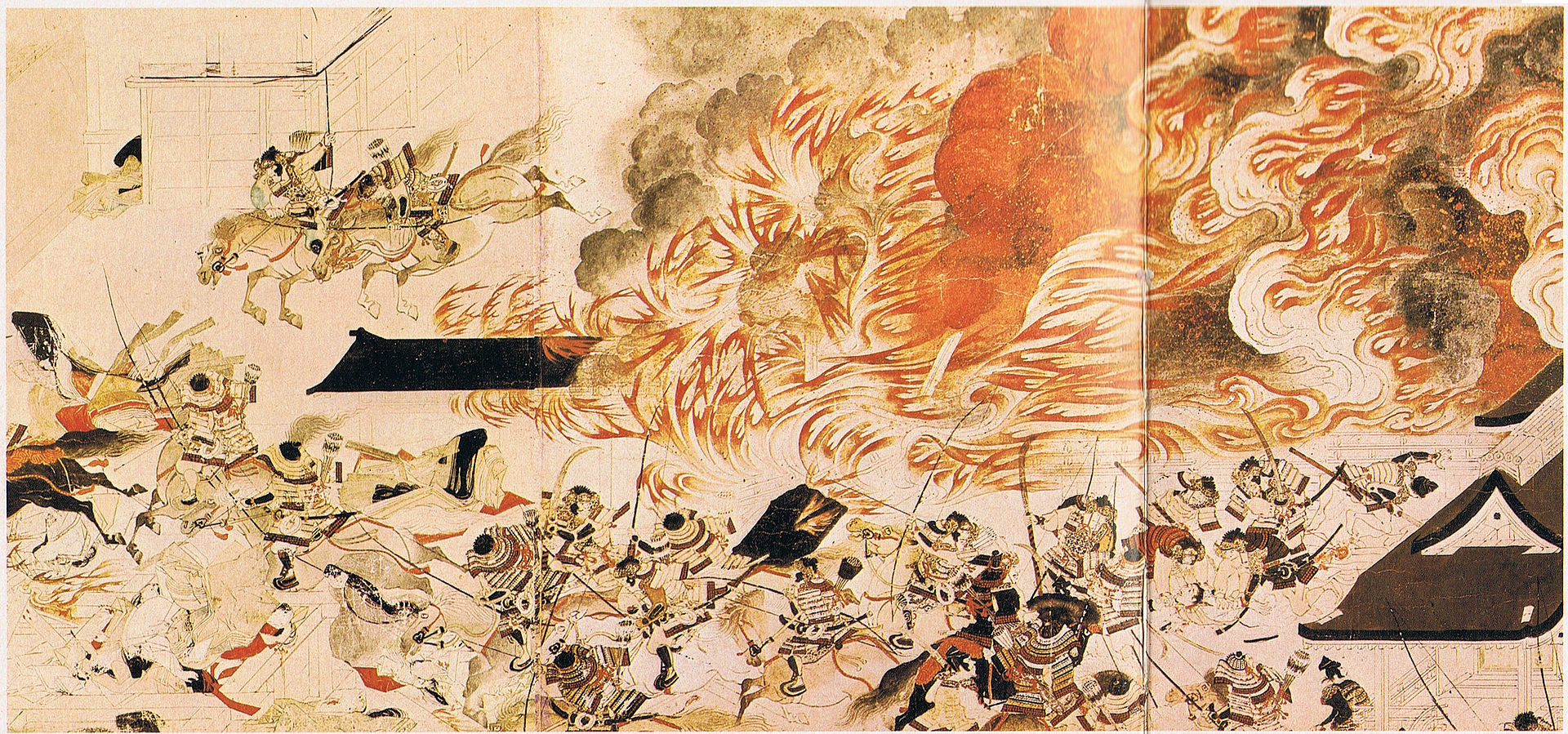
The combined forces of Fujiwara no Nobuyori and Yoshitomo attacked the Sanjo Palace, the residence of Retired Emperor Go-Shirakawa.
Fire caught the building.
People fled in panic, and many lost their lives.
The horror of that scene survives in the Illustrated Scrolls of the Heiji Rebellion’s Sanjo Palace Night Attack chapter, painted roughly a hundred years later.
Yoshitomo and his men seized Retired Emperor Go-Shirakawa and moved him into the imperial palace.
Their target, Shinzei, had already fled Kyoto.
Pursuers were sent out.
Shinzei fled toward Yamato, but ultimately took his own life, and his head was brought back to Kyoto.
In this first phase of the coup, Nobuyori and Yoshitomo had won completely.
Shinzei was dead. Retired Emperor Go-Shirakawa was in their custody. Emperor Nijo was in the palace too.
Nobuyori began handing out appointments.
Yoshitomo was promoted as well.
Even thirteen-year-old Yoritomo was made Acting Assistant Captain of the Right Watch.
For a few days, the house of Minamoto no Yoshitomo stood higher in Kyoto than it ever had.
But this success would not last long.
Kiyomori, who had been away on a pilgrimage to Kumano, was coming back to Kyoto.
Kiyomori Returns to the Capital
Even after Kiyomori returned to Kyoto, he did not immediately attack Yoshitomo.
Nobuyori and Yoshitomo held both Retired Emperor Go-Shirakawa and Emperor Nijo.
On paper, they held the court itself.
If Kiyomori struck first on his own initiative, he risked being branded the rebel.
So Kiyomori held back and instead made contact with the nobles supporting Emperor Nijo.
The turning point came on the night of the 25th of the 12th month.
Emperor Nijo slipped out of the imperial palace.
The emperor made his way to Rokuhara, Kiyomori’s base.
Retired Emperor Go-Shirakawa, too, slipped from Nobuyori’s custody and moved to Ninnaji temple.
The situation flipped overnight.
The emperor who had been in Yoshitomo’s hands the day before was now at Kiyomori’s Rokuhara.
Retired Emperor Go-Shirakawa was gone too.
Having lost both central figures of the court in one stroke, Nobuyori and Yoshitomo’s side lost its political footing instantly.
Kiyomori’s side now had Emperor Nijo.
An order went out to hunt down Yoshitomo and his men.
Before ever losing a duel on the battlefield, Yoshitomo had already suffered a massive political defeat.
The next day, the 26th, Genji and Taira clashed head-on in Kyoto.
The Taiken Gate — Yoshihira Against Shigemori
The fighting on the 26th is recounted in detail in the later Tale of the Heiji.
With so few contemporary records surviving, the fine detail of the fighting cannot be treated as a blow-by-blow account.
Still, it is widely recorded that Genji and Taira clashed around the Taiken Gate and the rest of the Greater Imperial Palace.
On the Genji side stood Yoshitomo, and his eldest son Yoshihira.
On the Taira side stood Kiyomori’s eldest son, Shigemori.
Yoshihira, who at fifteen had cut down his uncle Yoshikata at the Battle of Okura, was now about nineteen.
The Tale of the Heiji describes the fighting spreading from the Taiken Gate into the Greater Imperial Palace itself, with Yoshihira chasing Shigemori down.
Shigemori retreats. Yoshihira presses on.
Retainers throw themselves between them to protect their lord.
The dramatic duel supposedly carries all the way to the area near the Shishinden hall.
No one can say exactly how much of this happened as described.
But judging from this scene alone, Yoshitomo’s side was not simply outmatched.
The Genji fought fiercely too, and for a time pushed the Taira army back.
Chasing the Taira to Rokuhara, the Tide Turns
The Taira army retreated. Yoshitomo’s side gave chase.
The battlefield shifted from the Greater Imperial Palace toward Rokuhara.
Rokuhara was Taira no Kiyomori’s home base.
From Yoshitomo’s perspective, if he was going to bring down Kiyomori, this was the place to do it.
But the closer his force came to Rokuhara, the more the situation favored the Taira.
Taira troops were massed there. Emperor Nijo himself was at Rokuhara.
Which meant Yoshitomo was no longer simply attacking Kiyomori’s residence.
He was marching his troops toward the place where the emperor himself was staying.
Warriors began peeling away from Nobuyori’s side as well.
War chronicles describe Minamoto no Yorimasa and others withdrawing from the fight partway through.
Allies dwindled.
Fresh troops joined the Taira.
The momentum of the battle shifted.
Yoshitomo could not take Rokuhara.
There was no room left to regroup and fight again in Kyoto.
At last, he fled toward the eastern provinces.
The detailed fighting of the Heiji Rebellion has been covered elsewhere on this site, but looked at through the lens of Yoshitomo’s own life, a consistent pattern emerges here.
Defeated, Yoshitomo chose the east once again.
Why the Thirty-Eight-Year-Old Yoshitomo Kept Heading East
As Yoshitomo fled Kyoto, the Kanto must have been on his mind.
The place where he had been active in his twenties. Where he had waded into land disputes. Where he had built ties with the local warriors.
The Miura clan and others still held forces connected to him.
If he could reach the Kanto, there was a chance he could raise an army against the Taira once more.
This was Yoshitomo’s strength.
It was also the last path left open to a man now politically isolated in Kyoto.
His sons traveled with him.
His eldest, Yoshihira. His second son, Tomonaga. His third son, Yoritomo. His trusted retainer, Kamada Masakiyo.
But the flight through the depths of winter was brutal.
The men scattered, and pursuers pressed close.
Father and sons were separated little by little.
Thirteen-Year-Old Yoritomo, Lost in the Snow
The third son, Yoritomo, was thirteen by the traditional count.
The Heiji Rebellion is said to have been his first campaign.
Fleeing east with his father, Yoritomo became separated from the group along the way.
The Tale of the Heiji describes him losing his way in the snow.
He was eventually captured in Omi province and sent back to Kyoto.
The son of Yoshitomo, the central figure of the revolt.
His brother Yoshihira was also a mainstay of the Genji army.
It would have been no surprise had he been executed.
Yet Yoritomo was not killed.
Later sources, including the Tale of the Heiji, credit Kiyomori’s stepmother Ike no Zenni with pleading for his life.
What is certain is that Yoritomo’s life was spared, and he was exiled to Izu.
Twenty years later, this thirteen-year-old boy would raise an army in the east once more.
Yoshitomo had no way of knowing that future awaited.
Losing Tomonaga, Parting From Yoshihira
His second son, Tomonaga, was wounded during the retreat.
The Tale of the Heiji describes him collapsing at Aonohaka in Mino province, and, unwilling to become a burden to his father, asking to die — with Yoshitomo delivering the fatal blow himself.
His eldest son, Yoshihira, also parted from his father.
The war chronicles say he returned to the Kyoto area to hunt down Kiyomori.
Yoshihira was eventually captured and executed.
The man who had cut down his own uncle at the Battle of Okura and fought Taira no Shigemori in the Heiji Rebellion — “the Wicked Genta” — died before turning twenty.
His sons had been with him when he left Kyoto.
The further east they traveled, the more of them vanished, one by one.
The one who stayed by Yoshitomo’s side to the end was Kamada Masakiyo.
Noma — Killed by a House He Trusted
Noma, in Chita district, Owari province.
From here, the east was close.
The man Yoshitomo and Masakiyo turned to was Osada Tadamune.
Tadamune is said to have been Kamada Masakiyo’s father-in-law.
To a Yoshitomo in the middle of flight, this was no stranger.
He was kin to his most trusted retainer.
Here, surely, he could rest.
It would have been a reasonable thing to think.
Instead, Osada Tadamune killed him.
The Tale of the Heiji sets the scene in the bath house.
Yoshitomo, unarmed and bathing, was set upon.
He is said to have fought back, crying, “If only I had even a single wooden sword.”
At Nomadaibo temple in Mihama, Aichi prefecture, where Yoshitomo’s grave stands today, there remains a custom of offering wooden swords.
A tale from a war chronicle has lived on as local tradition for over eight hundred years.
Yoshitomo did not die on the battlefield facing Taira no Kiyomori.
He was killed by a man he had turned to for shelter, with the east almost within reach.
That is what makes his death linger all the more.
Was Yoshitomo Simply Weaker Than Kiyomori?
Looking only at how the Heiji Rebellion ended, the answer seems obvious.
Kiyomori won. Yoshitomo lost.
Afterward, Kiyomori rose to Chancellor of the Realm, while Yoshitomo died at thirty-eight.
But dividing the two into “strong Kiyomori, weak Yoshitomo” makes the Hogen and Heiji rebellions harder to understand, not easier.
In the Hogen Rebellion, Kiyomori mobilized over three hundred riders against Yoshitomo’s two hundred plus.
The court recognized Yoshitomo, too, as a major military power.
Had he made it back to the east, there was a real chance he could have gathered still more troops.
Even in the fighting at Kyoto during the Heiji Rebellion, accounts of how fiercely Yoshihira and the rest of the Genji fought have come down to later generations.
Where the real gap showed was politics.
Kiyomori had a network in Kyoto built up over his father Tadamori’s generation.
He held ties not only to Retired Emperor Go-Shirakawa but to Emperor Nijo’s faction as well.
In the Heiji Rebellion, welcoming Emperor Nijo into Rokuhara instantly made his forces the imperial army.
Yoshitomo had bound himself deeply to Fujiwara no Nobuyori alone.
As long as Nobuyori’s side controlled the court, that alliance was strong.
Once Emperor Nijo and Retired Emperor Go-Shirakawa slipped away, that foundation collapsed almost instantly.
Yoshitomo succeeded in building his own strength in the east.
When it came to converting that strength into political power in Kyoto, Kiyomori simply had the edge.
What Yoshitomo Left Behind for Yoritomo
In 1160, the year Yoshitomo died,
the future of the Kawachi Genji looked bleak.
Yoshihira executed. Tomonaga dead. Yoritomo exiled to Izu.
Noriyori would grow up in Totomi, and Yoshitsune was still an infant.
Yoshitomo’s branch of the Genji had all but vanished from Kyoto.
The Taira were the opposite.
With Kiyomori at the center, the clan grew stronger in the court, gaining both rank and wealth.
Twenty years later, in Jisho 4 (1180).
Yoritomo, in Izu, raised an army.
In his first battle, at Ishibashiyama, he was defeated by Oba Kagechika.
Even so, Yoritomo crossed the sea toward the Boso peninsula.
Chiba Tsunetane joined him. The Miura clan eventually followed. Kazusa Hirotsune came to Yoritomo’s side with a massive force of his own.
Their reasons for following Yoritomo were never just one thing.
Discontent with the Taira regime. Disputes over land. Local rivalries.
Each had its own calculation.
They did not gather simply because he was “Yoshitomo’s son.”
And yet, when Yoritomo appeared in the east, the name of the Genji was hardly unknown there.
Yoriyoshi. Yoshiie. And Yoshitomo.
The memory of generations of ties to the eastern provinces still lingered.
Among them all, Yoshitomo was the one who, from a young age, had waded directly into the land disputes of Bando and built direct ties with the warriors there.
Yoritomo did not inherit a finished organization from his father.
But he returned to the ground his father had once walked.
And there, warriors remained who had once had dealings with the Genji.
That was worth far more than starting from nothing.
The Father Who Never Made It Back East, and the Son Who Did
Yoshitomo’s life is marked, again and again, by moments of losing something right after winning.
When he expanded his power in the east, he collided with his brother Yoshikata’s forces.
When he won the Hogen Rebellion, he lost his father and many brothers.
In the Heiji Rebellion, his first coup succeeded, and he brought down Shinzei.
Yet the moment Emperor Nijo escaped, his fortunes collapsed, and within days he was fleeing Kyoto.
In the end, he could not even make it back to the east he had relied on more than anything.
And yet what Yoshitomo had built in the east in his younger years did not vanish with him at Noma.
In 1180, twenty years after his father failed to reach the Kanto, Yoritomo came back to it.
Yoritomo gathered warriors there and entered Kamakura.
This was the very Kamakura in Sagami province where Yoshitomo had once been active in his youth.
What followed was not simply Yoritomo repeating his father’s methods.
He bound the eastern warriors together through stronger bonds of lord and vassal, negotiated repeatedly with the court, and built a system that would grow into a warrior government.
He surpassed his father.
But that starting point began with Yoshitomo’s own generation.
Carrying the fame of Hachiman Taro Yoshiie, and refusing to depend on Kyoto alone, he went east in his twenties and built up a web of human relationships through his own effort.
He fought his own father in the Hogen Rebellion, was defeated by Kiyomori in the Heiji Rebellion, and lost his life at thirty-eight.
His was not a life that ended in victory.
And yet, from the place where Yoshitomo fell at Noma while still trying to reach home, Yoritomo’s era would begin twenty years later.
Minamoto no Yoshitomo was a warlord destroyed in the Heiji Rebellion — and, at the same time, the man of the Kawachi Genji who put down roots in the eastern provinces a generation before Yoritomo ever did.