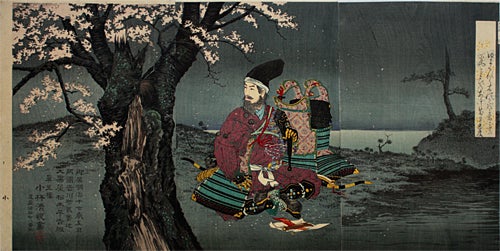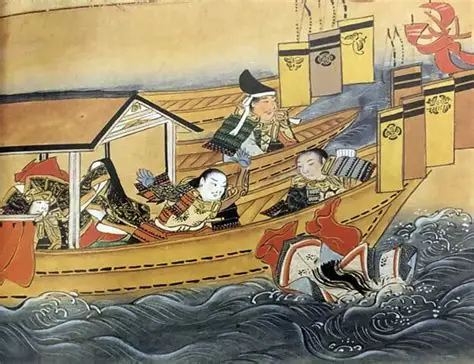
On February 7, 1184, during the Battle of Ichinotani in Settsu Province, the Taira forces suffered a defeat.
The Minamoto army launched attacks from the east, west, and the mountains, breaking through the Taira defense lines one after another.
Taira no Michimori, who was defending the hills of Fukuhara, was among the retreating troops.
According to the “Tale of the Heike,” Michimori was surrounded by seven enemy riders downstream of the Minatogawa River and was killed.
That evening, a lone warrior returned to the Taira fleet.
It was Kimita Takiguchi Tokiin.
He was a retainer serving Michimori.
Tokiin went to the ship where his master’s wife was and conveyed the news of Michimori’s last moments.
He apologized for surviving while being unable to save his master, who was surrounded by enemies.
His wife’s name was Kozaisho no Tsubone.
She had once served Empress Dowager Jōsei and was renowned for her beauty at court.
According to the “Tale of the Heike,” Michimori fell in love with Kozaisho no Tsubone at first sight and sent her love letters for three years before they were united.
The night before the decisive battle at Ichinotani, Michimori summoned his wife to his camp.
He told her that he might fall in the next day’s battle.
In response, Kozaisho no Tsubone revealed that she was pregnant.
Michimori was overjoyed and wished for the safe birth of their child.
However, he did not return from the battle the following day.
After learning of her husband’s death, Kozaisho no Tsubone spent several days on a ship bound for Yashima.
Then, on the night of February 13, she followed her husband into the sea, as recorded in the “Tale of the Heike.”
Michimori was the eldest son of Taira no Kiyomori‘s brother, Taira no Norimori.
From a young age, he held various court positions and was appointed Governor of Echizen in 1176.
Later, he was involved in suppressing anti-Taira forces in the Hokuriku region, experiencing defeat in Echizen and retreating to Tsuruga.
In 1183, he was promoted to Junior Third Rank and became known as “Sangi of Echizen.”
However, in the same year, the Taira forces suffered a major defeat to Minamoto no Yoshinaka in the Hokuriku campaign, eventually leading to their departure from Kyoto.
The period when Michimori rose through the court ranks coincided with the Taira clan’s loss of military control across various regions.
Born as the Eldest Son of Taira no Norimori
Taira no Michimori was born as the eldest son of Taira no Norimori.
His father, Taira no Norimori, was the son of Taira no Tadamori and the half-brother of Taira no Kiyomori.
For Tomomori, Kiyomori was an uncle, and Tadamori was a grandfather.
The exact birth year of Tomomori is not known.
There are theories suggesting he was born in the early 1150s, with years like 1153 or 1155 being mentioned, but there is a lack of definitive historical records to confirm his birth year.
His mother is believed to be a daughter of Fujiwara no Sukemoto.
Tomomori had younger brothers, including Norikyo and Gyomori.
Norikyo is known as the governor of Noto and is depicted in the “Tale of the Heike” as a person of exceptional valor.
Gyomori also grew up as a noble of the Taira clan and died in battle alongside his brother Tomomori at the Battle of Ichi-no-Tani.
Other children of Norimori include Chukai and Moriyori, who became monks, as recorded in family genealogies.
Norimori, Tomomori’s father, held an important position within the Taira clan, centered around Kiyomori.
He held various court positions and elevated his status by forming marital ties with influential figures at court.
Tomomori was born as the eldest son into such a family.
There are no detailed records of his early childhood.
However, the period when he obtained his official rank can be traced through genealogies and official records.
Tomomori served the court from a young age and became a prominent official of the Taira clan by the time he reached adulthood.
Father Norimori, Known as “Kadowaki Chūnagon”
Norimori, Tomomori’s father, was a key figure supporting the Taira clan’s political and military affairs.
He served the court as Kiyomori’s brother and later rose to the rank of Chūnagon.
He was also known by the nickname “Kadowaki Chūnagon.”
The name “Kadowaki” is said to be derived from the location of Norimori’s residence.
While Kiyomori’s house became the center of the Taira clan, Norimori’s house also rose in prominence as a powerful family line.
Norimori’s daughters formed marital alliances with influential figures at court.
Connections with figures like Fujiwara no Naramoto and Minamoto no Michichika, who were active around Emperor Go-Shirakawa, are also known.
Through these relationships, Norimori’s family was linked to the people of the court.
His eldest son, Tomomori, continued to rise as an official, while his brother Norikyo became active in military affairs.
Norimori himself was involved in the Taira’s military actions and led the clan to various regions when conflicts with the Minamoto began.
Tsunemori was in a position to inherit the political status and military role of the Taira clan from his father.
Promoted to Fifth Rank at a Young Age
In 1160, the first year of the Eiryaku era, Tsunemori was appointed to the Junior Fifth Rank, Lower Grade.
In the Heian period court, those holding a rank of Fifth or higher were recognized as having a certain status within the aristocratic society.
This means that Tsunemori held this status from a young age.
Later, in the second year of the Chokan era (1164), he became the Deputy Minister of the Ministry of Central Affairs, and in the first year of the Eiman era (1165), he also served as the Vice-Governor of Hitachi Province.
The Deputy Minister of the Ministry of Central Affairs was the second-in-command of the Ministry, while the Vice-Governor of Hitachi was the second-in-command of the provincial government of Hitachi.
He also held positions such as Assistant Captain of the Left Division of Inner Palace Guards and Governor of Noto Province.
In the third year of the Ninnan era (1168), he was promoted to Junior Fourth Rank, Lower Grade.
By the second year of the Jōan era (1172), he had risen to Junior Fourth Rank, Upper Grade, and then to Senior Fourth Rank, Lower Grade.
At this time, his uncle, Kiyomori, held significant power at the court.
After the Hogen Rebellion and the Heiji Rebellion, he increased his influence and became the Grand Minister of State in the second year of the Ninnan era (1167).
Kiyomori’s sons, brothers, and their children were also granted official positions one after another.
Tsunemori’s promotions coincided with the expansion of the clan’s power.
However, there are few detailed records of how much actual work young Tsunemori handled in these positions.
As he matured, records began to appear showing his participation in court ceremonies.
Appointed Governor of Echizen in the Second Year of the Angen Era
In the second year of the Angen era (1176), in the first month, Tsunemori was appointed Governor of Echizen.
The diary of Kujō Kanezane, “Gyokuyō,” records the appointment on the 30th day of the first month.
Meanwhile, “Kugyō Bunin” records it as the 20th day of the first month, indicating a discrepancy in the dates.
Echizen Province corresponds to the northern part of present-day Fukui Prefecture, including the area around Tsuruga.
It was an important province, as it was traversed by the Hokuriku Road and was significant for transportation along the Sea of Japan.
At that time, the lord of Echizen Province was Taira no Shigemori.
Shigemori was Kiyomori’s eldest son and Tsunemori’s cousin.
The lord of a province had significant influence over the appointments and revenues of the provincial government.
Shigemori managed Echizen Province, while Tsunemori, the eldest son of Taira no Tokimori, served as its governor.
Two branches of the Taira clan were interconnected through their control of Echizen Province.
Even after assuming this official position, Tsunemori continued to participate in court ceremonies in Kyoto.
On March 6, 1176, it is recorded that he served at an event celebrating the 50th birthday of Emperor Go-Shirakawa.
Additionally, on August 19, 1178, he was responsible for serving food at the purification ceremony for the Empress.
Serving food is a duty involving the handling of meals during court ceremonies.
The Yamaikiroku notes that Tsunemori also participated in purification and prayer ceremonies related to the Empress in October of the same year.
While Tsunemori was involved in local governance as the governor of Echizen, he was also engaged in court rituals in Kyoto.
The Court Life of the Taira Clan Supported by Echizen Province
The role of the governor of Echizen was not limited to local administration.
It was also crucial to deliver income and supplies from the province to the court and to cover the costs required for ceremonies.
In January 1179, the Yamaikiroku contains an entry regarding the burdens placed on Echizen Province.
When Emperor Takakura was to make a New Year’s visit to Emperor Go-Shirakawa, it was intended to order Tsunemori, the governor of Echizen, to procure supplies.
However, the person in charge misunderstood the type of burden and mistakenly sent a messenger to Shigemori, the lord of the province.
As a result, it is recorded that issues arose concerning the handling of the burden.
Additionally, during the ceremony celebrating the birth of the Crown Prince, Tsunemori, as the governor of Echizen, also covered part of the necessary supplies.
These records reveal how provincial governors and the Kyoto court were connected through the exchange of specific goods.
The Taira clan’s appointment as provincial governors and lords across various regions was also a means to secure financial resources to support their power at court.
Echizen Province was one of these crucial foundations.
However, in 1179, Tsunemori would lose his position as governor of Echizen.
The Death of Taira no Shigemori and the Dismissal of the Governor of Echizen
In July 1179, Taira no Shigemori passed away.
Shigemori was the heir of Kiyomori and a key figure supporting the Taira’s political influence at court.
After his death, Emperor Go-Shirakawa confiscated Echizen Province, which had been under Shigemori’s control.
On October 9, Fujiwara no Takanobu was appointed as the governor of Echizen.
Tsunemori was dismissed from his position as governor of Echizen.
For the Taira clan, losing a province they had long been involved with was a significant issue.
The relationship between Kiyomori and Emperor Go-Shirakawa had been deteriorating even before this.
The Emperor sought to curb the concentration of power within the Taira, while Kiyomori aimed to protect the positions and interests his clan had acquired.
The confiscation of Echizen Province further deepened the conflict.
On November 14, Kiyomori led a large army from Fukuhara and entered Kyoto.
This was the political upheaval of the third year of Jisho.
Kiyomori removed Emperor Go-Shirakawa’s close associates from their official positions and seized control of the court’s politics.
On November 17, Fujiwara no Tokiie was dismissed from his post as Governor of Echizen.
The following day, on the 18th, Tomomori was once again appointed as Governor of Echizen.
Furthermore, on the 20th, Emperor Go-Shirakawa was confined to the Toba Palace.
Tomomori regained the office he had lost in just over a month.
The appointments concerning the Governorship of Echizen were directly influenced by the conflict between Kiyomori and Emperor Go-Shirakawa.
Serving Tokuko as Vice Minister of the Imperial Household
In the third year of Jisho, Tomomori also served as Vice Minister of the Imperial Household.
The Vice Minister of the Imperial Household was a deputy position responsible for affairs and ceremonies related to the Empress.
At that time, the Empress was Taira no Tokuko.
She was Kiyomori’s daughter and had become the Empress of Emperor Takakura.
To Tomomori, she was a cousin.
In the second year of Jisho (1178), Tokuko gave birth to Prince Tokihito.
He would later become Emperor Antoku.
The Taira clan strengthened their ties with the imperial family through Tokuko, making the Imperial Household Office an important institution for the clan.
While Tomomori had a career as the governor of Echizen Province, he also became involved with Tokuko’s Imperial Household Office.
The timing of his appointment as Vice Minister of the Imperial Household is also relevant when reading “The Tale of the Heike,” which describes his encounter with Kozaisho no Tsubone.
In “The Tale of the Heike,” Tomomori is depicted participating in a cherry blossom viewing as Vice Minister and noticing Kozaisho no Tsubone.
However, the description that dates this scene to the Angen era does not match the 1179 appointment as Vice Minister.
The exact timing and circumstances of their meeting may have been organized in later stories.
Meanwhile, the union of Tomomori and Kozaisho no Tsubone can be confirmed from other historical sources.
Kozaisho no Tsubone Serving Empress Dowager Jōsei
Kozaisho no Tsubone was a lady-in-waiting serving Empress Dowager Jōsei.
Empress Dowager Jōsei was Princess Tokuko, the daughter of Emperor Toba, and the sister of Emperor Go-Shirakawa.
She was surrounded by ladies-in-waiting who supported the court’s ceremonies and daily life.
Kozaisho no Tsubone was one of them.
Her father was said to be Fujiwara no Norikata, the Minister of Justice, although some versions of “The Tale of the Heike” record him as “Noritaka.”
Kozaisho no Tsubone was known as a woman of exceptional beauty.
In “The Tale of the Heike,” she is even described as the most beautiful woman in the court.
Her reputation can also be gleaned from the records of contemporary lady poets.
This is about Kenreimon-in Ukyō no Daibu.
Ukyō no Daibu served Taira no Tokuko and was closely associated with Taira no Shigemori‘s son, Sukemori.
She documented the splendor of the Taira clan at court and the people lost to war in her own poetry collection.
The “Kenreimon-in Ukyō no Daibu Shū” mentions that during the Toyoake Festival, the ladies-in-waiting of Jōsei-mon-in came to watch.
Among them, Kozaisō no Tsubone was noted for her striking beauty.
Ukyō no Daibu recorded even the way her hair fell across her forehead.
It was also remembered by Ukyō no Daibu that Kozaisō no Tsubone became the wife of Tsunemori.
A Romance Said to Have Begun at the Cherry Blossom Viewing at Hōshō-ji
In “The Tale of the Heike,” Volume Nine, “Kozaisō’s Leap,” the story of how Tsunemori and Kozaisō no Tsubone came together is detailed.
When Kozaisō no Tsubone was 16, the lady she served went to Hōshō-ji for cherry blossom viewing.
Hōshō-ji was a temple established by Emperor Shirakawa, located in Shirakawa, Kyoto.
Kozaisō no Tsubone accompanied her lady to this event.
It is said that Tsunemori saw Kozaisō no Tsubone there and was captivated by her.
Afterward, he began sending her poems and love letters.
However, Kozaisō no Tsubone did not reply.
In the court society of the time, men and women often deepened their relationships through the exchange of poems and letters.
Receiving a reply poem was a crucial event that could determine the course of the relationship.
Despite sending many letters, Tsunemori received no response from Kozaisō no Tsubone.
According to “The Tale of the Heike,” this period lasted for three years.
Eventually, Tsunemori decided to write one last letter.
The messenger headed to Kozaisō no Tsubone but was unable to deliver it directly.
On the way back, by chance, they encountered the ox carriage carrying Kozaisō no Tsubone.
The messenger seized the opportunity to deliver the letter.
The Last Love Letter Thrown into the Ox Carriage’s Blind
According to “The Tale of the Heike,” when Tsunemori’s messenger spotted Kozaisō no Tsubone’s ox carriage, they threw the letter inside the blind.
Kozaisō no Tsubone was startled by the sudden event.
When she asked who had thrown it, her attendants did not give a clear answer.
Upon opening the letter, she found it was from Tsunemori.
She could neither leave it in the carriage nor discard it by the roadside.
So, she tucked it into her hakama and headed to the palace.
However, during her court duties, she accidentally dropped the letter.
The location was in front of the lady she served.
The lady picked up the letter and asked whose it was.
The ladies-in-waiting around her claimed ignorance, but only the Lady of the Kozai Bureau blushed and remained silent.
It is said that the Empress Dowager had long been aware of Tomomori’s feelings for the Lady of the Kozai Bureau.
When the letter was opened, it was filled with Tomomori’s expressions of love.
At the end, there was a tanka poem.
“My love is like the round bridge over the narrow valley stream, repeatedly crossing back, my sleeves soaked with tears.”
Just as one would tread back and forth over a round bridge spanning a narrow valley stream, he repeatedly sent letters, his sleeves wet with tears.
This poem expressed the agony of such love.
The Empress Dowager encouraged the Lady of the Kozai Bureau to reply and even composed a response herself, as recounted in the “Tale of the Heike.”
Thus, after a long period without a response, Tomomori’s love finally saw progress.
The three years of courtship, the incident with the ox carriage, and the Empress Dowager’s mediation are anecdotes passed down in war tales.
Meanwhile, the fact that the two became husband and wife is also recorded in the “Kenreimon-in Ukyō no Daibu-shū.”
The Marriage Story in the “Kenreimon-in Ukyō no Daibu-shū”
Ukyō no Daibu noted that there was a man who had long been in love with the Lady of the Kozai Bureau.
Despite his long-held feelings, the Lady of the Kozai Bureau was united with Tomomori.
The man whose love was unfulfilled was said to have been deeply saddened.
Ukyō no Daibu, upon hearing this story, sent a poem.
“Surely you must lament, as the autumn leaves you cherished were plucked by another.”
The autumn leaves he cherished were taken by another.
Surely, you must be grieving.
This was the meaning of the poem.
The man then replied, wondering why he had set his heart on the leaves plucked by another.
Ukyō no Daibu initially took this exchange as a playful love story.
However, after learning of subsequent events, she was reminded of their marriage.
Tomomori died in battle at Ichinotani, and the Lady of the Kozai Bureau followed him into the sea.
Ukyō no Daibu recorded that upon hearing this news, she felt anew the depth of their bond.
The “Kenreimon-in Ukyō no Daibu-shū” conveys that Tomomori and the Lady of the Kozai Bureau’s marriage was known even in the court of the time.
It also reveals that the Lady of the Kozai Bureau’s plunge into the sea was known not only to those on the Taira ships but also to the Kyoto court.
Marriage to Taira no Munemori’s Daughter and Their Children
It is said that Tomomori had another wife besides the Lady of the Kozai Bureau.
Genealogies record that Taira no Munemori’s daughter became Tomomori’s wife.
Munemori was the son of Kiyomori, making him and Tomomori cousins.
The marriage to Munemori’s daughter also served to unite the houses of Kiyomori and Tokimori.
Meanwhile, the Lady of the Kozai Bureau served the Empress Dowager and had deep connections with the court ladies.
Through such marriages, Tomomori was involved with both the Taira clan and the court society.
However, the exact timing of Tomomori’s marriages to each of these women is unknown.
As for Tomomori’s children, the name Taira no Michihira is recorded in genealogies.
There are also few clear records regarding his mother.
Later, in the ‘Tale of the Heike,’ it is depicted that on the eve of the decisive battle at Ichinotani, Kozaisho no Tsubone announced her pregnancy, and Tomomori rejoiced at the news of his first child.
However, genealogies that mention Michihira’s existence and articles in the ‘Azuma Kagami’ about Tomomori’s surviving children also remain.
Regarding the couple’s final conversation, it is necessary to separate the narrative from the actual family relationships.
The Genji Uprising and Turmoil in Echizen Province
In the fourth year of Jisho (1180), anti-Taira movements began across the country.
In May, Prince Mochihito and Minamoto no Yorimasa raised an army, and in August, Minamoto no Yoritomo rose in Izu Province.
In Shinano Province, Minamoto no Yoshinaka was expanding his influence, and in the Hokuriku region, warriors who did not follow the Taira began to take action.
For Tomomori, the situation in Echizen Province was particularly significant.
Echizen had long been a land where the Taira clan served as provincial governors and lords.
However, not all local warriors and religious institutions continued to accept Taira rule.
With Yoshinaka’s uprising, anti-Taira movements spread in Etchu and Kaga.
Their influence also reached Echizen.
On December 2nd of the fourth year of Jisho, the ‘Meigetsuki’ records that Tomomori and others, as punitive envoys, departed for the Omi region.
Around the same time, the Taira were engaged in suppressing rebel forces in Omi and Mino.
Tomomori, while holding the position of governor of Echizen, also began to participate in military actions.
And in the following year, the rebellion in the Hokuriku region intensified even further.
Kiyomori’s Death and the Battle of Sunomata River
On the intercalary 2nd month, 4th day of the fifth year of Jisho (1181), Taira no Kiyomori passed away.
The central figure of the Taira clan became Kiyomori’s son, Taira no Munemori.
However, the conflict with the Genji did not cease.
In March of the same year, near the Sumiyoshi River in Owari Province, the forces of the Taira clan clashed with the army of Minamoto no Yukie.
Yukie was the son of Minamoto no Tameyoshi and the uncle of Yoritomo and Yoshitsune.
He was also the person who spread the imperial order of Prince Mochihito to the Minamoto clan across the regions, calling for the overthrow of the Taira.
On the Taira side, Taira no Shigehira and others led their troops, and it is said that Tomomori also joined the punitive force.
According to the “Azuma Kagami,” Yukie’s forces crossed the Sumiyoshi River at night, attempting a surprise attack on the Taira camp.
However, the Taira army, having detected this movement, launched a counterattack.
Yukie’s side was defeated, and Yoritomo’s half-brother, Minamoto no Yoshimune, was also killed in action.
Meanwhile, the contemporary diary “Kikki” notes that many from the forces belonging to the Governor of Echizen were also killed.
There are discrepancies in the records regarding the course of the battle and the losses, making it difficult to trace Tomomori’s specific actions in detail.
However, it is evident that around the time of the Battle of Sumiyoshi River, Tomomori’s forces were also involved in military actions along the Tokaido.
Although the Taira emerged victorious in this battle, they were unable to weaken Yoritomo’s influence in the eastern provinces.
Moreover, anti-Taira forces were expanding in the Hokuriku region, prompting Tomomori to head towards Echizen.
The First Year of Yowa, Marching to Echizen
In the summer of the first year of Yowa (1181), resistance against the Taira was spreading in the Hokuriku region.
On July 17, the diary “Gyokuyo” by Kujo Kanezane recorded that local lords in Etchu and Kaga had joined the Minamoto side, with their influence reaching as far as Echizen.
On the following day, the 18th, rumors of the Governor of Echizen, Tomomori, heading to the Hokuriku were also noted.
On August 14, the court issued an imperial decree to suppress the rebellious forces in the Hokuriku region.
On the 15th, Taira no Tsunemasa departed for the Hokuriku.
And on the 16th, Tomomori also set out, as reported by the “Azuma Kagami.”
Tsunenari was the son of Taira no Tsunemori and a cousin of Taira no Tomomori.
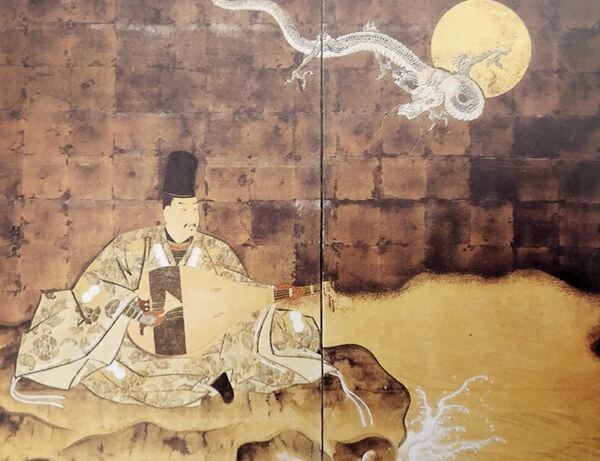
While renowned as a master of the biwa, he also participated in the military activities of the Taira clan.
On the occasion of this military expedition, Tomomori resigned from his position as Governor of Echizen.
On August 15, Taira no Chikafusa was appointed as his successor.
Tomomori left his official post and headed to Echizen as a commander to pacify the Hokuriku region.
However, around that time, the situation in Echizen rapidly deteriorated.
On August 23, anti-Taira forces attacked Echizen from the Kaga direction, burning Ono District and Sakakita District, as recorded in the “Kikki.”
In Echizen Province, long under Taira control, the conflict was intensifying.
Seeking Reinforcements at Echizen Provincial Office
Tomomori entered the Echizen provincial office to address the rebel forces.
The provincial office is thought to have been located around present-day Echizen City in Fukui Prefecture.
According to “Kikki,” on September 1, there were reports that Tomomori, while at the provincial office, requested reinforcements from Kyoto.
The Taira forces were unable to suppress the powers north of Kaga, and even within Echizen, there were warriors who did not follow orders.
By September 2, this situation had been communicated to Kyoto.
Tomomori was trying to maintain Taira control in a land where he had long served as Governor of Echizen.
However, the local warriors were not united.
Powerful temple and shrine forces in Hokuriku were also acting from their own positions.
Among them, Hakusan Heisenji was a major power, wielding not only religious authority but also military strength.
Whether or not they could secure local cooperation would significantly influence the Taira army’s actions.
And in September, Tomomori’s forces suffered successive defeats.
The Defection of Inazu Sanesumi and Heisenji Saimei
On September 6, the first year of Yowa, it is recorded that Tomomori was defeated in the battle in Echizen.
According to “Hyakurensho” and “Kikki,” local forces’ defection was a factor in this.
The names mentioned are Inazu Shinsuke Sanesumi and Heisenji Saimei.
Sanesumi was a local warrior in Echizen, while Saimei was a prominent figure associated with Hakusan Heisenji.
It is said that these two defected from the Taira side and joined the enemy.
The Taira army was not fighting solely with warriors dispatched from Kyoto.
They maintained their forces with the cooperation of local warriors and temple and shrine powers.
If that cooperation was lost, it would hinder supply and intelligence gathering.
Tomomori was cornered not only by battles with the enemy but also by the defection of local forces.
It became difficult to continue defending the Echizen provincial office, and the forces retreated south.
The destination was Tsuruga.
However, enemies awaited them even along the way.
The Battle of Mizuzu—Retreating to Tsuruga
On the Hokuriku Road from the Echizen provincial office to Tsuruga, there were treacherous areas where mountains and sea converged.
This is Suizu.
It corresponds to the area around Sugitsu in Tsuruga City, Fukui Prefecture today.
According to the “Azuma Kagami” entry for September 4, Kiso Yoshinaka’s ally, Nei Taro Yukichika, advanced to Suizu and fought against Tomomori’s forces.
However, it requires examination of historical sources to determine how directly Yoshinaka was commanding the warriors of the Hokuriku region in 1181.
The “History of Fukui Prefecture” also suggests a cautious view of understanding the movements of anti-Taira forces in Hokuriku solely as Yoshinaka’s army.
After the battle in the Suizu area, Tomomori retreated further south.
By around September 10, it is recorded in the “Kikki” that he had retreated to the castle in Tsuruga and was seeking reinforcements.
His cousin Tsunemasa was in the Wakasa area, but the reinforcements Tomomori hoped for did not sufficiently arrive.
The “Gyokuyo” also contains rumors that Tomomori was attempting to flee from Tsuruga Castle into the mountains.
Tomomori’s forces struggled not only to suppress the rebellious forces in Hokuriku but also to defend their stronghold in southern Echizen.
The Taira clan attempted to dispatch additional punitive forces, but plans were delayed due to a shortage of troops and other issues.
Unable to secure enough forces to counterattack from Tsuruga, Tomomori returned to Kyoto.
Defeat in Hokuriku and Return to Kyoto
In November of the first year of Yowa, Tomomori returned to Kyoto from Hokuriku.
The “Azuma Kagami” records the return on November 21, while the “Kikki” states it was on the 20th.
Meanwhile, Tsunemasa reportedly remained in Wakasa.
Tomomori was unable to defend the Echizen provincial capital, fought at Suizu, retreated to Tsuruga, and eventually returned to Kyoto.
The Taira clan continued to attempt to send forces to Hokuriku.
However, at the time, famine and epidemics were worsening, making it difficult to secure troops and supplies.
In the first year of Juei (1182), there was even a proposal to send Tomomori’s father, Norimori, to Hokuriku.
Nevertheless, the Taira clan could not regain control over Hokuriku.
Kiso Yoshinaka gathered warriors from Hokuriku and expanded his influence.
The situation in Echizen, where Tomomori was defeated, led to a large-scale expedition to Hokuriku.
And in the second year of Juei, Tomomori was once again sent to Hokuriku.
Known as “Saimi of Echizen”
In February of the second year of Juei (1183), Tomomori was promoted to Junior Third Rank.
The Third Rank is a rank among the court nobility.
Without being appointed as a councilor, Tomomori became known as “Saimi of Echizen,” combining his experience as Governor of Echizen with his rank.
This name is repeatedly used in the “Tale of the Heike.”
It was a significant promotion for Tomomori.
However, by the previous year, control over Hokuriku had significantly weakened.
Kiso Yoshinaka extended his influence from Shinano to Hokuriku, and warriors from Echizen, Kaga, and Etchu were also rebelling against the Taira clan.
The Taira clan decided to send a large army again to suppress these movements.
Having been promoted to the Third Rank, Tomomori was chosen as one of the commanders of the expeditionary force.
After achieving a high rank at court, Tsunemori soon found himself heading to the battlefields of the Hokuriku region.
Kurikara Pass—Leading a Large Army with Koremori
In April of the second year of Juei, the Taira clan advanced their forces to the Hokuriku region to confront Minamoto no Yoshinaka (Kiso Yoshinaka).
The commander-in-chief was Taira no Koremori.
Tsunemori also joined as one of the prominent generals.
The Taira army first moved into Echizen and attacked Hiuchi Castle.
Hiuchi Castle was a mountain fortress believed to be located near present-day Minami-Echizen Town in Fukui Prefecture, serving as a crucial stronghold on the Hokuriku Road.
After capturing this castle, the Taira forces advanced further into the Kaga region.
According to the Heike Monogatari, the Taira army split into two groups near Shinohara.
Koremori and Tsunemori were named as the generals leading the large force heading towards Tonami Mountain.
Having been defeated in Echizen the previous year, Tsunemori returned to the Hokuriku region now leading the main Taira forces.
However, Minamoto no Yoshinaka had gathered local warriors in the Hokuriku region and was preparing to counterattack.
On May 11, the two armies clashed near Kurikara Pass, close to the border between Kaga and Etchu provinces.
The Taira army suffered a crushing defeat.
The Heike Monogatari describes how Yoshinaka drove the Taira forces into a valley.
There is also the well-known tale of fire oxen, where torches were tied to oxen’s horns and driven into the enemy camp.
While the detailed course of the battle and the number of troops are likely embellished in war tales, it is certain that the Taira army suffered significant losses in the Hokuriku region.
It remains unclear where exactly Tsunemori was on the battlefield or how he retreated.
Subsequently, the Taira forces were also defeated at Shinohara in Kaga Province, losing their main strength in the Hokuriku region.
Tsunemori experienced another major defeat in Hokuriku, following the previous year.
Appeal to Enryakuji and the Flight from the Capital
After his victory at Kurikara Pass, Yoshinaka advanced from the Hokuriku Road towards Kyoto.
The Taira clan, having lost their main forces, found it difficult to defend the capital.
On July 5 of the second year of Juei, the Taira clan is said to have sent a written appeal for cooperation to Enryakuji.
This appeal included the names of Taira no Munemori, Taira no Kiyomori, Taira no Tomomori, and Tsunemori.
The Taira sought to ally with the warrior monks of Mount Hiei to defend Kyoto.
However, the forces of Enryakuji did not side with the Taira and leaned towards Yoshinaka’s faction.
The clan lost their last significant means of defense.
On July 25, Taira no Munemori and others left Kyoto with Emperor Antoku and the Imperial Regalia.
Tsunemori, along with his father Taira no Kiyomori and his brothers, headed west.
It is said that Kozaisho no Tsubone also joined the Taira clan’s fleet.
Kozaisho no Tsubone, who had lived at the Kyoto court, began a life of moving from place to place with the Taira.
The Taira first attempted to regroup their forces in Kyushu.
However, they faced resistance from local forces like Ogata Koreie in Bungo Province and could not establish a stable base.
Subsequently, the clan moved to Yashima in Sanuki Province.
He was attempting to gather forces once more, utilizing the maritime routes of the Seto Inland Sea.
The Battle of Mizushima—Counterattack in the Seto Inland Sea
In the intercalary 10th month of the 2nd year of Juei, the Taira forces defeated the army of Minamoto no Yoshinaka at Mizushima in Bitchu Province.
Yoshinaka had dispatched Ashikaga Yoshikiyo and others to the western provinces, intending to attack the Taira at Yashima.
In response, the Taira used their fleet to intercept them.
Led by Taira no Tomomori and other family generals, they commanded their forces.
Tomomori was involved in military actions in the western provinces alongside his father Taira no Kiyomori and his brother Taira no Noritsune.
The battle at Mizushima took place both at sea and along the coast, resulting in a defeat for Yoshinaka’s forces.
It is said that Ashikaga Yoshikiyo and others were killed in action.
Furthermore, in November, the Taira army defeated the forces of Minamoto no Yukie at Mount Muro in Harima Province.
These victories allowed the Taira to begin reestablishing their power in the western provinces.
The forces advanced from Harima towards Settsu, returning to the vicinity of Fukuhara, which had once been Kiyomori’s base.
Meanwhile, in Kyoto, the conflict between Minamoto no Yoshinaka and Emperor Go-Shirakawa deepened, prompting Yoritomo to send his brothers Noriyori and Yoshitsune to Kyoto.
On January 20, 1184 (the 3rd year of Juei), the Genji forces defeated Yoshinaka.
Yoshinaka was killed in battle at Awazu in Omi Province.
Having secured Kyoto, Noriyori and Yoshitsune then turned their attention to pursuing the Taira.
The Taira, stationed around Fukuhara, were once again poised for a decisive battle with the Genji.
Tomomori and Noritsune Defend the Mountain Side of Ichi-no-Tani
In February of the 3rd year of Juei, the Taira had deployed their forces from Fukuhara to Ichi-no-Tani.
To the east lay the Ikuta Forest, to the west was Ichi-no-Tani, with mountains to the north and the Seto Inland Sea to the south.
The Taira aimed to use this terrain to block the advance of the Genji forces.
On the Genji side, Noriyori advanced from the east, while Yoshitsune moved through the mountain paths of Tanba.
Between February 4 and 5, Yoshitsune’s forces launched a night attack on the troops of Taira no Koremori and Taira no Tomomori at Mikusayama, defeating them.
With the Taira forces guarding the mountain route defeated, Yoshitsune’s army moved closer to Ichi-no-Tani.
In the “Old Horse” chapter of the “Heike Monogatari,” it is recounted that upon receiving this news, Munemori attempted to order the family generals to defend the mountain side.
However, no one was willing to take on the task easily.
Thus, Munemori sent a messenger to Taira no Noritsune, the Governor of Noto.
Noritsune was the younger brother of Tomomori.
It is said that Noritsune declared that one should take on the most challenging enemies, and he accepted the mission to march out.
Munemori assigned Taira no Moritoshi and his forces to accompany Taira no Noritsune as he headed towards the mountains.
It is said that Noritsune, along with his brother Taira no Tomomori, defended the position at the base of Hiyodorigoe.
Legend has it that Tomomori summoned his wife, Kozaisao no Tsubone, to this position.
The Night Before the Battle: A Brother’s Reprimand
The “Old Horse” chapter of the Tale of the Heike depicts the night before the Battle of Ichinotani, focusing on Tomomori and Kozaisao no Tsubone.
Tomomori had called his wife to Noritsune’s camp, cherishing what might be their final farewell.
The couple spent some time talking together.
However, Noritsune, witnessing this, became angry.
They could not predict when the enemy might descend from the mountains.
In such a situation, lingering over a farewell with his wife would leave no time to prepare his armor.
It is said that Noritsune sternly admonished his brother.
Tomomori heeded these words and hurriedly prepared his armor.
He then sent Kozaisao no Tsubone back to the ship.
While the detailed conversation is depicted in the Tale of the Heike, the couple’s farewell was later incorporated into the Noh play “Tomomori.”
Moreover, in the “Kozaisao’s Lament” chapter of the Tale of the Heike, there is a scene where Kozaisao no Tsubone reflects on this final meeting after her husband’s death.
Another conversation between the couple is recorded there.
Kozaisao no Tsubone’s pregnancy.
Words to His Expectant Wife
According to the Tale of the Heike, on the eve of battle, Tomomori left words with Kozaisao no Tsubone that hinted at his premonition of death.
In tomorrow’s battle, I may be defeated.
If that happens, what will you do?
It is said that Tomomori asked her this.
Kozaisao no Tsubone then revealed something she had been keeping secret.
She was pregnant.
Tomomori is said to have been overjoyed by this news.
The Tale of the Heike recounts that Tomomori had no children until he was thirty.
He hoped for a son, if possible.
Even if he were to lose his life, a child would remain as a memento.
That was his wish.
Furthermore, he inquired about how many months pregnant she was and how she was feeling.
After the fall of the Heike, they wandered from place to place.
The women of the clan continued living on ships, moving according to the war situation.
Kozaisao no Tsubone was not in a situation where she could give birth comfortably.
The Tale of the Heike depicts Tomomori’s concern over this.
However, there are records indicating that Tomomori had other children.
The story of him having no children until thirty does not necessarily align with the actual family relations.
The “Tale of the Heike” poignantly captures the joy of becoming a father for the first time, juxtaposed with the sorrow of dying in battle the following day, to portray the separation of a husband and wife.
On February 7, the Genji forces launched their attack.
February 7 — The Collapse of the Heike Defensive Line
On February 7, 1184, the Battle of Ichinotani commenced.
In the eastern Ikuta Forest, Noriyori’s forces clashed with Taira no Tomomori and Taira no Shigehira and others.
On the western side at the mouth of Ichinotani, Kumagai Naozane and Hirayama Sueshige vied to lead the charge.
Meanwhile, Genji forces also advanced from the northern mountains.
The “Tale of the Heike” describes a scene where Yoshitsune charges down a steep slope with mounted warriors, launching a surprise attack on the Heike camp.
This event later became known as the “descent of Hiyodori Pass.”
In contrast, the diary “Gyokuyo” by Kujo Kanezane notes that Tada Yukitsuna broke through the mountain-side defenses.
There remains debate over the actual attack routes and the roles of Yoshitsune and Yukitsuna.
Under the Genji assault, the Heike defensive line crumbled in various places.
The warriors retreated to the coast, attempting to escape to ships anchored offshore.
However, not everyone managed to board the vessels.
Tomomori also retreated from the mountains.
It is said that he was overtaken by Genji warriors during his retreat.
Surrounded by Seven Riders at Minatogawa
According to the “Tale of the Heike,” Tomomori was surrounded by seven enemy riders downstream at Minatogawa.
Minatogawa was a river flowing east of Fukuhara, with its mouth near present-day Hyogo Ward in Kobe City.
As the Heike forces fled, Tomomori was pursued by the Genji.
The “Tale of the Heike” mentions two warriors involved in his final moments.
Kimura Saburo Naritsuna from Omi Province.
And Tamai Shiro Sukekage from Musashi Province.
Kimura Naritsuna is noted as a warrior associated with the Sasaki clan.
Tamai Sukekage was also a figure who joined the Genji from the eastern provinces.
In the “Tale of the Heike,” the news of Tomomori’s death, surrounded by seven riders, is conveyed through the words of a retainer.
Meanwhile, the “Azuma Kagami” also records that Tomomori perished in the Battle of Ichinotani.
The book states that Tsunemori was killed at Minatogawa, aligning closely with the accounts found in war tales.
However, the specifics of who killed Tsunemori and how the battle unfolded remain unclear.
Tsunemori died about a year after being promoted to Junior Third Rank.
When he met his end on the battlefield of Ichinotani, he was believed to be around 30 years old.
To deliver the news of his death to Kozaisho no Tsubone, one of his retainers returned to the fleet.
The Final Message Delivered by Kimita Takiguchi Tokiin
It was Kimita Takiguchi Tokiin who conveyed the news of Tsunemori’s death to Kozaisho no Tsubone.
In “The Tale of the Heike,” some manuscripts refer to him as “Tokiin,” while others call him “Tokisan.”
Tokiin was a retainer serving Tsunemori and accompanied him to the Battle of Ichinotani.
When his master was surrounded by enemies, Tokiin intended to die in battle as well.
However, he had received one command from Tsunemori beforehand.
No matter what happens to me, do not throw away your life.
You must survive and search for Kozaisho no Tsubone’s whereabouts.
It is said that he was ordered in this manner.
Tokiin escaped the battlefield and headed for the ship where his wife was.
He reported that Tsunemori was surrounded by seven riders and killed downstream of Minatogawa.
It was said that Kimura Naritsuna and Tamai Sukekage were among those who attacked.
Furthermore, Tokiin apologized for failing to save his master and being the only one to survive.
Kozaisho no Tsubone listened to his words but did not respond.
According to “The Tale of the Heike,” she simply covered herself with her robe and lay down.
It is not clear what orders Tsunemori had given his retainer beforehand or what their actual interactions were.
However, “The Tale of the Heike” uses this report to connect Tsunemori, left on the battlefield, with Kozaisho no Tsubone, who waited on the ship.
It is said that Kozaisho no Tsubone could not believe her husband’s death for some time after hearing the news.
The Six Days of Waiting for Her Husband’s Return
According to “The Tale of the Heike,” even after being informed of Tsunemori’s death, Kozaisho no Tsubone could not immediately accept it.
There might have been a mistake in the message.
He might have survived somewhere and could return later.
For the first two or three days, she waited as if expecting someone who had just stepped out to return.
However, as the fourth and fifth days passed, Tsunemori did not return.
No news came that he was alive.
It is said that Kozaisho no Tsubone gradually lost hope and became unable to rise.
A nursemaid stayed by her side.
The nursemaid, too, was said to be overwhelmed with grief, lying prostrate just like Kozaisho no Tsubone.
Tomomori was not the only Taira general who fell at the Battle of Ichinotani.
In the same battle, many noblemen, including Taira no Tadanori, Taira no Atsumori, and Taira no Tsunemasa, lost their lives.
Tomomori’s younger brother, Gyomori, also perished in battle.
On the Taira fleet, many were left behind who had lost husbands and children.
Amidst this, Kozaisho no Tsubone spent her days waiting for Tomomori, who never returned, as depicted in the “Heike Monogatari.”
Then, on the night of February 13, she began to share her thoughts with her nursemaid.
What She Told the Nursemaid on the Night of February 13
According to the “Heike Monogatari,” the Taira fleet was heading towards Yashima.
As night fell, Kozaisho no Tsubone spoke to her nursemaid.
At first, she did not want to believe the news of Tomomori’s death.
However, no one said that her husband was alive.
She began to accept that he was gone.
It is said that Kozaisho no Tsubone expressed these thoughts.
She also recalled the night before the decisive battle at Ichinotani.
Tomomori had said he felt as if he would be slain.
If she had known they would never meet again, she would have promised to be together in the next life.
She regretted not doing so.
Furthermore, she remembered Tomomori’s reaction when she told him she was pregnant.
Tomomori was overjoyed at the news of their child and wished for a safe birth.
It is said that Kozaisho no Tsubone was troubled over what to do with the child.
If she gave birth and raised the child, she could keep a memento of her husband.
However, seeing the child would constantly remind her of the late Tomomori.
With the Taira’s retreat ongoing, she had no idea where they would live or how she would raise the child.
The “Heike Monogatari” records that Kozaisho no Tsubone confided in her nursemaid her desire to follow her husband in death.
The Nursemaid’s Attempt to Dissuade Her
Upon hearing Kozaisho no Tsubone’s words, the nursemaid desperately tried to dissuade her.
The nursemaid was a woman who had left behind elderly parents and young children in Kyoto to accompany Kozaisho no Tsubone.
She had followed the Taira’s retreat from the capital and continued life aboard the ships.
The nursemaid told her that there were other women who had lost their husbands at Ichinotani.
Everyone was engulfed in deep sorrow.
Yet, they continued to live, seeking to pray for the soul of their deceased husband.
It was hoped that Kozaisho no Tsubone would safely give birth, raise her child, and offer memorial services for Tsumori.
This plea is depicted in the “Tale of the Heike.”
The wet nurse herself had spent a long time away from the capital, following the Heike.
If she lost Kozaisho no Tsubone, her own future would be uncertain.
Nevertheless, the wet nurse prioritized protecting Kozaisho no Tsubone’s life.
After lengthy persuasion, the two decided to rest.
However, it is said that as the night deepened and the wet nurse fell asleep, Kozaisho no Tsubone secretly headed to the edge of the boat.
Kozaisho no Tsubone Throws Herself into the Sea
According to the “Tale of the Heike,” Kozaisho no Tsubone stood at the edge of the boat and chanted prayers.
On the vast sea, it was difficult to determine which direction was west.
Thus, she considered the direction in which the moon set as west and prayed towards it.
She wished to reunite with the late Tsumori in the Pure Land.
And to be reborn on the same lotus.
It is said that Kozaisho no Tsubone made this wish.
Afterward, she threw herself into the sea.
Those on the boat noticed and raised their voices in alarm.
The wet nurse awoke in shock, but Kozaisho no Tsubone was already gone.
The people entered the sea and began their search.
The night sea was dark, and the spring mist and clouds dimmed the moonlight, as depicted in the “Tale of the Heike.”
Soon, Kozaisho no Tsubone was retrieved.
However, she had already passed away.
The wet nurse is said to have held the lifeless body and wept continuously.
As dawn broke, the people took out the garments left by Tsumori.
They wrapped them around Kozaisho no Tsubone’s body and submerged her in the sea again for burial.
The detailed account of this search and funeral is conveyed in the “Tale of the Heike.”
Meanwhile, Kozaisho no Tsubone’s act of entering the water after Tsumori’s death is also recorded in the “Kenreimonin Ukyodaibu Shu.”
The death of Kozaisho no Tsubone, upon learning of her husband’s demise in battle, was known even among the court people of the time.
The Wet Nurse’s Ordination and Chukai’s Memorial Services
After Kozaisho no Tsubone’s body was submerged in the sea, the wet nurse reportedly attempted to follow her.
However, she was stopped by those around her.
According to the “Tale of the Heike,” the wet nurse cut her hair on the spot, intending to become a nun.
Involved in this tonsure was Chukai, the Middle Counselor and monk.
Chukai was Tsumori’s brother and the son of Taira no Norimori.
Having become a monk, Chukai was also involved in the Heike’s departure from the capital, accompanying the clan.
The wet nurse received the precepts from Chukai and is said to have prayed for the souls of Tsumori and Kozaisho no Tsubone.
In later temple traditions, this wet nurse is sometimes referred to as “Kureha.”
However, it is difficult to confirm her real name from historical records of the time.
The wet nurse’s taking of vows is an event recorded in the ‘Tale of the Heike,’ alongside the drowning of Kozaisho no Tsubone.
News that Tsunemori’s wife also lost her life just days after he was killed in action at Ichinotani reached his father, Tadamori.
Tadamori’s Loss of Two Sons at Ichinotani
During the Battle of Ichinotani, Tsunemori’s younger brother, Gyomori, was also killed in action.
Gyomori was Tadamori’s son and the younger brother of Tsunemori and Kiyotsune.
In the ‘Tale of the Heike,’ he is depicted as a young nobleman.
Tadamori lost both his eldest son, Tsunemori, and Gyomori in a single day of battle.
Furthermore, just a few days later, Kozaisho no Tsubone also threw herself into the sea.
The ‘Tale of the Heike’ notes that Tadamori regarded Kozaisho no Tsubone as a memento of Tsunemori.
For Tadamori, who had lost his eldest son, his remaining wife was a connection to Tsunemori.
However, even Kozaisho no Tsubone passed away.
It is said that Tadamori deepened his sorrow upon hearing the news.
Meanwhile, Tadamori himself survived Ichinotani.
He retreated to Yashima with Emperor Antoku and Taira no Munemori, continuing to participate in the military actions of the Taira clan.
The Final Days of Kozaisho no Tsubone Heard by the Ukyo no Daibu
The deaths of Tsunemori and Kozaisho no Tsubone were also reported to the Kyoto court.
The one who recorded this news was Kenreimon-in Ukyo no Daibu.
Ukyo no Daibu remembered a man who had once been infatuated with Kozaisho no Tsubone.
She also knew that the man lamented when Kozaisho no Tsubone became Tsunemori’s wife.
At the time, it was one of the love stories exchanged at court.
Ukyo no Daibu sent a consoling poem to the man whose love had not been fulfilled, and he responded with a poem in return.
However, as the Genpei War progressed, Tsunemori was killed in action at Ichinotani.
Then came the news that Kozaisho no Tsubone had followed her husband into the sea.
Ukyo no Daibu recalled the previous exchange of poems.
She wrote that she was at a loss for words at how deep their bond had been.
The ‘Kenreimon-in Ukyo no Daibu Shu’ is a work in which a woman closely associated with the Taira clan recorded her memories and emotions in poetry.
It includes accounts of acquaintances who lost their lives in the war and conversations once shared at court.
The marriage of Tsunemori and Kozaisho no Tsubone, and her drowning, were among those memories.
On the other hand, the ‘Tale of the Heike’ presents a long narrative from three years of love letters to conversations on the eve of the decisive battle, and the drowning on the ship.
The lives of these two individuals were passed down to future generations through works written from different perspectives.
The Final Days of the Younger Brother, Noritsune, and Their Father, Norimori
Even after Tsunemori fell in battle at Ichinotani, the Taira clan continued to resist the Minamoto forces.
Their father, Norimori, retreated to Yashima with the clan and then moved further west.
Meanwhile, accounts of Noritsune’s final days vary depending on the source.
The Azuma Kagami lists Noritsune among those who died at Ichinotani.
However, in the Tale of the Heike, Noritsune is depicted as surviving Ichinotani and fighting until the Battle of Dan-no-ura.
It is said that he cornered Yoshitsune at Dan-no-ura, but when Yoshitsune escaped, Noritsune famously leapt into the sea with enemy warriors in his grasp.
Thus, there are discrepancies between sources regarding Noritsune’s actual year of death and his battle record.
On the other hand, their father, Norimori, perished at Dan-no-ura on March 24, 1185.
According to the Tale of the Heike, Norimori, along with his brother Tsunemori, attached anchors to their armor and entered the sea hand in hand.
Emperor Antoku also sank into the sea, and Taira no Tomomori followed suit.
Taira no Munemori was captured, and the Taira clan lost their military power.
This occurred about a year after Tsunemori’s death at Ichinotani.
The Discovery of Tsunemori’s Orphan in the First Year of Bunji
After Tsunemori’s death, records were kept regarding the existence of his child.
On December 17, 1185, the Azuma Kagami includes an entry about the search for surviving members of the Taira clan.
Even after the fall of the Taira, Minamoto no Yoritomo continued to pursue their descendants.
In Kyoto, Hojo Tokimasa and others were active in searching for the whereabouts of the Taira children.
During this time, it is recorded that one of Tsunemori’s children was found, along with Tadafusa, the son of Komatsu Naifu Shigemori, and the children of Taira no Munemori.
However, the name, age, and mother of this child are not detailed in the record.
The name Tsunehira is noted in genealogies as a child of Tsunemori.
Yet, it is unclear whether the child discovered in 1185 was Tsunehira.
Moreover, the Tale of the Heike depicts Kozaisho no Tsubone as being pregnant with Tsunemori’s child.
Kozaisho no Tsubone is said to have thrown herself into the sea after her husband’s death, leaving no solid evidence linking her to the child found in 1185.
It is possible that Tsunemori had another surviving child.
This child also became a target of the pursuit following the Taira’s downfall and was recorded in the Kamakura shogunate’s records.
The Noh Play ‘Tsunemori’—A Couple Appears in the Naruto Sea
The story of Tsunemori and Kozaisho no Tsubone was also featured in a Noh play during the Muromachi period.
The play is titled ‘Tsunemori.’
It is said to have been written by Iami and revised by Zeami.
The setting of the story is the coast of Naruto in Awa Province.
A monk is reciting sutras by the sea to pray for the Taira clan’s repose.
A small boat carrying an old man and a woman approaches.
The two spoke of the Heike clan, recounting the final moments of Tsunemori and Kozaisho no Tsubone.
Then, they vanished into the sea.
The two were the spirits of Tsunemori and Kozaisho no Tsubone.
That night, as a monk continued his prayers, Tsunemori appeared in the form of a warrior.
Kozaisho no Tsubone also appeared, and the couple reflected on the eve of the decisive battle at Ichinotani.
Tsunemori spoke of his last meeting with his wife and how he was admonished by his brother, Tadanori, before heading to the battlefield.
He further described the battle with the Genji forces and his own demise.
Receiving the monk’s prayers, the couple found salvation.
The Noh play ‘Tsunemori’ is based on the parting and drowning of the couple as told in ‘The Tale of the Heike.’
With the story’s setting moved to the shores of Naruto, the names of Tsunemori and Kozaisho no Tsubone became linked with the sea of Awa.
A warrior who fell at Ichinotani, and a wife who leapt into the sea from a ship.
Their deaths were repeatedly portrayed in the performing arts of the Muromachi period.
The Gorinto of Tsunemori and Kozaisho no Tsubone at Ganseiji
In today’s Hyogo Ward, Kobe City, there remains a gorinto dedicated to Tsunemori and Kozaisho no Tsubone.
This is at Ganseiji Temple.
Ganseiji is a Jodo sect temple located in Matsumoto-dori, Hyogo Ward, where gorinto memorials for Tsunemori, Kozaisho no Tsubone, and their wet nurse Kureha are preserved.
According to explanations from Kobe City, these stone towers originally stood in Karuhara Village.
They were relocated to their current site due to the construction of the Karuhara Reservoir.
Within the temple grounds, there is also a stone tower commemorating Juren, a disciple of Honen.
Additionally, temple traditions recount the relationship between the wet nurse Kureha and Juren.
However, the current gorinto does not necessarily indicate Tsunemori’s actual burial site.
‘The Tale of the Heike’ depicts Tsunemori’s death as occurring downstream of the Minatogawa River, but there are few historical records clearly indicating where his body was interred.
As for Kozaisho no Tsubone, it is said that after she leapt into the water from the ship, her body was submerged in the sea once more.
The gorinto at Ganseiji has been passed down through generations as a memorial to pray for the repose of Tsunemori, Kozaisho no Tsubone, and their wet nurse.
Meanwhile, in the Naruto area of Tokushima Prefecture, there are also graves and memorial traditions related to Kozaisho no Tsubone.
With the Noh play ‘Tsunemori’ set in the bay of Naruto, the couple’s story became intertwined with temples and historical sites across various regions.
Records Left After Tsunemori’s Death
On March 24, 1185, in the second year of Genryaku, the Heike forces were defeated at Dan-no-ura.
Tsunemori’s father, Tadamori, also lost his life in this battle, and Emperor Antoku was drowned at sea.
Munemori was captured by the Genji forces, and the Heike lost the political power they had built within the court.
Even after the fall of the Heike, searches for surviving members of the clan continued under Yoritomo’s rule.
On December 17 of the same year, an entry in the ‘Azuma Kagami’ records the discovery of one of Tsunemori’s children.
Meanwhile, Tsunemori’s life can be traced through court records in Kyoto and historical accounts of battles in the Hokuriku region.
His appointment as Governor of Echizen in the second year of Angen (1176).
The dismissal and reinstatement in 1179.
In 1181, the campaign to Echizen ended in defeat due to local forces defecting, leading to the battle at Suizu and a retreat to Tsuruga.
In 1183, he was promoted to Junior Third Rank and joined another expedition to the Hokuriku region, but the Taira forces suffered a crushing defeat at Kurikara Pass.
Afterward, Tsunemori fled the capital with his father and brothers, continuing military operations in the western provinces.
At Ichinotani, it is said that he defended the mountainside with his brother Noritsune, and on February 7, he met his end near Minatogawa.
Regarding Kozaisho no Tsubone, Kenreimon-in Ukyō no Daibu mentioned her in a poetry collection.
Ukyō no Daibu remembered Kozaisho no Tsubone’s beauty from the court.
She recorded the exchange of poems regarding Tsunemori’s marriage and noted her deep shock upon hearing that Kozaisho no Tsubone had thrown herself into the sea after learning of her husband’s death in battle.
Eventually, in “The Tale of the Heike,” the love letters between Tsunemori and Kozaisho no Tsubone, their farewell on the eve of battle, and her drowning on the ship were depicted in a lengthy section.
During the Muromachi period, the Noh play “Tsunemori” was created, portraying the spirits of the couple appearing before a monk in Naruto, Awa.
At Ganseiji Temple in Kobe, a five-ring pagoda commemorating Tsunemori, Kozaisho no Tsubone, and her wet nurse is preserved, with the stone pagoda that once stood in Ubara Village now located on Matsumoto Street in Hyogo Ward.