――Before Becoming the “Hero Who Defeated Masakado,” Sadamori Faced Multiple Defeats
When discussing the Taira no Masakado Rebellion, attention naturally gravitates towards the striking figure of Taira no Masakado himself.
The detailed progression of the Taira no Masakado Rebellion is thoroughly explained in this article.

A man who called himself the “New Emperor” and swept through the Kanto region.
The figures known for finally defeating Masakado are Fujiwara no Hidesato and Taira no Sadamori.
However, a closer look at Sadamori’s life reveals an unexpected story.
Sadamori did not initially set out to defeat Masakado.
His father was Taira no Kunika. Masakado was his cousin.
Even after his father Kunika was killed in battle against Masakado in 935, Sadamori attempted to mend relations with Masakado.
Yet, the family feud persisted.
Chased by Masakado, fleeing to Kyoto, appealing to the court, and still being pursued.
Sadamori, repeatedly cornered, made a significant counterattack in 940 when Masakado became an adversary of the court itself.
He allied with Fujiwara no Hidesato to corner Masakado.
And on February 14, 940,
Taira no Masakado was defeated.
Sadamori’s life changed dramatically from this point.
He received rewards from the court, rose as an official, and held positions such as Commander of the Defense Office and Governor of Mutsu.
Sadamori’s lineage, through his son Taira no Korehira, expanded into Ise, leading to the later Ise Taira clan.
Ultimately, this lineage led to Taira no Kiyomori.
1. The Early Life of Taira no Sadamori—Born into the Taira Clan of the Kanto Region
Taira no Sadamori’s father was Taira no Kunika.
He was a member of the Taira clan, descended from Emperor Kanmu’s grandson, Prince Takamochi.
Kunika held power in Hitachi Province and served as the governor there.
The exact year of Sadamori’s birth is not recorded in historical documents, nor is the year of his death.
Thus, it is impossible to state the exact years of his birth and death.
What can be traced with certainty is his activities from 935 onwards.
At that time, the Taira clan had widely expanded into the Kanto region.
Kunika, Yoshikane, Yoshimasa, Masakado.
Each held land and connections, building their own power bases.
They did not live harmoniously just because they were from the same clan.
On the contrary, disputes arose over land, marriages, and relationships with local powers.
Sadamori grew up amidst this fierce competition within the Taira clan.
2. Young Sadamori Heads to Kyoto
In his youth, Sadamori went to Kyoto.
The “Shomonki” records that Sadamori served in Kyoto as a Left Horse Assistant.
The Left Horse Assistant was an official position in the Left Horse Bureau.
The Left Horse Bureau managed the court’s horses.
Horses were the essence of military power at the time.
For warriors who fought on horseback, horses were both a means of transportation and a source of combat strength.
Thus, Sadamori had experience not only as an armed noble of the eastern provinces,
but also as a court official.
This experience would prove significant later in his life.
Sadamori was familiar with Kyoto’s politics and the military power of the eastern provinces.
He would utilize both in his conflict with Masakado.
3. 935—The Death of His Father, Taira no Kunika
An event occurred that would change Sadamori’s life.
In February 935, tensions between Taira no Masakado and the Minamoto no Mamoru clan escalated.
Masakado fought against Mamoru’s sons and, riding that momentum, attacked the strongholds of opposing forces.
The “Shomonki” records that regions such as Nomoto, Ishida, Ogushi, and Toriki were burned.
And Taira no Kunika‘s residence was also burned.
Kunika lost his life.
At the time of his father’s death, Sadamori was in Kyoto.
Upon receiving the news, Sadamori returned to the eastern provinces.
The one who killed his father was his cousin, Taira no Masakado.
From this point, Sadamori’s life became inextricably linked to the conflict with Masakado.
4. Despite Being His Father’s Avenger, Sadamori Sought Reconciliation with Masakado
This is where Sadamori’s character becomes intriguing.
After losing his father, Sadamori did not immediately seek revenge against Masakado.
The “Shomonki” notes that Sadamori attempted to befriend Masakado.
In other words, he sought to resolve the family feud.
Masakado was his cousin.
Continuing the conflict would only deplete the Taira clan.
Sadamori tried to mend relations with Masakado.
However, the surrounding family members did not allow this.
His uncle, Taira no Yoshikane, and others opposed Masakado, and the conflict continued.
Sadamori had no choice but to side with his family.
Thus, the man who was once “Masakado’s cousin” transformed into “Masakado’s enemy.”
5. Sadamori Pursued by Masakado
Sadamori opposed Masakado.
However, Masakado’s forces were strong.
Sadamori was pursued multiple times.
He fled and hid.
He moved again, only to be pursued once more.
This cycle repeated.
In particular, in 938, Sadamori attempted to head to Kyoto.
His goal was to appeal to the court.
However, Masakado detected Sadamori’s movements.
Sadamori was pursued as far as the Ochi District in Shinano Province.
Yet, he managed to escape.
During this period, Sadamori was not yet the “hero who defeated Masakado.”
Rather, he was a man who continued to flee from Masakado.
6. 938—Sadamori Heads to Kyoto
February 29, 938.
Sadamori secretly attempted to ascend to Kyoto.
However, Masakado detected him.
Pursued, Sadamori fled to the Ochi District in Shinano Province.
He escaped Masakado’s sphere of influence and finally broke free.
Sadamori’s destination was Kyoto.
The reason was clear.
He could not defeat Masakado with his own strength alone.
Therefore, he sought the power of the court.
Sadamori returned to Kyoto and appealed to the court about his conflict with Masakado.
He returned to the eastern provinces with the authority of the court behind him.
7. Even with the Court’s Orders, Masakado Remains Unstoppable
Sadamori obtained official orders from the court regarding the pursuit of Masakado.
With this, he thought he could corner Masakado. Sadamori believed so.
But reality was not so kind.
Returning to the eastern provinces, Masakado’s military power was there.
A court order alone could not subdue Masakado.
Sadamori was pursued by Masakado once again.
In October 938, when he tried to head to Mutsu, he was pursued by Masakado, according to the “Shomonki.”
In November, he attempted to defeat Masakado in Hitachi.
This too failed.
Sadamori hid with Fujiwara no Tamenori.
By this point, Sadamori’s determination was evident.
No matter how many times he failed, he never gave up on defeating Masakado.
8. A Major Opportunity Arises for Sadamori
The turning point came in 939.
Masakado attacked the provincial government of Hitachi.
He further conquered the provincial government of Kozuke.
He seized control of provincial governments across the Kanto region.
And he declared himself the “New Emperor.”
At this point, Masakado was no longer just a rival in a family feud.
He became a clear target for the court to defeat.
For Sadamori, this was a major opportunity.
Now, he was not the only one pursuing Masakado.
The court itself sought to defeat Masakado.
9. January 940—Unprecedented Rewards for Defeating Masakado
January 940.
The court issued official orders for the pursuit of Masakado.
The contents were significant.
Those who defeated Masakado would be granted a rank of Fifth Grade or higher.
Additionally, they would receive land that could be passed down to descendants.
Success in defeating Masakado would benefit not only oneself but also one’s descendants.
The court offered such substantial rewards.
This order rapidly heightened the momentum for Masakado’s defeat in the Kanto region.
At the center of this was Taira no Sadamori and Fujiwara no Hidesato.
10. Alliance with Fujiwara no Hidesato
Here, Sadamori gained a powerful ally.
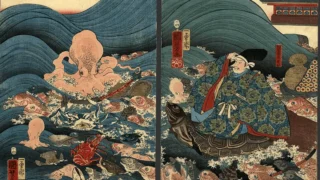
He was a powerful figure based in Shimotsuke Province.
Sadamori had reasons to defeat Masakado.
Hidesato had reasons to respond to the court’s pursuit orders.
Their interests aligned.
Sadamori and Hidesato joined forces to pursue Masakado.
The once-pursued Sadamori now became the pursuer of Masakado.
It was the greatest turning point in his life.
11. The Final Battle—The Disparity in Forces Cornered Masakado
February 940.
Sadamori and Hidesato’s forces pursued Masakado.
The “Shomonki” states that the pursuit army reached over 4,000 horsemen.
Meanwhile, Masakado had sent many of his soldiers home.
The forces remaining for the final battle were significantly reduced.
Masakado had the power to control the Kanto region.
However, maintaining such a vast area required manpower.
The longer the battles continued, the greater the burden of maintaining the army.
In the final stages, Masakado could not gather sufficient forces.
Then, the over 4,000-strong pursuit army closed in.
The tide of battle quickly turned against Masakado.
12. February 1—The Clash at Kawaguchi
February 1, Masakado confronted the forces of Sadamori and Hidesato.
The battlefield was Kawaguchi in Shimousa Province.
After fierce fighting, Masakado’s forces retreated. Sadamori and Hidesato’s forces pursued. Masakado continued to flee.
He was cornered near his stronghold.
On the 13th, Masakado’s stronghold was attacked.
Masakado’s final day was approaching.
13. February 14—The Decisive Battle at Kitayama
February 14, 940.
Sadamori and Hidesato’s forces clashed with Masakado’s at Kitayama in Kashima District.
Masakado’s forces were few.
Yet, Masakado stood on the battlefield.
The final battle raged fiercely.
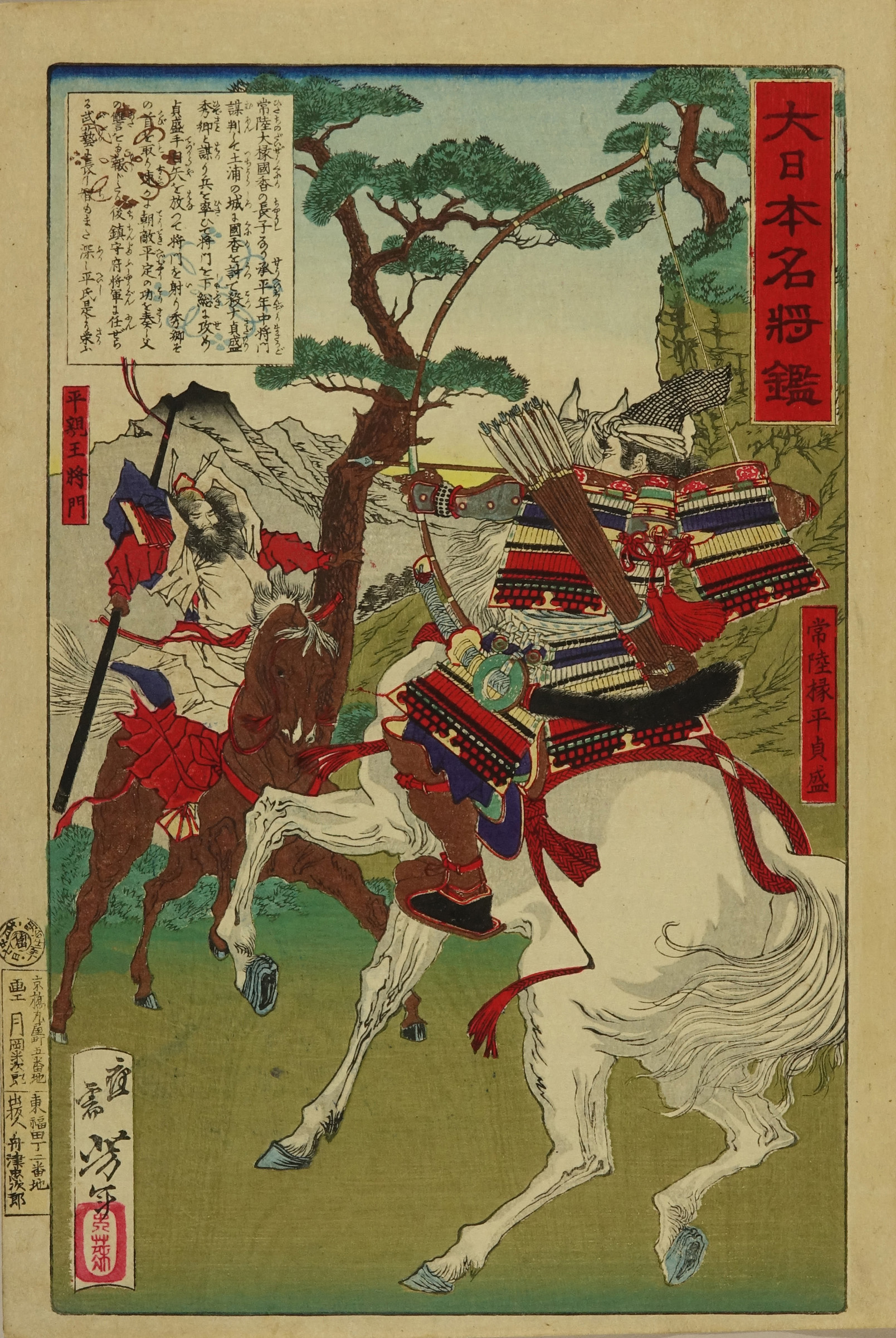
And Masakado was struck by an arrow in the forehead and died in battle.
Taira no Masakado was dead.
The series of conflicts that began in 935 ended here.
The “Shomonki” dramatically depicts Masakado’s last moments.
His helmet was lifted by a wind from the northeast, exposing his forehead.
At that moment, an arrow flew.
Masakado fell from his horse.
This scene, depicted as a military tale, left a lasting impression on later generations as the final image of Taira no Masakado.
And the names of Taira no Sadamori and Fujiwara no Hidesato were recorded as those who defeated Masakado.
14. Five Years After His Father’s Death—Sadamori’s Life Reverses
In 935, his father Kunika died.
In 940, he defeated his cousin Masakado.
In just five years, Sadamori’s position completely changed.
Moreover, Sadamori did not just defeat Masakado on the battlefield.
He repeatedly fled from Masakado’s pursuit.
He went to Kyoto, appealed to the court, and obtained official orders.
He returned to the eastern provinces and allied with Hidesato.
In other words, Sadamori turned his “five years of fleeing” into a final victory.
This is the most fascinating aspect of Taira no Sadamori.
15. The Month After Defeating Masakado, Sadamori Receives Rewards from the Court
The achievements of defeating Masakado were quickly recognized.
Sadamori was reportedly promoted to Senior Fifth Rank, Upper Grade and appointed as Assistant of the Right Horses.
By defeating Masakado, Sadamori became a figure acknowledged by the court.
The man who had been pursued by Masakado after his father’s death was now recognized by the court as a hero for defeating Masakado.
For Sadamori, it was an unparalleled reversal.
16. After Defeating Masakado—Sadamori Transitions from Warrior to Court Official
Even after defeating Masakado, Sadamori served the court.
He reportedly held positions such as Commander of the Defense Office and Governor of Mutsu.
He also served as Governor of Tanba, rising to Junior Fourth Rank, Lower Grade.
He leveraged the military fame gained from the battle with Masakado to secure a position within the court.
In his youth, Sadamori served as a Left Horse Assistant in Kyoto.
After defeating Masakado, he became a high-ranking official responsible for regional military and administrative affairs.
Sadamori transformed from a warrior of the Kanto region to a court warrior.
17. Sadamori’s Reputation as a “Master of the Bow”
Sadamori is remembered in later collections of tales, such as the “Konjaku Monogatari,” with a striking story.
Once, while staying at a monk’s house, thieves broke in.
Sadamori took up his bow.
And shot the thieves.
Volume twenty-nine of the “Konjaku Monogatari” includes a story titled,
“The Tale of Taira no Sadamori Shooting Thieves at a Monk’s House.”
This tale was compiled long after the defeat of Masakado.
From this story, we learn something interesting.
Later generations spoke of Taira no Sadamori as a “strong warrior skilled with the bow.”
Such tales of valor emerged because he was the one who defeated Masakado.
18. An Even More Intense Tale—The “Fetus Liver” Legend
Sadamori is also associated with a more terrifying legend.
Volume twenty-nine, tale twenty-five of the “Konjaku Monogatari.”
The title is “The Tale of Taira no Sadamori, Governor of Tanba, Taking a Child’s Liver.”
While serving as Governor of Tanba, Sadamori suffered from a severe skin disease.
He summoned a renowned physician from Kyoto.
The physician informed him that a medicine made from the liver of a male fetus, called “Jikan,” was needed.
Sadamori sought to obtain this medicine.
Furthermore, he attempted to kill the physician to silence him.
However, Sadamori’s son secretly informed the physician of the situation.
The physician escaped.
Sadamori believed he had killed the physician, but it was actually someone else.
It is quite a harrowing tale.
However, dismissing it as mere fiction would be less intriguing.
This story portrays,
a stark contrast to the “hero who defeated Masakado, Sadamori,”
depicting a terrifyingly tenacious Sadamori who would stop at nothing to achieve his goals.
This episode provides a vivid insight into how “Konjaku Monogatari” remembered Sadamori as a warrior.
19. Sadamori Also Expanded His Clan’s Influence
Sadamori’s achievements were not limited to defeating Masakado.
His descendants later expanded into various regions.
Particularly significant was Taira no Korehira. He was Sadamori’s son.
Korehira advanced into Ise Province, laying the foundation for the Ise Taira clan.
Subsequently,
Taira no Korehira
↓
Taira no Masamichi
↓
Taira no Masahira
↓
Taira no Masamori
↓
Taira no Tadamori
↓
Taira no Kiyomori formed a lineage.
The Ise Taira clan was established, and one of its ultimate figures was Taira no Kiyomori.
20. From Taira no Sadamori to Taira no Kiyomori—A Span of About 180 Years
Sadamori defeated Masakado in 940.
Taira no Kiyomori was born in 1118.
The gap is 178 years.
The society and politics of Sadamori’s time and Kiyomori’s era were vastly different.
Thus, it is not a simple story of “Sadamori defeated Masakado, and thus Kiyomori was born.”
Sadamori’s descendants established power in various regions, forming the Ise Taira family, from which Masamori and Tadamori emerged.
And eventually, Kiyomori came forth.
The defeat of Masakado in 940 was a long gateway into the later history of the Taira clan.
21. The Later Years of Taira no Sadamori
The exact years of Sadamori’s birth and death are not confirmed.
Some later genealogies suggest he died in 989, but this cannot be definitively stated as his year of death.
There are few detailed records of his later life.
However, his career after defeating Masakado is clear.
He served the court, became Commander of the Defense Office, and held positions such as Governor of Mutsu, rising to Junior Fourth Rank, Lower Grade.
Having served as a Left Horse Assistant in Kyoto in his youth, Sadamori ended his life as a high-ranking warrior trusted by the court.
He also left a legacy for his descendants.
From this legacy, the Ise Taira clan emerged.
22. The Man Known as Taira no Sadamori
Taira no Sadamori’s life was not smooth from start to finish.
935.
His father Kunika died. Sadamori returned to the eastern provinces. He considered reconciling with Masakado but was drawn into family disputes.
He was pursued by Masakado.
938. He headed to Kyoto. Appealed to the court. Returned to the eastern provinces. Pursued again. Failed numerous times.
Then in 939, Masakado declared himself “New Emperor.” The court moved to defeat Masakado.
940. Sadamori allied with Fujiwara no Hidesato. Led the pursuit army against Masakado.
February 14. The decisive battle at Kitayama. Masakado died in battle.
Here, Sadamori’s life completely reversed.
He received rewards from the court. Continued to hold various official positions. Served as Commander of the Defense Office, Governor of Mutsu, and more.
His descendant Korehira expanded into Ise. From this lineage, the Ise Taira clan developed.
And about 180 years later, Kiyomori emerged.
Taira no Sadamori is remembered as one of the warriors who defeated Masakado.
However, tracing his life reveals much more.
He lost his father, was pursued by his cousin, fled repeatedly, yet survived, and ultimately defeated that cousin.
Furthermore, after the war, he built a position as a court official and passed on his legacy to the next generation.
In later “Konjaku Monogatari,” Sadamori appears as a brave figure shooting thieves with a bow, as well as a terrifying figure seeking a fetus’s liver.
One man’s transformation from “a man repeatedly defeated by Masakado” to “the man who defeated Masakado” is the greatest allure of Taira no Sadamori.
For those who want to delve deeper into the battle between Taira no Sadamori and Taira no Masakado
This book offers a detailed analysis of the Taira no Masakado Rebellion through “Shomonki” and new sources.

The History of War in Japan (4) The Taira no Masakado Rebellion