Episode 143
February 1, 1185, Ashiya Bay.
The forces led by Minamoto no Noriyori, advancing into Kyushu, clashed with the warriors of the Taira clan.
Among the vanguard of the Minamoto were Hojo Koshirō Yoshitoki, Shimokobe Shoji Yukihira, Shibuya Shoji Shigekuni, and Shinagawa Saburō.
They were met by Harada Tanenao, the Dazai Shoni, and his son, Kama Hyōe-no-jō.
Harada Tanenao was a warrior with influence in Chikuzen Province, who had long supported the Taira’s control over Kyushu.
According to the Azuma Kagami, on February 1, 1185, Tanenao and his son led their troops to challenge the Minamoto forces.
Shimokobe Yukihira and Shibuya Shigekuni were among those who responded.
They reportedly circled around the enemy and unleashed a volley of arrows.
Though Tanenao’s forces attacked, they were defeated by the archery of Shibuya Shigekuni.
Furthermore, it is recorded that Yukihira slew a warrior named Miki Saburō Atsutane.
This Yukihira had parted with his armor just a few days earlier.
The Minamoto army, suffering from severe food shortages, also lacked enough ships to cross the sea.
Yukihira sold his armor to buy a small boat, intending to reach enemy territory before anyone else.
Why would he give up his armor just to lead the charge?
When questioned by those around him, Yukihira reportedly replied that he had no intention of sparing his life.
On the commander’s ship, one must follow its movements.
With his own boat, he could decide when to advance or retreat.
That is why Yukihira acquired a small boat.
About a year had passed since the great victory of the Minamoto at Ichinotani.
The Taira still maintained a fleet in the Seto Inland Sea and had strong allies like Harada Tanenao in Kyushu.
As Noriyori’s campaign dragged on, the Minamoto forces lost supplies, and some warriors even wished to return home.
The Battle of Ashiya Bay occurred at the end of this arduous campaign.
The Taira Remained in the West After the Defeat at Ichinotani
On February 7, 1184, the Minamoto and Taira forces clashed at Ichinotani in Settsu Province.
Minamoto no Noriyori’s forces attacked from the eastern Ikuta Forest, while Minamoto no Yoshitsune and others pressed the Taira positions from the west at Ichinotani.
The Taira army suffered defeats in various locations, losing many of their clan’s commanders.
Taira no Tadamori, Taira no Atsumori, Taira no Tsunemasa, and Taira no Tomomori were killed in battle, and Kiyomori’s son, Taira no Shigehira, was captured alive by the Minamoto forces.
The Taira clan, having briefly regained control of their strongholds around Fukuhara after their flight from the capital, lost them once again.
Surviving commanders like Munemori and Tomomori retreated to the western provinces, taking Emperor Antoku and the Imperial Regalia with them.
However, the Taira fleet continued to operate in the Seto Inland Sea.
It is said that Munemori and others took Emperor Antoku to Yashima, while Tomomori stationed forces on Hikoshima in Nagato Province.
Hikoshima is an island located in present-day Shimonoseki City, Yamaguchi Prefecture, facing the Kanmon Straits.
Beyond the straits lay Kyushu.
In Kyushu, there were samurai who had been loyal to the Taira since the time of Kiyomori.
These included the Harada clan of Chikuzen Province, the Yamaga clan at the mouth of the Onga River, and the Itai clan of Buzen Province.
Each of these clans maintained their own warrior bands, supporting the Taira’s control over the western provinces.
Moreover, the sea routes of the Seto Inland Sea were a crucial strategic asset for the Taira.
By using ships, they could move troops faster than the Minamoto forces advancing overland.
After their crushing defeat at the Battle of Ichinotani, the Taira relied on their remaining fleet and the western samurai to continue their resistance.
Minamoto no Noriyori’s Second Expedition to the West
In September 1184, Minamoto no Yoritomo dispatched his brother Noriyori to the western provinces once more.
Noriyori was the commander of the main force at the Battle of Ichinotani.
This time, he advanced west along the Sanyo Road with the mission of pursuing the remaining Taira forces.
The forces included prominent warriors from the eastern provinces, such as Hojo Yoshitoki, Ashikaga Yoshikane, Oyama Tomomasa, Chiba Tsunetane, Shimokobe Yukihira, Shibuya Shigekuni, and Wada Yoshimori.
Noriyori’s army advanced from Kyoto to Harima Province and then moved towards Bizen Province.
Along the way, a battle with the Taira forces occurred at Fujito in Kojima, Bizen Province.
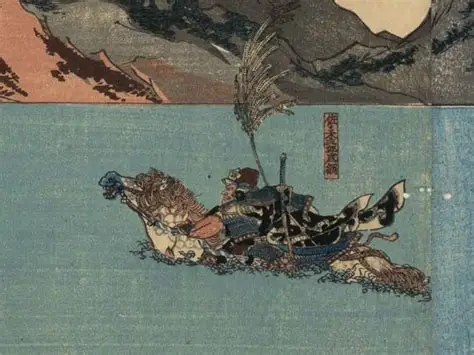
In the Battle of Fujito, it is said that Sasaki Saburo Moritsuna crossed the sea on horseback, causing the Taira forces to flee.
The “Azuma Kagami” records this event on December 7, while the “Heike Monogatari” places it on September 26, indicating a discrepancy in dates.
Although the Genji forces won at Fujito, they needed to advance further west to pursue the Taira forces at Yashima and Hikoshima.
Noriyori’s army soon faced a serious issue.
They were running out of provisions.
Running Out of Provisions and Warriors Wishing to Return Home
Noriyori’s army, composed of warriors gathered from the eastern provinces, was fighting far away in the western regions.
The further they advanced, the greater the distance from Kamakura became.
Attempts to procure provisions locally were thwarted in areas still under Taira influence.
Additionally, the inability to secure enough ships in the Seto Inland Sea hindered their progress.
The “Azuma Kagami” notes that a letter sent by Noriyori on November 14 of the previous year reached Kamakura on January 6 of the second year of Genryaku.
The contents of the letter were grim.
Provisions were scarce, and the army’s discipline was deteriorating.
The warriors from the eastern provinces longed for their homes, with more than half wishing to return.
Even the Genji warriors who had triumphed at Ichinotani were weary from the seemingly endless western campaign.
Noriyori appealed to Yoritomo for assistance.
He pleaded for more provisions and horses to be sent.
However, transporting supplies from Kamakura to the western regions would take time.
Noriyori needed to maintain his forces while seeking local warriors willing to cooperate.
Yoritomo’s Call for Cooperation with Kyushu Warriors
Upon receiving Noriyori’s report, Yoritomo sent a reply dated January 6.
The “Azuma Kagami” provides a detailed account of its contents.
Yoritomo emphasized the importance of allying with the warriors of Kyushu.
It was challenging to continue pursuing the Taira forces across the western regions with only the army dispatched from the eastern provinces.
If the Kyushu warriors cooperated, they could gather soldiers, ships, and provisions locally.
Yoritomo instructed Noriyori to act in a manner that would not incur the resentment of the people of Kyushu and to treat those willing to ally with respect.
He also paid attention to the custody of Emperor Antoku.
To safely receive Emperor Antoku, whom the Taira supported, and the women of their clan, he cautioned against rash military actions.
Despite the great victory at Ichinotani, one must not underestimate the Taira clan.
This was Minamoto no Yoritomo’s belief.
He had outlined a strategy where Minamoto no Noriyori would pursue the Taira in Kyushu, while Minamoto no Yoshitsune would do so in Shikoku.
By rallying warriors from various regions in the west, they aimed to attack the Taira strongholds.
To achieve this, Noriyori’s forces first needed to cross over to Kyushu.
Noriyori’s Army Halted at Akama
On the 12th day of the first month of Genryaku 2 (1185), Noriyori’s army reached Akama in Nagato Province.
Akama is located near present-day Shimonoseki City in Yamaguchi Prefecture, facing Kyushu across the Kanmon Straits.
Noriyori intended to cross the sea from there to advance into Kyushu.
However, there were no ships available.
They were also running low on provisions.
The Azuma Kagami records that Noriyori’s army was held up for several days, and the warriors from the eastern provinces began to wish to return home.
Among them was Wada Yoshimori.
Yoshimori was a member of the Miura clan from Sagami Province and had participated in battles across the land since Yoritomo’s uprising.
He was also a prominent figure in the Kamakura shogunate, serving as the head of the Samurai-dokoro.
Even Yoshimori was secretly considering returning to Kamakura.
Noriyori realized that he could not maintain his forces under these conditions.
Thus, he sought assistance from the Genji warriors in Kyushu to provide ships.
He relied on Usuki Koretaka and Ogata Koreie from Bungo Province.
The Usuki Brothers of Bungo Aid Noriyori’s Army
Usuki Jiro Koretaka and Ogata Saburo Koreie were members of the Oga clan, which held power in Bungo Province.
Koretaka was the elder brother, and Koreie was the younger.
The two commanded the warriors of Bungo Province and held a significant position in Kyushu.
Ogata Koreie, in particular, was known for resisting the Taira in Kyushu after their retreat from the capital.
In the second year of Juei (1183), the Taira, escorting Emperor Antoku, descended to Kyushu and attempted to reestablish their power around Dazaifu.
However, Koreie and others in Bungo Province did not comply with them.
The Taira were unable to establish a stable base in Kyushu and retreated once more to the Seto Inland Sea.
Now, Koreie and his brother Koretaka were to assist Noriyori’s army.
Noriyori requested ships from the two brothers.
On the 26th day of the first month, the long-awaited ships were delivered.
Eighty-Two Ships and Provisions
The Azuma Kagami entry for the 26th day of the first month of Genryaku 2 notes that Usuki Koretaka and Ogata Koreie provided 82 warships.
Additionally, Usa Naki Kamishichi Enryu of Suo Province contributed provisions of rice.
With ships and food secured, Noriyori’s army began their crossing to Bungo Province.
The Azuma Kagami lists the names of the warriors who participated in this crossing.
Among them were Hojo Yoshitoki, Ashikaga Yoshikane, Oyama Tomomasa, Yuki Tomomitsu, Chiba Tsunetane, Shimokobe Yukihira, Shibuya Shigekuni, Wada Yoshimori, and Hiki Yoshikazu.
The forces that had been held up at Akama-seki finally began to move toward Kyushu.
However, it remains unclear how many warriors, retainers, and horses were loaded onto the 82 ships.
Moreover, while the Azuma Kagami records the crossing of the sea on January 26th, it also notes that Minamoto no Noriyori crossed over to Bungo Province on February 1st.
There is a possibility that they crossed in separate advance and following units, but the exact schedule of the crossing cannot be confirmed.
When they acquired the ships, Shimokobe Yukihira took a bold action.
Shimokobe Yukihira Parts with His Armor to Buy a Small Boat
Shimokobe Yukihira was a warrior based in Shimokobe Manor in Shimousa Province.
The Shimokobe clan had been following the Kamakura side since Minamoto no Yoritomo’s uprising.
Yukihira participated in military actions across various regions and was known as a skilled warrior in archery and horsemanship.
According to the Azuma Kagami entry for January 26th, Yukihira was also struggling due to a lack of provisions.
However, Yukihira did not choose to leave the army and return home.
He decided to part with his armor and purchased a small boat.
The Azuma Kagami contains the following words:
“Throwing away armor, purchasing a small boat.”
This is a record of him parting with his armor to buy a small boat.
Yukihira boarded that boat, intending to set out first.
The surrounding warriors were astonished.
Heading into enemy territory without armor meant there was nothing to protect him.
Why not board the general’s ship and head to the battlefield in armor?
When asked this, Yukihira reportedly replied that he never valued his own life.
What Yukihira desired was a boat where he could decide his own course of action.
On the general’s ship, the timing of departure and destination would be dictated by the general’s orders.
With his own boat, he could head to enemy territory faster than anyone else.
Yukihira was determined to lead the charge, even if it meant parting with his armor.
Miura Yoshizumi Also Desired to Lead the Charge
Yukihira was not the only one who desired to lead the charge.
The same entry for January 26th also contains a story about Miura Yoshizumi.
Yoshizumi was a prominent warrior based in Miura District of Sagami Province, who had supported the Genji side since Yoritomo’s uprising.
As Noriyori prepared to cross to Kyushu, he decided to leave forces in Suo Province as well.
Suo Province was crucial for maintaining communication with Kyoto and Kamakura.
There was a need for someone to handle the transportation of provisions to the forces heading to Kyushu and to guard the rear.
Chiba Tsunetane recommended Miura Yoshizumi for that role.
Yoshizumi was brave and led many troops.
However, Yoshizumi expressed dissatisfaction.
He too wished to lead the charge.
Remaining in Suo Province would mean losing the opportunity to invade enemy territory and achieve military success.
He regretted this decision.
While acknowledging Yoshizumi’s bravery, Noriyori ordered him to remain in Suo Province.
It is said that Yoshizumi ultimately complied with the order and set up camp.
Yukihira aimed to lead the vanguard by purchasing his own ship.
Yoshizumi lamented having to stay behind.
The “Azuma Kagami” records the actions of the eastern warriors seeking military achievements.
Chiba Tsunetane, at Sixty-Eight, Also Crosses the Sea
Chiba Tsunetane was also part of Noriyori’s forces.
Tsunetane, based in Chiba Manor in Shimousa Province, was a prominent warrior who supported Yoritomo’s uprising.
In the second year of Genryaku, he was counted as 68 years old.
According to the “Azuma Kagami” entry for January 26th, Tsunetane crossed the sea, undeterred by his advanced age and the rough seas.
Additionally, it is noted that Kato Kageyasu joined the expedition despite being ill.
For the warriors who had traveled a long way from the eastern provinces, crossing to Kyushu was a new challenge.
They had to carry armor and weapons, transport horses, and secure provisions on the ships.
Nevertheless, Noriyori’s army headed for Kyushu.
The vanguard was led by Hojo Yoshitoki, Shimokobe Yukihira, Shibuya Shigekuni, and Sakawa Saburo.
Harada Tanenao and the Taira’s Control of Kyushu
Harada Tanenao, who opposed Noriyori’s forces, was a prominent warrior in Chikuzen Province.
The Harada clan is believed to be descended from the Okura clan and had expanded their holdings while serving as officials at Dazaifu.
Dazaifu had been the center of politics and diplomacy in Kyushu since ancient times.
By the late Heian period, local magnates had taken on the practical administration of Dazaifu, extending their influence over surrounding lands and warrior groups.
The Harada clan was one such family.
Harada Tanenao was known as the chief administrator of Dazaifu, and in the “Azuma Kagami” account of the Battle of Ashiya Bay, he is referred to as “Dazai Shoni Tanenao.”
Taira no Kiyomori‘s era saw him align with the Taira, taking a leadership role among the warriors of Kyushu.
The Taira had allied themselves with the officials of Dazaifu and local warriors across Kyushu, advancing their control over maritime routes and manors.
In addition to the Harada clan, there were other warrior families closely associated with the Taira, such as the Itai clan in Buzen Province, the Yamaga clan in Chikuzen Province, and the Matsura party in Hizen Province.
Tanenao was one of the key figures supporting this Taira control over Kyushu.
Tanenao’s Loyalty During the Taira’s Flight from the Capital
In July of Juei 2 (1183), the Taira left Kyoto due to Minamoto no Yoshinaka’s advance.
Munemori and others accompanied Emperor Antoku and the Three Sacred Treasures as they retreated to the western provinces.
Subsequently, the Taira clan entered Kyushu, attempting to reestablish their power around Dazaifu.
It is said that during this time, Tanenao remained loyal to the Taira, leading troops to support the clan.
However, not all the samurai in Kyushu aligned themselves with the Taira clan.
Figures like Ogata Koreie from Bungo Province resisted the Taira, and there were also anti-Taira movements in Higo Province.
The Taira were unable to establish a stable base in Kyushu and retreated once more to the Seto Inland Sea.
Tanenari continued to act as a prominent warrior for the Taira side.
Eventually, in the second year of Genryaku, Minamoto no Noriyori’s forces advanced into Kyushu.
Tanenari now found himself in a position to confront the Minamoto army.
February 1st: The Clash at Ashiya Bay
February 1st, Genryaku 2.
The Azuma Kagami records that on this day, Noriyori’s army crossed into Bungo Province and engaged the Taira forces at Ashiya Bay.
The vanguard of the Minamoto forces was led by Hojo Koshirō, Shimokobe Shoji, Shibuya Shoji, and Shina Saburō.
Hojo Koshirō was Hojo Yoshitoki.
He would later become a regent of the Kamakura shogunate, but at this time, he was a warrior serving Yoritomo, participating in battles across the region.
Shimokobe Shoji was Yukihira, and Shibuya Shoji was Shigekuni.
Shina Saburō is believed to be Shinagawa Kiyomi, a samurai associated with the Shinagawa district in Musashi Province.
As this vanguard advanced to Ashiya Bay, they encountered the Taira forces.
These were led by Dazai Shoni Harada Tanenari and his son, Kama no Hyōe no Jō.
According to the Azuma Kagami, Tanenari and his son led their troops to challenge the Minamoto forces.
The number of soldiers on each side is not recorded.
It is also unclear where the Harada forces were stationed or how they approached the Minamoto army from the coast.
Nevertheless, it is documented that the Harada forces, loyal to the Taira, stood in the path of the advancing Minamoto vanguard.
Noriyori’s forces, having crossed into Kyushu, now faced the Taira forces in battle.
Tanenari’s Son, Kama no Hyōe no Jō
The Azuma Kagami mentions Kama no Hyōe no Jō as a participant in the battle alongside Tanenari.
He is identified as Tanenari’s son.
In later regional histories, Kama no Hyōe no Jō is sometimes referred to as Taneaki.
Kama is thought to be a name associated with the Kama District in Chikuzen Province.
The Kama District corresponds to areas like present-day Iizuka City and Kama City in Fukuoka Prefecture.
The Harada clan was involved in various parts of Chikuzen Province, forming warrior bands in each region.
Tanenari and Kama no Hyōe no Jō likely led their faction’s forces as part of this clan.
However, the Azuma Kagami does not record Kama no Hyōe no Jō’s real name.
Additionally, details about how Tanenari and his son arranged their troops or the number of warriors they commanded remain unknown.
No detailed records of the troop formations at Ashiya Bay have survived.
The Azuma Kagami highlights the actions of Shimokobe Yukihira and Shibuya Shigekuni during the battle.
The Mounted Archery of Shimokobe Yukihira and Shibuya Shigekuni
When Harada Tanenari and his forces challenged them, the Minamoto side quickly responded.
The “Azuma Kagami” records that Yukihira and Shigekuni were running around shooting arrows.
“Yukihira and Shigekuni, etc., circled around and shot.”
This describes how Shimokobe Yukihira and Shibuya Shigekuni moved around the enemy while shooting.
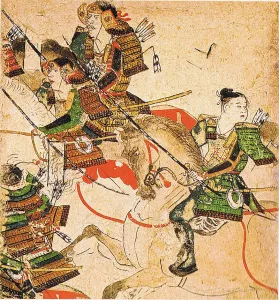
For warriors in the late Heian period, skill in archery and horsemanship was crucial.
In battles where arrows were shot from horseback, it was essential to maintain distance from the enemy and shoot while moving.
If the enemy approached, they would change position and shoot again.
Yukihira was known as a warrior skilled in such archery and horsemanship.
Shibuya Shigekuni was also a prominent warrior based in Shibuya Manor in Sagami Province.
The Shibuya clan was a branch of the Chichibu clan and was active under Yoritomo.
According to the “Azuma Kagami,” Tadanao also attacked, but was defeated by Shibuya Shigekuni’s shooting.
The Genji forces repelled the enemy attack and secured victory at Ashiyaura.
However, the duration of the battle between the two forces is not recorded.
The number of Genji casualties and the overall losses of the Taira side are also unclear.
Amidst this, the name of one warrior who was killed is preserved.
Miki Saburo Atsutane, Killed by Yukihira
The “Azuma Kagami” entry for February 1, Genryaku 2, notes that Shimokobe Yukihira killed Miki Saburo Atsutane at the Battle of Ashiyaura.
Atsutane was a warrior who had joined Harada Tadanao.
However, his detailed origins are unknown.
Later genealogies sometimes list him as a member of the Harada clan, but there are inconsistencies in the relationships.
What can be confirmed from the “Azuma Kagami” is the fact that Miki Saburo Atsutane was killed by Yukihira.
Additionally, later interpretations sometimes refer to him as Taneatsu.
Here, we follow the “Azuma Kagami” and use Atsutane.
There is no detailed description of how Yukihira killed Atsutane.
It is unclear whether he shot him with an arrow, used a sword in close combat, or engaged in hand-to-hand fighting.
The “Azuma Kagami” simply records the fact of the killing succinctly.
Nevertheless, this record clearly preserves the name of Shimokobe Yukihira.
A few days earlier, he had sold his armor to buy a small boat, eager to be at the forefront of the battle.
It was this Yukihira who killed an enemy warrior at Ashiyaura.
The Messenger Sent by Shibuya Shigekuni to Kamakura
About a month after the Battle of Ashiyaura, a courier from the western provinces arrived in Kamakura.
It was the night of March 1, Genryaku 2.
According to the “Azuma Kagami,” people gathered at the Kamakura palace, suspecting that some battle had occurred in the west.
The next day, on the 2nd, the sender of the messenger was revealed.
It was Shibuya Shigekuni.
The messenger reported on the military achievements when Noriyori crossed from Suo Province to Bungo Province in January.
The report stated that Shigekuni was the first to cross the sea and defeated Harada Tadanao.
A question remains here.
The battle account from February 1st notes that Harada’s forces were defeated by Shigekuni’s archery.
Then, the entry for March 2nd reports Shigekuni’s achievement in defeating Tanenao.
This report indicates that Shigekuni communicated his military success in defeating Tanenao to Kamakura.
However, there are other traditions regarding Tanenao’s final moments.
Did Harada Tanenao Die at Ashiyaura?
The accounts of Harada Tanenao’s end vary across historical and biographical sources.
One theory suggests he was killed in battle at Ashiyaura.
The March 2nd entry in the Azuma Kagami records that Shibuya Shigekuni reported defeating Tanenao.
Additionally, the Japanese Biographical Dictionary states that he died in battle at Ashiyaura on February 1st, Genryaku 2.
In contrast, there is a tradition that Tanenao survived the battle and surrendered after the Taira’s downfall.
According to some genealogies, he was later pardoned and lived in Itoshima District, Chikuzen Province.
If this account is accurate, Tanenao did not lose his life at Ashiyaura.
At the time, reports of military achievements, such as defeating an enemy, were often sent to Kamakura.
At Ashiyaura, Shibuya Shigekuni also reported the defeat of Tanenao.
However, later traditions recount Tanenao’s survival.
There is not enough evidence to conclusively determine Tanenao’s death.
Nonetheless, it is clearly stated in the battle account of the Azuma Kagami that Harada’s forces were defeated by the Genji at Ashiyaura.
The Harada clan was a powerful warrior group in Kyushu that long supported the Taira.
Their defeat by Noriyori’s forces was a significant blow to the Taira.
Is Ashiyaura Present-Day Ashiya Town?
Another major issue remains regarding the Battle of Ashiyaura.
The location of the battlefield.
It is generally believed that the battle took place in what is now Ashiya Town, Onga District, Fukuoka Prefecture.
Ashiya Town is located at the mouth of the Onga River, with the Hibiki Sea to the north.
It has long been a hub of maritime activity, and by the late Heian period, powerful warriors like the Yamaga clan held sway in the area.
The name Ashiya still exists in this region, and traditions related to the Genpei War are passed down here.
The regional history of Ashiya Town also covers the Battle of Ashiyaura in Genryaku 2.
Thus, the view that Ashiya at the mouth of the Onga River was the battlefield has been widely accepted.
However, reading the descriptions in the Azuma Kagami raises questions about the route taken.
It is recorded that Noriyori’s forces crossed from Suo Province to Bungo Province.
Bungo Province corresponds to the central area of present-day Oita Prefecture.
Meanwhile, Ashiya Town is located in northern Fukuoka Prefecture.
There is a considerable distance between the two.
How did Noriyori’s forces reach Ashiyaura?
This issue has led to research suggesting alternative locations for the battlefield.
Research Suggesting the Area Around Nakatsu in Buzen Province
The 2015 publication edited by Kazunori Hishinuma, “Minamoto no Noriyori,” includes an essay by Masahiro Kanazawa that examines the Battle of Ashiyaura.
Kanazawa proposes that the battlefield was located around Nakatsu in Buzen Province.
One of the bases for this theory is the movements of Noriyori’s army as recorded in the “Gengyo Bunji-ki.”
This historical source notes that Noriyori arrived in Usa on February 2.
Usa corresponds to the area around present-day Usa City in Oita Prefecture.
If the battle took place in present-day Ashiya Town, Fukuoka Prefecture, on February 1, and Noriyori arrived in Usa the next day, it implies a rapid movement over a long distance.
Considering this itinerary, the view that the battlefield was along the coast of Buzen Province has been suggested.
However, the “Gengyo Bunji-ki” has been passed down through later manuscripts, leaving room for examination regarding the circumstances of its composition.
Moreover, it is difficult to pinpoint the exact location of Ashiyaura around Nakatsu at that time.
While the “Azuma Kagami” mentions “Ashiyaura” in its battle accounts, it does not specify the province.
Thus, both the theory placing it in Chikuzen Province’s Ashiya and the one suggesting Buzen Province leave issues to be examined.
Did Noriyori’s Main Force and Vanguard Follow the Same Route?
When considering the location of Ashiyaura, the method of Noriyori’s army’s advance also becomes an issue.
The February 1 entry in the “Azuma Kagami” records that Hojo Yoshitoki, Shimokobe Yukihira, Shibuya Shigekuni, and Hinokawa Saburo were positioned as the vanguard.
It was these vanguard warriors who fought at Ashiyaura.
It is unclear whether Noriyori himself was at Ashiyaura or if the entire force followed the same route.
There is a possibility that the advance party moved ahead of the main force and took a different route.
Moreover, even though they acquired 82 ships on January 26, it would not have been easy to transport a large number of warriors, attendants, and horses all at once.
It is conceivable that the forces crossed in several groups.
If the advance party had acted separately, it would be difficult to determine the location of Ashiyaura based solely on Noriyori’s arrival date in Usa.
However, there are no detailed historical records of the separate force’s route.
The view that places the battlefield in present-day Ashiya Town is supported by local names and traditions, while the Buzen Province theory is based on the reasoning from Noriyori’s army’s movement schedule.
The question of where Ashiyaura was located is crucial for understanding Noriyori’s entire campaign in Kyushu.
Yamaga Hidetou, Who Controlled the Mouth of the Onga River
If Ashiyaura is considered to be present-day Ashiya Town, there is another warrior worth noting.
That is Yamaga Hidetou.
Hidetou was a prominent warrior based in Yamaga Sho in Onga District of Chikuzen Province, and he served the Taira clan.
Yamaga Sho corresponds to the area around present-day Ashiya Town, Fukuoka Prefecture, and was connected to maritime traffic at the mouth of the Onga River.
The Yamaga clan held extensive influence in this region, commanding many warriors.
Hidetou was known as a skilled archer and participated in the Taira clan’s military actions.
In the second year of Juei (1183), when the Taira clan retreated to Kyushu, it is said that Hidetou welcomed and protected the clan at Yamaga.
For the Taira clan, who had been driven away from the area around Dazaifu due to resistance from Ogata Koreie and others in Bungo Province, Yamaga became an important port of call.
It is said that Hidehara continued to follow the Taira and fought with them until the Battle of Dan-no-ura.
However, Hidehara’s name does not appear in the Azuma Kagami’s account of the Battle of Ashiya Bay.
There are no direct records indicating that he fought at Ashiya Bay alongside Tanenao and his son.
It is necessary to consider separately the fact that the mouth of the Onga River was an important stronghold for the Taira and whether Hidehara participated in the Battle of Ashiya Bay.
Why the Genji Were Victorious
The Azuma Kagami’s account of the Battle of Ashiya Bay is relatively brief.
Details about the deployment and strength of the forces on both sides are not recorded.
Therefore, it is difficult to reconstruct the overall movements on the battlefield.
However, two facts related to the Genji’s victory are recorded.
One was the acquisition of ships and provisions from the warriors of Bungo.
Usuki Koretaka and Ogata Koreie provided 82 warships, enabling Noriyori’s army, which had been stalled at Akama, to advance across to Kyushu.
The other was the effective performance of Yukihira and Shigekuni, who led the vanguard.
When Tanenao challenged them to battle, Yukihira and Shigekuni rushed about, firing arrows.
The Azuma Kagami notes that the Harada forces were defeated by the archery of Shibuya Shigekuni.
Furthermore, Yukihira defeated Miki Saburo Atsutane.
This is the specific part of the sources that can be traced regarding the Genji’s victory.
The number of enemy troops, the use of terrain, and whether there was an encirclement are unclear.
Rather than speculating on the scale of the forces to explain the victory, it is more appropriate to focus on the acquisition of ships and the performance of the vanguard.
Noriyori’s Continued Struggle with Provisions After Victory
Even after the victory at Ashiya Bay, Noriyori’s arduous campaign continued.
The Azuma Kagami entry for March 9, Genryaku 2, records a report sent by Noriyori from the western provinces to Yoritomo.
Noriyori complained that although he had crossed to Bungo Province to approach the Taira stronghold, the local residents had scattered, making it impossible to gather provisions.
When the army approached a village, the people fled, fearing they would be caught up in the fighting.
As a result, the expeditionary force could not procure food locally.
Among the forces, some, including members of the Wada Yoshimori family, Otawa Yoshinari, and Kudo Suketsune, wished to return home.
Noriyori persuaded them to stay and continue to accompany the army.
He was also dissatisfied with the actions of Kumano Betto Tansho.
Tansho was a figure who had cooperated with Minamoto no Yoshitsune.
Noriyori felt that if Tansho were to join the pursuit in Kyushu, where Yoshitsune was handling the Shikoku front and he himself was in charge of Kyushu, it would undermine his own standing.
Noriyori was troubled not only by battles with the Taira but also by the lack of provisions, the desire of warriors to return home, and the division of roles with other commanders.
Even after the victory at Ashiya Bay, the expedition to Kyushu did not proceed easily.
Yoritomo’s Evaluation of the Veteran Commanders and Young Warriors
On March 11, Yoritomo sent a reply to Noriyori.
The ‘Azuma Kagami’ chronicles the commendations given to the warriors who participated in the western expedition.
Minamoto no Yoritomo held Chiba Tsunetane in particularly high regard.
Despite his advanced age, Tsunetane endured the long campaign and crossed over to Kyushu.
Yoritomo praised his achievements and instructed Noriyori to treat him with greater care than other warriors.
Additionally, he sent respectful letters to twelve others, including Hojo Yoshitoki, Oyama Tomomasa, Oyama Munemasa, Nakahara Chikanobu, Kasai Kiyoshige, Kato Kagemasa, and Kudo Suketsune.
He recognized their military accomplishments in the western provinces.
However, this does not imply that all twelve directly fought at Ashiyaura.
Yoritomo commended their overall efforts in crossing to Kyushu and the entire western expedition.
Meanwhile, the military exploits of Shimokobe Yukihira and Shibuya Shigekuni at Ashiyaura are recorded in the entries for February 1st and March 2nd.
In Noriyori’s army, many warriors fulfilled their respective roles.
Among them, Yukihira is noted as someone who sold his armor to buy a ship, eager to lead the charge.
Yoshitsune Heads to Yashima
While Noriyori’s forces were engaged in Kyushu, Minamoto no Yoshitsune was making his way to Yashima in Shikoku.
On February 16th, 1185, Yoshitsune set sail from Settsu Province to pursue the Taira clan.
According to the ‘Azuma Kagami,’ Yoshitsune braved a storm with a small fleet, arriving in Awa Province at dawn on February 18th.
On February 19th, he launched an assault on Yashima in Sanuki Province.
At Yashima, Munemori and others had gathered the Taira forces, along with Emperor Antoku.
When Yoshitsune’s forces launched a surprise attack from land, the Taira moved Emperor Antoku and their kin onto ships.
Subsequent battles ensued around Yashima.
This battle is famous for the death of Sato Tsugunobu and the tale of Nasu no Yoichi’s arrow hitting a fan target.
Defeated at Yashima, the Taira retreated further west.
Meanwhile, Noriyori’s forces continued their military operations in Kyushu.
In Shikoku, Yoshitsune pursued the Taira, while in Kyushu, Noriyori battled the local Taira forces.
Taira no Tomomori Defends Moji and Hikoshima
Taira no Tomomori, the newly appointed middle counselor, regarded Hikoshima in Nagato Province as a crucial stronghold.
The ‘Azuma Kagami’ entry for February 16th notes that Tomomori led the Kyushu forces to fortify Moji and established a camp at Hikoshima.
Moji was a vital transportation hub connecting Kyushu and Honshu.
If the Taira controlled this strait, they could collaborate with Kyushu warriors and use ships to move their forces.
However, if Noriyori’s forces advanced into Kyushu and defeated the Taira warriors, it would disrupt their coordination.
The defeat of Harada Tanenao and others at Ashiyaura was a blow to the Taira in Kyushu.
However, it is difficult to conclude that this battle alone isolated the Taira forces at Hikoshima.
There were still warriors in Kyushu loyal to the Taira.
Noriyori’s forces also struggled with food shortages and had to win over local warriors to their side.
Meanwhile, the Taira fleet that retreated from Yashima headed towards Nagato.
The final showdown between the Genji and the Heike was approaching.
March 24: The Battle of Dan-no-ura
On March 24, 1185, the Genji and Heike forces clashed at Dan-no-ura in Nagato Province.
The Heike gathered their fleet and engaged the Genji navy.
According to the Azuma Kagami, the Heike were joined by forces such as Yamaga Hideharu and the Matsuura clan.
The Yamaga clan from Chikuzen Province and the Matsuura clan from Hizen Province were influential warriors involved in maritime affairs.
The Heike utilized their strength to confront the Genji forces.
However, the battle ended in victory for the Genji.
Emperor Antoku perished in the sea, and many Heike warriors lost their lives.
It is said that Tomomori, Norimori, Sukemori, Arimori, and Yukimori also met their end in this battle.
Munemori and Kiyotsune were captured alive.
This marked the downfall of the Heike.
In the Battle of Dan-no-ura, Yoshitsune played a central role for the Genji.
Meanwhile, Noriyori was in Kyushu.
Even after defeating the Harada clan at Ashiyaura, Noriyori’s forces continued to deal with the Heike in various parts of Kyushu.
Noriyori Remains in Kyushu After the Heike’s Fall
Even with the Heike’s downfall at Dan-no-ura, Noriyori’s work was not finished.
Former Heike warriors remained in Kyushu.
How to handle their territories?
Who should be rewarded, and which warriors should be newly brought under control?
Yoritomo needed to establish a governance system in Kyushu.
The Azuma Kagami entry for April 12, 1185, notes the plan to keep Noriyori in Kyushu for a while to handle the territories of the former Heike.
Even though the Heike were militarily defeated, the lands and warriors under their control did not disappear overnight.
It was necessary to establish new power relations across Kyushu.
Noriyori’s role was not only to win battles but also to build relationships with local warriors.
The Harada clan, defeated by the Genji at Ashiyaura, was also part of this transformation.
The Changes Faced by the Harada and Yamaga Clans
The fall of the Heike significantly impacted the warriors of Kyushu.
The Harada clan, to which Harada Tanenaga belonged, had long supported the Heike’s control over Kyushu.
However, having fought on the Heike side, maintaining their previous status became difficult.
Regarding Tanenaga himself, there are accounts of his death in battle at Ashiyaura and stories of his survival after surrendering.
The subsequent history of the clan varies according to genealogies and local histories.
Meanwhile, in the Onga River basin, Yamaga Hideharu was active on the Heike side.
Hideharu is said to have followed the Heike to Dan-no-ura and fought there.
After the Heike’s fall, the Kamakura side’s control extended to the Yamaga clan’s territories as well.
In Kyushu, new stewards were appointed to the former territories of the Taira clan, and warriors who advanced from the eastern provinces began to take part in the governance of these lands.
However, not all local warriors were displaced; some families maintained their traditional power while aligning themselves with the Kamakura faction.
To understand the subsequent history of the Harada and Yamaga clans, it is necessary to trace the movements of their individual territories and family members.
The History of the Genpei War Passed Down in Ashiya Town
In present-day Ashiya Town, Onga District, Fukuoka Prefecture, there is a history related to the Genpei War that has been passed down through generations.
The town is located at the mouth of the Onga River, with the Hibiki Sea stretching out to the north.
In the late Heian period, the area was the base of operations for Yamaga Hideharu, who was deeply involved with the Taira clan’s activities in Kyushu.
In 2022, the Ashiya Town History and Folklore Museum held a special exhibition titled “The Genpei War: The Era of the Mononofu,” focusing on the Genpei War.
The exhibition also featured the Battle of Ashiyaura and the activities of figures like Yamaga Hideharu.
On the other hand, there is a scholarly theory suggesting that the exact battlefield of Ashiyaura was around Nakatsu in Buzen Province, and research on this continues to this day.
The “Azuma Kagami” does not record the detailed topography of the battlefield.
It remains unclear where exactly on the coast of Ashiyaura Taira no Naokata set up camp or from where the Genji vanguard launched their attack.
Nevertheless, the “Azuma Kagami” records that on February 1, 1185, the Genji forces and the Harada clan’s troops clashed at Ashiyaura.
In the final year of the Genpei War, battles between the Taira and Genji forces continued even in Kyushu.
The Warriors Who Fought in Kyushu Fifty Days Before Dan-no-Ura
On February 1, 1185, at Ashiyaura, the forces of Minamoto no Noriyori clashed with those of Harada Tanenao and his son.
Among the Genji forces, Hojo Yoshitoki, Shimokobe Yukihira, Shibuya Shigekuni, and Shina Saburo were at the forefront.
According to the “Azuma Kagami,” when Naokata attacked, Yukihira and Shigekuni maneuvered around, shooting arrows and defeating the enemy.
It is recorded that Yukihira killed Miki Saburo Atsutane.
Later, Shibuya Shigekuni sent a report of his achievement in defeating Tanenao to Kamakura.
However, there are also theories suggesting that Tanenao survived or surrendered, and the exact location of the battlefield remains debated.
The detailed topography and troop strengths of the battle are still unclear.
Meanwhile, the “Azuma Kagami” provides specific accounts of the hardships faced by Noriyori’s forces during their campaign.
They ran out of provisions, and there were not enough ships.
Even prominent warriors like Wada Yoshimori considered returning, prompting Noriyori to seek assistance from Yoritomo.
The situation changed when Usuki Koretaka and Ogata Korehide provided 82 warships.
Shimokobe Yukihira even sold his armor to buy a small boat, eager to lead the charge.
It is recorded that Yukihira actually defeated enemy warriors at Ashiyaura.
Eighteen days later, Yoshitsune’s forces attacked Yashima.
On March 24, the Taira clan met their end at Dan-no-Ura.
In the Taira clan’s final year, the Genji forces continued their battles not only in Shikoku but also in Kyushu.
Hojo Yoshitoki, who fought at Ashiyaura, would later become the regent of the Kamakura shogunate.
Shibuya Shigekuni is remembered in the “Azuma Kagami” as the warrior who defeated the Harada forces.
And then there was Shimokobe Yukihira.
On the entry for January 26th, there is a record of Yukihira’s words, expressing his desire to lead the charge by selling his armor to buy a small boat.
The entry for February 1st notes that this same Yukihira defeated Miki Saburo Atsutane.
In Noriyori’s army, which was lacking in both ships and provisions, there was a warrior who sought the vanguard so earnestly that he parted with his own armor.
His actions are recorded alongside the battles in Kyushu, just before the decisive Battle of Dan-no-ura.