Episode 146
February 1185, Yashima in Sanuki Province.
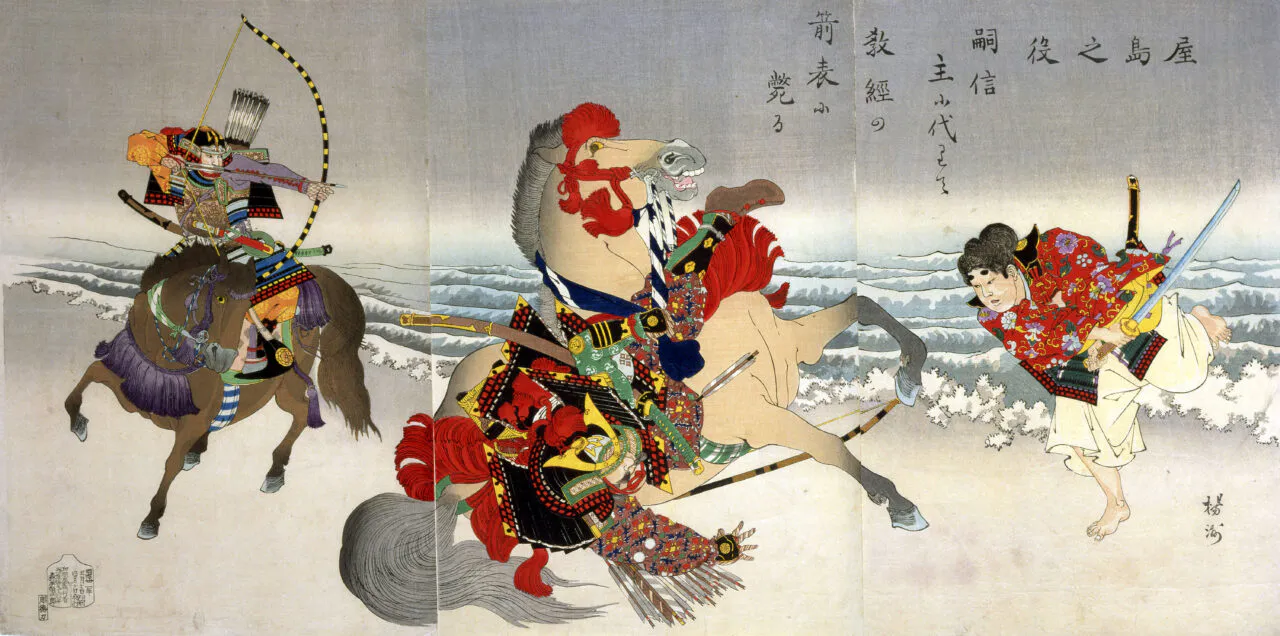
A man appeared from a ship of the Taira clan floating offshore.
He seemed to be about fifty years old, clad in armor with black leather lacing, and wielding a long sword with a white hilt.
The man stood at the edge of the ship and began to dance.
Shortly before, a young warrior from the Genji side had shot an arrow, knocking down a fan displayed on the Taira ship.
The crimson fan soared high into the sky, caught by the spring breeze, and fell into the sea.
It is said that the Taira on the ships clapped their sides, while the Genji on land beat their quivers and cheered.
The man dancing was likely moved by the impressive shot.
However, another arrow was shot from the land.
This time, the target was not the fan.
The arrow pierced the man’s neck, and he fell to the bottom of the ship.
The Taira side fell silent.
On the Genji side, cheers rose again, but among them were warriors who muttered “how pitiful.”
The “Yumi-nagashi” chapter of the Tale of the Heike recounts this scene.
The young warrior who shot the two arrows was Nasu no Yoichi.
He was a samurai from Nasu in Shimotsuke Province, said to have come to Yashima following Minamoto no Yoshitsune.
In the Tale of the Heike, he is depicted as a youth of about twenty years old.
Under Yoshitsune’s command, he shot down the fan on the small boat swaying in the waves.
For over eight hundred years, his name has been passed down, known as a master archer representing the Genpei War.
However, a detailed investigation into Yoichi’s life reveals unexpected issues.
The Azuma Kagami, which records the Battle of Yashima, does not mention Yoichi shooting down the fan.
There is a story that he was granted five provinces by Minamoto no Yoritomo, but no contemporary documents confirm this.
Neither his birth year nor his death year is known.
In recent years, research has been published questioning the existence of Nasu no Yoichi.
A young warrior vividly depicted in the Tale of the Heike.
Clues to his true image lie in the records left by the Nasu clan in his hometown and in genealogies passed down through the ages.
The Samurai Who Held Power in Nasu, Shimotsuke Province
Nasu no Yoichi’s hometown is said to have been Nasu District in Shimotsuke Province.
This corresponds to the northern part of present-day Tochigi Prefecture, where the Nasu mountain range towers to the north, and the Naka and Houki rivers flow through the region.
In the late Heian period, the Nasu clan, a family of samurai, held power in this area.
The Nasu clan is said to have descended from the Fujiwara clan in later genealogies and is believed to have settled in the Nasu region, expanding their domain.
However, the specific details of when the clan established their stronghold in this region and how they built their power remain unclear.
The Nasu clan continued to be active in the northern part of Shimotsuke Province from the Kamakura period onwards.
The clan divided into various branches, establishing bases in places such as Fukuhara, Karasuyama, Sakuyama, and Senbon.
From the Muromachi period through the Sengoku period, they maintained their influence while contending with neighboring clans like the Utsunomiya and Satake.
Even in the Edo period, the lineage of the Nasu clan continued, with the Nasu family of Fukuhara surviving until the end of the Edo period.
Throughout their long history, the Nasu clan particularly revered Yoichi as an important ancestor.
However, regarding the latter half of the 12th century, when Yoichi is said to have lived, there are few historical records detailing his activities.
The currently known biography of Yoichi largely derives from the “Heike Monogatari,” “Genpei Seisuiki,” and genealogies of the Nasu clan compiled in later generations.
Nasu Yoichi’s Father and Eleven Brothers
In Volume Eleven of the “Heike Monogatari,” Yoichi is introduced as follows:
“A resident of Shimotsuke Province, Nasu Taro Suketaka’s son, Yoichi Munetaka.”
His father was Nasu Taro Suketaka.
Yoichi’s real name is recorded as Munetaka.
On the other hand, in the traditions introduced by Tochigi Prefecture and Otawara City, the father is named Suketaka, and Yoichi’s real name is Munetaka.
The father’s name is Suketaka and Suketaka.
The individual’s name is also Munetaka and Munetaka.
While the readings are the same, the kanji used differ.
According to later genealogies of the Nasu clan, Suketaka had eleven sons.
Starting with the eldest son, Mitsutaka, and the second son, Yasutaka, followed by Mikitaka, Hisataka, Koretaka, Sanetaka, Mitsutaka, Yoshitaka, Asataka, Tametaka, and the youngest, Munetaka.
The nickname “Yoichi” is said to originate from being the eleventh son.
A child one more than ten.
For this reason, it was sometimes written as “Yoichi.”
At that time, samurai often used names like Taro, Jiro, and Saburo, which related to their birth order.
Yoichi was passed down as one of these nicknames.
However, there are variations in the genealogies regarding the eleven brothers.
Not all names, birth orders, or the families they later succeeded can be definitively confirmed.
It is also necessary to consider the circumstances under which genealogies were compiled to explain the origins of the clan after the Nasu clan began to operate in various regions.
Brothers Divided Between the Genji and the Heike
A story remains within the Nasu clan that during the Genpei War, the family split between opposing sides.
Their father, Suketaka, sided with the Heike, and it is said that the brothers from the eldest to the ninth also supported the Heike.
Meanwhile, the tenth son, Tametaka, and the youngest, Yoichi, are said to have joined the Genji.
Thus, brothers born of the same father ended up fighting on different sides.
Local historical materials from Otawara City introduce a tradition that in the fourth year of Jisho (1180), Minamoto no Yoshitsune visited Nasu on his way from Oshu to join his brother Yoritomo.
It is said that Tametaka and Yoichi followed Yoshitsune at this time.
Minamoto no Yoshitsune was under the protection of Fujiwara no Hidehira and spent his youth in Hiraizumi, in the northern region of Oshu.
In the fourth year of the Jisho era, upon learning of Yoritomo’s uprising, he set out for the eastern provinces.
According to later generations of the Nasu clan, it is said that during this journey, the Nasu brothers came to serve Yoshitsune.
However, the exact year when Yoshitsune visited Nasu and made Yoichi and others his retainers remains unconfirmed.
There are also many uncertainties about which Taira forces his father and brothers joined and in which battles they fought.
During the Genpei War, it was not uncommon for samurai families to be divided in their allegiances.
The traditions of the Nasu clan likely reflect the complexities of those times.
Yoichi, who followed Yoshitsune, became widely known after the Battle of Yashima.
The Taira Defeated at Ichi-no-Tani, Retreat to Yashima
On February 7, 1184, in the third year of the Juei era, the Taira clan suffered a major defeat at Ichi-no-Tani in Settsu Province.
Minamoto no Noriyori’s forces attacked from the east, while Yoshitsune and others advanced on the western positions.
Taira no Tadanori, Taira no Atsumori, Taira no Tsunemasa, and Taira no Tomomori were killed in action, and Taira no Kiyomori’s son, Taira no Shigehira, was captured by the Genji forces.
The Taira lost their strongholds around Fukuhara and retreated by sea to the western provinces.
However, Emperor Antoku and the Imperial Regalia remained in Taira hands.
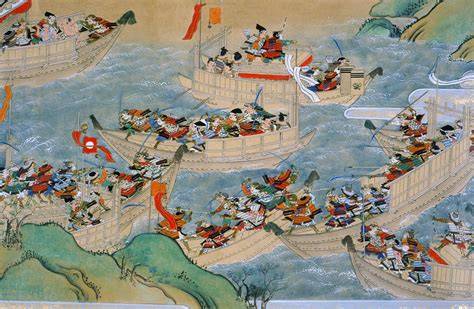
On Yashima in Sanuki Province, Taira no Munemori and others were sheltering Emperor Antoku, with many warships remaining in the Seto Inland Sea.
To pursue the Taira clan moving by sea, the Minamoto forces also needed to gather ships.
In September of Genryaku 1 (1184), Minamoto no Noriyori led a large army westward.
While Noriyori’s army advanced from the Sanyo Road towards Kyushu, the following February, Minamoto no Yoshitsune would head towards Yashima.
According to the “Azuma Kagami,” Yoshitsune crossed the sea despite a violent storm and landed in Awa Province.
He secured local guides to attack the Taira strongholds and advanced through the night into Sanuki Province.
On February 19, Yoshitsune’s forces appeared opposite Yashima.
They set fire to the houses in Mure and Takamatsu, leading the Taira to believe a large army was approaching.
Munemori and others moved Emperor Antoku onto a ship and retreated to the sea.
Meanwhile, Yoshitsune’s forces burned down the imperial residence on Yashima.
However, the Taira fleet remained offshore.
Realizing Yoshitsune’s forces were small, the Taira brought their ships back to the shore to fight.
In this battle, Sato Tsugunobu, who served under Yoshitsune, was killed in action.
And “The Tale of the Heike” describes how, at dusk that day, a small boat emerged from the Taira fleet.
The Lady Who Appeared on the Evening Sea
According to “The Tale of the Heike,” Volume Eleven, “Nasu no Yoichi,” after this, warriors from Awa and Sanuki joined Yoshitsune’s forces.
They gathered in groups of fourteen or fifteen, twenty riders at a time, eventually forming a force of over three hundred riders.
The battle continued until evening.
Yoshitsune realized it would be difficult to settle the fight by nightfall and was considering withdrawing his forces.
At that moment, a beautifully decorated small boat approached the shore from the open sea.
The boat turned sideways about seven or eight spans from the shore.
A lady, appearing to be about eighteen or nineteen years old, emerged from it.
She was said to be wearing a five-layered robe of willow and a crimson hakama.
The lady took out a crimson fan and stood it at the edge of the boat.
The fan was adorned with a design of the rising sun.
Then, she began beckoning to the Minamoto forces on land.
The Taira fleet lined the sea, while the Minamoto horsemen stood on land.
From the small boat floating between them, the lady was displaying the fan.
Yoshitsune called for Goto Heiemon Sanemoto.
What is she trying to do?
He asked.
Sanemoto replied that it was likely a challenge to shoot the fan.
However, he also considered another possibility.
If Yoshitsune advanced to see the beautiful lady, he might be targeted by the Taira’s skilled archers.
The fan might have been a trap to lure out the commander.
Despite his caution, Sanemoto suggested that someone should try to shoot the fan.
At that moment, Minamoto no Yoshitsune asked if there was an expert archer among the Genji forces.
The Young Warrior Recommended by Goto Sanemoto
The name Goto Sanemoto put forward was Nasu no Yoichi Munetaka.
He was the son of Nasu Taro Suketaka from Shimotsuke Province.
According to the “Heike Monogatari,” Sanemoto described Yoichi as a small but skilled archer.
It was said that if he aimed at three flying birds, he would surely bring down two of them.
Yoshitsune summoned Yoichi.
The “Heike Monogatari” notes that Yoichi was about twenty years old at the time.
He wore a brown hitatare adorned with red brocade trim and armor laced with light green threads.
He was equipped with a sword, carried arrows on his back, and held a Shigetou bow.
He removed his helmet and hung it on the cords of his armor, then stepped forward before Yoshitsune.
Yoshitsune ordered Yoichi to shoot down the fan on the sea.
However, Yoichi did not immediately accept the task.
If he missed, it would bring shame to the Genji.
He requested that the order be given to someone more certain to succeed.
That was his proposal.
The fan was on a boat swaying among the waves.
If the wind blew, the boat moved, and the target’s position changed.
Even for a skilled archer, there was no guarantee of hitting the target.
However, Yoshitsune did not allow him to decline.
Yoshitsune’s Reprimand and Yoichi’s Decision
The “Heike Monogatari” recounts that Yoshitsune was furious upon hearing Yoichi’s refusal.
Any warrior who had come from Kamakura to the western provinces must obey his orders.
Anyone with objections should return to Kamakura immediately.
That was Yoshitsune’s reprimand.
Yoichi did not refuse any further.
“If it is your command, I shall attempt it,” he replied.
He answered thus and left Yoshitsune’s presence.
Though summoned for his archery skills, Yoichi knew that missing the target would not be just his personal failure.
Genji warriors watched, while the Heike fleet lined the sea.
It was under these circumstances that Yoshitsune ordered him to shoot.
The “Heike Monogatari” vividly portrays the pressure on young Yoichi through his exchange with Yoshitsune.
Yoichi steadied his bow.
Then, he mounted his sturdy black horse.
The horse was fitted with a saddle adorned with gold fittings and decorated with a pattern known as “maruboya.”
Yoichi pulled on the reins and slowly made his way toward the shore.
Behind him, the Genji warriors watched intently.
Some said, “If it’s that young man, he’ll surely succeed.”
Such is the account given in the Heike Monogatari.
Even Advancing into the Sea, the Fan Was Distant
Yoichi rode his horse into the sea.
However, the fan was still far away.
The Heike Monogatari records that even after advancing one stage into the sea, the fan was still about seven stages away.
Seven stages are roughly equivalent to over seventy meters.
It was a long distance to shoot a small fan.
Moreover, the target was not placed on the ground.
It was set on a small boat swaying among the waves.
The Heike Monogatari notes the time as the hour of the rooster on February 18th.
This corresponds to around 6 PM today.
The north wind was strong, and the waves crashing against the shore were high.
The boat was lifted by the waves and then sank again.
Each time, the fan swayed.
Offshore, the Heike ships lined up in formation, while on land, the Genji horsemen watched Yoichi.
Yoichi aimed at the fan from horseback.
Before drawing his bow, he closed his eyes.
It was to pray to the gods of his homeland.
A Prayer to the Gods of Nasu
Yoichi prayed to the Hachiman Daibosatsu.
He also invoked the names of Nikko Gongen, Utsunomiya, and the Nasu Hot Spring Daimyojin.
These were all deities associated with the province of Shimotsuke.
Nikko Gongen is linked to the present-day Nikko Futarasan Shrine.
Utsunomiya is connected to the Futarasan Shrine, known as the primary shrine of Shimotsuke, and the Nasu Hot Spring Daimyojin is a deity associated with the current Nasu Onsen Shrine.
Yoichi sought the help of the gods who nurtured him in his homeland.
His wish was to hit the center of that fan.
If he missed, he would break his bow and take his own life.
If fate allowed him to return to his homeland, he prayed that he would not miss this shot.
Such is the prayer recorded in the Heike Monogatari.
When Yoichi opened his eyes, the wind had calmed a bit.
The swaying of the fan had also settled somewhat, making it easier to aim.
Yoichi took an arrow and nocked it on his bow.
He chose a kabura arrow.
This was an arrow equipped with a mechanism to make sound, resonating with the wind as it flew.
The Heike Monogatari describes the length of the arrow as “twelve hand spans and three fists.”
Yoichi fully drew his bow made of Shigetou wood.
And then he released it.
The Crimson Fan That Fell Into the Sea
The whistling arrow flew over the sea with a resounding noise.
According to the Tale of the Heike, the arrow sliced through the fan about an inch away from its center.
An inch is approximately 3 centimeters.
The whistling arrow then fell into the sea.
Meanwhile, the severed fan soared into the sky.
The fan floated in the air for a while before the spring breeze carried it down into the sea.
The crimson fan was adorned with a sunrise design.
The Tale of the Heike recounts how the fan, caught in the setting sun, bobbed on the white-capped waves.
The Taira forces offshore beat their ship’s sides.
The Genji forces on land also struck their quivers and cheered.
Both friend and foe alike praised Yoichi’s archery skills.
The warriors who had been holding their breath, wondering if the fan would be hit, all erupted in cheers.
Nasu no Yoichi’s name became widely known thanks to this single shot.
However, the story in the Tale of the Heike does not end here.
Immediately after shooting down the fan, Yoichi was to release another arrow.
The Second Arrow Released at the Dancing Man
The events following the shooting of the fan continue in the “Yumi-nagashi” section of volume eleven of the Tale of the Heike.
A man of about fifty years appeared from the Taira ship.
He wore armor with black leather lacing and carried a long sword with a white hilt.
The man advanced to where the fan had been set and began to dance.
The story suggests he was moved by Yoichi’s impressive archery.
At that moment, Ise Saburo Yoshimori rode up behind Yoichi.
He conveyed that it was Yoshitsune’s order to shoot the dancing man.
Yoichi drew his bow once more.
This time, he did not use a whistling arrow.
He took a standard arrow used in battle and nocked it to his bow.
And then he released it.
According to the Tale of the Heike, the arrow pierced the man’s neck, causing him to collapse onto the ship’s deck.
The Taira forces fell silent.
Once more, the Genji forces struck their quivers and cheered.
“Ah, he hit it,” some exclaimed joyfully.
However, there were also those who lamented the act, saying it was “heartless.”
When the fan was shot down, even the Taira praised Yoichi.
But with the second arrow felling a man, tension once again surged between the two armies.
The Taira forces, angered, reportedly landed their warriors on the shore to challenge the fight.
A young warrior shot down a fan, drawing cheers from both the Minamoto and Taira sides.
Immediately after, he used the same bow to kill a man.
The “Tale of the Heike” depicts these two shots in succession.
The Taira’s Intent in Raising the Fan
Why did the Taira raise the fan?
In the “Tale of the Heike,” it is suggested that Goto Sanekata saw it as a challenge to test archery skills and was wary of it being a trap to lure out Yoshitsune.
On the other hand, Professor Tetsuteru Nonaka from Kokugakuin University, a researcher of war tales, proposes that the fan target had the meaning of a divination for victory.
Professor Nonaka focused on the attire of the lady who held the fan and the design of the fan itself.
The lady was dressed in a five-layered robe of willow green and a red hakama.
The fan was red with a golden sun, a design associated with celebrations and religious ceremonies.
Furthermore, the arrow used by Yoichi was a kabura arrow, more susceptible to wind than a regular arrow.
Based on these points, Professor Nonaka believes that the Taira presented the fan to divine the fortunes of war.
If the Genji missed, it would signify fortune for the Taira.
Conversely, if it was shot down, it would be seen as divine protection for the Genji.
The scene where Yoichi prayed to the gods of his homeland is interpreted to hold such meaning.
However, no contemporary records have been found to show that the Taira actually raised the fan as a divination for victory.
This is a scholarly interpretation based on the analysis of the “Tale of the Heike.”
Yoichi drew his bow as the representative of the Genji, with both allies and enemies watching the outcome.
In the story, a single arrow was imbued with great significance.
Yoichi’s Name Absent in the “Azuma Kagami”
The fan target shot by Nasu no Yoichi is a particularly famous scene in the “Tale of the Heike.”
However, this anecdote is not recorded in the account of the Battle of Yashima in the “Azuma Kagami.”
The “Azuma Kagami” recounts Yoshitsune’s sea crossing, landing in Awa Province, the burning of the Yashima palace, and the death of Sato Tsugunobu.
It is known that fighting continued even after the Taira forces retreated to the sea.
However, there is no mention of Yoichi shooting down the fan.
No detailed records of the fan target have been found in the diaries of court nobles from that time either.
This anecdote was passed down through war tales such as the “Tale of the Heike” and the “Genpei Seisuiki.”
The “Tale of the Heike” was compiled in the Kamakura period and spread through oral storytelling and manuscripts.
The version widely read today, the Kakuichibon, traces back to the text organized by Akashi Kakuichi in the 4th year of Oan (1371) during the Nanboku-cho period.
It was about 190 years after the Battle of Yashima.
Moreover, there are multiple versions of the ‘Heike Monogatari,’ and the depiction and treatment of events and characters differ among them.
The story of Yoichi has also been passed down through these narratives.
There is no conclusive evidence to completely deny the possibility that the fan was shot down at Yashima.
However, it is difficult to determine who shot it, when, and under what circumstances, based solely on the descriptions in war tales.
This point cannot be overlooked when investigating the true image of Yoichi.
The Battle of Yashima Date Discrepancies
There are also issues with the dates concerning Yoichi’s fan target.
In the ‘Heike Monogatari,’ the shooting of the fan is said to have occurred at the hour of the Rooster on February 18.
This corresponds to around 6 PM in modern times.
On the other hand, the ‘Azuma Kagami’ records Minamoto no Yoshitsune’s attack on Yashima on the entry for February 19, Genryaku 2.
There is a discrepancy of one day.
Furthermore, other sources like the ‘Genpei Seisuiki’ and the ‘Nagato Edition of the Heike Monogatari’ also show differences in the dates and progression of the Battle of Yashima.
Therefore, it is impossible to definitively establish the fan target event as having occurred on the evening of February 19.
Yoichi’s age also varies among different versions.
In the ‘Heike Monogatari,’ he is about twenty years old.
The ‘Genpei Seisuiki’ describes him as seventeen.
There are also differences in the process of selecting the archer.
In the ‘Genpei Seisuiki,’ names like Hatakeyama Shigetada and Nasu Juro are mentioned, and it is depicted that Juro was injured, leading to his younger brother Yoichi being recommended.
This differs from the ‘Heike Monogatari,’ where Yoichi is chosen through the recommendation of Goto Sanekata.
Even for the same fan target event, the details of the story change depending on the version.
The Tale of Being Granted Five Provinces
It is said that due to his military achievements at Yashima, Yoichi received a significant reward from Minamoto no Yoritomo.
According to records from Tochigi Prefecture and Otawara City, he was granted estates in five provinces and became the head of the Nasu clan, as introduced in family traditions.
The head of the clan is the central figure who oversees the family and its estates.
The genealogy of the Nasu clan, recorded in the ‘Otawara City History,’ lists the following five provinces.
Tamba Province, Shinano Province, Wakasa Province, Musashi Province, Bitchu Province.
The names of the estates include Goka Manor in Tamba Province, Sumomo Manor in Shinano Province, Higashi Manor and Miyakawara in Wakasa Province, Honda Manor in Musashi Province, and Ebara Manor in Bitchu Province.
However, there are variations in the names of the estates depending on the genealogy.
There was a story that Yoichi was granted estates across five provinces.
The young warrior, the youngest brother from Nasu in Shimotsuke Province, became a landholding samurai nationwide due to his famous shot at Yashima.
However, there are no definitive records, such as official documents, confirming that Yoritomo granted these estates directly to Yoichi.
In later years, the fact that the Nasu clan held estates in various regions and that Yoichi acquired them due to his military achievements in 1185 requires separate examination.
The reward of five provinces is known as a family tradition passed down by the Nasu clan.
Yoritomo Forgives His Brothers
The Nasu clan’s traditions also include stories from after Yoichi became the head of the family.
His brothers, who sided with the Taira during the Genpei War, fled to Suwa in Shinano Province after their defeat.
Unable to return home, the brothers prayed continuously to the Suwa deity for their return.
It is said that eventually, a divine revelation appeared in a dream, leading them to send the fifth brother, Noritaka, to Kamakura.
Noritaka relied on his youngest brother, Yoichi, to petition Minamoto no Yoritomo for their pardon.
Yoritomo, in recognition of Yoichi’s military achievements, forgave the brothers.
It is said that ten brothers were able to return to their homeland.
The genealogy of the Nasu clan, recorded in the “History of Otawara City,” notes that their father, Suketaka, planned to distribute land among the ten brothers.
The story goes that the brothers established bases in places like Morita, Sakuyama, Fukuhara, and Senbon.
Subsequently, the Nasu clan indeed split into multiple houses and operated in various regions.
However, the detailed process of the brothers’ pardon in either the second or third year of Bunji and the land distribution by their father is a description from later genealogies.
It seems the clan’s division was traditionally linked to Yoichi’s military achievements.
Where Did Yoichi Go After the Fan Target?
About a month after the Battle of Yashima, on March 24, 1185, the Genpei forces faced their final showdown at Dan-no-ura in Nagato Province.
Yoshitsune led the Genji forces in battle, and the Taira clan met their end in this conflict.
However, it is unclear what actions Yoichi took at Dan-no-ura.
The “Azuma Kagami” does not contain specific articles about Yoichi’s military achievements at Dan-no-ura.
After the Taira’s downfall, Yoshitsune clashed with Yoritomo and eventually fled Kyoto.
Where Yoichi was during this time is also unknown.
Later genealogies of the Nasu clan suggest that Yoichi succeeded as the head of the family and distributed estates among his brothers.
There is also a tradition that he obtained an official position in Kyoto.
On the other hand, there are few reliable records indicating what role the young warrior, who served under Yoshitsune at Yashima, played within the Kamakura shogunate afterward.
The “Heike Monogatari” vividly describes Yoichi’s attire, horse, and the length of his arrows.
However, it tells little about his life after shooting down the fan.
We continue to trace the lineage of the Nasu family through later genealogies.
The Legend of His Death at Fushimi in Bunji 5
There are multiple theories about the final days of Yoichi.
One genealogy of the Nasu family records that he died on August 8, Bunji 5 (1189).
It is said that he died of illness in Fushimi, Kyoto.
On the other hand, another genealogy claims he died in Kenkyu 1 (1190).
According to this account, he suddenly died in Fushimi while on his way to Kyoto with Yoritomo.
The year of his death does not match between accounts.
There are also traditions that place his age at death in his early to mid-twenties.
In the “Heike Monogatari,” he is depicted as being about twenty years old during the Battle of Yashima, while the “Genpei Seisuiki” describes him as seventeen.
Thus, calculating his birth year from his age is also difficult.
Even official documents from Tochigi Prefecture list Yoichi’s birth and death years as unknown.
There is also a story that he became a monk at a young age.
The legends surrounding Yoichi’s final days are connected to Sokuseiin, located in present-day Kyoto City.
Yoichi’s Grave at Sokuseiin in Kyoto
Sokuseiin is located in the precincts of Sennyuji in Higashiyama Ward, Kyoto City.
This temple of the Shingon sect’s Sennyuji branch is known for enshrining statues of Amida Nyorai and twenty-five Bodhisattvas.
Within its grounds lies a stone pagoda said to be the grave of Nasu Yoichi.
According to the temple’s tradition, Yoichi fell ill while on his way to battle.
He then secluded himself in the temple and prayed to the principal image, Amida Nyorai.
It is said that his illness was cured, allowing him to achieve military success in the Battle of Yashima.
In gratitude for the Buddha’s protection, Yoichi later became a monk, built a hermitage at the temple, and ended his life there.
However, the exact timing of his illness and the circumstances of his ordination are not verified by detailed records.
Moreover, the current Sokuseiin is not located on the same site as during Yoichi’s time.
The temple’s origins are said to trace back to Komyo-in, established in Fushimi during the Heian period.
In Bunroku 3 (1594), it was moved to Fukakusa due to Toyotomi Hideyoshi’s construction of Fushimi Castle, and it was reestablished at its current location within Sennyuji during the Meiji era.
The position of the pagoda in the current precincts does not necessarily indicate the exact burial site from the 12th century.
What remains at Sokuseiin is the history of Yoichi’s commemoration in Kyoto.
Seven Memorial Towers at Genshoji
In Tochigi Prefecture, the birthplace of Yoichi, a gravesite remains.
This is at Genshoji Temple in Fukuhara, Otawara City.
Genshoji is a Soto Zen temple with deep ties to the Nasu clan.
Within its grounds, there is a cluster of gravestones belonging to the Nasu clan, including seven memorial towers for the family, among them Yoichi Munetaka.
Today, this cluster of gravestones is designated as a historic site by Otawara City.
However, the stone towers were not erected during Yoichi’s time.
According to cultural heritage materials from Otawara City, the gravesite was arranged by Nasu Sukemasa, the head of the Nasu family during the Edo period.
Sukemasa was born in Kansei 4 (1792) and passed away in Bunkyu 1 (1861).
By then, several centuries had already passed since the era in which Yoichi is said to have lived.
The Nasu family held lands in Fukuhara during the Edo period and arranged the gravestones to honor their ancestors.
As one of their important ancestors, Yoichi’s name was inscribed on the stones.
In Kyoto’s Sokuseiin, there is a pagoda said to be his grave, while Genshoji in Shimotsuke Province has a memorial tower.
Both sites bear Yoichi’s name, but neither has been confirmed as his actual burial place.
The Nasu Clan’s Legacy in Onda and Bitchu
Stories related to Yoichi’s grave exist in other regions as well.
In present-day Onda, Nakagawa Town, Tochigi Prefecture, there is the Goryo Shrine.
The later “Nasu Chronicles” record a tradition that Yoichi’s remains were also buried in this area.
Additionally, at Joyoji Temple in Katahira of the same town, Yoichi’s memorial tablet is preserved.
In various places where the Nasu clan lived, sites dedicated to their ancestor Yoichi have been maintained.
Furthermore, in Ebara Manor of Bitchu Province, where Yoichi is said to have been granted lands, traces of the Nasu clan remain.
This corresponds to the area around present-day Ibara City, Okayama Prefecture.
From the Kamakura period onward, samurai descended from the Nasu clan were active in this region.
The historical connection of the Nasu clan in both regions underlies the friendship city relationship between Otawara City and Ibara City.
There are still many unknowns about how the five-country reward to Yoichi was actually implemented.
Meanwhile, the history of the Nasu clan spreading across regions and acquiring lands is recorded in later documents.
Within this history, Yoichi has been remembered as an ancestor symbolizing the clan’s military achievements.
Did Nasu Yoichi Really Exist?
Researching the life of Nasu Yoichi leads to a fundamental question.
Did a person named Yoichi actually exist?
In the “Tale of the Heike,” he appears as a young warrior who shot down a fan at Yashima.
His exploits are also depicted differently in the “Gikeiki.”
However, the “Azuma Kagami” article on the Battle of Yashima does not mention the fan target.
The story of being granted lands in five provinces by Yoritomo is also difficult to verify with contemporary documents.
Moreover, the genealogy of the Nasu clan contains unresolved issues regarding relationships and succession.
Professor Tetsuteru Nonaka of Kokugakuin University has put forward a theory questioning the existence of Yoichi based on these points.
In his 2022 book, “Solving the Mystery of Nasu no Yoichi,” he provides a detailed analysis of the Nasu family genealogy.
Professor Nonaka focused on the relationship between Yoichi and his successors.
In the Nasu genealogy included in “Gunsho Ruiju,” the family headship is passed down through adoption after Yoichi.
He raises concerns about the fact that, despite the presence of other blood relatives, the headship was passed down to adopted sons for two consecutive generations.
Moreover, the Nasu genealogy in “Gyokushoku Hohon” does not even mention Yoichi’s name.
Considering these points, Professor Nonaka suggests that Nasu no Yoichi might have been a character shaped by stories.
However, this is a research hypothesis based on the analysis of genealogies and military tales.
The conclusion that Nasu no Yoichi did not exist is not universally accepted among researchers.
There remains the possibility that the deeds of a real person were transformed within the narrative.
Professor Nonaka is focusing on a certain samurai as a model for such a character.
The Samurai Named Nasu no Kosuke
The model for Yoichi that Professor Nonaka proposes is Nasu no Kosuke.
Kosuke is a samurai whose name appears in the “Azuma Kagami.”
In the year Kenkyu 4 (1193), Minamoto no Yoritomo went hunting in the Nasu fields of Shimotsuke Province.
During this event, Kosuke is recorded as having served as a local guide.
The Nasu fields are located in what is now the northern part of Tochigi Prefecture.
Yoritomo conducted hunts accompanied by prominent samurai from various regions.
Large-scale hunts required the cooperation of samurai who were knowledgeable about the terrain and the movement of animals.
Kosuke was a person capable of fulfilling that role.
Professor Nonaka views Kosuke as a pioneering lord of the Nasu region, skilled in archery and horseback riding.
He also suggests that Kosuke might have expanded his base to the Houkigawa river basin, around the present-day Kitakanemaru area of Otawara City.
Thus, he believes that real samurai of the Nasu clan, like Kosuke, provided the material for the later creation of the character Yoichi.
However, there is no record of Kosuke actually participating in the Battle of Yashima.
There is also no direct evidence that Kosuke was the one who shot down the Taira fan.
The theory that Kosuke served as the model for Yoichi is a hypothesis derived from the analysis of genealogies and military tales.
Nevertheless, the existence of Kosuke, whose name appears in sources close to Yoichi’s time, is significant when considering Yoichi’s life.
Why the Youngest of the Nasu Was Chosen
Professor Nonaka also pays attention to Yoichi’s birthplace and his position within the family.
Yoichi is depicted as a samurai from the Nasu region of Shimotsuke Province.
This area is close to the northern edge of the Kanto region.
At that time, Yoritomo’s forces included prominent samurai from Sagami Province, Musashi Province, and other areas.
The Hojo, Miura, and Hatakeyama clans were among the most notable.
However, “The Tale of the Heike” chose the eleventh son of the Nasu to be the archer of the fan target.
He was neither the head of his clan nor the leader of a powerful samurai group supporting Kamakura.
Yet, it is said that this young warrior shot down a fan in front of both the Minamoto and Taira clans.
Professor Nonaka believes that the way this individual was chosen reflects the position of samurai who were distanced from the core of Kamakura’s powerful warrior groups.
The interpretation is that the Yoichi in ‘The Tale of the Heike’ was portrayed as someone who demonstrated skill beyond the hierarchy of status and origin.
This is a scholarly perspective on the composition of war tales.
However, the fact that Yoichi appears as the youngest of the Nasu brothers holds intriguing significance for readers of the story.
It was Goto Sanekata who recommended him to Yoshitsune.
Although there were many skilled archers on the Minamoto side, Yoichi was the one chosen.
He initially declined, but after being reprimanded by Yoshitsune, he rode his horse into the sea.
‘The Tale of the Heike’ depicts the young Yoichi in this manner.
The Fan Target Depicted Across Regions
The fan target of Nasu no Yoichi has been repeatedly featured in later paintings and performing arts.
In the Yashima Battle Folding Screen, Yoichi is depicted aiming at a fan hoisted on a ship offshore.
The red flags of the Taira line the sea, while the white flags of the Minamoto flutter on land.
Between them, a young warrior draws his bow from horseback.
The fan target became a symbol of the Battle of Yashima and spread widely.
During the Edo period, it was depicted in warrior prints and ukiyo-e, making Yoichi’s name known throughout the country.
Moreover, ‘The Fan Target’ from ‘The Tale of the Heike’ has been widely read as a classic in schools.
As a result, among the generals of the Genpei War, Nasu no Yoichi is highly recognized.
However, many of the depictions in paintings are expressions by later artists based on the descriptions in ‘The Tale of the Heike.’
There is no authentic portrait that conveys Yoichi’s actual appearance.
A navy blue hitatare, a light green armor, a black horse, and an arrow released into the sea.
The image painted by the words of war tales has been passed down through paintings and performing arts.
Yoichi’s Name Remains in His Hometown of Nasu
In present-day Otawara City, Tochigi Prefecture, there are facilities that preserve the name of Nasu no Yoichi.
This is the Nasu Yoichi Densho-kan.
It introduces historical materials related to the Nasu clan and local traditions, including the fan target at Yashima.
In Otawara City, Yoichi has been cherished as a historical figure representing the local area.
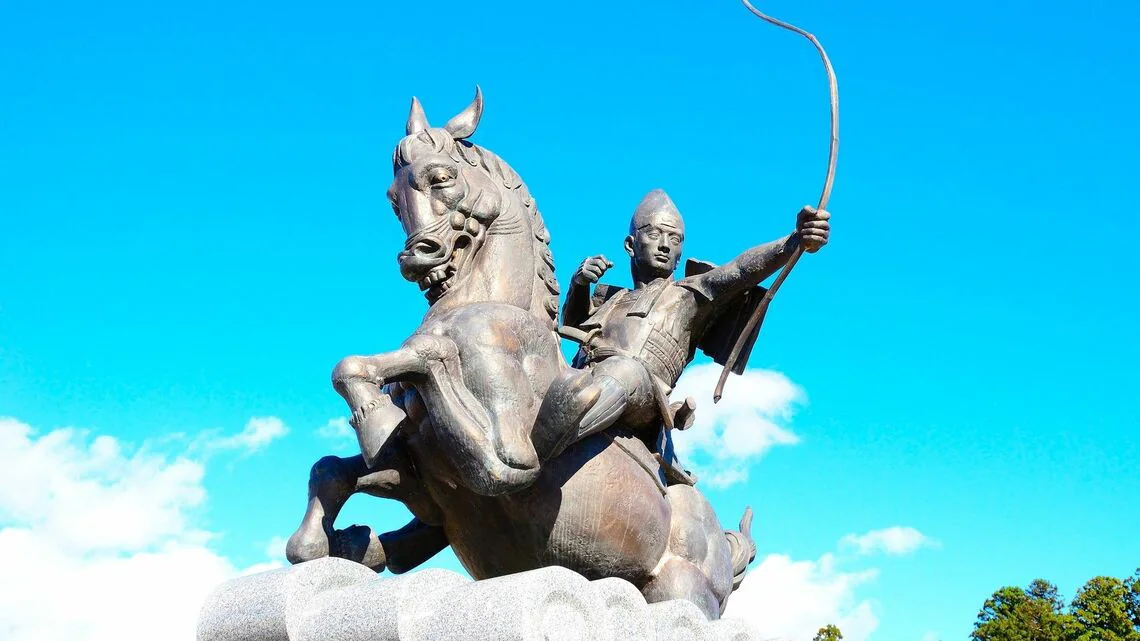
There are statues and monuments of Yoichi in the city, and at Genshoji Temple, a memorial tower for the Nasu clan remains.
Additionally, at Nasu Onsen Shrine in Nasu Town, Tochigi Prefecture, there is a tradition that Yoichi prayed there before shooting his bow at Yashima.
The Nasu no Yuzumi Daimyojin, whom Yoichi prayed to in ‘The Tale of the Heike,’ is tied to the faith of his hometown.
On the other hand, in Mure Town, Takamatsu City, which faces Yashima, there are rocks that bear the name of Yoichi.
These are the Prayer Rock and the Horse Stand Rock.
The Prayer Rock is said to be where Yoichi prayed to the gods and Buddha before shooting the fan.
The Horse Stand Rock is believed to be where he stopped his horse to aim at the fan.
The Horse Stand Rock appears when the tide recedes and is currently a registered historical site in Takamatsu City.
However, there are no records that can confirm the exact location from which Yoichi shot his arrow.
These two rocks have connected the scene depicted in the ‘Heike Monogatari’ to the coast of Yashima, preserving it for future generations.
In the Nasu shrine, Yoichi’s prayer is remembered, and on the coast of Yashima, the place where he drew his bow is preserved.
The name of the young warrior who is said to have shot down the fan at Yashima has been preserved in both his hometown and the battlefield.
Eight Hundred Years of the Arrow at Yashima
Much about the life of Nasu Yoichi remains unknown.
In the ‘Heike Monogatari’, he appears as a young warrior from Shimotsuke Province, who, under the command of Minamoto no Yoshitsune, shot down the fan.
However, details about when he was born, what military achievements he accomplished, and where he ended his life largely rely on later genealogies and temple traditions.
The event of shooting down the fan at Yashima is also difficult to confirm solely with contemporary records.
There is also a research theory that suggests another warrior, Nasu Kōsuke, as the model.
Nonetheless, the story of Yoichi has been passed down through the ages.
A young warrior who, after initially declining Yoshitsune’s order, advanced his horse into the sea.
He prayed to the gods of his homeland and aimed at the fan swaying between the waves.
The whistling arrow cut through near the center of the fan, sending the red fan soaring into the sky.
After cheers from both the Genji and Heike sides, Yoichi shot another arrow.
This time, he shot down the man dancing where the fan had stood.
The ‘Heike Monogatari’ even records that there were warriors who lamented, saying “how pitiful,” upon seeing the second arrow.
Yoichi is depicted as the person who shot two arrows.
The first arrow was praised by both friend and foe, while the second took a human life.
The scene is conveyed in the ‘Heike Monogatari’, which has been recited since the Kamakura period and has been passed down in later picture scrolls, warrior paintings, and local legends.
It remains difficult to verify the detailed biography of Yoichi himself.
However, the image of him drawing his bow towards the sea of Yashima has been repeatedly depicted in the narratives of the Genpei War.
Today, the Sokuseiin Temple in Kyoto houses a pagoda said to be Yoichi’s grave, and the Genshoji Temple in Otawara City has memorial towers for the Nasu clan.
On the distant coast of Sanuki, the rocks where Yoichi is said to have prayed and stopped his horse remain.
Nasu Yoichi.
The young warrior who shot two arrows continues to draw his bow towards the sea of Yashima, over eight hundred years later.